
Existential Wisdom from the Sickbed: Complete Chapter-by-Chapter Summary

Welcome to a special exploration of Shi Tiesheng's profound work, *Fragments Written in the Interstices of Illness*. This isn't just a book about sickness; it's a deep dive into what it means to be human when our bodies fail us.
The cover art captures the essence perfectly: a dark, cracked landscape illuminated by a single, golden line of light. This visual metaphor represents the core theme of the book. We are all walking through the "interstices"—the narrow, often painful spaces between life and death, health and illness. In these gaps, where our physical limitations are most stark, something unexpected happens. The constraints of our bodies don't just trap us; they actually expand the reach of our souls, our faith, and our capacity for love.
Shi Tiesheng writes from the very edge of this experience. Having lived with severe disability and kidney failure, he reframes suffering not as a tragedy to be avoided, but as a unique vantage point. He suggests that while our bodies might be broken—like a plane losing its landing gear or its engines—this very fragility forces us to look deeper. It strips away the noise of daily life and leaves us with the raw, essential questions of existence.
In these fragments, we find a powerful counter-narrative to the fear of death. Instead of fighting for endless life or fearing the end, Shi invites us to see life as something light and transient. He proposes a quiet dignity: to come without taking much, and to go without leaving a heavy burden. It's a perspective that transforms pain into wisdom, turning the "cracks" in our lives into the very places where light can finally shine through.

Today's slide presents a powerful metaphor: the "Assigned Role in the Human Drama." It compares our lives to a flight where fate hands us a specific aircraft and trajectory, leaving no room for negotiation. Just as an airplane cannot choose its engines or landing gear, we cannot choose our bodies or our starting conditions.
Look closely at the diagram. On the left, we see a mechanical failure: the aircraft can no longer taxi. On the right, we see a dual engine stall, requiring external dialysis to filter toxins. This isn't a graphic about tragedy; it's an insight about perspective. The slide argues that sickness is not a karmic punishment for past lives, but simply a malfunction in the vessel we were assigned.
Think about it this way: if your legs are the landing gear and your kidneys are the engines, a breakdown isn't a personal failure; it's just a plot point in a larger story. The slide introduces "The Truth of Relativity," reminding us that every disaster is preceded by the word "more." We only realize the brilliance of standing when we are forced into a wheelchair; we only appreciate health when we face fever.
Ultimately, this slide invites us to stop viewing our suffering as a curse and start seeing it as a lesson in the profound relativity of fortune. We are all actors in a drama we didn't write, but by understanding our assigned role, we can find the grace to navigate the turbulence with dignity.

Today's slide contrasts two very different approaches to faith: the illusion of bribery versus true faith. On the left, we see "Transactional Religion," which operates on the logic of bribery. Here, the motive is purely utilitarian—people pray for health, wealth, or a guaranteed return in the next life. The core belief is a transactional one: "I am pious and compliant, therefore God owes me a cure." This turns religion into an extension of human greed, projecting worldly corruption onto the divine. It's about what you can get out of God, treating the sacred as a marketplace.
On the right stands "True Faith," inspired by the trial of Job. This isn't about bargaining; it's about spiritual survival in the face of absolute, unyielding despair. The core logic here is radical acceptance: embracing the entirety of creation, including its inevitable suffering, without demanding a reward. True faith isn't a promise of future glory or a safety net for your current problems. Instead, it is an endless road of hope that dictates how you walk the path, not what you arrive with at the end. It's about finding strength in the dark, trusting that the journey itself has meaning, even when the destination remains unseen. This is the difference between asking God for a favor and walking with God through the fire.

Imagine you're standing in front of three different gods, each promising a different kind of life. The first one, God 1, is "The Liar." He's the god of convenience who promises you practical benefits, cures, and universal salvation if you just pay your dues. He sounds like a salesman at a car dealership, right? He's driven entirely by human greed, and when real, inescapable human tragedy hits, he fundamentally fails. He's not a savior; he's just a reflection of our own desire for a shortcut.
Then you have God 2, "The Prankster." This is the god of absolute chance and randomness. Think about the last time you prayed for a good call during a football match, or maybe you're just hoping the lottery numbers come up today. This deity is fundamentally unreliable and entirely indifferent. It doesn't care about your story, your pain, or your joy. It just plays dice, and you're left wondering why you're the one holding the losing hand.
But here is the third option, and it changes everything. God 3 is "The True Divine." This god does not intervene to solve your specific physical hardships. He doesn't fix your broken leg or cure your illness on demand. Instead, He exists only in the moment of your yearning for perfection amidst a flawed, suffering reality. He is the ultimate compass of love. He doesn't give you the answer; He gives you the strength to keep asking the question. This isn't about getting what you want; it's about finding your way even when the path is dark.

Look at this diagram: "The Violent Trap of 'We'." It illustrates a terrifying social dynamic that we often ignore. The world is split into three groups: "We," the powerful collective; "They," the isolated enemy; and "You," the frightened bystander.
Notice the arrows. The "You" are forced by fear to assimilate into "We." Why? To avoid becoming "They." This is what the slide calls "The Assimilation Loop." We are terrified of being left out, so we surrender our individuality to the group.
But what happens next? The slide warns of "The Resulting Curse." When "We" becomes a magical force, it swallows your individual reason. It erases your personal boundaries and replaces morality with blind loyalty. Suddenly, you aren't thinking for yourself anymore; you are just fuel for the group. And where does this lead? Inevitably to collective violence.
This isn't just about politics; it's about human nature. When we define ourselves by "Us versus Them," we lose our humanity. The true trap isn't the enemy outside; it's the cage we build for ourselves by blindly following the crowd. We must break this loop. We must stop fearing "They" so much that we lose who "We" truly are. Real freedom starts when you stop needing to be part of the mob and start standing on your own ground.

True repentance isn't about looking backward to blame history for our sins. It's not using the past as a convenient garbage bin to keep our conscience clean and comfortable. Real repentance starts with acknowledging the mirror. When we see ugliness in others, we must realize that the potential for that same ugliness lives within us too. It's about facing the truth we'd rather ignore. But the most painful part of all is inward interrogation. True repentance asks the agonizing question: "If the whip had been handed to me, would I have had the courage to refuse?" It challenges us to step out of the victim's role and take responsibility. Are we brave enough to admit that we could have done better? Can we stop blaming the world and start confronting our own choices? That is where real change begins.
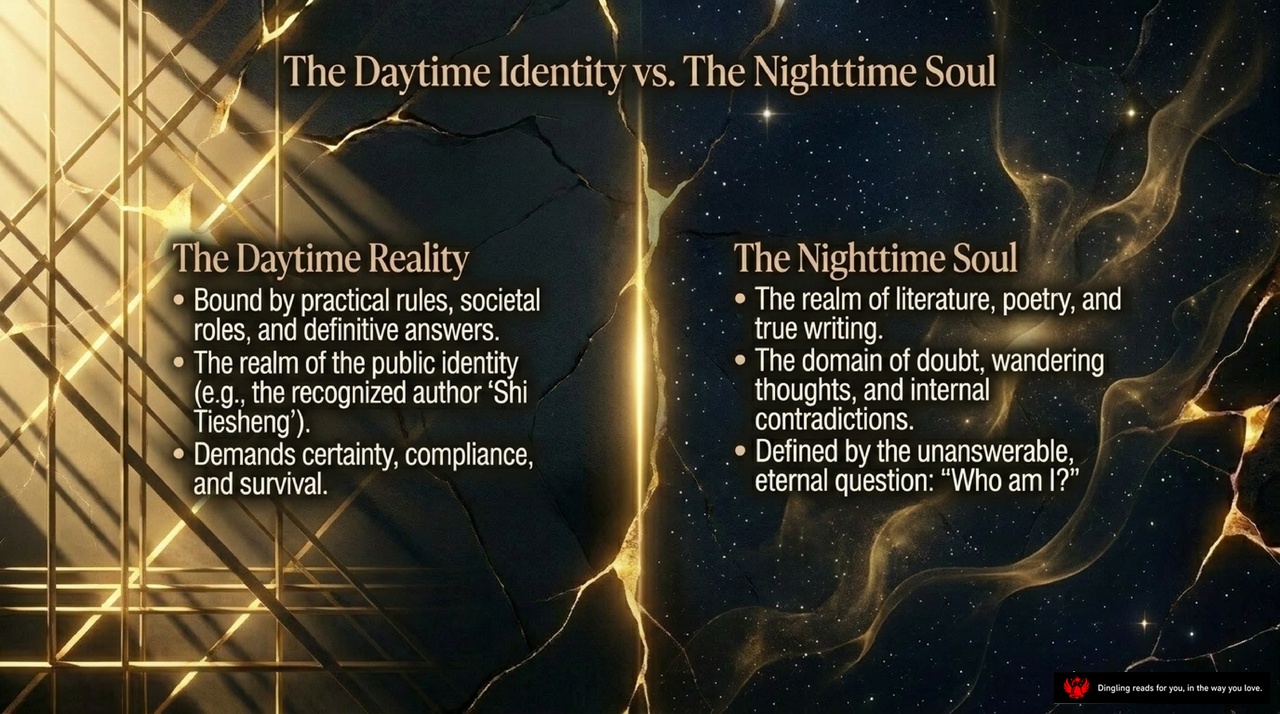
Imagine your life split into two distinct worlds: the rigid, structured reality of the day, and the boundless, starry expanse of the night.
On the left, we have "The Daytime Reality." This is the world of practical rules, societal roles, and definitive answers. It's the realm of the public identity—like the recognized author "Shi Tiesheng"—where everything demands certainty, compliance, and survival. It's about getting things done and fitting into the script.
But on the right, we step into "The Nighttime Soul." This is the realm of literature, poetry, and true writing. It's the domain of doubt, wandering thoughts, and internal contradictions. Here, you aren't defined by what you do, but by the unanswerable, eternal question: "Who am I?"
This slide captures the core tension in Shi Tiesheng's life. By day, he was bound by the limitations of a disabled body and the expectations of society. By night, however, he was free to explore the infinite possibilities of the human spirit. He taught us that while our daytime identity might be confined by fate, our nighttime soul has the power to transcend it, finding meaning not in the answers we find, but in the beautiful, endless questions we ask ourselves in the dark.

The written word isn't just about telling stories; it's about diving into the hidden corners of the human heart that we're often forced to hide. Think of it as a nighttime search, peering into the depths of our souls where societal rules try to keep us in check. Literature shouldn't be a servant to "real life" or a tool for propaganda; it's a space for honest self-interrogation. True writing doesn't capture a perfect, finished product. Instead, it captures the wandering soul in the middle of the struggle—the hesitation, the doubt, and the agonizing process of creation. It's not about finding a final answer, but about being brave enough to sit with the questions, exploring the messy, unpolished truth of what it means to be alive.

Imagine a birdcage, not made of bars, but of our own biological limitations and the silent judgments of society. On the left, we see the "Biological Reality"—the hard truth that our bodies can fail. Legs that can no longer walk, organs that shut down. It is a mere physical constraint, a vessel that has broken down. But on the right, the cage tightens with something far heavier: "The Societal Prison." This is the unspoken verdict that tells the disabled they do not belong in the realm of romantic love, reducing them to nothing more than biological survivors.
But look at the light breaking through. That is "The Ultimate Rebellion." The text reminds us that denying a person love is nothing less than denying their humanity. A life without love, even in a perfectly healthy body, is the only true disability. When we strip away the right to love, we strip away what makes us human. This slide isn't just about disability; it's a call to break the invisible walls that society builds around us. It challenges us to see that love is not a privilege for the able-bodied, but a fundamental right for every soul. True freedom begins when we stop accepting the cage and choose, instead, the courage to love and be loved, no matter what our bodies can or cannot do.

The Evolution of Human Sexuality isn't just a biological chart; it's a journey from the ground up, from the raw necessity of survival to the highest expression of the human soul.
It all starts at the foundation: Stage 1, Reproduction. This is pure biology—the baseline mechanism ensuring our species survives and continues. It's the non-negotiable duty of life.
But as we evolve, we break free from that biological cage. We enter Stage 2: Entertainment, or Gratification. Here, sex becomes a release from duty, a playground for pleasure. Yet, even in this freedom, we remain anchored to the physical boundaries of our flesh. It's fun, but it's still bound by the body.
The true transformation happens in Stage 3: The Language of the Soul. This is where sex transcends the physical entirely. It becomes an extreme, desperate, and beautiful attempt to shatter the absolute isolation of the lonely soul. It's no longer about the act; it's about merging entirely with another. It is the ultimate art form, a way to connect our spirits across the vast distance of individual existence.
So, while our bodies may be limited, our capacity to love and unite through this language of the soul knows no bounds.

Love is often mistaken for a calculated contract or a permanent deed of ownership, but the truth is far more profound. It is an irrational, deep-seated yearning of the soul—a desperate need for connection that no social rule can fully satisfy. Yet, this very depth brings a heavy requirement: absolute honesty. When we truly love, we cannot afford to deceive, even if that truth causes immense pain. Deception doesn't just hurt the other person; it strips love of its spiritual beauty, reducing a sacred collision of souls into something shallow and mechanical.
Consider the tragic dilemma of the "third party." When a new love emerges, the real tragedy isn't the shift in affection itself. That is a natural part of life. The true spiritual crime is the deception we use to mask it. We try to hide our new feelings behind lies to protect the old relationship, but in doing so, we destroy the very foundation of trust that makes love possible. We cannot have it both ways. We cannot demand the purity of a spiritual bond while hiding the reality of our hearts behind a veil of lies. True love demands the courage to be vulnerable, to say what is hard to hear, and to accept the consequences of that honesty. Only then can we move beyond the pain of change into the freedom of truth.

The Myth of the Cure-All Utopia isn't just a philosophical concept; it's a trap we all fall into. We are constantly promised a world without pain, suffering, or limitation—a "Flatline" where everything is perfect and effortless. But let's be honest: a world without friction, without the struggle to grow, is actually a world without meaning. If we remove all pain, we don't become gods; we devolve into the state of a stone or a plant. That's the hard truth of the "Pulse"—the reality of being human.
So, how do we move forward? We don't escape the struggle of existence; we find our purpose within it. The soul's ultimate purpose isn't to avoid the crucible of suffering, but to discover love, art, and transcendence right in the middle of it. As the text reminds us, disability and love are the essential codes of humanity. Disability represents our limits, while love is the force that breaks through them. It's not about achieving a pain-free paradise; it's about finding the divine in our brokenness. True faith isn't a transaction where we bribe the universe for good times; it's the courage to keep walking when the path is dark, knowing that hope is found not in a perfect destination, but in the act of loving despite the pain.

Science demands proof; it dissects the physical, analyzing the finite mechanics of the universe. It is our compass for survival, yet it hits a wall when facing the ultimate, unquantifiable void of death. In that darkness, where data ends and mystery begins, faith steps in. Faith requires no empirical proof. It is a courageous bridge built deliberately into the dark unknown, addressing the soul directly. It provides a spiritual compass of love precisely where science must abandon us. One is the pursuit of truth; the other is the practice of sincerity. Together, they form the complete map of human existence.

The Wave and the Water, or as we might call it, the individual versus the infinite. Look at this image: it's a beautiful metaphor for how we often view our own lives. We see ourselves as that solitary, fleeting wave—temporary, crashing, and destined to fade away. But then, look at the water beneath it. That is the universal soul, the shared human experience of love, suffering, and the endless questions we all ask.
The text tells us that true immortality isn't found in the flesh, which is just this temporary wave. It lives in our shared yearning. When our body eventually perishes, the message of our soul doesn't vanish; it returns to that infinite deep, ready to be carried forward by the next wave. We are immortal not because we last forever, but because we are part of something that never ends. It's a comforting thought: that while we are just a single, fleeting moment in the grand ocean, our capacity to love and our struggles are woven into the eternal flow of humanity. So, don't fear the crash. Just remember, you are the wave, but you are also the water.

The cracks in our reality are often where the light breaks through. As we explore the human condition, we confront a profound truth: our limitations—our fragile bodies, our inevitable mortality, and the relentless suffering of the physical world—are not just obstacles, but the very space where the soul awakens. It is precisely within these fractures of fate that we transcend the flesh, connecting with the infinite through art, faith, and profound love.
Consider this: if our physical bodies are merely temporary vessels for the universe to experience its endless yearning, are we living just to survive the journey of the vessel? Or are we daring to let our souls speak? The text challenges us to move beyond mere survival. It suggests that life isn't about avoiding the cracks, but about what we do within them. When we stop fearing our limitations and start embracing them as part of a larger, divine script, we find that the "flesh" is no longer a prison, but a canvas.
So, the question remains for all of us: are you trapped by the vessel, or are you ready to let the soul take the lead?