
X Thinking: Building Better Brands in the Age of Experience: Complete Chapter-by-Chapter Summary

Welcome to our deep dive into "Experience Thinking" by Huang Feng and Lai Zujie. Today's cover sets the stage for a transformative journey: we're exploring a top-level paradigm for creating value in the modern, digital-first economy.
Think about the world we live in right now. It's no longer just about products or services; it's about the entire experience. This book argues that true innovation comes from understanding the human element, continuously digging into evolving value, and committing to sustainable growth. As we move forward, we'll see how shifting from simply "providing products" to "creating value experiences" is the key to thriving in today's competitive landscape. Get ready to rethink how businesses connect with people and create lasting impact.

The slide on your screen perfectly captures the shift from the old world to the new one. On the left, we see the **Traditional Economy**: a rigid, industrial model focused on **Industry & Brand**, where companies simply **supply products** and fight for **profit margins** in a **zero-sum market share battle**. It's a game of scarcity, where one company's gain is another's loss.
But look at the right side: the **Experience Economy**. This isn't just an upgrade; it's a complete transformation of how value is created. The core focus shifts from products to **People & Human Needs**. Instead of just selling things, companies now **demand and co-create experiences** with their customers. Value is no longer defined by transaction costs, but by **deep meaning, resonance, and relationships**. Finally, the growth model changes from fighting for a slice of the pie to **symbiotic, non-zero-sum ecosystem growth**.
Think about it: in the old model, if you want to grow, you have to steal market share from a competitor. But in the experience economy, growth happens when you build a thriving ecosystem where everyone wins. It's about moving from a transactional mindset to a relational one, proving that the future belongs not to the biggest factories, but to the brands that best understand and empower the people behind them.
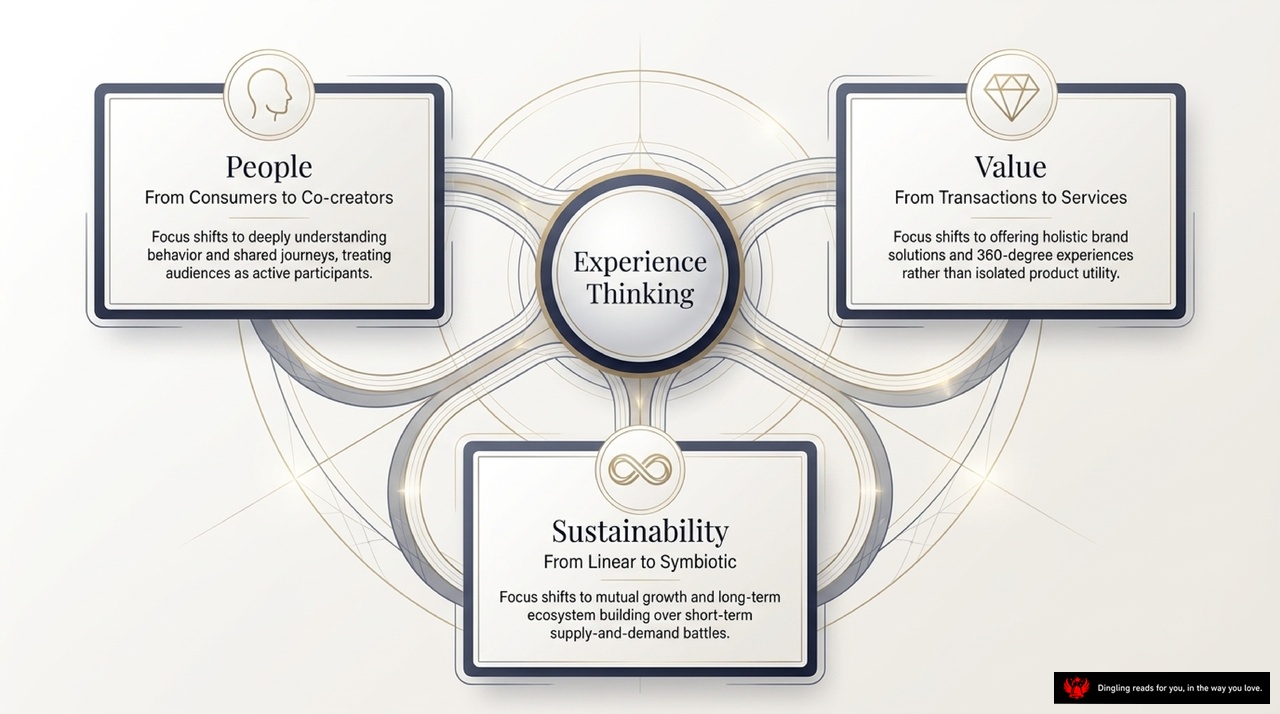
Today's slide breaks down the three pillars of Experience Thinking: People, Value, and Sustainability. Let's dive into how these dimensions redefine business.
First, look at **People**. The shift here is from treating customers as passive consumers to empowering them as active co-creators. It's about moving beyond simple transactions to deeply understanding human behavior and shared journeys. Think of brands like Xiaomi or Nike, where users don't just buy products; they help design them, share their stories, and shape the brand's future. When audiences become participants, trust deepens, and innovation accelerates.
Next, we have **Value**. The focus shifts from isolated product utility to offering holistic, 360-degree brand solutions. It's the evolution from simple transactions to comprehensive services. Consider Disney: they aren't just selling tickets; they are selling an immersive, emotional journey. Or think of mobile banking apps that have evolved from simple ledger tools into full-life service platforms. The goal is to provide seamless, end-to-end experiences that solve real-life problems, not just sell items.
Finally, there's **Sustainability**. This moves us from short-term supply-and-demand battles to long-term symbiotic ecosystem building. Instead of competing against others for a slice of the market, successful brands now focus on mutual growth. They build networks where brands, people, and even other brands collaborate and empower each other. A perfect example is the smart travel ecosystem, where car manufacturers, tech giants, and cities work together to create a smarter, greener future for everyone.
In short, Experience Thinking isn't just a strategy; it's a new way of being. By centering on People, redefining Value, and embracing Sustainability, businesses can stop fighting for market share and start building lasting, thriving ecosystems together.

In the experience economy, the relationship between brands and people has evolved from a one-way transaction into a dynamic, co-creating ecosystem. Think of it as a journey of deepening connection: starting with strangers, moving to acquaintances, then friends, and finally becoming family. At the stranger stage, brands must use sharp insights to create strong first impressions, like how Mengniu Pure甄 used a hit TV show to break through the noise. Once you're acquaintances, as Luckin Coffee did, the goal is to build familiarity through consistent, multi-touchpoint interactions. When you reach the friend stage, trust becomes the currency; brands like Li-Ning tap into shared cultural memories to foster emotional loyalty. But the ultimate goal is becoming "family"—where customers become loyal advocates who actively participate in the brand's success, much like Amway's community model.
However, this path isn't always smooth. Poor experiences can sever these bonds instantly. The Samsung Galaxy Note 7 disaster serves as a stark warning: by ignoring user safety and treating customers differently, the brand lost its trust and its market share in China almost overnight. In today's digital age, word-of-mouth is the engine of this ecosystem. Influencers, KOLs, and experts act as the core drivers, turning individual experiences into viral movements that can make or break a brand. Social commerce further accelerates this by leveraging trust and relationships, turning social interactions into direct sales opportunities. Ultimately, by navigating these stages of connection and leveraging the power of shared experiences, brands can transform from mere suppliers into indispensable partners in their customers' lives.

In the symbiotic state—the sweet spot where human needs and brand experience overlap perfectly—brands stop chasing trends and start building deep, lasting relationships. Think of it as moving from being a vendor to becoming a partner. Take Xiaomi's MIUI system, for example. Instead of just pushing updates, they invited users to co-create the operating system, turning every user into a brand advocate. Or look at Nike's ID service, where fans don't just buy shoes; they design them. This shift transforms the consumer from a passive buyer into an active co-creator, deepening the emotional bond and making the brand feel like an extension of the user's own identity.
But building this connection requires more than just great products; it demands a complete transformation of how we deliver value. We're moving away from simple product transactions toward holistic brand services. Consider Wilma's digital approach to automotive retail. They dismantled the traditional 4S store model, replacing it with an immersive experience center where the car isn't just sold—it's lived. Users can test autonomous driving simulations and customize their vehicles on-site, creating a journey that feels personal and engaging rather than transactional. Similarly, WeWork didn't just rent desks; they built an entire ecosystem connecting startups with investors, communities, and cross-industry resources, turning a simple office space into a thriving network of opportunity.
This evolution is driven by two powerful forces: digitalization and ecosystem building. Digitalization uses technology to make every touchpoint smarter and more responsive, while ecosystem integration connects disparate industries to solve complex user needs in one seamless flow. Together, they allow brands to create experiences that are not only efficient but deeply resonant. When a brand successfully aligns its human-centric values with these technological and structural shifts, it doesn't just survive the market—it thrives alongside its users, creating a sustainable, self-reinforcing loop of trust and value.
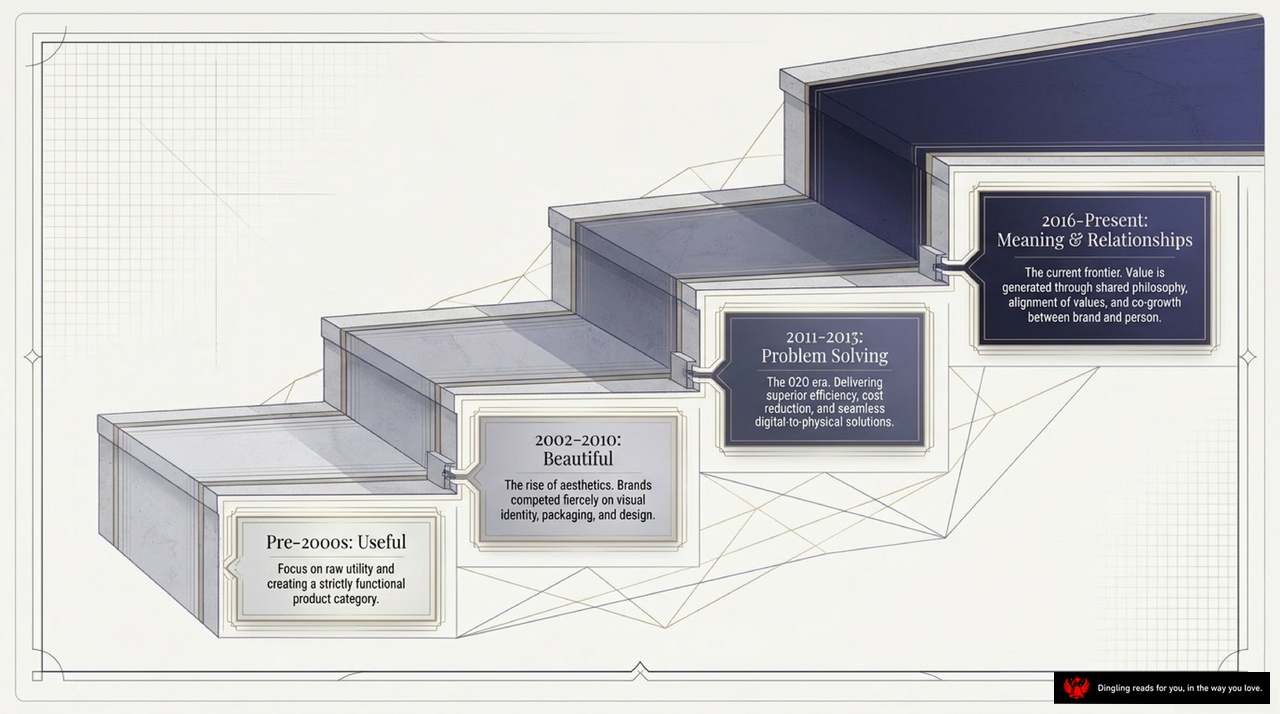
In the era of the experience economy, the relationship between brands and people has evolved from a one-way supply-and-demand dynamic into a symbiotic partnership of mutual growth. This deepening connection relies on consistent, high-quality experiences, guiding us from strangers to friends, and ultimately to family—where loyalty and shared destiny take root.
At the stranger stage, the goal is to refresh a weak perception with strong contact. Brands must find the right touchpoints to make an initial impact. Take Mengniu Pure甄, for instance; by sponsoring the show "Produce 101" with slogans that resonated with young attitudes, they successfully left a preliminary mark in the minds of their target audience, paving the way for deeper engagement.
Once we move into the acquaintance stage, the focus shifts to interaction and understanding. Brands need to dive deeper into user needs to provide tailored products and services. Luckin Coffee mastered this by leveraging social coupons for rapid acquisition and combining "master coffee" with celebrity endorsements. These multi-touchpoint experiences helped people gradually get to know the brand, though recognition was still scattered at this point.
The friend stage represents a stable relationship built on trust and value alignment. Here, people prioritize a brand when a need arises, often driven by emotional connection. Li-Ning transformed into a domestic streetwear brand by tapping into shared cultural nostalgia, while Wang Wang expanded into fashion to trigger memories for the 80s and 90s. In this phase, purchasing becomes about seeking spiritual companionship and emotional resonance.
Finally, we reach the family stage—the highest level of brand-human connection. Customers become loyal fans who actively participate in brand building, and the brand places their needs at the forefront. Companies like Amway emphasize mutual respect and success, fostering communities where everyone wins. Brands at this stage drastically reduce churn and unlock the full lifetime value of their customers.
However, this journey isn't always linear. Poor experiences can cause relationships to deteriorate at any stage. The Samsung Galaxy Note 7 incident serves as a stark warning; by refusing to address the safety crisis fairly, especially for Chinese users, Samsung caused its brand image to collapse, seeing its market share in China plummet from 23.8% to under 1%.
In today's digital world, word-of-mouth has become the decisive force for a brand's future. The rise of platforms like Dianping proves that real user experiences have transformed into a powerful catalyst for transactions, turning reputation into an "invisible business." Key influencers—experts, KOLs, and internet celebrities—drive this momentum. Experts build trust through authority, KOLs like Li Jiaqi convert attention into sales with incredible efficiency, and influencers like Papi Jiang connect through unique personalities. By capturing these key voices, brands can accelerate their journey from strangers to family, fueling sustainable growth in the symbiotic ecosystem of the experience economy.
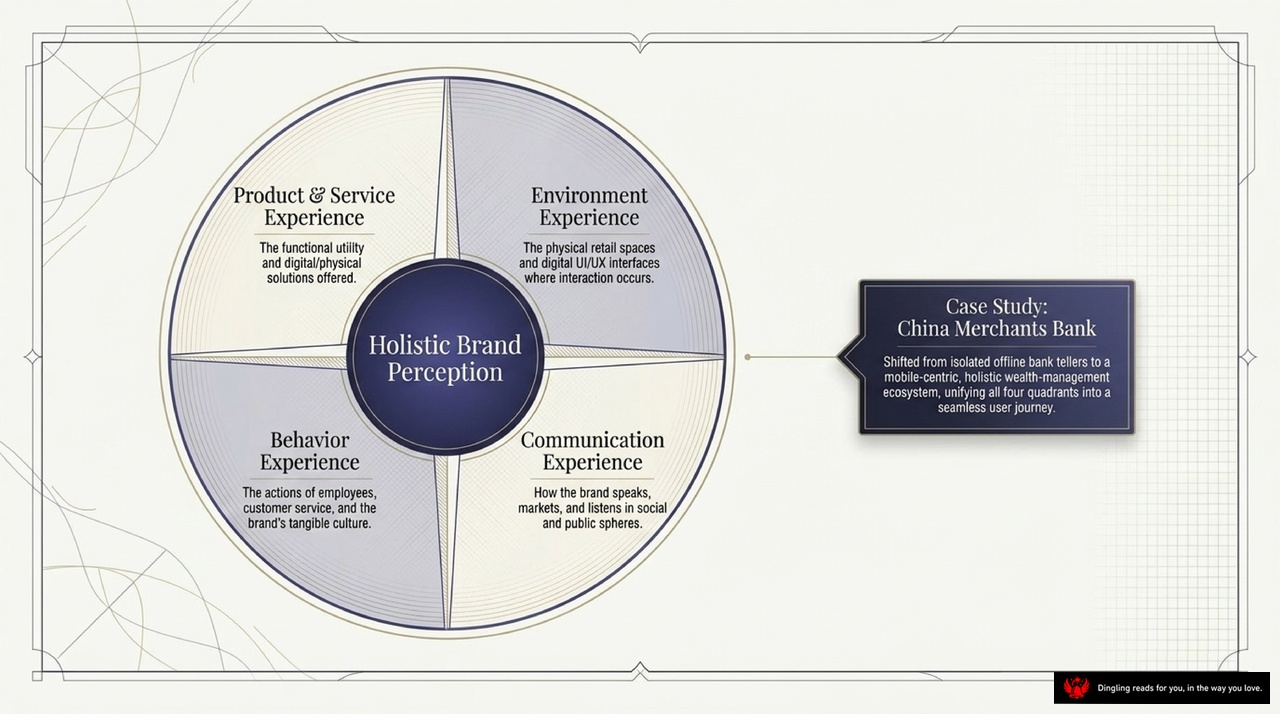
Let's dive into the core of what makes a brand truly unforgettable. It all comes down to **Holistic Brand Perception**. Think of it as a compass with four quadrants that guide how customers experience your brand every single day.
First, there's **Product & Service Experience**. This is the functional utility—the actual solutions you offer, whether they are digital apps or physical goods. It's the core promise you keep.
Next, look at **Environment Experience**. This covers where the magic happens. It includes the physical retail spaces you walk into, but also the digital UI/UX interfaces on their phones. It's about the setting of the interaction.
Then, we have **Behavior Experience**. This is all about the human element: the actions of your employees, the quality of customer service, and the tangible culture that defines your brand. It's the feeling of being treated with care.
Finally, **Communication Experience**. This is how your brand speaks, markets, and listens in the social and public spheres. It's the voice and the conversation.
Now, let's see how this framework plays out in the real world. Take **China Merchants Bank** as a case study. They didn't just stick to isolated offline tellers; they shifted to a mobile-centric, holistic wealth-management ecosystem. By unifying all four quadrants, they created a seamless user journey. They realized that to win in the experience economy, you can't just sell a product; you must orchestrate the entire perception of your brand across every touchpoint. That is the key to building deep, lasting loyalty.
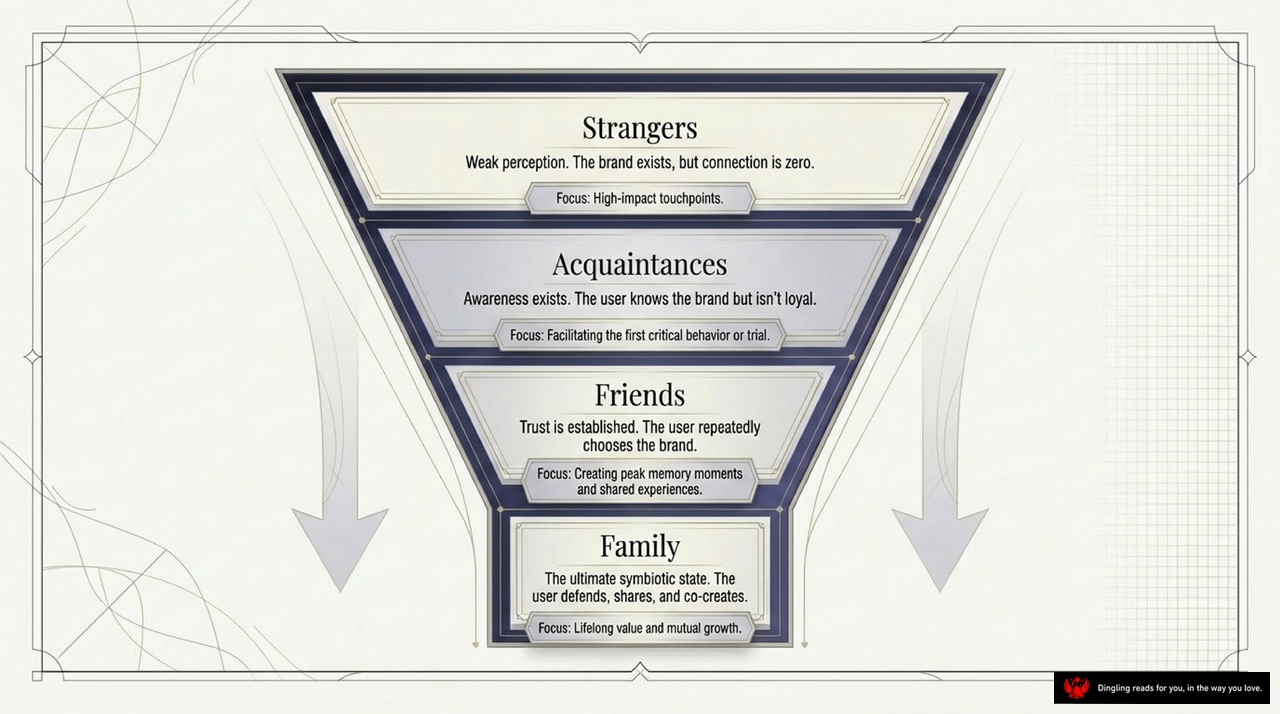
In the ultimate symbiotic state, the relationship between a brand and its user transforms from a transaction into a true partnership. This is the "Family" stage—the highest level of connection in our journey. Here, the user doesn't just buy; they defend, share, and co-create with the brand. Think of it as an extended family where loyalty is instinctive, not forced. The focus shifts from simple sales to lifelong value and mutual growth.
Take Amway as a prime example. They don't just sell products; they build a community based on mutual respect and shared success. When users reach this level, they become brand advocates who actively help others join, creating a self-sustaining ecosystem. But this deep bond isn't guaranteed. A single bad experience, like Samsung's mishandling of the Note 7 crisis, can shatter years of trust, proving that maintaining this "Family" status requires constant care.
However, reaching this stage is the goal because it unlocks the most powerful force in the experience economy: word-of-mouth. In the digital age, individual voices can ripple globally instantly. Experts, KOLs, and influencers act as the engines of this growth, turning satisfied users into a viral network. This trust-based model, seen in social commerce platforms like Pinduoduo, proves that when you treat users as family, they give you their time, their money, and their entire network. It's the only way to build a brand that truly lasts.

Today's slide maps out the three essential relationships that define a thriving brand ecosystem: Brand-to-Person, Person-to-Person, and Brand-to-Brand. Think of this as the engine driving modern growth.
First, look at **Brand-to-Person**. This is about mutual growth through constant feedback loops and personalized value delivery. It's not just about selling; it's about building a relationship where the brand and the user evolve together. Take **WM Motor** as our case study here. They aren't just selling cars; they are linking vehicles, human habits, and smart city infrastructure into one cohesive ecosystem. By doing this, they turn a simple transaction into a seamless, personalized journey that grows with the user.
Next, we have **Person-to-Person**. This is the engine of modern growth, powered by word-of-mouth, social sharing, and community building. When people trust each other, they trust the brands they recommend. On the right side of this connection, we see **Brand-to-Brand**. This represents cross-border empowerment, where brands partner to create entirely new scenarios. Instead of competing, they collaborate. A perfect example is **Sesame Credit**. They are turning invisible trust into tangible social and financial access across multiple brand partners. By connecting users, merchants, and financial institutions, they create a network where trust becomes a currency everyone can use.
Together, these three loops create a self-reinforcing system. The brand serves the person, the people share the experience, and other brands join the party to expand the possibilities. This is how you move from being a vendor to becoming an essential part of someone's life.

This slide outlines the evolution of Amway's business model, marking a powerful leap from traditional door-to-door sales to a fully digitized, O2O social commerce ecosystem. At the heart of this transformation is the shift from simply selling products to empowering individual micro-entrepreneurs.
Let's break down the three critical stages that drive this change. First, we have **Digitization**, where the focus is purely on efficiency. This is about moving offline actions online and breaking down data silos. By doing this, Amway improved its raw operational efficiency and provided basic access, laying the digital foundation for everything that follows.
Next comes **Datafication**, shifting the focus to understanding. Here, raw interactions are transformed into structured insights. Amway built comprehensive Persona Maps to deeply understand the user's journey. This isn't just about collecting data; it's about truly knowing who the people are behind the screens and how they move through their day.
Finally, we reach **Intelligentization**, the AI frontier where the focus is on personalization. This is where the magic happens: proactively delivering hyper-personalized, one-person-one-face services based on predictive algorithms. The system doesn't just wait for a request; it anticipates needs and delivers the right solution to the right person at the right time.
Underpinning all these stages is the core case study: Amway itself. By integrating these three phases, Amway successfully created an ecosystem that directly empowers its independent distributors, turning a traditional sales model into a dynamic, tech-driven partnership.

Look at this shift in the game. On the left, we see the old guard: Return on Investment, or ROI. It's all about the bar chart—stacking investment to get a return, hoping for profit. It's a linear, transactional mindset. But the real opportunity lies in the infinity loop on the right: Return on Experience, or ROX.
This isn't just a buzzword; it's a complete reversal of how we build value. Notice how the loop feeds itself. Start with **Deeper Identity**—when your brand's values align perfectly with who your customers are, you stop competing on price and start competing on belief. That leads to **Higher Spend**. People aren't just buying products anymore; they're paying a premium for a seamless, superior experience that feels personal.
From there, you unlock **Longer Relationships**. Because the experience is meaningful, customers stay. Their lifetime value explodes, far outlasting the cycle of a single product purchase. And finally, that satisfaction fuels **More People**. When the experience is genuinely great, it triggers organic, viral growth through real advocacy. You don't need to buy ads; your community does the work for you.
So, stop chasing short-term profit spikes. Build an ecosystem where identity, experience, and community create an endless cycle of value. That's the power of ROX.

Today's slide breaks down the two powerful engines reshaping our commercial world: The Demographic Catalyst and The Technological Catalyst. On the left, we see Gen Z and the 00s—this demographic isn't just buying products; they are demanding high-penetration co-creation, anti-routine communication, and a deep alignment with brands that matches their aesthetic and philosophical values. They want to be part of the story, not just the audience.
On the right, we have the Technological Catalyst, driven by 5G and the Internet of Things. This is about breaking down the screen barrier. We are moving away from isolated cloud ecosystems toward instant, seamless smart-city integration with zero latency. It's no longer about just connecting devices; it's about creating a fluid, invisible layer of service that fits perfectly into our lives.
When you combine these two forces, the result is a commercial landscape where human desire for connection meets technology's ability to deliver it instantly. Brands that ignore the Gen Z demand for authenticity or fail to leverage 5G for seamless experiences will simply get left behind. The future belongs to those who can merge these demographic shifts with technological breakthroughs to create truly meaningful, frictionless experiences.

In the experience economy, we've hit a turning point where one-off transactions simply don't cut it anymore. Today's market demands something deeper: continuous, symbiotic relationships built on genuine, human-centric value. Think about it—are you just selling products to consumers, or are you co-creating a sustainable ecosystem with your ultimate partners?
The answer lies in shifting from a transactional mindset to a relational one. Instead of chasing isolated sales, successful brands are now focusing on the entire journey, turning passive buyers into active co-creators. This means understanding that every interaction, from the first touchpoint to the final loyalty moment, is an opportunity to build trust and shared value. When you prioritize this human connection, you stop competing on features and start winning on resonance, creating a business model that not only survives but thrives in an ever-changing world.