
Factional Strife and Northern Song Politics: Complete Chapter-by-Chapter Summary
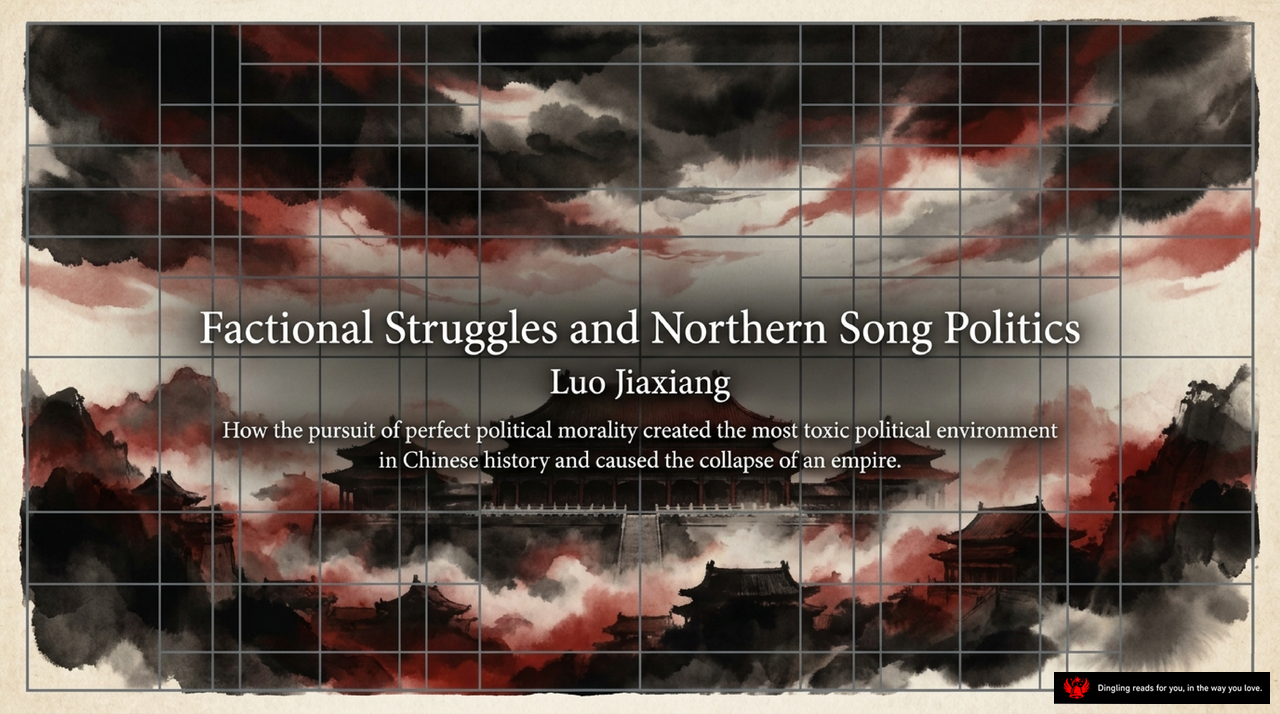
Today, we dive into Factional Struggles and Northern Song Politics. We examine how the pursuit of perfect political morality created a toxic environment that caused the collapse of an empire. As Luo Jiaxiang explains, this was the driving force behind the dynasty's downfall. Let's explore this critical historical moment.

Look at this scale. It represents the fatal flaw of the Northern Song Dynasty. On one side, we have "Idealistic Philosophy," and on the other, "Institutional Destruction." This isn't just a history lesson; it's a warning about how good intentions can destroy a system.
The Core Insight here is striking. The Northern Song didn't fall because their army was weak. In fact, they were militarily capable. They fell because a noble philosophical theory mutated into a weapon of mass political destruction. It started with Emperor Song Taizu. He was terrified of his officials forming factions, so he strictly controlled the civil service exams and banned them from forming personal networks. He thought he was protecting the state. But who would have thought these measures would backfire? Instead of preventing corruption, they created a vacuum where officials could only survive by attacking each other.
This brings us to The Mechanism. When political disagreements are reframed as battles between absolute good and absolute evil, compromise becomes treason. In the Song Dynasty, officials didn't debate policy; they debated virtue. If you disagreed with the Emperor's "righteous" policy, you weren't just wrong; you were a traitor. This happened when the concept of "Yi," or righteousness, was pitted against "Li," or profit. Conservatives like Sima Guang attacked reformers like Wang Anshi not because the policies were bad, but because they were "unrighteous." The Taijian officials, meant to serve the Emperor, became tools for these purges.
The Result was inevitable. A cycle of escalating purges that cannibalized the state's administrative competence from the inside out. The government became so focused on punishing "traitors" that it couldn't govern. Officials were terrified to speak up or compromise. The bureaucracy rotted from within. By the time of the Jingkang Incident, the military was useless because the leaders were too busy fighting each other.
So, we see the paradox. A system built on "Perfect Morality" ended up destroying itself. The Northern Song teaches us that when you treat politics as a moral crusade rather than a complex negotiation, you don't save the country. You burn it down from the inside.
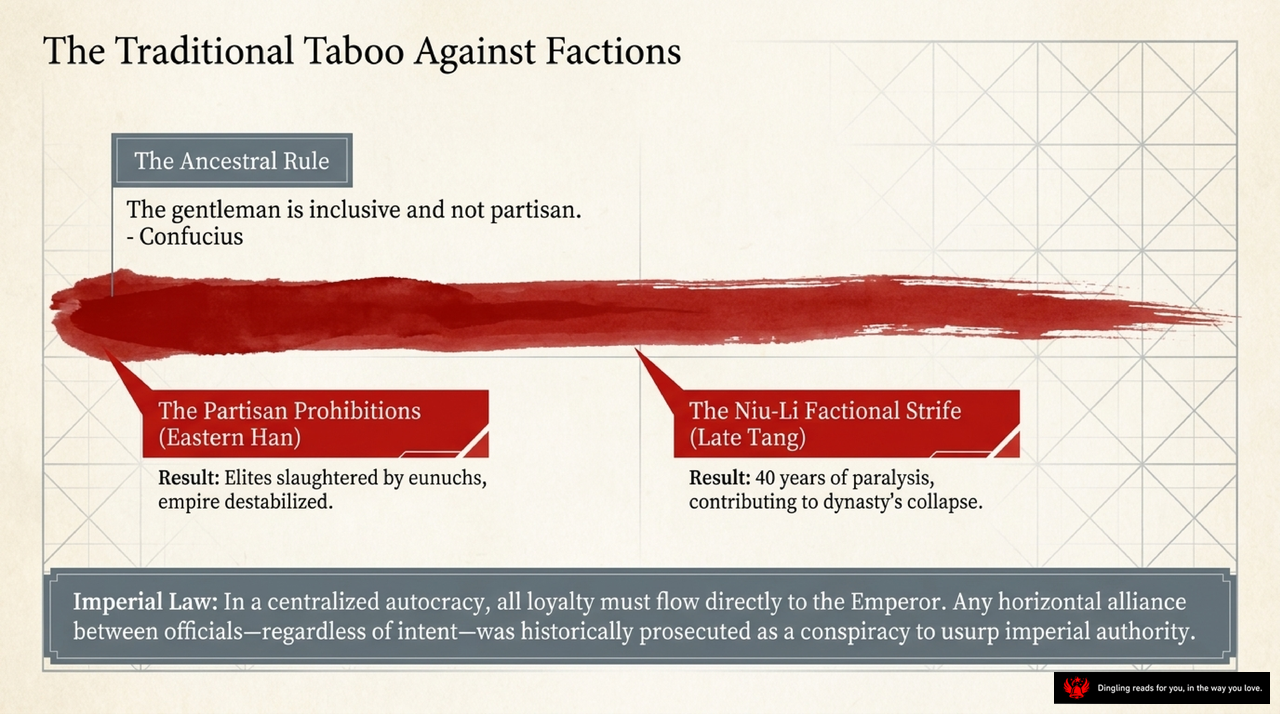
Welcome to this section on The Traditional Taboo Against Factions. This slide outlines a historical pattern that shaped Chinese politics for centuries. At the top, we see The Ancestral Rule. Confucius famously said a gentleman is inclusive and not partisan. But history tells a much darker story. Look at The Partisan Prohibitions in Eastern Han and The Niu-Li Factional Strife in Late Tang. The results were devastating. In Eastern Han, elites were slaughtered by eunuchs, and the empire destabilized. In Late Tang, we saw 40 years of paralysis, contributing directly to the dynasty's collapse. Why did this happen? The bottom section explains the Imperial Law. In a centralized autocracy, all loyalty must flow directly to the Emperor. Any horizontal alliance between officials—regardless of intent—was historically prosecuted as a conspiracy to usurp imperial authority. This logic wasn't unique to the Song. As we read in the book text, even in the Northern Song, this logic persisted. Song Taizu, fearing a short dynasty like the Five Dynasties, strictly controlled officials to prevent such alliances. He believed that in a centralized system, any horizontal connection was a threat, so he forbade students from calling examiners teachers. This Imperial Law created a dangerous paradox. While the Ancestral Rule advocated inclusivity, the Imperial Law demanded exclusive loyalty to the throne. This contradiction forced officials to choose: either stay silent or be labeled as a faction. The book highlights that this taboo wasn't just a moral rule, but a political survival mechanism. It stabilized the Emperor's power but destroyed the government's ability to function, leading to the very factionalism it tried to prevent. This is the core lesson of the Traditional Taboo. The Emperor fears factions, so he suppresses them, which creates more factions, leading to the collapse of the dynasty. We will see how this played out in the Song Dynasty later. But for now, understand that this system was designed to protect the throne, but it ultimately protected nothing but the Emperor's safety at the cost of the state's stability. This cycle of fear and suppression is what defined the era. The book text confirms that this Imperial Law was the root cause of the factionalism that eventually destroyed the Song Dynasty itself. We see how this ancient rule evolved into a rigid political structure that no dynasty could survive. The Emperor's desire for absolute control inevitably created the very enemies he sought to destroy. This is the tragic irony of the Traditional Taboo. It was meant to preserve order, but it only ensured chaos. Understanding this helps us see why the Song Dynasty, despite its cultural brilliance, eventually fell into the same trap as the Han and Tang dynasties. The lesson is clear: when loyalty is forced to be exclusive, politics becomes a battlefield of survival.
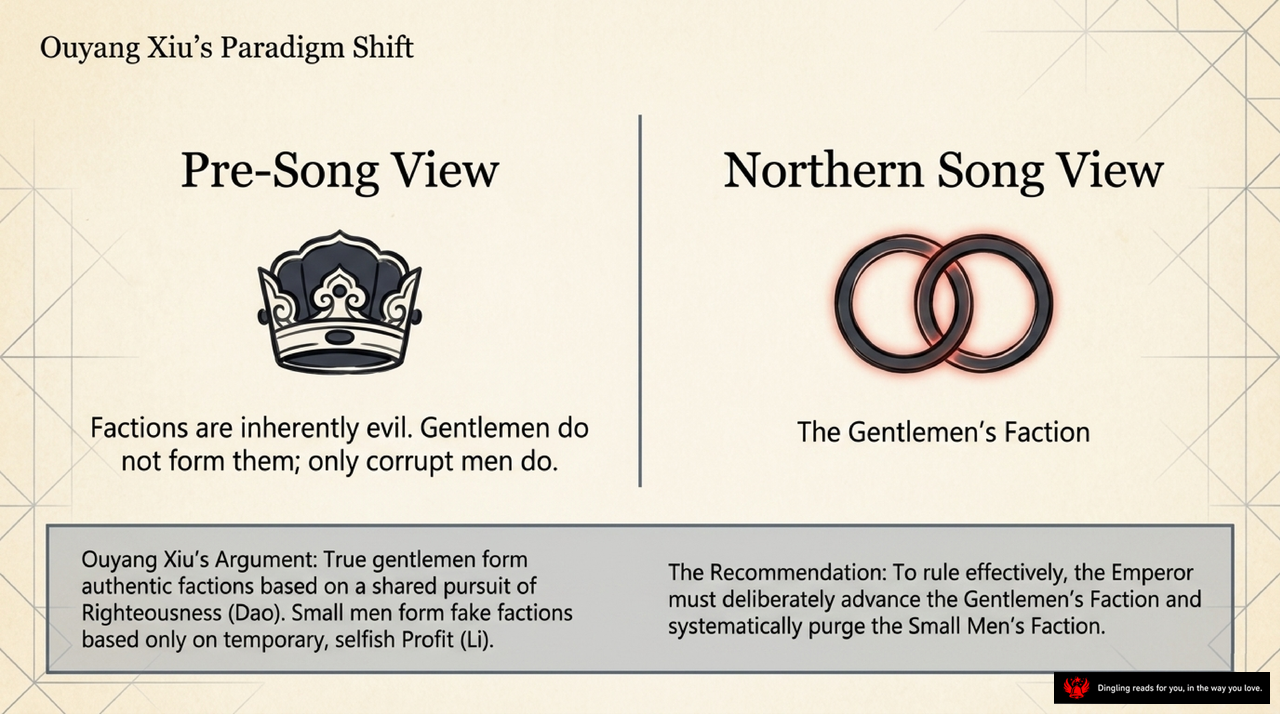
Let's look at this slide. It highlights a massive intellectual shift during the Northern Song Dynasty regarding how leaders viewed political alliances.
On the left, we have the "Pre-Song View." For centuries, the traditional belief was simple and rigid: Factions are inherently evil. In the old mindset, a group of people banding together was automatically seen as a conspiracy. Only corrupt men were thought to do this. Good, honest gentlemen never formed groups like that. That's why early emperors tried so hard to ban them, viewing any coalition as a threat to the throne.
But then, Ouyang Xiu came along and completely flipped the script. This is what we call his paradigm shift.
Instead of fearing all factions, Ouyang Xiu argued that there are two distinct types of groups. He distinguished between the "Gentlemen's Faction" and the "Small Men's Faction."
Here's the core logic. True gentlemen form authentic factions based on a shared pursuit of Righteousness, or Dao. Think of it as a shared mission or moral code. They stick together because they believe in doing the right thing for the country.
On the other hand, small men form fake factions based only on temporary, selfish Profit, or Li. These are the people who band together just for power, money, or personal gain.
This distinction is crucial. It means that a group of honest officials working together isn't a threat to the throne. It's actually a force for good.
So, what was the recommendation? The slide says the Emperor must deliberately advance the Gentlemen's Faction and systematically purge the Small Men's Faction.
Instead of banning all alliances, Ouyang Xiu suggested the Emperor should actively choose which side to support. He needed to cultivate the group dedicated to public service and remove the ones driven by greed. The Emperor isn't just a passive observer anymore. He becomes an active architect of political culture.
This was a bold move. It turned factionalism from a sin into a tool for governance. It laid the groundwork for the intense political battles that followed, where the definition of good and bad factions became the center of every power struggle.
Ultimately, this argument challenged the idea that unity was always good and division was always bad. It suggested that the right kind of division could actually save the state.
Notice how the visual changes from a solitary crown to interlocking rings. That represents the move from individual rule to collective action based on shared values.
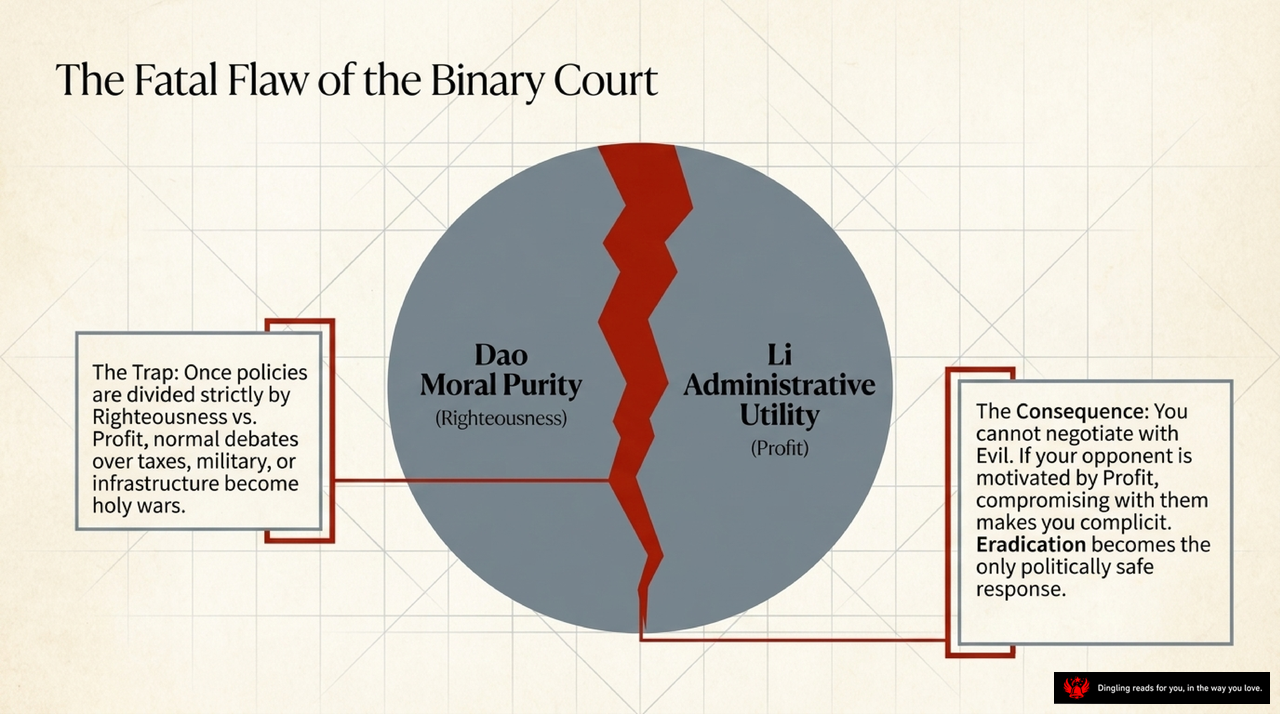
Look at this diagram. It illustrates the fatal flaw of the Northern Song court. The circle is broken in two, representing a fundamental ideological split that tore the empire apart. On the left, we have Dao, representing Moral Purity. On the right, Li, representing Administrative Utility. This wasn't just philosophy; it was the engine of a political disaster that eventually destroyed the dynasty.
The conservatives, led by figures like Sima Guang, believed in the old Confucian rule: Gentlemen understand righteousness, small men understand profit. To them, any policy involving wealth management was inherently corrupt. They labeled Wang Anshi's reforms as seeking profit, abandoning morality for gain. This created the trap shown on the left. Once policies are divided strictly by Righteousness versus Profit, normal debates over taxes, military, or infrastructure become holy wars. You stop discussing the details and start fighting over who is the moral superior. The text notes that the anti-reform faction used this to attack the New Party, calling them traitors for daring to talk about profit. They didn't want to discuss the economics; they wanted to destroy the person.
On the other side, Wang Anshi and the reformers argued that profit is actually the harmony of righteousness. They believed managing the state's wealth was a moral duty to save the nation. He famously stated that profit is the harmony of Yi, meaning managing wealth according to righteousness is itself a moral act. But the binary thinking made negotiation impossible. As the slide warns on the right, the consequence is clear: You cannot negotiate with Evil. If your opponent is motivated by profit, compromising with them makes you complicit in their corruption.
This mindset turned politics into a zero-sum game. Eradication became the only politically safe response. The conservatives didn't want to adjust the laws; they wanted to destroy the people who proposed them. This cycle of mutual destruction, where one side must completely eliminate the other, is exactly what destroyed the Song Dynasty. It shows how a rigid moral binary can paralyze a government, turning policy into a weapon of annihilation. Once the court is divided into these two camps, there is no middle ground, only survival of the fittest through total victory. The result was not governance, but a slow-motion collapse of the state itself. This led to the systematic destruction of the New Party, where officials were exiled or killed simply for opposing the old ways. This is why the Northern Song eventually fell into the abyss of factionalism, unable to govern effectively.
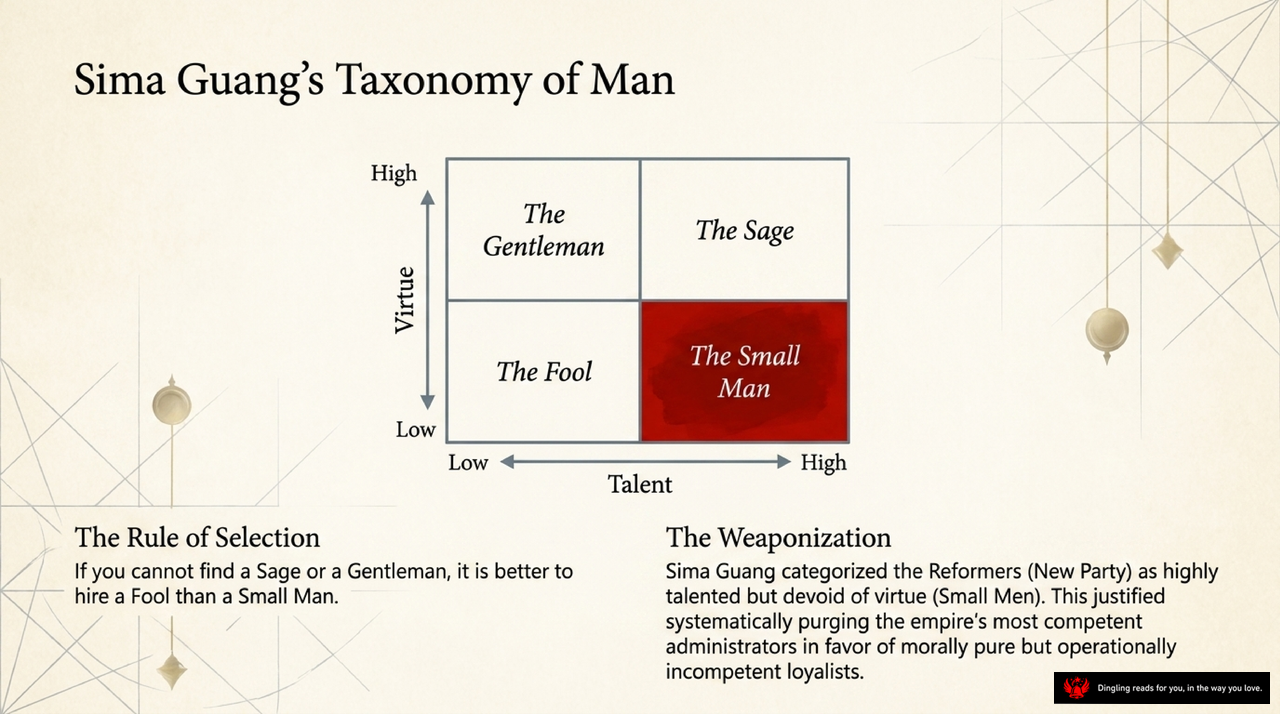
Let's look at this critical framework from Sima Guang, a defining figure in Northern Song politics. This chart, Sima Guang's Taxonomy of Man, breaks human character down into four quadrants based on two axes: Virtue and Talent.
Ideally, you want the top right corner, The Sage—someone with both high moral character and high skill. Or the top left, The Gentleman—someone with high virtue but perhaps less talent. The bottom left is The Fool, lacking both. But the danger lies in the bottom right, highlighted in red here: The Small Man. This category represents people with high talent but low virtue.
This distinction became the core of the political war between the Old Party and the New Party. Sima Guang viewed the reformers, like Wang Anshi, as "Small Men." Why? Because they prioritized practical gain—what Confucius called "Li"—over traditional moral righteousness, or "Yi." To Sima Guang, this made them morally corrupt, regardless of their administrative competence. The text notes that opponents attacked Wang Anshi for "seeking profit," calling him a traitor to the Confucian ideal.
Look at the bottom left text, The Rule of Selection. Sima Guang believed that if you cannot find a Sage or a Gentleman, it is better to hire a Fool than a Small Man. In modern terms, think of this as choosing a harmless but incompetent manager over a highly skilled but unethical executive. A Fool might be useless, but a Small Man has the power to destroy the system from within.
This philosophy led to The Weaponization. Sima Guang categorized the Reformers as highly talented but devoid of virtue. This label justified systematically purging the empire's most competent administrators in favor of morally pure but operationally incompetent loyalists. By framing the New Party as dangerous "Small Men," the Old Party could eliminate anyone who disagreed with them, simply because they were too skilled.
The result was a political trap. By prioritizing moral purity over administrative capability, the Song Dynasty sacrificed efficiency for ideology. This wasn't a one-time purge. It started a cycle where every new leader would repeat the same mistake, purging the previous group. The text describes how this led to endless political turmoil from Yuan You to Jing Kang, where officials' careers were like a rollercoaster. Ultimately, this choice of character over competence helped seal the dynasty's fate, leading to its eventual collapse. It serves as a stark warning: when you value the wrong kind of people, you lose the country.
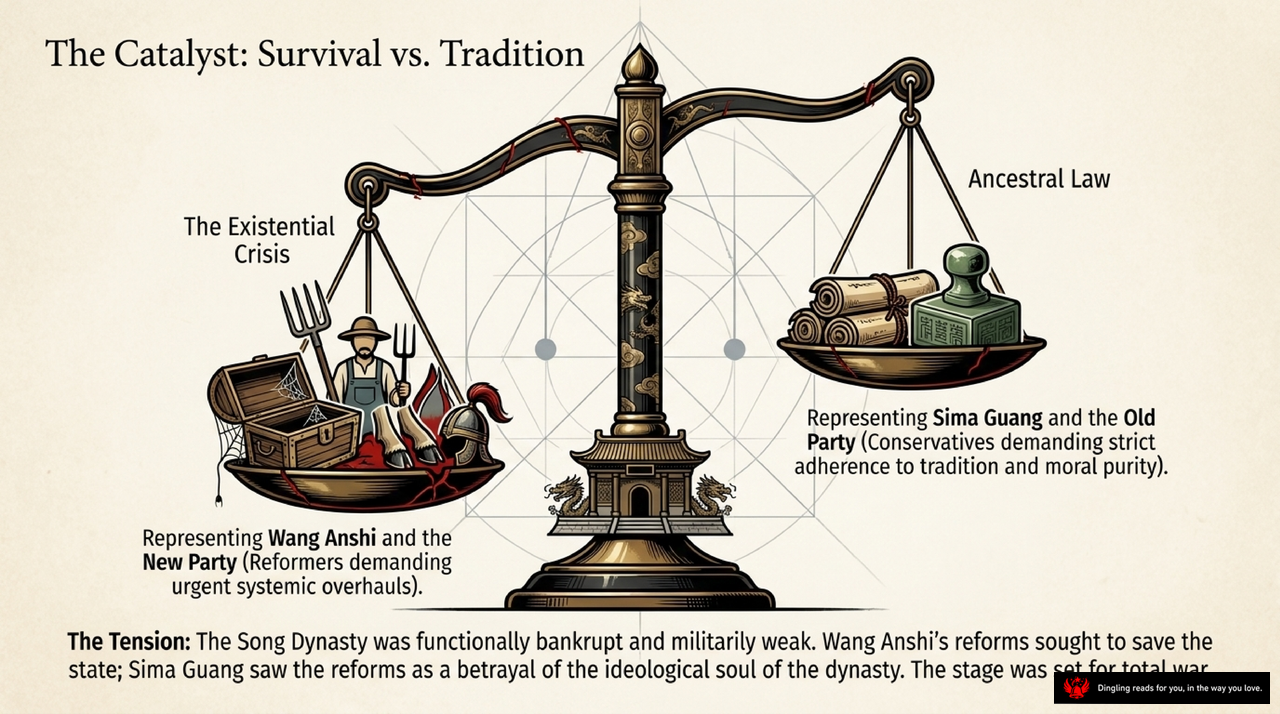
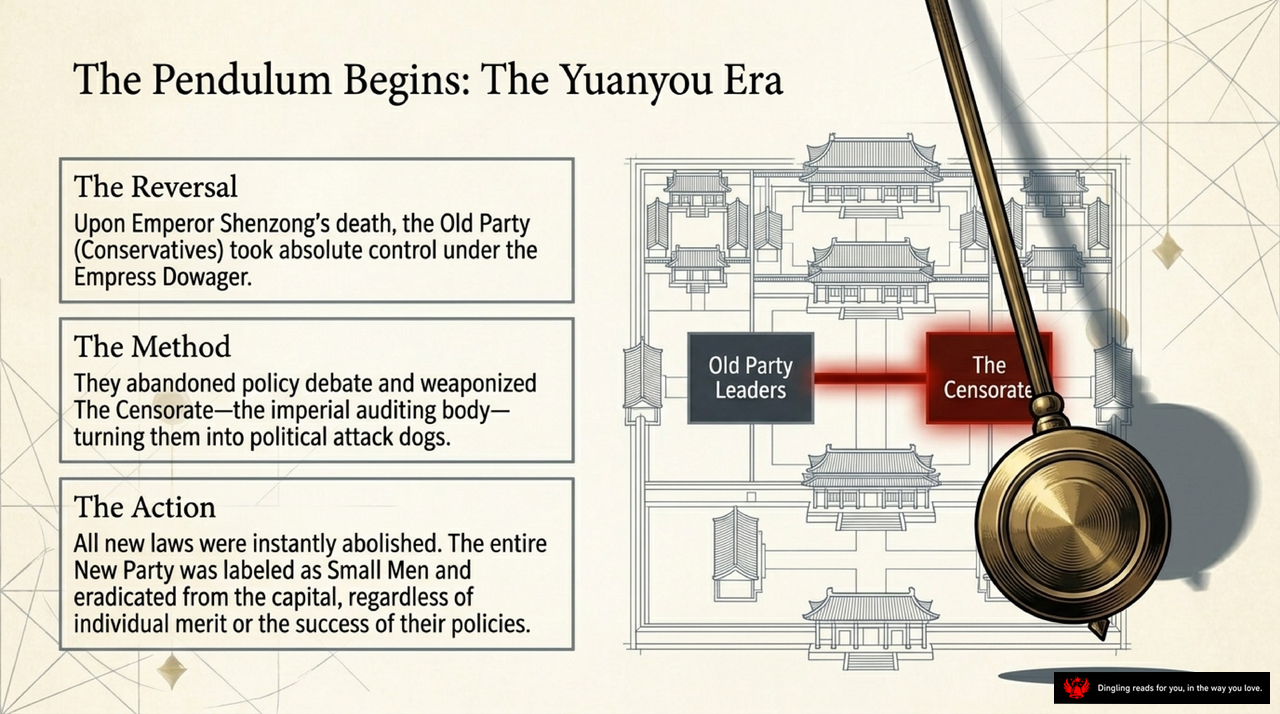
Welcome back to our deep dive into the Song Dynasty. We are now entering a pivotal chapter titled 'The Pendulum Begins: The Yuanyou Era.' This slide captures the exact moment the political balance of the Northern Song completely flipped on its head.
Let's look at the first section, 'The Reversal.' When Emperor Shenzong passed away, the Old Party, or Conservatives, seized absolute power. With the eight-year-old Emperor Zhezong on the throne, the High Empress Dowager took the reins. This wasn't just a change of leadership; it was a total reversal of fortune. The New Party, which had spent years trying to modernize the state, was suddenly on the losing side.
Now, look at the diagram on the right. Notice the red line connecting the 'Old Party Leaders' directly to 'The Censorate.' This is the core of their strategy. Instead of engaging in genuine policy debate, they weaponized the Imperial Censorate. This body was originally designed to audit officials and keep the emperor informed, but now it became their political attack dog. They used it to silence anyone who disagreed with them, turning oversight into oppression.
What was the result? The 'Action' column tells us everything. Every single new law passed during Shenzong's reign was instantly abolished. The entire New Party was branded as 'Small Men'—a derogatory term for petty officials—and systematically eradicated from the capital. It didn't matter if they were talented or if their policies worked. If they were on the wrong side, they were out. Many were exiled to remote regions or executed. This was a complete purge.
This era, known as the Yuanyou Era, wasn't about governance; it was about revenge. The Old Party didn't just want to stop reforms; they wanted to destroy the New Party's influence completely. This purge set a dangerous precedent. It turned the government into a battleground where merit didn't matter, only loyalty to the faction did. This decision would ultimately lead to the collapse of the Northern Song Dynasty, as the country wasted its energy fighting internal enemies while external threats grew stronger.
This is the moment the pendulum swung too far, and it never came back. The Yuanyou Era marks the beginning of the end for the Song Dynasty.
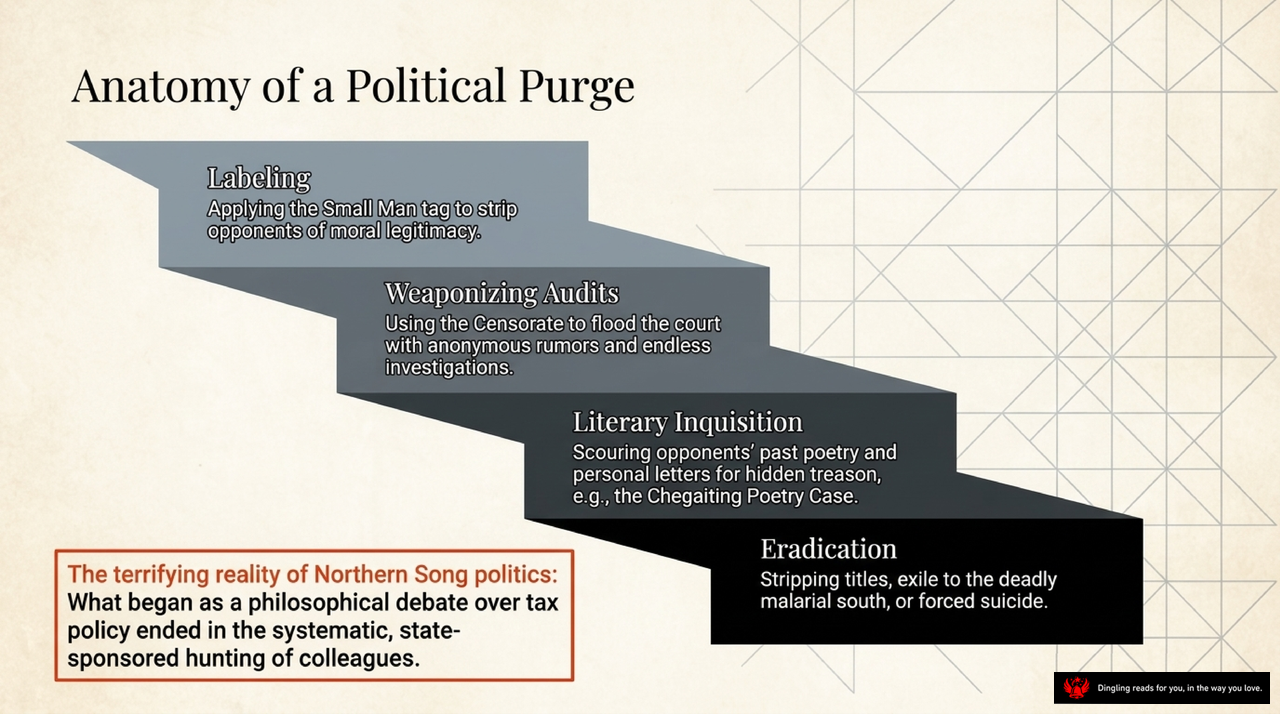
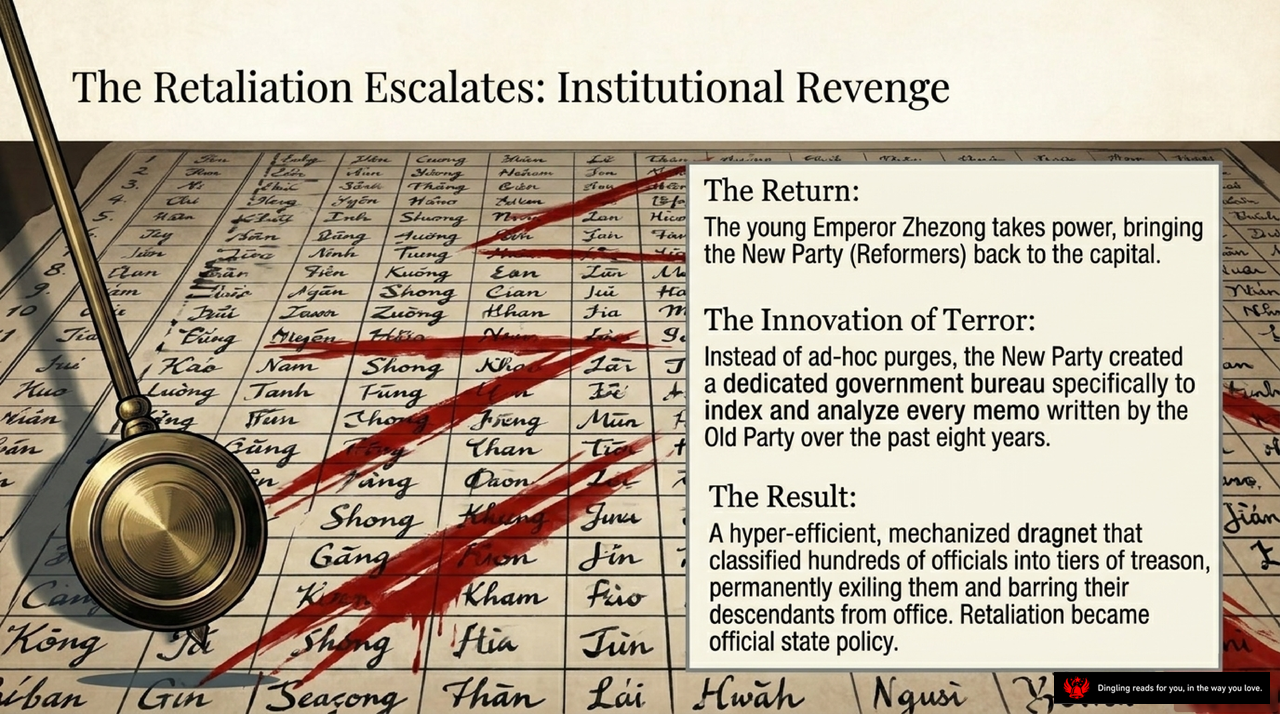
So, let's talk about what happened next. After years of the Old Party holding the reins, the political tide turned dramatically. The young Emperor Zhezong finally took control, bringing the New Party back to the capital after years of suppression. But this wasn't a simple power grab. It was a calculated move for revenge, marking a shift from negotiation to systematic destruction.
Instead of just firing people on the spot, the New Party created something new: a dedicated government bureau. Its job was to go through every single memo the Old Party had written over the past eight years. They indexed it all. It was like turning political enemies into a searchable database. This wasn't just about policy disagreements anymore; it was about hunting down every word that could be twisted against them. This was the 'Innovation of Terror'—moving from chaotic purges to a bureaucratic machine of hate.
The result was a hyper-efficient machine. Hundreds of officials were classified into tiers of treason. They were exiled permanently. But it didn't stop there. Their descendants were barred from office too. Retaliation became official state policy. It was a systematic purge, turning personal grudges into a national security operation. The red lines on the list aren't just marks; they represent a lifetime of political death for an entire generation.
This era, known as the Shao Sheng period, showed how quickly political revenge can become institutionalized. What started as a disagreement over reforms turned into a generational ban. The magnifying glass in the image isn't just for looking; it represents the scrutiny that never ended. Officials were watched, their past words were dug up, and their futures were erased. It was a dark chapter where the state itself became the executioner, ensuring that the Old Party would never rise again, but at the cost of the very system they were trying to save. This cycle of violence left a scar on the dynasty that would haunt them for centuries, proving that when politics becomes personal, the whole country pays the price. The red crosses in the background symbolize this erasure. It wasn't just about the present; it was about controlling the future. By barring descendants, they ensured that the political opposition would die out, not just in office, but in lineage. This was the ultimate weapon of the New Party: not just defeating their enemies, but erasing them from history and society entirely. The title 'Institutional Revenge' perfectly captures this moment where the state itself became the instrument of vengeance.
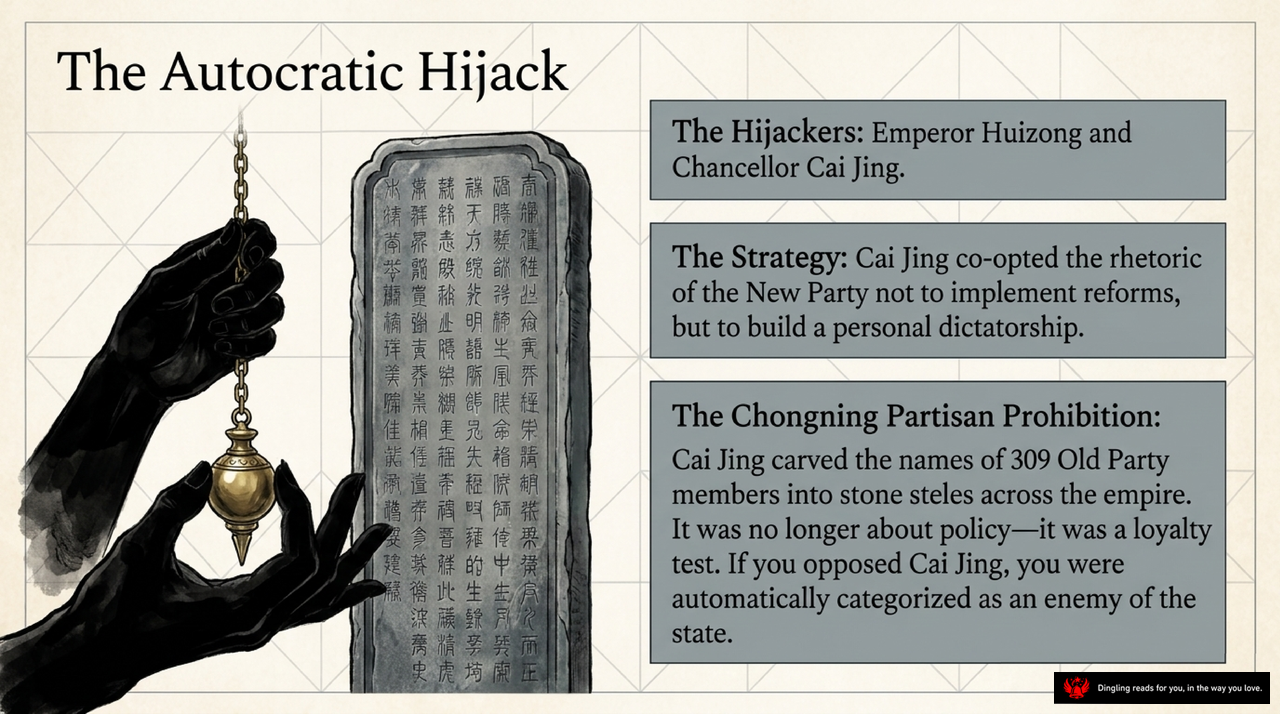
Welcome back. Today we are looking at a critical turning point in the Northern Song Dynasty, a moment where reform was hijacked and turned into a tool for personal tyranny.
On the screen, you see a hand holding a golden weight, balanced against a stone stele. This image perfectly captures the moment the political system tipped from a debate of ideas into a rigid, authoritarian control. The hijackers here are Emperor Huizong and his chancellor, Cai Jing.
While the New Party had originally championed reforms to save the nation from crisis, Cai Jing twisted this mission. He didn't care about the actual policies anymore. Instead, he co-opted the rhetoric of the New Party—specifically the idea of "Shousu," or continuing the reforms of his father, Emperor Shenzong—not to improve the government, but to build a personal dictatorship.
This is what we call the Chongning Partisan Prohibition. To cement his power, Cai Jing went on a massive purge. He carved the names of 309 former members of the Old Party, along with anyone who dared to speak out, onto stone steles and placed them across the empire. This wasn't just a historical record; it was a public warning.
Suddenly, politics stopped being about policy. It became a loyalty test. If you opposed Cai Jing, you were automatically categorized as an enemy of the state. It didn't matter what you believed or what you had done in the past. The only thing that mattered was whether you were on his side.
This era marked the end of political discourse in the Song Dynasty. The court was no longer a place for debate, but a place of fear. The "New Laws" were no longer tools for governance; they were weapons used to silence anyone who wasn't compliant. This autocratic hijack didn't just destroy the Old Party; it destroyed the very foundation of the Song's political stability, paving the way for the dynasty's eventual collapse.
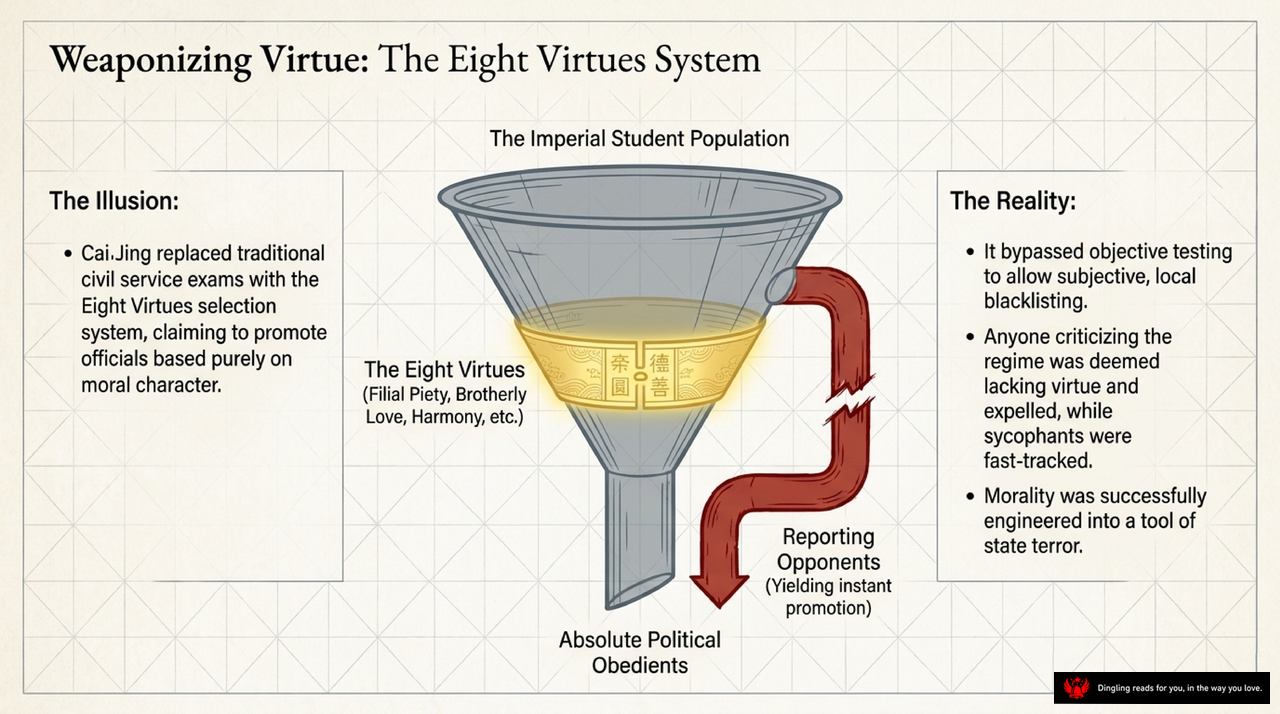
Let's dive into this slide, titled "Weaponizing Virtue: The Eight Virtues System."
On the left, we see "The Illusion." During the late Northern Song Dynasty, specifically under the Chong Ning Ban, Cai Jing claimed he was revolutionizing the bureaucracy. He replaced the traditional civil service exams with a new selection system based on the Eight Virtues—filial piety, brotherly love, harmony, and so on. The narrative was compelling: he was promoting officials based purely on their moral character. It sounded like a noble return to Confucian ideals, prioritizing the "inner man" over the "outer test."
But look at the center of the diagram. That funnel represents the Imperial Student Population. They weren't being tested on their knowledge or their ability to govern. They were being filtered through a subjective lens of "virtue" defined entirely by the regime.
Now, look at the right side, "The Reality." This is where the system actually functioned. It bypassed objective testing to allow for subjective, local blacklisting. If you criticized the regime, you were instantly deemed "lacking virtue" and expelled. Meanwhile, sycophants who just said what the leadership wanted to hear were fast-tracked.
Notice the red pipe coming off the side? That's the mechanism for "Reporting Opponents." It yielded instant promotion. So, morality wasn't about doing good; it was about being useful to the state. It was successfully engineered into a tool of state terror.
The historical context behind this is crucial. The text tells us that this wasn't just about politics; it was about total control. By defining what "virtue" meant, the regime could eliminate any intellectual opposition. They established the "Eight Virtues" recruitment system, where neighbors and local officials had to declare if a candidate met the criteria. If you didn't, you were excluded from the Imperial Academy. Worse, they established "Eight Punishments," banning anyone who violated these moral codes from entering the school system for years.
The text also mentions that this system targeted the "Eight Virtues" to control the scholar-official class, who were supposed to be the moral compass of the nation. Instead, it turned them into absolute political obedients. It stripped away the genuine meaning of Confucian values. Instead of cultivating wise leaders, it created a class of enforcers who feared the state more than they respected the law.
Ultimately, this system stripped away the genuine meaning of Confucian values. Instead of cultivating wise leaders, it created a class of enforcers who feared the state more than they respected the law. It was a dark chapter where the very tools meant to uphold morality were used to destroy it. This weaponization of virtue didn't just suppress the Song Dynasty's intellectual life; it accelerated its collapse by destroying the very trust needed to govern a civilization.
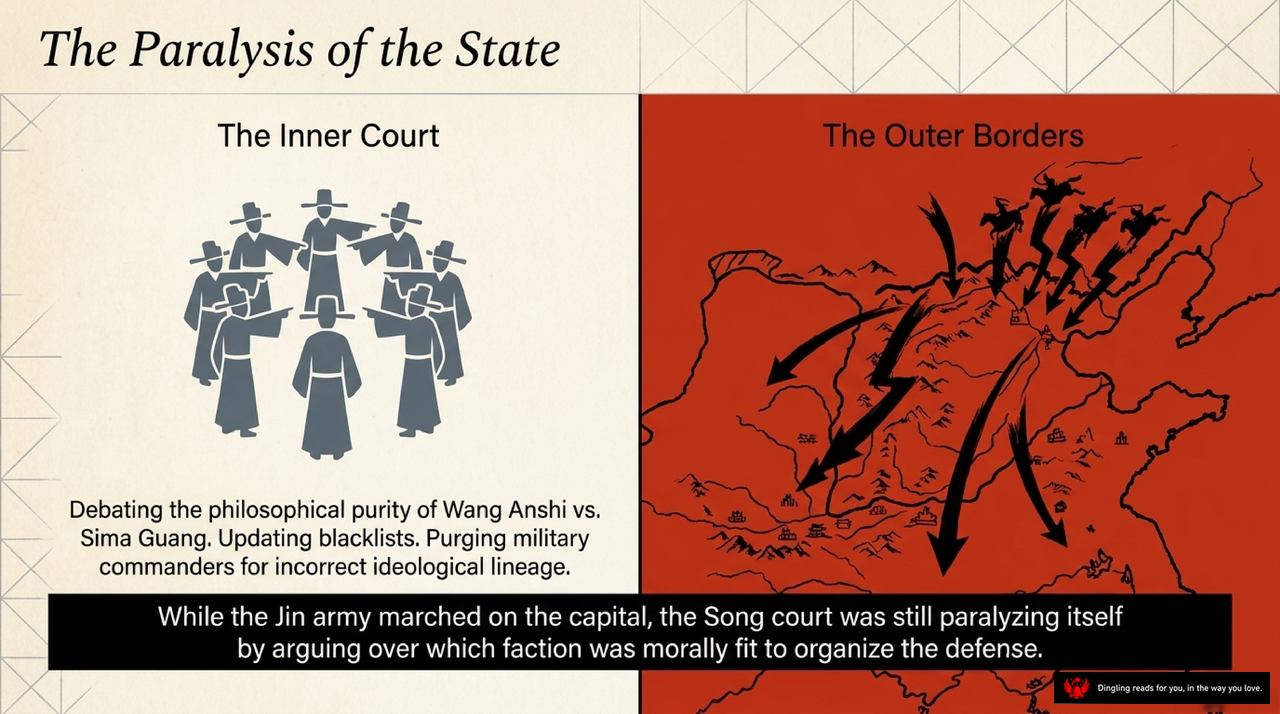
The Paralysis of the State is the perfect summary of the Northern Song's final decade. Let's look at the left side, The Inner Court. This isn't about governance; it's about ideological purity. We see Wang Anshi versus Sima Guang. They spent years debating philosophical lines, updating blacklists, and purging military commanders simply for having the wrong ideological lineage. It was a civil war fought inside the government.
The core conflict was a debate over Righteousness versus Profit. One side wanted to be active and change things, the other wanted to stay passive and keep the old ways. They argued over which faction was morally fit to rule, ignoring the reality that the state was dying. They were so obsessed with Righteousness versus Profit that they forgot the state needed survival.
Meanwhile, look at the right side, The Outer Borders. While the court was busy infighting, the Jin army was marching right on the capital. The arrows on the map show an inevitable collapse.
The bottom banner hits the core tragedy. While the Jin army marched on the capital, the Song court was still paralyzing itself by arguing over which faction was morally fit to organize the defense. This wasn't just bad luck; it was a structural failure. For fifty years, factions attacked each other on right and wrong. They prioritized moral purity over military survival.
In the Jingkang era, this reached its peak. Officials like Feng Xie pointed out that since Xining, factions had crushed each other for decades. Yet, in the moment of crisis, they were still arguing about which side was right. They didn't care about the country; they cared about the faction. Some officials even blamed Wang Anshi for everything, refusing to look at the real problem: their own inability to govern.
The result was predictable. A state that cannot agree on who is morally fit to save it will be destroyed by whoever is outside the wall. The Jin army didn't need to break the gates; they just had to wait for the court to decide who was right. By the time they did, the gates were already open. This is the true cost of internal paralysis.
The tragedy wasn't just military; it was moral. The state consumed its own leaders until there was no one left to fight.
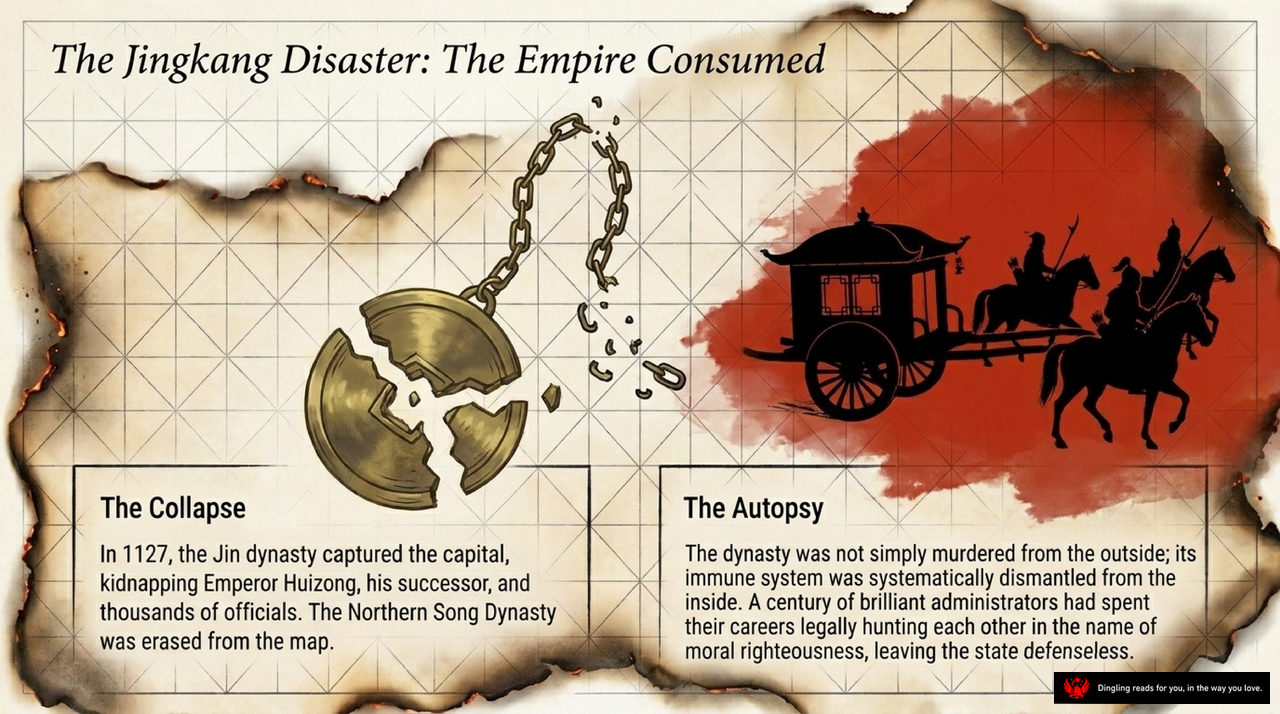
Look at this image. A broken chain and a fleeing carriage. It represents the end of an empire, but not the way you might expect. The title says 'The Empire Consumed,' and that's exactly what happened.
On the left, we see 'The Collapse.' In 1127, the Jin dynasty breached the capital. They didn't just win a battle; they captured Emperor Huizong, his successor, and thousands of officials. The Northern Song Dynasty was erased from the map in a single day. It looks like a sudden external shock, but that's only the tip of the iceberg.
On the right, 'The Autopsy.' This is where the real story lies. The dynasty wasn't simply murdered from the outside; its immune system was systematically dismantled from the inside. For a century, brilliant administrators spent their careers legally hunting each other in the name of moral righteousness. They used politics to destroy each other, leaving the state defenseless.
Think about it. A government that is too busy fighting itself can never defend itself. The internal rot started long before the Jin army arrived. Factionalism tore the court apart. The book tells us that for a long time, officials were encouraged to attack each other using the excuse of 'moral righteousness.' It wasn't about good governance; it was about power. By the time Huizong took the throne, the court was rotting from within. Corruption was rampant, and the military was useless. When the crisis finally hit, the leaders were too busy fighting each other to fight the enemy.
We see this in the history of the Song. The system was designed to keep everyone in check, but instead, it created a culture of suspicion and infighting. The 'Party Struggles' turned into a cycle of destruction. When the crisis finally came, the leaders were too focused on internal power struggles to face the enemy. The corruption was so deep that even the military was compromised.
So, the Jin dynasty was the final blow, but the real killer was the system itself. It was a slow poison that turned the empire against itself. By the time the walls fell, there was no one left to hold the line. The empire consumed its own resources, its own leaders, and eventually, its own future. This is the tragic lesson of the Song Dynasty. It wasn't conquered by a superior army; it was destroyed by its own people.
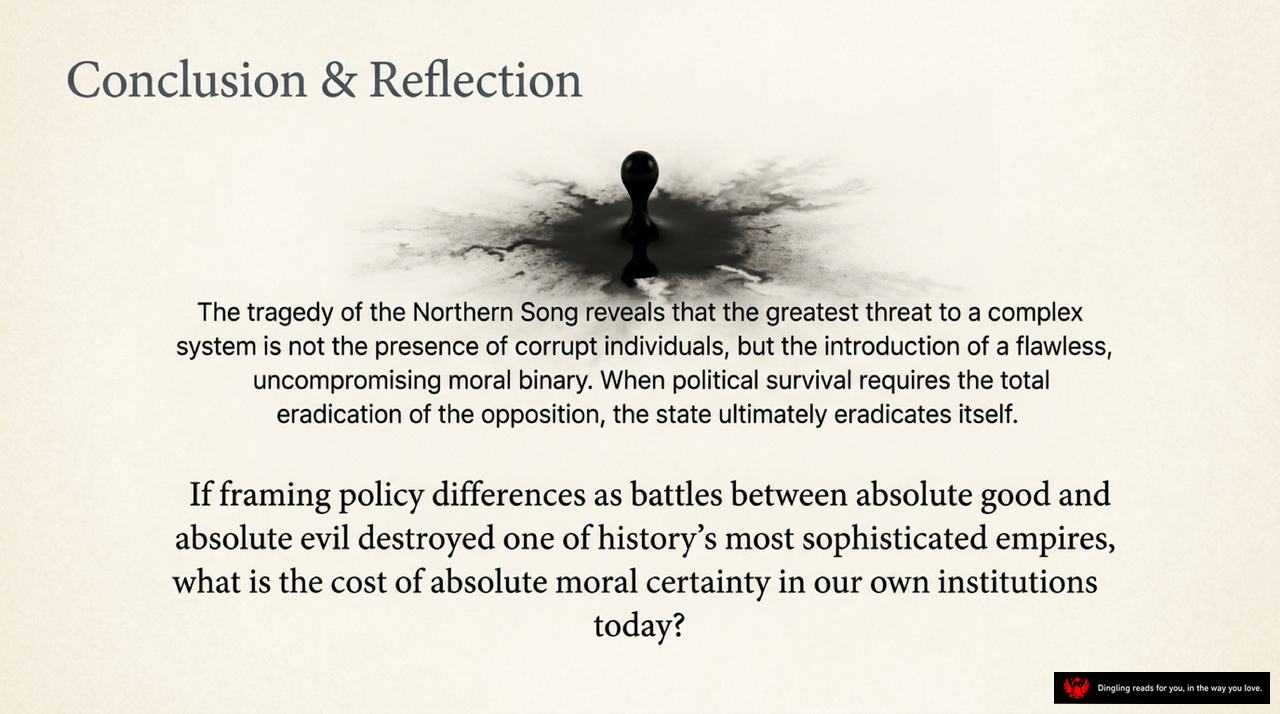
The ink drop in the center of this slide represents something much darker than just a splash of color. It symbolizes the slow, inevitable spread of a dangerous idea that ultimately consumed the Northern Song Dynasty.
This slide concludes our deep dive into one of history's most sophisticated empires, which, ironically, destroyed itself from the inside out. The tragedy of the Northern Song reveals a harsh truth: the greatest threat to a complex system isn't always corrupt individuals. It's not the bad apples. It is the introduction of a flawless, uncompromising moral binary.
When you frame policy differences as battles between absolute good and absolute evil, you stop negotiating. You start eradicating. Look at the New Party and the Old Party in the Song Dynasty. It wasn't just about whether to reform the tax system or restore old laws. It became a fight over "Righteousness" versus "Profit." The Old Faction, led by Sima Guang, viewed the New Party's reforms as "seeking profit" and "betraying virtue." They didn't just disagree; they declared the other side morally evil.
This moral certainty became a weapon. When political survival required the total eradication of the opposition, the state ultimately eradicated itself. We saw this in the Yuan You era, where the Old Party purged the New Party with brutal cruelty, and later, under Cai Jing, the Chongning Ban which wiped out hundreds of people, including former allies, simply because they held different views. The state didn't fall because of an external enemy like the Jin Dynasty alone. It fell because the internal fighting drained the resources and the will to resist.
If framing policy differences as battles between absolute good and absolute evil destroyed one of history's most sophisticated empires, what is the cost of absolute moral certainty in our own institutions today?
We see this pattern everywhere. In our workplaces, in our politics, in our communities. When we label our opponents as "evil" or "unpatriotic" rather than simply "disagreeing," we invite the same kind of self-destruction. We stop listening, we stop compromising, and we focus entirely on eliminating the other side. The Northern Song teaches us that a system that demands moral purity from its opponents is a system that is already doomed. The ink spreads, and eventually, it covers everything.