
Father Goriot: Complete Chapter-by-Chapter Summary
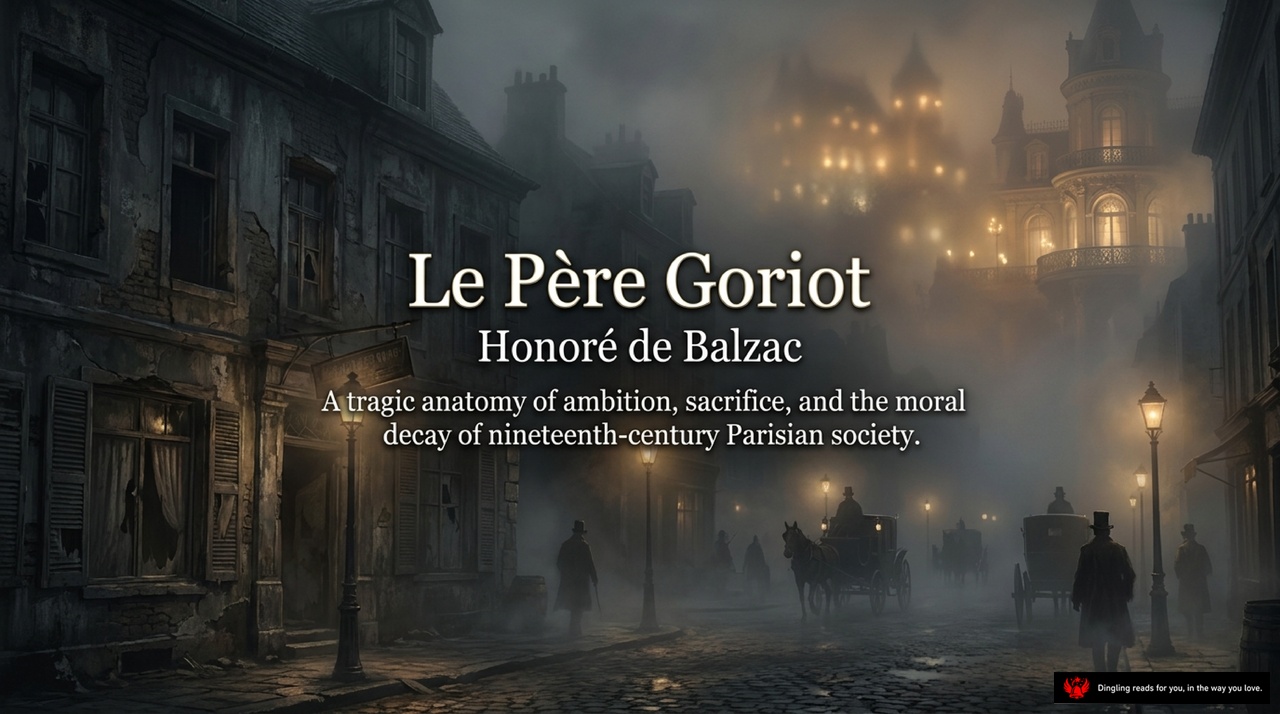
Welcome to the world of *Le Père Goriot* by Honoré de Balzac. Tonight, we step into a fog-shrouded Paris of the 19th century, where cobblestones glisten under gaslight and secrets hide behind crumbling facades. This is the story of a tragic anatomy of ambition, sacrifice, and the moral decay of society.
At the heart of this tale lies the Vauquer Pension, a shabby boarding house on Rue Saint-Denis. It is a place where ambition meets despair, and where the rich get richer while the poor simply disappear into the shadows. Here, ambition is not a noble pursuit but a desperate struggle for survival.
Our protagonist, Vautrin, is a mysterious figure who seems to know everything about this dark world. He is a convict turned criminal mastermind, yet he moves through the pension with an air of authority that commands both fear and respect. His presence alone hints at the complex web of crime and corruption that underpins this seemingly ordinary neighborhood.
As we delve deeper into this narrative, we will uncover how personal sacrifices often lead to unforeseen consequences. The characters in this story are not just victims of circumstance; they are architects of their own destinies, driven by desires that often exceed their understanding of reality.
Join us as we explore the intricate relationships and moral dilemmas that define this timeless masterpiece. In the end, it is not just about the fall of one man, but the rise of an entire generation that learns too late the true cost of their ambitions.
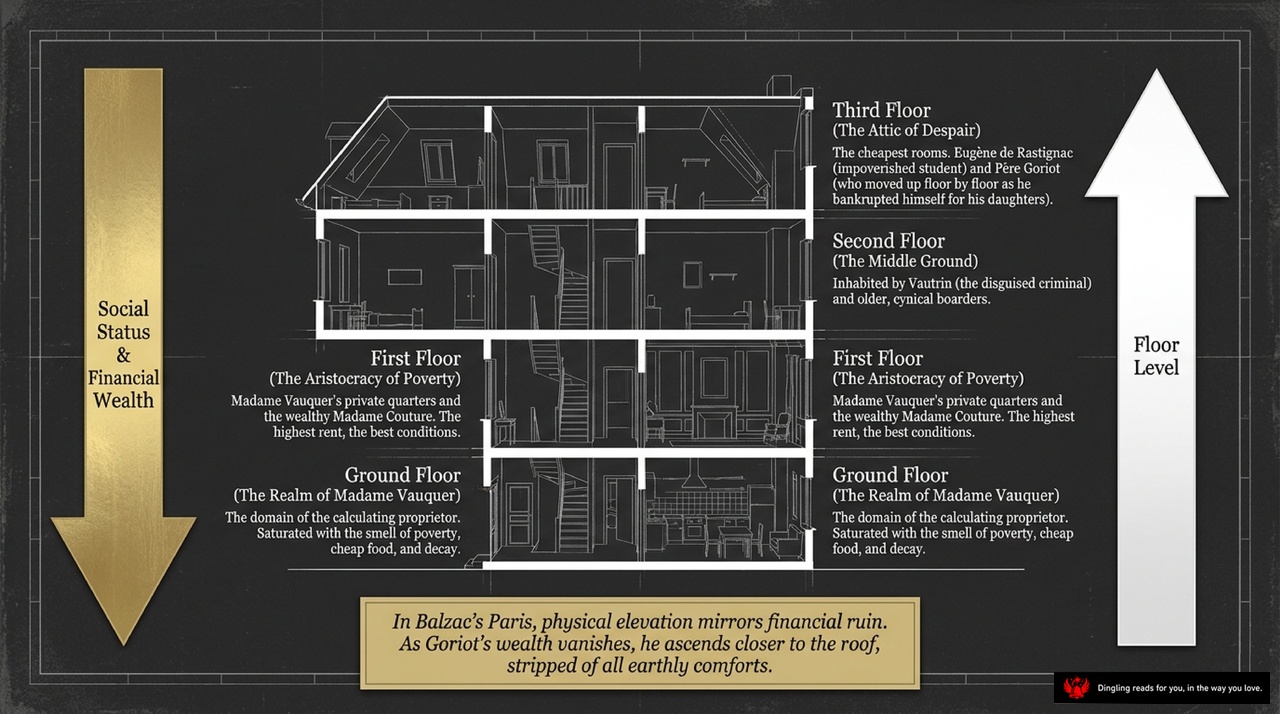
Look at this cross-section of the Vauquer House. This isn't just a building; it's a brutal thermometer measuring social status and financial ruin. Notice the golden arrow on the left pointing down? That represents wealth. As you climb the floors to the right, you're actually moving deeper into poverty.
At the bottom, the Ground Floor is the realm of Madame Vauquer herself—the calculating landlord who profits from the misery above. Just one step up to the First Floor, and you enter the "Aristocracy of Poverty." This is where wealthy Madame Couture and the private quarters of the desperate Vauquers live. They pay the highest rent, yet they are still trapped in this grim reality.
Move up to the Second Floor, the "Middle Ground." This is where Vautrin, the disguised criminal, and cynical boarders reside. They are slightly better off but still stuck in the grind. Finally, at the very top, the Third Floor is labeled the "Attic of Despair." This is the cheapest accommodation, home to the impoverished student Eugène de Rastignac and Père Goriot, who moved up here only after his wealth completely vanished.
The text at the bottom summarizes it all perfectly: In Balzac's Paris, physical elevation mirrors financial ruin. As Goriot's wealth vanishes, he ascends closer to the roof, stripped of all earthly comforts. He trades his dignity and comfort for a higher floor, only to find that in this city, climbing up means falling further behind in life.
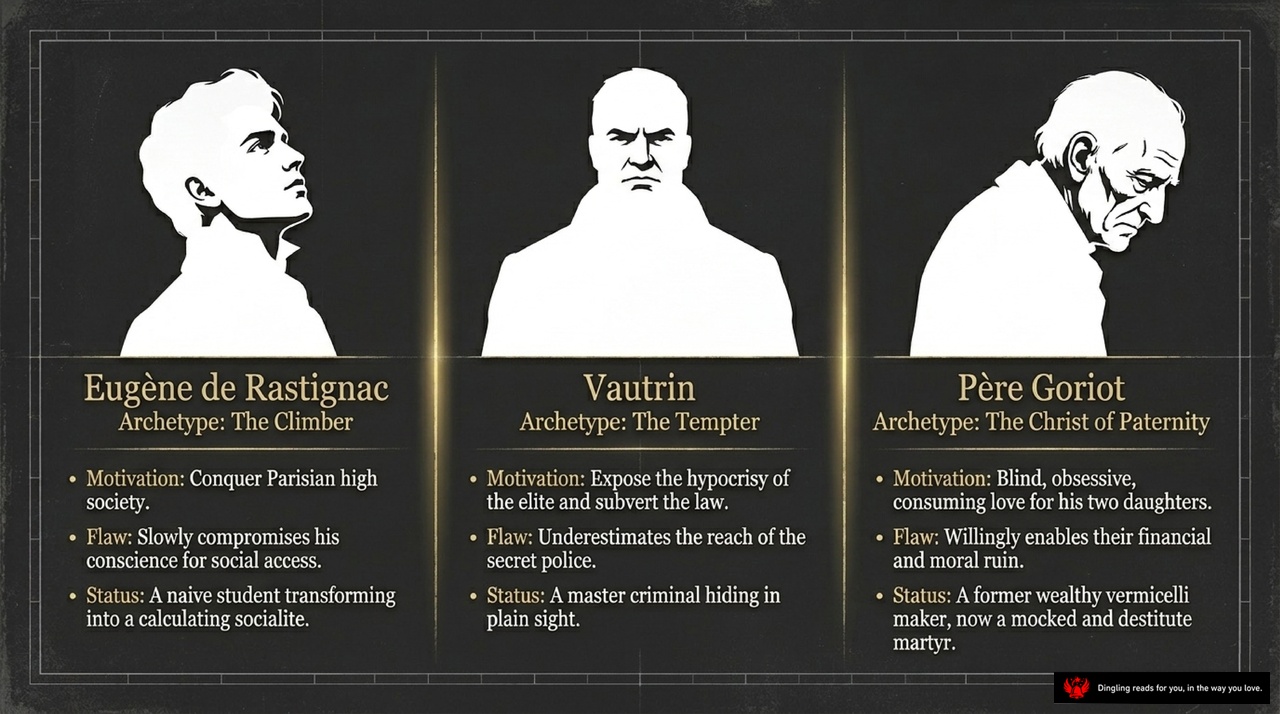
Look at these three archetypes that define the tragic heart of Paris: Eugène de Rastignac, Vautrin, and Père Goriot.
First, we have Eugène, the ultimate climber. He starts as a naive student from the provinces, desperate to conquer the glittering high society of Paris. But his fatal flaw is his willingness to compromise his conscience just for social access. He is slowly transforming into a calculating socialite, trading his soul for a seat at the table.
Then there is Vautrin, the tempter. He is a master criminal hiding in plain sight, a man who knows the dark rules of the city better than anyone. His motivation is to expose the hypocrisy of the elite and subvert the law. Yet, his downfall lies in underestimating the reach of the very secret police he tries to outsmart. He represents the dangerous allure of the criminal underworld.
Finally, we have Père Goriot, the Christ of Paternity. Once a wealthy vermicelli maker, he is now a mocked and destitute martyr. His motivation is a blind, obsessive, and consuming love for his two daughters. He willingly enables their financial and moral ruin, selling his health and dignity just to keep them happy. His tragedy is that his selfless sacrifice is met with cold indifference, proving that in this world, love is the first thing money can buy out.
These three lives intertwine in the shadowy confines of the Vauquer Apartments, creating a brutal lesson about desire, sacrifice, and the crushing weight of a society that values gold over humanity.

Look at this diagram. It lays out the ultimate choice facing our protagonist, Rastignac, and the entire Parisian social order. At the very top, the goal is clear: one million francs and total social supremacy. But how does one get there? The slide presents two distinct paths.
On the left, we have Path A: The Path of Virtue, or what we might call "The Long Game." This is the traditional route. The action involves studying law, working honestly, and dedicating decades to the grind. The outcome? As the slide bluntly states, a mediocre salary, endless suffering, and ultimate obscurity. It's the safe, respectable, but ultimately unfulfilling life for the average man.
Then, on the right, lies Path B: The Path of the Jungle, known here as Vautrin's Plot. This is the shortcut. The action is ruthless: allow Vautrin to murder Victorine's brother, marry Victorine for her inherited millions, and simply pay Vautrin a commission. The outcome? Instant wealth, power, and yes, blood on your hands.
This graphic perfectly captures the core conflict of the novel. Vautrin strips away the illusion of Parisian morality, proving to Rastignac that great wealth is simply a crime that was executed flawlessly. The choice isn't just about money; it's about whether you are willing to become the monster you despise to climb out of the shadows.

Anastasie and Delphine: The Two Faces of Betrayal
Look at these two golden frames. On the left is Anastasie, the aristocrat, and on the right is Delphine, the representative of the bourgeoisie. Though they come from different social circles, they share the same cold heart toward their father.
Anastasie married into the old, prestigious nobility, the Comte de Restaud. Her motivator was paying off the crippling debts of her lover, Maxime de Trailles. When she needed money, she would come to her father, selling her mother's diamond necklace to save her lover from prison. Yet, when her father was dying, she was too busy with her ball and her lover to even visit him. She treated him like a resource to be drained, closing her doors to him and only visiting the boarding house to extort his last silver and pensions.
On the right, we see Delphine, married to a wealthy but controlling German banker, the Baron de Nucingen. Her motivator was gaining access to the exclusive Faubourg Saint-Germain salons. She uses her father as a middleman to facilitate her affair with Rastignac and to fund her social ambitions. Even when her father was on his deathbed, she was more concerned with her ball gown than his suffering.
These two daughters represent the ultimate cruelty of Parisian society. They viewed their father not as a beloved parent, but as a bank account. They exploited his love, took his money, and discarded him the moment he became useless. Their betrayal is the darkest truth of this city.

Goriot's Fortune: A Vast Empire Built on the Vermicelli Trade During the Revolution.
This slide reveals the tragic trajectory of Goriot's wealth. Once a prosperous merchant who amassed a fortune selling vermicelli during the Revolution, his vast empire was systematically dismantled by his own daughters. The flowchart illustrates three key drains on his capital. First, the 800,000 francs paid as dowries to secure aristocratic marriages for Anastasie and Delphine. Second, the life annuities he sold off to cover the mounting debts of his daughters' lovers. Finally, the family heirlooms, including his last silver plates, pawned to fund their ball gowns.
The result is Total Incineration. Goriot is reduced to living on a few sous a day. His fortune is entirely consumed by the vanity of high society. As the text reminds us, love in Balzac's Paris is a commodity. Once Goriot's capital is completely depleted, his utility as a father vanishes. He has sacrificed everything, only to be left with nothing but the hollow echo of his daughters' names.

Look at this chart. It captures the tragic arc of Rastignac's evolution in a single, haunting visual. Notice the two crossing lines: one represents his rising Social Status, the other his plummeting Moral Integrity. It's a perfect metaphor for the cost of ambition in Paris.
Let's trace his journey. It starts at Point 1, where he arrives with innocent ideals, fueled by his family's last savings. But quickly, at Point 2, Vautrin's cynical lecture on the "law of the jungle" plants the seed of corruption. He realizes that in this city, morality is a liability.
By Point 3, he fully enters Delphine's orbit. This is the turning point. He begins relying on gambling and borrowed money, trading his honesty for a ticket into high society. He learns that to survive, he must stop caring about the rules.
The tragedy deepens at Point 4. He witnesses Goriot's agonizing death and the absolute absence of his daughters. This moment shatters his last shred of innocence. He sees the brutal truth that blood is thinner than water when money is involved.
Finally, at Point 5, he buries Goriot. As he sheds his last tear of youth, he declares war on Paris. He chooses the path of the social climber over the conscience of a man. The graph doesn't just show a change; it shows a transformation. Rastignac didn't just gain status; he sold his soul. And in doing so, he became exactly the kind of ruthless player he once admired.

The timeline on this slide captures the heartbreaking final hours of Father Goriot's life, a tragic countdown where love is met with indifference. It starts at Hour 1, when Goriot suffers a severe stroke. In his delirium, he cries out for his daughters to comfort him, unaware that they are miles away. By Hour 24, the silence deepens. Delphine claims she caught a cold and cannot come, while Anastasie is locked in a fierce financial dispute with her husband, completely oblivious to her father's suffering. Neither daughter arrives. At Hour 48, Goriot oscillates feverishly between cursing them as monsters and forgiving them as angels. He is alone in the dark, waiting for a reunion that will never happen. Finally, in The Final Moment, he dies holding the hands of Rastignac and a medical student, mistaking them for his daughters. The slide concludes with a devastating truth: He had given them his life, his fortune, and his soul. In return, they could not spare him an hour.
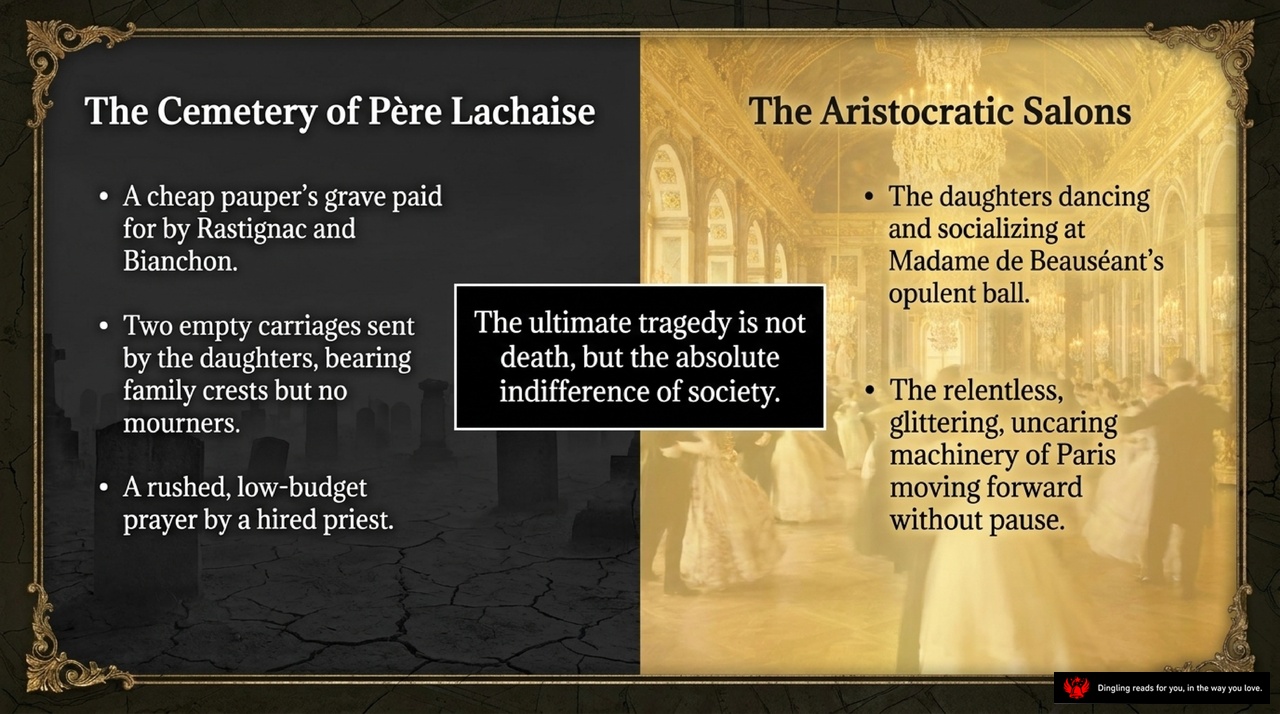
On the left, we see the grim reality of Père Lachaise Cemetery: a cheap pauper's grave paid for by Rastignac and Bianchon, two empty carriages bearing family crests but no mourners, and a rushed, low-budget prayer by a hired priest. On the right, the scene shifts to the Aristocratic Salons, where daughters dance and socialize at Madame de Beauséant's opulent ball, driven by the relentless, glittering machinery of Paris that moves forward without a pause. This stark contrast reveals the ultimate tragedy: it is not death itself, but the absolute indifference of society. While the father dies in silence, ignored by the very people he sacrificed everything for, the daughters continue their luxurious lives, completely detached from his suffering. This moment marks the final break for Rastignac, forcing him to choose between the cold truth of this world and the illusions of the past.

Look at this slide. It cuts right to the heart of *Le Père Goriot*. Balzac isn't just writing a novel; he's exposing a world where human relationships are entirely transactional. In this Parisian microcosm, paternal love is portrayed as a fatal weakness, while ambition demands the shedding of innocence. The glittering elite are sustained by the literal blood and bankruptcy of the classes beneath them.
Consider the price of ascending the social ladder. For the daughters, it meant selling their father's dignity and life to buy a title. For the elite, it meant consuming the very people they claimed to disdain. Rastignac's final gaze upon the city is not one of triumph, but a declaration of war against a spiritually bankrupt world.
So, let's ask the question posed here: If the price of ascending the social ladder is the death of human conscience, who are the real monsters in the Parisian jungle? Is it the ruthless aristocrats, or is the monster simply the system itself, which rewards those willing to sacrifice their humanity for status?