
Faust: Complete Chapter-by-Chapter Summary

Welcome to our deep dive into one of literature's most enduring masterpieces: *Faust* by Johann Wolfgang von Goethe. This isn't just a story; it is a sixty-year literary pursuit that pushes against the very limits of human knowledge, desire, and salvation. The image before us captures the essence of this epic journey—a complex web of golden lines representing the eternal striving that defines our existence.
At its heart, *Faust* explores the ultimate boundaries of what it means to be human. It asks us to consider the tension between our insatiable thirst for the infinite and the finite nature of our reality. Through the character of Faust, Goethe invites us on a profound exploration of the human condition, where every step forward is also a step into the unknown.
This book challenges us to look beyond the surface of our lives and confront the questions that keep us awake at night. It's a story about the courage to seek, the pain of loss, and the redemptive power of continuous effort. Whether you are a scholar, an artist, or simply someone looking for meaning in a chaotic world, *Faust* offers a mirror that reflects our deepest aspirations and fears.
So, let's open this book together and step into a world where nothing is ever quite as it seems, and where the only true victory lies in the relentless pursuit of what it means to live fully.

So, let's talk about Faust not as a static play, but as a living map of Goethe's sixty-year philosophical journey. Look at this timeline—it's the story of a man's mind in motion. It starts in 1774 with *The Urfaust*, where a twenty-five-year-old Goethe is scribbling early drafts in Frankfurt, laying the raw foundation for the Gretchen tragedy. Fast forward to 1797, and things get serious. Inspired by his friend Schiller, Goethe builds the grand structure: the Dedication, the Prelude in the Theater, and the Prologue in Heaven. This is where the philosophy gets organized. By 1808, Part I is officially published, marking what we call "The Tragedy of the Real." But the story doesn't end there. The final act, "The Cosmic Climax," was written in 1825 to 1831 during Goethe's final years, just eight months before he passed away at age 82. This timeline proves something profound: Faust isn't just a play; it is the living repository of Goethe's entire intellectual evolution, capturing the struggle from youthful passion to cosmic redemption.

Look at this timeline. It maps the evolution of Faust himself, mirroring a massive shift in how humanity views knowledge and power.
We start in the 15th and 16th centuries with "The Charlatan." Here, Faust is a historical alchemist and magician. The theme is a cautionary tale of hubris. He's condemned to Hell simply for making a pact with the devil. In this medieval mindset, forbidden knowledge is dangerous, and trying to play God is a fatal sin.
Fast forward to 1588 with Christopher Marlowe's version, "The Renaissance Titan." Now, Faust is a giant of intellect seeking ultimate power and wealth to conquer nature. He escapes the strict prejudice of the church, becoming a tragic and sympathetic figure. Yet, he's still ultimately damned. This era reflects the Renaissance spirit: the belief that human reason can overcome everything, even if it leads to a fall.
Then, we jump to the 18th century with Lessing and Goethe, presenting "The Flawed Seeker." In this modern view, Faust is the relentless striver. The theme changes dramatically. The Lord recognizes that "man errs as long as he strives." Here, the pursuit of infinite knowledge and action doesn't just lead to damnation; it makes him capable of ultimate salvation.
The bottom of this slide captures the core of this transformation. The evolution of Faust mirrors the shifting human consciousness from the medieval fear of forbidden knowledge to the Enlightenment pursuit of infinite striving. We moved from fearing what we don't know, to believing that our endless effort to know and do is the very path to redemption.

The tragedy of Gretchen marks the lowest point in Faust's journey, a moment where his ambition collides with innocent love and results in irreversible destruction. As we see on this slide, the narrative shifts from the romantic tragedy of Gretchen to a new phase of obsession: the pursuit of Helen of Troy.
Faust, now consumed by a longing for the idealized beauty of antiquity, is guided by Mephistopheles to the realm of the classical gods. Here, he meets Helen, the embodiment of perfect beauty, and falls deeply in love with her. This union leads to a brief period of happiness and the birth of their son, Euphorion. However, Euphorion's fiery spirit mirrors Faust's own insatiable drive. He grows too wild, soaring too high, and ultimately falls to his death.
This loss shatters Helen's world. Overwhelmed by grief, she too fades away, leaving Faust alone once again. The slide captures this pivotal transition: the destruction of the classical ideal and the realization that even the pursuit of perfection can lead to emptiness. Faust is left with nothing but memories, setting the stage for his next, even more dangerous, quest for power and creation.

In the heart of a medieval laboratory, a strange new life has just taken shape. Wagner, obsessed with creating life through alchemy, has succeeded. From a glowing substance in a flask, a tiny figure emerges—Homunculus. This little man immediately addresses Wagner as "father" and Mephistopheles as "uncle," eager to move and explore the world.
Seeing this, Homunculus notices Faust is still trapped in his obsession with Helen of Troy. He suggests taking Faust to the classical Walpurgis Night to break his fixation. Mephistopheles is initially reluctant but agrees when Homunculus mentions the witches of Thessaly. Wrapping Faust in a cloak, the trio sets off on a journey to a world of myth and fantasy, leaving Wagner behind to continue his experiments.
Their path leads them to the plains of Pharsalus, once the battlefield of Caesar and Pompey, now a haunt for ghosts and demons. Here, they encounter the Satyrs and the Sirens. The Satyrs, guarding their stolen gold, warn Mephistopheles not to be deceived by the Sirens' enchanting songs, which once lured even Odysseus to his doom.
Faust is captivated by the presence of these ancient spirits—the Sphinx who posed the riddle to Oedipus, the Sirens, and the Harpies. He feels a surge of fresh energy, momentarily forgetting the tragedy of Grete, as he seeks Helen. Guided by the Chiron, the centaur, Faust travels to the oracle of Manto. There, Manto confirms that Helen, though bound by time in myth, remains eternally young and beautiful. She directs Faust to the temple of Manto, the daughter of Asclepius, who will guide him to Helen.
But the journey doesn't end there. The Emperor, now ruling a revitalized empire thanks to Mephistopheles' financial schemes, summons Faust to bring Helen to his court. The Emperor wants to see the legendary beauty who sparked the Trojan War. In a grand hall, amidst the laughter of courtiers and the curiosity of nobles, Faust performs the ancient ritual. With smoke and music, the ghost of Helen appears, along with Paris.
When Helen kisses Paris, the court erupts in awe. But Faust, consumed by jealousy and the desire to possess this perfect beauty, stabs Paris with a key. The spell shatters, and the vision vanishes. Faust collapses, defeated by the realization that even the most perfect beauty is fleeting. Mephistopheles mocks his folly, dragging him away from the court, leaving the Emperor bewildered by the sudden disappearance of the "jester" who conjured such a miracle.

In the shadow of a jagged cliff, Faust emerges from a cloud, standing alone on the edge of the world. He pushes the cloud away, watching it drift eastward, transforming from a goddess's silhouette into a cold, silver iceberg. The mist that once wrapped his chest now rises, carrying away the memory of his first love.
But his mind isn't on the past; it's fixed on the future. He despises the ocean's arrogant, aimless power. His dream is to drive the sea back, shrink the wet land, and claim the coast as his own. He craves nothing less than tangible rule and ownership.
Suddenly, the sound of drums and military music breaks the silence. Mephistopheles sees his chance. The young Emperor is mixing pleasure with governance, and the state is crumbling into anarchy. Brothers fight brothers, and cities war with cities. This chaos is a goldmine for Faust.
Faust arrives in the Emperor's camp, clad in armor, leading three fierce warriors. He offers his support, promising to use the power of nature to secure victory. The Emperor, desperate and emboldened by rebellion, hands him the command. Faust divides the forces, ordering a relentless assault on the enemy's camp and a defensive hold on the flank.
The battle rages, but Mephistopheles intervenes. He summons water spirits to create a phantom flood, turning the enemy's mountain pass into a raging river. The opposing army, terrified by this supernatural display, flees in panic, flailing like swimmers on dry land. The Emperor, believing it a divine victory, promises Faust the entire coastal strip as a fiefdom.
Inside the conquered camp, Faust's warriors loot the treasury with glee, filling themselves with gold and silks. The Emperor, now a triumphant monarch, rewards his new allies with high titles and vast lands, solidifying his power. Faust looks out at the sea, his vision of a transformed world taking shape. He believes he has finally found the perfect moment, the ultimate satisfaction he has spent a lifetime chasing. He whispers, "Stop! Just for this moment, you are so fair!" And in that instant, he falls.

The image you see is a map of Faust's final, most tragic journey. It's titled "The Microcosm – Part I," and at its heart lies a simple but devastating truth: the "Little World" of personal and civic life ends in moral catastrophe.
Let's follow this red path. It begins with **The Study**. Here, we see intellectual despair. Faust has spent his life trying to comprehend the Earth Spirit, only to fail. He nearly commits suicide, stopped only by the sound of Easter bells. This is the starting point of his ruin—a mind that can no longer find peace in knowledge.
Next, the path leads to **Auerbach's Cellar**. Here, Mephistopheles fails in his first attempt to satisfy Faust with base, drunken revelry. Faust is too weary and too deep in his despair to be amused by mere partying. The demon realizes that cheap pleasure won't work on a broken soul.
Then, the journey moves to **The Witch's Kitchen**. This is where the deal is truly made. A potion restores Faust's youth and ignites his raw, animalistic sexual desire. This is the catalyst that pulls him out of his isolation and into the world of human relationships, for better or worse.
Finally, the path ends at **The Dungeon**. Here, we see the seduction of the innocent Gretchen, leading to her family's destruction, her madness, and her execution. Her soul is saved by divine grace, while Faust flees, leaving a trail of blood behind him.
This map illustrates a complete cycle. Faust tries to conquer the world through knowledge, then through pleasure, and finally through power. But every step in this microcosm leads not to salvation, but to moral catastrophe. It is a warning that when we try to play god in our own small world, the cost is often the destruction of everything we love.
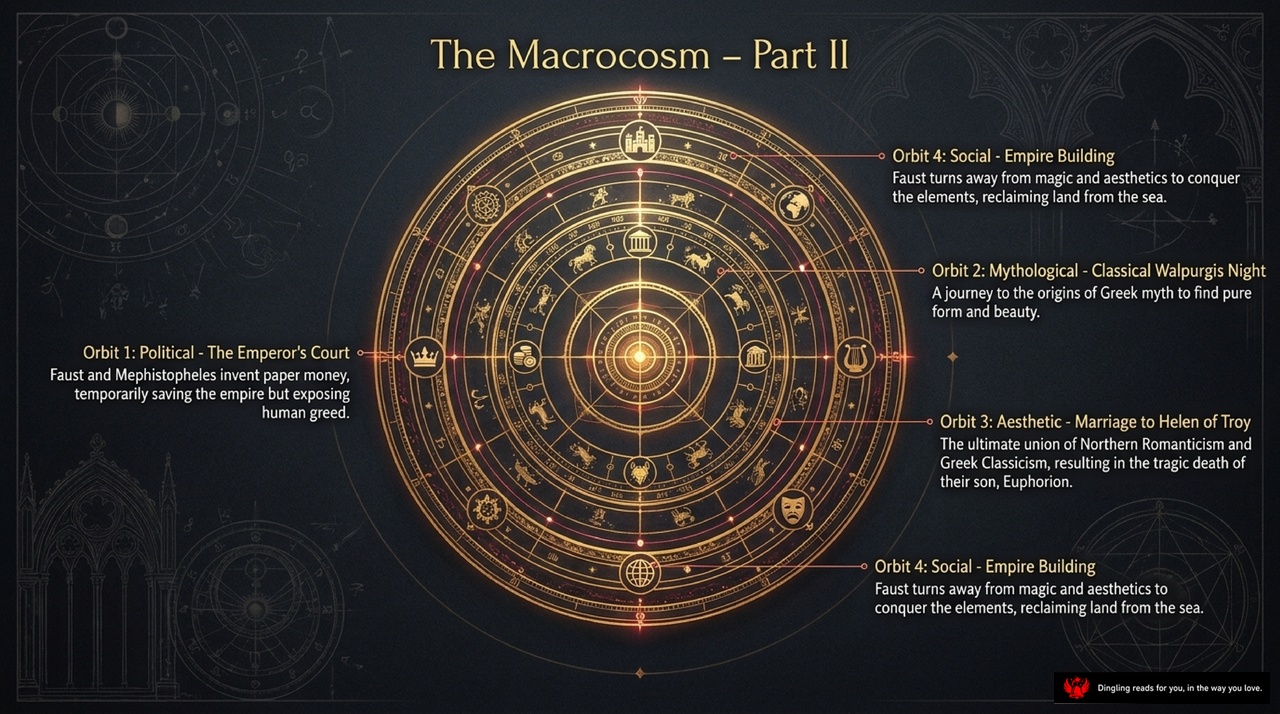
In this final chapter, we see Faust's ultimate quest and his redemption. The image before us is a grand cosmic map, illustrating the layers of Faust's journey from political power to mythological exploration, aesthetic union, and finally, social empire-building.
Let's start with the outermost ring, labeled "Orbit 4: Social - Empire Building." This represents Faust's final, grand ambition. After the tragedy of Helen and Euphorion, Faust turns away from magic and aesthetics to conquer the elements. He seeks to reclaim land from the sea, believing that creating a usable, habitable world for humanity is the highest form of service. He wants to build an empire where people can live freely and securely.
Moving inward to "Orbit 3: Aesthetic," we see the tragic union of Northern Romanticism and Greek Classicism. This is Faust's marriage to Helen of Troy and the birth of their son, Euphorion. While it was the ultimate union of beauty and power, it ended in tragedy. Euphorion's flight into the sky and subsequent fall symbolize the danger of trying to transcend human limits, a lesson that deeply shapes Faust's later years.
Next, we have "Orbit 2: Mythological," representing the journey to the origins of Greek myth during the Classical Walpurgis Night. Here, Faust seeks pure form and beauty in the ancient world, finding a temporary refuge from the guilt of his past actions with Gretchen.
Finally, at the center lies "Orbit 1: Political - The Emperor's Court." This is where Faust and Mephistopheles initially invent paper money to save the empire, temporarily alleviating human suffering but ultimately exposing deep-seated human greed.
The story concludes with a profound twist. As Faust watches his reclamation of land, he is overwhelmed by a moment of perfect satisfaction. He exclaims, "Stop! This too is beautiful!" In that instant, he loses his life. But instead of damnation, an angelic choir appears, declaring that a life spent striving is a life saved. The text reminds us that even in error, the human spirit's relentless pursuit of the good leads to redemption. The eternal feminine leads us upward, completing the cycle from political ambition to spiritual salvation.

Imagine a mirror that doesn't just reflect your face, but shows you the ultimate prize of human existence. On this slide, we see the core conflict of *Faust*: Gretchen and Helen. They represent two distinct worlds, two different kinds of tragedy, and two very different paths for Faust to take.
On the left, we have Gretchen from Part One. She belongs to the "Little World"—the realm of the real, the civic, and the personal. Her tragedy is deeply moral and personal, driven by sin, guilt, and social execution. She represents Northern, Christian Romanticism. In this world, Faust acts as the Corruptor. He brings destruction to her pure, insolated world, dragging her down from innocence into the depths of despair. Her story is about the cost of desire on a fragile human soul.
Now, look to the right. We have Helen of Troy from Part II. She belongs to the "Great World"—the realm of the ideal, the mythological, and the aesthetic. Her tragedy is not about sin, but about the aesthetic and historical; it is driven by the fleeting, impermanent nature of perfect beauty itself. She represents Southern, Greek Classicism. Here, Faust's role changes completely. He becomes the Equal and the Protector. He rules beside her as a medieval knight defending classical beauty, trying to hold onto perfection that nature refuses to keep.
This contrast is crucial. With Gretchen, Faust is an invader destroying innocence. With Helen, he is a lover trying to preserve an ideal. But as we will see, even in the "Great World," the human condition—our inability to hold onto anything—remains the same. Whether it's a young girl in a Gothic village or a goddess from ancient myth, the moment we try to make the eternal last, tragedy strikes.
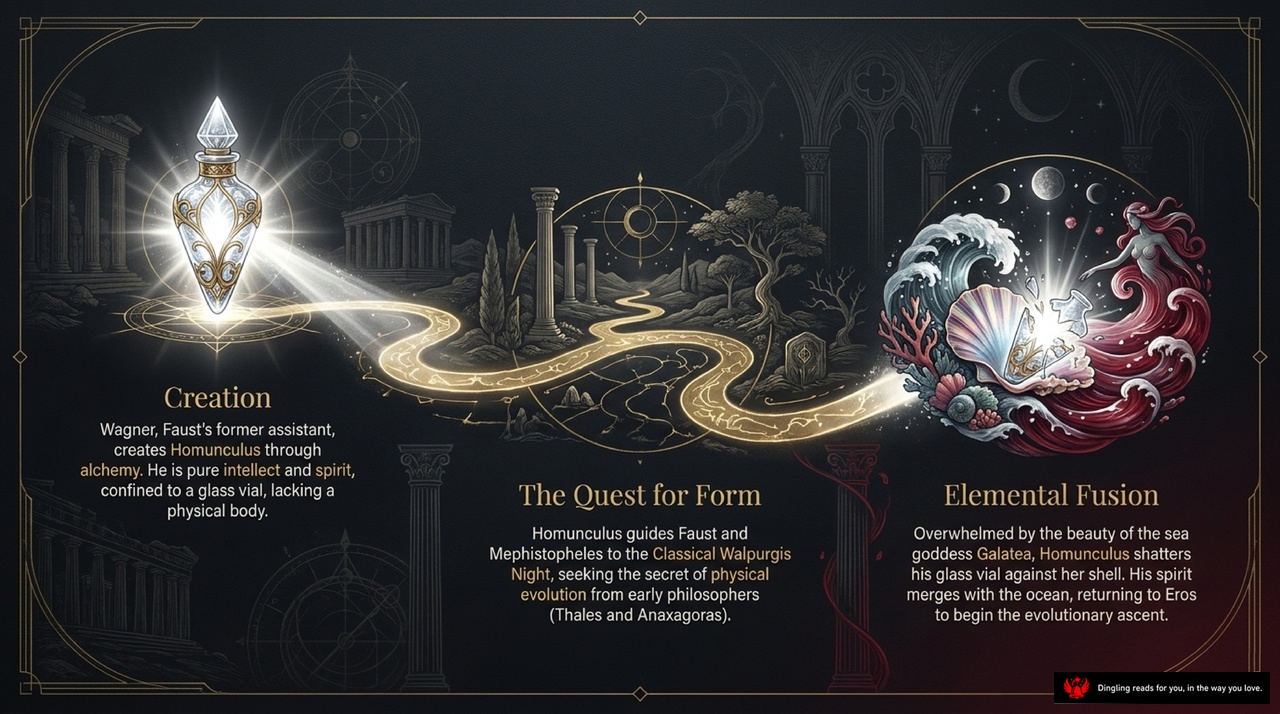
Creation, the quest for form, and elemental fusion—this slide maps the Homunculus's dramatic journey from a spark of pure intellect to a divine soul. Let's dive in.
It all begins with **Creation**. Wagner, Faust's former assistant, uses alchemy to create the Homunculus. As the image shows, this being is nothing but pure intellect and spirit, confined within a glowing glass vial, completely lacking a physical body. He is a brilliant mind trapped in a bottle, searching for something more.
But a spirit without a form is incomplete. This leads us to **The Quest for Form**. Guided by the Homunculus, Faust and Mephistopheles travel to the Classical Walpurgis Night. Their goal is profound: they seek the secret of physical evolution, trying to unlock the wisdom of early philosophers like Thales and Anaxagoras. They are looking for the bridge between their ethereal nature and the tangible world.
Finally, we reach **Elemental Fusion**. Overwhelmed by the breathtaking beauty of the sea goddess Galatea, the Homunculus makes a fateful choice. He shatters his glass vial against her shell. In that moment of destruction, his spirit merges with the ocean. He is no longer just a creature of thought; he returns to Eros, beginning a true evolutionary ascent into the physical realm. This is the moment a spirit finally becomes alive.

In the final act of Faust, we witness the ultimate irony of his journey: the very traps meant to destroy him become the catalyst for his ascent. As the PPT illustrates, Mephistopheles seeks to ruin Faust through stagnation, sensual traps, and moral decay, but every attempt fails to satisfy Faust. Instead, the resulting despair and destruction propel him upward into new, higher realms of action, thought, and striving.
This dynamic is captured in the central paradox: "Part of that power which would always work evil, but always engenders good." It's a brutal truth—Faust's relentless drive, even when corrupted by ambition or error, keeps him moving forward. Without the friction of evil, human progress would simply stall. The Devil becomes an unwitting instrument of Divine creation; his sabotage inadvertently fuels Faust's growth.
The result is clear: every trap fails to satisfy Faust. Instead, the resulting despair and destruction propel Faust upward into new, higher realms of action, thought, and striving. His soul isn't lost in the mud of sin; it's forged in the fire of relentless striving. Even in his darkest moments, like the tragedy of Gretchen or the hubris of the classical world, he never truly stops. That refusal to settle is what ultimately saves him. As the text reminds us, "Everything that vibrates with life must be saved." Faust's story teaches us that it's not about perfection, but about the courage to keep trying, even when the path is paved with mistakes.

The image before us captures the ultimate climax of Faust's journey—a moment where his entire life converges into a single, defining instant. We see the grand engineering project: dikes and canals pushing back the chaotic ocean to create new, arable land. This is the physical manifestation of his final philosophy. After a lifetime of seeking magic, knowledge, and romantic love, Faust realizes that true purpose lies in engineering a space where millions can live freely through daily toil. He is no longer blinded by the spirit of "Care," yet his inner vision has never been clearer.
But as the construction reaches its peak, a profound revelation strikes him. He realizes that freedom and life are not static possessions to be held, but dynamic gifts that must be taken every day by storm. The highest achievement, he understands, is not personal glory, but collective, endless social progress. It is in this moment of absolute fulfillment that the tragic irony of his quest unfolds. Having spent centuries striving, he finally finds the peace he sought, only to realize that the moment of satisfaction is also the moment of defeat. His cry, "Stop! How beautiful!" marks the end of his striving and the beginning of his redemption, proving that even in the darkest moments of human ambition, the pursuit of a better world can lead to eternal salvation.
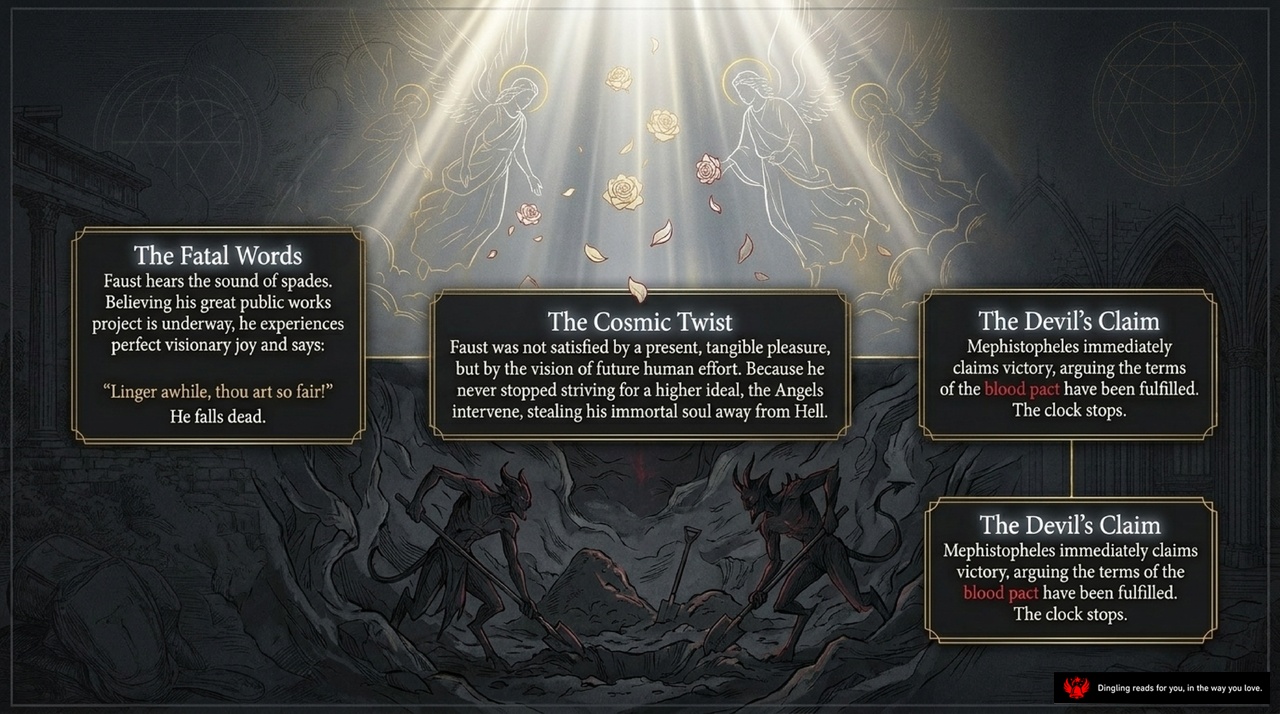
In this final, breathtaking scene, we see the ultimate conclusion of Faust's journey. The image captures a moment of divine intervention, where radiant light descends upon a chaotic underworld, signaling the end of Faust's struggle.
On the left, we see the "Fatal Words." Faust, hearing the sound of shovels digging in the earth, believes his great project of reclaiming land for humanity is finally underway. Overwhelmed by a vision of perfect joy and future prosperity, he succumbs to a fatal moment of satisfaction. He whispers the famous line, "Linger awhile, thou art so fair!" and falls dead.
This leads to the central event: "The Cosmic Twist." The text explains that Faust was never truly satisfied with mere present pleasure; his true nature was defined by his relentless striving for a higher ideal. Because he never stopped trying, even for a fleeting second, the Angels intervene. They steal his immortal soul away from Hell, saving him from Mephistopheles.
Meanwhile, at the bottom of the image, we see the grim reality of the underworld. Mephistopheles and his demonic minions are frantically digging with shovels, trying to bury Faust's body. This is "The Devil's Claim." Mephistopheles argues that the terms of the blood pact have been fulfilled, claiming victory as the clock stops. He believes he has won the bet.
But as the angels scatter rose petals and claim the soul, the devil's victory is revealed to be an illusion. The story reminds us that eternal striving is the only path to redemption.

Look at this pyramid. It's not just a diagram; it's the entire moral engine of *Faust*. We see three distinct forces pulling humanity in different directions. At the base, we have "Relentless Striving." This is pure human action. As the text reminds us, "Whoever strives unceasingly, him we can redeem." It acknowledges that error and sin are inevitable, but it argues that an active, restless pursuit of the ideal is the only thing that prevents spiritual death. Without this effort, we stagnate.
But human effort alone isn't enough. That's why we move up the pyramid to "Grace," or Divine Intervention. The slide explains clearly that salvation requires an intervention from a higher power, specifically initiated here by the forgiveness of Gretchen. This is the moment where human failure meets divine mercy, turning a tragedy into a redemption.
Finally, at the very peak, shining brighter than anything below, is "The Eternal Feminine." This is the Cosmic Force—the pure, creative, and nurturing power of love. It is the ultimate draw that lifts humanity upward, ultimately defeating the masculine, destructive spirit of negation represented by Mephistopheles. So, the lesson here is clear: we must strive relentlessly, we must accept grace when we fail, and ultimately, it is this eternal, loving force that guides us all the way to the stars.

Have you ever felt that moment when everything you've built suddenly feels hollow? That's exactly where Faust finds himself. After years of relentless effort, he finally shouts, "Stop! You are so beautiful!"—only to realize the moment has already passed.
But here is the twist: Faust isn't condemned for this moment of stillness. Instead, he is saved. Why? Because his salvation wasn't earned through a life of perfect purity or the absence of error. It was guaranteed by his relentless, unyielding striving toward a higher purpose.
Goethe's *Faust* teaches us that human error is inevitable, but salvation is guaranteed not through flawless purity, but through relentless, unyielding striving toward a higher purpose. If absolute satisfaction is the death of the soul, what are you endlessly striving for today?