
First Person Singular: Complete Chapter-by-Chapter Summary

Welcome to our first stop on this literary journey. Today, we are spinning the turntable of an aging mind to explore Haruki Murakami's *First Person Singular*. Imagine eight fragments of memory swirling together, composing a singular reflection on youth, music, and the masks we wear to survive. This book isn't just a collection of stories; it's a deep dive into the interior world of a narrator who is learning to navigate the complexities of his own life. From a fleeting encounter with a mysterious woman in a cheap Italian restaurant to a dream where the legendary jazz musician Charlie "Bird" Parker plays a fictional album, these fragments reveal how the past constantly reshapes our present. It's a meditation on how we remember, how we lose ourselves, and how we find meaning in the quiet, often invisible moments that define us.
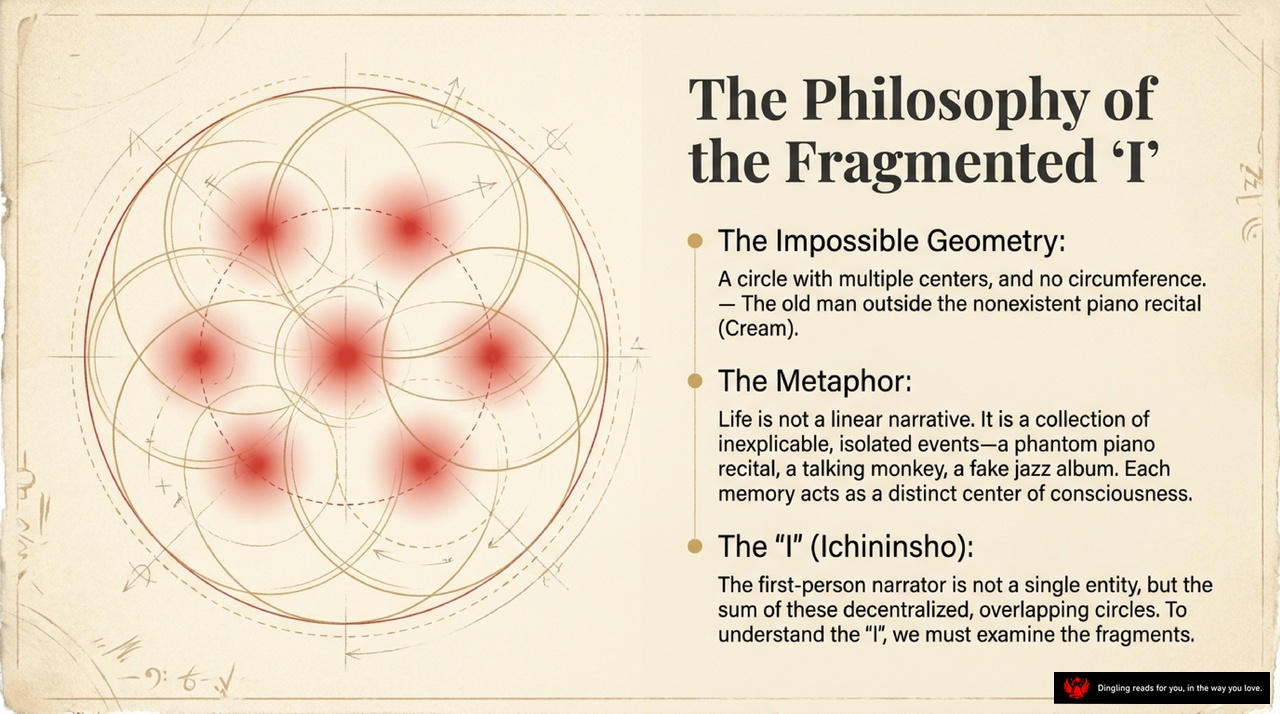
Imagine a circle that defies all the rules of geometry. Not just one center, but many. No clear edge, no defined boundary. It's a shape that exists only in the mind, a concept that feels impossible yet somehow essential. This is the "Impossible Geometry" that haunts the narrator in *After Dark*. He remembers an old man sitting in a quiet park, watching him with a strange intensity. The man speaks of circles with multiple centers, even circles without a circumference. He calls it "crème," the essence of life, something you can't find in a textbook.
This metaphor reshapes how we see the human experience. Life isn't a straight line with a clear beginning and end. It's not a linear narrative we can easily follow. Instead, it's a collection of isolated, inexplicable moments—a phantom piano recital that never happened, a talking monkey in a lonely hot spring, a fake jazz album that no one ever bought. Each of these fragments acts as its own center of consciousness, overlapping and intersecting like those impossible circles.
So, what is the "I"? In this philosophy, the self isn't a single, solid entity. The narrator isn't just one person. He is the sum of these decentralized, overlapping circles. He is the old man, the boy at the piano, the man who never met the woman, and the stranger who walked out of a bar. To truly understand the "I," we have to stop looking for a single answer and start examining the fragments. Because in the end, we are all just a collection of memories, floating in that vast, undefined space, trying to make sense of a life that was never meant to be simple.

Picture: The Yakult Swallows Poetry Collection, Catalyst: A perpetually losing baseball team, Motif: The beauty of defeat, Aftermath: Acceptance of loss.
Script:
Look at this drawer: "The Yakult Swallows Poetry Collection." What is the catalyst here? It's not a grand event, but a perpetually losing baseball team. For eighteen years, from 1968 to 1977, I watched the Swallows fail over and over again. While the rival Giants were dominating, I was out there alone, lying on the grass drinking beer, telling myself that losing is just part of life. It was only in 1978, when the team finally won the championship, that I published my first novel. But the real poetry came from those years of defeat. I wrote poems during the breaks, realizing that true wisdom isn't about winning, but about how beautifully you can lose. This collection, published in 1982, became a rare collector's item. The motif here is the beauty of defeat. We often fear failure, but I found that accepting loss allows us to find a strange, quiet joy. The aftermath is a profound acceptance of loss. By embracing the pain of a losing team, I learned to embrace the fragility of my own life, turning the ashes of defeat into something precious and enduring.

In this chapter, we dive into the surreal world of a fake album that somehow becomes real. The narrator, a young university student, writes a satirical music review about a jazz legend, Charlie Parker, playing a Bossa Nova album in 1963—a decade after the musician's death and long before the genre even took off. It's a harmless prank, a piece of fiction meant to be a joke. But the editor, trusting his friend's recommendation, publishes it as fact. The story spreads, and soon, people are actually searching for this impossible record.
Fifteen years later, the narrator finds himself in New York, walking through a vintage record shop on East 14th Street. There, on the shelf, sits the very album he invented: *Charlie Parker Plays Bossa Nova*. It's a bootleg, white cover, black text, and the tracklist matches his original fabrication perfectly. He tries to leave, convinced it's a prank gone wrong, but he can't shake the feeling. He returns the next day, only to be told by the shop owner that the record has never existed. Yet, the narrator knows better.
The climax of this story happens in a dream. Charlie Parker appears, not as a ghost, but as a living, breathing musician. He plays *Corcovado* on a saxophone that's clearly broken—rusty, taped together with a spoon and duct tape. And yet, the music is pure, transcendent, and heartbreaking. Parker tells the narrator that death is both sudden and slow, and that he is grateful for the chance to play this new style of music one last time. In that moment, the line between illusion and reality blurs completely. Art, whether it's a fake review or a dream, acts as a bridge, allowing us to resurrect the dead and give them a second life.

Look at this slide titled "The Absurdity of the Literal." It contrasts two very different stories from the book. On the left, we have "Cream," based on the narrator's strange encounter at eighteen. He arrives at a locked concert hall, only to find a mysterious old man in a pavilion. The man speaks of "circles with multiple centers"—a concept no school teaches, calling it the "cream of the cream," the true essence of life that requires effort to find. It's a metaphor for those unexplainable voids we must endure to forge our souls.
On the right, we see "Confessions of a Shinagawa Monkey." This is a surreal tale where a talking monkey, wearing an "I♥NY" shirt, confesses to an impossible lust for human women. To cope, he magically steals fragments of their names. The absurdity here perfectly encapsulates the isolating burden of unrequited love. While one story finds meaning in a philosophical circle, the other finds it in the theft of identity. Both illustrate how life's most profound truths often hide in the most literal, yet utterly absurd, moments.
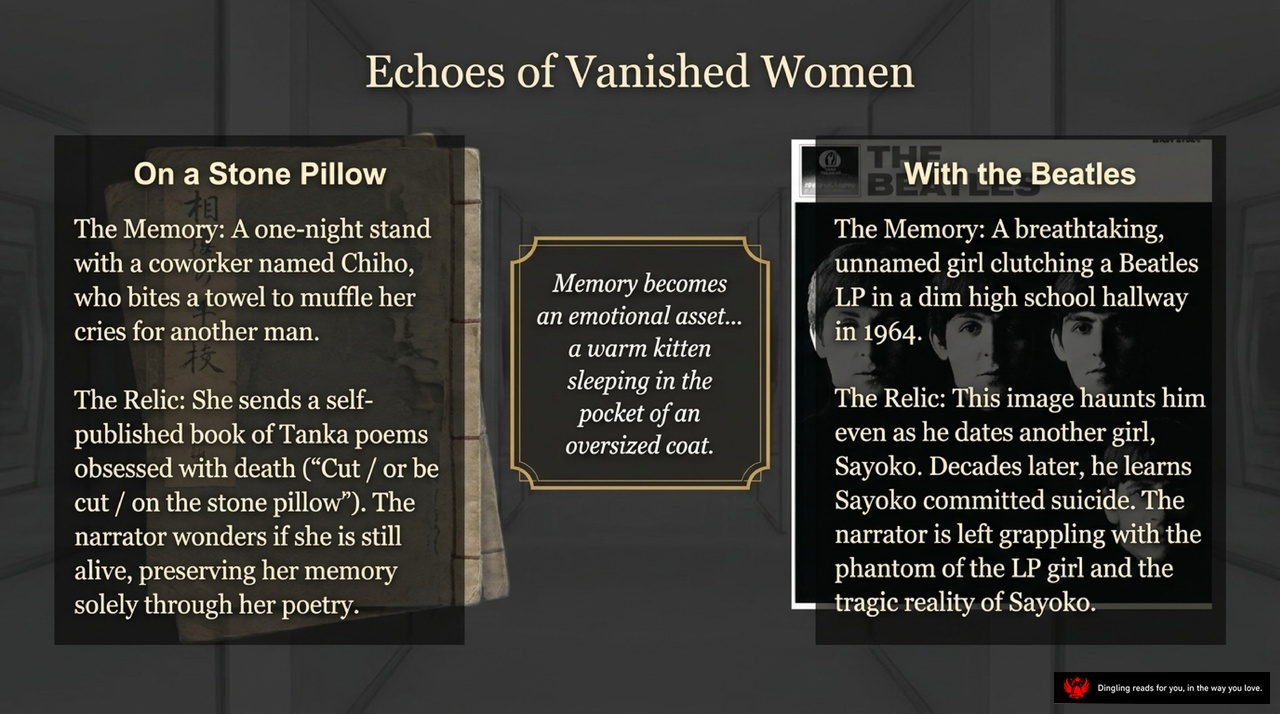
In the realm of human connection, there exists a paradox where the most striking feature can become the greatest source of attraction. Today, we explore the story of a woman the narrator calls "F"—a woman defined not by conventional beauty, but by a raw, unapologetic ugliness that somehow radiates a unique vitality.
The text describes F as having a face that is "ugly" in the most direct sense, a trait that sets her apart from the many beautiful women the narrator knows. While others might be consumed by anxiety over minor flaws, F embraces her appearance with a rare confidence. This stark contrast between her unattractive features and her brilliant, witty conversation creates a magnetic tension. It is this very dissonance—the gap between how she looks and how she speaks—that makes her so compelling.
Their bond is forged over a shared love for music, specifically Schumann's "Carnaval." They discover that this complex piece resonates with them on a deep level, discussing how Schumann himself lived between masks and reality. F reveals a profound insight: everyone wears a mask, and underneath that mask, whether it hides an angel or a demon, there is always a simple, honest face waiting to be seen. This philosophical depth, combined with her ability to navigate the world with such ease, suggests that her perceived "ugliness" is actually a form of authentic freedom, unburdened by the need to please others.
However, the narrative takes a dark turn when F is revealed to be involved in a massive investment fraud scheme alongside her handsome, model-like husband. This revelation challenges the narrator's initial admiration, forcing a confrontation between the charm of her intellect and the reality of her actions. Yet, even in the face of this tragedy, the narrator's memory remains fixated on her unique presence. She becomes a ghost in his life, a figure he continues to search for at music halls, hoping she might reappear. Her story serves as a haunting reminder that human value cannot be measured by a single standard of beauty, but is instead found in the complex, often contradictory layers of our souls.

Have you ever felt like a stranger in your own life? That exact moment of alienation is at the heart of the story we're exploring today, titled "Rituals of the Aging Self."
On the left, we see a scene from "The Yakult Swallows Poetry Collection." Here, the narrator has created a personal ritual: sitting alone in the outfield of Jingu Stadium, drinking dark beer, and watching his favorite team lose, year after year. At first glance, it looks like a pathetic act of defeat. But the deeper meaning is profound. Writing poems about the outfielders' backs becomes a meditation on failure. He realizes that true wisdom isn't about learning how to win, but learning how to lose beautifully. This ritual provides comfort, a safe space where he can accept the inevitable passage of time and the quiet acceptance of defeat.
On the right, we shift to a story told in the "First Person Singular." The narrator, who usually avoids suits, decides to dress up in a Paul Smith suit and a Zegna tie just to sit alone in a bar reading a book. This is his own version of a ritual—an attempt to impose order and sophistication on his aging self. However, this ritual is violently disrupted. An unknown woman viciously attacks him verbally, accusing him of being out of place. In that moment of panic, he flees. As he runs away, he has a terrifying realization: the suit he wore has transformed him into an alienated stranger. He is no longer himself; he is just a costume, a prop in a play he didn't agree to.
These two stories highlight a central truth about growing old. As the "I" ages, routine brings a necessary comfort. It gives us a sense of control. But when we step out of that routine, when we try on a new identity or face an unexpected disruption, it reveals terrifying, hidden dimensions of our existence. We are forced to confront who we are without the scripts we've written for ourselves. It is a painful but necessary journey of discovering the self beneath the rituals.

Have you ever felt like your life is just a series of boring, predictable milestones? We spend so much time trying to make sense of the world, only to realize that the most profound moments often come from the illogical. Think about it: a piano recital that doesn't exist, a monkey speaking fluent Japanese, or a fake jazz record materializing in New York. These aren't just random fantasies; they are the raw, illogical inputs that our brains are designed to process.
When we face these impossible things, our brain activates a filter—The "I." This isn't just about thinking; it's a survival mechanism. It's made to help us understand things we can't actually understand. It forces us to find meaning in the chaos. And out of this struggle, out of trying to make sense of the absurd, something magical happens.
We distill these inexplicable, illogical moments into what I call "The Golden Drops." These are the cream of life, the absolute, pure essence of a lived experience. While the mundane, predictable parts of our days are just boring, unavoidable filler, it is these strange, unexplainable encounters that become the crème de la crème. They are the only things that truly matter, the only moments that shake us to our core and leave a lasting mark on our souls.
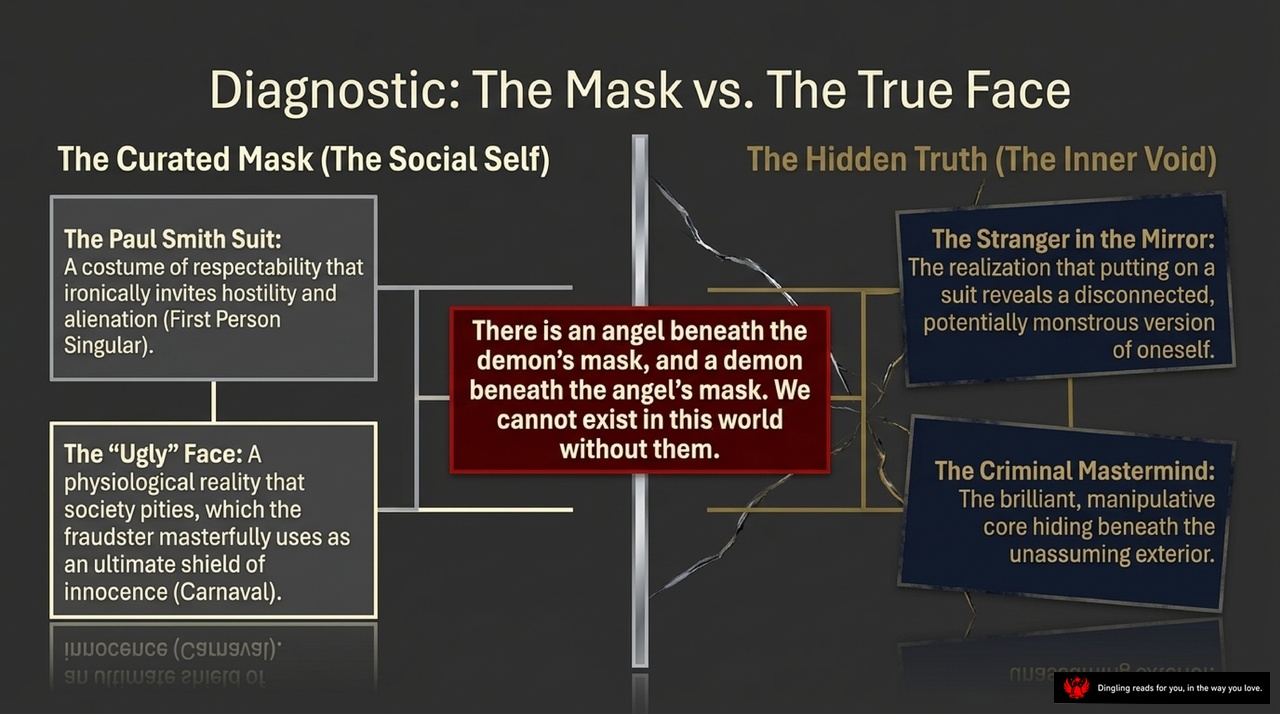
Imagine a world where we are constantly performing, wearing invisible masks to fit into society. On the left side of our lives, we don the "Curated Mask"—the social self. Think of it as the Paul Smith suit: a costume of respectability that ironically invites hostility and alienation. We also hide behind the "Ugly" Face, a physiological reality society pities, which we use as a shield of innocence. But on the right side lies the "Hidden Truth," the inner void we fear. Here, we become strangers in the mirror, disconnected and potentially monstrous versions of ourselves. Or, we reveal the criminal mastermind hiding beneath our unassuming exteriors. The core truth is this: there is an angel beneath the demon's mask, and a demon beneath the angel's mask. We cannot exist without both. This diagnostic reveals that our true face is not one thing, but a complex duality of the mask we wear and the void we hide.

Have you ever wondered who you really are when you take off all your masks? The "I" we think we are isn't a fixed point; it's a shifting constellation of lost women, imaginary jazz, talking monkeys, and beautiful defeats. Over time, our illogical memories and the suits we wear fuse together to form the very essence of our existence. But what happens when you strip away the suits, the music you claim to love, and the carefully curated memories? Who is the stranger left staring back at you from the mirror? That stranger is the true sum of everything we've been, everything we've loved, and everything we've lost.