
Floating Wood: Complete Chapter-by-Chapter Summary
Welcome to "Driftwood" by Yang Benfen. Imagine a single, fragile dewdrop resting on weathered, dark wood. That tiny drop captures the vast, turbulent history of ordinary lives in 20th-century China. It's a story of immense resilience, where the most precious things—like a mother's love, a brother's sacrifice, and the simple act of surviving—are reflected in the ripples of that dewdrop. This book isn't just about the past; it's about how the human spirit endures against all odds.

When you honestly present an ordinary life, it radiates the power to inspire others. This isn't just a quote; it's the very heartbeat of Yang Benfen's journey. Imagine this scene: an elderly woman, Yang Benfen herself, sitting in her kitchen at the age of 80. She's not writing a grand epic; she's drafting her memories right between cooking and doing chores. This is the essence of "Writing Against Forgetting."
Yang Benfen's mission was deeply personal yet universally resonant. She wanted to rescue her family's missing history from total oblivion. Her story is a sequel to her acclaimed debut, but it stands on its own as a testament to the power of ordinary people's stories. These aren't just random anecdotes; they are the threads that weave together the fabric of our lives.
Consider her advocate, her daughter Zhang Hong. Zhang recognized something profound: that the stories of ordinary people are rarely recorded, yet they hold a universal resonance that can touch anyone. Yang Benfen's life, filled with the joys and sorrows of a typical family—raising children, dealing with loss, navigating the hardships of war and political turmoil—becomes a mirror for us all. It reminds us that our daily struggles and triumphs matter.
In her book, Yang Benfen shares intimate details of her life, from the birth of her youngest brother Yang Rui to the tragic loss of her son Tian Si. These stories are not just about her family; they are about the resilience of the human spirit. They show us how love persists even in the face of immense adversity, and how the act of remembering can be a powerful form of resistance against the forces of forgetting.
So, when we read Yang Benfen's words, we are not just reading about someone else's life; we are seeing our own lives reflected back at us. We are reminded that our stories, no matter how ordinary they may seem, have the power to inspire and connect us all. This is the true power of writing against forgetting.
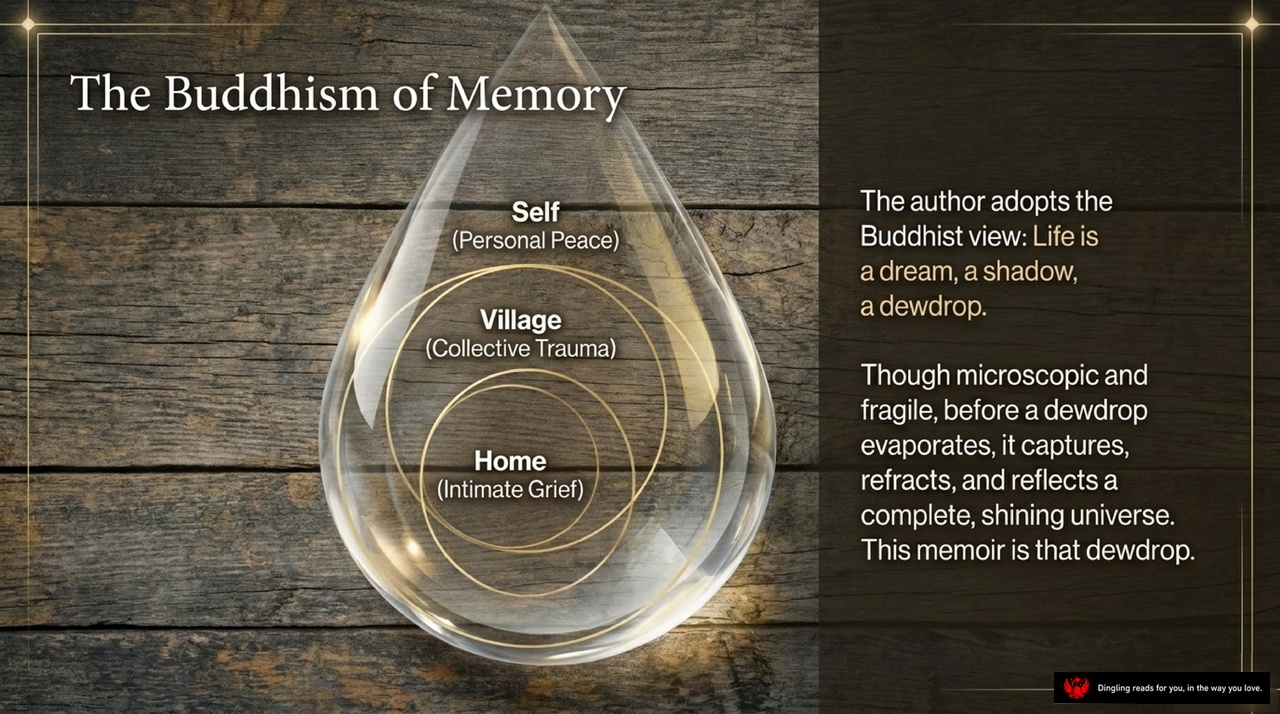
The author adopts the Buddhist view: Life is a dream, a shadow, a dewdrop. Though microscopic and fragile, before a dewdrop evaporates, it captures, refracts, and reflects a complete, shining universe. This memoir is that dewdrop.
Look at this image. It shows the layers of memory: Self, Village, and Home. The author sees her life through the lens of Buddhism, understanding that personal peace, collective trauma, and intimate grief are all part of the same whole. Just like a dewdrop, her life story, though small, holds the entire universe within it.
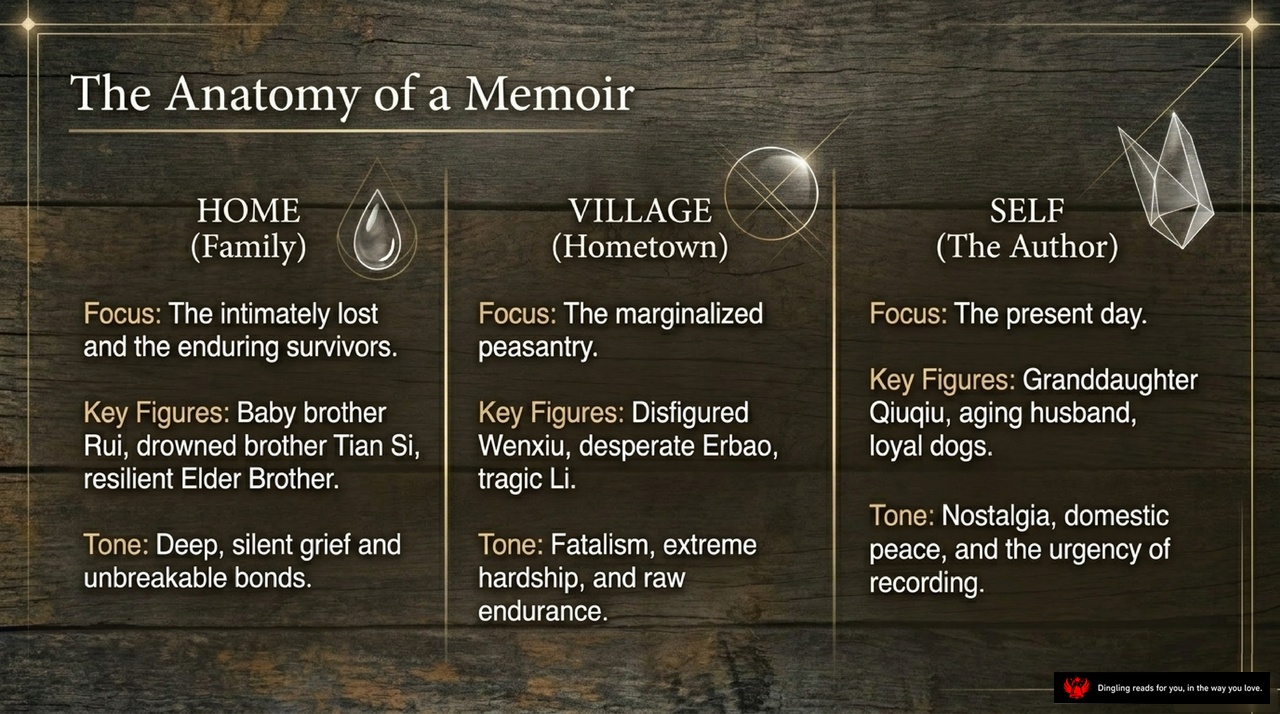
Today's slide breaks down the "Anatomy of a Memoir" into three essential pillars: Home, Village, and Self. Think of these not just as settings, but as the emotional DNA of the story.
First, look at **Home**, or Family. This is where the memoir finds its deepest, most intimate grief. The focus here is on the survivors and the bonds that hold them together even when everything falls apart. In my story, this is represented by my baby brother Rui, who died so young, and my resilient elder brother. The tone here is one of silent, unbreakable love—a quiet endurance against loss.
Moving to the **Village**, which represents the Hometown. This is the backdrop of the marginalized, the harsh reality of peasant life where survival was a daily battle. Key figures here include the tragic Li, the desperate Erbao, and my brother Tian Si, who drowned in a river he never knew how to swim in. The tone shifts to fatalism and raw hardship, capturing the extreme endurance required just to keep breathing.
Finally, we have the **Self**, or The Author. This section anchors the narrative in the present day, bridging the past with the now. The key figures here are my granddaughter Qiuqiu, my aging husband, and even our loyal dogs. The tone is a mix of nostalgia for the domestic peace we once knew and a burning urgency to record these stories before they fade. It's about how the past shapes who we are today.

In the 1950s, life was a daily tightrope where poverty meant the constant struggle for survival. The author writes to reunite her fractured family through the power of literature, restoring missing pieces of a broken past. Look at the two tragic stories on this slide: Yang Rui, just 13 months old, died of pneumonia in his sister's arms. The era was so starved and desperate that the family was too emotionally numb to even produce tears. Then there is Tian Si, 15 years old, who drowned unexpectedly in Hubei. He left behind a diary filled with classical poetry, revealing a complex, melancholic soul lost to early tragedy. These stories highlight how hardship shaped their lives, leaving scars that time could not fully heal.
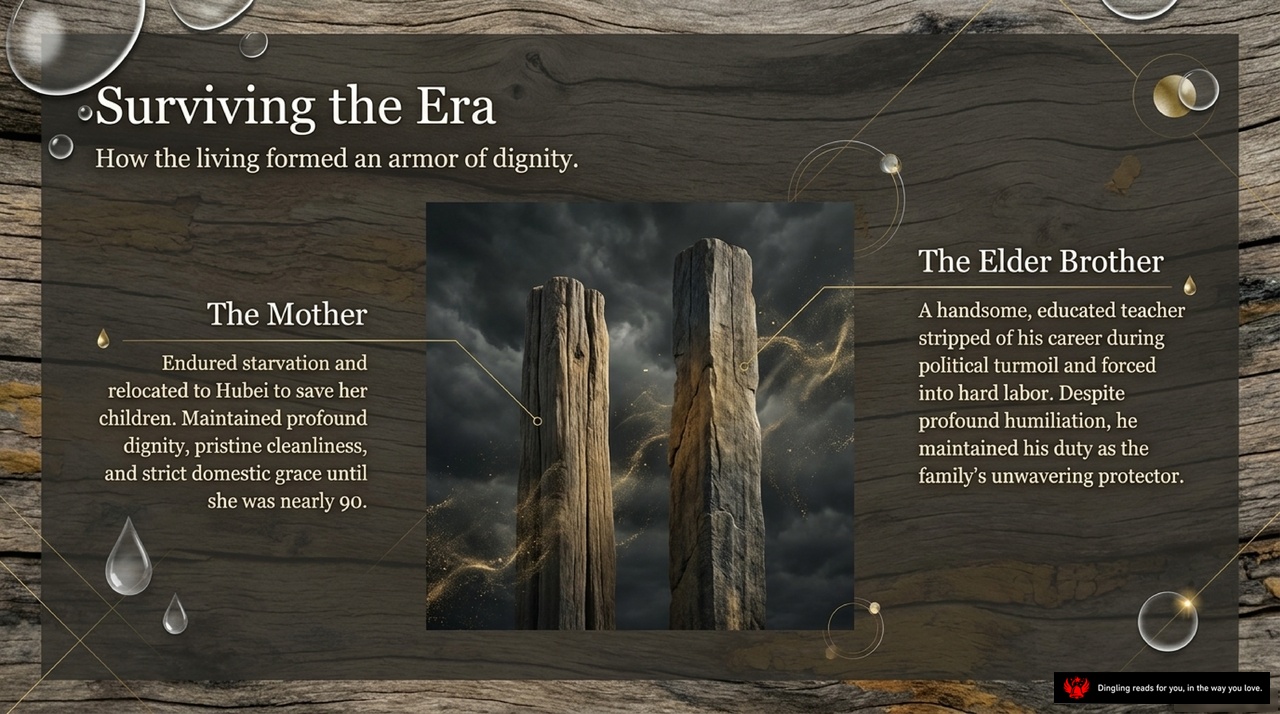
Surviving the Era: How the Living Formed an Armor of Dignity.
Look at these two pillars standing against the storm. They represent the unyielding spirit of my mother and my elder brother, who built an armor of dignity to survive a chaotic era.
My mother, despite enduring starvation and being forced to relocate to Hubei to save her children, never lost her grace. Even in those darkest days, she maintained pristine cleanliness and strict domestic order until she was nearly 90. Her dignity wasn't a choice; it was her shield.
Then there is my elder brother. Once a handsome, educated teacher, he was stripped of his career and forced into hard labor during the political turmoil. Despite profound humiliation, he never broke. He kept his duty as the family's unwavering protector, standing firm like those weathered pillars.
They didn't just survive; they defined what it meant to live with honor.
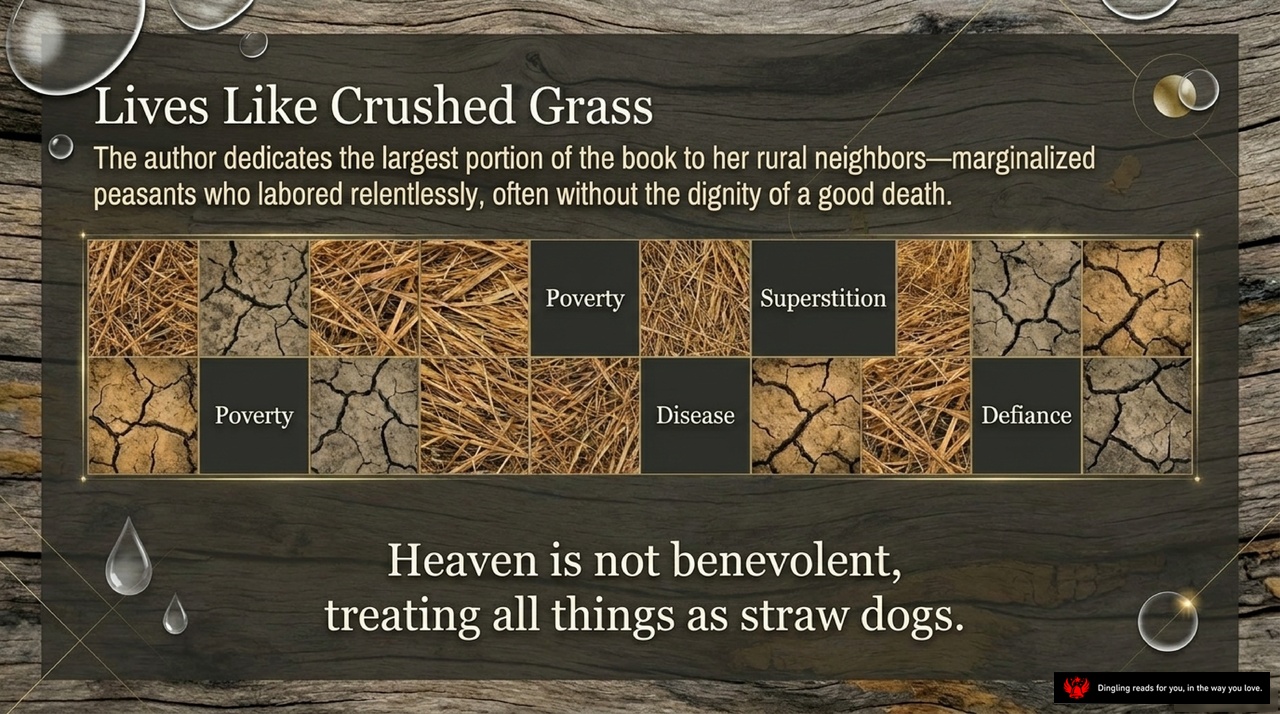
Look at this slide. The title "Lives Like Crushed Grass" perfectly captures the harsh reality of the rural life my mother and her neighbors endured. The image shows cracked, dry earth mixed with straw, symbolizing the relentless struggle for survival. The words "Poverty," "Superstition," "Disease," and "Defiance" aren't just labels; they were the daily battles my family fought.
My mother dedicated the largest part of her life to these marginalized peasants who labored endlessly, often without the dignity of a good death. I saw this firsthand. When my youngest brother, Yang Rui, was born, our mother's face was pale with exhaustion. She whispered, "My son, you've come at the wrong time." Later, my four-year-old brother Tian Si fell ill with a high fever. My mother tried every folk remedy, even burning honeycomb with ginger, but nothing worked. In the dead of night, I ran to a distant doctor, battling fear of ghosts and thunderstorms, just to save him. He survived, but fate was cruel. Years later, Tian Si drowned in a river. His diary was filled with contradictory poems—both despair and ambition—leaving us to wonder about his inner world.
Then there was my brother. In the Cultural Revolution, he was falsely accused of distorting the leader's image and stripped of his teaching job. He even considered suicide when the news of Tian Si's death hit him, but he held on. He later forced my third brother, who had forgotten everything after farming for years, to take the college entrance exam. That decision changed our lives forever.
The slide also says, "Heaven is not benevolent, treating all things as straw dogs." This line hits hard. It reflects the feeling that the universe was indifferent to our suffering. We were treated like "straw dogs"—discarded and trampled. Yet, despite the crushing weight of poverty, superstition, and disease, my family found a way to defy fate. My brother rebuilt his life, and I eventually left to study in the city. We survived not because heaven cared, but because we refused to give up. Our lives were like crushed grass, trampled down, yet we still managed to grow back.

The Mechanics of Rural Survival isn't just a title; it's a stark reality for four women whose lives were shattered by the weight of tragedy. Look at Wenxiu: a beautiful young mother whose life was abruptly cut short by a fall, leaving her with a disfiguring scar and a deep, unhealing trauma. Instead of fighting back, she chose silence, channeling her pain into relentless labor and even blocking her own daughter's future to protect her from suffering. Then there is Erbao, a woman desperate for a child in a barren marriage. Her response? Desperation turned into superstition, leading her to steal a statue from a temple—a act of faith that ultimately couldn't save her from terminal cancer. Old Li represents the crushing weight of poverty and shame; forced to share her bed with her adult son for warmth, she found no dignity left, choosing suicide as the only escape from societal humiliation. Finally, Dingkun, an elder paralyzed by the guilt of losing two grandsons to an accidental drowning, simply vanished into thin air, unable to bear the unbearable weight of her unresolved grief. These aren't just stories; they are the raw, unfiltered mechanics of survival when the world offers nothing but despair.
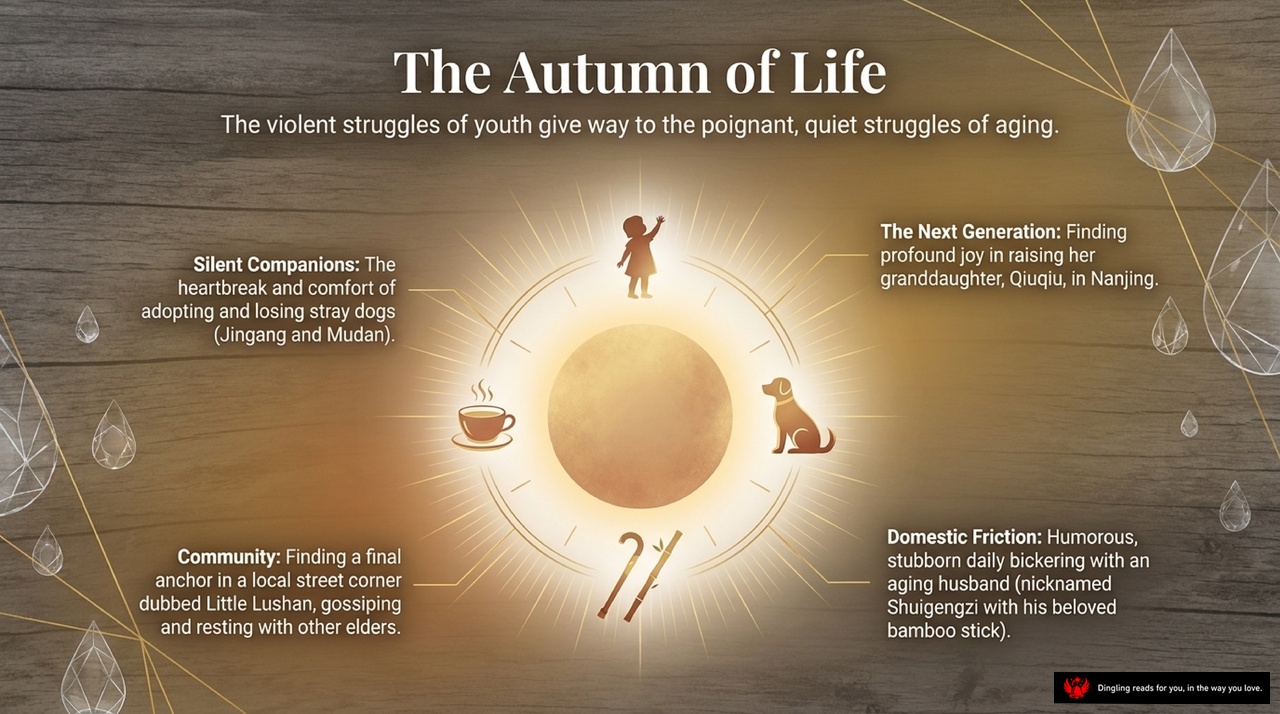
The violent struggles of our youth eventually give way to the poignant, quiet struggles of aging. As we step into this "Autumn of Life," we find our battles have changed. The frantic fighting for survival is replaced by a different kind of resilience.
On the left, we see our "Silent Companions." For many of us, the heartbreak of loss is often followed by the unexpected comfort of new life. Whether it was adopting stray dogs like Jingang and Mudan, or simply finding solace in their presence, these animals became anchors when the world felt too heavy.
Moving to the bottom left, we find our "Community." In our later years, we often discover our final anchor isn't in a grand place, but in a local street corner. It's a spot like "Little Lushan," where we gather with fellow elders, share gossip, and rest together. This simple connection reminds us we are never truly alone.
On the right side, we see two contrasting yet equally profound joys. First, "Domestic Friction." Aging doesn't mean the end of humor; it often means the start of a new chapter of stubborn, loving bickering with a spouse. Whether it's arguing over daily routines or sharing a laugh about a beloved bamboo stick, these moments are the heartbeat of a shared life.
Finally, at the top right, we look to "The Next Generation." There is a profound, quiet joy in raising a granddaughter like Qiuqiu. Watching her grow in a place like Nanjing brings a happiness that heals the past.
So, as we embrace this season of life, let us remember that aging is not just about decline. It is about finding silent companions, leaning on our community, laughing through domestic friction, and finding deep joy in nurturing the next generation.

In this pivotal moment, the narrative shifts from mere survival to a profound act of resistance. The slide highlights "Writing as Resistance," capturing the daughter's realization from the postscript: writing is not a privilege for the famous or wealthy, but a lifeline for the nameless. Throughout the story, we saw how ordinary history—the suffering of the unnamed, the tragic loss of children like Yang Rui and Tian Si, the quiet struggles of the mother and brother—is rarely recorded. Without the act of writing, these lives would be buried by time and oblivion.
But by putting pen to paper, the author reclaims human agency. Writing in old age becomes an act of self-salvation. It transforms the author's own memories into a complex universe of love and grief, ensuring that these "straw dogs" of history are remembered as real, breathing souls. The text on the screen reminds us that through the simple act of writing, the author ensures that these forgotten stories are not lost to the wind, but preserved as a testament to their enduring humanity.

Driftwood proves that the lowest, most invisible lives are not merely dust in the wind, but complete universes of love, grief, and immense resilience that deserve a permanent place in human history. If every ordinary life is a disappearing universe, who will be left to record the history of your family when the last dewdrop fades?
Think about the stories of the neighbors we met along the way. There was Wenxiu, a beautiful woman whose life was shattered by a falling tree, leaving a scar that no amount of kindness could fully hide. Her husband, Songlin, stood by her through the pain, refusing to let her die, even when she wanted to. He taught her that life was not something to be run away from, but a journey to be walked, however difficult. Their daughter, He Meili, grew up carrying her mother's silence, only to find her own love with a young man named Chunsheng. But fate had other plans; her mother's hatred, born from her own suffering, tried to destroy Meili's happiness, forcing her into a marriage she didn't want.
Then there was the story of the twins, Da Mao and Er Mao. Their grandfather, Dingkun, was a kind man who had lost a leg in a landslide. He loved his grandchildren more than anything, taking them to the fields to pull weeds under the hot sun. But one afternoon, in a moment of carelessness, he left the door unlocked. The children ran off to play, and tragedy struck. They fell into the pond, and despite the frantic efforts of the neighbors, it was too late. A kind mother-in-law, Qingmei, blamed her father-in-law, but deep down, everyone knew that life's tragedies often happen not because of malice, but because of a single, unguarded moment.
These stories remind us that no life is too small to matter. Whether it is a mother fighting for her child's survival, a father protecting his family from the storms of politics, or a neighbor helping another find a place to sit and rest, every action ripples through time. We are all driftwood, carried by the currents of fate, yet we have the power to hold onto each other. When the last dewdrop fades, may these memories of love, loss, and resilience remain, ensuring that the history of our families—and indeed, our humanity—is never forgotten.