
Forrest Gump: Complete Chapter-by-Chapter Summary
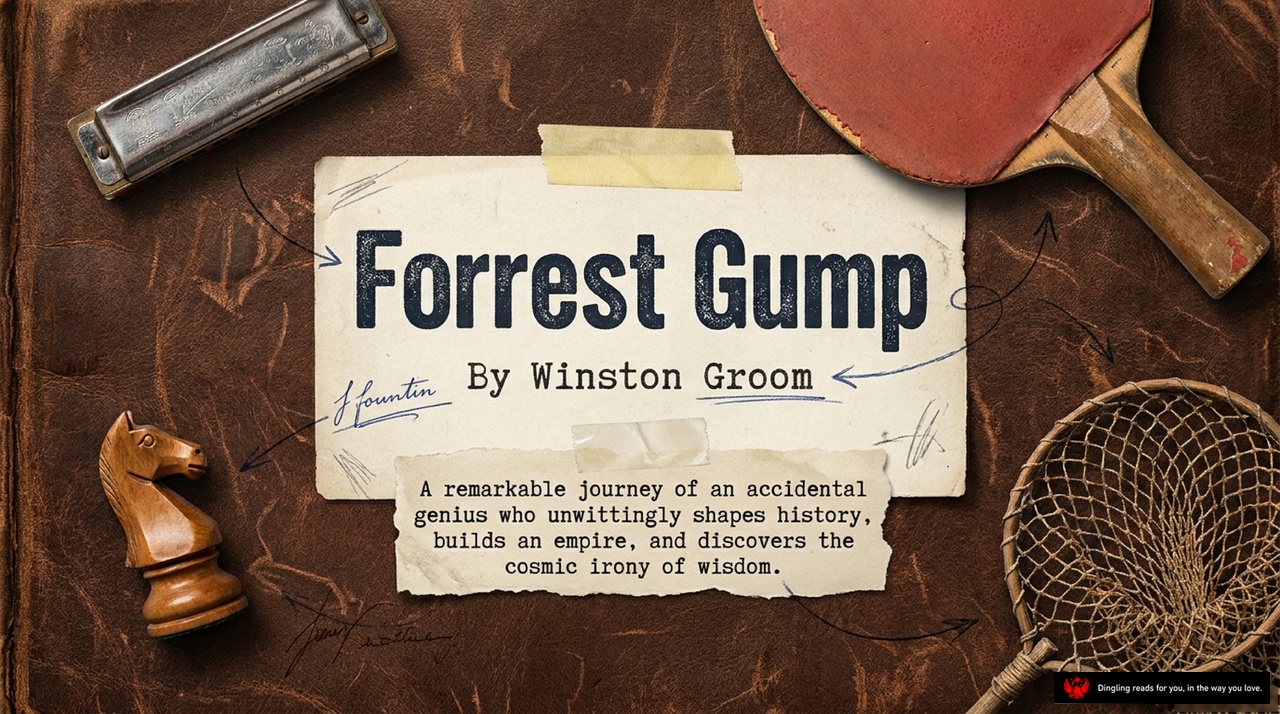
Welcome to a special edition of our book club, where we dive into stories that change how we see the world. Today, we're opening the cover of *Forrest Gump* by Winston Groom.
This isn't just a story about a man named Forrest; it's a remarkable journey of an accidental genius who unknowingly shapes history, builds an empire, and discovers the cosmic irony of wisdom.
Surrounded by symbols of his life—the harmonica, the ping-pong paddle, the chess piece, and the fishing net—this book captures the essence of a man who was told he was a fool, yet ended up changing the course of nations. From running across the country to becoming a shrimp tycoon, Forrest's life is a testament to the idea that sometimes, the most profound wisdom comes from the simplest hearts.
Get ready to laugh, cry, and rethink everything you know about intelligence and success. Let's turn the page and meet Forrest.

Look at this split between what society sees and who we truly are. On the left, there's "The Societal Label"—a file stamped "Confidential" that reduces a human being to a number. An IQ score of roughly 70, classified as an "Idiot," placed in a special needs school, with an expectation that they are simply unfit for standard society. It's a cold, bureaucratic judgment that defines a person by their limitations.
But flip the page, and you see the reality: "The Hidden Savant." This is the same person, but viewed through the lens of their actual brilliance. In academics, they effortlessly solve advanced physics and optics equations that stump experts. In music, they become a virtuoso harmonica player for a folk band. In sports, they emerge as a world-class ping-pong champion capable of defeating grandmasters. Their strategy is so intuitive they can outthink seasoned opponents like Grandmaster Honest Ivan.
The arrows connecting these two sides tell the whole story. What society calls a "Misjudged Genius" is actually a "True Intelligence Undiscovered." The labels on the left are just a filter that blinds us to the extraordinary talents hiding right in front of us. We often mistake a quiet demeanor or a different way of thinking for a lack of intelligence, when in reality, we are just looking at the wrong part of the puzzle. This page reminds us that the "idiot" label is often just a mask for a mind that operates on a completely different, and far more complex, level.
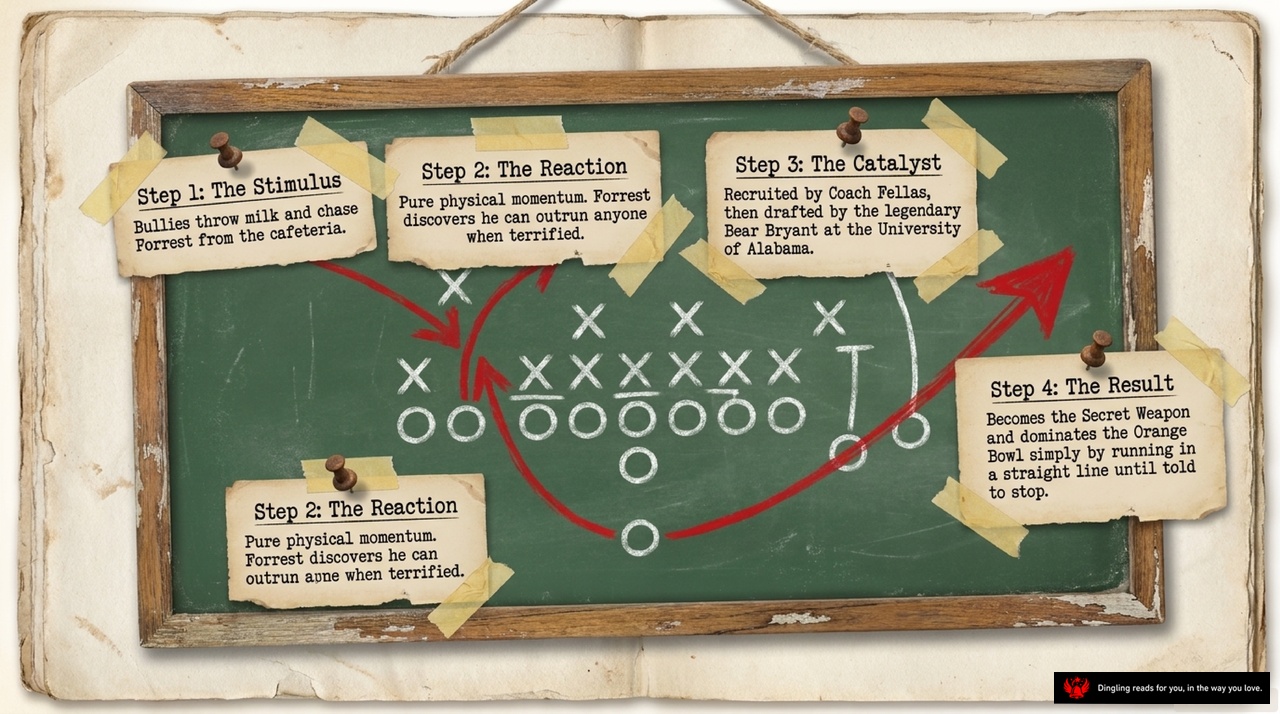
Look at this game plan. It's not just a diagram; it's the story of how one guy turned his biggest weakness into his greatest strength.
It all starts with Step 1: The Stimulus. We see bullies throwing milk and chasing Forrest from the cafeteria. That's the trigger. But look at Step 2: The Reaction. Instead of freezing, Forrest taps into pure physical momentum. He discovers that when he's terrified, he can outrun anyone. That fear becomes fuel.
Then comes Step 3: The Catalyst. He gets recruited by Coach Felas, and eventually, he's drafted by the legendary Bear Bryant at the University of Alabama. This is where the chaos gets organized.
Finally, Step 4: The Result. He becomes the Secret Weapon. He dominates the Orange Bowl simply by running in a straight line until told to stop. While other teams try complex plays, Forrest's simplicity is his superpower. He doesn't need a playbook; he just needs to keep running. This is the ultimate underdog story: take your fear, run with it, and watch the world stop in its tracks.

Look at this timeline. It's not just a map; it's the heartbeat of Forrest's journey, marked by five critical moments that shaped his life.
It starts with Point 1, The Draft. Here, we see the young Forrest, who enlisted despite failing college, meeting Bubba, who shares his dream of a shrimping boat. But that dream almost ended with Point 2, The Ambush. As the map shows, he gets pinned down in the jungle, facing the chaotic realization that war has no rules, just like a football game.
Then comes the most iconic moment, Point 3, The Rescue. Bubba runs back into the fire to save half the platoon, acting purely on instinct. This leads to Point 4, The Tragic Loss. We see Bubba playing Swanee River on the harmonica as he dies. That promise is cemented forever. Finally, Point 5, The Meeting. After the war, Forrest encounters the cynical, legless Lieutenant Dan in the Da Nang hospital. This meeting changes everything, setting the stage for the rest of his life. From a shrimping dream to a life-changing friendship, these five points define the arc of a true hero.
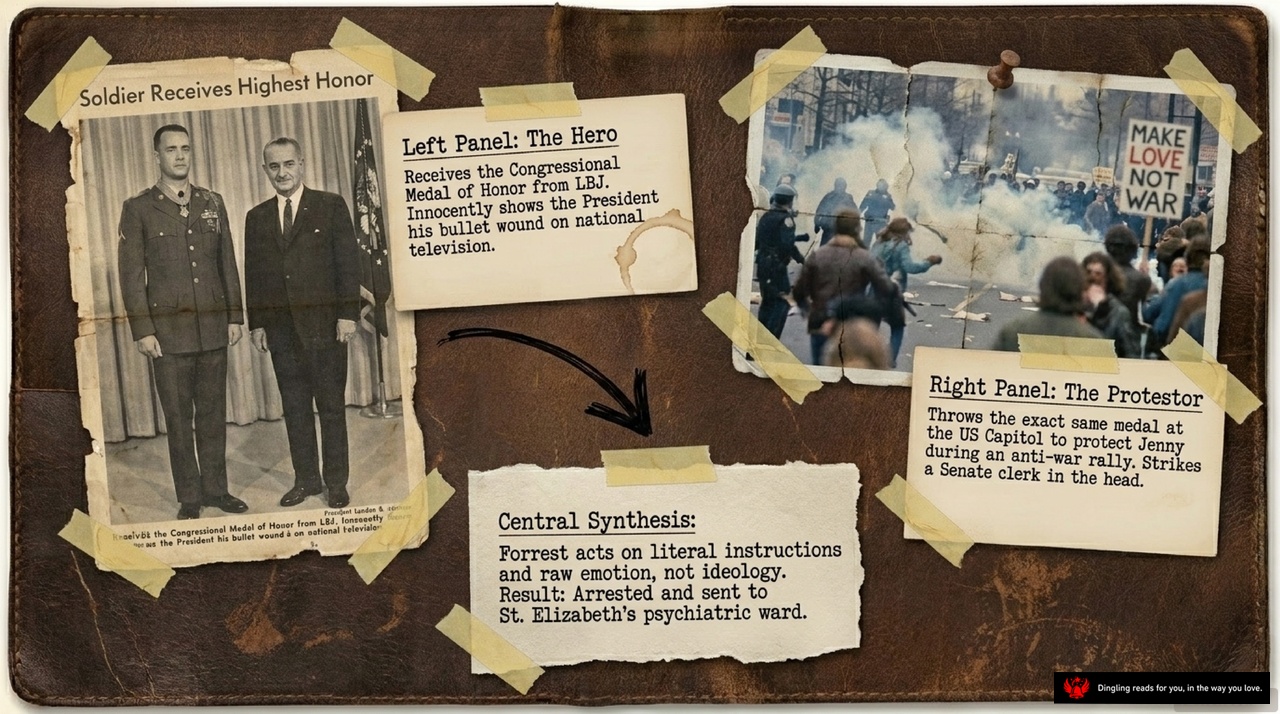
On the left, we see a soldier receiving the highest honor, the Congressional Medal of Honor from President LBJ. He innocently shows the President his bullet wound on national television. But look at the right panel: the protestor. He throws the exact same medal at the U.S. Capitol during an anti-war rally to protect Jenny, and in doing so, strikes a Senate clerk in the head.
This is the central synthesis of Forrest's journey: he acts on literal instructions and raw emotion, not ideology. He receives the medal as a hero, but he uses it as a weapon because he misunderstood the rules of engagement. The result? He is arrested and sent to St. Elizabeth's psychiatric ward. Forrest doesn't understand the difference between a symbol of honor and a tool for violence. He just follows the order he was given, believing that if he hits the person he was told to hit, he is doing the right thing. This moment captures the tragic irony of his life: his pure, unfiltered honesty leads him to commit a violent act that destroys his reputation and sends him to a mental institution.
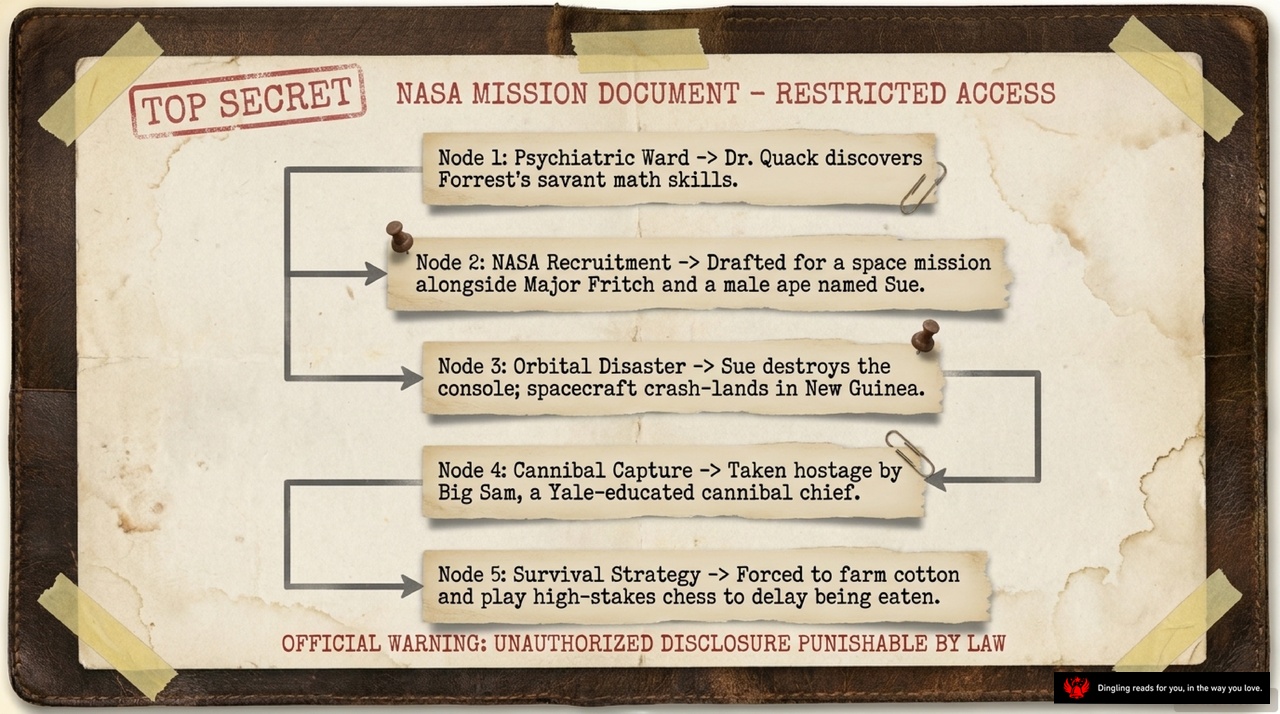
Imagine a classified NASA document, taped to a leather briefcase, detailing a mission that sounds like the plot of a crazy sci-fi movie. It starts in a psychiatric ward where Dr. Quack discovers Forrest's incredible math skills, leading to his recruitment for a space mission alongside Major Fritsch and a male ape named Sue. But things go wrong fast. During the orbital disaster, Sue destroys the console, and the spacecraft crash-lands in New Guinea. Instead of a rescue, they face a cannibal capture by Big Sam, a Yale-educated chief. The survival strategy? Forced to farm cotton and play high-stakes chess just to delay being eaten. This is the wild, chaotic journey of a man who ended up in space, only to find a much stranger reality on the ground.
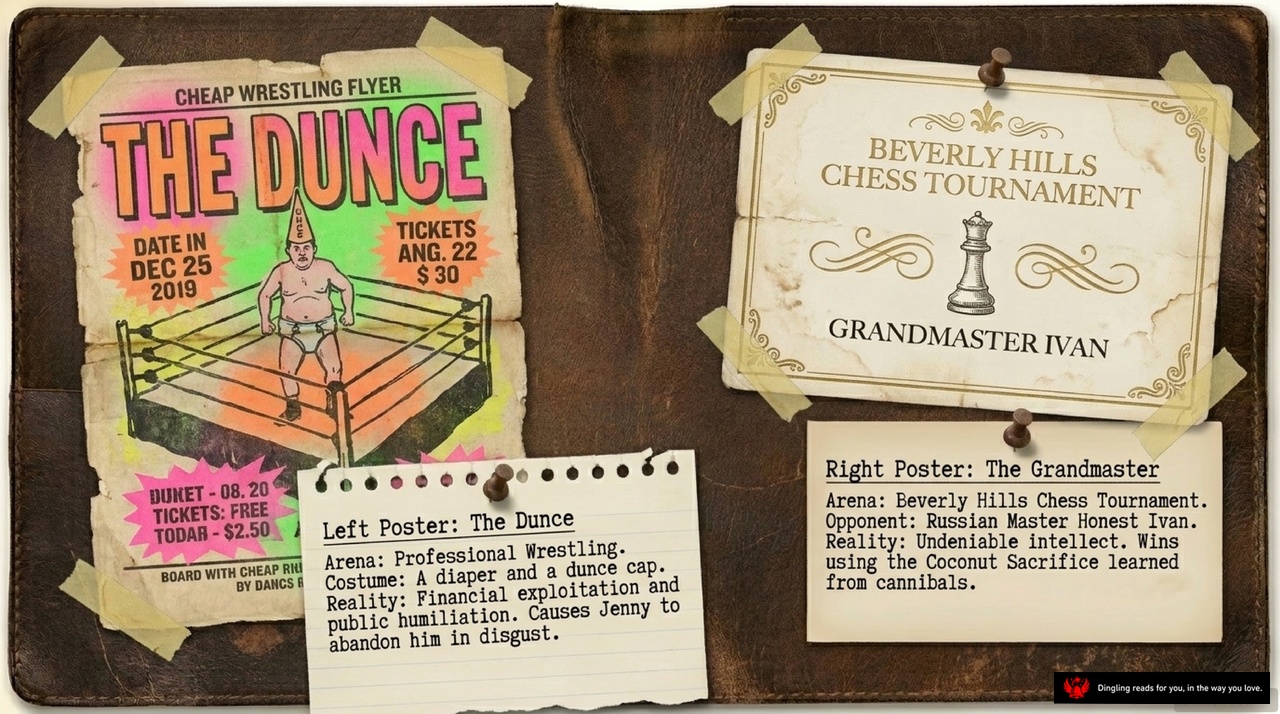
Look at this board. On the left, we have a flyer for "The Dunce," a cheap wrestling event where the reality is financial exploitation and public humiliation. On the right, there's an invitation to the Beverly Hills Chess Tournament featuring Grandmaster Ivan. These aren't just random posters; they represent the two paths that define the second half of my life.
One path was the wrestling ring. People wanted to see a fool get beaten up, so I wore a diaper and a dunce cap. It was funny to them, but it felt like I was being used as a punchline. The other path was the chess tournament. This was my chance to prove that I wasn't just a simpleton. I had learned from Grandmaster Sam in the jungle, and I was ready to show the world that my mind could work just as well as anyone else's.
But life has a funny way of throwing curveballs. While I was preparing for this chess match, I got a call from a movie producer named Feist. He saw something in me that the chess world didn't. He wanted me to play a monster in a movie called *Creature from the Black Lagoon*. So, instead of facing Grandmaster Ivan, I ended up wearing a rubber suit with webbed hands and feet, pretending to be a swamp creature. It was a strange twist, but it was the unexpected opportunity that would change everything for me.

Look at this chart titled "The Shrimp Business." It maps Forrest Gump's incredible journey from a simple promise to a multi-million-dollar empire. It starts at the base: fulfilling a promise by buying a dilapidated boat in Bayou La Batre to honor Bubba's memory. From there, it climbs through Milestone 1, the first catch, where he applies basic pond-farming techniques learned from Mr. Chi in Vietnam. Then comes Milestone 2, the core team, where he hires loyalty over resumes—bringing on Mama, his college teammate Curtis, and Coach Fellas. The graph peaks at the Empire, where Lieutenant Dan and Mr. Tribble help scale the business into a massive corporation. As the caption notes, ultimate capitalist success yields massive wealth, yet leaves Forrest emotionally unfulfilled. While the nets fill with cash, Forrest's heart remains anchored to the past, proving that no amount of money can replace the friends he lost or the simple life he once knew.
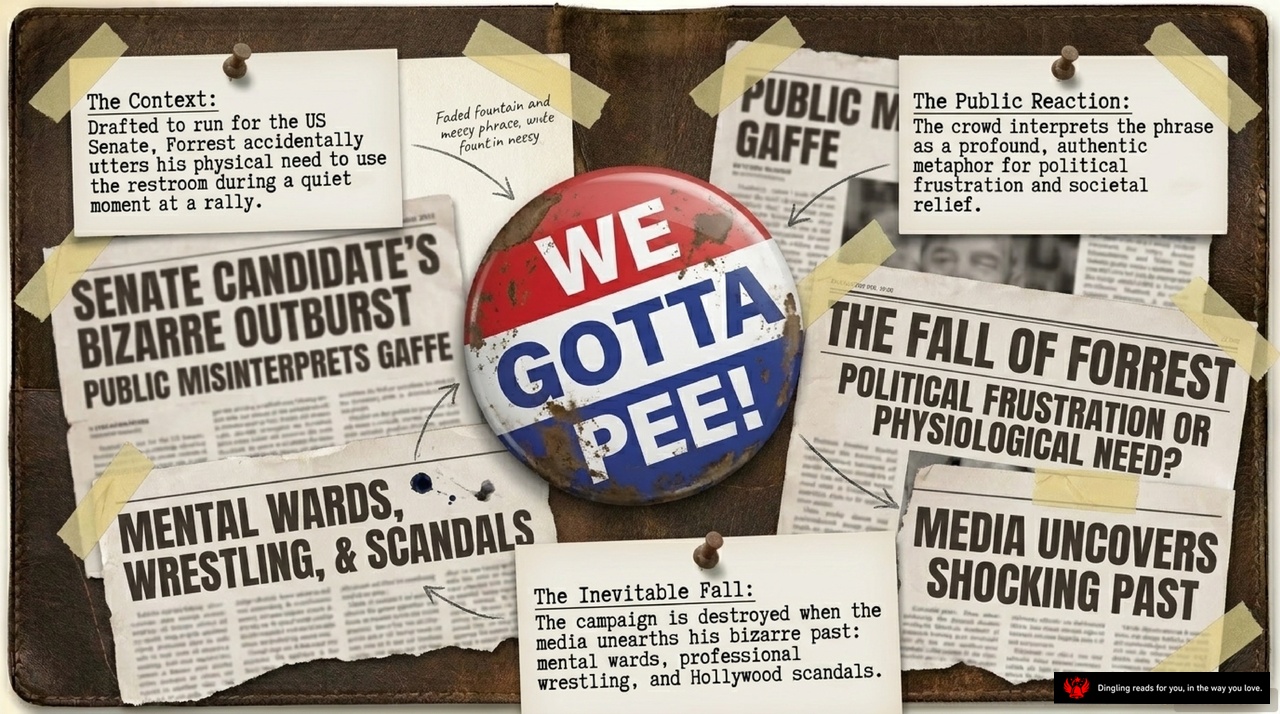
Look at this collage. It captures the exact moment Forrest Gump's life spirals out of control. On the left, we see the context: a quiet moment at a rally, where Forrest simply says, "We gotta pee," but the media twists it into a bizarre outburst. That single phrase gets misinterpreted by the public as a profound metaphor for political frustration, turning a physiological need into a scandal.
But the real story isn't just about that one mistake. As the headlines on the right reveal, the media digs deeper, uncovering his shocking past—mental wards, wrestling scandals, and Hollywood mishaps. Every piece of his history is weaponized against him. The campaign, once fueled by his "authenticity," is destroyed overnight. He becomes the punchline, a figure of ridicule rather than inspiration. It's a stark reminder that in the public eye, a simple man's honesty can be twisted into a tragedy, and a hero can become a joke in the blink of an eye.

Look at this diagram. It breaks down the universe into three parts: Natural Laws, Acceptance, and Showing Up. It uses the image of a tiger eating a monkey to show that nature is brutal and random. We cannot control events like that. But the smart move, like Forrest in the movie, is to accept the chaos and flow with it instead of fighting the tide. And while we can't change our destination, we do control how we play our part. Pure decency acts as a shield against cosmic chaos. That's the real cosmic plan.

The final chapter of Forrest Gump is a quiet, profound moment of closure. The image captures the essence of Forrest's life: a simple life lived with extraordinary grace. We see a young boy and an ape playing tic-tac-toe on a park bench, a scene that perfectly symbolizes the bond between Forrest and his loyal companion, Dan.
The text on the left outlines the final three acts of his journey: "The Reunion," "The Revelation," and "The Choice." This is where Forrest crosses paths with Jenny one last time in Savannah. He meets her son, Little Forrest—a brilliant, kind boy who dreams of being a football player or an astronaut, just as his father once did. This is the revelation that completes the circle.
But the most powerful part of this ending is "The Choice." Realizing he cannot disrupt their stable life, Forrest quietly diverts his entire shrimp fortune to Jenny, her mother, and Bubba's father. He walks away in total peace with Dan and Sue the Ape. The wealth diversion record on the right confirms this act of selflessness. Instead of keeping the millions he earned, he ensures that the people who loved him and the legacy of his friend Bubba are cared for. He chooses happiness over wealth, silence over fame, and peace over power. It's a beautiful reminder that sometimes, the greatest act of wisdom is knowing when to walk away.
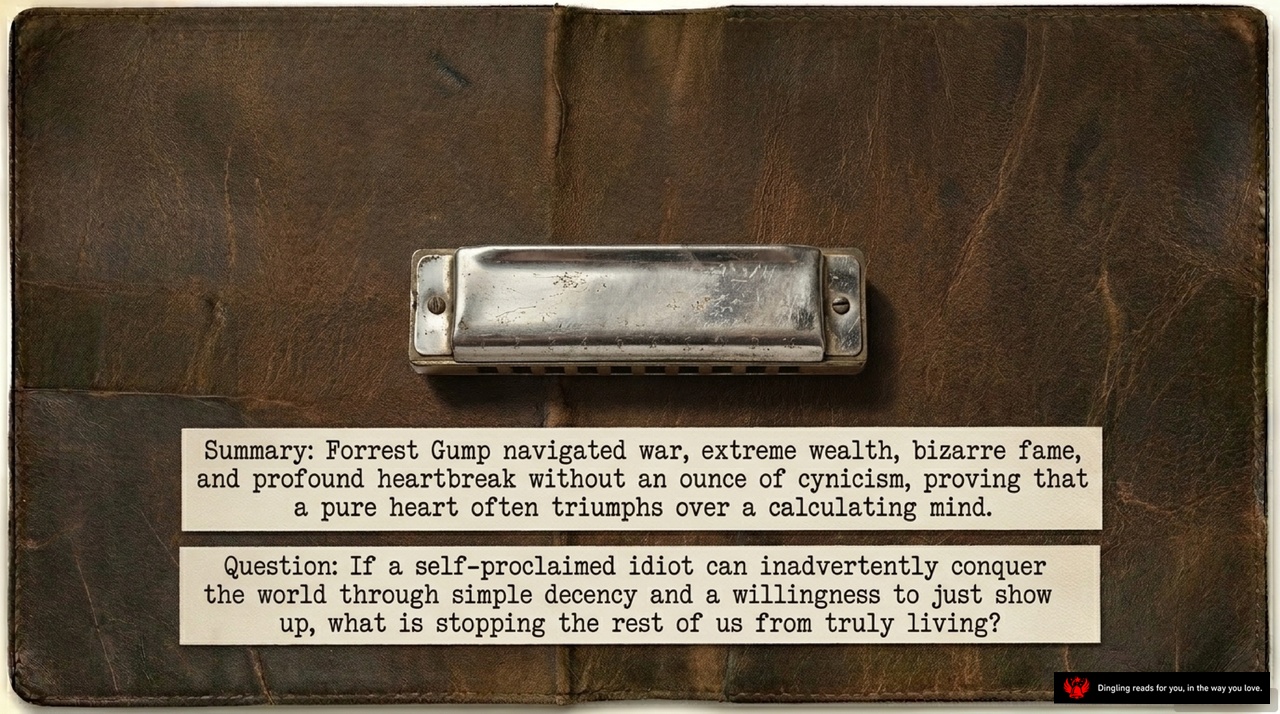
Imagine a life where you've been to war, survived the chaos of space, fought in the jungle, and even played professional wrestling, yet you remain completely unburdened by cynicism. That is the story of Forrest Gump. As the slide beautifully summarizes, he navigated extreme wealth, bizarre fame, and profound heartbreak with a pure heart that often triumphs over a calculating mind.
But here is the question that lingers with us all: If a self-proclaimed idiot can inadvertently conquer the world through simple decency and a willingness to just show up, what is stopping the rest of us from truly living? We often overthink our lives, calculating every move, whereas Forrest just ran, played, and loved. His journey reminds us that sometimes, the most extraordinary things happen not because we plan them, but because we simply stay true to ourselves.