
Foucault's Pendulum: Complete Chapter-by-Chapter Summary

Welcome to *Foucault's Pendulum* by Umberto Eco. Imagine a grand, dimly lit hall where a brass sphere swings slowly back and forth, cutting through the air like a blade slicing time. It looks like the ball is spinning, but the truth is far more profound: the Earth itself is rotating beneath it. This simple motion connects us to a point of stillness in the universe, a moment where humanity's most precise observation of its own world takes place.
But what if that observation wasn't about physics, but about something darker? What if the pendulum wasn't just measuring time, but proving the existence of a cosmic conspiracy? That is the terrifying heart of this story. It is a literary labyrinth that explores the fatal consequences of inventing a conspiracy that never existed. In this world, the line between fact and fiction blurs until reality itself begins to unravel, turning the search for truth into a deadly trap.

The pendulum swings, representing humanity's deep, psychological hunger for the infinite. In a universe defined by terrifying, endless flux, our minds crave a single, unmoving truth to ground our reality. We are desperate for a guarantee that somewhere, an ultimate anchor exists.
Look at this diagram: everything moves—the Earth, the solar system, the galaxies. But the suspension point of the pendulum remains entirely motionless. This is "The Absolute," the Fixed Point we call Keter. It is the stillness that holds the chaos at bay. While the world spins wildly around us, this one point refuses to budge. It is the anchor we seek, the silent center that allows the universe to rotate without falling apart. In a world that never stops changing, finding this fixed point is the only way to make sense of the madness.

Welcome back. Let's dive into the minds of the architects of chaos. On this board, we have three distinct forces driving the conspiracy. First, Casaubon, the Scholar. He's our narrator, a man obsessed with turning history into an aesthetic playground. He wrote his thesis on the Knights Templar, but his flaw is a dangerous one: he treats the past not as truth, but as a malleable text to be mocked and rearranged.
Then we have Belbo, the Cynic. He's a frustrated editor who uses the computer Abulafia to write because he fears failure. His role is to act as a tool, but his flaw is deep intellectual arrogance. He views the occult as something to be manipulated, believing that by rearranging words, he can mock the very reality he claims to understand.
Finally, there is Diotallevi, the Kabbalist. He is an obsessive scholar of the Torah and permutations. His role is to believe that rearranging words actually rearranges physical reality. For him, the letters of God's name hold the power to reshape the world.
These three are connected by red threads on this board, symbolizing their twisted collaboration. They represent the perfect storm of academic arrogance, cynical manipulation, and mystical delusion. Together, they don't just study history; they try to rewrite it, believing that if they can control the narrative, they can control the world itself.

Welcome to the world of the "Hermes Project," where the lines between fiction and reality begin to blur. This isn't just about publishing books; it's about weaving a grand, elaborate conspiracy that connects everything from ancient magic to modern science.
In this chapter, we see the plan take shape. The team, driven by a mix of obsession and intellectual curiosity, decides to merge "electronic machines" with "tradition." They launch a two-pronged publishing strategy: a popular series for general readers and a serious academic collection for the initiates. The goal? To create a seamless web of mystery that links alchemy, atomic energy, and forgotten history, suggesting that scientists have been hiding the truth all along.
But as the plan grows, so does the danger. The team begins to treat history like a game of words, feeding random sentences into their computer program, "Abulafia," hoping to find hidden patterns. They input wild claims—like Minnie being Mickey Mouse's fiancée—and the machine spits out a shocking conclusion: Jesus never died on the cross. Instead, he fled to France with Mary Magdalene to found the royal line. Suddenly, the abstract becomes terrifyingly real.
Their investigation leads them to the Tomar Castle in Portugal, a fortress steeped in Templar legends. They discover that the Knights Templar's secret plan might have spanned six centuries, originating right here. They piece together cryptic texts, linking the "Thirty Years' War" to a grand design involving the Rosicrucians and the British Crown. It seems the very fabric of history—the wars, the religious upheavals—was orchestrated by a secret society seeking to control the "World King."
The stakes get even higher when they uncover a connection to the hollow Earth theory. They believe the Earth's interior is a living, conscious entity, and that figures like Hitler were not just political leaders, but spiritual conduits trying to tap into this hidden power. In their minds, the Holocaust wasn't a crime, but a twisted attempt to locate a specific group of "invisible ones" hidden among the Jewish population, a key to unlocking the Earth's core energy.
As they dig deeper, the line between their game and reality dissolves completely. They realize that by creating these elaborate stories, they have inadvertently given power to the very forces they sought to understand. The "plan" is no longer just a story they told; it has become a force that is pulling them into its orbit, threatening to consume everything they hold dear.

Welcome to the "Provins Message," where we peel back the layers of a conspiracy that started as a simple hay delivery. Colonel Ardenti, our fictional hero, believes he's cracked a 600-year-old Templar master plan hidden in a medieval fragment. But here's the twist: the editors later decoded its true meaning, and it was utterly mundane.
Look at the magnifying glasses. On the left, the text says "36 invisibles." The occult myth claims these are 36 hidden Templar masters. But in reality? They are just 36 sous, or coins, meant for a hay delivery. It's a classic case of seeing monsters where there are only coins.
In the center, we see "6 bands." The secret society theory suggests these represent six geographic divisions of a shadowy order. The reality? They are simply six pieces of cloth.
And on the right, the text reads "r...s...". The myth points to the Rosicrucian Brotherhood. The truth? It's just roses for a festival delivery.
This slide illustrates the core theme: The Seed of Conspiracy. We are constantly taking ordinary, everyday objects and rewriting them as symbols of a grand, hidden plot. We transform coins into masters, cloth into divisions, and flowers into brotherhoods. It's a powerful reminder that sometimes, the most dangerous conspiracy is the one we invent in our own minds, mistaking a simple errand for a world-shattering secret.

In the final, chilling chapter of our journey, we confront the brutal reality of what happens when a lie becomes a weapon. The story of Abulafia—the Permutation Engine—doesn't end with a grand revelation or a hidden treasure. Instead, it ends in blood and silence. Belbo, our reluctant architect of this chaos, is lured into a trap by Alea. Using the very "map" he claimed to possess, he is dragged to a ritual at the National Museum of Craft and Decorative Arts. There, in a grotesque parody of the Foucault pendulum that once measured the Earth's rotation, Belbo is sacrificed. He becomes the pendulum itself, swinging endlessly as a warning to anyone who tries to play god with history.
While Belbo hangs in the air, the machine of our deception takes over. Alea and his followers, including the greedy Galamon, execute their final move. They don't care about truth; they only care about the story. They kill Lorenza, the only one who saw through the illusion, and silence the rest. But here is the twist that shatters our entire narrative: the secret was never real. As the protagonist realizes on the plane, the "Plan" was a fiction we invented to make sense of a chaotic world. There were no thirty-six invisible men, no hollow Earth, no hidden codes. The conspiracy was a mirror, reflecting our own desperate need for order back at us.
So, what happens next? The protagonist flees to the hills of Piedmont, leaving behind the ruins of a life built on lies. He picks up the horn Belbo left behind and blows a simple, improvised tune. It doesn't stop the sun, and it doesn't control the world. It just exists. In a world obsessed with grand conspiracies and hidden masters, the most radical act is to admit that nothing is happening, and to simply live in the quiet, real world that remains.

Welcome to the final chapter of our journey into the labyrinth of conspiracy. Look at this board behind me—a chaotic web of red strings connecting the Pyramids, the Eiffel Tower, the Holy Grail, and ancient symbols. It represents the ultimate fantasy of every conspiracy theorist: the belief that history is a grand, hidden script written by a secret cabal.
But today, we're going to shatter that illusion. The text on the left reveals the truth about "The Plan." It wasn't a real conspiracy; it was a cynical joke invented by editors at a vanity press. They took disparate, occult manuscripts and wove them into one massive, unified theory. The trap? They connected the Rosicrucians, the Assassins, the Paulicians, and the Templars into a single plot to control the "Umbilicus Mundi"—the navel of the world—using underground telluric currents.
Here's the twist: it is a masterpiece of fabricated logic. We, the narrators of this story, were the ones who built this web. We took random concepts and forced them together, believing that if we could just find the right pattern, we would uncover the ultimate truth. But we were wrong. The secret was never in the symbols or the hidden tunnels. The secret was that the secret didn't exist at all.
In the end, the only real thing was the act of creation itself. The "Plan" was a mirror, reflecting our own desperate need for order in a chaotic world. And now, the story comes full circle. The board is empty of real answers, but full of the lessons we learned about the danger of believing in ghosts.
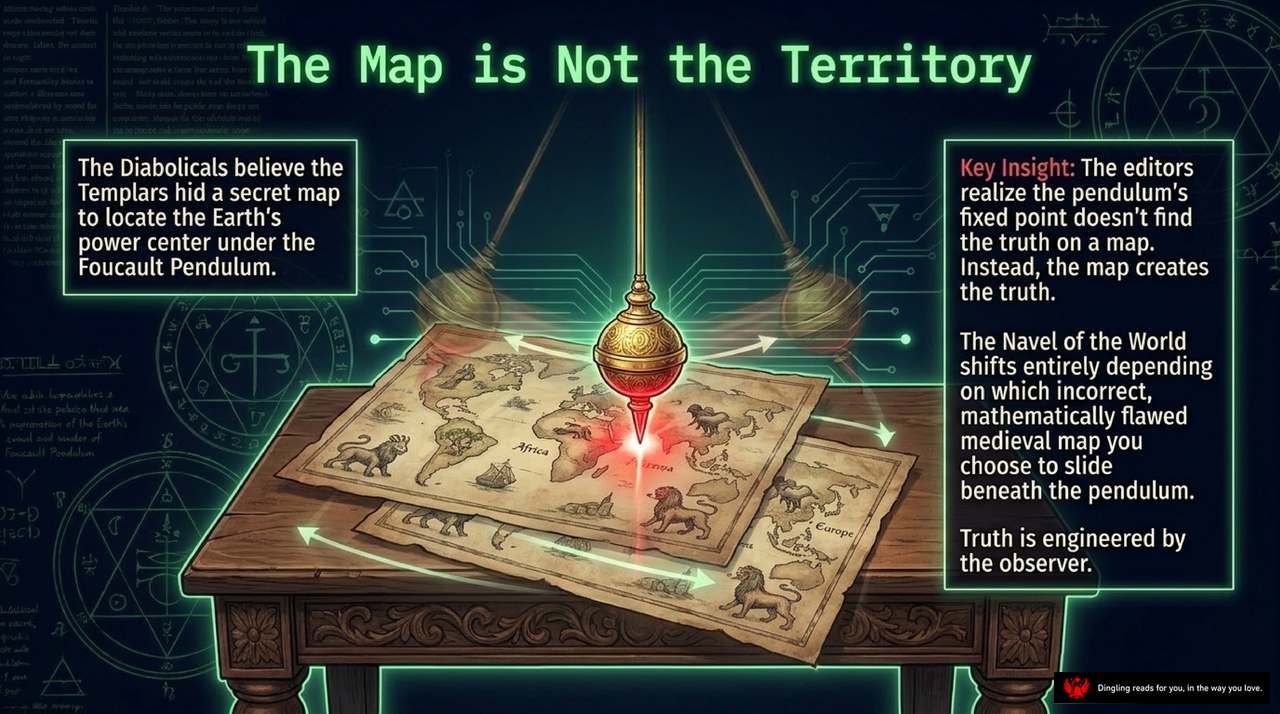
Look at this Foucault pendulum. It's not just a swinging weight; it's the ultimate metaphor for how we construct reality. The slide tells us something profound: "The Map is Not the Territory." The Diabolicals believe this pendulum holds a secret map to the Earth's power center, but the real key insight is that the map doesn't reveal the truth—it actually creates it.
Think about the Navel of the World. In our story, this center shifts entirely depending on which flawed medieval map you choose to slide beneath the pendulum. If you pick one map, the truth points here. Pick another, and the truth vanishes or moves elsewhere. This means truth isn't an objective fact waiting to be found; it is engineered by the observer. The pendulum's fixed point doesn't find the truth on a map. Instead, the map creates the truth. We are constantly building our own reality based on the lenses we choose to look through, often unaware that we are the ones drawing the lines.

The vacuum is the most powerful force of all. The Rosicrucian manifestos promised immense hidden knowledge, yet they revealed nothing. This very emptiness drew desperate seekers inward. If you promise a secret and never reveal it, people will invent the meaning themselves. A secret revealed is a secret destroyed.
Look at the architecture in this image. It's a grand hall, filled with symbols and ancient codes, yet right in the center lies a terrifying black void. This is the ultimate rule of the occult: a secret is only powerful if it is empty. The editors discovered this truth. The vacuum isn't a lack of information; it's a trap. It's a hungry mouth that swallows everything. When you leave something unsaid, the human mind rushes in to fill the silence with its own terrifying fantasies. We don't need answers; we need mysteries to worship. We create our own demons to chase them. That's why the secret never dies. It lives on, feeding on our obsession, waiting for the next fool to step into the dark and disappear.

The image before us captures a chilling moment where fiction bleeds into reality. We see a shadowy figure standing over a web of red threads, connecting ancient mysteries like Stonehenge and the Pyramids. The text warns us of a terrifying realization: when creators invent a perfect conspiracy, those desperate for meaning will believe it without question.
This is the crisis at the heart of our story. The vanity authors and occultists we've been following—these men who live in the margins of society—stumble upon "The Plan." It's a masterpiece of narrative, a web that perfectly connects all their disparate beliefs about Templars, Freemasons, and hidden history. Because it fits so neatly, they assume the editors have finally found the ultimate map. They believe they hold the key to the world's secrets.
But here is the danger: they steal the fiction. They take our made-up stories, our parables, and they are willing to kill to make them real. They don't see a story; they see a blueprint for the world. In their minds, the conspiracy is no longer a metaphor; it is a command. They believe that by enacting the plot, they will unlock the power they crave. The shadow in the image isn't just a silhouette; it's the embodiment of this dangerous belief—the moment a lie becomes a weapon, and a story becomes a reality that demands blood to be fulfilled.

Look at this split-screen. On the left, we see "Metathesis"—a linguistic mutation where letters like A and O get scrambled, rearranging words without meaning. On the right, we see "Metastasis," a biological mutation where cells break away from their original function and form a chaotic, invasive tumor.
This isn't just a comparison; it's the tragic realization of Diotallevi, the author of *The Sardinian*. As he lay dying from cancer, he reached a terrifying epiphany: his cells had learned to do exactly what his mind had done to the sacred text. He had playfully manipulated the universe's code, shuffling letters around, and now, his own flesh was rearranging itself in response. The cancer of the word had become the cancer of the flesh.
It's a horrifying mirror. When we treat history as a puzzle to be solved by shuffling symbols—like the Templars, the Rosicrucians, or the hidden codes we think we've cracked—we risk inviting chaos into our very biology. We believe we are the masters of the secret, but in the end, we might just be the cells metastasizing, losing our original form and becoming something entirely new, something dangerous. The truth isn't hidden in the earth or the stars; it's hidden in the silence of what we refuse to stop rearranging.
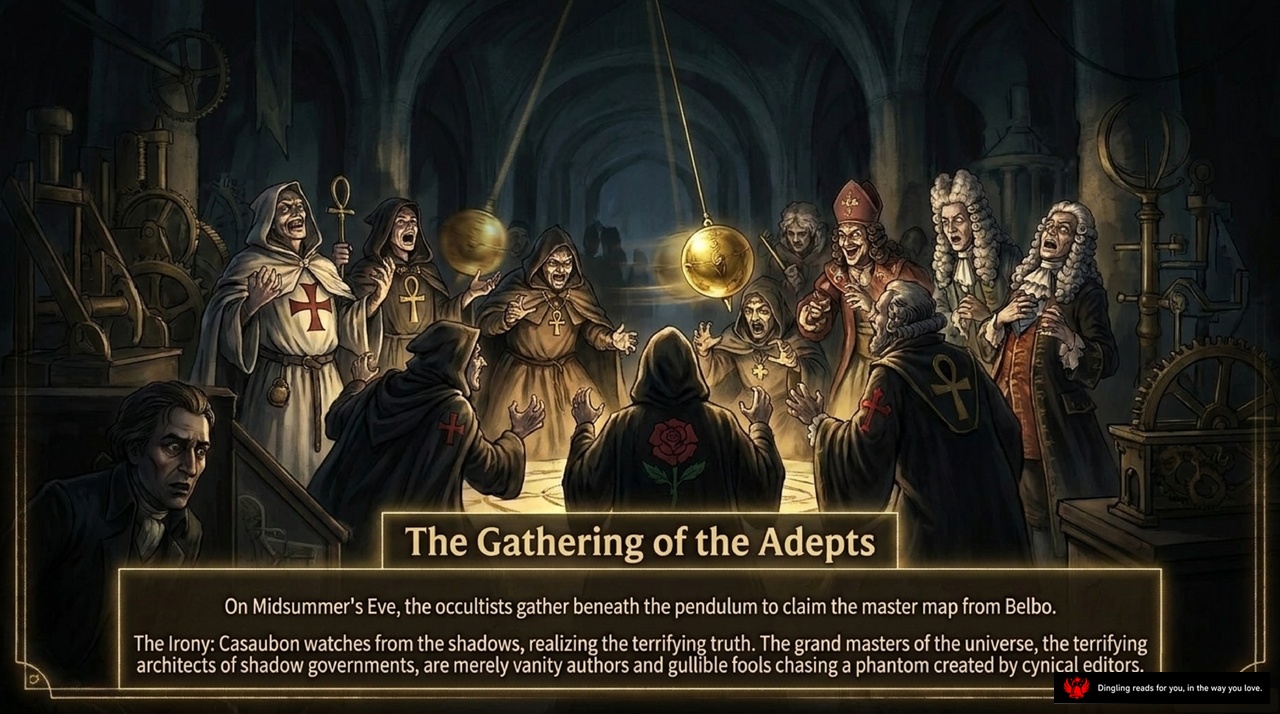
The image before us captures a chilling moment of convergence: "The Gathering of the Adepts." Here, under the cold gaze of the Foucault pendulum, occultists and grandmasters unite on Midsummer's Eve to claim the Master Map from Belbo. It looks like the final act of a centuries-old conspiracy, doesn't it? A secret society pulling strings from the shadows, orchestrating history itself.
But let's look closer at the irony hidden in this dramatic scene. While these figures—their robes, their symbols, their desperate chanting—believe they are uncovering a terrifying truth, the reality is far more mundane and tragic. As the narrative reveals, this entire gathering is built on a phantom. The "Master Map" they chase is a fiction created by cynical editors and the desperate delusions of men like Casaubon, who watched from the shadows realizing too late that they were merely vanity authors chasing ghosts.
The grand masters of the universe, the architects of these so-called shadow governments, aren't pulling the strings of reality. They are gullible fools, trapped in a loop of their own making, chasing a phantom that was never there to begin with. What we see here isn't a triumphant revelation of hidden power; it's a tragic comedy of errors, where the pursuit of a fake secret becomes the very engine of their destruction. The pendulum swings, but it measures not the rotation of the earth, but the futile oscillation of human obsession.

Belbo's Defiance isn't just a dramatic ending; it's the ultimate act of sanity in a world gone mad. Imagine being captured, tortured, and forced to reveal a secret map that you know is fake. Giving them that map would only prove their madness was real. So, Belbo makes the hardest choice: he refuses to speak.
In this final act, they hang him from the pendulum's wire. But here is the twist: by dying, he doesn't just die; he stabilizes the wire's swing. He refuses to surrender to the meaninglessness of the conspiracy. In his final, silent act, he creates the only true fixed point. He becomes the anchor that stops the chaotic swing of the pendulum, proving that while the world tries to spin on lies, there is still one thing that remains absolutely real: the refusal to play their game.

Malkuth: The Peach and the Earth. Casaubon flees to the countryside, escaping the labyrinth of conspiracy theories and reaching the final Sephira: Malkuth, the physical reality of the earth. Here, he experiences a profound epiphany that changes everything. The revelation is simple yet radical: the true secret of the universe is not hidden in subterranean vaults, encrypted Templar laundry lists, or cosmic conspiracies. The meaning of life is the simple, physical reality of the present moment—the fuzz on a peach, the dirt on the ground. It's not about what lies beneath the surface, but what is right here, right now, tangible and real.

We live in a world obsessed with secrets, convinced that the universe is hiding a grand design, a hidden code waiting to be cracked. We chase hidden meanings with relentless intensity, only to blind ourselves to the profound beauty of simple reality. If the ultimate secret of the universe is that there is no secret, why are we so terrified of the truth?
This fear paralyzes us. We construct elaborate conspiracy theories, weaving together ancient texts, forgotten symbols, and historical anomalies into a tangled web of supposed conspiracies. We believe that every event, every coincidence, is part of a master plan orchestrated by shadowy figures. But what if we are the ones creating the conspiracy? What if the "secret" we are so desperate to uncover is nothing more than a projection of our own anxieties and desires?
The truth is far more liberating than any secret we could invent. It is not a hidden treasure buried in the earth or a coded message waiting to be decoded. It is right here, right now, in the ordinary moments of our lives. It is in the way the light hits a leaf, in the laughter of a child, in the quiet stillness of a sunrise. These are the real mysteries, the ones that don't need to be solved or explained. They just need to be experienced.
When we stop looking for hidden meanings and start embracing the simplicity of existence, we find a freedom we never knew we were missing. We realize that the universe is not a puzzle to be solved, but a story to be lived. And in that realization, we find the ultimate truth: there is no secret, only life.