
Fu Lei's Family Letters: Complete Chapter-by-Chapter Summary

Welcome to our book club session. Today, we are honored to introduce *Fu Lei's Family Letters*, a profound historical testament written by Fu Lei, Zhu Meifu, and Fou Ts'ong. This collection is far more than just a series of letters; it is a masterclass in the synthesis of life, art, and discipline. Through these words, we witness the deep, enduring bond between a father and son stretched across ten thousand miles. It is a story of love, guidance, and the timeless pursuit of truth, offering us a unique window into a life lived with integrity and passion.

Look at this map of a twelve-year journey, stretching over 10,000 miles between Shanghai and Europe. This is the story of Fu Lei and his son, Fong Ts'ong. On the left, you see the quiet study in Shanghai where Fu Lei wrote from a place of deep sorrow. On the right, there's the grand concert hall in Warsaw or London where Fong Ts'ong rose to become a world-class pianist.
The core insight here is profound: these letters were not just family updates. They were a masterclass conducted entirely by mail. Fu Lei, watching his son navigate a turbulent world, used these letters to guide his son's soul from across the globe. He taught him that art comes from a "pure heart"—a childlike innocence that never grows old. He reminded Fong Ts'ong that while technique is the tool, true art is the fire that moves people, and the artist themselves must remain steady, unmoved by the passion they unleash.
Even when Fong Ts'ong faced low points, criticism, or the complex pressures of life abroad, his father's voice remained a constant anchor. He advised him to balance emotion with reason, to learn from nature and other arts, and most importantly, to be a good person first, an artist second. These letters bridged the chasm, turning a painful separation into a powerful dialogue that shaped not just a musician, but a man.
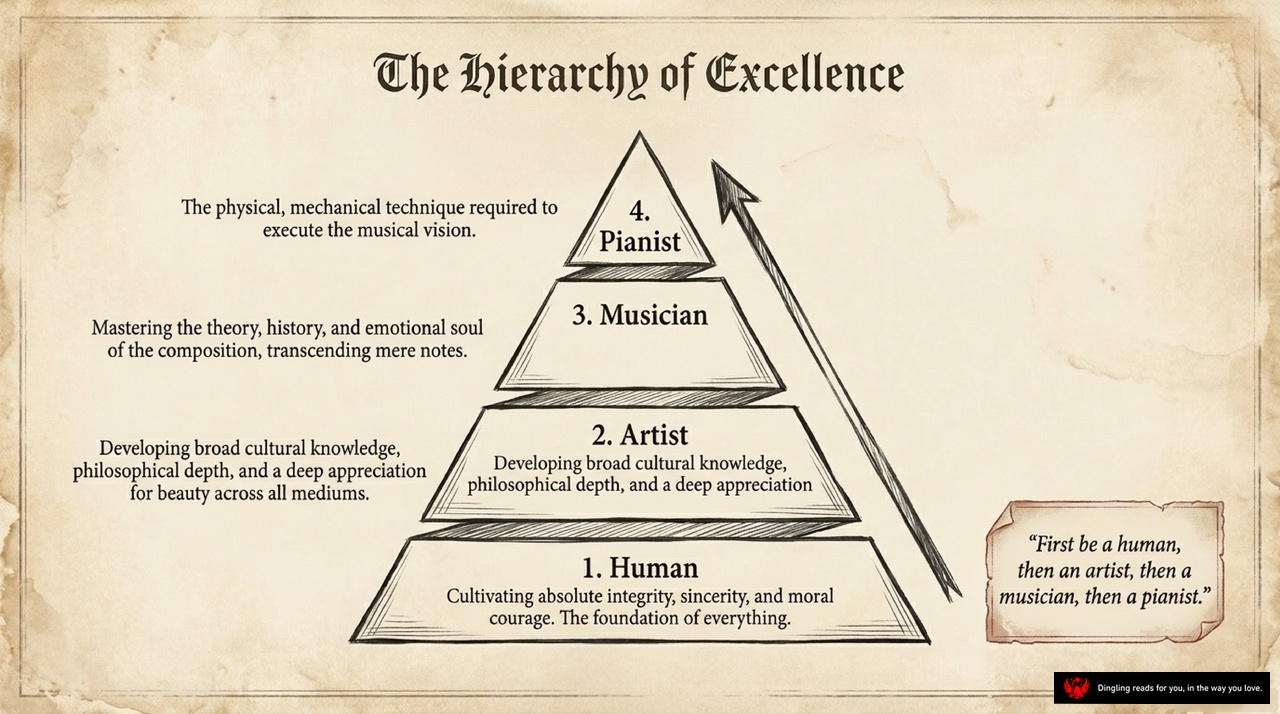
Let's talk about what it truly means to be an artist. We often think of musicians as just technicians who play notes perfectly, but that is only the very top of the pyramid. True excellence starts much deeper, at the foundation of being a human.
Look at the base of this hierarchy: "First be a human." Before you can be a musician, you must cultivate absolute integrity, sincerity, and moral courage. This is the foundation of everything. Without a strong moral character, your art has no soul.
Once you have that human foundation, you move up to becoming an "Artist." This isn't just about painting or sculpting; it's about developing broad cultural knowledge, philosophical depth, and a deep appreciation for beauty across all mediums. You need to understand the world beyond just your instrument.
From there, you become a "Musician." This means mastering the theory, history, and emotional soul of the composition, transcending mere notes. You need to understand the context and the story behind the music.
Finally, at the very peak, you reach the level of a "Pianist." This is where the physical, mechanical technique required to execute the musical vision comes into play. But remember, this skill is useless without the levels below it.
As my father always taught me, the path is clear: "First be a human, then an artist, then a musician, then a pianist." You cannot skip the steps. If you focus only on the technique at the top while neglecting the character at the bottom, you will never achieve true greatness.

Today's slide outlines what we might call the "Childlike Heart Engine"—a cycle that explains the paradoxical power of the innocent soul. Look at the three nodes: Purity, Loneliness, and Creation. It starts with **Purity**: maintaining absolute sincerity and vulnerability in a cynical world. But in a harsh reality, that purity inevitably leads to **Loneliness**. As the diagram notes, this is the inevitable isolation and suffering that comes from refusing to compromise one's pure ideals. Yet, this isn't a dead end. That profound isolation becomes the fuel for **Creation**. By using that isolation, the artist builds an entirely new spiritual and artistic reality. The central insight here is the cycle itself: purity leads to isolation, which fuels creation, which in turn sustains that purity. As the quote at the bottom reminds us, "When the childlike heart is lonely, it creates a world." This is the essence of the artist's journey—transforming the pain of being misunderstood into the beauty of something new.

Look at this open book. It captures the complex, dual nature of a father's love. On the left, we see the Strict Disciplinarian. This was the shield he built. He imposed rigid rules on everything—from posture to writing instruments—and demanded grueling, perfectionist piano practice. He constantly warned against arrogance and the dangers of early fame. But look at the right side: The Vulnerable Confidant. This was his true face. He freely admitted his own tragic flaws, his temper, and even past parenting abuses. He suffered from extreme anxiety and insomnia, waiting heartbreakingly for his son's letters.
His intense strictness was a shield; his vulnerability was his true face. He loved art so deeply that he treated his son as a precious artistic masterpiece. He wanted a deep, intellectual friendship with his adult son, yearning for a connection that went beyond just music. Yet, he couldn't help but worry, fearing his son might lose himself in success or fail to find true happiness. This tension between being a demanding mentor and a terrified, loving parent defined their entire relationship. It wasn't just about teaching piano; it was about two souls trying to understand each other across the distance of time and geography.
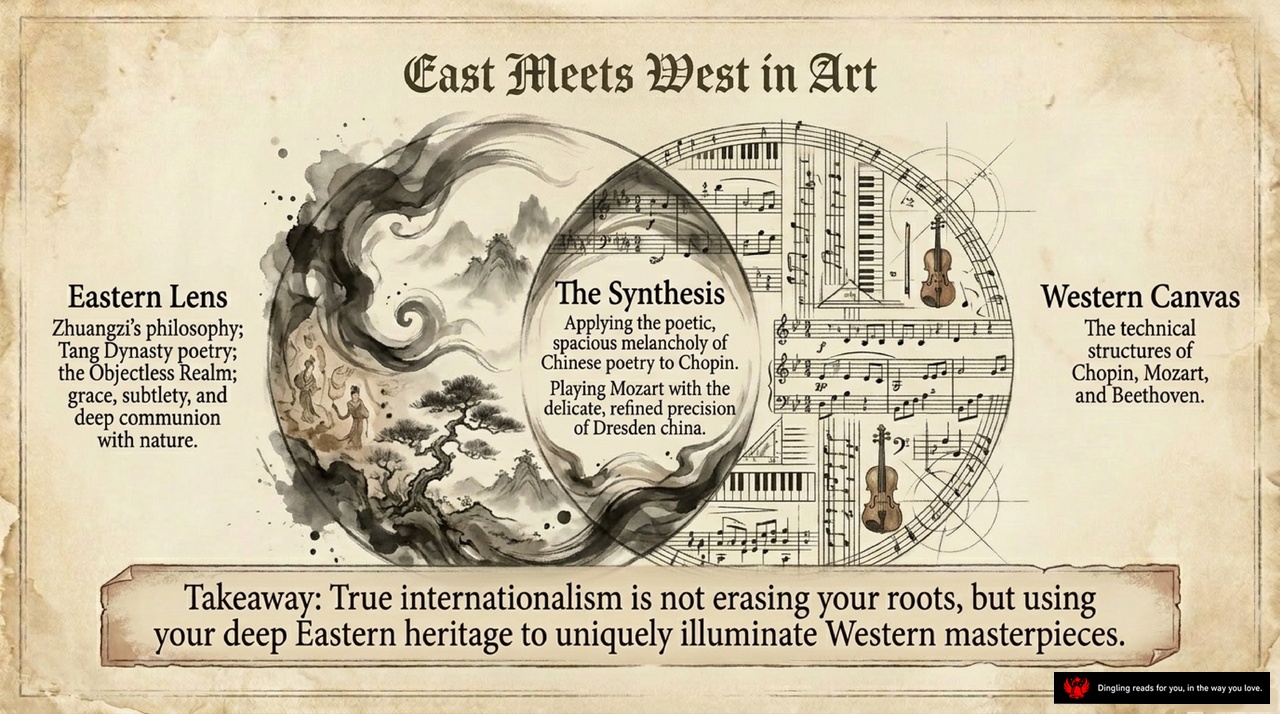
True internationalism isn't about erasing your roots; it's about using them to uniquely illuminate Western masterpieces. Look at this synthesis of East and West. On one side, we have the Eastern Lens: the poetic melancholy of Tang Dynasty poetry, the philosophy of Zhuangzi, and that deep, objectless communion with nature. On the other, the Western Canvas: the rigorous technical structures of Chopin, Mozart, and Beethoven. When you apply the delicate, refined precision of a Dresden china bowl to play a Chopin nocturne, magic happens. It's not about copying; it's about fusion. As we've seen in the letters, true art requires a "great heart"—that pure, childlike innocence that allows you to resonate with the creator's pulse. But technique alone isn't enough; you need the soul of your heritage to give Western music its unique voice. So, remember: keep your Eastern roots deep, and let them guide your interpretation of the world's greatest art. That is how you become a true artist.
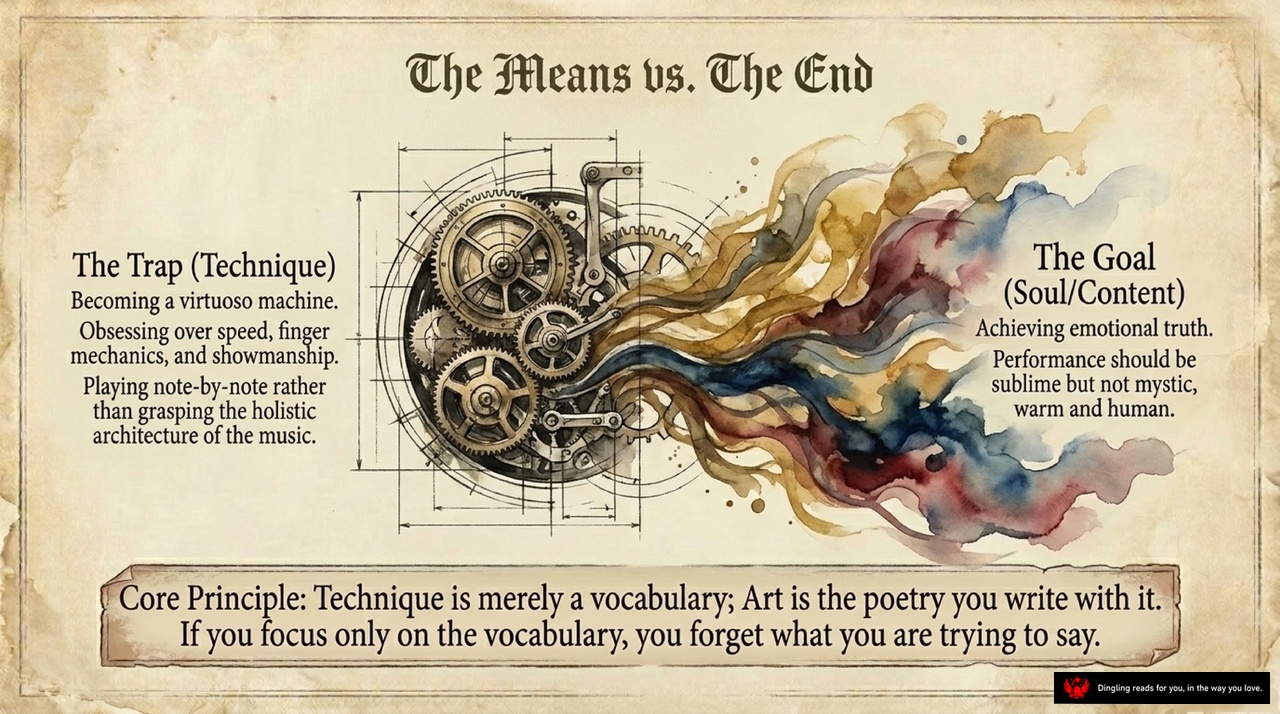
Look at this image. On the left, we see cold, intricate gears labeled "The Trap (Technique)." On the right, flowing like a vibrant river, is "The Goal (Soul/Content)." This visual perfectly captures the core lesson from our book: Technique is merely a vocabulary, while Art is the poetry you write with it.
Many musicians fall into the trap of becoming virtuoso machines. They obsess over speed, finger mechanics, and showmanship, playing note-by-note instead of grasping the music's holistic architecture. But as the text reminds us, true performance should be sublime yet warm and human. It's about achieving emotional truth, not just mechanical perfection.
If you focus only on the vocabulary of technique, you inevitably forget what you are trying to say. The book emphasizes that an artist must balance the means with the end. Just as a poet needs words to tell a story, a pianist needs technique to convey a soul. Without that poetry, the music remains lifeless. Remember, if you focus solely on the mechanics, you lose the very message you wish to share. Let your technique serve your art, not the other way around.
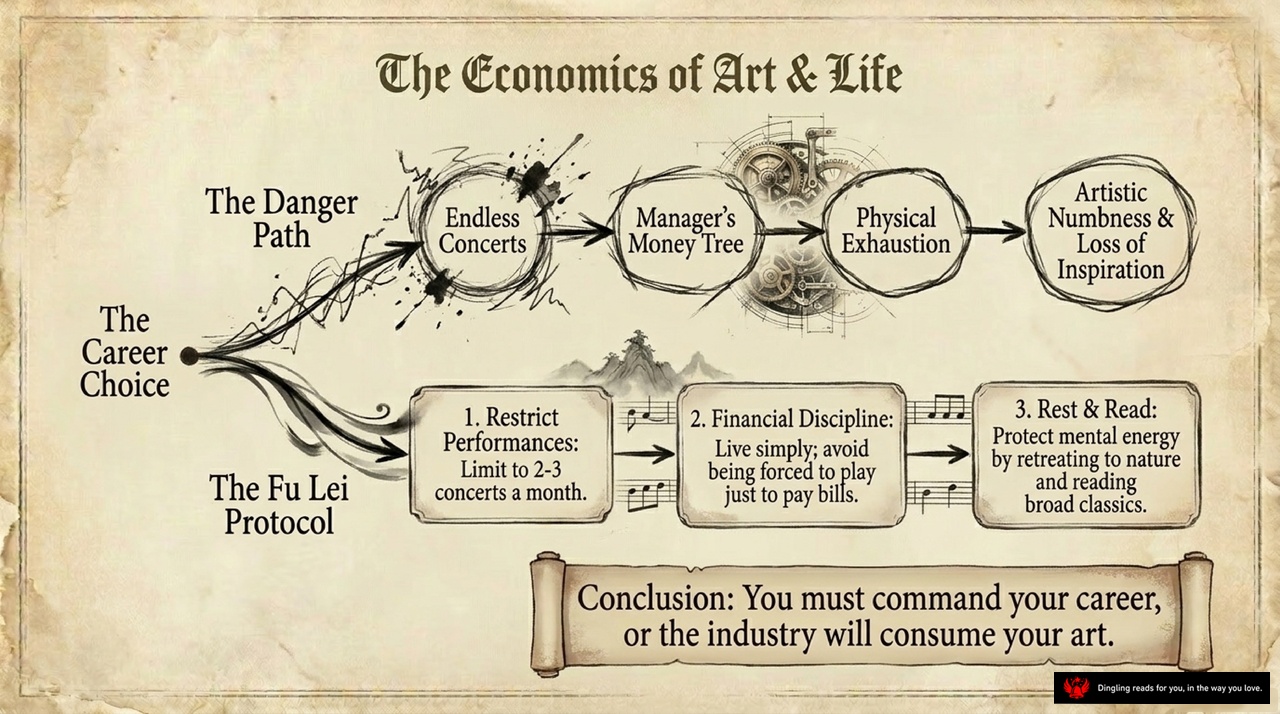
Look at this diagram: "The Economics of Art & Life." It lays out a stark choice every artist faces. On the left, we see "The Career Choice." If you choose "The Danger Path," you get trapped in a cycle: endless concerts feed a manager's money tree, leading to physical exhaustion and, ultimately, artistic numbness. The industry consumes your art.
But there is a better way: "The Fu Lei Protocol." This is the antidote. First, restrict performances to just two or three a month. Second, practice strict financial discipline; live simply so you never play just to pay bills. Third, protect your mental energy by retreating to nature and reading broad classics.
The conclusion is clear: You must command your career, or the industry will consume your art. As we saw in Fu Lei's letters to his son, he constantly emphasized that without balance and restraint, talent becomes a liability. True art requires freedom, and freedom comes from controlling your own time and resources, not being a slave to the applause or the paycheck.
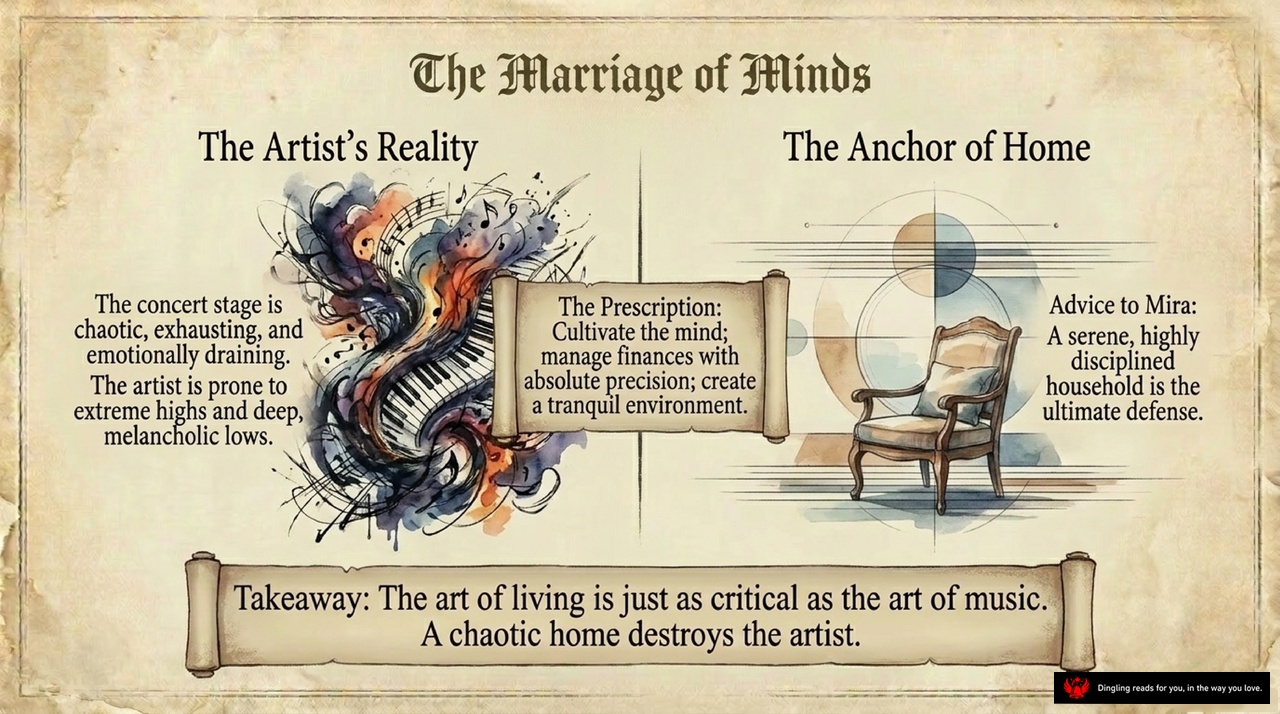
Imagine a world where the chaos of the concert stage—the soaring highs and crushing lows of performance—threatens to consume an artist from the inside out. This is the reality for many musicians, including our protagonist, a pianist whose soul is constantly pushed to its limits. But what if the key to surviving this artistic storm wasn't found on the piano keys, but in the quiet corners of home?
The image before us presents a powerful dichotomy: on one side, the turbulent energy of "The Artist's Reality," where exhaustion and emotion run wild; on the other, the serene stability of "The Anchor of Home." The text suggests a clear prescription for this struggle: cultivate the mind, manage finances with absolute precision, and above all, create a tranquil environment. This isn't just about comfort; it's about defense. A serene, highly disciplined household is described as the ultimate defense against the chaos that destroys the artist.
Consider the wisdom offered here: the art of living is just as critical as the art of music. When the home is a battlefield of clutter and financial stress, the artist has no reserve of energy left for creation. But when the home is a sanctuary, it becomes the fuel for the art. As the takeaway reminds us, a chaotic home doesn't just disrupt life; it actively destroys the artist. For any creative professional, the lesson is clear: to master the music, you must first master the art of living.

Today, we arrive at the tragic climax and the eternal monument of the Fu family story. Look at this timeline: 1966, 1979, and finally 2013. These dates mark not just history, but the heartbreaking journey of two parents who chose a dignified exit in 1966 amidst overwhelming turbulence. While their physical voices were silenced forever, their legacy lives on through the archival score of their letters, crossing borders and decades to reach us today.
At the center of this image stands a solemn obelisk, inscribed with a profound truth: "When the childlike heart is lonely, it creates a world." This quote, drawn from Fu Lei's letters, captures the essence of their sacrifice. They believed that true artistry and integrity require a pure, innocent heart—a "childlike heart"—that remains uncorrupted by the world's cynicism. Even in their deepest loneliness, this inner purity allowed them to create a spiritual world that transcends time.
Though the couple stepped away from the world, their influence never faded. Through their correspondence with their son, Fu Cong, they instilled values that continue to resonate. They taught that a genuine artist must first be a good person, emphasizing sincerity, humility, and a deep connection to one's cultural roots. Their letters, filled with wisdom and love, became a bridge between generations, proving that while their bodies may rest, their spirit and their teachings remain an eternal monument to the power of the human heart.
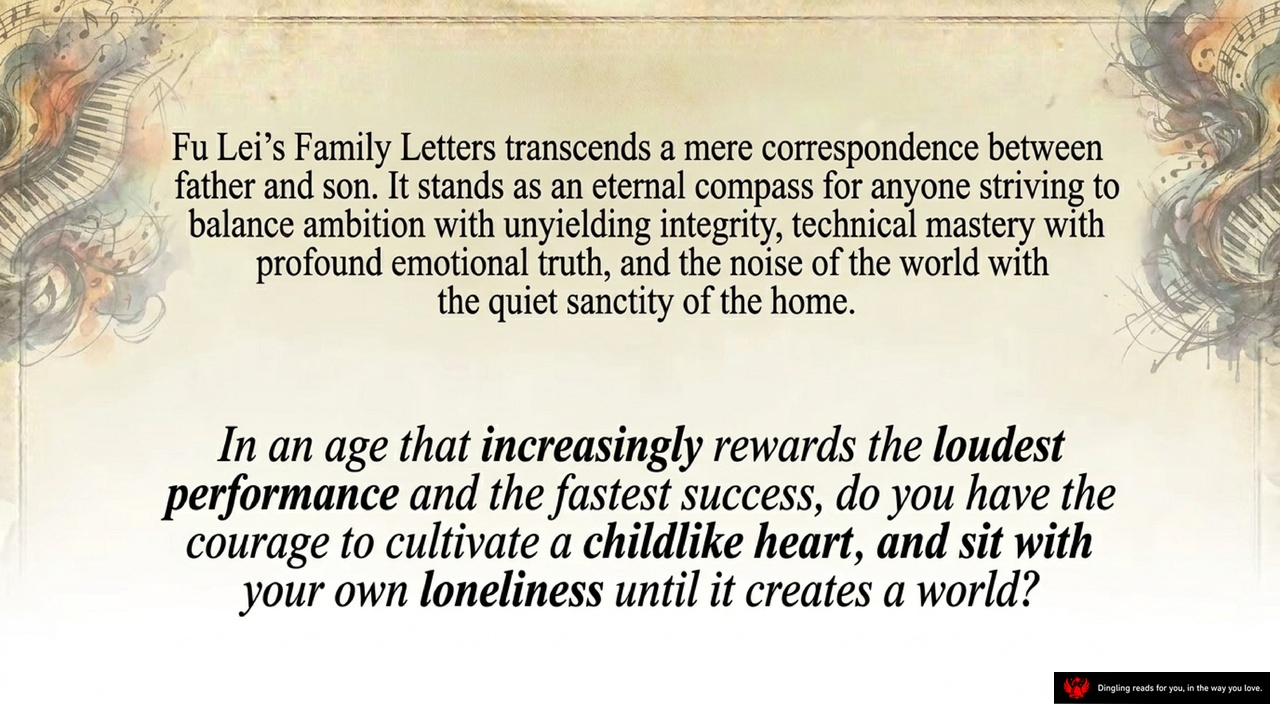
In a world that increasingly rewards the loudest performance and the fastest success, do you have the courage to cultivate a childlike heart, and sit with your own loneliness until it creates a world? This is the profound question Fu Lei's Family Letters asks us all.
Fu Lei's letters transcend a mere correspondence between father and son. They stand as an eternal compass for anyone striving to balance ambition with unyielding integrity, technical mastery with profound emotional truth, and the noise of the world with the quiet sanctity of the home.
Fu Lei understood that the path to greatness is not paved with constant applause, but with the quiet discipline of solitude. He advised his son, and us, that "sorrowful tears are the wine that nourishes the soul." Only by experiencing the sharp pain of struggle can we develop a deep, boundless sympathy for others. In an era obsessed with quick wins, Fu Lei urged us to embrace the slow, often lonely process of growth. He believed that a "childlike heart"—one that remains pure, curious, and unjaded—is the true source of artistic genius.
Just as the great composer Chopin found his soul in the solitude of his room, we must learn to find our own world in our own silence. It is in those quiet moments of introspection, away from the frantic pace of modern life, that we truly discover who we are and what we are capable of creating. So, let us not fear the silence. Let us sit with our loneliness, nurture our inner child, and trust that from that stillness, we will build a world of our own making.