
Getting Things Done: Complete Chapter-by-Chapter Summary

Welcome to Getting Things Done by David Allen. This isn't just another productivity book; it's a definitive system designed to help you achieve stress-free productivity and truly master the art of knowledge work.
Imagine a state where you're surrounded by endless tasks yet remain completely clear-headed, effortlessly in control, and doing everything out of genuine commitment and interest. That's the promise of GTD. It moves you from a state of chaos to a state of "active calm."
The method rests on three core purposes. First, it collects every single thing on your mind, moving it out of your head and into a reliable external system to clear your mental cache. Second, it forces you to make decisions upfront, ensuring every item has a clear "next action." And third, it helps you manage and coordinate everything, allowing you to keep every promise you make.
This system works for everyone—from the professional drowning in emails to the parent juggling family and career. It's built on simple, proven logic that fits how your brain actually works. By adopting this approach, you stop trying to remember everything and start trusting a system that works for you, giving you back the freedom to focus on what truly matters.

In the industrial age, work was simple and finite. Think of a conveyor belt: tasks were visible, physical, and had clear boundaries. You could see exactly when a job was "done." But today, we live in the Information Age, and the rules have completely flipped. As this slide illustrates, modern work has no distinct edges. Inputs are infinite, roles are fluid, and the definition of "done" is entirely subjective. It's a chaotic web of connections where nothing ever truly ends.
This shift creates what we call "The Cognitive Toll." When you try to hold infinite inputs in a finite human mind, the result is inevitable anxiety. Here's the hard truth: stress isn't caused by a lack of time. It's caused by a lack of control, organization, preparation, and action. Your brain is constantly trying to remember every unfinished task, which drains your mental energy and paralyzes you.
But there is a way out. The GTD method is designed specifically to solve this paradox. It liberates your mind by taking control of your commitments. By capturing every single thing in your brain and organizing it into a trusted external system, you stop worrying about what you might forget. You clear your mental cache so your brain can focus on what actually matters: making decisions and taking action. This isn't about doing more; it's about thinking clearly so you can act with confidence and peace of mind.

Imagine throwing a pebble into a still pond. The water responds with absolute appropriateness to the force and mass of the input; then it returns to calm. It neither overreacts nor underreacts. This is the state of perfect readiness we are aiming for.
Today, we dive into "Entering the State of Perfect Readiness" by mastering the art of a mind like water. The promise of this approach is threefold. First, we achieve 100% focus by engaging completely in the current moment without distraction. Second, we operate with zero friction, maintaining a clear head and relaxed control. And third, we unlock maximum fluidity, allowing us to shift instantly from a micro-task to a macro-vision.
Look at the diagram here. At the center lies "The Mind." Surrounding it are the chaotic, jagged arrows representing the noise of our daily lives—emails, interruptions, and endless to-do lists. But notice how the outer ring creates a boundary. When we build a reliable external system, we stop letting these external forces dictate our internal state. We don't react impulsively; we respond with precision.
By capturing every thought, clarifying the next action, and organizing our commitments, we transform that chaotic water into a calm, powerful force. We move from being overwhelmed by the input to responding with grace. This is how we stop just surviving the day and start truly mastering it.

Welcome to the "Cartography of Productivity." Imagine your life not as a chaotic mess, but as a cockpit with two distinct dimensions of control. True mastery isn't just about working harder; it's about aligning the mechanics of your daily actions with the compass of your ultimate intention.
Let's look at this map. The horizontal axis, or the X-Axis, represents **Horizontal Control**. Think of this as your runway. It's about taming the chaos of your daily workflow. The goal here is simple but powerful: ensuring that no open loop is left unresolved. Whether it's an email, a thought, or a project, we need five phases to capture and resolve everything so nothing gets stuck in your subconscious.
Now, look up at the vertical axis, the Y-Axis. This is your **Vertical Perspective**. While the horizontal axis keeps you grounded in the present, the vertical axis lifts your view. It consists of six altitudes of alignment, ensuring that every single action you take is driving you toward your ultimate life purpose. Without this vertical pull, you might be efficient, but you could be moving in the wrong direction.
Notice the target in the top right corner, marked at 50,000 feet? That represents the ideal state where you have both total control over your tasks and perfect alignment with your goals. When you master both the horizontal flow of your work and the vertical direction of your life, you stop running on the runway and start soaring toward mastery. This is the essence of a stress-free, highly productive life.

So, let's talk about the engine that keeps the GTD system running smoothly: the Review. Without it, your system is just a graveyard of old ideas. Think of your review process as a weekly "check-in" with yourself to ensure everything is still relevant and moving forward.
First, look at your calendar. This is your non-negotiable. It holds your fixed appointments and time-bound commitments. You need to glance at it daily to stay on track. But here's the real magic: the Weekly Review. Schedule this for about an hour, preferably at the end of your week. This isn't just about checking off tasks; it's about resetting your entire system.
During this review, you do three critical things. First, you capture. Pull everything from your physical and digital inboxes, your brain, and your voice mail. If it's not in your trusted system, it's cluttering your mind. Get it all out. Second, you update. Clear out completed actions, check your "Waiting For" list to see if anyone has stalled, and assess the progress of all your projects. Third, you create. Look at your "Someday/Maybe" list and turn any viable ideas into actual projects. Capture new inspirations that have popped up.
By sticking to this rhythm, you clear your mental RAM. You stop worrying about what you might have forgotten because you know it's safely stored and being checked. You gain a bird's-eye view of your life, which instantly reduces anxiety. You move from a state of reactive panic to proactive control. Remember, the goal isn't just to manage tasks; it's to maintain a state of calm confidence where you know exactly what's next, regardless of how chaotic the world feels outside.

So, we've walked through the capture, clarify, organize, and review stages. Now, let's look at the final piece of the puzzle: choosing what to do right now.
Imagine you have a massive inbox—emails, calls, ideas, everything. The question isn't "what's most important?" It's simply, "What is the very next physical action?" If you can't answer that clearly, you're just spinning your wheels. Once you identify that next step, you apply the "Golden Rule": if it takes less than two minutes, do it immediately. Don't let small things clutter your mental RAM.
If it takes longer, ask yourself: can I delegate this? Or should I defer it? You're not just making a to-do list; you're making a decision engine. By filtering tasks through context, time, and energy, you stop reacting to chaos and start directing your day. This is how you move from being overwhelmed to being in control, one clear action at a time.

Let's talk about how to stop overthinking and actually get things done. Many of us fall into the trap of "overthinking," getting stuck in a loop of worrying about details, meaning, or risks without ever taking action. In this state, thinking becomes a cage rather than a tool. The key is to think just enough to answer two simple questions: "What result do I want?" and "What is the very next physical action?" Once you have those, stop the internal friction and start moving.
One of the most effective ways to break this mental deadlock is to simply finish the unfinished work. Those hanging tasks silently occupy your mental bandwidth, making it impossible to focus on the present. The solution is to get them out of your head and into a reliable external system—like a project list or a to-do sheet. Then, apply the "two-minute rule": if a task takes less than two minutes, do it right now. If it's a larger project, break it down into the next immediate step. If you can't do it yet, either put it on a "Someday/Maybe" list or let it go.
True focus requires clearing the clutter, both external and internal. When your brain is overloaded with pending items, you can't concentrate, no matter how hard you try. By trusting your external system to hold all your commitments, you free your mind to enter a state of deep flow. This balance between thinking and acting is crucial. Thinking gives you direction, but only action brings results. GTD helps you create a cycle where clear thinking leads to focused action, and completed tasks give you the confidence to think even more clearly.
Finally, remember that a stable internal order is the soil where creativity grows. You don't need chaos to be creative; you need a clear framework. When your tools are organized and your tasks are defined, your mind can wander freely and generate new ideas without being pulled back by anxiety. GTD bridges the gap between your "dreamer" side, which generates ideas, and your "doer" side, which executes them. It allows you to be both organized and innovative, turning your vision into reality without the stress of trying to do everything at once.

Today's slide brings us to the heart of how we actually make choices when the world feels chaotic. On the left, we see "The Weekly Review," which acts as the engine maintenance for your entire system. Think of it as your weekly reset button. Just once a week, you empty your head, update your lists, and review your projects. This isn't just about cleaning up; it's the critical success factor that transforms your static to-do lists into a living, trusted external brain. Without this regular reflection, your system drifts out of sync with reality.
On the right, we look at "Intuitive Action." Once your system is maintained and your mind is clear, deciding what to do stops being a stressful debate and becomes a matter of instinct. You simply filter your options through four criteria: Context, Time Available, Energy Available, and Priority. This is "Action in Context." With a clear mind and a trusted system, you don't need to overthink; you just trust the system to guide you to the right next step instantly.
The goal is simple: maintain the engine so you can trust your intuition. When your external brain is up to date, your internal decisions become effortless, allowing you to engage with the world from a place of calm confidence rather than reactive panic.

Imagine your mind as a cockpit, but instead of an altimeter, you're using a six-layer navigation system to stay grounded. This is the core of the GTD method: aligning your daily grind with your ultimate purpose.
Look at the slide. We start at the bottom with "Projects" and "Next Actions"—the immediate tasks you're facing right now. But if you stop there, you're just reacting to chaos. True clarity comes from looking up.
At 10,000 feet, you manage your projects. At 20,000 feet, you define your Areas of Focus—your key responsibilities. Moving up to 30,000 feet, you set your annual Goals. Then, at 40,000 feet, you visualize your long-term Vision. And finally, at the top, at 50,000 feet, you anchor everything to your Purpose and Principles.
The magic happens when you shift between these layers. The text reminds us that action without purpose is exhausting, while purpose without action is just a daydream. By using this "Horizons of Focus" model, you can smoothly shift from micro-details to macro-vision. It ensures that every granular task you do today perfectly aligns with your lifelong destiny. Instead of being overwhelmed by the noise, you gain the navigational clarity to move forward with confidence and calm.

Imagine your life and work as a flight, where different altitudes represent different levels of focus and responsibility. At the highest level, 20,000 feet, you're looking at your core areas of responsibility—health, finances, team morale, product quality. These are the 10 to 15 key domains you must actively maintain to keep your life's engine running smoothly.
Dropping down to 10,000 feet, you see your projects. These are the specific outcomes you've committed to finishing within the next 12 months. Think of hiring a new marketing director or renovating your kitchen. These are the tangible results that bridge your daily actions with your broader goals.
Finally, at runway level, you're focused on your next actions. This is where the rubber meets the road. It's about the granular, physical steps you take today. Whether it's calling Sarah regarding the Q3 budget or buying printer ink, these are the immediate moves that propel you forward.
The beauty of this model is how it helps you manage the mechanics of your current reality without getting overwhelmed. By clearly distinguishing between your high-level responsibilities, your medium-term projects, and your immediate next steps, you can navigate complexity with clarity. You stop worrying about the distant horizon and instead focus on the very next step you need to take right now. This operational altitude framework ensures that every action you take is aligned with your responsibilities and contributes to your projects, creating a seamless flow from vision to execution.

Imagine you're piloting a high-performance aircraft. You wouldn't just stare at the instrument panel and hope for the best; you'd need to know your altitude, your trajectory, and your ultimate destination to fly safely. Today's slide, "The Strategic Altitudes," gives us that exact mental map for defining our life's trajectory and ultimate destination.
Think of your personal or professional journey as a flight path with three critical layers. At the very top, at 50,000 feet, is your Purpose and Principles. This is the ultimate "Why." It's the foundational values and the singular intention that guide everything you do. For example, it might be to innovate sustainable solutions while maintaining radical transparency. This layer sets your compass, ensuring that no matter where you go, you stay true to who you are.
Just below that, at 40,000 feet, lies your Vision. This is the concrete picture of long-term success. It answers the question: What does success actually look, sound, and feel like in three to five years? It's a projection of your future life, giving you a clear target to aim for so you don't just fly aimlessly.
Finally, at 30,000 feet, we have our Goals. These are the tangible milestones you intend to achieve within the next one to two years. These are the specific steps you need to take right now to make that distant vision a reality. Without these goals, your vision remains just a dream; with them, it becomes an achievable plan.
The beauty of this model is how these altitudes connect. Your daily actions at 30,000 feet must directly support your goals, which must align with your vision, all while staying grounded in the principles of your purpose at 50,000 feet. By consciously managing these strategic altitudes, you stop reacting to random events and start steering your life with intention. You ensure that every task you complete today is actually moving you toward the life you want to live tomorrow.
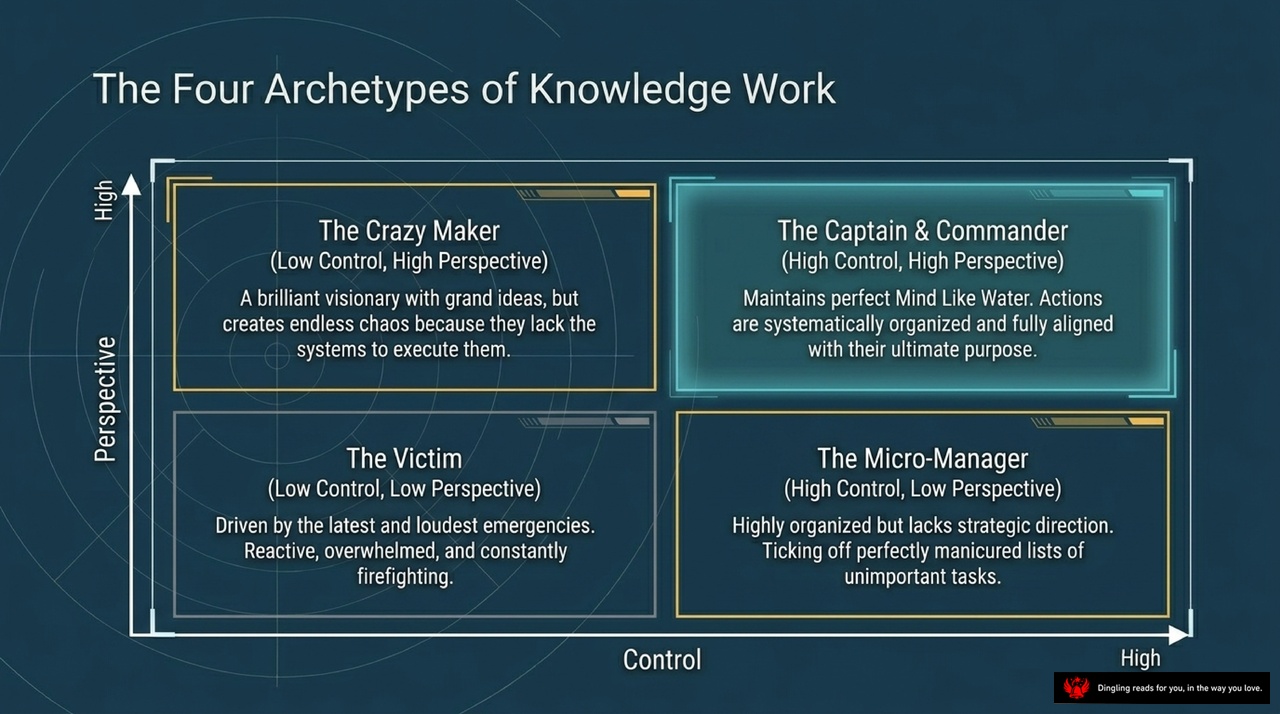
Today's slide breaks down the four distinct archetypes of knowledge work, mapping how our relationship with control and perspective shapes our productivity. On the left, we have the Crazy Maker and the Victim. The Crazy Maker operates with high perspective but low control—a brilliant visionary with grand ideas who creates endless chaos because they lack the systems to execute them. Conversely, the Victim lives in a state of low control and low perspective, driven by the latest emergencies, constantly reactive and overwhelmed, essentially just putting out fires without a broader strategy.
On the right side, we see the two paths to mastery. The Micro-Manager has high control but low perspective. They are highly organized, ticking off perfectly manicured lists of unimportant tasks, yet they lack strategic direction and never align their actions with a greater purpose. Finally, in the top-right quadrant, we find the ideal state: The Captain & Commander. This archetype combines high control with high perspective. They maintain a perfect Mind Like Water, ensuring their actions are systematically organized and fully aligned with their ultimate purpose. This is the balance we strive for—having the vision to see the big picture while possessing the discipline to execute it flawlessly.
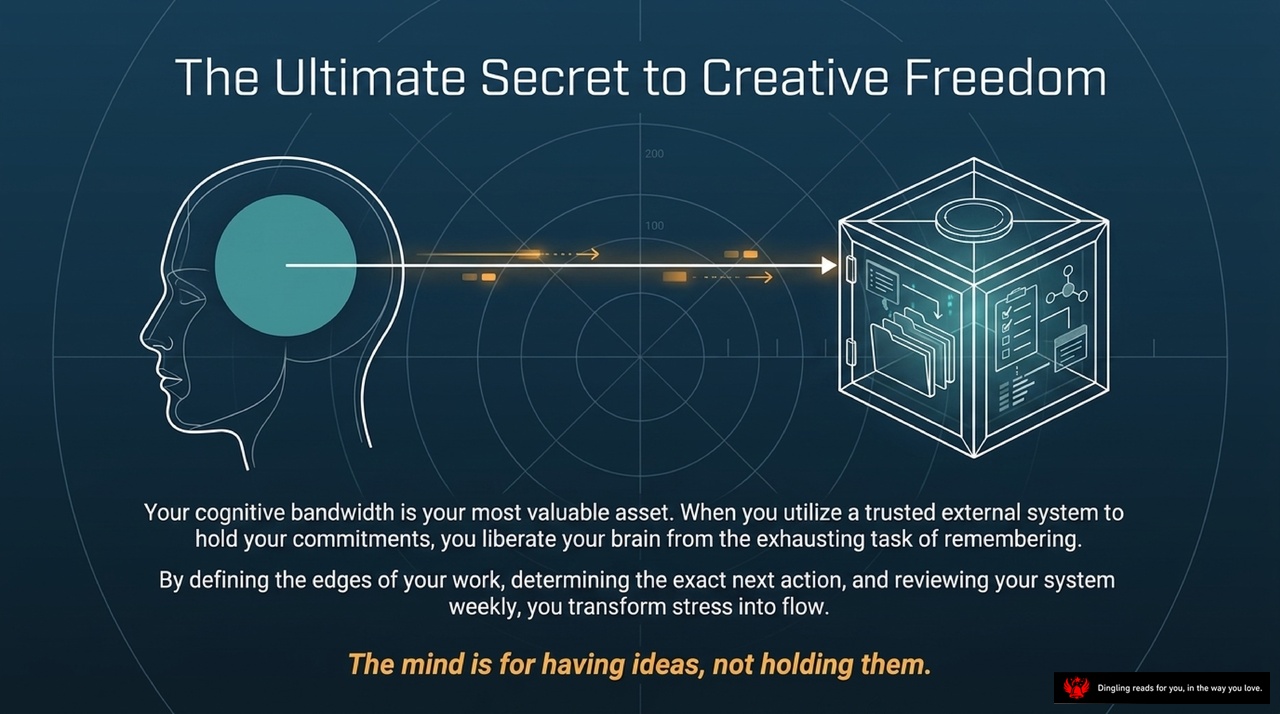
Your cognitive bandwidth is your most valuable asset, and protecting it is the ultimate secret to creative freedom. As the slide illustrates, when you utilize a trusted external system to hold your commitments, you liberate your brain from the exhausting task of remembering. Think of your mind not as a hard drive for storage, but as a processor for ideas. By defining the edges of your work, determining the exact next action, and reviewing your system weekly, you transform stress into flow. The goal is simple yet profound: your mind is for having ideas, not holding them. When you offload the mental burden of "what's next," you create the mental space necessary for true innovation and deep focus.

So, we've walked through the mechanics of GTD—the capturing, clarifying, organizing, and doing. But today, let's step back and look at the bigger picture. What does all of this actually achieve?
The core promise of stress-free productivity isn't about working harder; it's about balancing absolute control over your daily workflow with a clear perspective on your life's highest altitudes. By capturing every open loop, deciding the immediate next action, and trusting an external system, you finally free your mind to focus fully on the present moment.
Imagine a world where your brain isn't a hard drive storing every "to-do." If your mind were entirely free from the burden of remembering what you have to do, what incredible things would you finally have the space to create? That shift from mental clutter to mental clarity is the real breakthrough. It's not just about getting more done; it's about creating more of what truly matters.