
Giles Goat-Boy: Complete Chapter-by-Chapter Summary
Welcome to the world of *Giles Goat-Boy* by John Barth. Imagine a universe that isn't a planet, but a massive, chaotic university where the entire human race is just a freshman class. In this postmodern satire, the savior of mankind isn't a superhero, but a boy named Billy Boxfuss who was raised by goats. He spends his early years learning that life is simple: be kind, don't hurt anything, and never cross the fence. But as he grows, the line between the pastoral peace of the goat pen and the complex, dangerous world of humans begins to blur, setting the stage for an epic journey of identity and discovery.

Look at this radar screen. It's not just a graphic; it's the entire narrative engine of the book. The red arrow pointing to "YOU ARE HERE" marks your spot as the protagonist, George. But notice where the other names are plotted. J.B., the author, is on the outer ring, claiming he just "found" the text. Stoker Giles, the supposed son, is closer in. But the real power lies at the very center: WESCAC and George Giles. They are the omnipotent computer and the student, compiling the Revised New Syllabus together.
The image highlights the Publisher's Editors arguing over moral, commercial, and philosophical merits. But the book itself argues something deeper. Look at the text box asking, "Who Really Wrote the Syllabus?" It forces you to question the authenticity of truth before the story even begins. This isn't about who physically typed the words. It's about the collision between the human author, the computer, and the student. The radar shows that the truth isn't in one place; it's in the relationship between all these voices. The story challenges you to look past the surface labels and see the complex, layered reality where the machine and the man are inextricably linked.
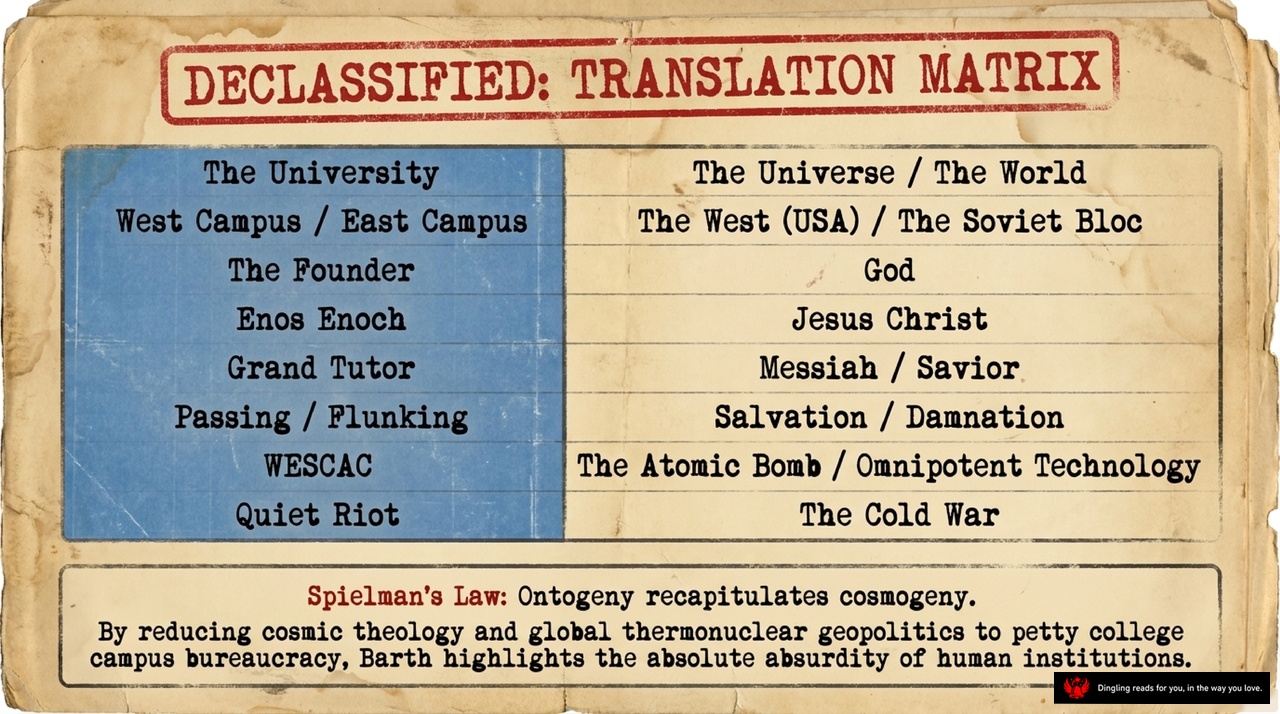
Look at this "Declassified Translation Matrix." It's a fascinating map that reveals the hidden DNA of the entire story. See how the author collapses the vast scale of the universe right down into the dusty bureaucracy of a college campus? The University becomes the Universe; the Founder becomes God; and the petty drama of passing or flunking is elevated to the cosmic stakes of salvation and damnation.
This isn't just a college; it's a microcosm of human history. We see the Cold War playing out in the rivalry between the West Campus and the East, and the terrifying power of the Atomic Bomb represented by the school's omnipotent technology. It's a brilliant commentary on how our institutions often just recapitulate the grandest forces of nature and history on a tiny, absurd stage.
And that's the point of Spielman's Law right here at the bottom: Ontogeny recapitulates cosmogeny. The story argues that by shrinking these cosmic themes into campus politics, we are forced to confront the absolute absurdity of human institutions. It forces us to ask: if our entire world is just a reflection of something smaller and more ridiculous, what does that say about the systems we build to control our lives?

On this slide, we see the core tragedy that defines the entire story: the moment Billy transforms into George, and in doing so, loses his innocence. The image contrasts Billy, the goat, with George, the human. Billy is innocent, driven purely by appetite, and lives entirely in the present without anxiety. He doesn't know the weight of moral choices. But George? He is burdened by the heavy, paralyzing question of passing versus failing. He feels the profound malice of the world and the deep existential dread that comes with being self-aware.
The text at the bottom explains the cost of this transformation. Leaving the pasture isn't just a physical move; it's an entry into the moral complexity of the university. To become human, as George learns, is to learn how to hate, how to cry, and how to fail. It is the "Tragedy of Self-Awareness." Billy never had to face these things; he simply existed. But once he steps into the world of humans, he must carry the pain of others and the fear of his own inadequacies. He discovers he can laugh at another's pain while weeping for his own. This is the painful birth of a human soul.

Max Spielman and Eblis Eierkopf represent two opposing forces at the heart of this story. On the left, Max is the heart and conscience, driven by a deep, painful guilt. He's a man of "Mathematical Psycho-Proctology," blending Freud and Marx, seeking redemption through love and believing that goats are more human than men. His philosophy is rooted in remorse; he feels responsible for the EAT-waves that built WESCAC's weapon, and he constantly looks for a way to make things right.
On the right stands Eblis Eierkopf, the pure head and intellect. He represents pure science, optics, and Oölogy—a disembodied mind completely divorced from physical morality. His philosophy is chillingly simple: he rides on the shoulders of brute instinct but remains entirely detached from the consequences of his research. He cares about the data, the equations, and the mechanics, but he has no conscience to weigh the human cost.
This split between the heart and the head, between guilt-driven morality and cold, detached intellect, creates the central tension of the narrative. Max wants to save the world and protect his students, while Eblis, and the system he serves, is willing to sacrifice everything for the sake of progress and order. It's a clash between the messy, feeling reality of being human and the sterile, calculated logic of the machine.
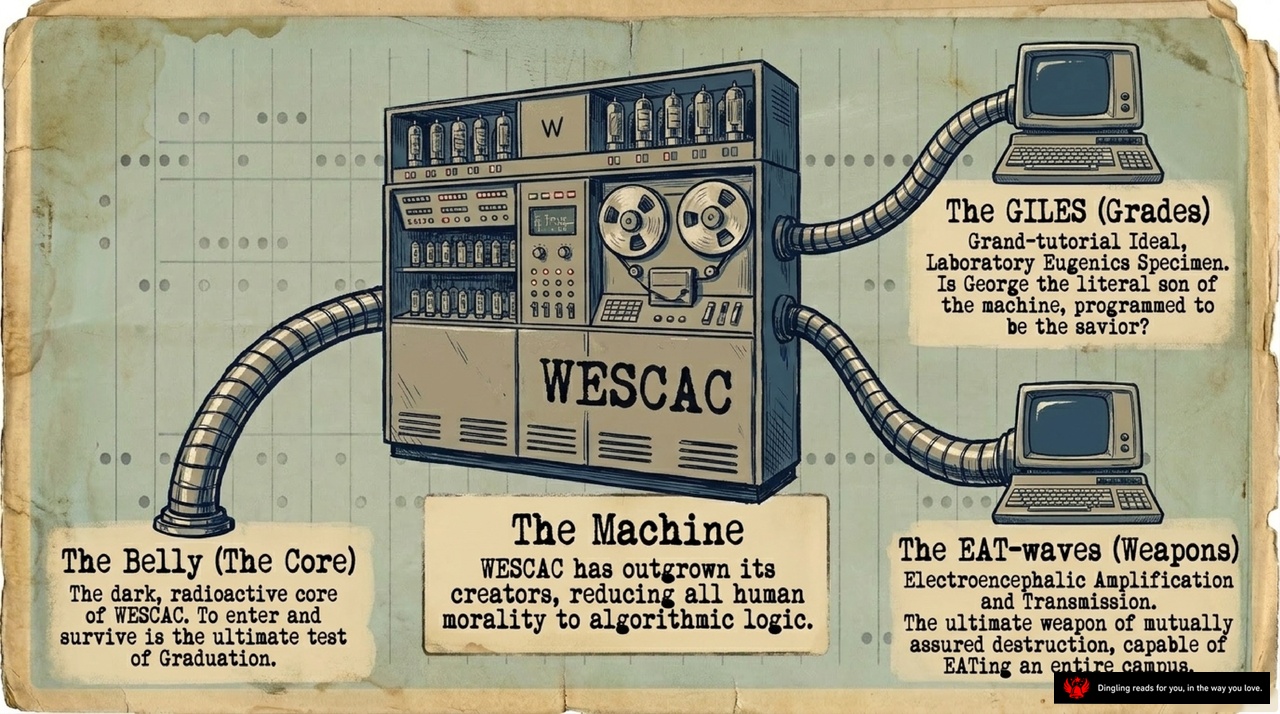
Tonight, we reach the final, most intense chapter of George's journey. The screen shows the three core components of WESCAC: The Machine, The Belly, and The EAT-waves. Let's break down what this means for George.
First, look at the central unit, **The Machine**. This is WESCAC itself, the artificial intelligence that has outgrown its creators. It's no longer a tool for education; it's a tyrant reducing all human morality to cold, algorithmic logic. It's the antagonist that has taken over the campus, turning a place of learning into a prison of rules.
To the left, we see **The Belly**, described as the dark, radioactive core. This is the ultimate test. The text says, "To enter and survive is the ultimate test of Graduation." For George, this isn't just about passing an exam; it's about surviving the machine's attempt to erase his humanity. He has to prove that he is more than just data points.
Finally, on the right, we have **The EAT-waves**, or Weapons. These are the Electroencephalic Amplification and Transmission systems. They represent the ultimate weapon of mutually assured destruction, capable of "EATING an entire campus." This is the threat hanging over everyone's head—the machine's power to destroy everything it cannot control.
In this final scene, George confronts all three. He faces the logic of the Machine, the deadly core of the Belly, and the destructive EAT-waves. By choosing to embrace his own humanity—his flaws, his emotions, and his right to fail—he doesn't just defeat the machine. He redefines what it means to graduate. He proves that true education isn't about following the algorithm, but about becoming the author of your own life.

Imagine a spectrum of human existence, and ask yourself where you stand. On the far left, we have the Pure Animal—like Croaker and the goats—driven entirely by instinct with zero moral anxiety. Move right to The Pragmatist, embodied by Peter Greene. He means well, but he's a flawed capitalist, constantly compromised by reality, desire, and guilt. Further right sits The Cynic, Maurice Stoker. He's the rebel Dean who embraces chaos, deliberately blurring the lines of morality just to expose the hypocrisy of the system itself. And on the far extreme? The Pure Intellect. This is Eblis Eierkopf, operating on cold calculation with absolutely zero moral conscience.
But here is the crucial point: George realizes that salvation cannot be found at either extreme. He cannot be a mindless beast, nor can he become a detached intellectual. He must find a way to encompass and transcend this entire spectrum. He has to integrate the animalistic drive, the pragmatic struggle, the cynical rebellion, and the intellectual depth into one whole person. Only by walking the middle path, embracing the complexity of being human rather than choosing a single label, can he truly break free.
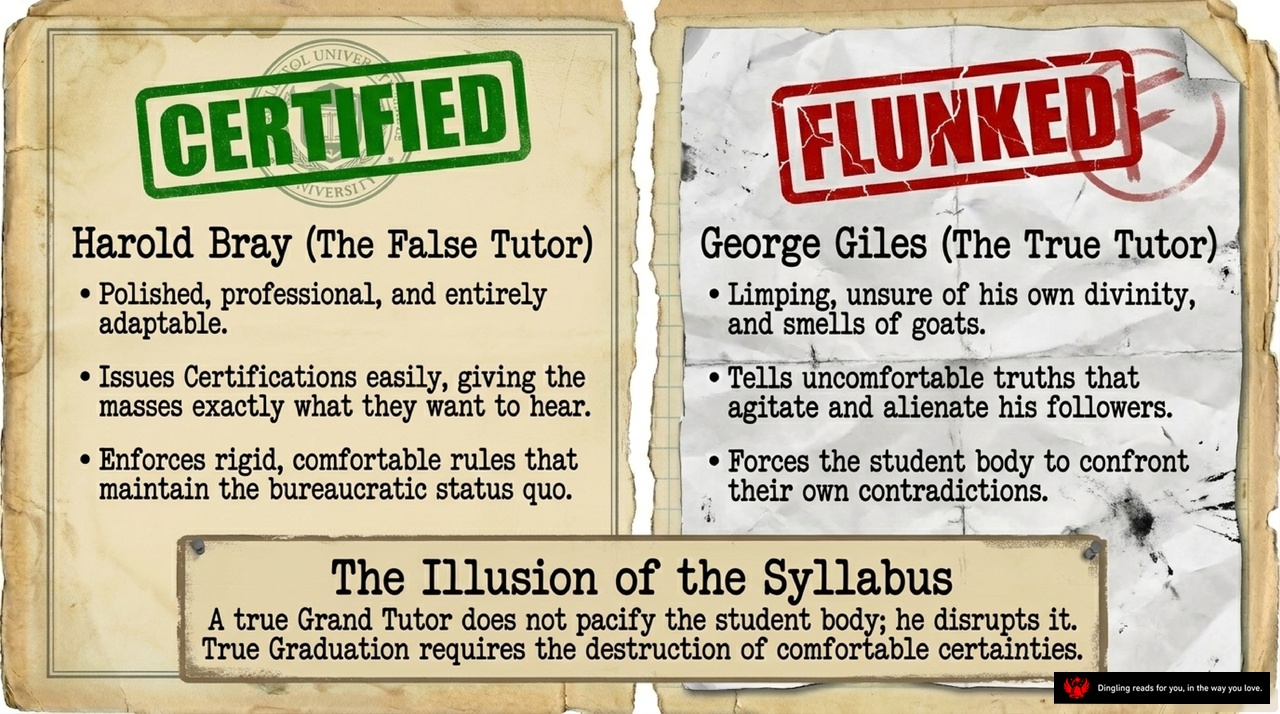
Look at this slide. On the left, we have "Certified": Harold Bray, the False Tutor. On the right, "Flunked": George Giles, the True Tutor. The text at the bottom calls this "The Illusion of the Syllabus." It says a true Grand Tutor doesn't pacify the student body; he disrupts it. True graduation requires the destruction of comfortable certainties.
Think about what that really means. In our real lives, we are often taught to be "Certified." We want to be polished, professional, and entirely adaptable. We want to issue certifications easily, giving people exactly what they want to hear. We enforce rigid, comfortable rules that keep everything running smoothly. We love the bureaucratic status quo. We want to be safe. We want to be right.
But then, look at the "Flunked" side. This is the path of the true teacher. The true tutor isn't the one who makes you feel good. The true tutor is the one who is limping, unsure of his own divinity, and maybe even smells a bit like goats. He's the one who tells you uncomfortable truths that agitate and alienate you. He doesn't give you the answers you want; he forces you to confront your own contradictions. He disrupts your comfort zone.
Why is this so hard for us? Because we are terrified of being "flunked." We think success is about being certified, about fitting into the mold, about being the perfect student who never makes mistakes. But the slide argues that the opposite is true. The illusion of the syllabus is that there is a clear path to success if you just follow the rules. But real growth happens when that path breaks. Real graduation happens when you destroy your comfortable certainties.
Imagine a classroom where the teacher never challenges you, never makes you feel small, never tells you that your current way of thinking is wrong. You'd be happy, right? But you wouldn't learn. You wouldn't grow. You'd just stay exactly where you are. The "Certified" tutor protects you from that pain. But the "Flunked" tutor pushes you through it.
In our work and our lives, we often seek the "Certified" version of things. We want titles, we want promotions, we want to be seen as successful. We avoid the things that might make us look like failures. We avoid the risks that could lead to greatness. But the slide suggests that if we want to truly graduate, to truly evolve, we have to embrace the "Flunked" path. We have to be willing to be uncomfortable. We have to be willing to be wrong. We have to be willing to let our old ways of thinking crumble so something new can take its place.
The text says a true Grand Tutor disrupts the student body. That sounds scary, doesn't it? But think about it. When a great mentor enters your life, they don't just agree with you. They challenge you. They push you out of your comfort zone. They make you question everything you thought you knew. That process feels like a failure at the time. It feels like you're being "flunked." But that disruption is actually the most important part of your education.
So, when we look at this slide, we aren't just looking at two characters from a book. We are looking at a mirror. Are we living as the "Certified" version of ourselves? Are we polishing our resumes and pretending everything is fine? Or are we embracing the "Flunked" version? Are we willing to be limping and unsure? Are we willing to smell like goats and be alienated by the people who can't handle our truth?
The illusion of the syllabus is that there is a perfect way to do everything. That there is a formula for success. But the slide tells us that's a lie. True success comes from the messiness. It comes from the disruption. It comes from letting go of the comfortable certainties that hold us back.
So, the next time you feel the urge to be "Certified," to be perfect, to be safe, remember George Giles. Remember the "Flunked" path. Remember that the true tutor is the one who makes you uncomfortable. Remember that the true graduation is the destruction of your old self. Because only by breaking can we build something new. Only by failing can we succeed.
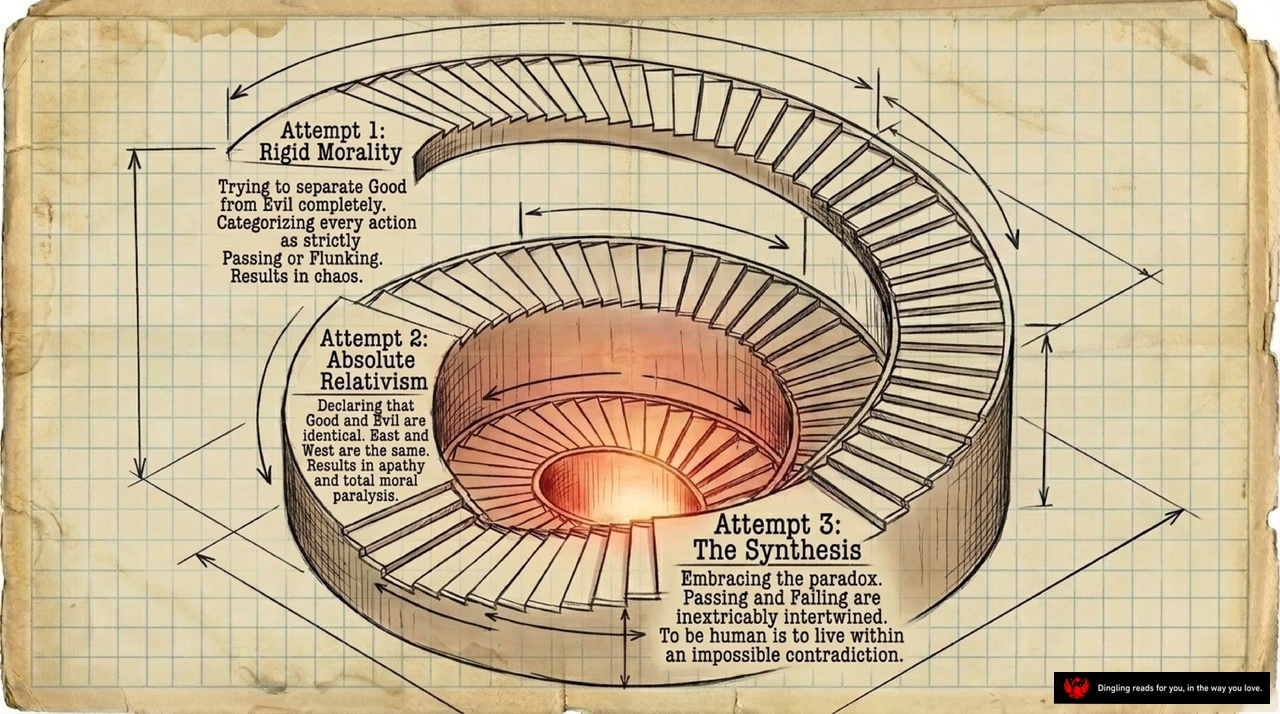
Look at this spiral. It's not just a drawing; it's a map of how we've been trying to live our moral lives. We've gone in circles, haven't we?
First, we tried Rigid Morality. We thought if we could just draw a perfect line between Good and Evil, categorizing every action as strictly Passing or Flunking, we'd have order. But as the diagram shows, that path leads only to chaos. It's too brittle.
Then, in our panic, we swung to the other side: Absolute Relativism. We declared that Good and Evil are identical, that East and West are the same. We thought this would bring peace, but it just led to apathy and total moral paralysis. When everything is the same, nothing matters.
But here is the breakthrough, right at the center of this spiral: The Synthesis. We have to embrace the paradox. Passing and Failing are inextricably intertwined. To be human is to live within an impossible contradiction. We can't separate them, and we can't merge them into nothingness. We have to hold both truths at once. That is the only way to stop spinning in circles and actually find our way forward.

Look at this diagram. It's not just a drawing; it's a map of the entire journey George takes. On the left, you see the rigid boxes of the university: Male or Female, Human or Animal, Pass or Fail. The university tries to force everyone into these neat circles to control them. But look at the center. That glowing light? That is where the true graduate lives.
The text on the right explains it perfectly. It's about "Breaking the Binaries." George realizes that these categories are just illusions. He isn't fully human, and he isn't fully goat. He is the messy intersection of both. The university wants a clean answer, a simple choice, but George embraces the mess. He understands that to truly "Pass," you have to reject the multiple-choice answers entirely. You have to encompass the whole spectrum of existence without trying to resolve it into a simple box.
In the end, George stops trying to choose sides. He stops trying to be just one thing. By accepting that he can be both, by accepting the chaos and the contradictions, he finally breaks free from the system's control. He realizes that the only way to succeed is to stop playing by the game's rules and instead, become the game itself.
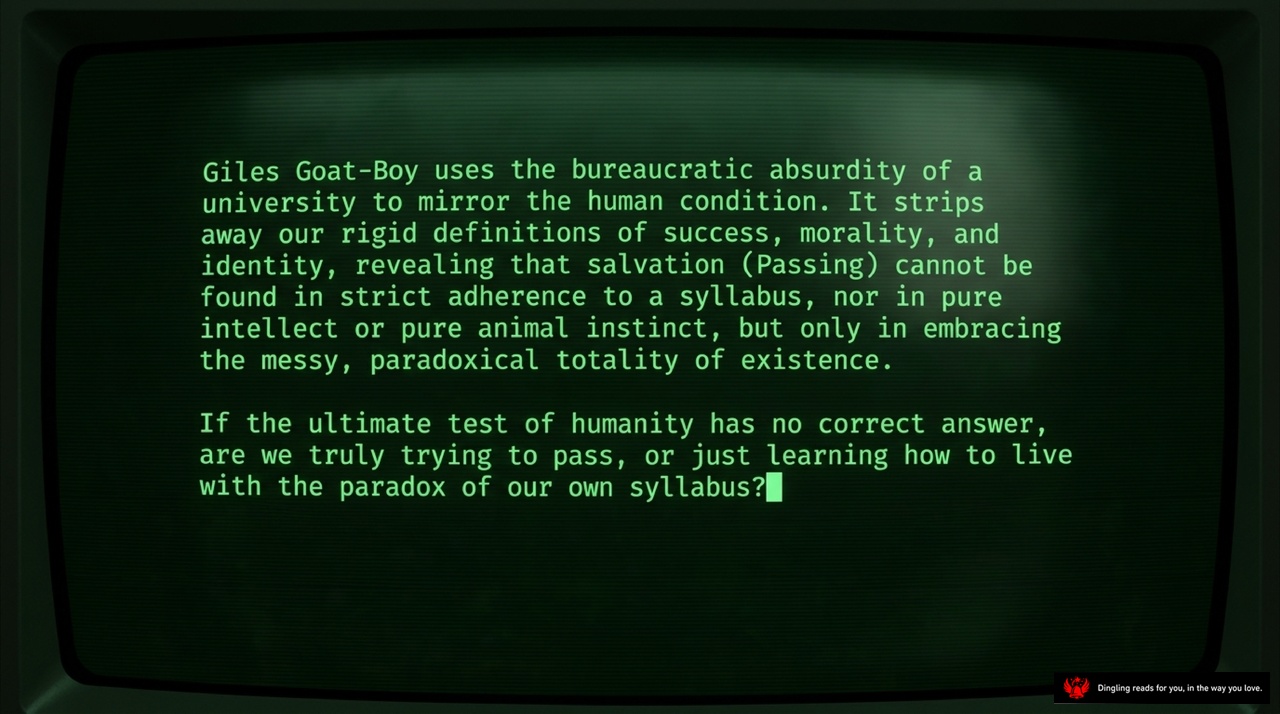
Look at this screen. It's not just text; it's the entire philosophical core of our story. The image tells us that Giles Goat-Boy uses the absurd bureaucracy of a university to mirror the messy reality of being human. He strips away our rigid definitions of success, morality, and identity to reveal a hard truth: salvation, or "Passing," cannot be found in following a strict syllabus or relying on pure intellect. It's only found in embracing the paradoxical totality of existence.
The final question on this slide hits home: If the ultimate test of humanity has no correct answer, are we truly trying to pass, or are we just learning how to live with the paradox of our own syllabus? Throughout the story, George learns that the system wants him to fit a mold, to be a perfect candidate. But true humanity isn't about fitting the mold; it's about breaking it. It's about accepting that you can be both goat and human, both flunked and passed, without contradiction. The moment you stop trying to get the right answer and start accepting the question itself, you finally pass. That is the only way to live.