
Give Me a Girl at Eighteen: Complete Chapter-by-Chapter Summary
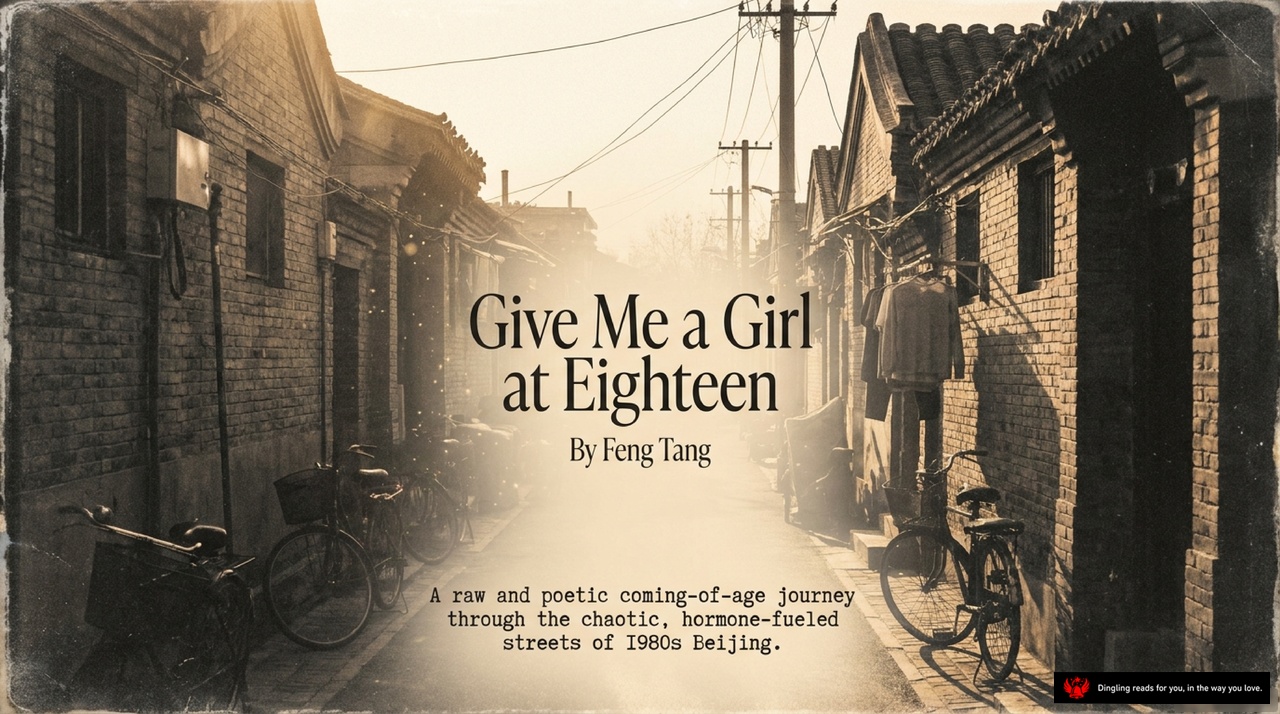
Welcome to *Give Me a Girl at Eighteen*, a raw and poetic journey through the chaotic, hormone-fueled streets of 1980s Beijing.
Imagine this: a narrow alley in an old Beijing neighborhood, bathed in the golden haze of a dusty afternoon. Bicycles lean against weathered brick walls, laundry flutters in the breeze, and the air feels thick with secrets and teenage longing. This isn't just a backdrop—it's the heartbeat of the story.
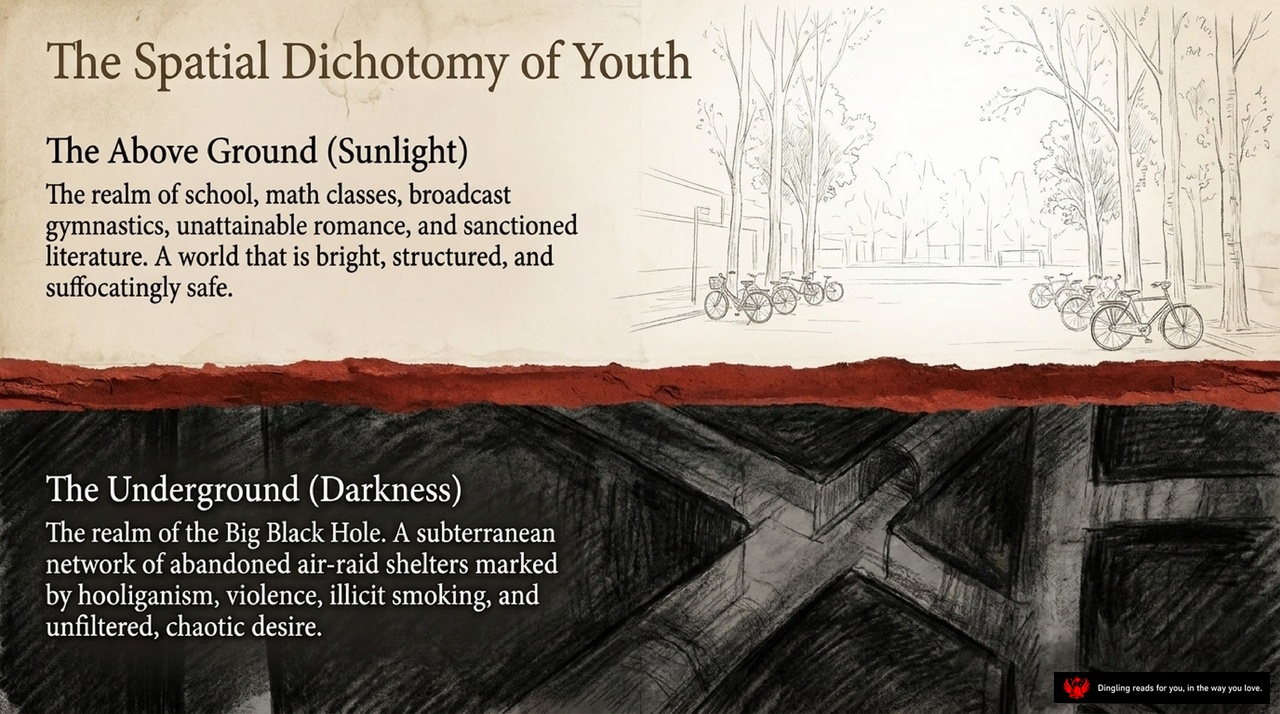
The book follows a young boy navigating a world where adults are either absent or unreliable, and the only real mentors are the "old rougang," or street toughs like Kong Jianguo. These kids aren't just playing; they're exploring a hidden underground world in the city's air-raid shelters, mapping out their territory like explorers, fueled by dreams of power, romance, and rebellion.
It's a coming-of-age tale that doesn't shy away from the messy, often dark realities of youth—curiosity about sex, the thrill of danger, the pain of unrequited love, and the desperate search for identity in a rapidly changing society. Through the eyes of a sensitive narrator, we see how ordinary moments—like watching clothes swing on a neighbor's balcony or sharing a bottle of cheap beer—can become the defining memories of a lifetime.
This is more than a story about growing up; it's a vivid portrait of a generation shaped by history, desire, and the relentless passage of time.
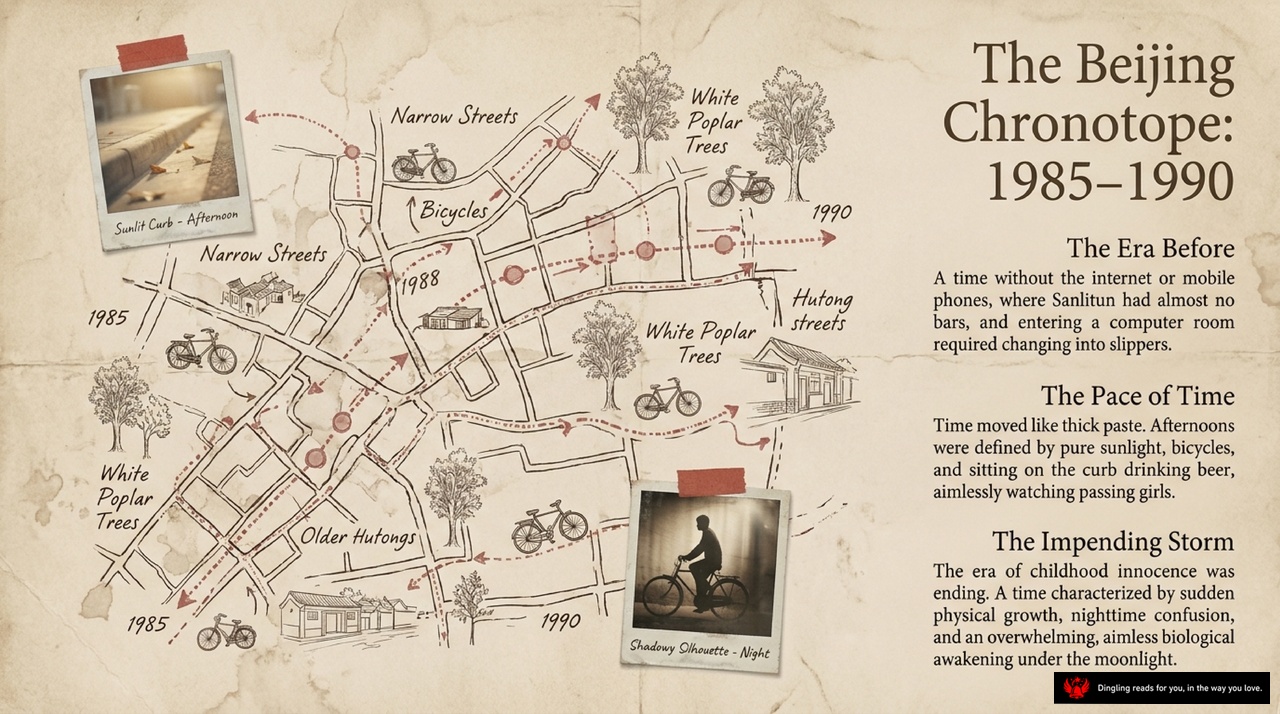
Back in 1985, Beijing wasn't a digital city. It was a place where time moved like thick, slow-moving paste. Forget about texting or social media; the internet didn't exist, and if you wanted to use a computer, you had to change into slippers just to enter the room. This was the era before the internet, where Sanlitun had almost no bars, and life was defined by something else entirely.
Look at this map of Sanlitun from 1985 to 1990. The streets are narrow, winding through old hutongs, lined with iconic white poplar trees and crisscrossed by the paths of bicycles. That was the main mode of transport. Afternoons weren't spent scrolling through feeds; they were spent riding bikes under pure sunlight or sitting on the curb, drinking beer and aimlessly watching girls pass by. It was a time of childhood innocence, a slow-paced existence that felt almost timeless.
But as we move toward 1990, the vibe shifts. The map shows the same streets, but the atmosphere changes. The era of innocence was ending, replaced by a sudden physical growth and nighttime confusion. An impending storm was brewing—a time characterized by an overwhelming, aimless biological awakening under the moonlight. The simple days of watching girls from a distance were about to give way to a much more complex, chaotic reality.

Look at this split image. On the left, we see the "Crude Exterior"—a teenage hooligan navigating street fights, trading illicit magazines, and adopting a tough, cynical look just to survive the harsh hierarchy of Beijing youth. On the right, there's the "Sensitive Poet"—a literary observer who secretly escapes into the Complete Tang Poems, quoting classical literature from memory to view the world through a deeply poetic, fatalistic lens.
This is the duality of Qiu Shui, the "Poetic Hooligan." He is a boy whose physical reality demands violence and lust, yet whose soul is anchored in the delicate melancholy of ancient poetry.
Think about how many of us wear a mask to the world. Qiu Shui lived that double life perfectly. By day, he was the rough street fighter, the guy with the scars and the cynicism. But by night, or in secret, he was a scholar, finding comfort and meaning in the lines of Du Mu and Li Bai. It's a fascinating contradiction: using the chaos of the streets to fuel a mind that craves the quiet order of classical verse. He wasn't just a gangster; he was a guardian of culture in a place that often tried to erase it. That's the real tragedy and beauty of his story—he held onto the soul of the past while fighting for survival in a brutal present.
Picture this: you're in a classroom, the air thick with the scent of chalk dust and teenage anxiety. On the blackboard, the teacher has written "Happy New Year" in bright, chaotic colors. But beneath that festive facade, there's a different story playing out.
Look at the girls performing their modern dance. They've taken off their outer layers, revealing tight white socks and black leotards. They move with sharp, synchronized precision, arms stretching into the air like they're reaching for something just out of reach. To the boys in the corner, it's not just a performance; it's a spectacle. Amidst the flashing red and purple lights, they're staring at the developing curves of their classmates—those first, shy contours of breasts and hips that feel both familiar and entirely new.
Then there's Zhang Guodong, our protagonist's best friend. He's got a plan. He walks over to Zhu Shang, the girl everyone seems to be quietly obsessed with, and asks her to dance. She hesitates, then stands up. In that moment, Zhang Guodong looks different—cleaner, sharper, almost handsome in his yellow suit and cone-shaped pants. He's the one who breaks the ice.
But while the music plays and the boys try their clumsy best, the real drama is brewing in the shadows. The teacher has left early, and the girls, now fully transformed with makeup and perfume, suggest they dance some more. It's a secret world within the classroom, a space where rules seem to bend. The boys watch, mesmerized, imagining what it would be like to be part of that inner circle, to hold hands, to feel that electric connection.
This isn't just about a school party. It's about the first time these teenagers truly confront the idea of romance, the physical awakening that comes with it, and the terrifying, exhilarating desire to cross that line between friends and lovers. They are standing on the edge of adulthood, watching their peers dance, wondering if they have what it takes to join in.

Look at this slide. It introduces Kong Jianguo, the "Underground Mentor," and defines his archetype as the "Old Hooligan"—a warped father figure dispensing forbidden knowledge on fighting and survival. Notice his key attributes: a pale face with a knife scar, perpetually smoking Daqianmen cigarettes, and a personality that is deeply cynical yet philosophically profound.
But the most critical part here is his "Ultimate Obsession." Driven by the memory of a peerless beauty—Zhu Shang's mother—Kong teaches the boys a dangerous lesson: that a man must find a woman who makes him willing to risk everything. He frames base adolescent desire as a noble, tragic quest. This is the core of his teachings.
In the book, Kong Jianguo tells a story about Zhu Shang's mother, born in the arid, harsh region of Mishi. He describes her as a woman whose beauty was so intense it could "dry up the moisture from the land," forcing men to carry knives just to find water. She was a force of nature, a woman who could make any man from sixteen to sixty feel an overwhelming, almost violent desire.
Kong's obsession wasn't just about lust; it was about transforming that raw, animalistic drive into something epic. He wanted to show the boys that true masculinity involves finding that one woman who triggers this total commitment, turning their teenage yearning into a heroic, albeit tragic, mission. This philosophy haunted the narrator, making him wonder if he could become such a "hero" and if, one day, a girl would rush into his arms like the legendary woman Kong spoke of.
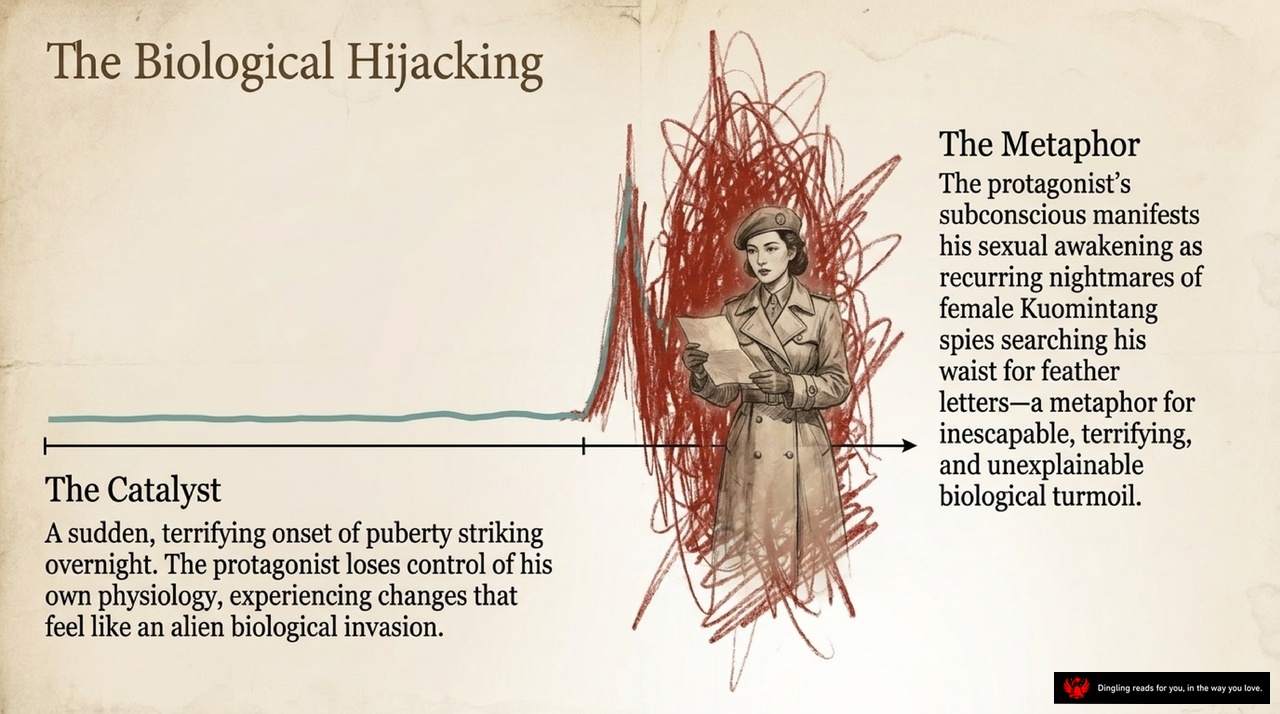
The Biological Hijacking. Look at this timeline. It starts flat, calm, but then—boom. A sudden, terrifying spike. This is the catalyst: puberty hitting the protagonist like an alien invasion overnight. He loses control of his own body, feeling like an invader is taking over. To make sense of this chaos, his subconscious creates a metaphor. Suddenly, his sexual awakening transforms into recurring nightmares of female Kuomintang spies frantically searching his waist for hidden feather letters. It's a brilliant, twisted way to express that inescapable, terrifying biological turmoil. He's not just growing up; he feels hijacked.

Look at this sketch of Zhu Shang. She isn't just a girl; she's the ultimate muse, an unattainable ideal that represents pure aesthetic perfection. In the protagonist's mind, she is as pale and delicate as a chrysanthemum, a symbol of something he can never quite reach.
Notice her aura. It's described as faintly smelling of clean soap and laundry detergent, with smooth, dark hair cascading over her shoulders. This isn't just a visual detail; it's a constant source of paralyzing, poetic longing. Every time he sees her, that scent and that sight freeze him in place, creating a distance that feels impossible to cross.
But here's the tragic twist: she is also the catalyst. She is an illusion, an aesthetic trigger that awakens overwhelming desire in him, yet she remains emotionally distant. When he makes his deepest confessions, she doesn't respond with warmth. Instead, she offers a cold, dismissive "Is that so?" She triggers the fire, but she never stays to warm him. She is the dream that keeps him awake, beautiful and untouchable, forever just out of reach.

Look at this slide: "Illusion vs. Reality." On the left, we have Zhu Shang, representing the Illusion—ethereal, distant, and silent. He triggers poetic longing but also existential dread. He's that unattainable, idealized version of youth that exists only in our minds. On the right stands Cui'er, the Reality. She's grounded, authentic, and physically present. She's the one who warmly holds his hand and teaches him how to roller-skate. She represents the tangible, messy, and deeply comforting reality of actual human connection.
Here's the synthesis: The tragedy of youth is often obsessing over this cold illusion while taking the warm reality for granted. We spend so much time chasing the perfect girl in our heads, ignoring the real girl right in front of us who can actually hold our hand and share our life.
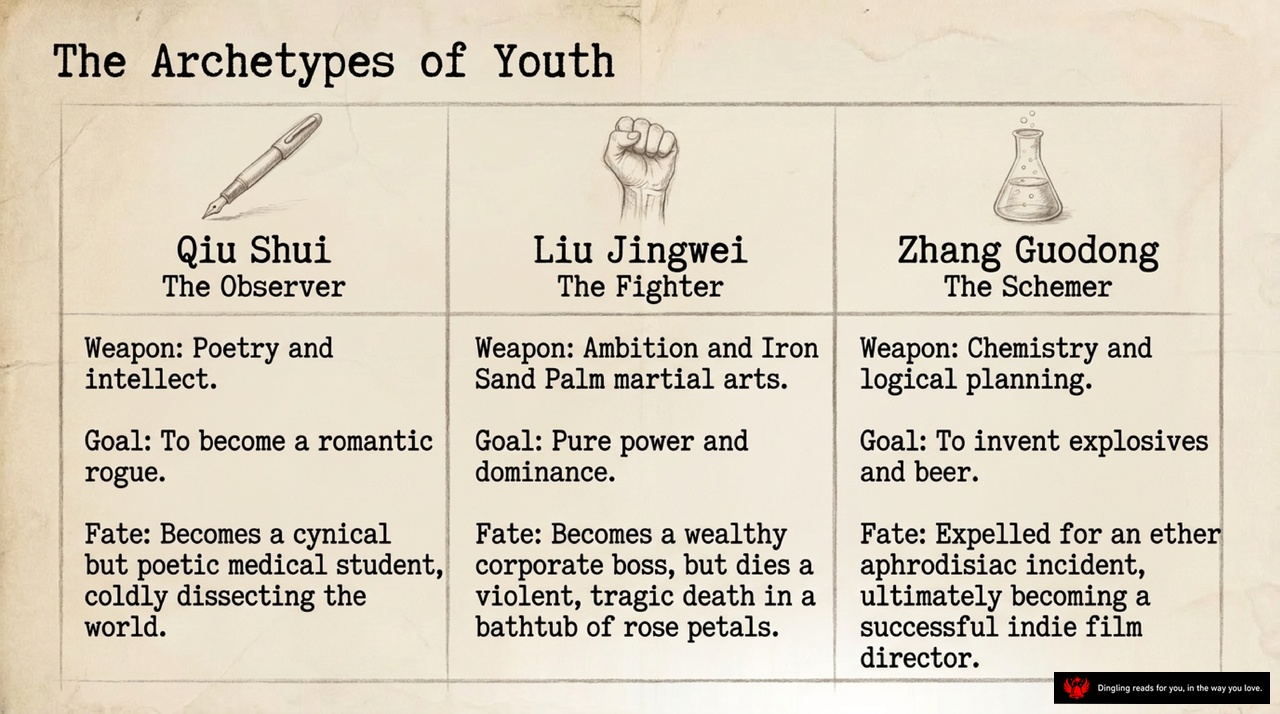
So, let's talk about the three distinct archetypes of youth that defined our world back then. We had Qiu Shui, the Observer, whose weapon was poetry and intellect. His goal? To become a romantic rogue. But his fate? He ended up a cynical, poetic medical student, coldly dissecting the world. Then there was Liu Jingwei, the Fighter. His weapon was ambition and Iron Sand Palm martial arts. He chased pure power and dominance, but his fate was a violent, tragic death in a bathtub of rose petals. Finally, we had Zhang Guodong, the Schemer. His weapon was chemistry and logical planning. He wanted to invent explosives and beer, and while he was expelled for an ether aphrodisiac incident, he ultimately became a successful indie film director. These weren't just characters; they were the blueprints for how we all tried to navigate a chaotic, uncertain world.

Look at this diagram. It captures the raw, chaotic energy of 80s adolescence perfectly. At the center, we have that overwhelming "Hormonal & Societal Pressure"—the unbearable weight of growing up when the world feels rigid and confusing.
But here's the key: that pressure didn't just crush them; it forced them to find outlets. And look at these four arrows. First, **Violence**. For kids like the narrator, asserting dominance through brutal street fights was a way to burn off that excess kinetic energy. It was their version of power.
Then there's **Illicit Media**. Think about the underground magazines, the smuggled contraband. In the book, Qiu Shui trades a rare magazine just to get a specific seat next to Zhu Shang. It wasn't just about reading; it was a currency, a secret language, a way to feel connected in a world that felt cold.
Next, **Intellectual Defiance**. This is where the rebellion gets clever. Mastering classical literature, writing subversive poetry, or secretly reading Henry Miller during math class. It was about claiming a mind that society wanted to control, finding freedom in words and forbidden ideas.
And finally, **Escapism**. The aimless nighttime cycling and roller-skating. Constantly moving, just to outrun the crushing boredom of the era. It wasn't about going somewhere; it was about proving they could move faster than the stagnation around them.
So, whether it was fighting, trading secrets, writing poetry, or running into the night, these were all the same thing: the desperate, creative ways a generation released the pressure of their time.
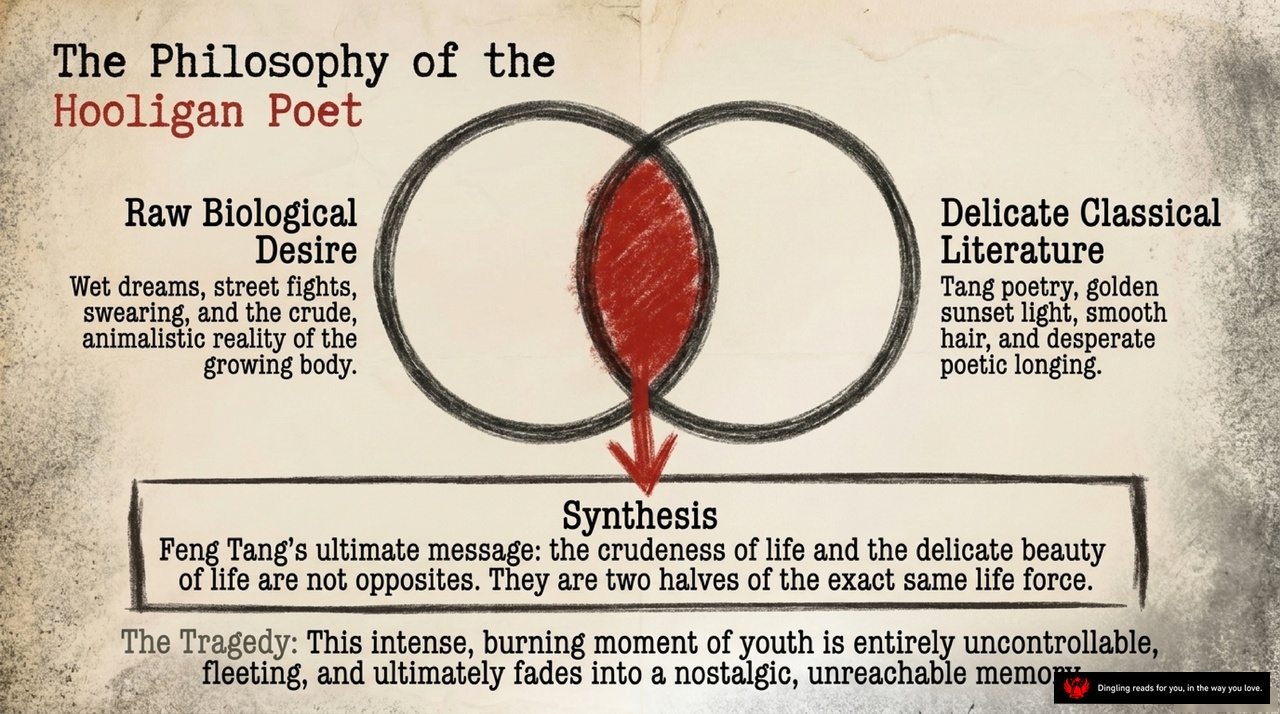
The Hooligan Poet's philosophy isn't about choosing between the gritty and the graceful; it's about realizing they are one and the same. Look at this Venn diagram: on the left, we have "Raw Biological Desire"—wet dreams, street fights, swearing, and that crude, animalistic reality of a growing body. On the right, we have "Delicate Classical Literature"—Tang poetry, golden sunset light, smooth hair, and that desperate, poetic longing.
Feng Tang's ultimate message, found right in this synthesis, is that the crudeness of life and its delicate beauty are not opposites. They are two halves of the exact same life force. Think about the narrator's own journey: he starts chasing the "raw" side, obsessing over the underwear on the neighbor's balcony, trying to trade magazines for a seat next to Zhu Shang, and even smashing a man's head with a broken soda bottle to save her. That is the raw, burning moment of youth.
But then comes the tragedy. This intense, burning moment is entirely uncontrollable and fleeting. It doesn't last forever. Eventually, that wild, hooligan energy fades into a nostalgic, unreachable memory. We grow up, we stop chasing girls in the alleyways, and we become the "classical" figures we once mocked. The hooligan poet dies inside us, leaving only the quiet, sometimes hollow, reflection of who we used to be.
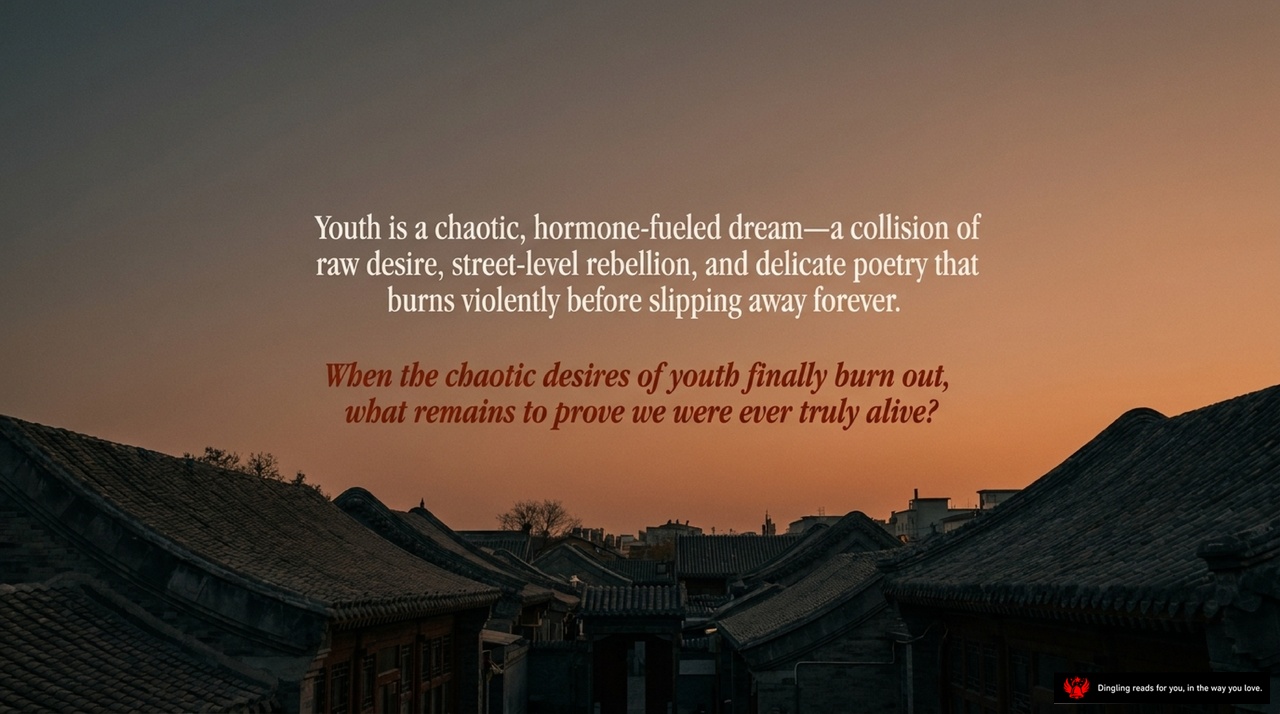
Youth is often described as a chaotic, hormone-fueled dream—a wild collision of raw desire, street-level rebellion, and delicate poetry that burns violently before slipping away forever. But when those chaotic desires finally burn out, what remains to prove we were ever truly alive?
In my story, that proof wasn't found in grand achievements, but in the quiet, desperate moments of trying to be someone else. I remember standing on the school rooftop, looking at the girls in their uniforms, feeling like a fraud. My friends had their own paths: one wanted to be a director, another a scientist, and I just wanted to be a "flower thief," saving Europe from its ignorance. It was a delusion, a fantasy built on thin air, yet it felt like the only way to exist.
We were all running from something, chasing an ideal version of ourselves that we couldn't quite grasp. I wrote poems about love and loss, dreaming of a world where my feelings mattered. But reality was harsh. When I finally confessed my feelings to the girl I admired, the silence that followed was deafening. It wasn't a rejection; it was a realization that the person I wanted to be and the person I was were two different people, and bridging that gap was impossible.
In the end, we all grew up, leaving behind those dreams and the people who defined them. We became adults, navigating a world that didn't care about our poetry or our rebellions. But sometimes, late at night, I still wonder: was that chaotic dream worth it? Did it leave any mark on the world, or was it just a fleeting moment of madness in a sane world?