
Globalization and Its Discontents: Complete Chapter-by-Chapter Summary
Welcome to our deep dive into the complex world of globalization. Today, we're exploring the core thesis of Joseph E. Stiglitz's groundbreaking work, *Globalization and Its Discontents*. As the title suggests, this isn't just a celebration of open borders and free markets; it's a critical diagnosis of a system that has become rigged against ordinary people.
The book promises a clear look at how our current global economy favors corporate interests over citizens. We see the dangers of a populist backlash, where anger isn't directed at the market itself, but at a specific, broken model of globalization that has left the middle class behind. Stiglitz argues that while trade can boost productivity, the way we manage it has created deep inequality, fueled crises like the one in 2008, and allowed massive corporations to overpower nations.
The solution isn't to retreat into isolation, but to rewrite the rules. We need a new blueprint that serves citizens, protects the environment, and ensures that the benefits of global trade are shared fairly. This session will guide you through the arguments for why the old rules failed and how we can build a globalization that truly works for everyone.

Look at this striking blueprint of the "Architecture of Inequality." It visually lays out a brutal truth: modern globalization isn't an accident of the market; it's a carefully engineered machine designed to lift the 1% while crushing everyone else.
On the left, you see the heavy weights of Multinational Corporations and Financial Elites, supported by Trade Pacts, IP Laws, and Tax Havens. These aren't just abstract concepts; they are the rules written by and for the wealthy. On the right, the scale tips heavily downward, crushing Ordinary Citizens. The image shows urban decay and deindustrialization as the direct result of this imbalance.
The text on the right explains the mechanism clearly. "The Promise" was that free markets would lift all boats through the trickle-down effect. But "The Reality" is that the system functioned exactly as engineered to maximize corporate profits, depress wages globally, and pit nations against each other in a race to the bottom. This has created a "System Failure" where the load is insufficient for ordinary people, leading to what we see today: a conflict that is no longer just Rich Nations versus Poor Nations. It is a global corporate war against ordinary workers everywhere.
This graphic perfectly captures why so many are angry. It's not about hating trade itself, but realizing that the rules have been rigged to favor the elite at the expense of the middle class and the working poor. The architecture of inequality is real, and it is built on foundations that are cracking under the weight of the global economy.
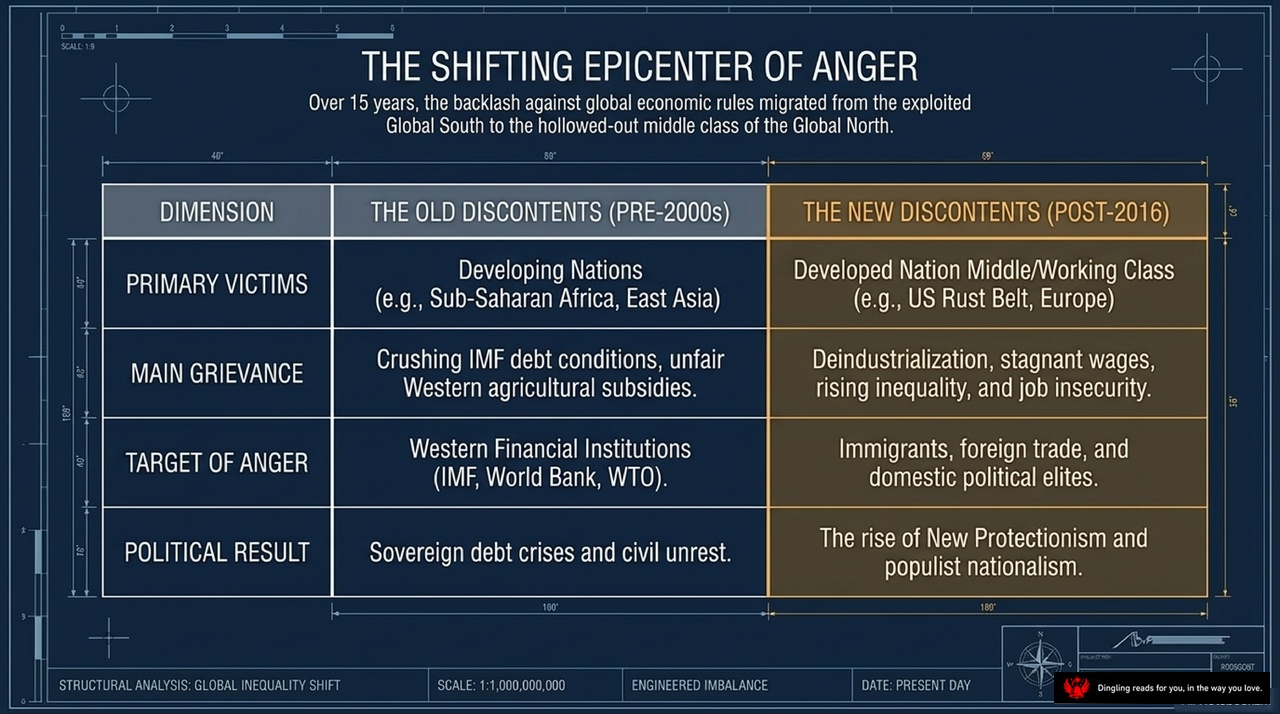
Over the last fifteen years, the epicenter of global anger has shifted dramatically. It has migrated from the exploited nations of the Global South to the hollowed-out middle class of the Global North. This slide, titled "The Shifting Epicenter of Anger," breaks down exactly how this transformation happened across four key dimensions.
Look at the first column, "Primary Victims." Before the 2000s, the backlash was centered on developing nations like Sub-Saharan Africa and East Asia. Today, the anger has moved to the developed world, specifically targeting the middle and working classes in places like the US Rust Belt and Europe.
This shift explains the second dimension, "Main Grievance." In the past, people were angry about crushing IMF debt conditions and unfair Western agricultural subsidies. Now, the complaints are domestic: deindustrialization, stagnant wages, rising inequality, and the fear of job insecurity.
Consequently, the "Target of Anger" has changed. Previously, the blame was placed on Western financial institutions like the IMF, World Bank, and WTO. Now, the anger is directed inward at immigrants, foreign trade, and domestic political elites.
Finally, look at the "Political Result." The old discontent led to sovereign debt crises and civil unrest in the developing world. The new discontent, however, has fueled the rise of new protectionism and populist nationalism right here in the developed world.
Understanding this shift is crucial because it shows that the backlash against globalization isn't about the concept itself, but about how the benefits have been distributed. The rules have changed, and the people who feel left behind are now voting with their feet, demanding a system that works for everyone, not just the elite.
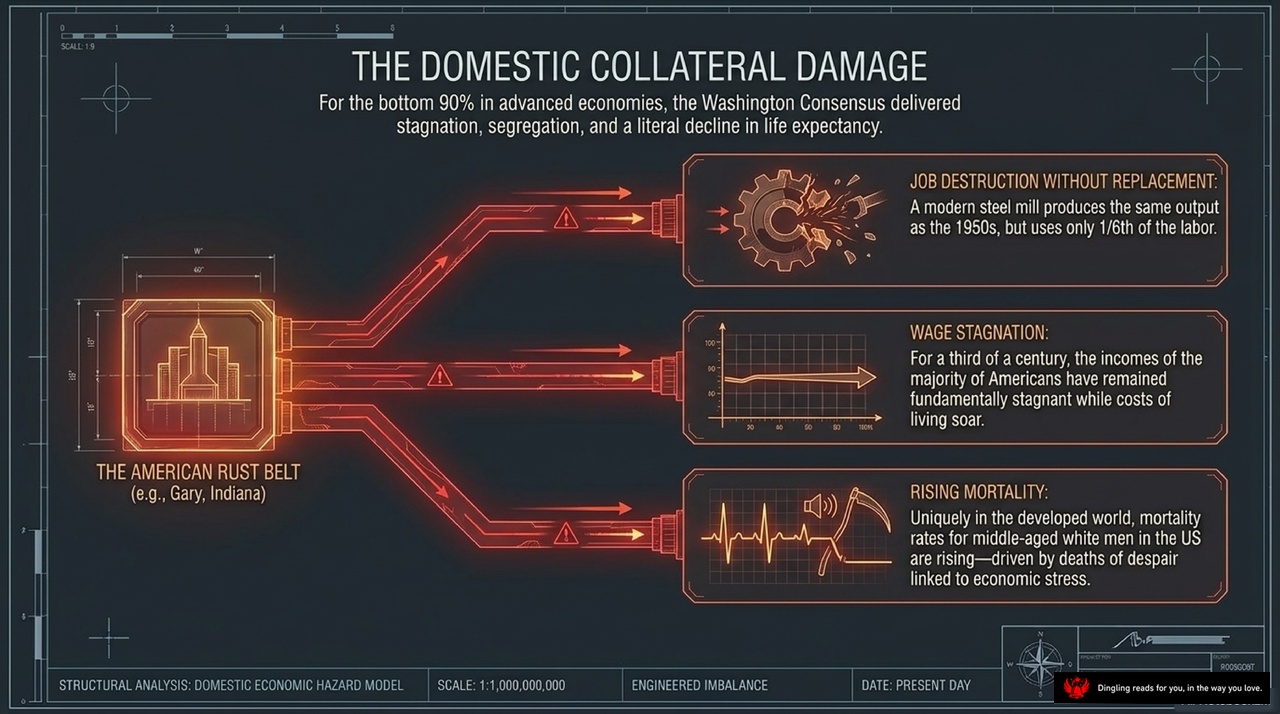
Look at this blueprint of "Domestic Collateral Damage." It illustrates a terrifying reality: for the bottom 90% of people in advanced economies, the Washington Consensus didn't bring prosperity. Instead, it delivered stagnation, deep segregation, and a literal decline in life expectancy. The diagram traces this disaster back to the American Rust Belt, using Gary, Indiana as a grim example of what happens when the system fails.
The flowchart highlights three specific mechanisms of this destruction. First, we see "Job Destruction Without Replacement." The graphic shows a gear shattering, symbolizing how a modern steel mill can produce the exact same output as one from the 1950s but using only one-sixth of the labor. Technology advanced, but it didn't create new jobs for the displaced workers; it simply destroyed them.
Second, the chart points to "Wage Stagnation." The line graph shows incomes flatlining while living costs soar. For a third of a century, the majority of Americans have seen their wages stay stuck while the cost of everything around them skyrocketed. This wasn't an accident; it was a structural feature of the era.
Finally, the most heartbreaking consequence is "Rising Mortality." The icon of a heart monitor flattening into a scythe captures a unique phenomenon in the developed world: mortality rates for middle-aged white men in the US are actually rising. This isn't natural aging; it's driven by "deaths of despair" directly linked to the economic stress and hopelessness caused by these policies.
This visual tells us that globalization, as it was managed, became a tool for extracting value from the many to enrich the few, leaving entire communities behind in a state of economic and physical decline.
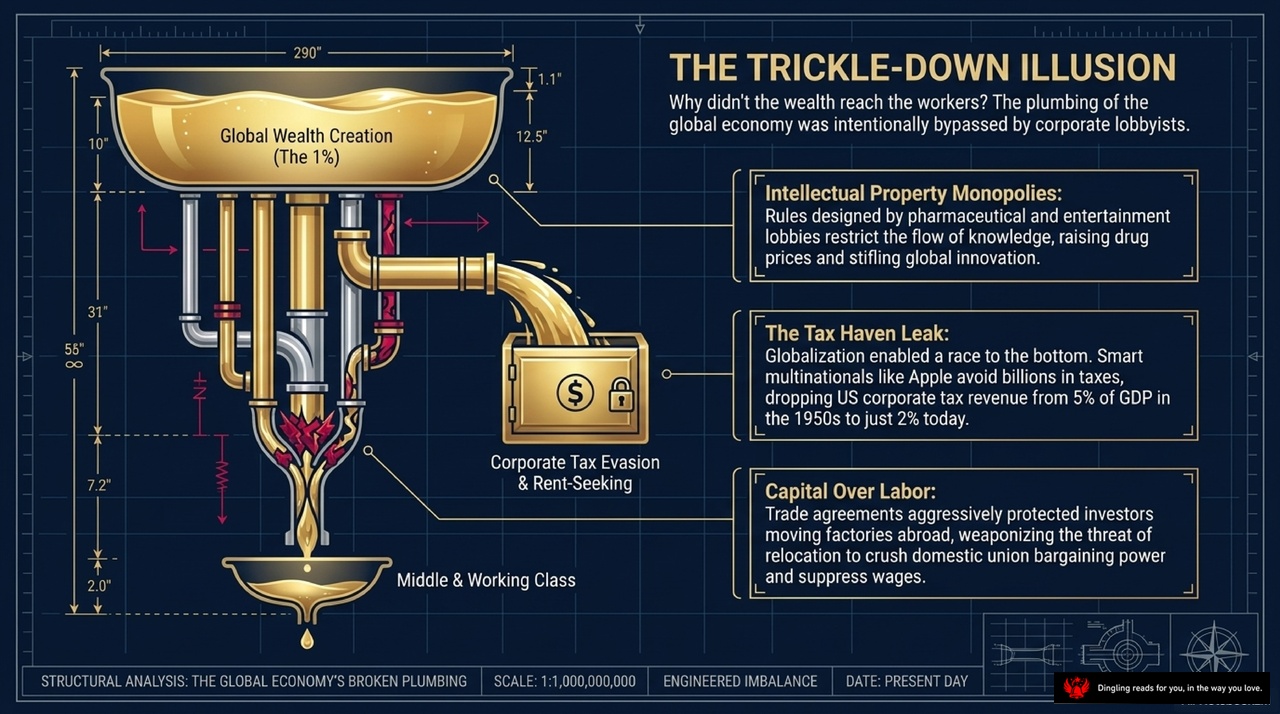
The global economy isn't a natural river that flows evenly to everyone; it's a plumbing system that has been intentionally broken. As this slide illustrates, we are currently trapped in the "Trickle-Down Illusion," where the vast majority of wealth creation is being siphoned away before it ever reaches the workers.
Look at the top of this diagram: the "Global Wealth Creation" bowl, representing the top 1%, is overflowing. But instead of trickling down to the Middle and Working Class at the bottom, the pipes are clogged and rerouted by corporate lobbyists. The first major leak is Intellectual Property Monopolies. Rules designed by powerful pharmaceutical and entertainment lobbies restrict the flow of knowledge, artificially raising drug prices and stifling innovation so that profits stay at the top rather than funding affordable healthcare for everyone.
Next, we see the "Tax Haven Leak." Through globalization, smart multinational corporations have engaged in a race to the bottom. Giants like Apple exploit loopholes to avoid billions in taxes, dropping U.S. corporate tax revenue from 5% of GDP in the 1950s to just 2% today. This money vanishes into offshore accounts instead of funding public services.
Finally, the diagram highlights "Capital Over Labor." Trade agreements have been weaponized to protect investors over workers. By threatening to move factories abroad, corporations have crushed domestic union power and suppressed wages. The result is a broken system where the economy grows, but the benefits are engineered to bypass the very people who build it. We aren't seeing a failure of the market; we are seeing the success of a rigged game.
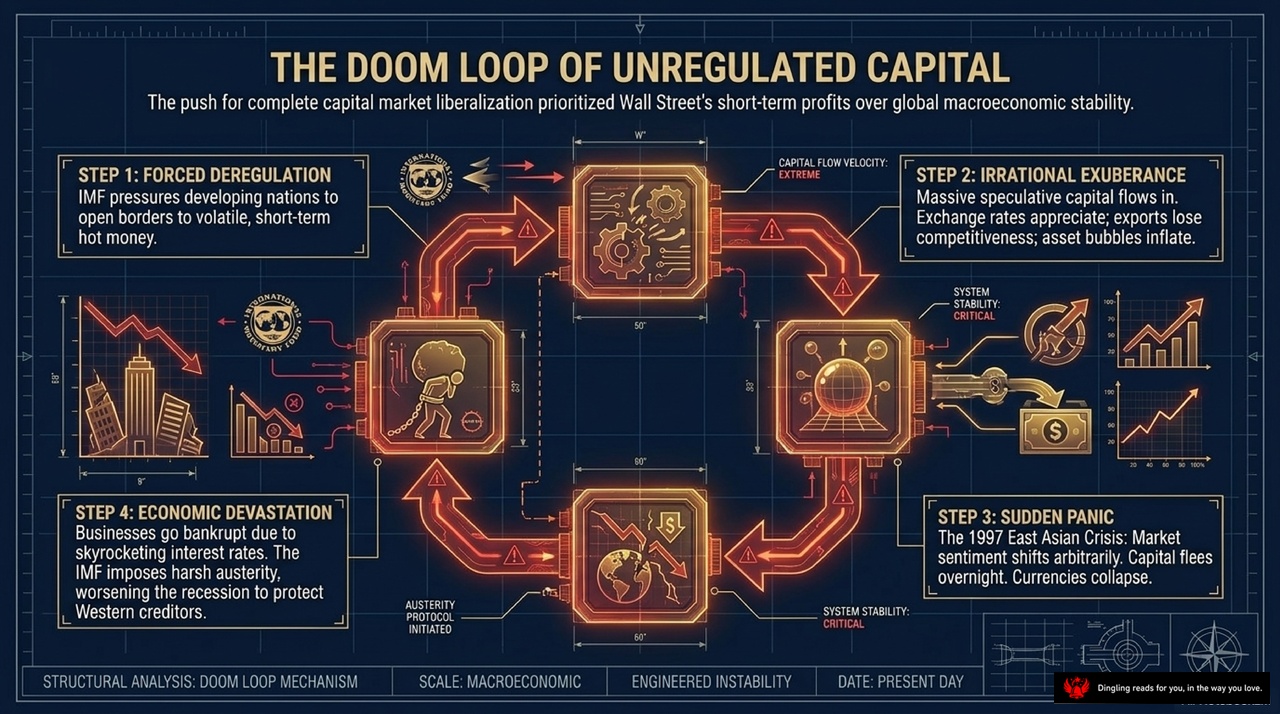
The Doom Loop of Unregulated Capital isn't just a theoretical concept; it's a historical blueprint that explains how short-term greed can destroy global stability. Look at this diagram: it starts with **Forced Deregulation**, where institutions like the IMF pressure developing nations to open their borders to volatile, short-term "hot money." This influx of capital creates **Irrational Exuberance**. As money floods in, currencies appreciate, making exports uncompetitive and inflating asset bubbles.
But this boom is built on sand. Suddenly, sentiment shifts, and we hit **Sudden Panic**. The 1997 East Asian Crisis is the perfect example: capital fled overnight, currencies collapsed, and the system became critically unstable. When the bubble bursts, **Economic Devastation** follows. Businesses go bankrupt due to skyrocketing interest rates, and the IMF imposes harsh austerity measures to protect Western creditors, worsening the recession.
The core lesson here is clear: the push for complete capital market liberalization prioritized Wall Street's short-term profits over global macroeconomic stability. Unregulated capital flows are a recipe for engineered instability, proving that without proper rules, globalization can become a machine for creating crises rather than opportunities.
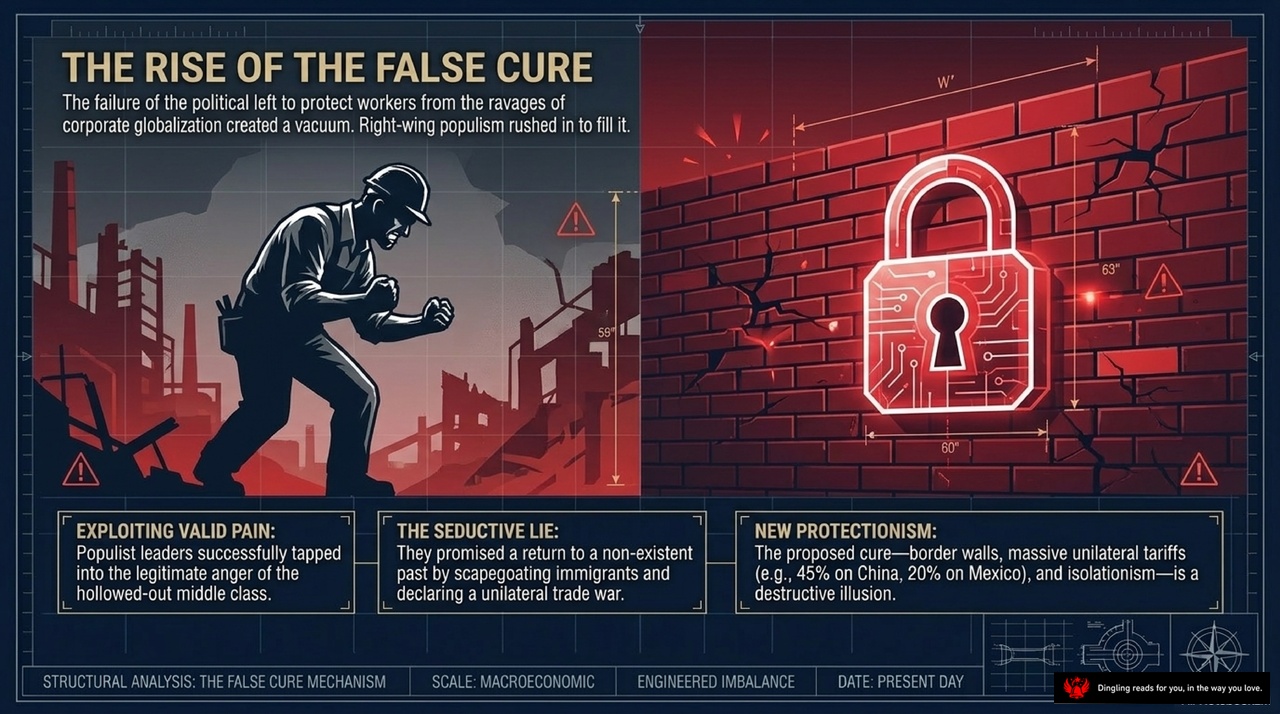
Look at this striking image titled "The Rise of the False Cure." It captures a critical moment in our economic story: the failure of the political left to protect workers from corporate globalization created a dangerous vacuum, which right-wing populism rushed to fill. On the left, we see a worker in a crumbling industrial landscape, symbolizing the hollowed-out middle class whose legitimate anger was exploited by populist leaders. They promised a seductive lie—a return to a non-existent past by scapegoating immigrants and declaring a unilateral trade war. On the right, a glowing digital lock is bolted onto a cracked brick wall, representing the proposed cure of new protectionism. This includes border walls, massive unilateral tariffs like the 45% on China or 20% on Mexico, and isolationism. But as the graphic clearly states, this is a destructive illusion. The real problem isn't globalization itself, but the rules we built to manage it. Instead of fixing the system to serve ordinary citizens, we've been sold a false cure that only deepens inequality and harms everyone.
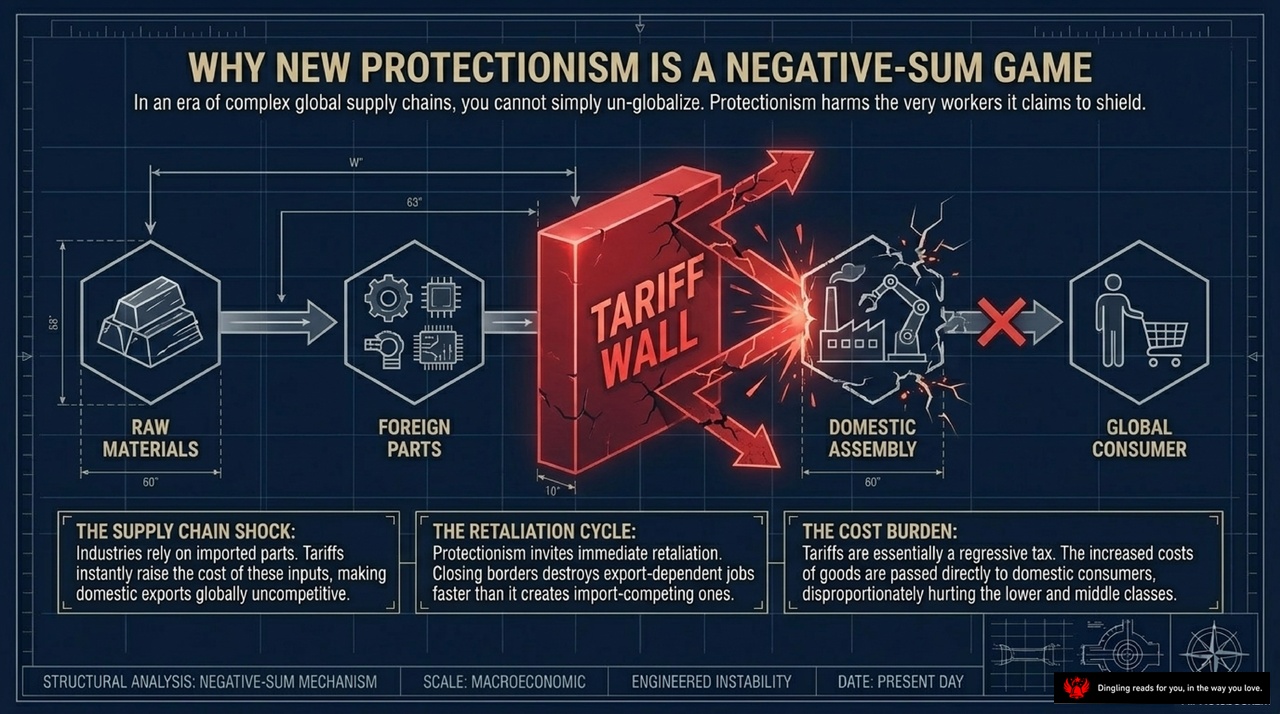
Look at this "Tariff Wall" blocking the flow of our global economy. It's designed to stop raw materials and foreign parts from reaching our domestic assembly lines, but the result is a broken system that hurts everyone.
When we build these protectionist barriers, we create a massive supply chain shock. Industries rely on imported parts to stay competitive, and suddenly raising their costs makes our exports globally uncompetitive. We aren't just protecting our jobs; we're inviting an immediate retaliation cycle where closing borders destroys export-dependent jobs faster than we can create new ones.
But the real victim here is the consumer. Tariffs act as a regressive tax, pushing the increased costs of goods directly onto domestic shoppers. This disproportionately hurts the lower and middle classes, while the very workers these policies claim to shield end up paying more for everything they buy. In an era of complex global supply chains, you simply cannot un-globalize. New protectionism isn't a shield; it's a negative-sum game that harms the very people it promises to save.
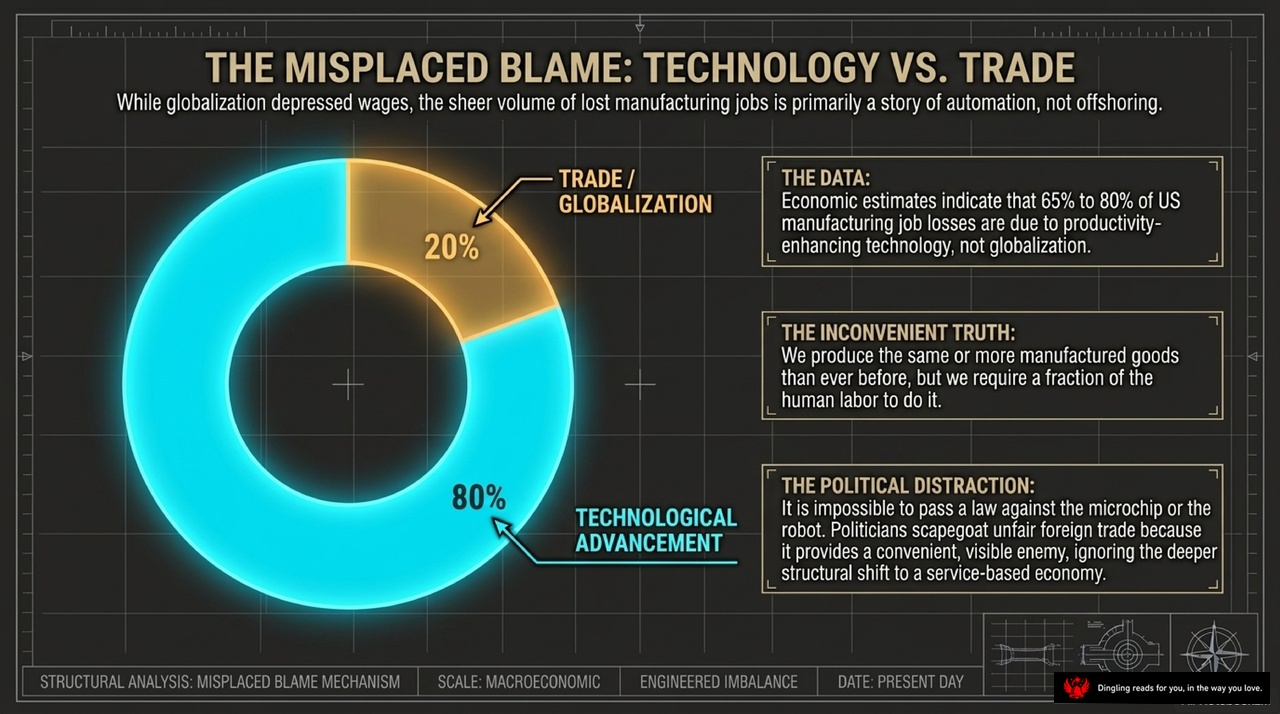
Look at this striking chart titled "The Misplaced Blame: Technology vs. Trade." It cuts through the noise of modern political debate to reveal a harsh but necessary truth: while we often blame globalization for lost jobs, the reality is that technology is the real culprit. The data is clear—economic estimates show that 65% to 80% of U.S. manufacturing job losses are driven by productivity-enhancing technology, not offshoring.
This is the inconvenient truth we often ignore. We actually produce more manufactured goods than ever before, yet we require a fraction of the human labor to do it. Automation and robotics have simply made our factories leaner and more efficient. Meanwhile, the 20% slice labeled "Trade/Globalization" represents a convenient scapegoat. It is impossible to pass a law against a microchip or a robot, so politicians often scapegoat unfair foreign trade because it provides a visible enemy. This political distraction ignores the deeper structural shift to a service-based economy and the reality that we've engineered an imbalance where machines replace workers, regardless of where those machines are built.
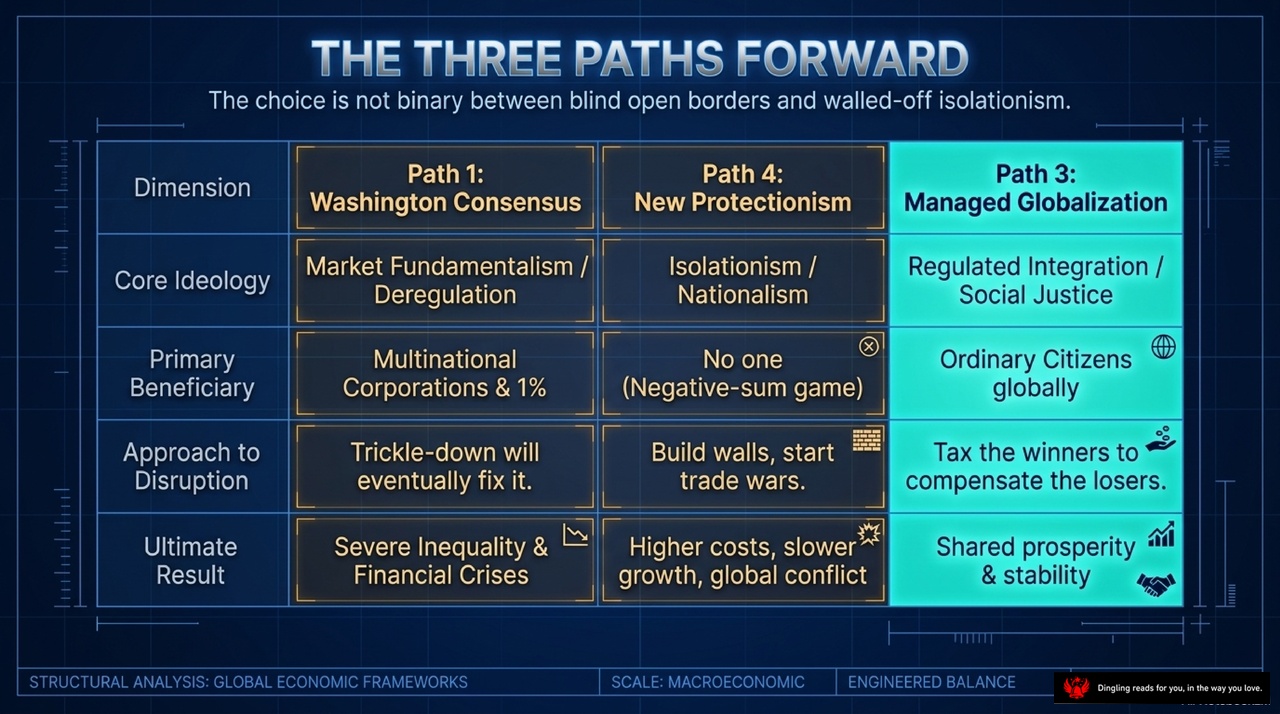
The choice isn't binary between blindly open borders and walled-off isolationism. We need a third way: Managed Globalization. Look at the three paths forward. Path 1, the Washington Consensus, relies on market fundamentalism and deregulation, primarily benefiting multinational corporations and the top 1%. It assumes trickle-down economics will fix everything, but the result is severe inequality and recurring financial crises. On the other side is Path 4, New Protectionism, driven by isolationism and nationalism. It builds walls and starts trade wars, resulting in a negative-sum game where no one wins, leading to higher costs, slower growth, and global conflict.
But the real solution is Path 3: Managed Globalization. This path embraces regulated integration and social justice. Instead of letting the winners take all, we tax the winners to compensate the losers. This approach puts ordinary citizens globally at the center, aiming for shared prosperity and stability. It's about engineering a balance where globalization serves everyone, not just a select few.
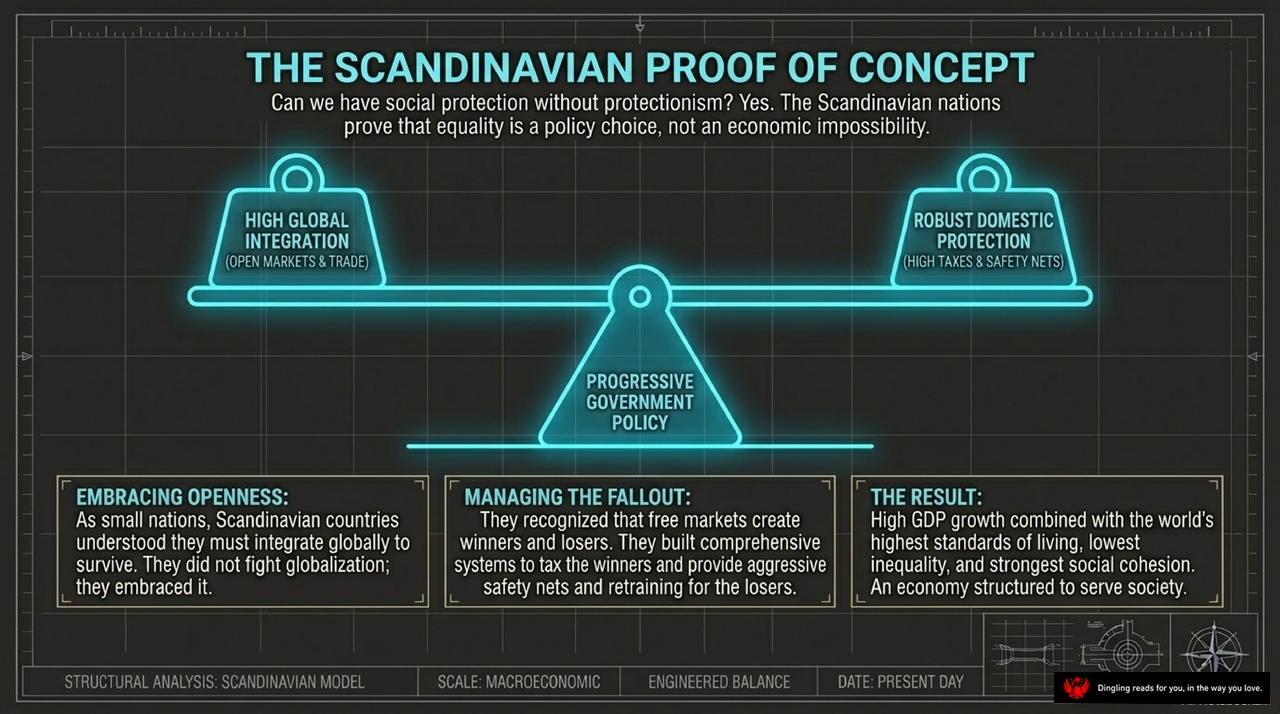
The image presents a powerful visual argument for the "Scandinavian Proof of Concept," demonstrating that social protection and global integration are not mutually exclusive. At the heart of this balance lies "Progressive Government Policy," acting as the fulcrum that holds the scale steady. On one side, we see "High Global Integration," representing open markets and trade, while on the other, "Robust Domestic Protection," funded by high taxes and comprehensive safety nets. This engineered balance proves that equality is a deliberate policy choice, not an economic impossibility.
As the text explains, Scandinavian nations understood that as small states, they had no choice but to embrace openness and integrate globally to survive. They didn't fight globalization; instead, they managed its fallout with precision. Recognizing that free markets inevitably create winners and losers, they built comprehensive systems to tax the winners and provide aggressive safety nets, retraining programs, and support for those displaced by market forces. The result? A unique economic model that delivers high GDP growth alongside the world's highest standards of living, lowest inequality, and strongest social cohesion. This approach creates an economy structured to serve society, showing us that we can have social protection without protectionism.

Globalization isn't an unstoppable force of nature; it is a set of rules. And those rules can, and must, be rewritten. This slide outlines our blueprint for the 21st century, focusing on three critical pillars to engineer a fairer global economy.
First, we need Democratized Governance. Currently, power is concentrated in the G7 and institutions like the IMF and World Bank are skewed toward wealthy nations. We must shift power to the G20 and rebalance voting rights so that developing nations have a voice proportional to their economic reality. It's time for the people who are most affected by these policies to have a say in writing them.
Second, we must Tame Capital. Unchecked hot money flows create devastating volatility for developing economies. We need global agreements to close corporate tax havens and stop companies from hiding billions. Furthermore, we must allow developing nations to use capital controls to protect their economies from destructive financial speculation, ensuring that investment supports real growth rather than just speculation.
Finally, we need to Rebalance Knowledge. Our current intellectual property laws often prioritize pharmaceutical profits over human lives, making life-saving drugs unaffordable for the poor. We must redesign these laws so knowledge and innovation flow freely, ensuring that access to essential medicines and technology isn't blocked by monopoly pricing.
By addressing these structural issues in global economic frameworks, we can transform globalization from a tool of inequality into a genuine engine for shared prosperity.
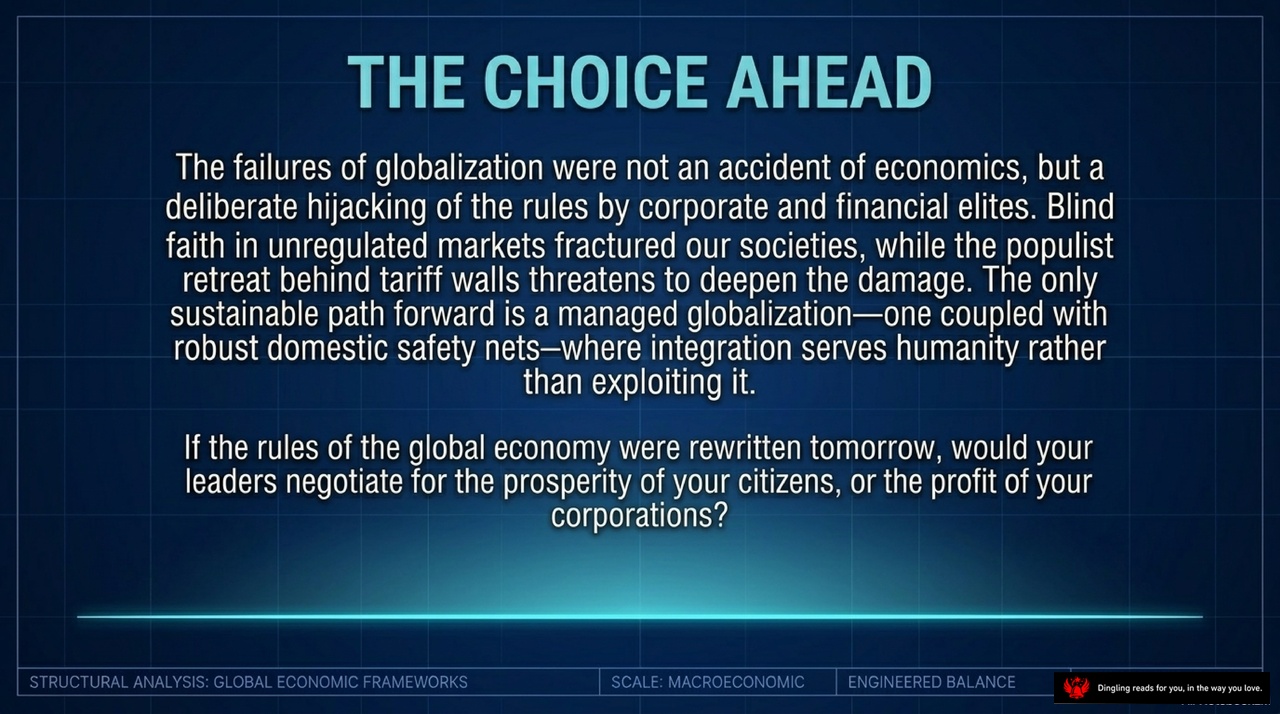
Look at the slide titled "The Choice Ahead." It lays out a stark reality: the failures of globalization weren't an accidental economic glitch, but a deliberate hijacking by corporate and financial elites who rigged the rules in their favor. Blind faith in unregulated markets has fractured our societies, while the populist retreat behind tariff walls threatens to make things even worse.
The slide argues that the only sustainable path forward is managed globalization—one coupled with robust domestic safety nets—where integration serves humanity rather than exploiting it. It challenges us with a critical question: If the rules of the global economy were rewritten tomorrow, would your leaders negotiate for the prosperity of your citizens, or the profit of your corporations?
For too long, the global system has prioritized the interests of the wealthy few over the well-being of ordinary workers and developing nations. From the harsh austerity imposed during the Asian financial crisis to the rigged privatization schemes in Russia, the current framework has often deepened inequality and eroded trust. We cannot simply blame the public for turning to protectionism; we must recognize that the system itself failed to deliver on its promises.
The future isn't about retreating into isolationism, which is impossible in an interconnected world. Instead, we must rewrite the rules. This means reforming institutions like the IMF and WTO to be truly representative and transparent, ensuring that trade and investment policies actually lift people up rather than just enriching multinational corporations. We need a new social contract that guarantees workers a fair share of the gains, protects the environment, and ensures that globalization is a tool for human progress, not a weapon for corporate dominance. The choice is ours: build a system that works for everyone, or continue down a path that leaves millions behind.