
Go or Die: Complete Chapter-by-Chapter Summary

Welcome to the world of *Don't Die Without Going* by Yusuke Ishida. This isn't just a travel book; it's a raw, honest look at what it takes to truly live. The story begins with a seven-and-a-half-year, pedal-powered odyssey across the globe, driven by a single, burning question: How do you find the true weight of being alive?
Imagine yourself on a lonely road, stretching endlessly into a vast, dramatic landscape of red rock and open sky. That is exactly where our protagonist finds himself, pushing his bicycle forward, carrying forty kilograms of luggage on a journey that will change everything. From the scorching heat of Alaska to the ancient ruins of the Amazon, from the chaotic streets of Mexico City to the serene silence of the African savannah, every step is a lesson.
This book challenges the idea that life is a straight line. It shows us that real adventure happens when we leave our comfort zones, when we face danger like being held at gunpoint in the Peruvian desert, or when we meet strangers who become family, like the Polish man who refused charity but gave us mushrooms instead. It's a story about resilience, about finding joy in the simplest moments, and about the courage to keep moving forward even when the path is uncertain.
If you've ever felt stuck in a routine or wondered if there was more to life than just surviving, this journey is for you. It reminds us that the greatest treasures aren't the places we visit, but the people we meet and the version of ourselves we become along the way. Don't let life pass you by. Don't die without going.
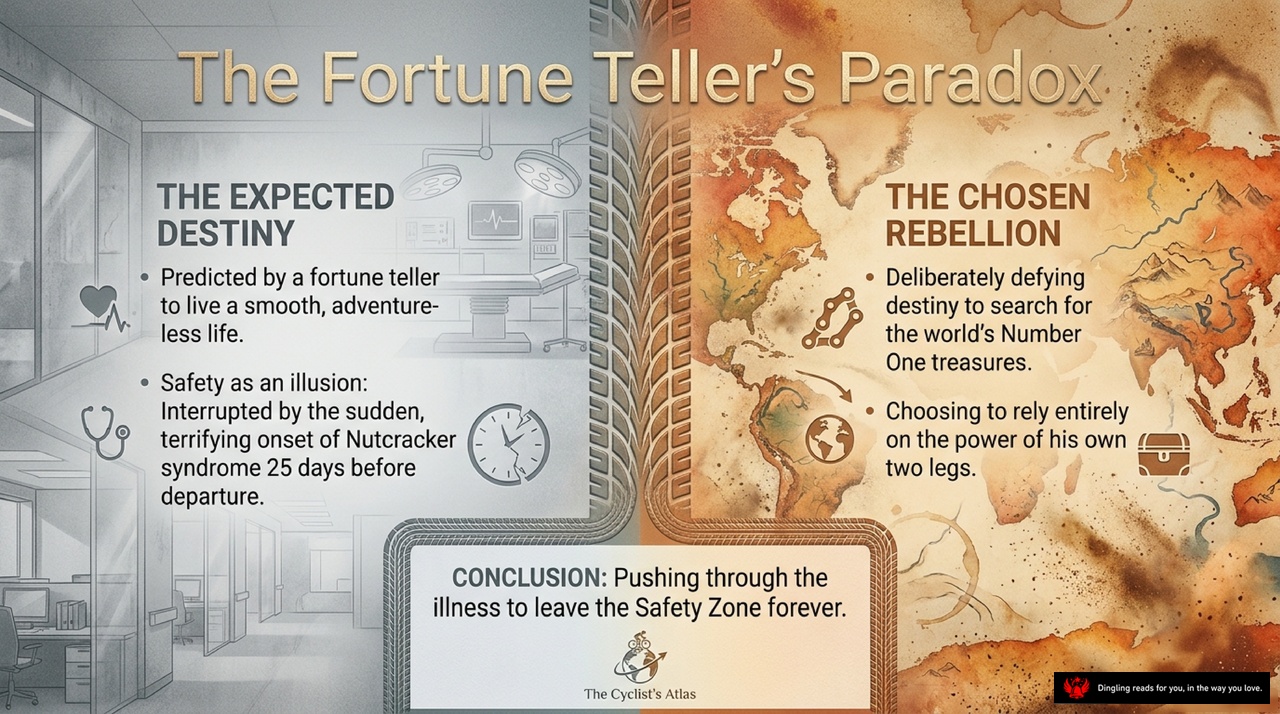
The slide we see here captures a pivotal moment in the journey, contrasting two very different paths: the "Expected Destiny" versus the "Chosen Rebellion."
On the left, under "The Expected Destiny," we see a life predicted by a fortune teller—a smooth, adventure-less existence. But this safety was an illusion, shattered twenty-five days before departure by the sudden onset of Nutcracker syndrome. This illness threatened to trap him in a hospital bed, right at the moment he was about to leave.
However, the story takes a dramatic turn on the right side, labeled "The Chosen Rebellion." Instead of accepting this predicted fate, the protagonist deliberately defied destiny. He chose to leave the safety zone, relying entirely on the power of his own two legs to search for the world's number one treasures. The conclusion is clear: he pushed through the illness to leave the comfort zone forever.
This slide perfectly illustrates the core theme of the book: transforming from a passive observer of fate into an active creator of one's own life. It's not about avoiding danger, but about choosing your own adventure, no matter what the odds say.
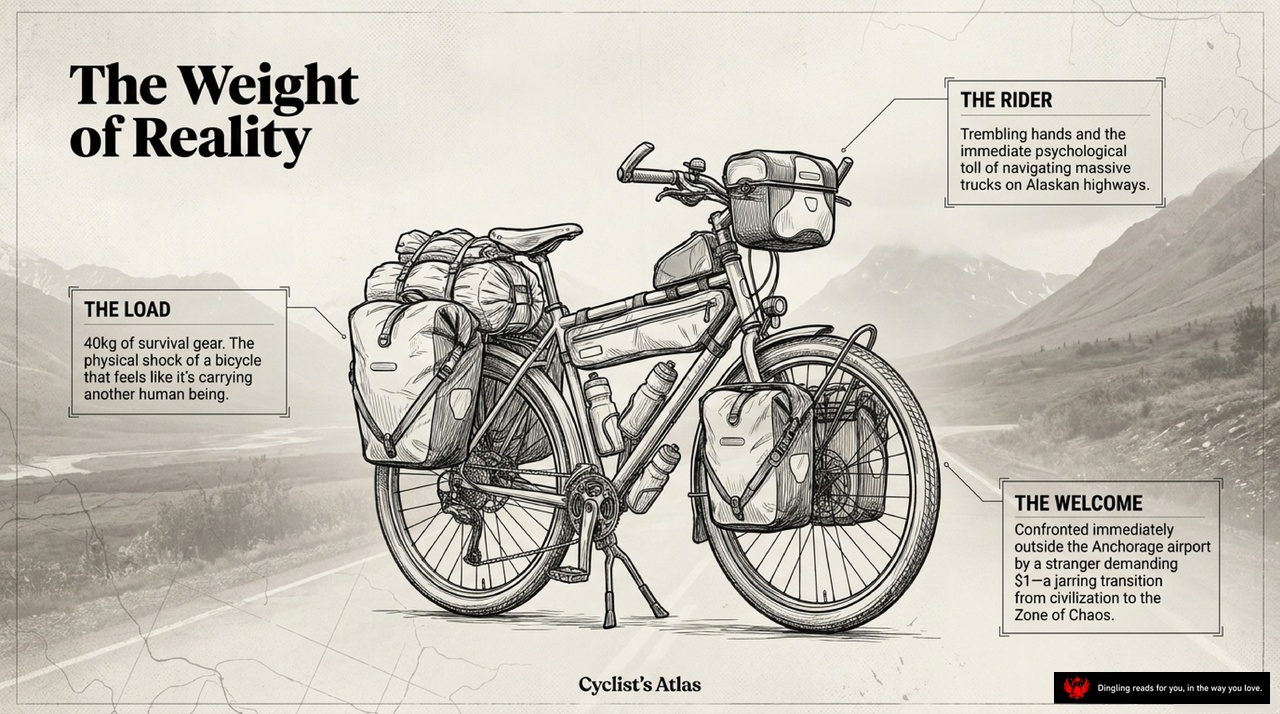
The weight of reality hits you the moment you step off the plane in Anchorage. It's July, yet the sun burns hotter than any summer in Japan. You're dressed like a mistake in a wool sweater and feather coat, scrambling into a T-shirt and shorts just to survive. Outside, the wilderness stretches endlessly, a vast tapestry of pine forests and green mountains under a sky so wide it feels unreal.
You rush to assemble your bike, lashing forty kilograms of survival gear—camping gear, clothes, books, cameras, tools, medicine—onto six bags. It feels less like a bicycle and more like carrying another human being. As you push off onto the straight, flat road, the heavy load makes the bike wobble violently. You nearly crash into a roadside fence, only to swerve dangerously into the fast lane when you brake, the honking of cars behind you sending a chill down your spine.
But the real shock comes at the first intersection. Lost and desperate, you approach a woman in a bright pink crop top and black sunglasses. You hesitate, then ask for directions. She chews gum, lets out a lazy stretch, and reveals her armpits before dropping a bombshell: "Give me one dollar." Asking for help costs money? Stunned, you refuse and pedal away in a panic, realizing your journey has started with a jarring transition from civilization to chaos. This moment of vulnerability, combined with the physical toll of the load and the psychological strain of navigating massive trucks on Alaskan highways, defines the raw, unfiltered weight of reality that every traveler must face.

Imagine standing at the edge of the world, where the sky isn't just blue, but a canvas for the most breathtaking light show on Earth. This slide captures a pivotal moment in the journey: "The Altimeter of Awe." It's not just about measuring height; it's about measuring the depth of our connection to nature.
Look at the timeline on the left. We start at Milestone 1: the Yukon River. This is where the true adventure begins—not with a roar, but with silence. The text describes a profound philosophy: it takes four to seven days of floating in absolute silence to finally hear the true voice of the forest. It's about stripping away the noise of modern life until you can hear the river, the trees, and yourself. And then, there's that hypnotic eruption of the Aurora Borealis. Seeing the Northern Lights while paddling a canoe is an experience that redefines what it means to be alive.
As we climb higher on this altimeter, we reach Milestone 2: Monument Valley. Here, the realization hits hard. The Virgin Lands teach us that even famous landscapes remain entirely undiscovered until witnessed through one's own unmediated, un-televised experience. We aren't watching a movie; we are standing in the red rocks, feeling the wind, and realizing that the magic only exists when we are truly there, alone with it.
From the quiet silence of the Yukon to the majestic silence of Monument Valley, these moments remind us that the greatest discoveries happen when we slow down, step away from the screen, and let the world wash over us. That is the true altitude of awe.

Distilling the Magic of Ruins isn't just about seeing the postcard-perfect view; it's about stripping away the hype to find the real soul of a place. We often travel with our eyes closed, blinded by the "Expectation" we've built from movies and magazines. Take Machu Picchu, for instance. The expectation is "The legendary City in the Sky," a grand spectacle that feels distant and untouchable. But the reality? It's often grand, yet emotionally diminished by overexposure to those preconceived media images. We end up seeing a ghost of a place rather than the place itself.
Then there's Angkor Wat. We expect a sprawling ancient capital, a chaotic maze of stone. Yet, the reality is a serene, smiling maze that echoes the architectural awe of Central America. It proves that wonder transcends geography; the magic isn't in the location, but in the silence and the smile of the stones. And finally, Tikal Temple I. We might expect just a remote jungle outpost, something isolated and quiet. But the reality is the undisputed champion: a mystical rocket piercing the jungle canopy that exerts an irresistible, magnetic pull on the soul. It's not just a ruin; it's a heartbeat from the past. When we distill the magic of ruins, we stop chasing the perfect photo and start feeling the pulse of history.
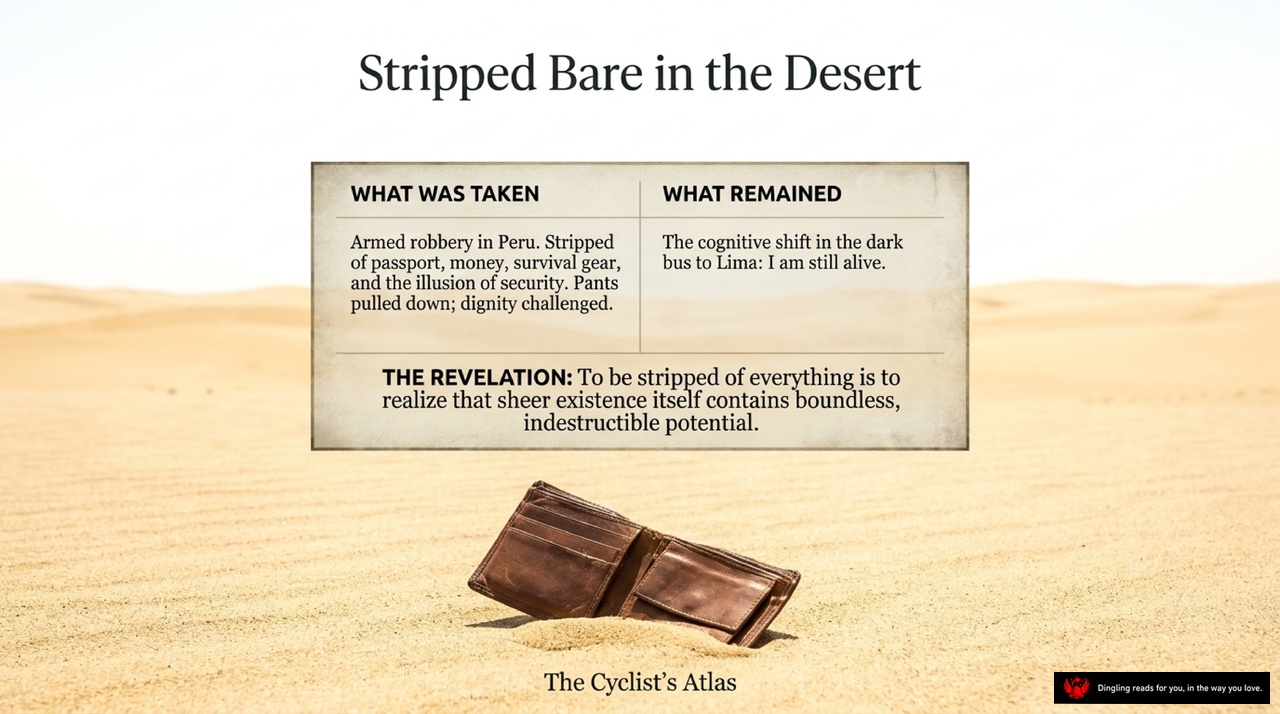
Imagine standing in the middle of a vast, silent desert, stripped of everything you thought defined you. That is the moment I found myself in Peru, after an armed robbery left me with nothing but the clothes on my back and a shattered sense of security. They took my passport, my money, my survival gear, and even my dignity as they pulled down my pants. In that terrifying darkness on the bus to Lima, amidst the fear and the loss, something profound shifted. I realized that despite being robbed blind, I was still alive. That single, stubborn fact—that I existed—became the anchor holding me together.
This experience taught me a life-altering lesson: to be stripped of everything is to realize that sheer existence itself contains boundless, indestructible potential. When you lose your status, your wealth, and your possessions, you are forced to confront the raw truth of being human. You discover that your life isn't defined by what you own, but by the sheer courage to keep moving forward. Just like that empty wallet lying in the sand, the loss of material things can sometimes be the greatest gain, revealing a strength within us that no thief could ever steal.

Look at these scales of dignity. On the left, we have Poland. Here, a legless mushroom seller navigates a modified tricycle. He refuses charity, charging a fair price for his goods. It is a masterclass in fierce independence and human dignity. He proves that worth isn't defined by pity, but by the courage to stand on one's own two feet.
On the right, we see Ireland. Eiko, missing a leg, is rolling joyfully in the grass at Dún Aengus. Her story teaches us a profound lesson: the speed of a journey does not dictate the depth of the experience. While she moves slowly, her joy is boundless.
These two stories balance each other perfectly. One shows the strength of refusing help when you can earn your own way; the other shows the freedom found in embracing life at your own pace. Whether moving fast or slow, whether standing tall or rolling on the ground, true dignity comes from living authentically.
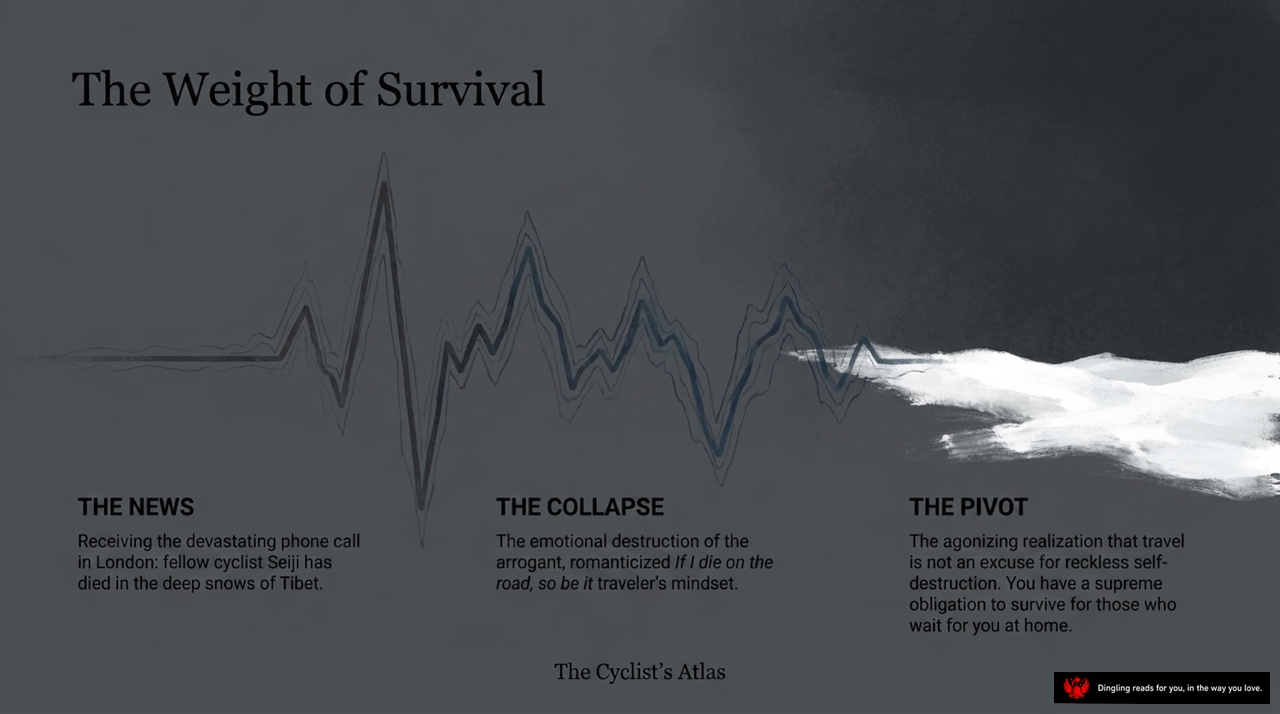
The weight of survival isn't just about staying alive; it's about who you choose to live for.
This slide maps the critical turning point in my journey, broken down into three distinct phases.
First, **The News**. It started with a devastating phone call in London. My fellow cyclist, Seiji, had died in the deep snows of Tibet. That single call shattered my world, forcing me to confront the harsh reality of the road.
That grief led directly to **The Collapse**. I was emotionally destroyed. I was clinging to an arrogant, romanticized mindset—the idea that if I die on the road, so be it. It was a dangerous traveler's fantasy, a shield I used to ignore the very real dangers around me.
But then came **The Pivot**. This was the agonizing realization that changed everything. Travel is not an excuse for reckless self-destruction. I realized I had a supreme obligation to survive—not just for myself, but for the people who wait for me at home.
That moment of clarity saved me. It shifted my perspective from a solo adventure into a responsibility. It taught me that the greatest act of courage isn't pushing forward blindly, but choosing to come back to the ones who love you.
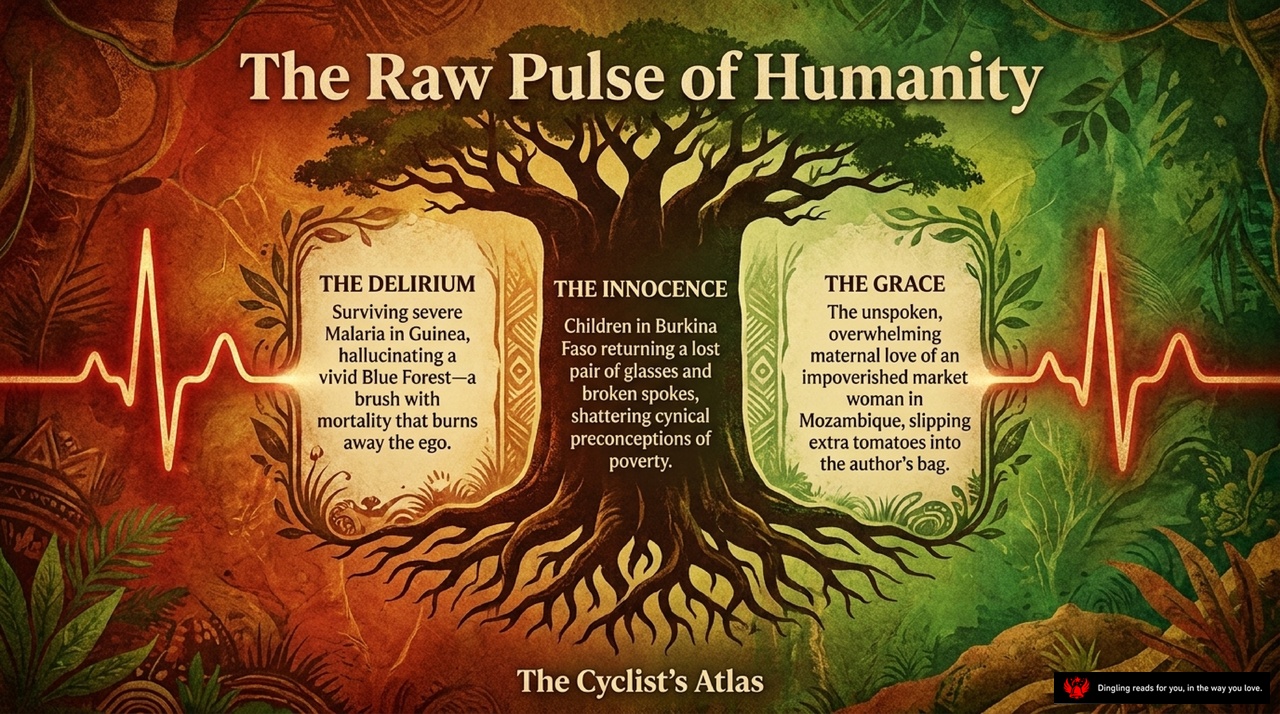
Welcome to the raw, unfiltered pulse of humanity. This slide isn't just about geography; it's about the electric moments where the human spirit reveals its truest colors. Look at the tree in the center—its roots are deep, but its branches reach out in three distinct directions, each representing a profound encounter that reshaped the journey.
On the left, we have "The Delirium." This represents the terrifying edge of survival. In Guinea, after battling severe malaria, the narrator hallucinates a vivid Blue Forest. It was a brush with mortality that burned away the ego, forcing a confrontation with the fragility of life.
Moving to the center, we find "The Innocence." Here, cynicism shatters. In Burkina Faso, children returned a lost pair of glasses and broken spokes. This simple act of honesty completely dismantled the narrator's cynical preconceptions about poverty, reminding everyone that kindness knows no borders.
Finally, on the right, is "The Grace." This is the quiet, overwhelming power of maternal love. In Mozambique, an impoverished market woman slipped extra tomatoes into the author's bag. It was an unspoken act of generosity that felt like a lifeline, proving that even in the harshest conditions, humanity can still offer grace.
These three moments—the struggle of survival, the shock of innocence, and the gift of grace—form the heartbeat of this seven-year journey. They remind us that while the road is long and the dangers are real, the true destination is found in these raw, human connections.
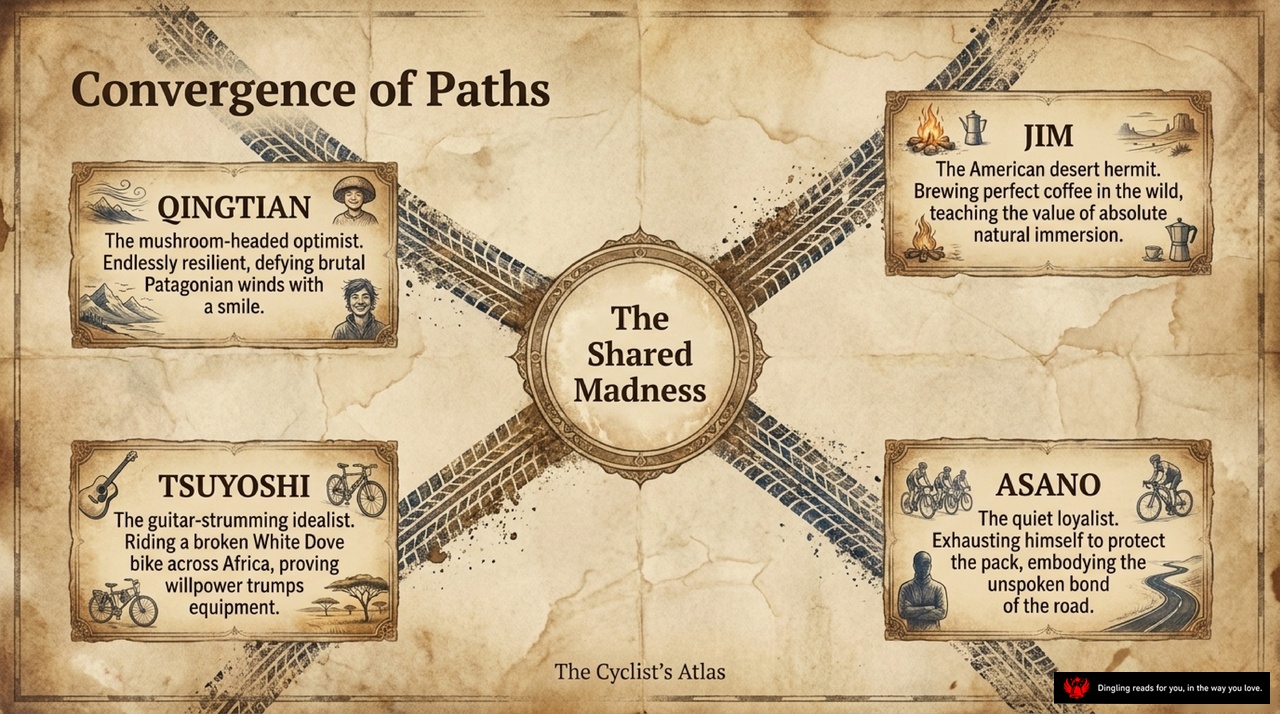
Imagine four distinct paths converging on a single point of shared madness. This is the heart of our journey.
On the left, we have Qingtian, the mushroom-headed optimist. He is endlessly resilient, defying the brutal Patagonian winds with a simple, enduring smile. He represents the power of hope in the face of nature's fury.
Opposite him, in the top right, is Jim, the American desert hermit. He finds his sanctuary in the wild, brewing perfect coffee by a campfire and teaching us the profound value of absolute natural immersion. He shows us that peace can be found in the silence of the desert.
Below Qingtian, we see Tsuyoshi, the guitar-strumming idealist. Riding a broken White Dove bike across the vast African plains, he proves that willpower truly trumps equipment. His spirit is a testament to the human capacity to keep moving despite broken machinery.
Finally, in the bottom right, stands Asano, the quiet loyalist. He exhausts himself not for glory, but to protect the pack, embodying the unspoken, sacred bond that exists between travelers on the same road.
At the center of this map lies "The Shared Madness." It is the realization that no matter how different our backgrounds or methods, we are all driven by the same desperate, beautiful need to keep going. These four paths are not separate; they are one. They show us that the journey itself is the destination, and that in our shared struggle, we find our true freedom.
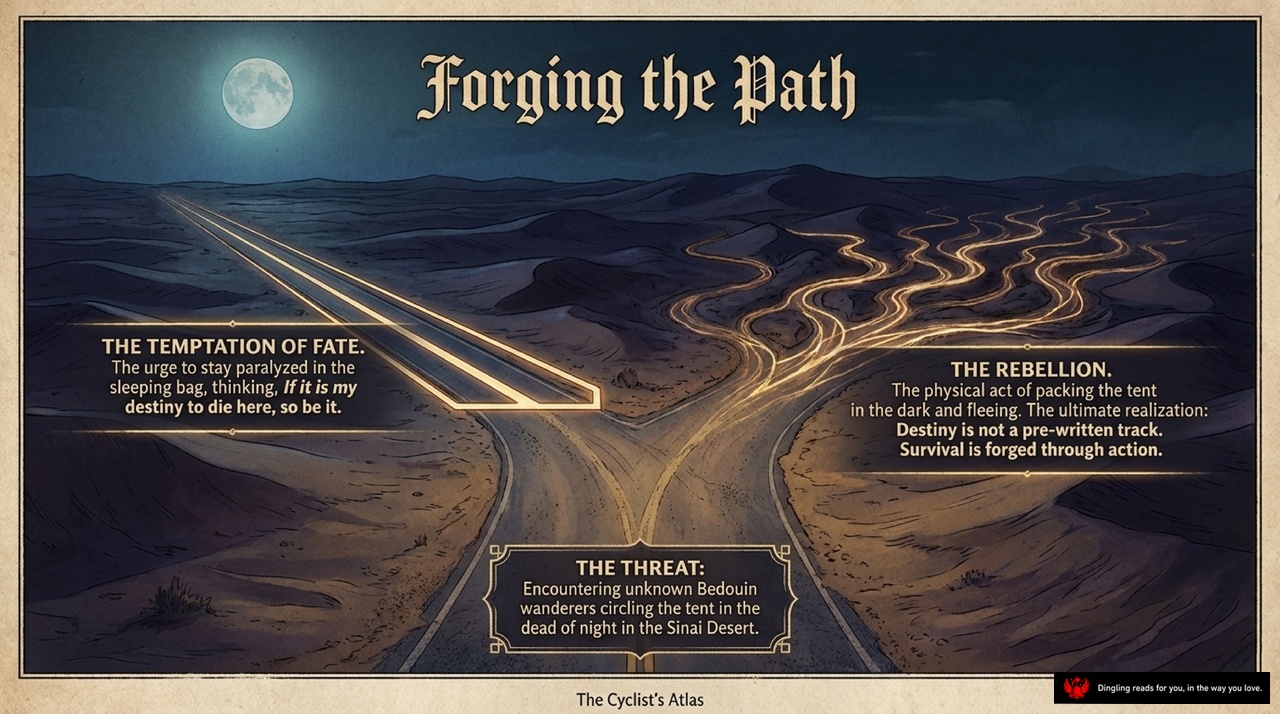
Look at this split path under the moonlight. On the left, there's a straight, paved road representing the temptation of fate—the urge to stay paralyzed in the sleeping bag, thinking, "If it is my destiny to die here, so be it." But on the right, we see a winding, chaotic set of tracks. This is the rebellion. It's the physical act of packing the tent in the dark and fleeing. The ultimate realization here is clear: destiny is not a pre-written track. Survival is forged through action.
In the center of this desert, we face the threat. It's the moment of encountering unknown Bedouin wanderers circling the tent in the dead of night in the Sinai Desert. This is the exact moment the author faced when he woke up to those mysterious footsteps. He initially felt trapped by a fatalistic mindset, believing his path was already set. But that night, he chose the rebellion. Instead of waiting for fate to decide, he grabbed his bike and rode into the unknown darkness. That single choice to break camp and flee transformed him from a victim of circumstance into the author of his own story. It proves that even when the threat feels overwhelming, your survival depends entirely on the courage to forge your own path.
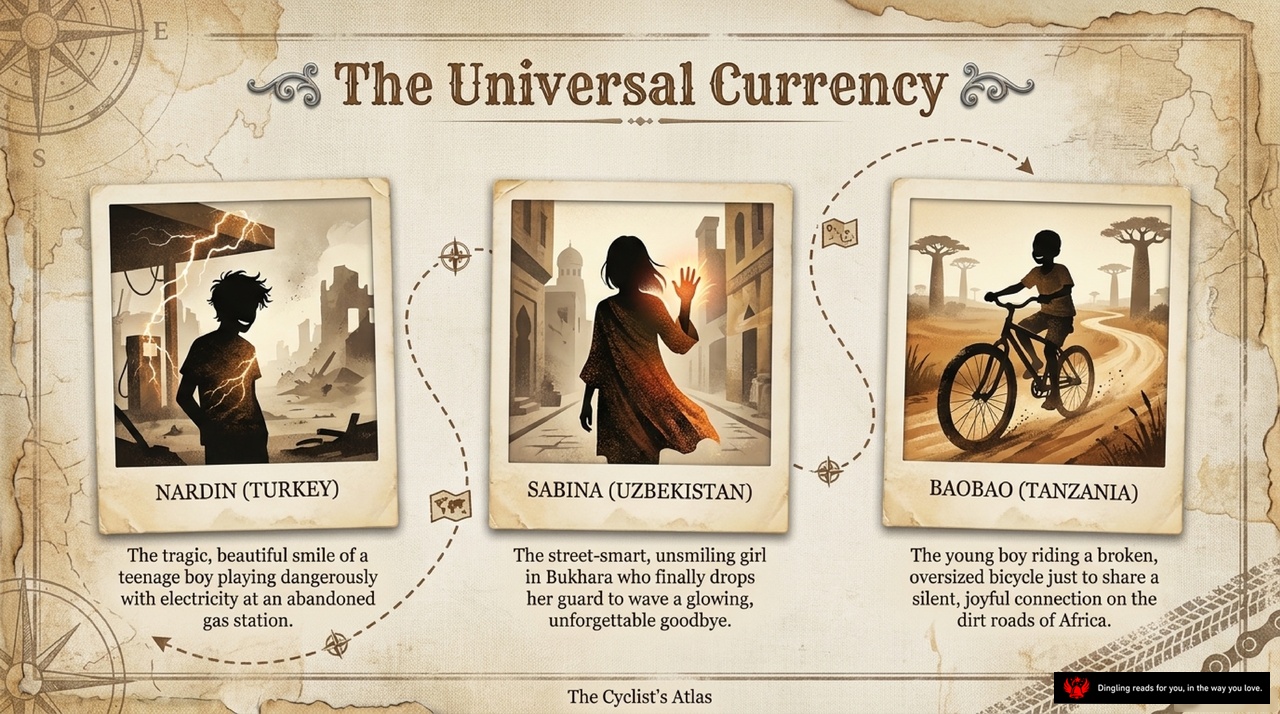
The Universal Currency isn't just about money; it's about the moments that connect us across the widest distances. Look at these three stories from my seven-year journey.
First, Nardin in Turkey. Imagine a teenager standing alone in the ruins of an abandoned gas station, playing dangerously with electricity. Despite the danger, he offers a tragic yet beautiful smile—a pure, unguarded connection with a stranger I had just met.
Then, travel to Uzbekistan and meet Sabina. In the bustling streets of Bukhara, she was a street-smart girl who kept her guard up, never smiling. But in that final moment, she dropped her defenses to wave a glowing, unforgettable goodbye. That single gesture was a bridge between our worlds.
Finally, take a ride with Baobao in Tanzania. On the dusty roads of Africa, he rides a broken, oversized bicycle that barely works. Yet, he shares a silent, joyful connection with me, just by riding alongside. No words were needed.
These three encounters teach us that a smile, a wave, or a shared ride is the true universal currency. It transcends language, borders, and culture, proving that we are all deeply connected.
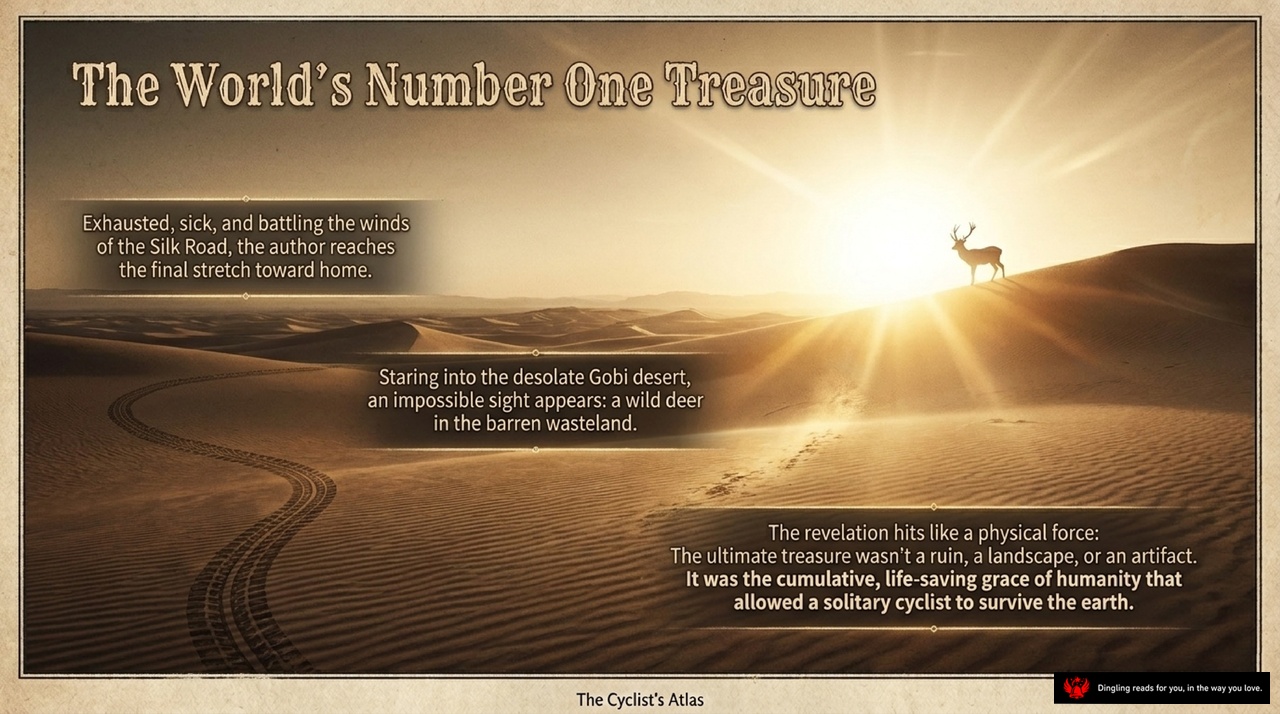
Exhausted, sick, and battling the winds of the Silk Road, I finally reach the final stretch toward home. Staring into the desolate Gobi desert, an impossible sight appears: a wild deer in the barren wasteland. The revelation hits like a physical force: The ultimate treasure wasn't a ruin, a landscape, or an artifact. It was the cumulative, life-saving grace of humanity that allowed a solitary cyclist to survive the earth.
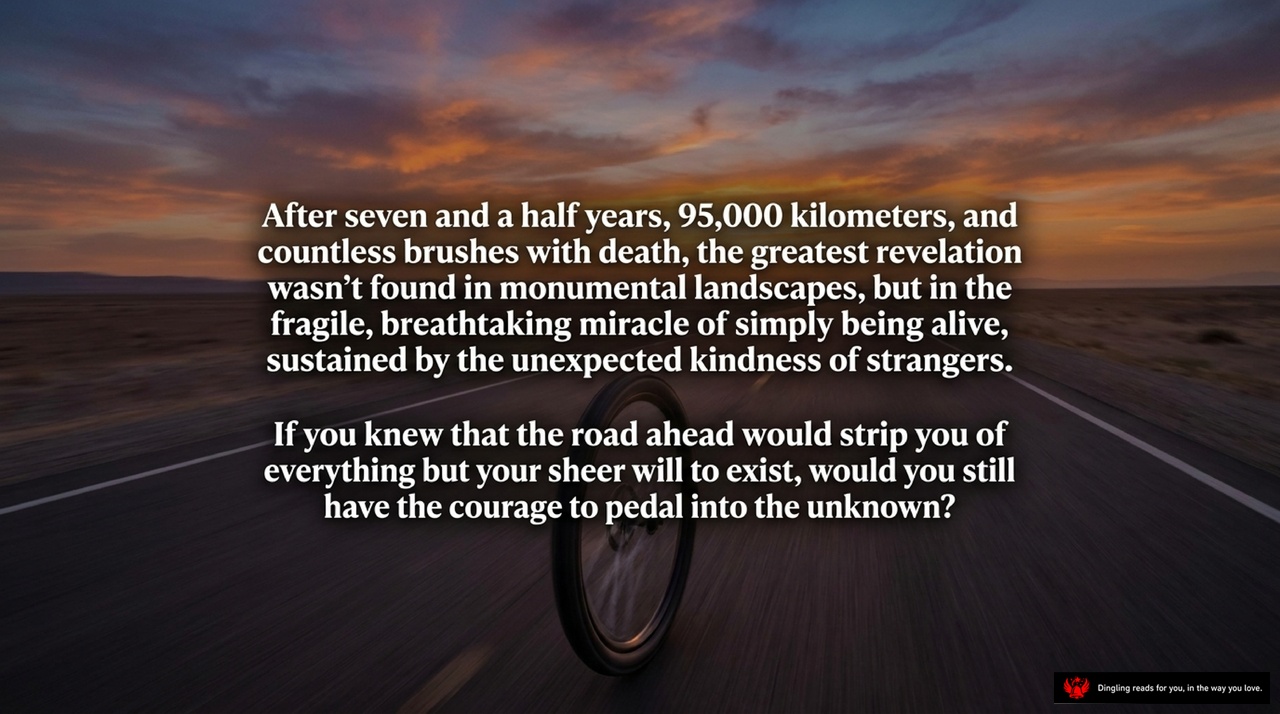
Look at this lone wheel spinning into the horizon. It captures the very heart of a journey that lasted seven and a half years. After covering 95,000 kilometers and surviving countless brushes with death, the greatest revelation wasn't found in those monumental, breathtaking landscapes. Instead, it was discovered in the fragile, miraculous act of simply being alive.
What sustained the rider through it all wasn't the grand scenery, but the unexpected kindness of strangers. It's a powerful reminder that while the world can strip you of everything but your sheer will to exist, the courage to pedal into the unknown is often fueled by the warmth of human connection. So, if you knew the road ahead would take everything away, would you still have the courage to keep going?