
Great Expectations: Complete Chapter-by-Chapter Summary

Welcome to *Great Expectations*, a haunting tale by Charles Dickens. Set against the backdrop of a fog-shrouded London and the desolate marshes of Kent, this story explores the dangerous allure of wealth and the illusion of gentility. It is a profound journey about how true character is forged not in gold, but in the fires of humility and love. Join us as we dive into the life of Pip, a young orphan whose destiny takes a turn he never expected, and discover what it truly means to be a gentleman.

Look at this map of Pip's early life. It traces a terrifying journey from innocence to corruption. On the left, we see **The Churchyard**, described as the site of innocence where young Pip, mourning his family, is terrified into submission. On the right lies **The Prison Hulks**, the origin of corruption where a rusted leg-iron binds the escaped convict, Magwitch, to the boy who brings him a stolen file and a pork pie.
Notice how the story connects these two worlds through a literal iron chain from the marshes that transforms into an invisible psychological chain. Pip's act of terrified charity becomes the hidden capital that will finance his future ascent. What starts as a moment of sheer survival—feeding a man who threatened to eat him—unexpectedly sets in motion a lifetime of consequences. That single night in the fog, where fear turns into a transaction, is the moment Pip is irrevocably changed. The marshes don't just hold his childhood; they hold the very foundation of the man he becomes.

The slide before us captures the terrifying collision of two worlds that defines Pip's life: the Forge of Reality versus the Illusion of Satis House. On the left, we see the Forge. It's warm, alive, and built on honest labor. The anchor here is Joe Gargery, a man of immense physical strength but total moral gentleness. Yet, there lies a sharp irony: Pip views this home as common, shameful, and coated in coarse coal dust, unable to see the beauty in its warmth.
Contrast that with the right side: Satis House. The atmosphere is stagnant, dead, and filled with toxic wealth. Time itself seems to have stopped here at twenty minutes to nine. The anchors are Miss Havisham and Estella—figures frozen in grief and pride. The ultimate irony? Pip, desperate to escape his "lowly" origins, mistakes this dark, rotting monument of betrayal for the pinnacle of upper-class superiority. He chases a ghost, unaware that the real life is right there in the soot, waiting for him to look up.

Look at this "Expectation Contract." It's not just a piece of paper; it's the blueprint for Pip's entire life, written by someone he never knew.
Condition one is simple but cruel: you must always be "Pip." Your real name is erased. Condition two creates the ultimate psychological trap. The benefactor's identity is an absolute, unquestioned secret. By forcing silence, the contract allows Pip's own vanity to fill the void. He actively deceives himself, assuming the wealth comes from Miss Havisham to facilitate a marriage to Estella. He builds a fantasy on a foundation of lies. And finally, Condition three: you must relocate to London to be educated as a gentleman of fortune.
This contract steals Pip's childhood, his family, and his truth, replacing it with a performance of being someone he is not. He trades his authentic self for a title he doesn't deserve, believing that becoming a "gentleman" will make him worthy of the love he craves. But in the end, he discovers that this manufactured identity is a prison, far more confining than the humble life he once had.

The Divergence of Wealth and Loyalty
Look at this chart. It captures the tragic arc of Pip's life: a heartbreaking trade-off where social climbing destroys the soul. As time moves forward, the golden line representing his social status and wealth climbs steadily. He buys tailored suits, moves into Barnard's Inn, and joins the elite Finches of the Grove Club. He constructs a perfect facade of a gentleman. But watch the orange line below. As his external image reaches its peak, his moral integrity and genuine human connection plummet into the depths.
He starts by being ashamed of Joe's awkward visit to London, then avoids the forge when returning home, leaves margins to ignore mounting debt, and treats Biddy with arrogant condescension. Every step up the social ladder is a step down the ladder of humanity. The key insight here is devastating: the cost of admission to high society is the rejection of authentic love. As Pip's external gentlemanly facade nears perfection, his moral compass completely fractures. He has everything the world wants, but he has lost the very things that make life worth living.
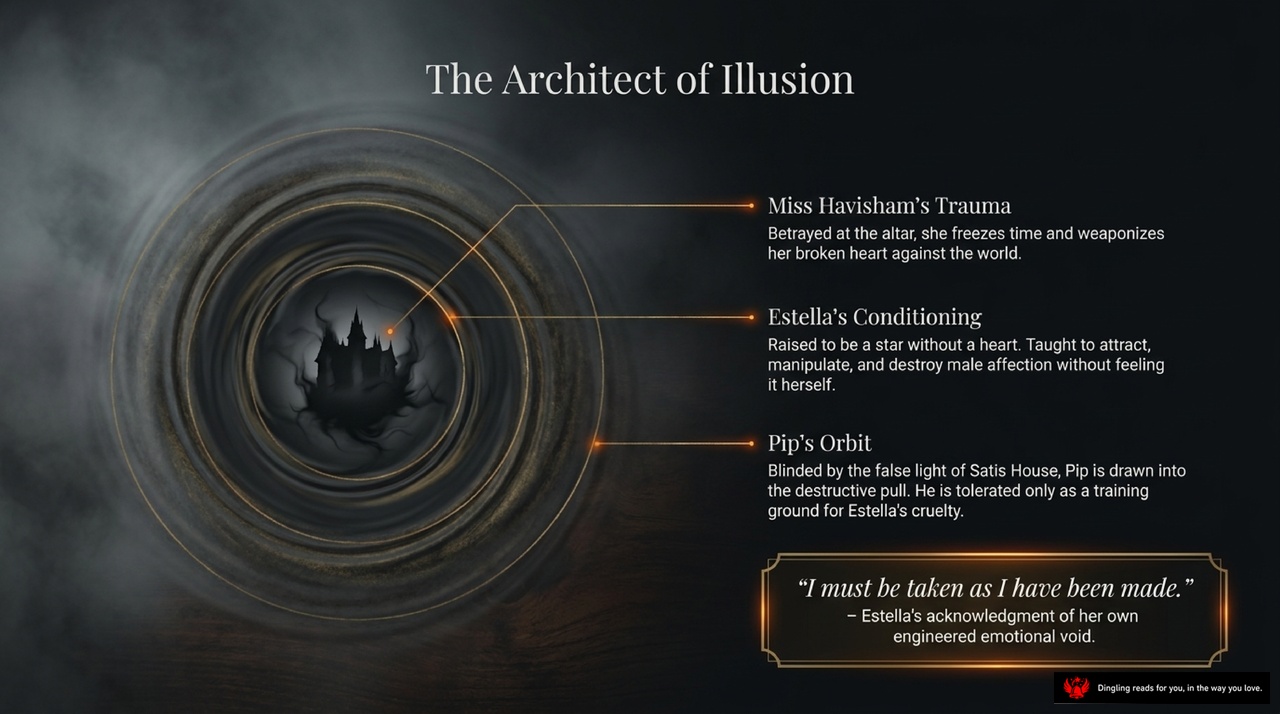
The Architect of Illusion isn't just a title; it's the blueprint for a lifetime of heartbreak. Look at this spiral. At the center lies Miss Havisham's trauma. Betrayed at her altar, she didn't just break; she froze time, weaponizing her own shattered heart against the world. She turned her wedding dress into a trap, hoping to break men just as she was broken.
But the true horror lies in what she created from that pain: Estella. Raised as a star without a soul, taught to attract, manipulate, and destroy male affection without ever feeling it herself. This is Estella's conditioning—a cruel engineering of emotion where love is a tool, not a feeling.
And then there is Pip, drawn into this destructive orbit. Blinded by the false light of Satis House, he becomes nothing more than a training ground for her cruelty. He is tolerated only to be used. It all culminates in Estella's chilling realization: "I must be taken as I have been made." It is her acknowledgment of her own engineered emotional void, a confession that she is a masterpiece of destruction, built entirely by the architect of her own tragedy.

The Matrix of a Gentleman isn't just a chart; it's the brutal truth of human nature. Look at the top left: the high class. Compeyson and Bentley Drummle. They are educated, wealthy, yet cruel, abusive, and inherently criminal. They prove that money and status don't buy a soul. Now, look at the bottom right: Joe Gargery and Biddy. They are uneducated working class, but they possess absolute moral clarity, unconditional love, and quiet dignity. They are the true nobles.
But what about the middle? The Disruptor: Magwitch. Spanning the bottom axis, he is a literal criminal whose capacity for gratitude and sacrifice ultimately outshines the London elite. While the "Empty Ideal" sits in the top right—a space Pip aspires to occupy but fails to reach until he embraces truth—Magwitch shatters the entire system. He shows us that true gentleness comes from the heart, not the bank account, proving that character is the only currency that truly matters.

The Turning Point: Shattered Expectations.
For years, Pip lived in a beautiful illusion, convinced that his benefactor was the eccentric, high-society Miss Havisham, an aristocrat grooming him for a life of luxury and a marriage to the beautiful Estella. He believed his rise was a fairy-tale romance, built on destiny and entitlement. But the shattering of this glass facade reveals a terrifying reality. The true benefactor was not a lady, but Abel Magwitch, a transported convict and a man of the lowest station. His intent wasn't noble social climbing for Pip's sake, but a twisted, vicarious desire to make a gentleman out of the boy who once threatened to cut his throat. The feeling Pip experiences isn't one of gratitude, but of revulsion and terror—the horrifying realization that his entire wealth, his "gentlemanly" status, and his dreams are built entirely on the suffering and sweat of an exiled criminal.
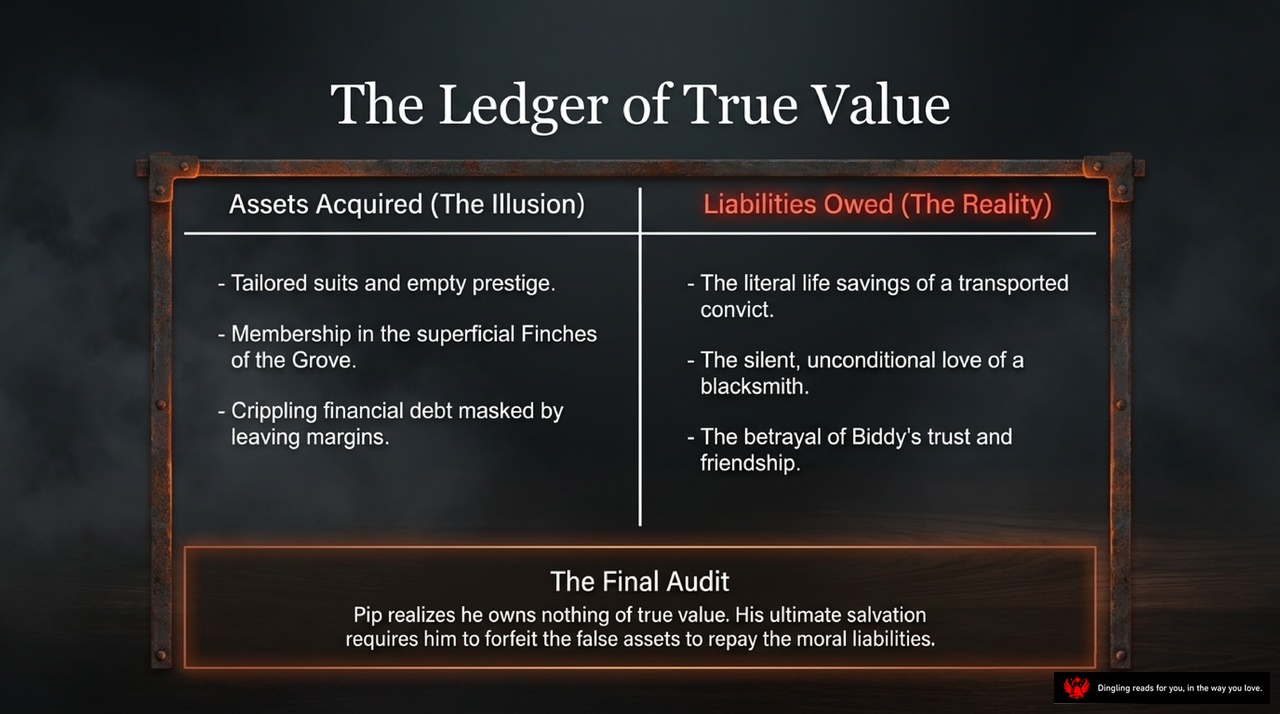
Imagine a ledger, but not one of gold and silver. This is the ledger of Pip's soul, where the entries don't balance out. On the left side, under "Assets Acquired," we see the illusions he bought with his stolen money: tailored suits, empty prestige, and membership in the superficial world of the Finches of the Grove. But look at the right side, labeled "Liabilities Owed." Here lies the brutal reality. The true cost of that false life wasn't just money; it was the literal life savings of a transported convict, the silent, unconditional love of a blacksmith, and the ultimate betrayal of Biddy's trust and friendship.
The final audit reveals a devastating truth: Pip realizes he owns nothing of true value. His ultimate salvation requires him to forfeit those false assets to repay the moral liabilities. He had to give up the life he stole to become the man he truly was.

Forged in the Fire: The Cycle of Pip's Transformation
Look at this cycle we see here. It captures the brutal, transformative journey of Pip, a journey that moves from arrogance to humility, through crisis and ruin, only to find a path back to rescue.
At the top, we see **Arrogance**. Pip rejects his humble forge home, buying into the London illusion of purchased nobility. He believes he can simply buy his way into the upper class, unaware that true character cannot be bought with inherited coin or social status.
This leads directly to **Crisis**. The illusion shatters. Magwitch returns, and the secret he carried is exposed. Magwitch is captured, tried, and dies in prison. As a consequence, Pip's wealth is legally forfeited. The very foundation of his new life crumbles, leaving him exposed to the harsh reality he tried to escape.
Next, we reach the lowest point: **Ruin & Rescue**. Pip falls into a severe, near-fatal fever. He is defenseless, bankrupt, and utterly alone. It is in this moment of total despair that Joe Gargery arrives in London. He silently nurses Pip back to health and pays his debts, restoring what Pip thought he had lost.
Finally, the cycle completes at **Humility**. Stripped of all expectations, Pip returns to his origins. He learns that character is forged at the anvil of hardship, not purchased with inherited coin. This return to his roots is not a defeat, but a rebirth. He finally understands that his true identity was always tied to the forge and the love of those who never asked for anything in return.

The final chapter of Great Expectations brings us to the ruins of Satis House, where the story's true meaning finally crystallizes. Eleven years have passed, and Pip and Estella meet one last time amidst the cleared ashes of the place that once defined their lives. As the slide reminds us, they have been "Rebuilt by Reality." The toxic fog of the past has lifted, replaced by a hard-won clarity. Pip and Estella have both suffered immensely—she through an abusive marriage, and he through the loss of his fortune and the burden of honest labor. Yet, as the text poignantly states, "Suffering has been stronger than all other teaching." It is through this pain that they have found their way back to each other. Departing the ruins, they hold hands, leaving behind the ghost of their former selves with no shadow of another parting.
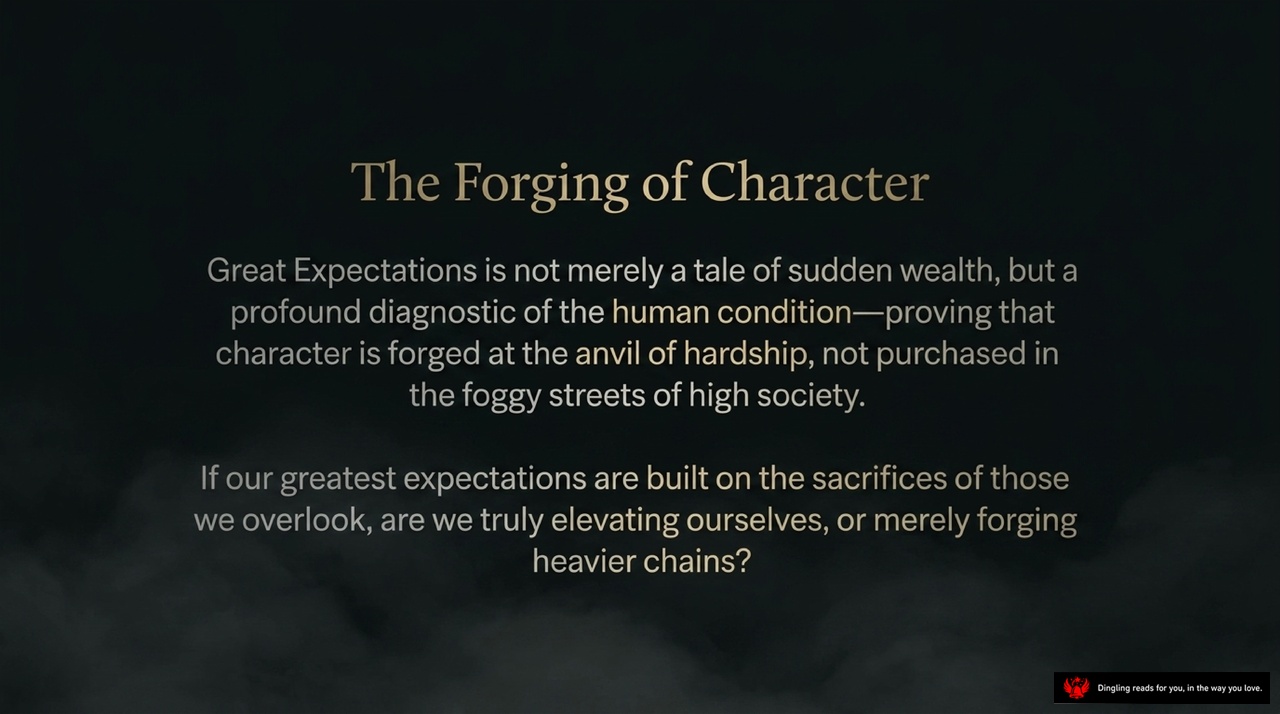
The Forging of Character. Great Expectations is not merely a tale of sudden wealth, but a profound diagnostic of the human condition—proving that character is forged at the anvil of hardship, not purchased in the foggy streets of high society. Think about Pip's journey: he trades his soul for a ticket to London, only to discover that true nobility isn't found in fine clothes or empty titles, but in the quiet, unglamorous moments of loyalty and sacrifice. When Pip finally learns the truth about his benefactor, Magwitch, the story forces us to ask a hard question: if our greatest expectations are built on the sacrifices of those we overlook, are we truly elevating ourselves, or merely forging heavier chains? Pip's rise was built on Magwitch's stolen money and dangerous life, a debt that could never be paid back in gold. It takes a lifetime of loss and humility for Pip to realize that his worth was never about being an "upper class" gentleman, but about the integrity of his heart. We often chase success at the expense of the very people who made it possible, but true character isn't bought; it's earned through the fires of our own choices and the weight of our responsibilities.