
Haidilao You Can't Learn: Complete Chapter-by-Chapter Summary
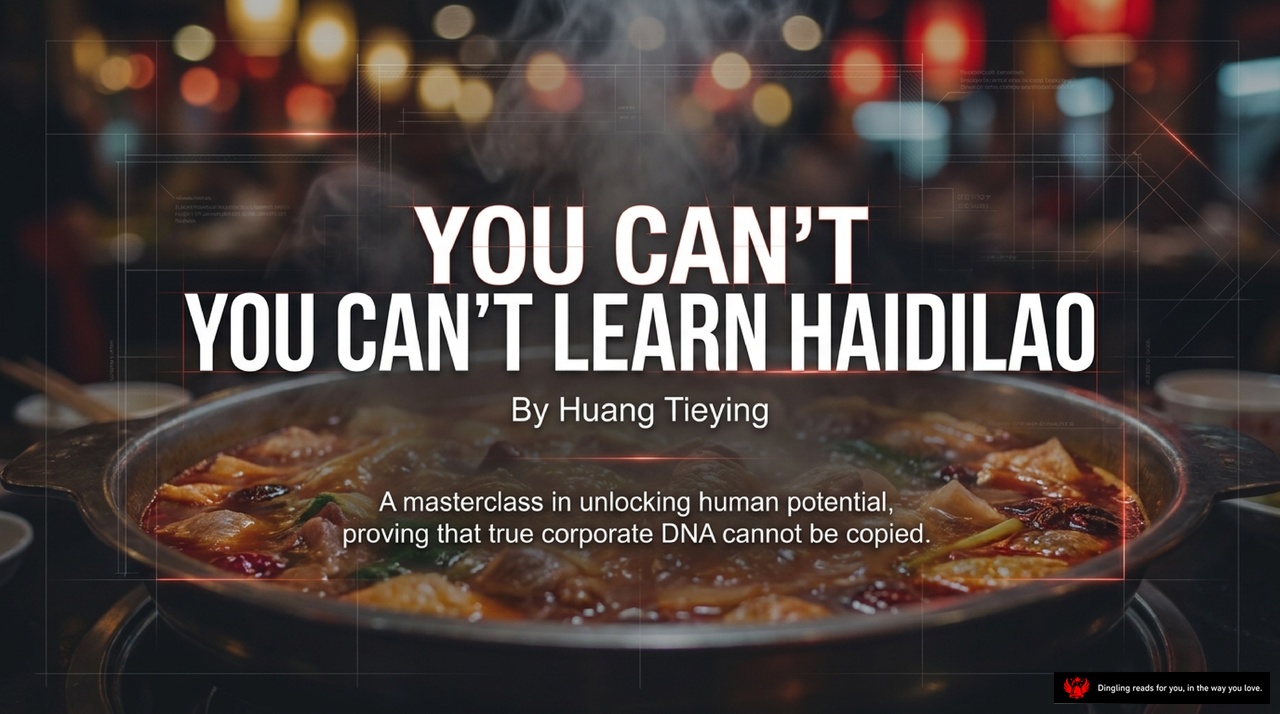
Welcome to a special session on the hidden engine behind Haidilao. Today, we are diving into a powerful truth that many business leaders struggle to grasp: You can't learn Haidilao.
The image before us shows a steaming pot, symbolizing the heart of this restaurant giant. While everyone tries to copy Haidilao's service, the author Huang Tieying reveals a deeper secret: true corporate DNA cannot be copied. It's not about the free manicures or the free hotpot; it's about unlocking human potential in a way that competitors simply cannot replicate.
Consider the story of Yang Xiaoli, a former debt-ridden employee who became a top store manager. When she was in crisis, Haidilao didn't just give her money; they treated her as family, forgiving her debt and giving her full bonuses. This created a bond so strong that when a competitor offered her millions, she walked away, saying, "Without Haidilao, there is no me."
This loyalty stems from a radical trust. Haidilao empowers ordinary servers to give free meals or upgrade dishes without asking a manager. Why? Because they believe that when people are trusted, they respond with responsibility. As the text asks, "If you gave me this power, would you?" The silence in the room is the answer.
While competitors focus on rigid processes, Haidilao focuses on the human. They don't hire robots; they hire people and treat them like family, providing housing, education for children, and even helping parents. When employees feel valued and respected, they don't just work; they innovate. They create their own solutions, like a server who invented a phone bag to keep screens clean, or another who helped a disabled child eat.
The lesson here is clear: You can copy a menu, you can copy a service script, but you cannot copy a culture built on genuine trust and care. Haidilao's success isn't a formula you can buy; it's a result of treating people as the most important asset. In a world of standardized management, the real competitive edge remains deeply human—and that is something no competitor can ever truly learn.
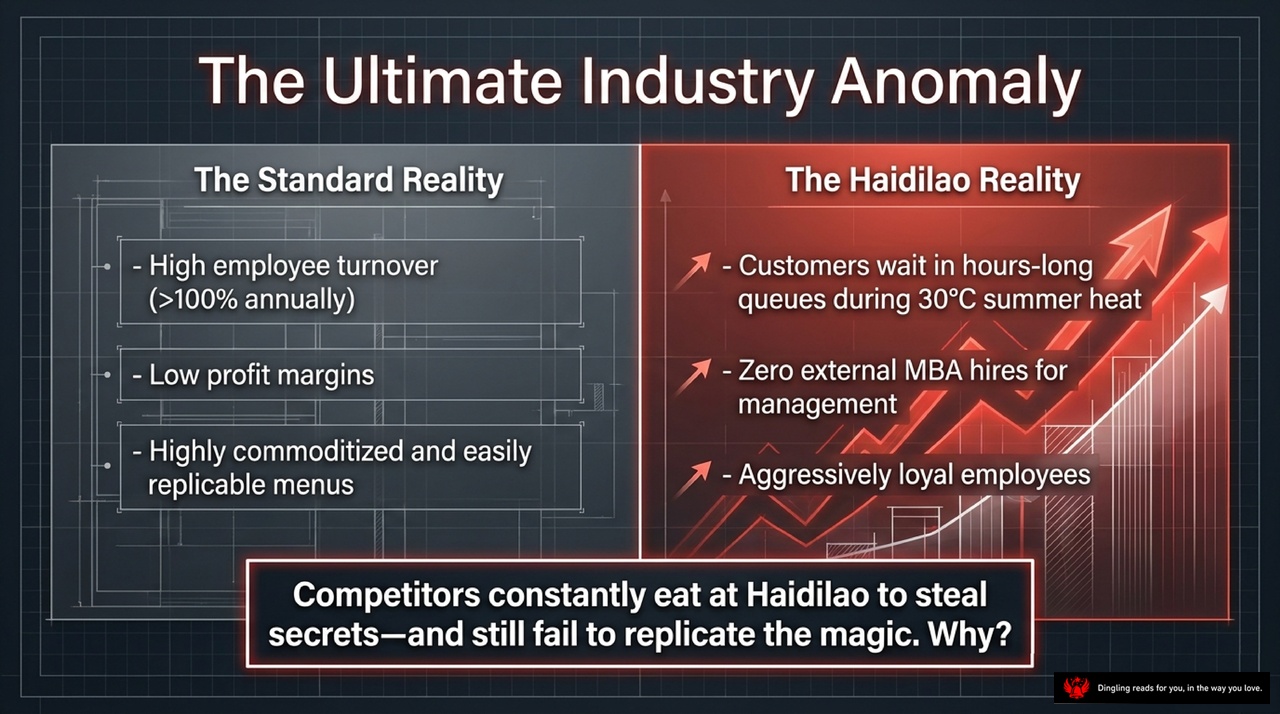
Imagine a scenario where a restaurant defies every rule of the industry. While competitors are bleeding cash with 100% annual employee turnover and thin profit margins, one chain is thriving with customers lining up for hours even in 30-degree summer heat. How is this possible? The answer lies in the "Haidilao Reality," a stark contrast to the standard industry model.
Look at the slide: on the left, we see the "Standard Reality"—high turnover, low margins, and easily copied menus. On the right, Haidilao flips the script. They have zero external MBA hires for management, yet they cultivate aggressively loyal employees who stay for years. Why do competitors fail to replicate this magic despite copying their menu and even stealing their secrets?
The secret isn't a secret recipe; it's a secret culture. Haidilao treats its employees not as workers, but as family. They provide real apartments, cover education costs for children, and even support parents of managers. This creates a sense of belonging so strong that employees fight for the company. One manager once stood alone against 60 armed men trying to smash the restaurant, protecting her "family." Another employee refused a million-dollar job offer from a rival because she felt she had no life outside Haidilao.
This deep loyalty translates directly into customer experience. Because these employees feel trusted and valued, they are empowered to make decisions on the spot—like giving a free meal to a struggling family or inventing a phone case to keep hands clean. This flexibility creates a service level that rigid, standardized competitors simply cannot match. In a world where everyone is fighting for attention, Haidilao proves that treating people like family is the ultimate competitive advantage.

What competitors see versus what actually matters is best understood through the iceberg metaphor we see here. On the surface, you have the free shoe shines, manicures, board games, and smiling servers—things competitors easily copy. But they fail because they try to install the software without building the cultural hardware underneath.
Beneath the waterline lies the real engine: extreme psychological trust, decentralized financial power, fair promotion pathways, and treating marginalized migrant workers with deep dignity. This is where the magic happens. When employees are treated like family—given housing, education for their children, and the power to make decisions like granting free meals—they don't just work; they fight for the brand.
Competitors see the perks, but they miss the soul. They copy the service rituals but never build the trust that makes those rituals meaningful. True differentiation isn't about what you offer; it's about who you empower and how deeply you value them. That's the engine that drives everything else.
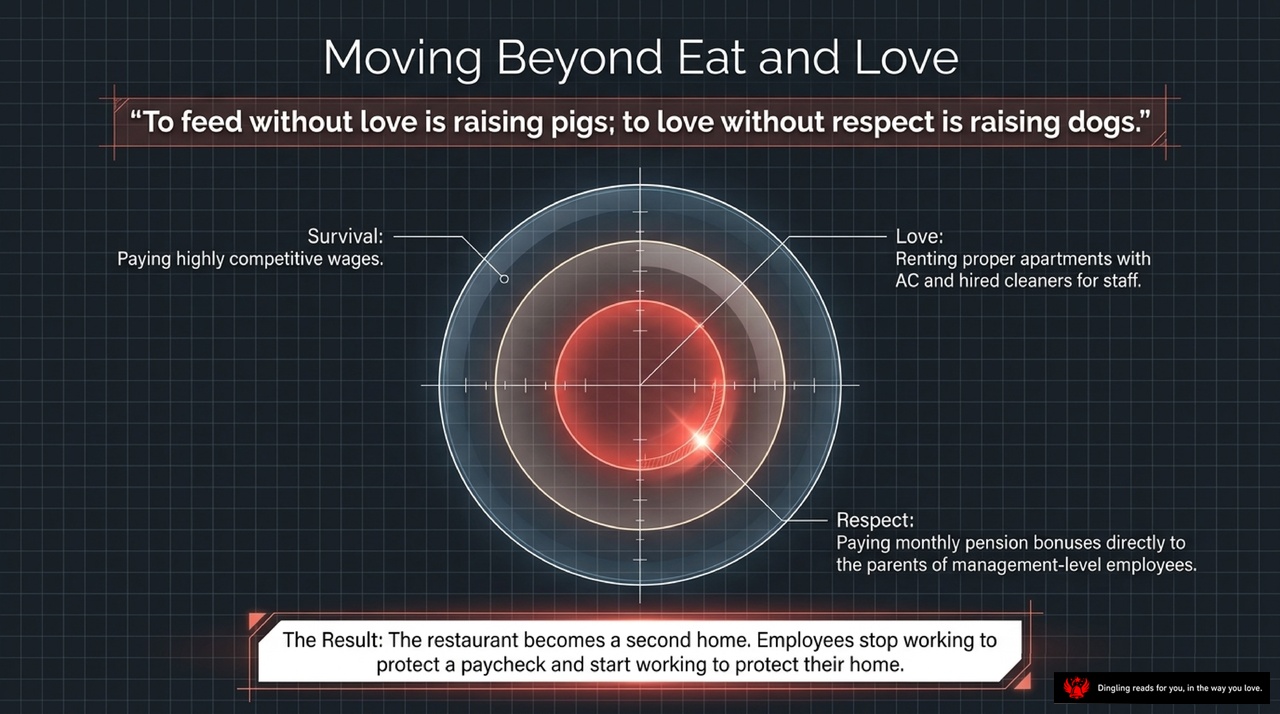
The slide illustrates a powerful shift in mindset: moving from a transactional relationship to a genuine sense of belonging. The core message here is that feeding without love is just raising pigs, and loving without respect is merely raising dogs. True connection requires all three: survival, love, and respect.
In the book, we see how Hai Di Lao operationalizes this philosophy. "Survival" isn't just about paying a paycheck; it's about offering competitive wages so employees feel secure. "Love" goes further—providing apartments with AC, hiring cleaners, and even solving childcare and education issues for staff. This creates a real home away from home. But the most critical element is "Respect." Hai Di Lao pays pension bonuses directly to the parents of management-level employees, signaling that the company values the employee's entire life, not just their labor.
The result, as the graphic shows, is profound. When employees feel truly cared for and respected, the restaurant transforms into a second home. They stop working merely to protect a paycheck and start working passionately to protect their home. This shift from transaction to belonging is what drives the extraordinary service and loyalty that defines Hai Di Lao today.
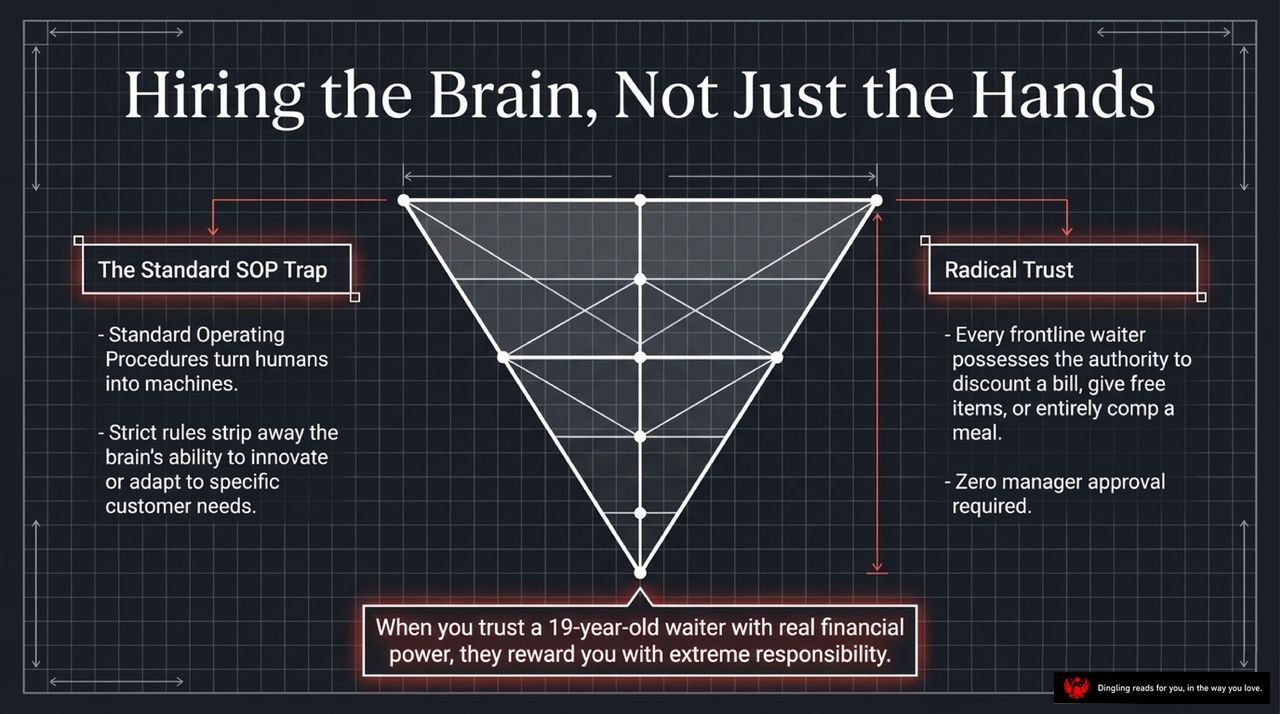
Hiring the Brain, Not Just the Hands. Look at this inverted pyramid on your screen. On the left, we have "The Standard SOP Trap." In many companies, rigid standard operating procedures turn humans into machines. Strict rules strip away the brain's ability to innovate or adapt to specific customer needs. It's the old way of management—control everything, expect nothing.
But look at the right side: "Radical Trust." This is the heart of Haidilao's philosophy. Here, every frontline waiter possesses the authority to discount a bill, give free items, or entirely comp a meal. Zero manager approval is required. When you trust a 19-year-old waiter with real financial power, they reward you with extreme responsibility.
Think about this: why does giving power work? Because it shifts the mindset from "I am a cog in a machine" to "I am the owner of this experience." When employees feel trusted, they stop following scripts and start using their brains to solve problems. They become innovators. They become the brand. This isn't just about being nice; it's about unlocking human potential. True management isn't about monitoring every move; it's about empowering people to do the right thing, even when no one is watching.
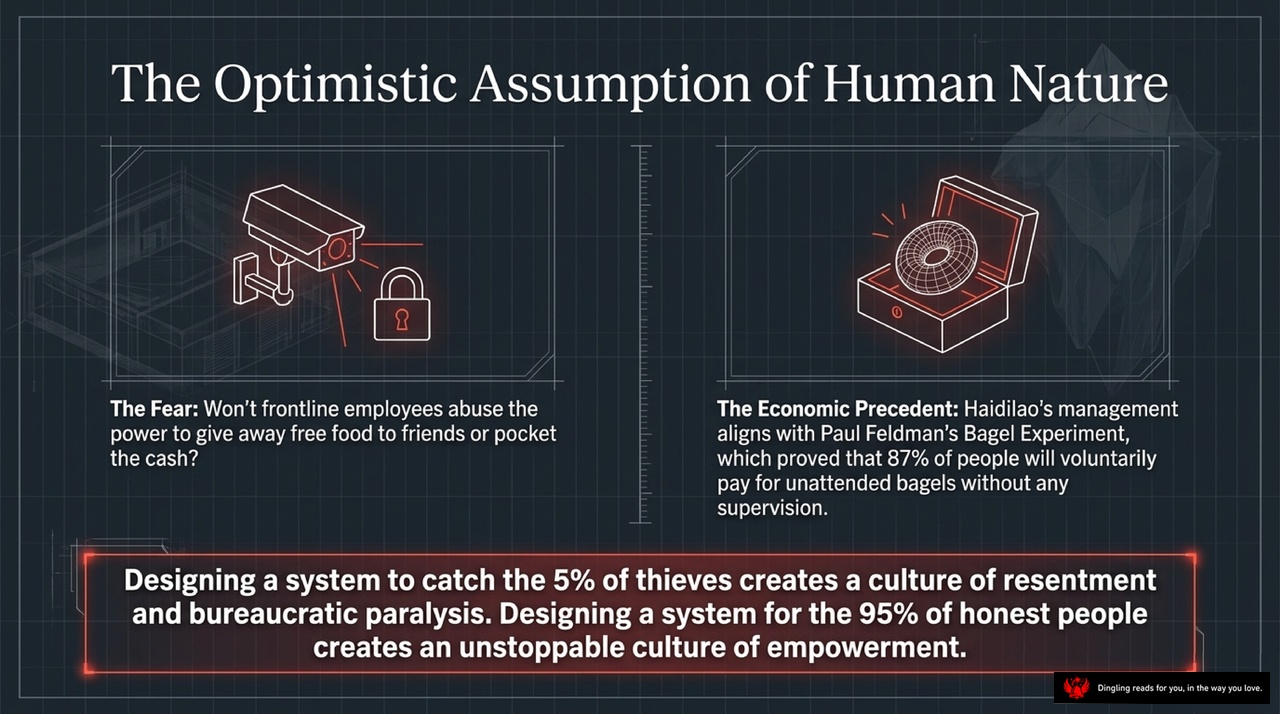
Imagine a world where you trust your employees so much that you leave the till open and the cash register unattended. Sounds risky, right? But science says otherwise. In a famous experiment by economist Paul Feldman, people voluntarily paid for unattended bagels 87% of the time. This isn't just about honesty; it's about the power of trust.
Haidilao's entire management philosophy is built on this "optimistic assumption of human nature." While many companies design systems to catch the 5% of thieves—creating a culture of resentment and bureaucratic paralysis—Haidilao chooses to design for the 95% of honest people. By giving frontline employees the power to give away free food, pocket cash, or even waive bills, they aren't risking chaos; they are unlocking empowerment.
The fear that employees will abuse this power is real, but the alternative is far worse. If you treat your staff like potential criminals, you get a workforce that feels like one. Instead, Haidilao treats its employees like family. When you feel trusted and cared for, you naturally rise to meet that expectation. The result? A culture where innovation flows freely, because employees aren't afraid to make mistakes or take initiative. As the slide suggests, designing a system for the 95% creates an unstoppable culture of empowerment, proving that sometimes, the best way to manage is simply to trust.
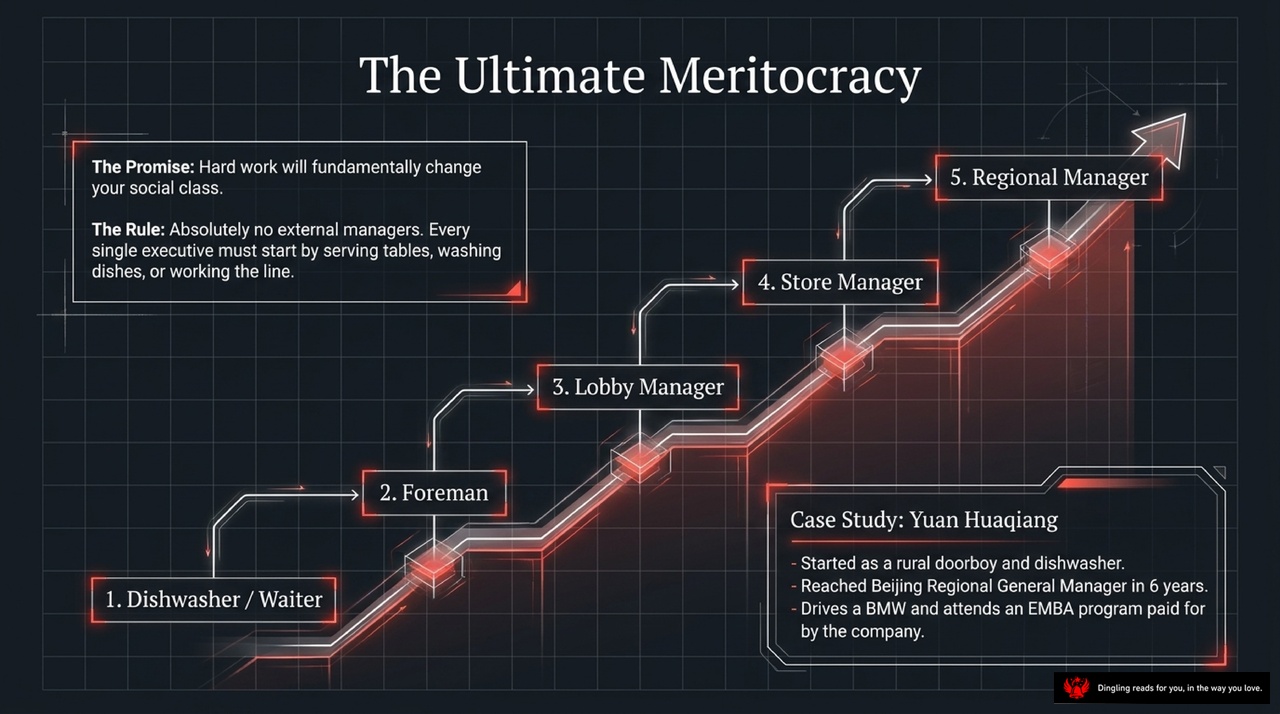
The Ultimate Meritocracy isn't just a slogan; it's the engine that drives Haidilao's success. As the slide illustrates, the promise is clear: hard work fundamentally changes your social class. There are absolutely no external managers here. Every single executive, from the top Regional Manager down to the front line, must start by serving tables, washing dishes, or working the line. This is the rule.
Take Yuan Huaqiang as a prime example. He started as a rural doorboy and dishwasher with no background. Yet, thanks to this system, he reached the position of Beijing Regional General Manager in just six years. Today, he drives a BMW and attends an EMBA program paid for entirely by the company. His story proves that at Haidilao, your potential isn't defined by your resume or your connections, but by your willingness to work and your ability to grow. This vertical path from dishwasher to manager creates a culture where everyone believes that their hands can truly change their destiny.

Look at this slide. It clearly contrasts two worlds: the rigid, top-down "Standard Corporate Model" versus the agile, human-first "Haidilao Model."
In a typical company, waiters are just replaceable labor units who must ask for permission before doing anything. Management hires external MBAs to run the show, and cost control is about strictly enforcing portion sizes and zero waste. But at Haidilao, the playbook is completely different.
First, they flip the script on authority. Instead of asking for permission, waiters act as on-the-spot managers. They have the power to give discounts or even free meals instantly. This isn't just about being nice; it's about giving employees the trust to solve customer problems in real-time without waiting for approval.
Second, they change how they hire and promote. While other companies look for external elites, Haidilao promotes 100% internally from the floor. They believe that the best managers are those who have stood in the shoes of the staff.
Third, they redefine cost control. Instead of punishing waste with strict metrics, they allow calculated waste if it guarantees immediate customer delight. If a guest is sad, giving them extra food is a better investment than saving a few dollars on portions.
Finally, and most importantly, they shift the employee view. In standard models, employees are cogs in a machine. At Haidilao, employees are the primary customers of the company. By treating staff like family and giving them dignity, Haidilao unlocks a level of service that no rigid system could ever replicate.
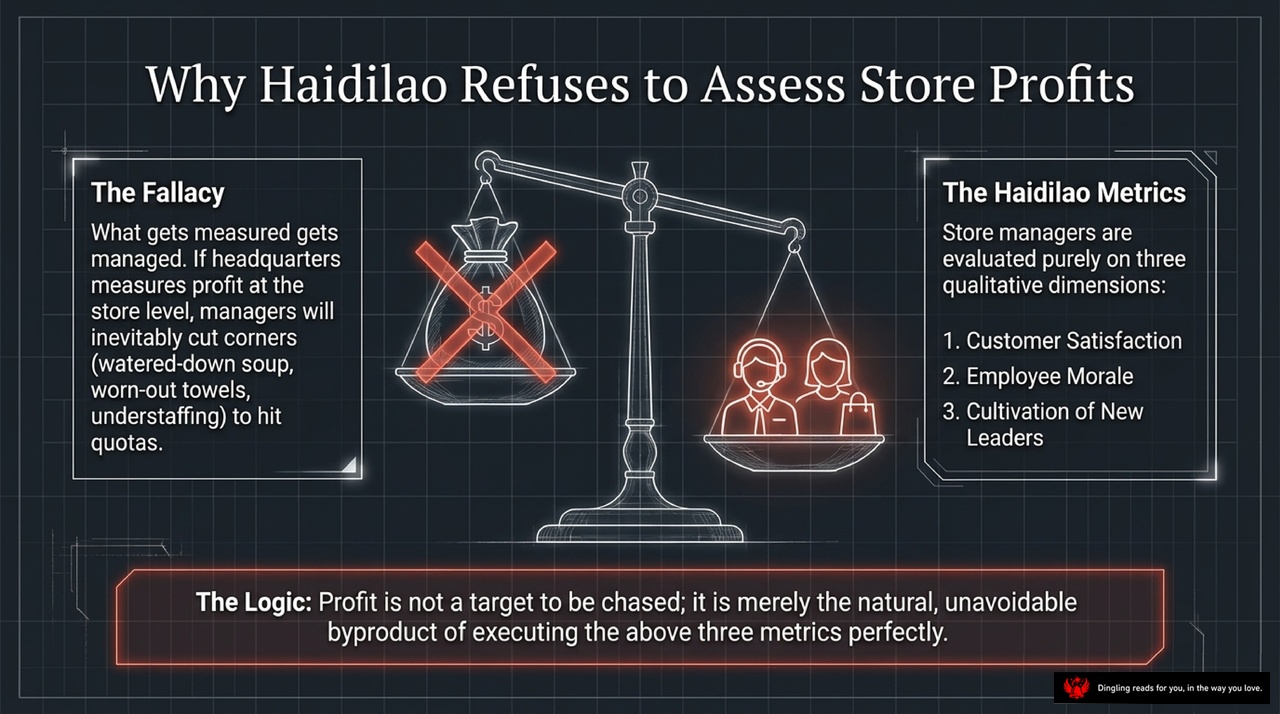
Why Haidilao Refuses to Assess Store Profits
Look at this scale. On one side, we have the traditional approach: measuring profit. The image clearly shows that if you make profit the primary target, the result is cutting corners—watered-down soup, worn-out towels, understaffing. This is the trap of "what gets measured gets managed." If headquarters forces managers to hit a profit quota, they will inevitably sacrifice the customer experience and employee well-being to hit that number.
But look at the other side of the scale. Haidilao flips the script entirely. They don't measure store profits at all. Instead, managers are evaluated purely on three qualitative dimensions: Customer Satisfaction, Employee Morale, and the Cultivation of New Leaders.
The logic here is profound. Profit isn't a target to be chased; it is merely the natural, unavoidable byproduct of executing these three metrics perfectly. When you treat your employees like family and give them the trust to serve guests without hesitation, the business succeeds on its own. By refusing to fixate on the bottom line, Haidilao actually protects it, proving that true growth comes from people, not spreadsheets.

The True Measure of a Leader isn't about the capital you control or the targets you set on a spreadsheet. It's about the people you leave behind when you step away. Look at this diagram: at the center is the Manager Node, radiating out to Store Nodes. The core principle here is simple but radical: "Only a hen that lays eggs is valuable." In the world of Haidilao, a leader's success isn't defined by how many stores they open personally, but by how many capable leaders they can create.
This is known as "The Expansion Rule." Haidilao refuses to open a new store unless the current manager has already trained a successor who is fully capable of running it. They don't expand based on available cash or arbitrary yearly quotas; they expand based on talent depth. If you can't grow someone else, you aren't ready to grow the business.
How do you measure this? That's "The Metric." A leader is only considered successful if 80% of their direct reports are promoted to the next tier within a specific timeframe. This flips traditional management on its head. Instead of asking, "How many stores did you build?", the question becomes, "How many leaders did you build?"
This approach creates a self-replicating system of excellence. When every manager is obsessed with elevating their team, the entire organization becomes a factory for talent. It ensures that no matter how fast the company grows, the quality of leadership never dilutes. It turns every employee into a potential leader and every leader into a multiplier of success.

Imagine a boardroom where ten executives are sweating over a whiteboard, trying to brainstorm the perfect customer experience. Now, contrast that with a bustling hotpot restaurant where ten thousand frontline workers are simultaneously thinking about how to make the next guest feel a little more comfortable. The slide clearly states that ten thousand active minds will universally defeat ten executives in a boardroom. This is the core insight behind Haidilao's success: micro-innovations over macro-strategy.
Instead of mandating top-down innovation, Haidilao's headquarters removes psychological burdens and gives true agency to its frontline staff. The result? Thousands of organic micro-innovations emerge naturally. You see this in real life every day. Waiters don't just serve soup; they distribute hair ties for long-haired customers, provide specialized plastic bags to protect phones from steam, and even supply lens cloths for glasses fogged by the hotpot. These aren't scripted actions; they are spontaneous acts of care born from trust.
The mechanism is simple but powerful: when you treat your employees like family and give them the power to make decisions, they become the ultimate innovators. Ten thousand employees thinking about customer comfort will always outperform a handful of executives trying to guess what customers need. That is the true secret of Haidilao's dominance.
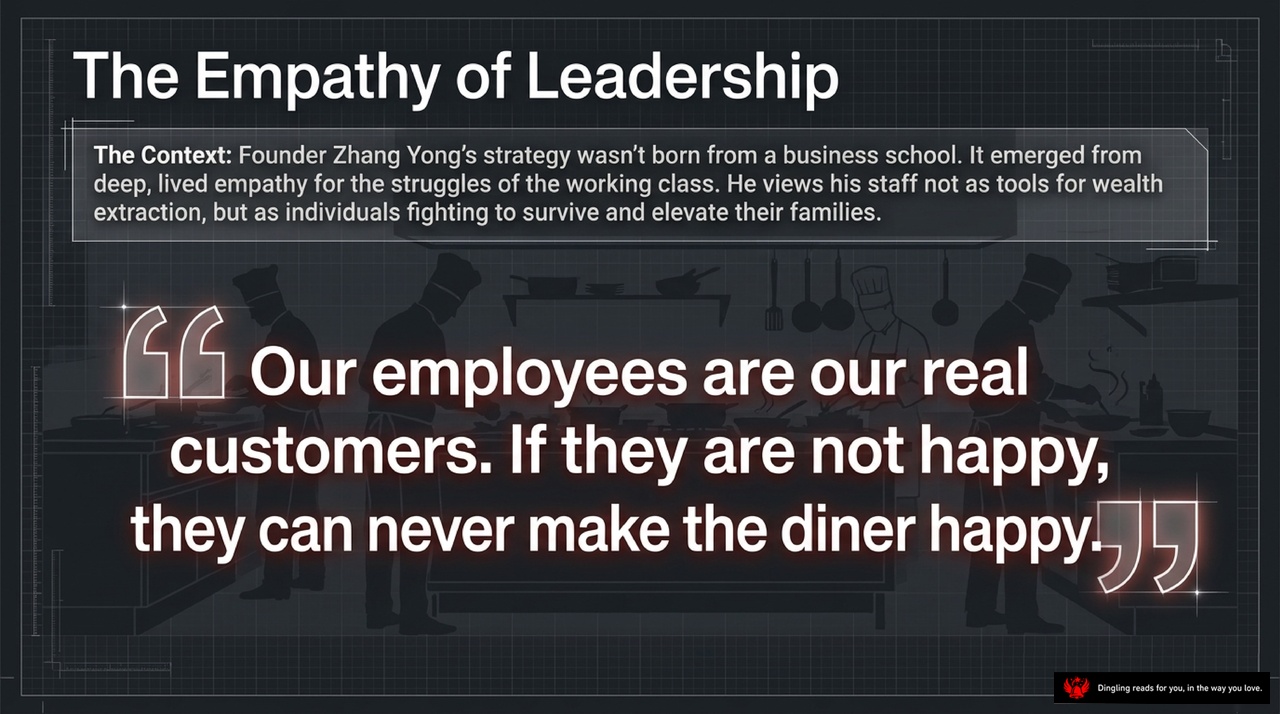
Leadership isn't about having the biggest title or the most impressive office; it's about understanding the people who work for you. Today, we're exploring a powerful concept called "The Empathy of Leadership," and it all comes down to one simple, yet revolutionary idea: your employees are your real customers.
Look at the background here, featuring the busy kitchen staff. This isn't just a scene of cooking; it represents the heartbeat of a successful organization. The core message on the slide highlights a profound truth often overlooked in traditional business: if your team is unhappy, your customers will never be happy either.
This philosophy wasn't born in a business school lecture hall. It emerged from deep, lived empathy. Consider a leader who views his staff not as tools for extracting wealth, but as individuals fighting to survive and elevate their families. When you treat your employees with genuine care, respecting their struggles and aspirations, something magical happens. They stop working *for* the company and start working *for* the family they've built within it.
When you invest in your people's happiness, their motivation skyrockets. A happy employee brings energy, creativity, and a genuine smile to the table. That positive energy is exactly what your external customers are looking for. If the staff is burnt out or resentful, that negativity inevitably leaks out to the customers, ruining the experience. Conversely, when you empower and care for your team, they become the brand ambassadors who create unforgettable moments for everyone they serve.
So, the next time you think about leadership, ask yourself: are my employees treated as my real customers? Because if they aren't happy, no amount of marketing or product innovation can truly make the diner happy. True leadership starts with empathy, and that is where lasting success begins.
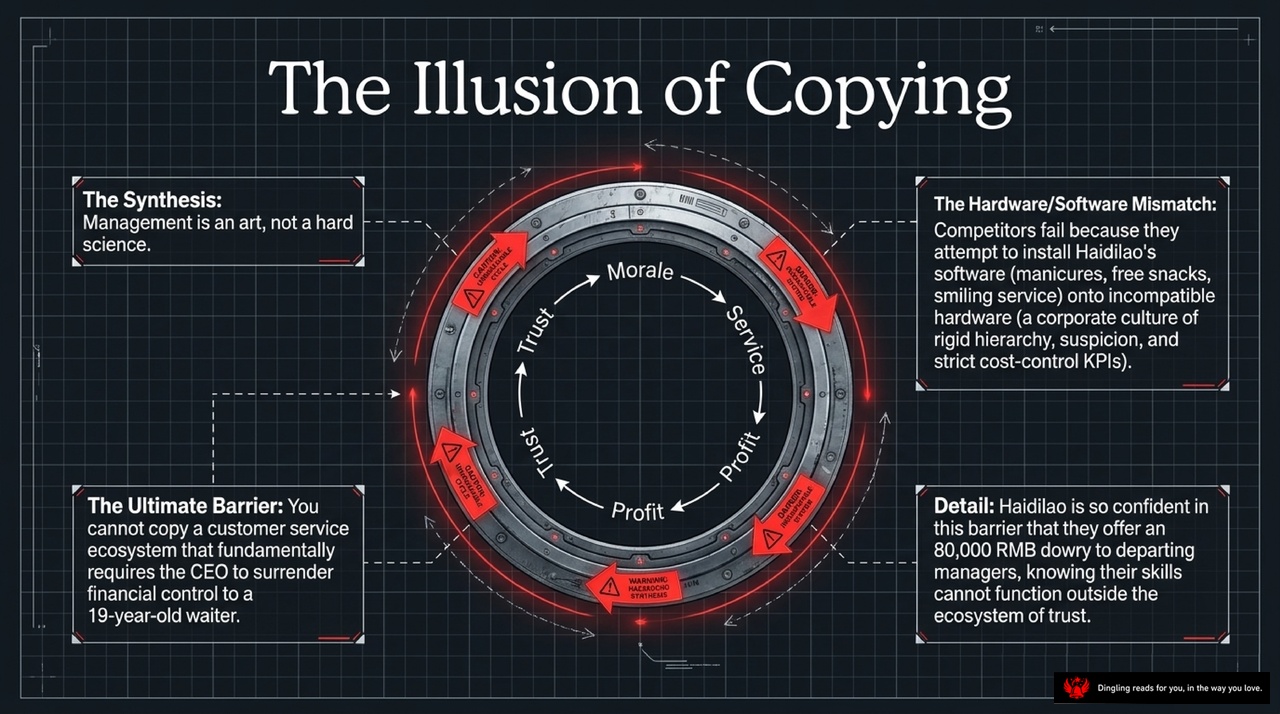
The illusion of copying is the biggest trap for competitors trying to replicate Haidilao. As the slide illustrates, they often fail because of a fundamental hardware and software mismatch. They attempt to install Haidilao's software—like manicures, free snacks, and smiling service—onto incompatible hardware. That incompatible hardware is a corporate culture built on rigid hierarchy, suspicion, and strict cost-control KPIs. You simply cannot copy a customer service ecosystem that fundamentally requires the CEO to surrender financial control to a 19-year-old waiter.
This brings us to the ultimate barrier: management is an art, not a hard science. Haidilao's success isn't about copying their menu or their perks; it's about the deep-seated trust that empowers employees to act like family. When a manager trusts an employee enough to give them the power to waive a bill or make a decision on the spot, that employee responds with a level of dedication and innovation that no rigid rulebook could ever produce. Competitors who try to mimic this without first building that culture of trust are just building a facade. They might copy the look, but they can never copy the soul.

Haidilao's success isn't built on hotpot, but on a radical belief in human dignity. By choosing absolute trust over strict control, replacing profit KPIs with morale metrics, and treating marginalized workers as the company's most valuable asset, they created an uncopiable ecosystem of extreme loyalty and innovation.
You know their secret now, but are you truly brave enough to hand the keys of your company over to your lowest-paid employees?