
Hamlet: Complete Chapter-by-Chapter Summary

Welcome to the world of *Hamlet*, the timeless tragedy by William Shakespeare. Set against the dark backdrop of a poisoned court, this play unfolds as a haunting tale of a prince's agonizing hesitation and the ultimate, devastating price of revenge. At the heart of this story lies a crown, a symbol of power that has become stained with blood. When the ghost of the former king appears, he reveals a shocking truth: the current king, Hamlet's uncle, murdered him in his sleep using poison. This revelation sets Hamlet on a collision course with his own conscience and the corrupt world around him. As he grapples with the weight of justice and the fear of the unknown, Shakespeare invites us to explore the depths of human nature, where love, duty, and madness intertwine in a tragic dance that continues to resonate across centuries.

The foundation of Elsinore's peace shatters upon a ghostly revelation. What looks like a peaceful kingdom is actually built on a fragile lie. The public mourns under the illusion that King Hamlet was struck down by a venomous serpent in his orchard, but the dark truth is far more sinister. An apparition from purgatory reveals a fratricidal coup: the true serpent now wears the crown, having poured lethal poison into his brother's ear. This isn't just a murder; it's a betrayal of trust and a violation of the natural order. The ghost's command sets the tragedy in motion—avenge the murder and purge the throne, but spare the mother and bear the psychological weight of regicide. This revelation transforms Hamlet from a grieving son into a reluctant avenger, forcing him to navigate a world where appearances are deceiving and every action carries the weight of ancient sin.

Hidden tensions and fatal loyalties bind the Danish court. At the center is Hamlet, but look closely at the web of relationships surrounding him. Each connection tells a different story of betrayal, manipulation, or tragic innocence.
To his top left is Claudius, the Usurper Uncle. He is connected to Hamlet by a jagged crimson line of deceit and stolen authority. This red, erratic path represents the murder of the father and the theft of the crown, a crime that casts a long, bloody shadow over the entire kingdom.
Directly below is Gertrude, the Complicit Mother. Her line is a shifting gradient of red to white, representing a hasty, incestuous marriage that stains her loyalty. She stands trapped between her past love and her current husband, her actions blurring the line between mother and accomplice.
On the left is Polonius, the Meddling Advisor. He is tethered by a dashed grey line of surveillance and manipulation. He is a sycophant who weaves a web of spying, ultimately becoming a tragic obstacle that Hamlet must cut through, even at the cost of a life.
At the bottom right is Ophelia, the Tragic Pawn. Her connection is also a dashed grey line, symbolizing genuine but doomed affection. She is controlled by the men around her—her father and her lover—making her a casualty of the court's political games rather than a master of her own fate.
Finally, to the top right is Horatio, the Singular Anchor. He is the only node tethered by an unbroken, solid white line of absolute trust and rational grounding. While everyone else is caught in the web of lies and madness, Horatio remains the only true friend, the steady eye of the storm who will survive to tell the tale.

Look at this slide. It contrasts three grieving sons—Hamlet, Laertes, and Fortinbras—and how they each choose a completely different path for revenge.
First, we have Hamlet, represented by the maze. His approach is "Thought over Action." He is paralyzed by philosophy, morality, and over-analysis. He demands absolute proof before moving, using his "antic disposition" to delay justice. This hesitation allows Claudius to manipulate him, causing widespread collateral damage while Hamlet remains stuck in the loop of his own mind.
Next is Laertes, symbolized by the flame. His methodology is "Action over Thought." Driven by fiery passion and immediate impulse, he is easily manipulated. He openly declares he would cut his enemy's throat in a church, willing to damn his own soul without a second thought. Unlike Hamlet, Laertes has no filter; his grief turns instantly into violent retribution.
Finally, there is Fortinbras, shown by the chess piece. His strategy is "Pragmatism over Emotion." He doesn't fight for blood or honor; he calculates political opportunity from the chaos of others. He rallies an army for a worthless patch of land, using military discipline to ultimately secure the entire Danish throne without shedding a drop of his own blood.
The tragedy of the play lies in this comparison: Hamlet overthinks, Laertes overacts, and Fortinbras simply overcomes.

The image before us splits the tragedy of *Hamlet* into two stark realities: a calculated maze of deception and a shattered glass of genuine ruin. On the left, we see the "Calculated Mask"—Hamlet's strategic madness. He doesn't just lose his mind; he weaponizes it. By adopting an "antic disposition," he turns his erratic behavior into a shield, a way to investigate the King and mock his courtiers without facing immediate execution or censorship. It is a performance of insanity designed to survive a world that demands rationality.
But look to the right. This is "The Genuine Fracture." While Hamlet constructs a maze, Ophelia is left with no path but destruction. Torn between Hamlet's cruel rejection and the sudden, violent murder of her father, her mind does not strategize; it shatters. She descends into true, fatal psychosis, culminating in her tragic suicide. Where Hamlet uses madness as a tool to navigate the political storm, Ophelia is simply swept away by it. Her madness is not a shield; it is the only thing left when the patriarchal demands of her father and the erratic cruelty of her lover collide. The contrast is brutal: one man builds a fortress out of lies, while a woman is reduced to the debris of truth.
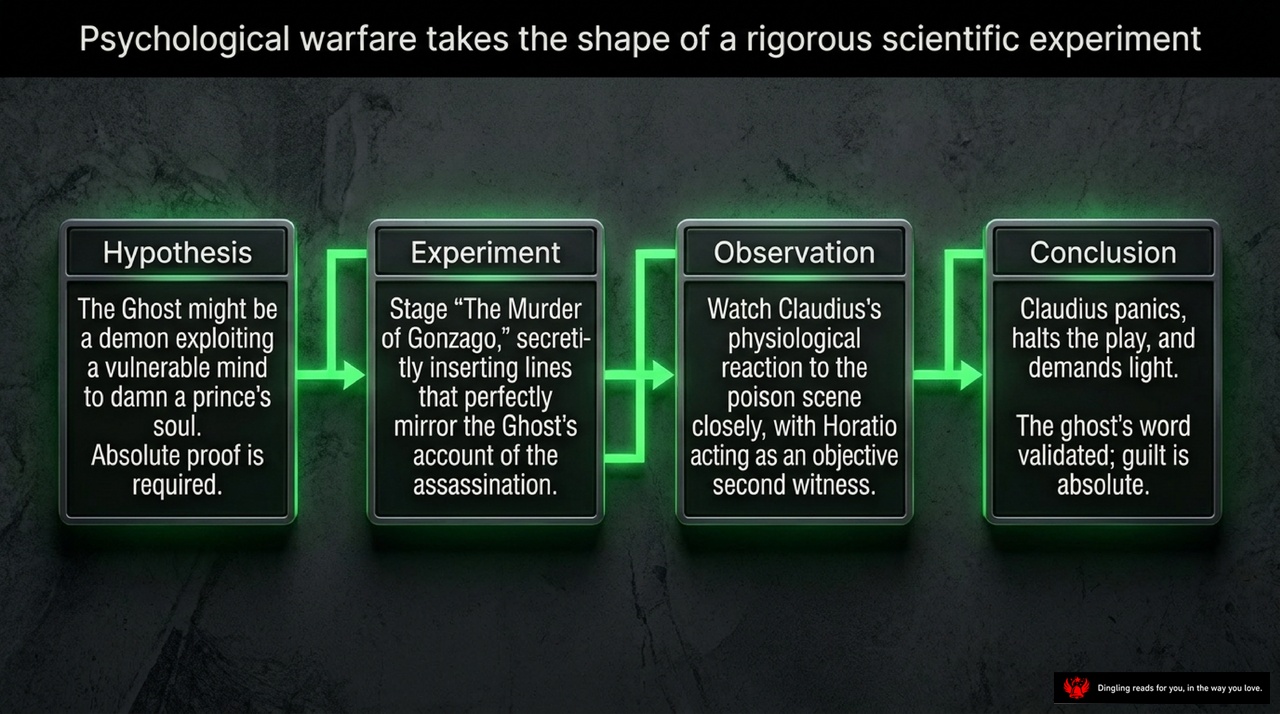
Psychological warfare doesn't just happen in the abstract; in *Hamlet*, it is executed with the precision of a rigorous scientific experiment. Look at this flowchart: it maps the exact moment Hamlet transforms from a grieving son into a detective hunting a ghost.
The process begins with the **Hypothesis**. Hamlet, skeptical of the ghost's claims, treats the supernatural as a potential deception. He assumes the ghost might be a demon exploiting his vulnerable mind to damn a prince's soul. Absolute proof is required.
To test this, he designs a controlled **Experiment**. He stages "The Murder of Gonzago," secretly inserting lines that perfectly mirror the ghost's account of the assassination. He creates a scenario where the truth must play itself out on stage.
Next comes the critical **Observation**. Hamlet watches Claudius's physiological reaction to the poison scene closely, with Horatio acting as an objective second witness. He isn't guessing anymore; he is watching for a specific, involuntary flinch.
Finally, the **Conclusion**. Claudius panics, halts the play, and demands light. The ghost's word is validated; guilt is absolute. Hamlet has successfully used the theater as a trap, turning psychological doubt into undeniable evidence.

The tragedy pivots on a fatal imbalance between hesitation and impulse, a theme visualized right here as a scale tipped dangerously to the side. On one side, we see the "Missed Opportunity," where Hamlet finds Claudius vulnerable in prayer but refuses to strike. He overthinks the spiritual consequences, fearing that killing a repentant man would send him straight to heaven, leaving Hamlet's own father to burn in purgatory. The blade is sheathed, and that moment of delay costs him dearly.
But the scale tips violently to the other side: "Fatal Impulsivity." Moments later, acting on blind, sudden rage, Hamlet stabs through a tapestry at an unseen eavesdropper. He expects the King, but instead, he slaughters the meddling Polonius. This shift is irreversible. The narrative transitions instantly from a delayed pursuit of justice to a bloody cascade of collateral damage. Hamlet's hesitation didn't save anyone; his subsequent impulse destroyed an innocent life, setting the entire tragedy in motion.

The royal court of Elsinore isn't just a place of power; it's a trap that slowly swallows everyone in its path. As the feud between the royal family deepens, the gravity of the conflict pulls in the innocent and the sycophants alike, dragging them all into the abyss. Look at the four figures marked with red crosses: Polonius, Ophelia, Rosencrantz, and Guildenstern. Polonius, the chief counselor, was slain behind an arras due to his own espionage and Hamlet's unchecked rage. His daughter, Ophelia, was driven to madness tormented by the loss of her father and her lover's cruelty, ultimately drowning among the weeping willows. Then there are Rosencrantz and Guildenstern, childhood friends turned royal spies, sent to the executioner's block in England through Hamlet's forged counter-orders.
This tragic outcome stems from a critical failure: The Cost of Delay. Hamlet's inability to strike directly at the source creates a vacuum that destroys the entire court ecosystem. While he hesitates, innocent lives are lost, and the web of deceit tightens around everyone, turning allies into victims and friends into enemies.

The final conspiracy relies on a triple-redundancy system of death.
Claudius doesn't just rely on one method to eliminate Hamlet; he builds an unbreakable trap with three layers of failure.
Layer one is the unbated sword. During a "friendly" fencing match, Laertes secretly wields a rapier stripped of its safety tip. This ensures that any strike, no matter how light, will draw blood.
Layer two is the venomous blade. The exposed steel is coated in an extraordinarily rare, lethal contagion. A mere scratch is guaranteed to bring immediate death.
But what if Hamlet evades the blade? That's where Layer three comes in: the poisoned pearl. Should Hamlet survive the fight, Claudius prepares a backup—a poisoned chalice offered as a victory toast to quench the prince's thirst.
The absolute trap: Claudius engineers a scenario where survival is statistically impossible. With the poisoned sword, the lethal poison, and the poisoned drink all converging, his secret remains safe. There is no escape.

The poisoned conspiracy collapses upon its architects in a matter of minutes. What began as a calculated trap by King Claudius ends in total, chaotic destruction. Let's look at how this deadly domino effect plays out.
First, we have The Accidental Victim. Queen Gertrude, unwittingly, raises the poisoned chalice to toast her son, drinking the fatal draft before Claudius can intervene. Her love for her son becomes her undoing, turning her into the first casualty of her own husband's treachery.
Then comes The Fatal Strike. Laertes wounds Hamlet with the venomous blade. In the ensuing scuffle, the rapiers are dropped and scrambled. This moment of chaos is crucial because it changes the game.
Next is The Reversal. Hamlet unknowingly arms himself with the poisoned weapon and strikes Laertes, condemning the conspirator to his own trap. The poison meant for Hamlet is now the instrument of Laertes' death, a perfect poetic justice.
Finally, we reach The Vengeance. Realizing the truth, Hamlet forces the venomous blade into Claudius and pours the remaining poisoned wine down the usurper's throat. With the wine in his throat and the dagger in his heart, Claudius meets his end.
In the end, the poison that was meant to destroy the innocent spreads through the entire royal family, bringing down the corrupt regime built on lies.

A singular survivor must bear the heavy burden of historical record. In the final act of Hamlet, we see the tragic weight of memory fall squarely on Horatio's shoulders. As the poison takes its deadly toll on Hamlet, a devastated Horatio attempts to drink the dregs of the poisoned chalice, wishing to die alongside his prince. But Hamlet, in his final moments, physically wrestles the cup away, ordering Horatio to "absent thee from felicity awhile." He knows that his story must survive him.
With the Danish royal line extinguished and Fortinbras claiming the throne, Horatio transforms from a passive, rational observer into the sole architect of Hamlet's legacy. He becomes the vessel for truth in a world that has been blinded by corruption and madness. He must tell the true story to a blind world, ensuring that the facts of this tragedy are not lost to time or twisted by the victors. Horatio's survival is not just an act of endurance; it is a sacred duty to preserve the integrity of history against the eroding forces of power and forgetting.

Usurpation acts as a creeping venom that rots the ecosystem of a nation. This isn't just a metaphor; it's the literal, psychological, and political reality of Elsinore.
First, look at the mechanics of death. In this corrupted state, murder relies entirely on hidden toxins. It's poison poured into a sleeping ear, smeared on a duelist's blade, or dropped into a celebratory cup. The violence is never direct; it is insidious, designed to bypass the victim's defenses just as the corruption bypasses the nation's conscience.
Then, consider the psychological toll. The characters are paralyzed by the venom of grief, suspicion, and toxic obsession. Hamlet's mind is infected by the ghost's mandate, while Ophelia is destroyed by trauma. The "venom" spreads from the crown to the soul, turning a grieving son into a hesitant avenger and a loving sister into a drowning victim.
Finally, we see the political consequence. As the play opens, we hear the famous warning: "Something is rotten in the state of Denmark." The initial unnatural act of fratricide poisons the entire political body of the state. It creates a vacuum of trust where only suspicion thrives. This requires a total, bloody purge before balance can be restored. The state cannot heal while the root remains infected; the only cure is the complete destruction of the corrupt system itself.

The image captures the haunting aftermath of a royal tragedy, where a single skull rests on the stone steps beneath an empty, shadowed throne. This stark visual perfectly encapsulates the central question Hamlet faces: if acting on revenge makes us monsters, but inaction makes us cowards, is true justice ever achievable without destroying ourselves in the process?
Hamlet's quest for justice ultimately purges Elsinore of its rot, but the delay demands the ultimate sacrifice, consuming the innocent and the guilty alike in a total collapse of the royal house. We see this destruction unfold as the innocent, like Polonius and Ophelia, are caught in the crossfire of a conspiracy they never understood, while the guilty, including the King himself, are consumed by their own paranoia and greed. The empty throne symbolizes the void left by this moral decay, a space no one can fill once the family line is extinguished.
In the end, the only victor is Fortinbras, a stranger who arrives to claim a crown stained with the blood of others. Hamlet's final words to Horatio are a testament to this brutal reality: "The rest is silence." He recognizes that his actions, while necessary to expose the truth, have led to a world where everyone is dead, leaving only the memory of the crime to speak. The skull in the foreground reminds us that in the theater of revenge, no one escapes the grave, and the pursuit of justice often demands a price far higher than we ever imagined.