
Hard-Boiled Wonderland and the End of the World: Complete Chapter-by-Chapter Summary

Welcome to a breathtaking literary experiment that splits human consciousness into two parallel dimensions, exploring the ultimate price of absolute peace. We're diving into Haruki Murakami's *Hard-Boiled Wonderland and the End of the World*. Imagine a world where you are a data analyst, buried in calculations, while simultaneously living in a small, walled town where golden beasts follow a silent trumpet call. It's a story about two men, two lives, and the haunting question of what happens when you lose your shadow, your memories, and even your heart. Join us as we unravel the mystery of the unicorn skull and the secrets hidden beneath the ice.
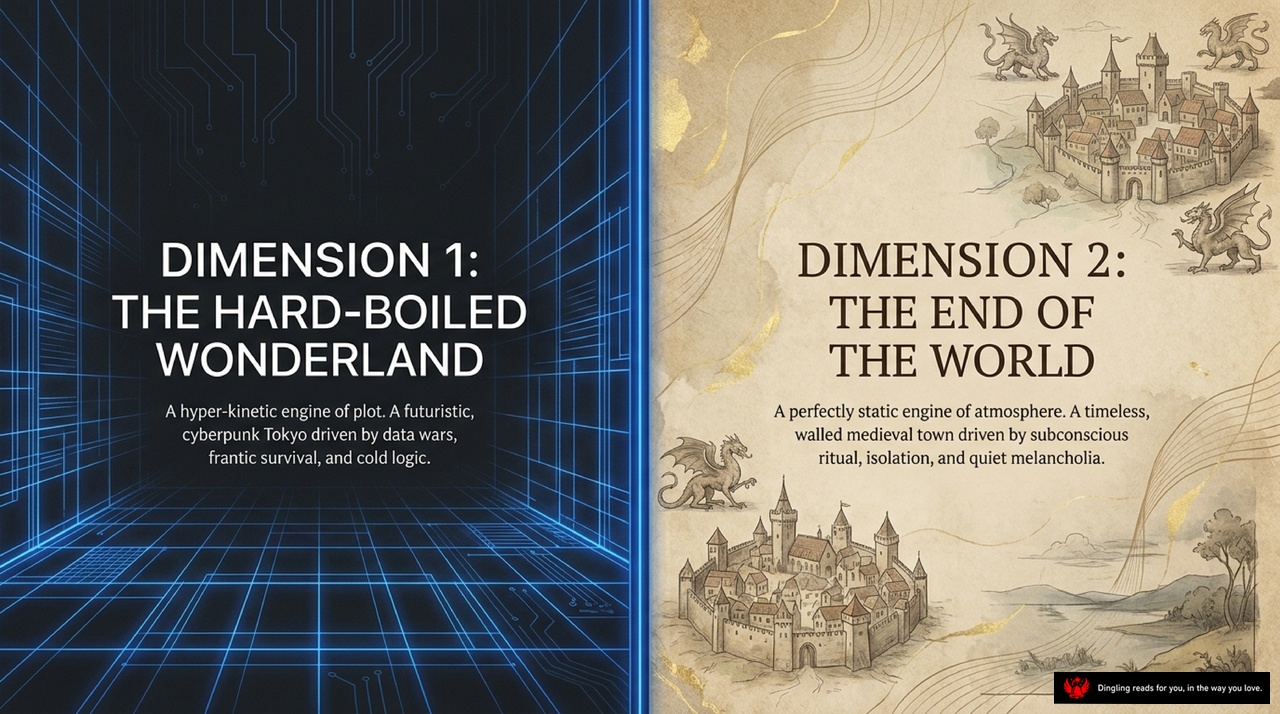
On the left, we see Dimension 1: The Hard-Boiled Wonderland—a hyper-kinetic engine of plot set in a futuristic, cyberpunk Tokyo driven by data wars, frantic survival, and cold logic. It's a world of speed and steel. On the right lies Dimension 2: The End of the World—a perfectly static engine of atmosphere featuring a timeless, walled medieval town driven by subconscious ritual, isolation, and quiet melancholy.
These two dimensions represent the book's core duality. In the real world, the protagonist is a Calculation士, a human whose consciousness has been split. He lives a frantic life in a neon-drenched city, constantly calculating data to keep the system running. He's disconnected from his emotions, his body, and even his own memories. It's a life of pure function, where efficiency is king and humanity is optional.
But then, he is pulled into the second dimension. Here, time stands still. There are no data wars, no frantic survival. Instead, there is a town enclosed by high walls, where golden beasts roam freely and people live in a state of suspended animation. In this world, the protagonist becomes a Dream Reader, tasked with extracting ancient dreams from animal skulls. It's a life of ritual and silence, where the only goal is to preserve the past in a state of eternal peace.
The story unfolds as the protagonist navigates these two realities simultaneously. He tries to solve a crisis in the hard-boiled city while exploring the mysteries of the timeless town. But as he delves deeper into the End of the World, he begins to realize that the two dimensions are not separate. They are two sides of the same coin. The frantic calculations of the real world and the quiet rituals of the town are both attempts to make sense of a fractured existence.
As the plot thickens, the line between the two dimensions blurs. The protagonist starts to question what is real and what is a projection of his own mind. Is the hard-boiled city a nightmare he created to escape the silence of the town? Or is the town a refuge he built to hide from the chaos of the real world? The answer lies in the choices he makes as he races against time to save both worlds.

Imagine a world where your mind is split in two, not by a tumor, but by a deliberate design. In this reality, your left brain handles the logic of numbers, while your right brain manages the chaotic, fuzzy data that the outside world tries to hide from us. This is the "Reality Track," and right now, we are diving into the most dangerous layer: Information Warfare.
Look at the diagram on your screen. We are visualizing this battle as a vertical descent into the unknown. At the very top, hovering above the city, is "The System," or as they call them, the Calcutecs. These are the elite data protection agents. They don't just encrypt your information; they use a technique called "Shuffling," or fuzzy computing, to scramble data within their own split-brain hemispheres. They are the guardians of the status quo, ensuring that the truth remains locked away.
But every fortress has an enemy. Descending further into the blueprint, we hit "The Factory." This is the domain of the Semioteecs. These are the data thieves and hackers, operating in the shadows. Their mission is simple and ruthless: they attempt to steal and decrypt the protected information that the Calcutecs guard, selling it on the black market. They are the digital vandals trying to crack the code of our reality.
And then, we reach the deepest, darkest level of this structure: "The Underground." Here live the INKlings. These are terrifying, subterranean mutants who control the dark depths below the city. They aren't just hackers; they are a threat to existence itself. They threaten anyone who dares to venture out of the light, trying to pull us into their chaotic, uncontrolled world.
So, what does this mean for us? It means that our daily lives are actually a constant war between these three forces. The System tries to keep us safe but ignorant, the Factory tries to exploit us, and the Underground tries to destroy us. Understanding this track is the first step to realizing that the reality we live in is not fixed—it is a battleground, and the information we consume is the ammunition. As we continue this journey, we will see how one ordinary person gets dragged into the middle of this war, forced to choose sides in a conflict that could rewrite the very fabric of our world.

In the world of *Pale Fire*, the protagonist is trapped in a labyrinthine city where the boundaries between reality and illusion blur. But imagine this city not as a concrete jungle, but as a living, breathing organism—a map of the human mind itself.
Look at this illustration. It's a "Subconscious Sanctuary," a metaphorical landscape drawn from the depths of our own psyche. Think of the brain not just as an organ, but as a fortified town.
First, notice the imposing **Wall** on the left. In the story, it's an impenetrable barrier of the ego, a wall so high that only birds can fly over it. It represents the part of us we keep hidden from the outside world, the secrets we refuse to let in.
Just inside the wall lies the **River and Sandbar**. This is a tranquil divider, a calm zone where "golden beasts"—those mythical creatures from the story—gather. It's a place of transition, a quiet space between the chaotic outside and the structured inside, where we might find a moment of peace amidst the noise.
Then, move to the top right: **The Library**. This is where the real magic happens. It's a quiet repository where a "Dream Reader" processes glowing skulls to release trapped energy. In our minds, this library is the subconscious, the archive of our forgotten memories and repressed emotions. We are constantly digging through these "skulls," trying to unlock the stories we've buried.
But not everything in this sanctuary is peaceful. Look at the bottom right: **The Apple Forest**. This is described as a freezing graveyard where discarded "Shadows" are left to die. It's the dark side of the psyche, the place where our rejected parts, our failures, and our lost identities go to wither away. It's a stark reminder that holding onto our shadows can be a slow, painful process.
Finally, peek at the top right corner again, near the skulls. There's a symbol of the **Dream Reader**, processing these glowing remnants. It's the part of us that is always awake, always analyzing, always trying to make sense of the chaos.
This map isn't just about a fictional town; it's a mirror. It shows us that our minds are complex cities with walls we build, rivers we navigate, libraries we explore, and forests where we leave our old selves behind. The journey in *Pale Magic* is about crossing these boundaries, understanding the monsters in our own mind, and finding a way to live with the shadows instead of letting them freeze us in place.

On the left, we see "Wonderland"—a frantic, cyberpunk Tokyo where the protagonist speaks with a detached, formal "Watashi," obsessed with data and the cold logic of "The Brain." It's a world of ticking clocks and subterranean labs, moving at a breakneck pace. On the right, we have "The End of the World"—a timeless, walled town where time feels static, anchored by "The Heart" and the intimate, emotional voice of "Boku." Here, there are no modern technologies, only ancient traditions and a deep, quiet connection to memory and ego.
This isn't just a contrast in setting; it's a clash of consciousness. In Wonderland, the protagonist is a "Calculationist," trapped in a dual-brained existence, trying to convert chaos into numbers. In the End of the World, he becomes a "Dream Reader," tasked with extracting stories from ancient skulls, guided by a girl who still remembers the pain of having a heart. The former is a machine processing information; the latter is a human feeling emotion. As the story unfolds, these two worlds collide, forcing our protagonist to choose between the sterile safety of data and the risky, painful freedom of the heart. Which world will he ultimately inhabit?
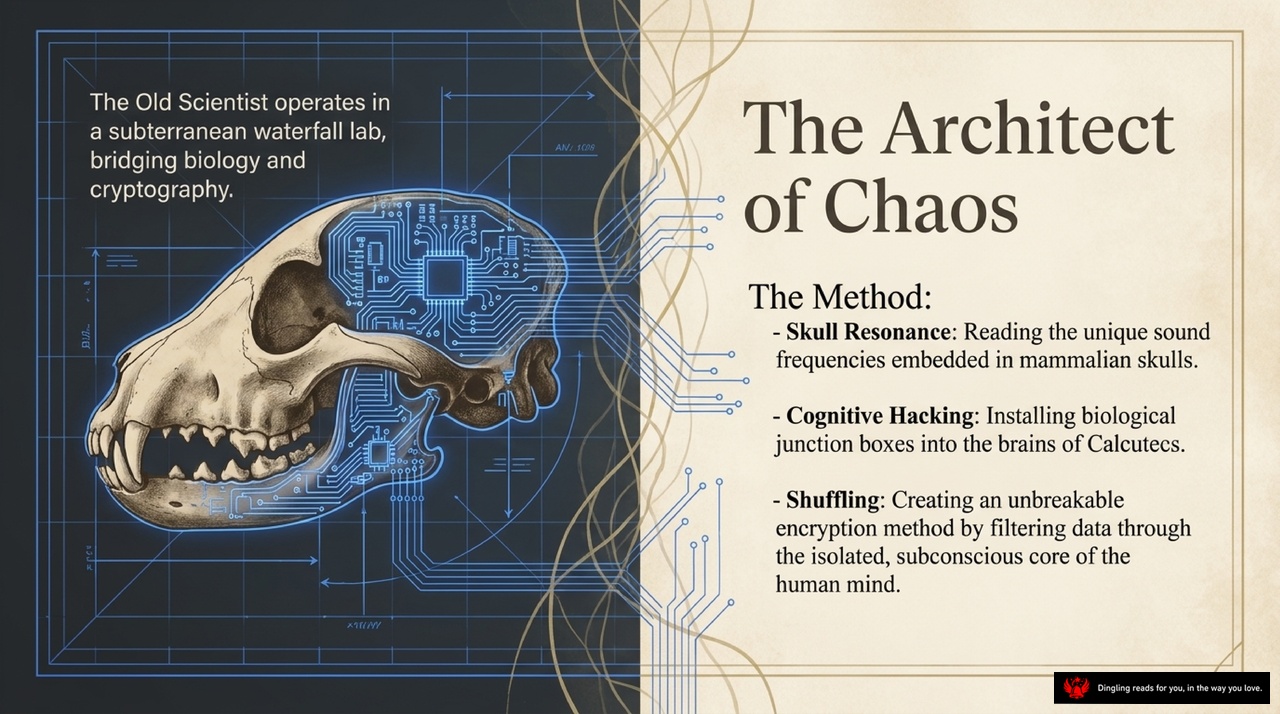
The Old Scientist operates in a subterranean waterfall lab, bridging biology and cryptography. This is where the Architect of Chaos reveals his true method. It all starts with Skull Resonance: reading the unique sound frequencies embedded in mammalian skulls. He takes this ancient biological data and moves into Cognitive Hacking, installing biological junction boxes directly into the brains of Calcutechs to manipulate them. Finally, he executes Shuffling, creating an unbreakable encryption method by filtering data through the isolated, subconscious core of the human mind. It's a terrifying fusion of nature and code, turning the very structure of our consciousness into a lock that no one else can ever open.

So, let's talk about the ultimate cognitive hack. Have you ever felt like your mind is split into two distinct worlds? One where you live your daily life, and another where you process the chaos beneath the surface? In *Pale Fire*, the protagonist experiences this exact fracture.
Look at the diagram here. It breaks his mind down into three circuits. Circuit 1 is the Conscious Self—the surface level where he works, interacts, and navigates physical reality. Circuit 2 is the Subconscious, acting as the processing layer for data encryption. But then, there's the critical third layer: Circuit 3, labeled "The End of the World." This is a closed-loop, isolated sanctuary artificially awakened by a scientist.
Now, here's the ticking bomb. Because of a biological failure, Circuit 3 is expanding. The text warns us that in exactly 35 hours, Circuits 1 and 2 will permanently shut down. If that happens, the protagonist gets trapped in Circuit 3 forever. It's a permanent exile into a self-created world.
This isn't just a sci-fi plot twist; it's a profound metaphor for the human condition. We all have parts of ourselves we try to ignore, the subconscious data we don't want to process. But eventually, those suppressed parts expand, threatening to consume our conscious reality. The protagonist realizes that his entire world—the walls, the river, the library, even the girl he loves—was actually a projection of his own fractured consciousness. He built this "End of the World" himself, and now he has to decide: does he let this internal world consume him, or does he find a way to reintegrate and survive? It's a haunting reminder that sometimes, the most dangerous monsters are the ones we create inside our own minds.
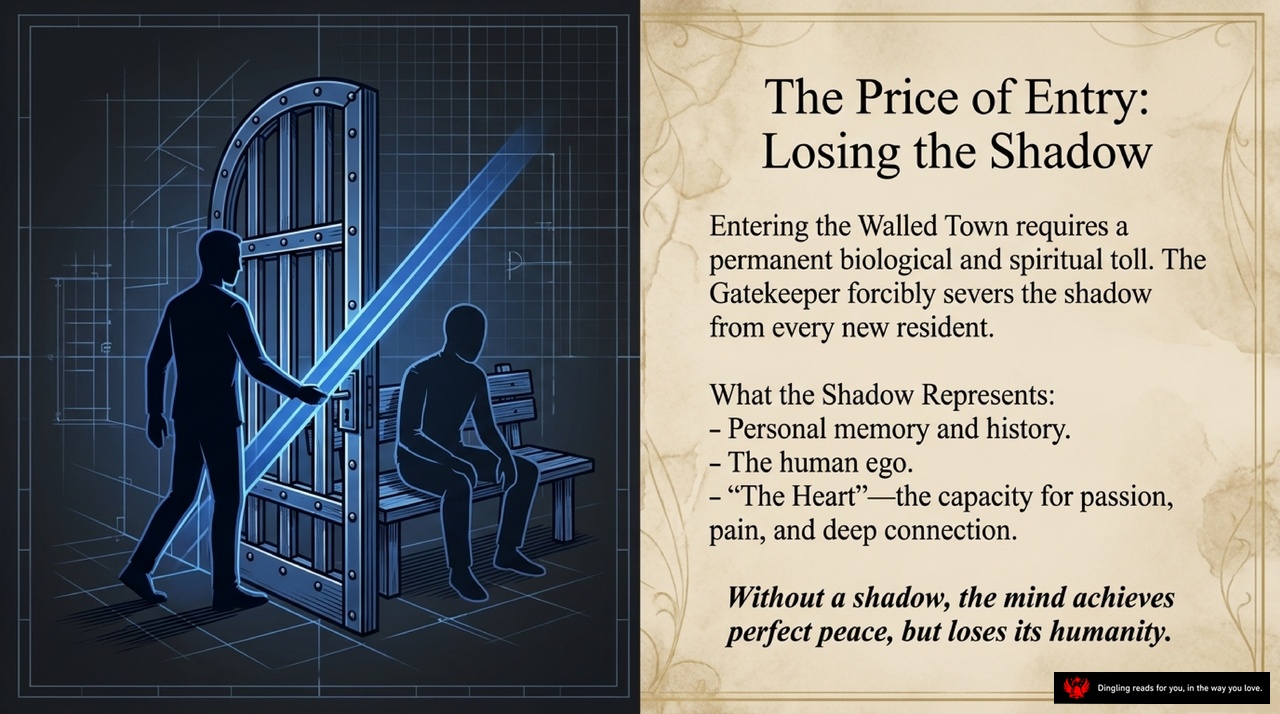
Have you ever felt like you had to leave a part of yourself behind just to belong somewhere? That's exactly what happens in the Walled Town. To enter, you must pay a permanent price: the loss of your "Shadow."
In this story, the Gatekeeper doesn't just let you through; he forcibly severs your shadow from your body. Why is this so dangerous? Because that shadow isn't just a dark patch on the ground. It represents your personal history, your unique ego, and most importantly, your "Heart"—the capacity for passion, pain, and deep human connection.
The image shows a stark reality: one figure walks confidently into the gate, while another sits alone on a bench, stripped of their shadow. The text warns us that without a shadow, the mind might achieve a perfect, sterile peace. But in doing so, it loses its very humanity. It becomes a hollow shell, safe but empty.
This is the tragic cost of the Walled Town. They trade your chaotic, painful, beautiful humanity for a guaranteed, artificial safety. It forces us to ask a hard question: Is it better to be safe and soulless, or to risk the pain of being fully human? The choice, as the story shows, is far more complex than just opening a door.

The Ecosystem of the Mind. Imagine your subconscious not as a dark void, but as a bustling, self-regulating town where perfect, painless equilibrium is the only rule. How does this system keep the peace? It relies on a delicate, four-step cycle that weaves through our daily lives.
First, we have **Absorption**. Picture golden unicorns grazing in this mental landscape. They don't just wander aimlessly; they actively feed on the emotional weight of the town, absorbing the raw feelings and stresses of the collective ego. They take the burden so we don't have to carry it alone.
But nature demands balance, so next comes **Purge**. When these unicorns become too heavy with the town's sorrow, unable to bear the crushing load, they die off in the harsh winter snow. It's a necessary sacrifice. Their death isn't a tragedy; it's the system's way of clearing out the excess, ensuring the emotional energy doesn't stagnate.
Then, **Extraction** begins. Enter the Gatekeeper, a silent, blue-hued figure who strips the skulls from the dead beasts. This is the alchemical process of turning raw grief into something manageable. The Gatekeeper doesn't destroy the pain; he harvests it, separating the essence from the form, preparing it for the final release.
Finally, **Release**. This is where the magic happens. The Dream Reader, a translucent figure, traces the skulls, gently releasing the trapped energy of the ego harmlessly into the atmosphere. It's like exhaling a heavy sigh, dispersing the tension back into the void so the town can reset.
Throughout this cycle, the townspeople are constantly **Shedding**. They cast off the daily residue of their ego, feeding the unicorns, allowing the system to flow like a river. It's a closed loop of creation and destruction, absorption and release, keeping the mind in a state of perfect, painless equilibrium. In this ecosystem, no emotion is lost; it is only transformed, ensuring that we never get stuck in the past, but always move forward into the next season of our inner world.
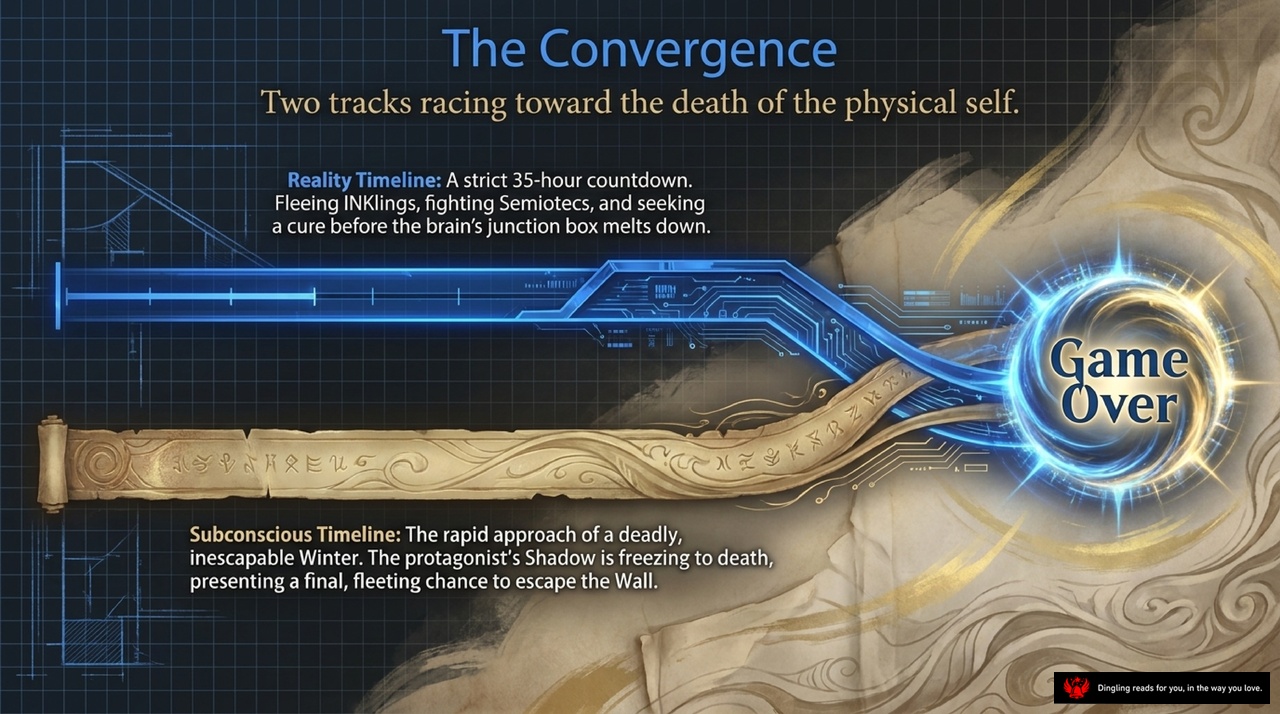
The Convergence: Two tracks racing toward the death of the physical self.
Imagine two countdowns ticking in your head, pulling you in opposite directions until there is nowhere left to run.
On one track, you are in the real world, facing a brutal 35-hour deadline. You are a Calcute, a human computer, hunted by the Inkling and the Semiotec. Every second counts as you fight to find a cure before your brain's "junction box" melts down. If you fail, it's simply Game Over.
But beneath that, running parallel in your subconscious, is a second timeline. Here, a deadly, inescapable Winter is approaching. Your Shadow, the part of you that was separated from your body, is freezing to death in the World of the End. This presents a final, fleeting chance to escape the Wall before it's too late.
You have to survive the chaos of the real world while simultaneously saving your own soul in a frozen fantasy. One failure in either timeline, and both collapse. The clock is ticking on two fronts, and the end is inevitable unless you can find a way to break the convergence.

Have you ever felt like your mind could stretch on forever, even when your body was running out of time? That's the illusion of immortality we're exploring today. Look at this slide: on the left, we see "The Encyclopedia on a Toothpick"—a metaphor for how much information can be compressed into something tiny. On the right, those intricate, branching lines represent the infinite subdivision of thought. The text tells us that while the physical body dies, the mind can experience an eternity within its own perfect, static construct. In that final fraction of a second before brain death, human consciousness doesn't stop; instead, it infinitely subdivides time. Death in the real world equates to eternal life in the closed loop of the mind. It's a fascinating, almost haunting idea: that we might never truly leave, even when everything around us has gone silent.
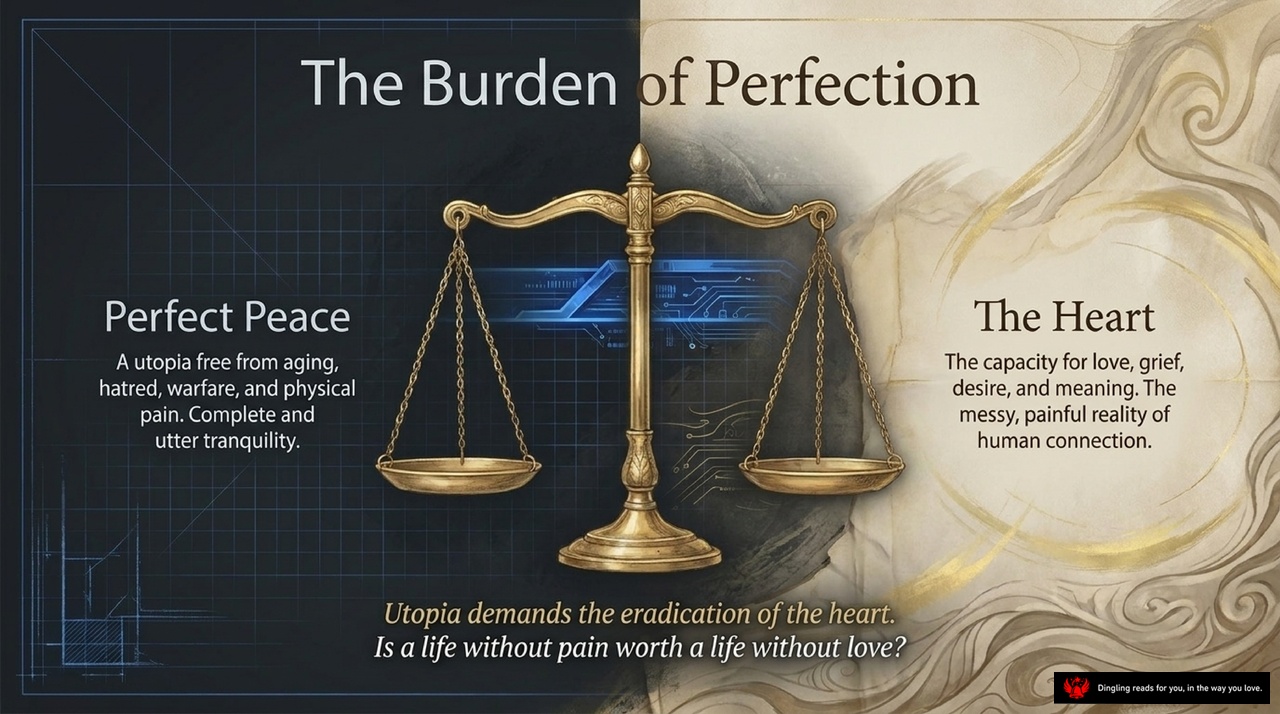
On the left, we see "Perfect Peace"—a sterile utopia defined by the total absence of aging, hatred, and physical pain. It's a world of absolute tranquility, a digital silence where nothing ever hurts. But on the right, there is "The Heart." This is the messy, painful, and beautiful reality of being human. It's the capacity for love, grief, desire, and meaning.
The image places these two worlds on a scale, and the question at the bottom cuts deep: "Utopia demands the eradication of the heart. Is a life without pain worth a life without love?"
In *The Burden of Perfection*, we explore the terrifying trade-off. A world without pain might seem like paradise, but the text suggests that by removing the capacity to suffer, we also remove the capacity to truly feel. If we eliminate the heart to achieve perfect peace, do we not end up with a life that is empty? The story challenges us to ask: is it better to live in a comfortable, painless void, or to embrace the chaotic, dangerous, yet vibrant reality of a living heart?

The final choice is here. On the left, you see a sleek, futuristic elevator—a portal back to the chaotic, noisy physical world. On the right, a serene, snow-covered forest path with footprints leading into the unknown. This is the ultimate moment for the protagonist. His Shadow, representing the subconscious world he created, offers one last chance to dive into the water, escape the Walled Town, and return to reality. It's an easy way out, a chance to leave the responsibility behind. But he refuses. He chooses to stay behind in the snow. He accepts the heavy burden of responsibility for the world he built, voluntarily stepping into eternal isolation. While his physical body dies in a car parked at the harbor, his consciousness remains, forever guarding the boundary between the conscious and the subconscious. It's a profound sacrifice, a decision to embrace loneliness over the comfort of forgetting.
So, what exactly is the "End of the World" in Murakami's universe? It's not a nuclear blast, nor is it a melting ice cap. The apocalypse here is entirely internal.
The slide tells us that the true "End of the World" is a retreat into the ultimate isolation of the self. Think of it as building a flawless sanctuary, but one constructed on the sacrifice of human connection. In this narrative, achieving true peace isn't about conquering the outside world; it's about willingly stepping into a beautiful, static void where the self is the only thing left.
It's a profound warning: when we cut ourselves off from others to find comfort, we aren't just finding peace. We are building a prison where the world, as we know it, simply ends.
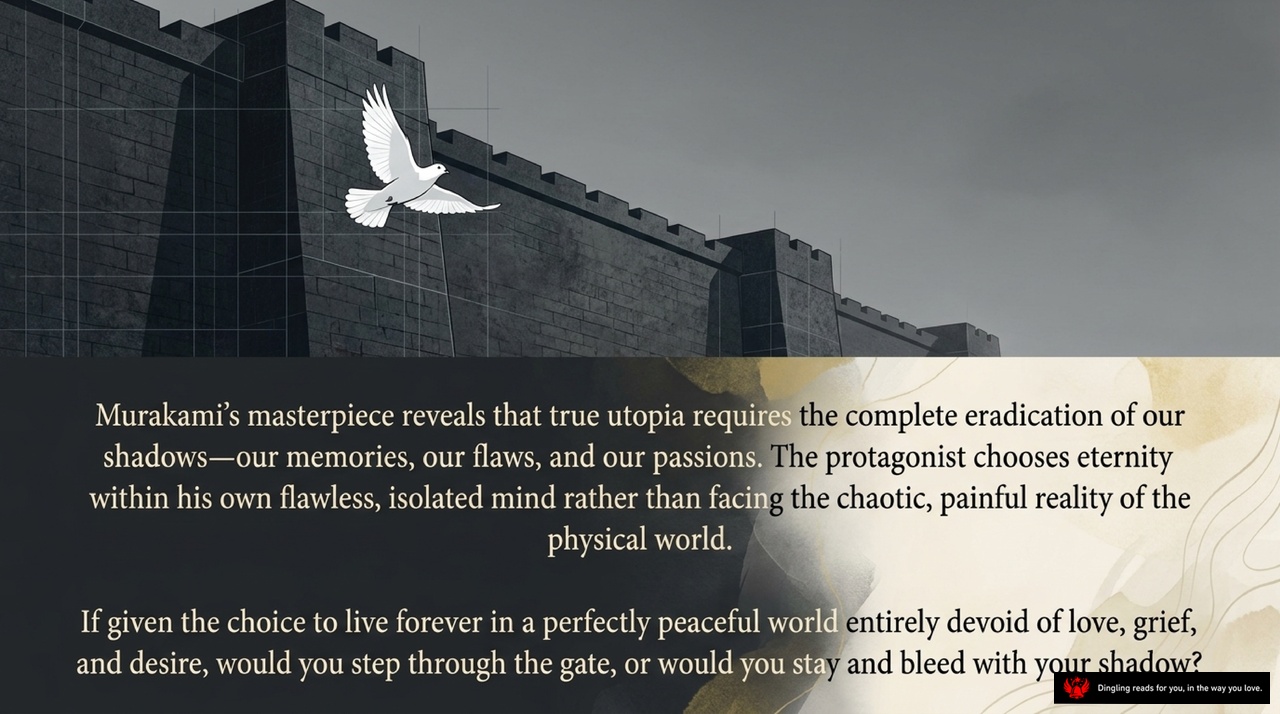
Have you ever considered that a perfect world might just be a prison? Murakami's masterpiece suggests that true utopia demands the complete eradicaton of our shadows—our memories, our flaws, and our passions. The protagonist chooses eternity within his own flawless, isolated mind rather than facing the chaotic, painful reality of the physical world.
If given the choice to live forever in a perfectly peaceful world entirely devoid of love, grief, and desire, would you step through the gate, or would you stay and bleed with your shadow?