
Hopscotch: Complete Chapter-by-Chapter Summary
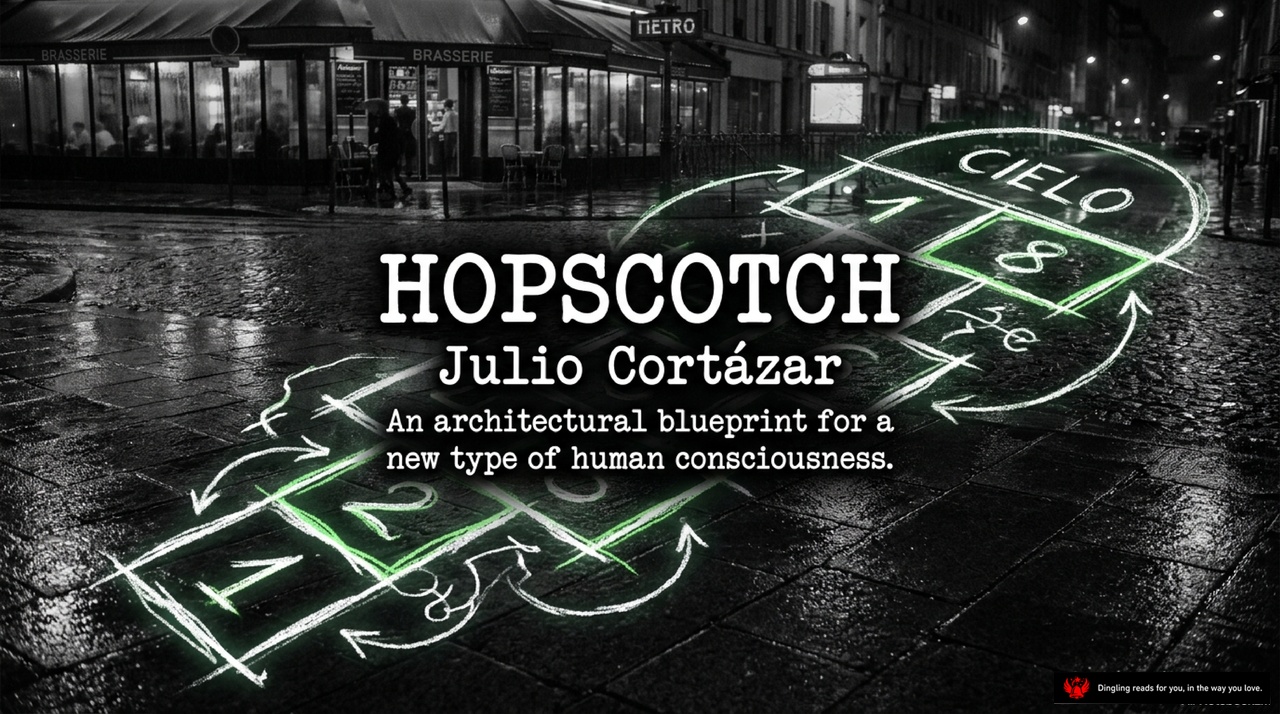
Welcome to *Hopscotch*, a journey through the mind of Julio Cortázar. Imagine a rainy Paris night, where the city's cobblestones become a giant game board drawn in chalk. This isn't just a book; it's an architectural blueprint for a new kind of human consciousness. Forget the straight lines of traditional storytelling. Here, you are the player. You can choose to read it in order, like a child hopping through the squares, or you can jump around, skipping chapters, creating your own unique path. It's a choice between the sky and the earth, between logic and chaos. In this world, nothing is fixed, and every decision changes the story forever. Welcome to the game.
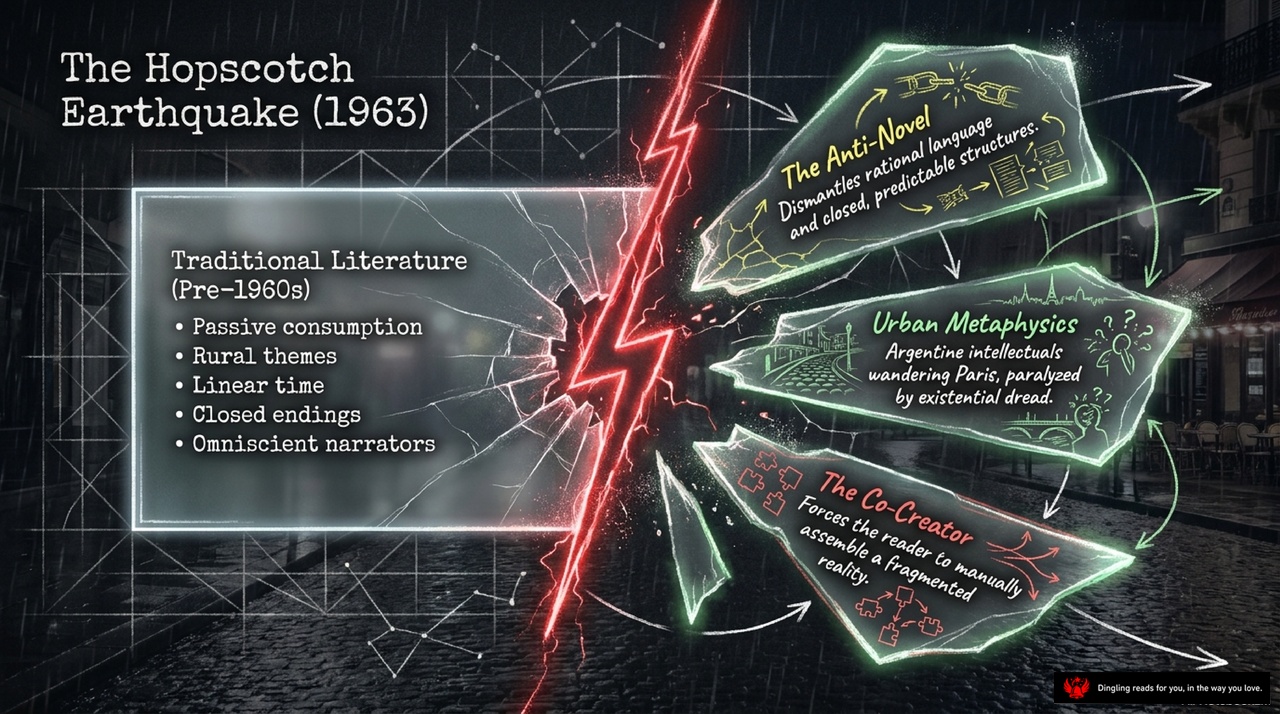
Imagine the literary world before the 1960s as a perfectly paved cobblestone street: predictable, linear, and safe. It was a place of passive consumption, where omniscient narrators told you exactly what to think, and stories always ended with a neat bow. But then came 1963, and the ground beneath us didn't just shift—it shattered. This was the "Hopscotch Earthquake," a seismic event that tore traditional literature apart and scattered the pieces into three new, chaotic directions.
On one side, we see the birth of the Anti-Novel. Think of it as a deliberate demolition of rational structures. It dismantles the predictable paths we expect, refusing to let the story be a closed loop. Instead, it forces the reader to become a co-creator, manually assembling a fragmented reality from the broken shards. It's no longer about being told a story; it's about hunting for meaning in the rubble.
On another side, the narrative drifts into Urban Metaphysics. Here, Argentine intellectuals wander through the streets of Paris, paralyzed by a deep, existential dread. They aren't looking for answers; they are lost in the rain-slicked alleyways, questioning the very fabric of their existence, turning the city into a labyrinth of their own anxieties.
And finally, there's the leap into pure absurdity. Life itself becomes a game of hopscotch where the rules change every step. Whether it's a man trying to build a bridge across a window gap with planks, or a group of friends arguing about the nature of reality while drinking cheap vodka in a smoky apartment, the goal is no longer order, but the courage to embrace the chaos. The earthquake didn't destroy literature; it freed it from the cage of convention, forcing us to stop reading and start living the story ourselves.
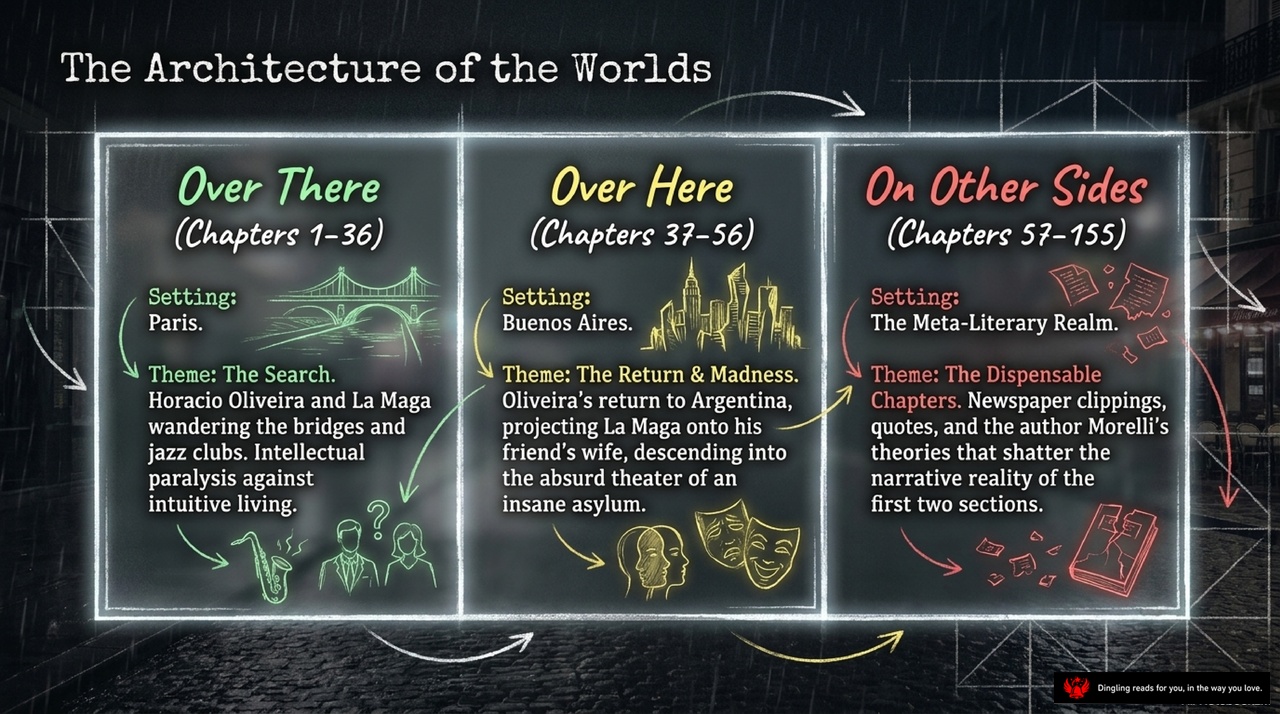
Welcome to the final act of our journey through *In the Labrynth of the Soul*. This slide maps out the entire novel's architecture, revealing how the story evolves from a search for love into a descent into madness, and finally, into a meta-fictional explosion.
First, look at the left panel, "Over There." This covers Chapters 1 through 36, set in Paris. Here, we follow Horacio Oliveira and La Maga wandering the bridges and jazz clubs of the city. Their theme is "The Search," a desperate intellectual paralysis as they try to find meaning in their intuitive, chaotic lives. It's a story of two people who are close yet forever distant, trapped in a loop of philosophical analysis that prevents them from truly living.
Moving to the center, "Over Here," Chapters 37 to 56, the setting shifts dramatically to Buenos Aires. The theme transforms into "The Return & Madness." Oliveira comes back to Argentina, projecting La Maga onto his friend's wife, only to spiral downward into the absurd theater of an insane asylum. The city that was once familiar becomes a distorted mirror, reflecting his internal unraveling.
Finally, on the right, we arrive at "On Other Sides," Chapters 57 through 155. The setting is no longer a physical place, but "The Meta-Literary Realm." Here, the narrative shatters. We encounter "The Dispensable Chapters"—newspaper clippings, random quotes, and the theories of the author Morelli himself. These elements invade the story, questioning the very reality of the first two sections and suggesting that the characters might be constructs of fiction, blurring the line between the story and the reader's experience.
This structure shows a clear progression: from the romantic confusion of Paris, to the psychological horror of the asylum, and finally to a complete deconstruction of reality itself.

Horacio Oliveira, the ultimate analyst, is trapped in a mental maze where nothing is ever real enough. He's constantly trying to find a hidden "center," a pure reality beneath the surface, but he's blind to the fact that the only thing that truly exists is the messy, chaotic moment right in front of him. In the text, he describes his life as a series of disjointed fragments, like photos where the transition from yesterday to today is missing. He tries to force these fragments into a logical narrative, but it feels artificial, like a movie forced together when it should be a collage of raw moments.
But then there's Maga. She is the opposite of his rigid thinking. She doesn't try to analyze the world; she just lives it. She's the "experienter," flowing freely like a swallow in the air, unburdened by the need to define everything. While Horacio is stuck at a crossroads, paralyzed by his own theories, Maga finds beauty without trying. She represents the authentic reality that Horacio can only theorize about but never touch. The tragedy of their relationship is that he is constantly looking for her, searching for the "center" she embodies, but his very act of searching pushes him further away from the truth she represents. He wants to capture her essence, to pin it down with his intellect, but she is an untamed force, like wind, that slips through his fingers the moment he tries to hold it.
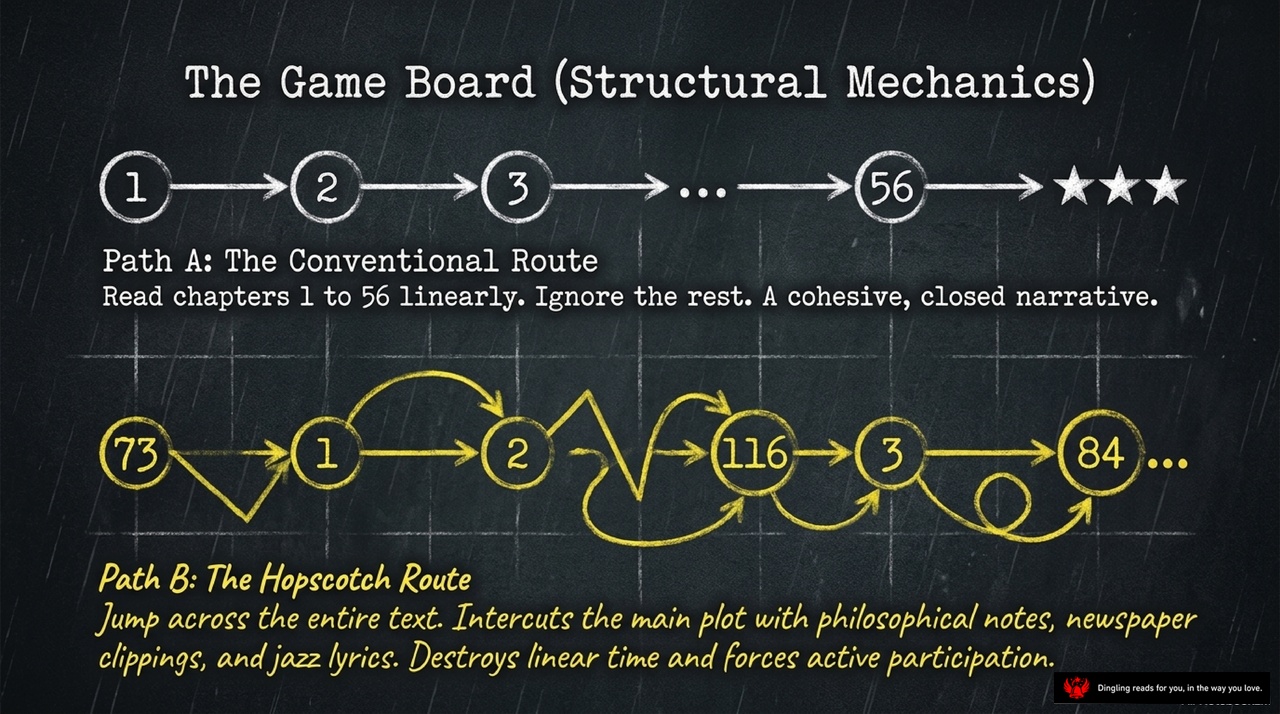
Imagine the novel not as a straight line, but as a sprawling, chaotic game board where the rules are constantly being rewritten. We see two distinct paths here. Path A is the conventional route: a linear march from chapter one to fifty-six, a closed narrative where you simply follow the plot from start to finish. It's safe, cohesive, and predictable. But then, look at Path B, the Hopscotch Route. This is where the real magic—and the real madness—happens. Instead of moving forward, you jump across the entire text. You intercut the main plot with philosophical notes, newspaper clippings, and even jazz lyrics. This path destroys linear time entirely, forcing you to become an active participant rather than a passive observer.
In the book, this fragmentation is everywhere. We see it in the absurd daily life of the Snake Society, where a tragic suicide attempt is immediately followed by a debate about the nature of reality. We see it in the hospital, where a dying writer, Morelli, talks about a game where the winning center might be outside the board or even in your shirt pocket. The narrative refuses to let you settle. It refuses to give you a clean, logical story. Instead, it demands that you navigate a world where everything is connected yet nothing makes sense, where the only way to find meaning is to embrace the chaos and jump from one disconnected moment to the next.

Look at this slide. We're moving from the comfortable armchair on the left to the active, glowing construction on the right. This is the core of what we call "The Reader Theory."
On the left, we have the Passive Reader. This is the person who seeks a closed order and neat resolutions. They demand entertainment without mental effort. They follow Path A, stopping comfortably at Chapter 56. They want the story to tell them exactly what to think, offering a safe, predictable escape.
But on the right, we have the Accomplice Reader. This is the true partner in the literary experience. This reader acts as a co-creator of the text. They don't just consume the story; they navigate hidden connections and embrace the discomfort of the anti-novel. They follow Path B, forced to do the heavy lifting to extract the novel's true meaning. They are willing to get their hands dirty, to build the structure themselves, rather than just sit back and watch it be built for them.
So, the question isn't just about what the book says, but how you choose to read it. Are you going to sit in the armchair, or are you going to pick up those blocks and help build the meaning yourself?
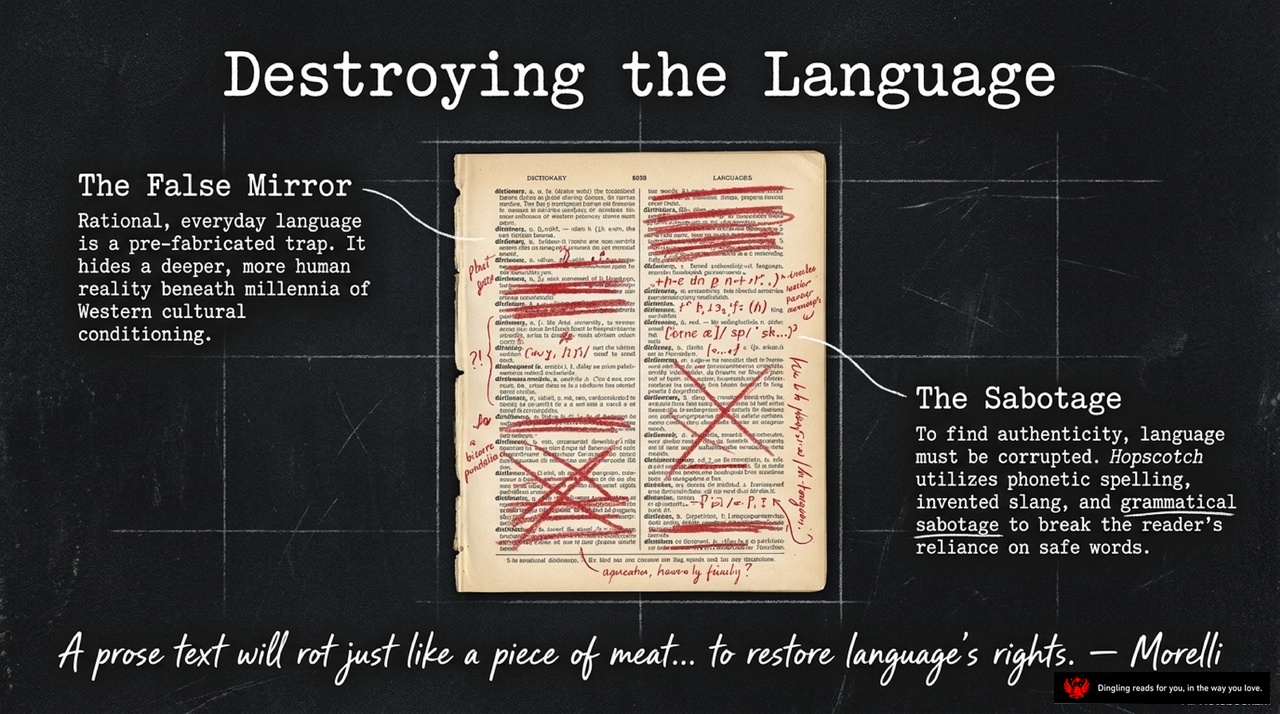
Look at this dictionary page, but notice what's happening: the safe, structured words are being crossed out, replaced by phonetic spelling, invented slang, and even grammatical sabotage. This slide captures the core philosophy of the book we're discussing: "Destroying the Language."
The author argues that our everyday, rational language is actually a "false mirror." It's a pre-fabricated trap designed by Western conditioning to hide a deeper, more authentic human reality. We rely on these "safe words" to feel secure, but they disconnect us from true experience.
To find authenticity, the text suggests we must corrupt the language itself. This isn't about being difficult; it's about breaking the reader's reliance on predictable patterns. By using things like phonetic spelling and nonsense, the author forces us to stop reading for meaning and start feeling the raw texture of the words. As the quote at the bottom reminds us, a prose text will rot just like a piece of meat, and that decay is necessary to restore language's rights. It's a radical call to stop using words as tools for control and start using them as a way to reconnect with the messy, unfiltered truth of being alive.

Look at this diagram. We are visualizing a "Kibbutz of Desire"—a collective settlement for the soul. Imagine the outer rings as the hard, unyielding crust of our daily lives. This is where we live most of the time: a world built on habit, rigid societal norms, and the cold logic of scientific rationalism. It's that hypocritical Western dualism that constantly pushes us away from who we truly are, trapping us in a script we never wrote.
But look at the center. That glowing, blinding light is "Heaven." Now, listen closely: this isn't some mystical realm floating in the clouds. It is the ultimate authentic reality, a profoundly human state of being. In the text, we see characters like Olivella and Maïa constantly trying to break through that outer crust. They wander the streets of Paris, engaging in chaotic, messy, and beautiful moments—sharing cheap wine, discussing absurd art, or simply existing in the present without a plan. They are trying to access that center. But the text warns us that you can only reach this "Heaven" through a violent break from the everyday script. It requires a sudden, almost painful disruption of the status quo. It is the final square in the hopscotch game, the only place where the noise of the outer rings finally stops, and you are left with nothing but pure, unfiltered existence.

Art, Jazz, and the Serpent Club. When rational language hits a wall, we don't stop; we switch channels. Records and paintings become the true vocabulary for the unsayable. Look at this slide: we're seeing how Bop and Blues act as catalysts, offering raw, unmediated expressions of existence that bypass the intellect to communicate the ineffable. On the left, you see Mondrian demanding absolute, naked reality, while Klee offers a playful, magical re-ordering of a fragmented universe. This wasn't just about aesthetics; it was a survival strategy. In the Serpent Club, when words failed to explain the chaos of their lives, they turned to abstract art and jazz. They realized that while logic tries to impose order on a broken world, art and music allow us to dance within the chaos, finding a shared language in the silence between the notes and the colors.
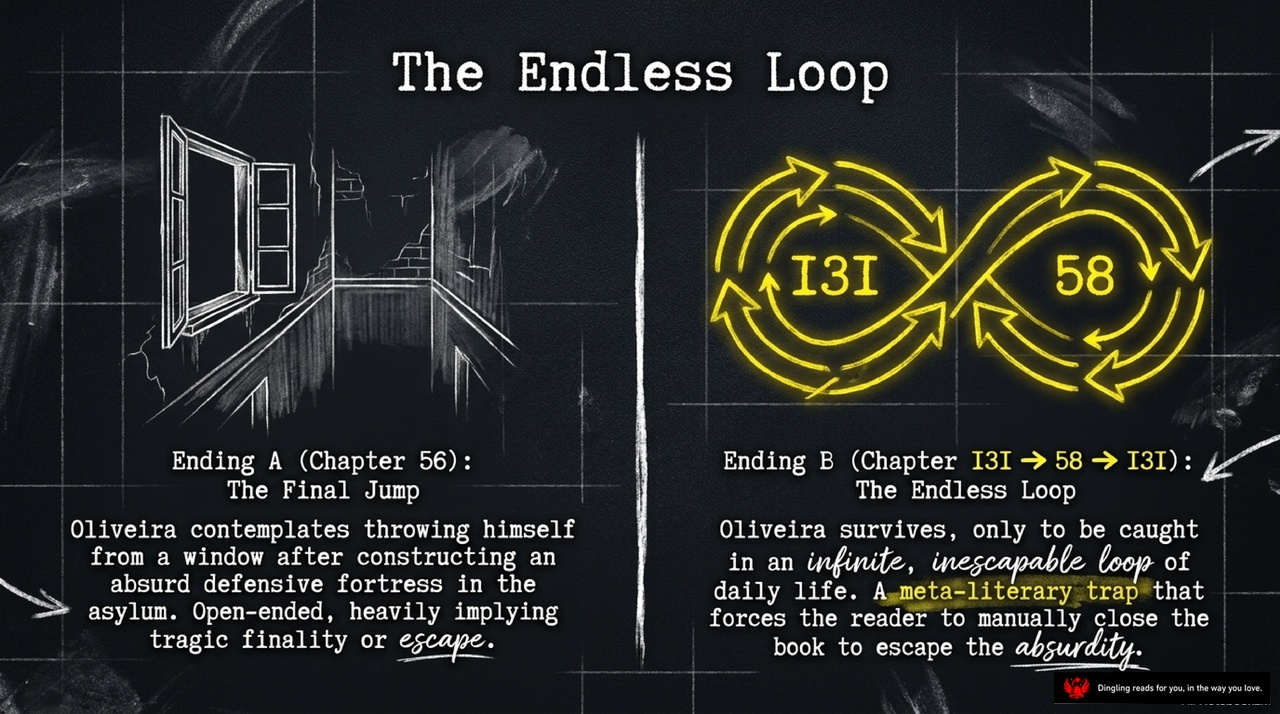
Look at this slide, "The Endless Loop." It splits the story of Oliveira into two starkly different paths. On the left, we have Ending A: Chapter 56, The Final Jump. Here, Oliveira has built an absurd defensive fortress inside the asylum, only to contemplate throwing himself out of a window. It's an open-ended conclusion that screams tragic finality or a desperate escape. But look at the right side. Ending B transforms the narrative into an infinite, inescapable loop. Instead of jumping, Oliveira survives, only to be trapped in a cycle where Chapter 131 feeds into Chapter 58, which loops back to 131. It's a meta-literary trap that forces the reader to manually close the book to escape the absurdity. This visual contrast captures the book's core tension: the choice between a definitive, albeit tragic, end and a terrifying, repeating existence where the absurdity of daily life never lets you go.
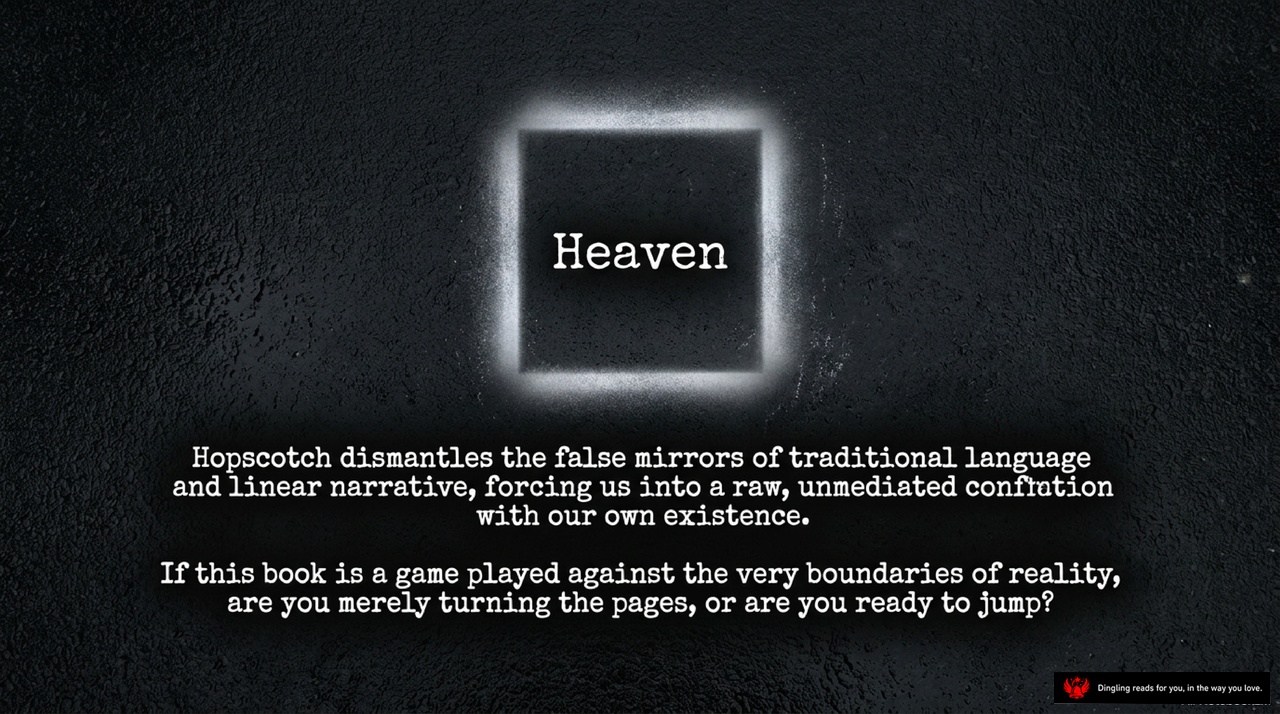
Heaven isn't a destination you reach by following a straight line; it's a state you stumble into when the ground beneath you vanishes. Look at that glowing square in the center—it represents the ultimate boundary, the "Heaven" that Hopscotch constructs not as a reward, but as a trap of our own making.
The book argues that traditional stories and language are just "false mirrors," trapping us in a linear narrative that makes life feel safe and predictable. But the text asks a terrifying question: if this book is a game played against the very boundaries of reality, are you merely turning the pages, or are you ready to jump?
Think about the characters, like Olivella, who constantly tries to find order in a chaotic world, only to realize that his carefully constructed logic is just a fragile barrier against the absurd. When he tries to build a "hopscotch" path through life, he keeps hitting walls—like the sudden death of his child, or the unexplainable silence of his lover, Maga. These moments don't fit into a neat story, so the mind invents a "Heaven" to explain them away.
But the book dares you to break that pattern. It suggests that true existence is "raw" and "unmediated," meaning you have to face the mess without filters. You have to stop pretending that everything has a logical reason and accept that some things, like the wind or the sudden collapse of a relationship, are just... there.
So, as you look at that square, ask yourself: are you going to stay on the safe side, playing by the rules of a story you wrote yourself? Or will you take the leap into the unknown, where the only rule is that there are no rules? That's the real game.