
How to Talk So Kids Will Listen & Listen So Kids Will Talk: Complete Chapter-by-Chapter Summary
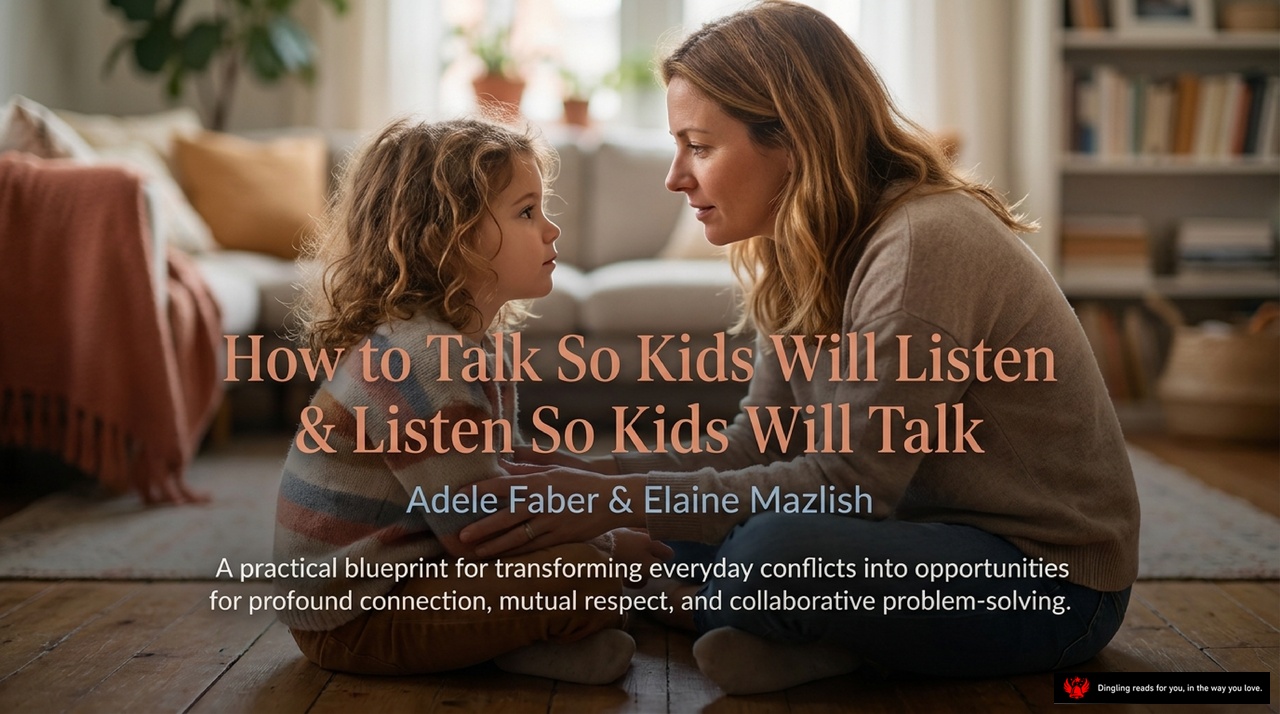
Welcome to our book club session on "How to Talk So Kids Will Listen & Listen So Kids Will Talk" by Adele Faber and Elaine Mazlish.
This isn't just another parenting book; it's a practical blueprint designed to transform everyday conflicts into opportunities for deep connection. Imagine a living room where a mother and child sit face-to-face, not as adversaries, but as allies ready to solve problems together. That is the vision we are exploring today.
The core message is simple yet revolutionary: the key to getting your child to listen lies first in listening to them. Instead of dismissing their feelings or rushing to offer solutions, we must validate what they are experiencing. When a child feels heard and understood, they naturally become more willing to communicate.
This book offers a clear path forward, moving away from power struggles and toward mutual respect. It teaches us that by acknowledging a child's emotions and working collaboratively on solutions, we build a foundation of trust that lasts a lifetime. Let's dive into how we can apply these powerful principles in our own homes.

Let's look at the two distinct worlds presented on this slide. On the left, we see "The Old Paradigm," a cycle where focusing on behavior leads to punishment or lectures, which makes the child feel misunderstood, resulting in worse behavior—a vicious loop that only pushes parents and children further apart. On the right, we have "The New Paradigm," a positive cycle that starts by focusing on feelings, acknowledging and validating them, which helps the child feel heard, leading naturally to cooperation.
The core message here is simple but transformative: children's behavior is a direct reflection of their feelings. If we want to change behavior, we must first accept the feelings. Instead of reacting to the action, we need to connect with the emotion behind it. When a child feels understood, the need for defensive or aggressive behavior often disappears, making space for genuine cooperation and a healthier relationship.

The foundation of effective parenting isn't about fixing the problem immediately; it's about validating the feeling first. Look at this slide: it contrasts the "Denial Default" with the "Empathetic Pivot." When a child says, "It hurts!" the natural instinct is to minimize it with, "It's not that bad." But that shuts them down. The empathetic pivot simply acknowledges the reality: "That looks like it really hurts."
Consider another scenario: a child says, "I hate my drawing!" Instead of lying and saying, "It looks beautiful," which invalidates their frustration, try saying, "You're frustrated with how it turned out." This doesn't mean you agree the drawing is bad; it means you grant the child the right to their own emotional reality. Even when a child says, "I'm scared," telling them, "There's nothing to be afraid of," is just more denial. The powerful response is, "You seem really worried." Empathy is not agreement; it is the bridge that allows a child to feel seen, understood, and finally, ready to listen.

Here are five powerful ways to invite cooperation without ever raising your voice, all based on the bathroom faucet scenario.
First, simply describe what you see. Instead of accusing your child, just state the fact: "I see the bathroom faucet dripping." This removes the blame and helps them focus on the problem.
Next, give them information. Explain the impact: "Even a slow drip wastes gallons of water every day." This helps them understand the real consequence.
Then, offer a choice. Ask, "Do you want to use your left or right hand to turn it off?" Giving them a sense of control makes them much more willing to help.
You can also say it with a single word. Just point and say, "The faucet!" This is perfect for when they are busy brushing their teeth and need a quick reminder without an interruption.
Finally, write a note. You can leave a little sticky note that says, "If you hear a drip, run to the sink quick!" This creates a gentle, lasting reminder that helps them remember to act independently.

Parents often find themselves in a frustrating loop: they try to praise their children, only to see the opposite reaction. Instead of feeling encouraged, kids might argue, shut down, or even act out, as if they are trying to prove the parent wrong. This happens because we are often using "evaluative praise"—words like "smart," "beautiful," or "great job." These labels make children feel judged and, more importantly, afraid of making mistakes. If a child is labeled "smart," they stop trying because failure would mean they aren't smart anymore.
The solution is to switch to descriptive praise. Instead of judging the outcome, describe what you see and how it makes you feel. For example, instead of saying "You're so smart," say, "You kept trying until you solved that puzzle." Or instead of "Great job on the drawing," try, "I love how the sunset colors in your painting make me feel calm." This approach shifts the focus from talent to effort, helping children build true confidence and resilience.
You can also summarize specific behaviors with a single word to reinforce character. When a child shares their last cookie with a sibling, you can say, "That is what 'generosity' looks like." When they finish their homework without being reminded, you can say, "That is 'responsibility' in action." This helps them internalize these positive traits.
Even when things go wrong, like a child rushing and missing the bus, avoid criticizing their slowness. Instead, describe what they have already done: "You've dressed and eaten; you just need to find your shoes." When they complain about too much homework, acknowledge the difficulty but highlight their progress: "Addition can be tough, but I see you've already finished two problems." By focusing on the process and offering specific, non-judgmental descriptions, we help children see their own strengths and learn that their worth isn't tied to being perfect, but to their effort and character.

When we think about how to praise our children, we often fall into a trap that actually undermines their confidence. On the left side of our slide, we see "The Trap: Evaluative." Parents might say, "100 on your math test! You are so smart!" While this feels nice in the moment, it creates a heavy burden. The child's internal voice starts whispering, "What if I fail the next one? I have to be perfect to be loved." This type of praise focuses on fixed traits like intelligence or looks, making kids afraid of making mistakes because they feel their worth depends on being flawless.
But there is a powerful alternative on the right side: "Descriptive Praise." Instead of labeling the child, we simply describe what we see and how we feel. The formula is simple: Describe what you see plus describe how you feel. For example, instead of saying "You are so smart," a parent can say, "You stayed focused and kept trying until you solved every single problem! That is what I call perseverance." This shifts the focus from who the child is to what they did. The result is transformative. The child's internal voice changes from fear to empowerment: "I am capable. I don't give up when things get hard." By using descriptive praise, we build a growth mindset where effort matters more than perfection, giving our children the courage to keep trying no matter what happens.

How to Be Angry Without Doing Harm
Look at this slide. We're tackling a critical question: How do we express our anger without hurting our child? The core rule here is simple but powerful: Express your intense feelings, but do not attack the child's character.
On the left, we have "The Exploding Boiler." This happens when we launch a "You Attack." For example, saying, "You are so irresponsible! You never clean up!" This approach creates defensiveness and triggers counter-attacks. It puts the child on the defensive and damages the relationship.
On the right, we have the solution: "The Safety Valve." This uses an "I Statement." Instead of attacking the child, we describe the situation and our feelings. The example here is perfect: "I worked all day, and coming home to dirty dishes in the sink makes me incredibly frustrated!" Notice the difference? This focuses on the parent's feelings and the objective problem, not the child's personality.
The tip at the bottom is crucial. Use intense words to describe your feelings—say "I am infuriated!"—but leave the child's personality completely out of it. When we stop labeling the child and start sharing our own emotions, we release the pressure without causing harm. This is how we stay connected even when we're angry.

The Empathetic Blueprint: What to Say
Look at this chart. It shows a powerful shift in how we talk to our kids. On the left, we have the "Traditional Default"—the automatic, often unhelpful responses we've all used for years. Think about those times you said, "Stop crying over nothing," or "Clean this up right now!" or even "You're so smart!" These phrases might seem helpful, but they actually shut down connection. They tell the child their feelings are wrong or that their effort doesn't matter.
Now, look at the third column: "The Empathetic Pivot." This is where the magic happens. Instead of fixing the behavior or judging the child, we validate their experience. When a child has a tantrum over a toy, we don't say it's nothing; we say, "You really wanted that. It's so disappointing." When the room is messy, instead of demanding immediate action, we say, "I see blocks on the floor and we need to walk." When they get good grades, we move away from labeling them as "smart" and instead acknowledge the hard work: "You studied hard for weeks, and it shows!"
Notice the pattern here? We are replacing judgment with understanding, and demands with partnership. By saying things like, "I expect the rules to be followed. Let's fix this," rather than "You never listen!" we transform the moment from a power struggle into a collaborative problem-solving session. This isn't about being soft; it's about being clear and kind at the same time. When we pivot to empathy, we don't just manage the behavior; we build a lasting relationship where the child feels safe enough to listen and grow.

True discipline isn't about controlling behavior through fear; it's about guiding behavior through empathy. When we shift from lecturing to listening, and from evaluating to describing, we equip our children with the emotional intelligence and self-worth they need to navigate the world. Think about it: if we want our children to listen to us when they become adults, shouldn't we start truly listening to them while they are still children? It's a simple but powerful shift that changes everything.