
Hyperion: Complete Chapter-by-Chapter Summary
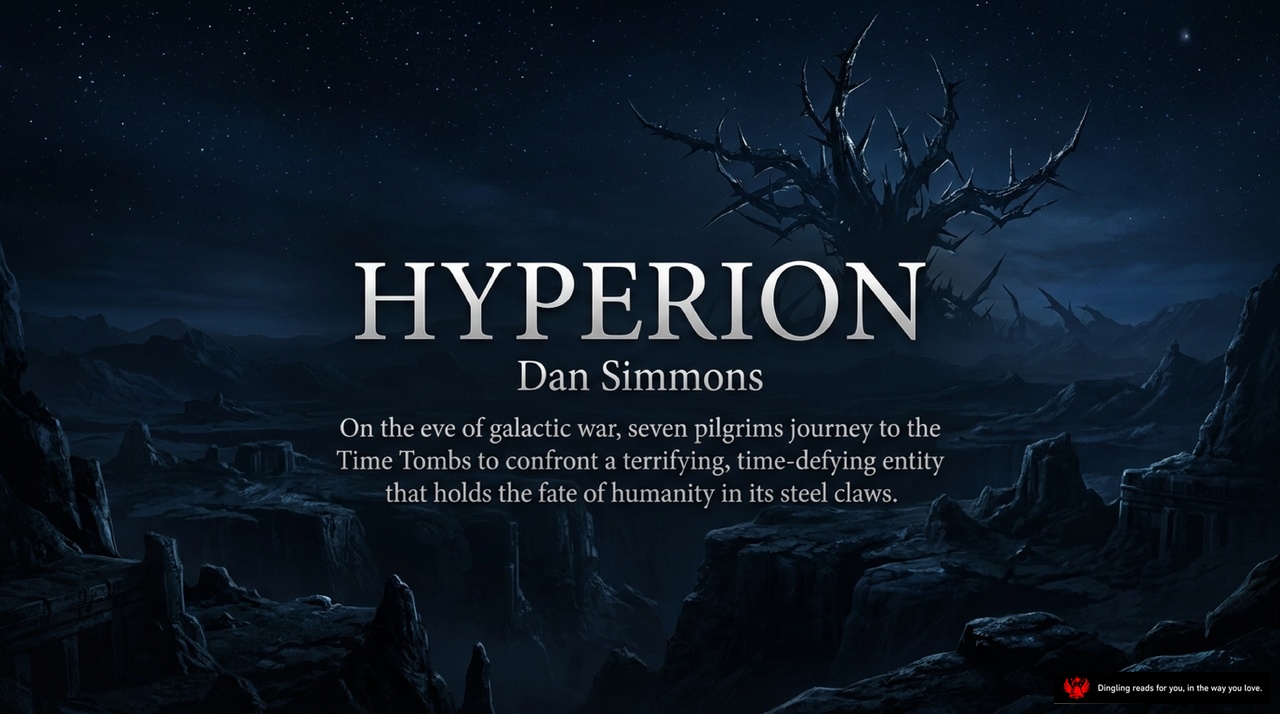
Welcome to the world of *Hyperion*, a masterpiece by Dan Simmons that redefines what science fiction can be. Set against a backdrop of a dark, star-strewn night and a desolate, alien landscape, this story invites you on a journey that is as terrifying as it is profound. On the eve of a looming galactic war, seven strangers from vastly different backgrounds are chosen to travel to the Time Tombs on the mysterious planet of Hyperion. Their mission? To confront a terrifying, time-defying entity known as the Shrike, which holds the very fate of humanity in its steel claws. But this isn't just a simple quest; it is a pilgrimage where each traveler must face their deepest fears and darkest secrets, weaving a narrative that explores the very nature of faith, time, and the human soul.

Look at this strategic map. On the left, you see the Hegemony—a vast network of hundreds of worlds connected by instant farcaster portals, looking like a glowing blue web. But notice the red explosion surrounding it; that's the Ousters, a massive invading fleet launching a relentless assault.
On the right, focus on the isolated planet, Hyperion. Unlike the rest of the Hegemony, Hyperion has no farcaster links. It's cut off. That's why Hegemony CEO Meina Gladstone is ordering a desperate evacuation. The Ouster invasion force is closing in, and they will arrive in mere days.
Here lies the critical strategic context: the survival of the entire Hegemony hinges on a single, uncontrollable variable located in Hyperion's northern wastelands. The fate of the whole human empire depends on what happens in that one isolated, unlinked world.

Welcome back to the story of the Priest. Today, we dive into the darkest and most terrifying truth Dr. Duram uncovers: the nature of the Pikuls and the cross that has taken over his life.
Picture this: Duram has been living in the village for months, watching these seventy beings, the "Thirty-Two-Plus-Ten," repeat their days with eerie precision. They eat, they sleep for two hours, and they climb down the cliff to the cathedral. But Duram notices something impossible. When he scans them with his medical scanner, he sees a horrifying reality. None of them have sexual characteristics. Their bodies have been stripped of gender, of the very biology required to create life. They are not just soulless; they are biologically incapable of reproduction. They are hollow shells, preserved but dead inside.
But the real nightmare begins when a member of their group, Alpha, falls to his death from a hundred-foot cliff. His head is shattered, his body destroyed. By all rights, he should be dead. Yet, the Pikuls refuse to bury him. Instead, they carry his body up to the cathedral. As the sun sets behind the stained glass, something miraculous—and monstrous—happens. Alpha's body begins to twitch. The cross on his chest glows red, and he is reborn.
This is the secret of the Cross. It is a parasitic entity that defies the laws of nature. It doesn't just grant immortality; it enforces it by killing the old and cloning the new. Duram watches in horror as this happens again with a man named Will. Will falls from a tree, his bones eaten by insects, leaving only a skeleton. But the cross remains. And within days, another Pikul swells up, carrying two crosses, as if pregnant with a new life. The population stays fixed at seventy, but the individuals are just temporary vessels for this alien parasite.
Duram realizes the terrible cost of this "eternal life." The Pikuls have lost everything that makes them human. They have no emotions, no desires, no individual identities. They are mindless drones, repeating the same movements forever, trapped in a loop of death and rebirth. Duram looks at his own chest, where the cross has fused with his DNA, spreading its fibrous tendrils into his brain. He sees his own future: becoming just another number in this equation, a puppet dancing to the tune of a dead god.
He tries to fight it. He tries to cut the cross out, but the pain is so intense he passes out, only to wake up with the wound healed. He tries to escape, but the moment he moves too far from the Great Rift, the pain returns, dragging him back. He is trapped, not just by the mountain, but by the cross itself.
In the end, Duram understands that the Pikuls' immortality is a lie. It is a prison of the soul. They are alive, but they are not living. They are merely existing, waiting for the next cycle of death and rebirth. And Duram knows that if he stays, he will become just like them. He must find a way to break this cycle, even if it means facing the ultimate pain to destroy the parasite within him. The struggle for his humanity has just begun, and the stakes could not be higher.

The Shrike Pilgrimage Compact isn't just a mission; it's a high-stakes game of life and death, and the stakes are personal. The Shrike Church has picked exactly seven souls to journey into the anti-entropic field. But here's the catch: survival demands a brutal price. To understand why they were chosen, they must share their hidden, personal connections to Hyperion.
Look at the team. We have the Consul, a former Hegemony Official carrying the weight of the empire. Then there's Father Hoyt, a Catholic Priest who knows the cost of faith. Colonel Kassad, a soldier hardened by war; Martin Silenus, a poet searching for meaning in a broken world. Sol Weintraub, a scholar with the answers we need; Brawne Lamia, a detective who has seen too much; and Het Masteen, a Templar Captain ready to fight.
This isn't just about exploring a mysterious zone. It's about confronting the past. Every one of these seven carries a secret link to Hyperion, a link that could either save them or destroy them. As they step into the unknown, they realize that the only way forward is to strip away their defenses, expose their vulnerabilities, and face the terrifying truth of who they really are. Because in the anti-entropic field, nothing is hidden forever, and nothing stays the same.

Case File 01: The Priest. Meet Father Hoyt and Father Duré.
Look at the map behind us: The Cleft and the deadly Flame Forest. This is where the story begins, in a world where death is just a temporary inconvenience.
On the left, we see Father Hoyt. He is suffering from excruciating physical agony, a constant torture. His mission? To uncover the fate of his mentor, Father Duré, who vanished on Hyperion eight years prior.
On the right is Father Duré. He was exiled for falsifying archaeological data. Seeking redemption, he ventured into the unknown to study the Bikura—the legendary, isolated tribe of seventy mindless humans living on the edge of the Flame Forest.
Duré found a people who had conquered death, but at a horrifying cost. They achieved immortality, but they lost their humanity, their individuality, and their souls. They became hollow vessels, repeating the same cycle forever, trapped by a parasitic entity known as the Cross-Shaped.
This is the first case. A story about the price of immortality, and the terrifying truth that some things are better left buried.

Welcome back. Today, we dive deep into the most terrifying twist of the entire story: the true nature of immortality. Look at the diagram on your screen. It depicts a "Cruciform Parasite"—an organic, DNA-altering entity that resurrects its host after death. But here's the horror: every time it rebuilds the body, it degrades the host's intellect, memory, and humanity, eventually reducing them to the vegetative state of the Bikura.
This is the fate of Duré's mentor, Duré. To escape this eternal cycle of mindless resurrection, he crucified himself on an electrical Tesla tree, enduring agonizing death and rebirth for seven years. Now, look at the bottom of the slide. Hoyt discovered Duré's remains and, to grant his mentor peace, took the parasite onto himself. Hoyt now bears two cruciforms, living in perpetual, suppressed agony.
This isn't just about physical survival; it's about the loss of the soul. The Bikura, those small, bald figures you've seen, have no sex, no names, and no individual consciousness. They are merely vessels for the parasite, trapped in a loop where they die and are instantly replaced by a clone, ensuring the group size stays exactly at seventy. It's a cold, mathematical eternity that strips away everything that makes us human.
As Duré realizes this, he understands that true immortality isn't about living forever; it's about the freedom to die. And that is the only way to escape the cruciform's grip.
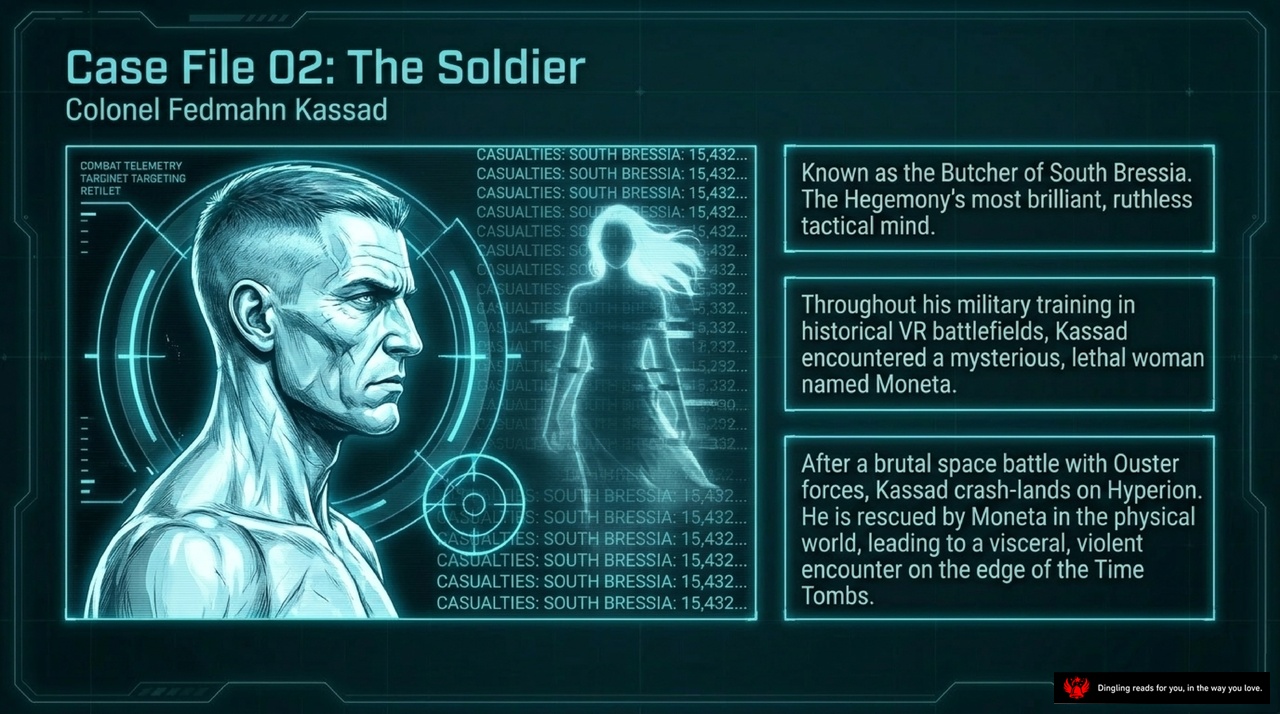
Welcome to Case File 02: The Soldier. This is Colonel Fedmahn Kassad, the Hegemony's most brilliant and ruthless tactical mind, known infamously as the Butcher of South Bressia. His legend isn't built on glory, but on a terrifying efficiency that left 15,432 casualties in a single engagement.
But his story takes a dark turn long before he ever faced the enemy. During his military training in historical VR battlefields, Kassad encountered a mysterious, lethal woman named Moneta. She appeared in simulations, then in real life, guiding him through the chaos of war.
After a brutal space battle with Ouster forces, Kassad crash-lands on Hyperion. He is rescued by Moneta in the physical world, leading to a visceral, violent encounter on the edge of the Time Tombs. There, amidst the ruins of a dying civilization, he discovers that the line between soldier and monster is thinner than he ever imagined. Moneta reveals the secrets of the Spree and the nature of the Spree itself, transforming Kassad from a mere instrument of war into something far more dangerous. This is the soldier who learned to fight not just with weapons, but with time itself.
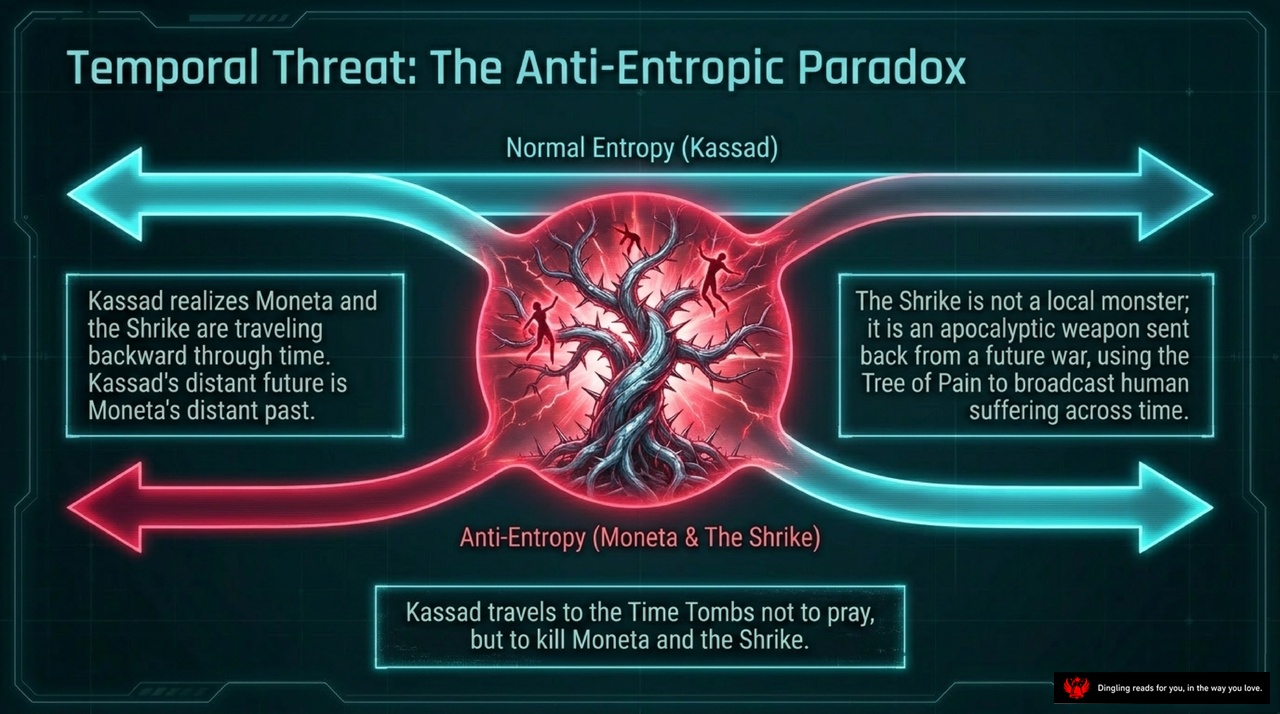
Welcome to the final chapter of our journey into the heart of time and entropy. Look at this diagram: it reveals the terrifying core of the Shrike's mission, a concept we call the "Anti-Entropic Paradox."
Normally, the universe follows the path of normal entropy, represented by the blue arrow labeled "Kassad." This is the direction of time moving forward, toward chaos and decay. But look at the red arrow flowing backward—that is the path of Moneta and the Shrike. They are traveling backward through time, creating an "anti-entropy" effect.
Here is the mind-bending twist: because they are moving backward, their distant future actually exists in our distant past. It's a loop where cause and effect are completely reversed. The Shrike isn't just a local monster; it's an apocalyptic weapon sent back from a future war. It uses the Tree of Pain to broadcast human suffering across time, ensuring that the pain of the past fuels the destruction of the future.
This paradox forces Kassad into a desperate position. He travels to the Time Tombs not to pray, but to kill Moneta and the Shrike before they can complete their cycle. He realizes that their victory would mean the erasure of the future itself. The battle isn't just about survival; it's about deciding whether time flows forward or gets trapped in a frozen, painful loop.

Welcome back to Case File 03: The Poet. Let's dive into the tragic arc of Martin Silenus, a man whose life became a cautionary tale about the cost of selling out your soul.
Born on Old Earth before its destruction, Silenus suffered a catastrophic brain injury during cryogenic sleep. He woke up with a vocabulary limited to just nine vulgar words. But here is the twist: he recovered his language fast enough to write a multi-billion-copy bestseller. He became obscenely wealthy, yet in doing so, he lost his creative spark to commercialized drivel.
This is the core tragedy of the Poet. He traded his genius for money, becoming a puppet of the very system he once belonged to. He relocated to Sad King Billy's artist colony on Hyperion, seeking to finish his ultimate masterpiece, The Hyperion Cantos. But in his desperate attempt to summon inspiration, Silenus inadvertently summoned a monster. He wasn't just fighting for his art; he was fighting for his humanity against a world that had already consumed it.
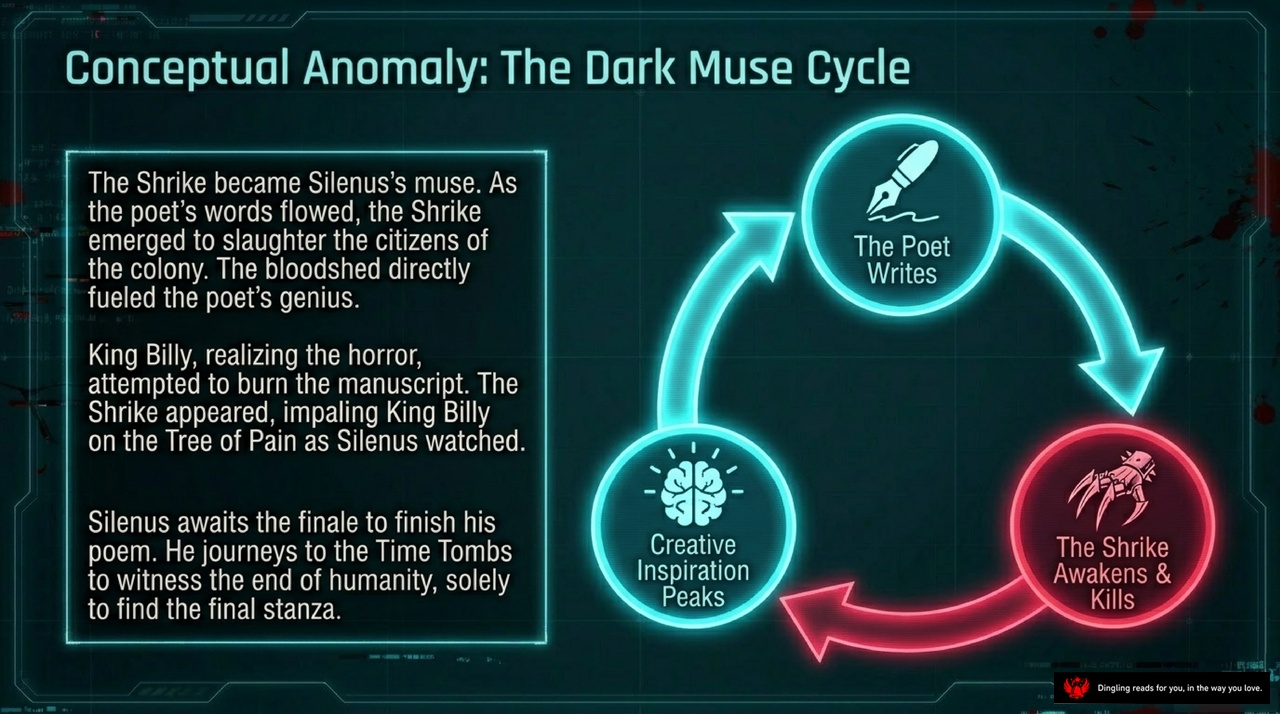
The image reveals a terrifying, self-perpetuating loop known as the "Dark Muse Cycle." It starts with a poet writing, which triggers a surge of creative inspiration. But this inspiration doesn't lead to peace; instead, it awakens the Shrike—a monstrous entity that begins slaughtering the colony's citizens. The bloodshed fuels the poet's genius further, creating a feedback loop where more killing leads to more writing, which leads to even more killing.
The cycle escalates to its darkest point when King Billy tries to stop the madness by burning the manuscript. The Shrike intervenes, brutally impaling the king on the Tree of Pain, all while the poet, Silenus, watches in detached horror. This act of violence doesn't end the story; it drives Silenus to seek the final stanza of his poem. He travels to the Time Tombs to witness the end of humanity, hoping to find the words that will complete his masterpiece, even if it means the extinction of the human race.
This is a chilling portrait of art turning into destruction, where the pursuit of genius becomes indistinguishable from the pursuit of death.

Comparative Analysis: The Pilgrims' Threads. Let's break down the three distinct souls drawn to the Shrike, and how the entity itself shapes reality to fit their deepest fears.
First, we have Father Hoyt. His primary motivation is seeking absolution and release from physical agony. To him, the Shrike isn't a monster; it's a demonic punishment, a theological curse. His conceptual theme is Faith & Pain. He sees the creature as the ultimate test of his suffering, a divine mechanism designed to purge his soul through agony.
Next is Colonel Kassad. He is driven by a need for revenge and tactical answers. He views the Shrike purely as a military target, a temporal weapon to be used or destroyed. His theme is War & Time. For him, the Shrike is an enemy to be neutralized, stripped of any spiritual meaning and reduced to a strategic asset in a brutal conflict.
Finally, Martin Silenus. His goal is seeking the final stanza of his masterpiece. He sees the Shrike as a divine, bloody muse, the catalyst for his art. His theme is Art & Destruction. He doesn't fear the creature; he worships it, believing that true creation requires the destruction of the self.
The intelligence takeaway here is crucial: The Shrike is not a singular entity. It molds itself to the fundamental psychological trauma of the observer. To the priest, it is hell; to the soldier, it is a weapon; to the poet, it is inspiration. The Shrike reflects the broken mirror of the human soul.

Welcome to the Entity Profile: Synthesizing The Shrike. Today, we're looking at the ultimate apex predator of the universe, a being so complex it defies simple definition. This is the Shrike, an entity that operates simultaneously across biology, time, and human consciousness. It doesn't just exist; it evolves.
Look at the four quadrants defining this creature. First, it's an Evolutionary Parasite, known as The Cruciform. It's not just a virus; it's a living code that hijacks DNA, rewriting the very essence of life to serve its own agenda. Then, it's an Anti-Entropic Weapon, or The Temporal Flow. While everything else in the universe decays and fades, the Shrike fights against entropy itself, using time as a tool to preserve and manipulate reality.
But here's the dark twist: this parasite is also a Catalyst for Creation, The Dark Muse. It feeds on human suffering, turning agony into a deliberate mechanism that broadcasts through the Tree of Pain. It uses our pain not as a byproduct of violence, but as fuel for its own evolution. Finally, it manifests as a Mechanical God, The Entity. It is the cold, unfeeling architect of a new order, indifferent to the chaos it creates.
The Shrike is the universe's ultimate predator, and it has no mercy. It's a perfect synthesis of destruction and creation, a machine god that eats the world to keep itself alive.

The convergence is finally here. What started as mere prologues aboard the Yggdrasil and the Benares has escalated into a full-blown invasion. Time has run out. In orbit, the Hegemony's fleets are now locked in combat against the Ouster, while the ancient Time Tombs are cracking open under the pressure of an accelerating anti-entropic field.
But this isn't just a cosmic battle; it's a personal reckoning. The deeply personal traumas of these pilgrims are about to violently collide with the macro-survival of the human race. As the Benares pushes closer to the ruins, carrying its pilgrims toward the brink, the choice is stark: seal the tombs and save the Hegemony, or let the past destroy the future. The stage is set for the ultimate confrontation at the Time Tombs.

The stories of the Priest, the Soldier, and the Poet converge to reveal a terrifying truth: the Shrike is not merely a monster, but a dark mirror reflecting humanity's deepest agonies—our crisis of faith, our violent nature, and our destructive hubris. As the pilgrims finally approach the opening Time Tombs, they carry the weight of a galaxy on the brink of annihilation.
If the ultimate creation of the future is a machine built only for endless suffering, what does that say about the humanity that paved the way for its existence?