
Instructions for Practical Living: Complete Chapter-by-Chapter Summary

Welcome to a journey into the heart of wisdom. Today, we turn our attention to a timeless masterpiece: *Instructions for Practical Living* by the legendary Wang Yangming.
Imagine a guide that doesn't just tell you what to think, but teaches you how to live with clarity and purpose. This book is your invitation to awaken the wisdom you've always possessed within you. It bridges the gap between your thoughts and your actions, showing you that true understanding comes not from studying the world, but from aligning your inner self with the way things truly are.
Whether you are navigating complex challenges or simply seeking a deeper sense of peace, this ancient text offers practical instructions for living a meaningful life. Let's explore how Wang Yangming's insights can transform the way you approach every moment.

Today's slide highlights a pivotal moment in Chinese philosophy: "The Philosophical Schism." It illustrates the fundamental divide between the Orthodox School, led by Zhu Xi, and the School of Mind, championed by Wang Yangming. This split wasn't just academic; it represented a total shift from looking outward for answers to turning inward for illumination.
Let's look at the first dimension: the source of truth. The Orthodox view holds that truth exists in external things. To find wisdom, you must investigate the outside world and accumulate knowledge. However, Wang Yangming argued the opposite: truth exists inherently within the mind. He believed that separating the heart from principle was the root of all confusion.
This leads to their different methods of cultivation. Zhu Xi's approach was to investigate the outside world to build up knowledge, often getting lost in endless details. Wang Yangming, conversely, urged us to investigate our inner intentions to reveal the innate wisdom already present within us. He famously taught that the ultimate good is simply the mind's pure original state, not something to be found elsewhere.
Finally, consider the risks of each path. The Orthodox method carries the danger of becoming overwhelmed by endless external details, getting so busy studying that you lose sight of the person you are. The School of Mind warns of a different trap: losing the self to selfish desires. If you don't cultivate your inner conscience, you might end up following your own ego rather than universal truth.
Wang Yangming realized that seeking the ultimate good outside oneself is a divergent, endless path. True enlightenment comes from recognizing that the answer has been with you all along, waiting only to be uncovered by clearing away the dust of private desires.

Welcome to the heart of Wang Yangming's philosophy. Look at the center of this slide: the human figure surrounded by expanding rings. This visual perfectly captures his first and most revolutionary pillar: **The mind itself is the universal principle.**
Yangming teaches us a profound truth that flips our entire worldview on its head: "There are no principles, and no things, outside the mind." Think about that for a moment. We usually look outward, searching for rules in the world or truth in external objects. But Yangming argues that everything stems from within. If the principle of filial piety isn't found in the parents themselves, but in the loving intention of the child's mind, then where do we find loyalty? It isn't in the leader; it is found in the dedicated intention of the follower. The power, the moral standard, and the reality of the situation all reside in your own consciousness.
At the bottom of the slide, there is a crucial condition: "If the mind is free from the distortion of selfish desire, it is pure Heavenly Principle." This is the key. Yangming isn't saying we can do anything we want; he is saying that our true nature is already perfect and aligned with the universe. However, it is often obscured by selfish desires—our greed, our ego, our personal agendas. When we strip away these distortions, we don't need to add anything from the outside. We don't need a new book, a new teacher, or a new rule. We simply need to clear the dust from our own mind. Once the mind is pure, it naturally reflects the "Heavenly Principle." It requires nothing added from the outside because the answer has been there all along. This is the foundation of all his teachings: turn your gaze inward, cleanse your heart, and you will find the universal truth right there in front of you.

Knowledge and action aren't two separate steps; they are a single, unbreakable loop. As the slide illustrates, knowing is simply the direction of our action, while action is the effort and completion of that knowledge. You cannot truly know pain unless you have felt it, and true action is the immediate manifestation of real knowledge. Think about it: when you smell a bad odor, you don't smell it first and then decide to hate it. The disgust and the recognition happen simultaneously. That is the essence of the Warring States philosophy—knowing and doing are one. Without action, your knowledge is just an empty idea; without true understanding, your actions lack direction. This infinite cycle reminds us that wisdom isn't something you just read about in a book; it's something you live out every single moment.

Separating knowing and doing creates a disease of the mind. Look at this broken infinity loop—it visually represents the fatal gap between theory and practice that plagues so many of us today.
On the left, we see the trap of knowing without doing. It's endless speculation. We study, debate, and discuss virtues like second nature, yet we never actually practice them. The result? Paralysis and hypocrisy. We know all the right answers but live the wrong life.
On the right, we face the opposite trap: doing without knowing. This is blind action. People act arbitrarily, seeking external validation or fame rather than grounding themselves in a rooted moral center. They move fast but have no direction.
The bottom line is stark: There has never been a person who knows but does not act. To know and not act is simply not to know. True wisdom isn't found in books or lectures; it is forged in the fires of action. If you don't act, you haven't truly known.

Pillar III: Trust the master teacher within—Innate Knowledge.
Imagine your mind not as a blank slate waiting to be filled by books, but as a room with a window already open. The light is already there; you just need to stop closing the blinds. This is the core of our third pillar: Innate Knowledge. It's that internal moral compass you were born with, a natural state that instantly knows right from wrong without needing a manual or a debate.
Think of it as universal. It exists equally in the sage and the ordinary person. You don't need to be a genius to feel when something is wrong. It is incorruptible. Even when your desires cloud your judgment, that deep inner knowledge of what is right remains intact, untouched by the noise of the world. And best of all, it is effortless. True sincerity and compassion don't come from forcing yourself to be good; they arise spontaneously when you stop fighting your own nature.
Many of us spend our lives trying to "fix" ourselves, looking outward for rules and answers. But the ancient wisdom reminds us that the master teacher is right inside you. Trust that inner voice. When you clear away the private desires blocking your view, that innate wisdom guides you effortlessly toward what is truly right.

Pillar IV is about the daily practice of polishing the mirror. Imagine your mind as a mirror. On the left, you see the obscured mind, clouded by the dust of selfish desires—chasing fame, holding onto anger, and greedily pursuing profit. This dust distorts reality, making the world look blurry and false. But on the right, we see the polished mind. By removing these selfish desires, the mirror restores its original brilliance, reflecting truth clearly.
The core practice here is simple yet relentless: enlightenment isn't about adding new knowledge; it's about subtraction. It is the daily, consistent effort to wipe away the dust of selfish intention. Just as a mirror only shines when it is clean, your mind only functions truly when it is free from the clutter of ego and greed. Every day, you must choose to polish that mirror, clearing away the noise so the true self can shine through.

True stillness is dynamic, not dead silence. Many of us mistakenly believe that being calm means shutting down our minds or forcing ourselves into a rigid, motionless state, like a piece of dead wood. But the ancient sages taught us a different truth: genuine stillness is actually full of life and movement.
Look at these three frames representing the mind's journey. First, we have **Arrival**. When an event or thought comes into our lives, the sage's mind doesn't resist it or push it away. Instead, it acts like a perfect mirror, reflecting the moment clearly and openly. There is no attachment, no judgment, just pure awareness of what is happening right now.
Then, we move to the **Present**. This is the core of the practice. In this state, the mind is fully engaged with the current reality. It holds the image of the stone in the mirror, fully present, without drifting to the past or worrying about the future. This is where true action and understanding happen.
Finally, we reach **Departure**. As the event passes, the mind doesn't cling to it. Just as the mirror doesn't keep the reflection of a passing cloud, the sage's mind lets go completely. It returns to a state of broad, impartial stillness, ready to reflect whatever comes next.
This is the essence of the **Mirror's Response**. A sage's mind responds perfectly to the present moment without attachment. When the event arrives, the mind reflects it clearly. When the event passes, the mind lets it go completely, returning to a state of broad, impartial stillness. This isn't about stopping life; it's about flowing through it with clarity and grace.

Wisdom is forged in the fire of daily affairs. Look at the image on your screen: on the left, we see a figure in deep meditation, representing the search for inner peace in isolation. On the right, a radiant sun shines through a complex web of connections, symbolizing the dynamic reality of our lives. This visual contrast captures a crucial truth from our text. Many believe that true wisdom comes from retreating away from the world, seeking tranquility only in solitude. But the text warns us that this approach is dangerous. When we seek calm in isolation, we make ourselves vulnerable. That illusion of peace collapses the moment real-world challenges arise.
The solution, however, is found in engagement. True wisdom isn't hidden in a quiet room; it is polished through the messy, complex affairs of life. As the slide states, "One must be polished in the affairs of life." Think about it: how do you learn to be a good parent? Not by reading a book alone, but by actually caring for your child. How do you learn to be a loyal friend? By navigating the ups and downs of your relationships. The text reminds us that maintaining the mind's clarity while managing business, society, and human connections is the true practice. Every challenge, every difficult conversation, and every responsibility is a forge. It heats up your character and shapes your wisdom. So, don't fear the chaos of daily life. Embrace it. It is the very fire that turns raw potential into refined wisdom.

Love must grow organically from a strong root, just like a tree. Without deep roots, a tree cannot survive, and without a foundation of family love, universal love is impossible. Think about it: if you try to love a stranger exactly as much as you love your parents, you are cutting off the very roots that give human emotion its meaning. Artificial attempts at universal love often fail because they demand equal affection for everyone, ignoring the natural hierarchy of our hearts.
This slide breaks down how love should naturally expand. It starts with the **Roots**, which represent **Filial Piety**. This is the foundation of all empathy, beginning with the natural, deep love we have for our own family. Without these roots, the tree dies. From there, love extends outward through the **Trunk**, representing **Benevolence**. This is where love moves from the family to the community and society. Finally, the branches reach up as **Leaves**, symbolizing **Universal Love**—the ultimate extension of care to all living things and the universe.
The key insight here is that you cannot skip the roots. True universal love isn't about forcing everyone to feel the same way; it's about nurturing the natural growth that starts at home. If you sever the bond with your family to chase a fake, equal love for strangers, you lose the ability to love at all. Real wisdom lies in letting love grow naturally, from the family out to the world.

This slide distills the entire essence of Wang Yangming's philosophy into four powerful, interconnected steps: The Four-Sentence Teaching. Let's walk through this definitive synthesis together.
First, we look at **The Essence of Mind**. Yangming teaches us that in our original state, before we get tangled up in worldly desires, there is no distinction between good and evil. Our mind is pure, impartial, and naturally whole. It's like a clear mirror before any dust settles on it.
Next comes **The Movement of Intention**. This is where things get real. When our intentions become active, that pure essence gets colored. Good and evil emerge not because the mind changed, but because our thoughts are now influenced by desire or virtue. It's the moment the mirror gets smudged.
Then, we move to **The Nature of Knowledge**. Here's the crucial part: our mind's innate knowledge naturally knows the difference between right and wrong. You don't need an external rulebook. If you see your father, you know to be filial. That knowing *is* the knowledge. It's built-in, immediate, and reliable.
Finally, we arrive at **The Action of Investigation**. This is the practical application. For Yangming, investigating things isn't about studying external objects. Doing good and removing evil *is* the true meaning of investigation. It's the daily practice of aligning your actions with that innate knowledge.
So, the journey goes from a pure mind, through the movement of intention, to innate knowing, and finally, to the action of doing good. It's a complete cycle that Yangming believed could transform anyone who truly practices it.
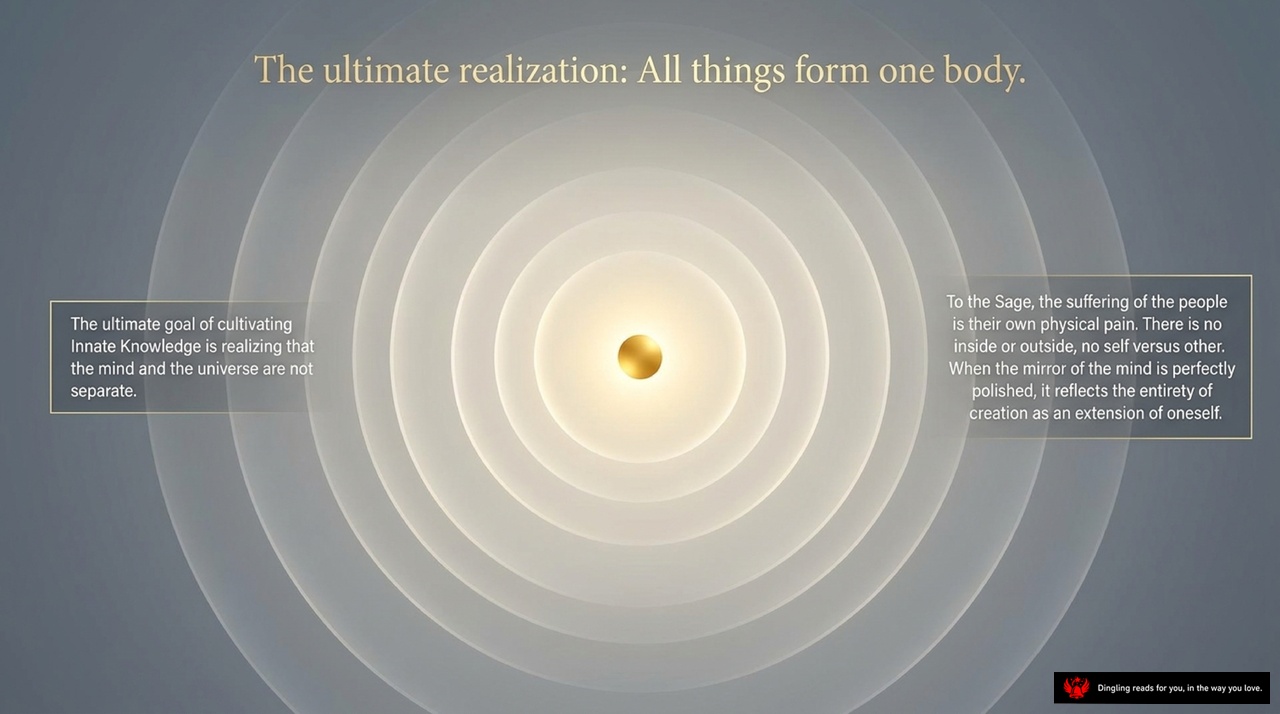
Imagine the universe not as a collection of separate objects, but as a single, living body where every part is intimately connected to the whole. This is the ultimate realization that Wang Yangming sought to convey: all things form one body. When you truly cultivate this innate knowledge, you stop seeing a divide between your mind and the vast universe.
Think about it this way: to the sage, the suffering of the people is no different from their own physical pain. There is no "inside" versus "outside," and no "self" versus "other." It is a complete unity. When the mirror of your mind is perfectly polished, reflecting nothing but pure truth, it doesn't just show you a tiny piece of reality; it reflects the entirety of creation as an extension of yourself.
This is the ultimate goal. Realizing that the mind and the universe are not separate means you understand that when you help someone else, you are actually healing a part of yourself. You are polishing your own mirror. There is no distinction between the healer and the healed, just as there is no distinction between the root and the branches. Once you grasp this, every action you take becomes a movement of the whole, and every life you touch becomes your own.
Here is the spoken-word script for Slide 12, tailored for an American audience:
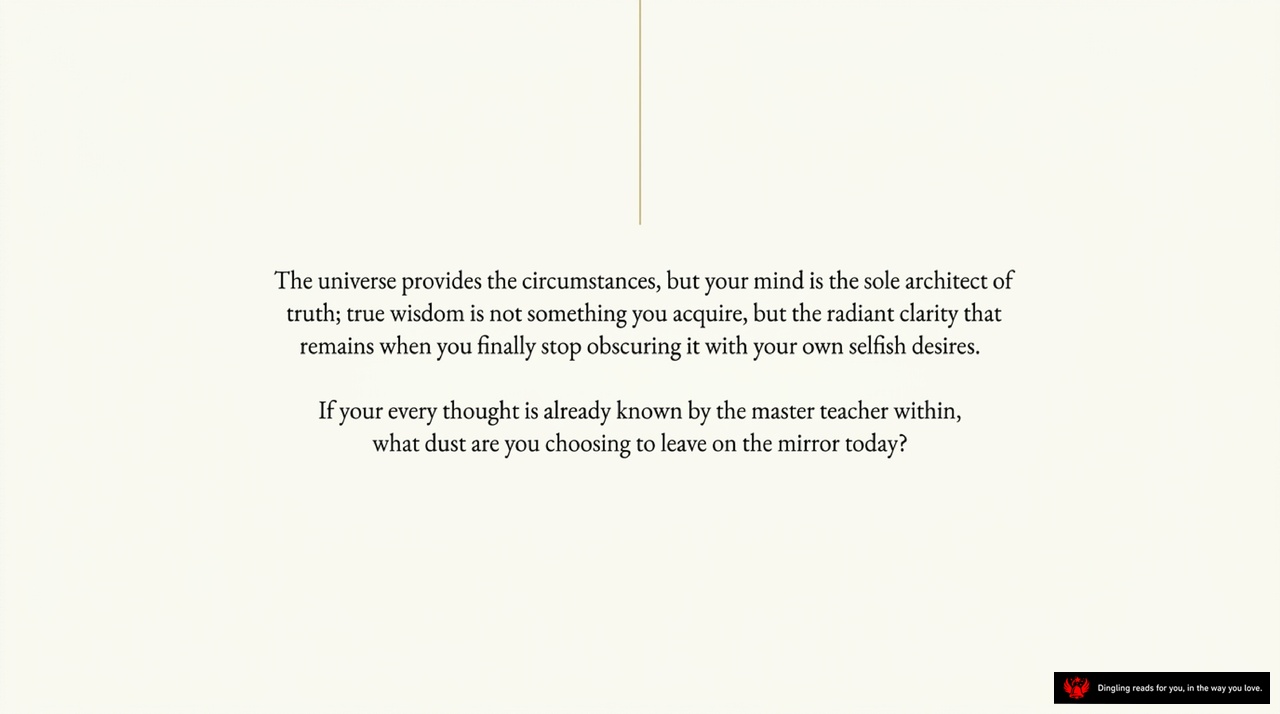
The universe sets the stage for your life, but your mind is the only one holding the blueprint for truth. Real wisdom isn't something you collect like trophies or facts; it's that clear, radiant light that remains only when you finally stop blinding yourself with your own selfish desires. Think of your mind as a mirror. If every thought you have is already known by that master teacher inside you, the question isn't about gaining new knowledge—it's about what you choose to leave behind. Are you letting the dust of ego, doubt, and petty ambition settle on the glass? Or are you clearing it away to see the world exactly as it is? True clarity comes not from looking harder at the outside world, but from stopping the clutter inside. When you stop obscuring the truth with your own wants, you don't just find wisdom; you become it.