
Jane Eyre: Complete Chapter-by-Chapter Summary

Jane Eyre by Charlotte Brontë. This is the definitive journey of a Victorian orphan who braves oppression, madness, and heartbreak to forge her own path toward equality, independence, and love. Set against the backdrop of a gloomy, imposing estate under a stormy sky, this story follows a young woman's relentless struggle for her identity. From the cruelty of her childhood to the mysteries of Thornfield Hall, she refuses to be defined by others. Instead, she chooses to define herself on her own terms, proving that true strength lies in maintaining one's moral integrity even when the world tries to break her.

Jane Eyre's journey isn't just about moving from one house to another; it's a physical map of her soul's evolution. As the slide illustrates, her path to self-actualization is anchored by five distinct estates, each demanding a unique sacrifice to forge a stronger character.
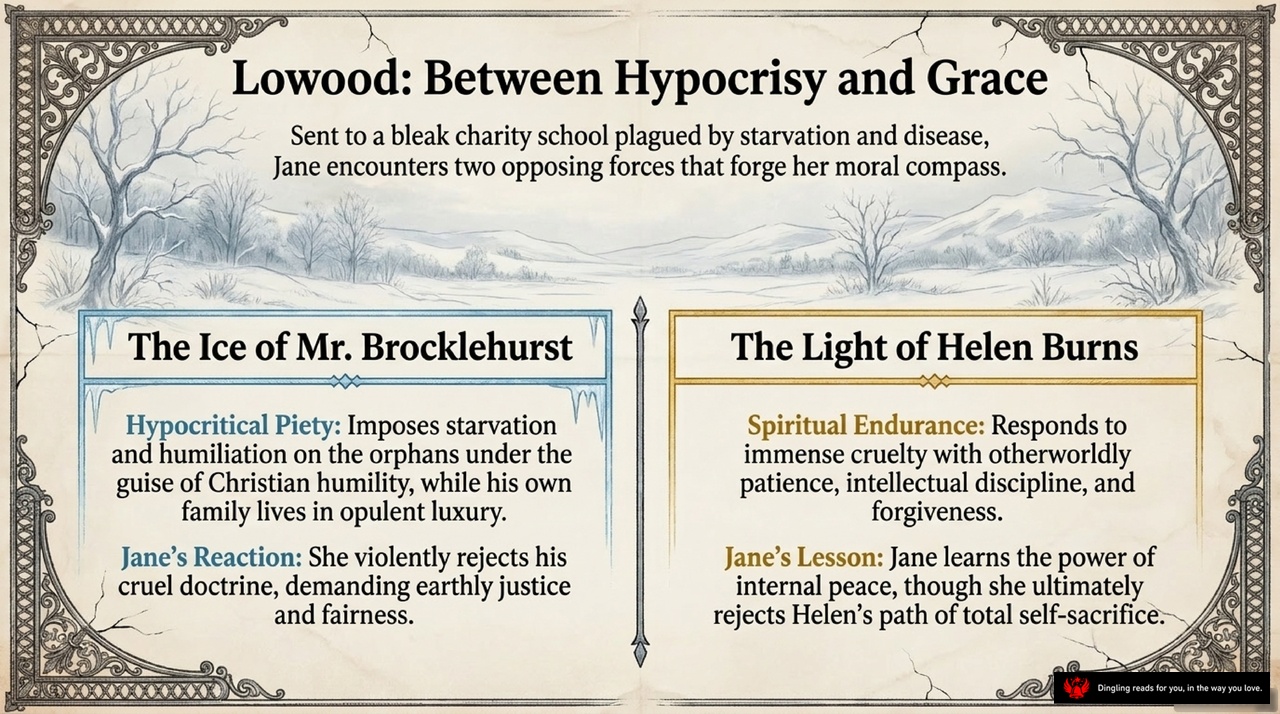
It begins at Gateshead Hall, the Crucible of Oppression. Here, childhood isolation and the birth of rebellion shape her early defiance. She then moves to Lowood, the Crucible of Endurance, where harsh discipline, spirituality, and tragic loss teach her resilience. Next is Thornfield, the Crucible of Passion, defined by romance, gothic deception, and a moral crisis that tests her integrity.
Her journey continues at Moor House, the Crucible of Independence. Amidst wealth and found family, she faces the icy threat of duty, learning to stand on her own. Finally, she arrives at Ferndean Manor, the Crucible of Equality. This is where true partnership and ultimate synthesis occur, allowing her to emerge as her complete, authentic self. Each escape from these trials builds a layer of her identity, culminating in the woman she becomes today.

Gateshead: The Birth of Rebellion. Look at this dark, imposing room. This is the Red Room, the very heart of Jane's childhood trauma. As a penniless dependent, ten-year-old Jane was relentlessly abused by her cousin John Reed and completely outcast by her aunt. Her ultimate punishment was being locked in this terrifying, ghostly space—a place of absolute powerlessness where she was trapped with the memory of her uncle's death.
Driven to the edge of terror, Jane experiences her first spark of fierce resistance. In that moment of sheer fear, she realizes that unjust authority must be fought. She screams out against the injustice, laying the foundation for her lifelong demand for human fairness. As she later reflects, "Unjust!—unjust! said my reason... my blood was still warm; the mood of the revolted slave was still bracing me." This single act of defiance transforms her from a passive victim into a woman who refuses to be silenced, proving that even in the darkest corners, the human spirit can rise up against oppression.
From the very moment I arrived at the gates of Thornfield, the silence here felt different from the cruelty of Gateshead. It wasn't an attack, but a mystery. While I taught Adele and explored the grounds, strange sounds began to haunt my nights—a suppressed, hysterical laughter drifting from the third floor, followed by the terrifying sound of something being dragged across the floorboards.
When I finally confronted Mr. Rochester about these noises, he dismissed my fears with a lie, claiming it was just a servant's nightmare. But his evasive eyes and the locked door on that third floor told me the truth: he was hiding something dangerous. My curiosity, once a quiet habit, became an obsession. I began to sneak up those stairs, listening for whispers behind the closed door, trying to piece together the puzzle of this haunted house.
Then, one night, the nightmare became reality. A scream tore through the silence, followed by the frantic cries for help. When I rushed to the scene, I found Mr. Rochester trying to wake a man named Mason, who was covered in blood. As I watched from the doorway, I heard a familiar, mocking laugh coming from the room—Grace Poole's laugh. But when Rochester left me alone to guard Mason, the laughter stopped, replaced by the sound of a dog barking and someone groaning in pain.
The evidence was overwhelming. The blood, the broken door, and the terrified servant pointed to one conclusion: a violent crime was happening in that forbidden room. My fear gave way to a cold, hard determination. The mystery of Thornfield was no longer just a story; it was a crime, and I knew, with terrifying certainty, that I was about to uncover the dark secret Mr. Rochester had been desperately trying to keep hidden from me.

The wedding day that felt like a fairy tale ended in absolute horror. As the priest asked the final question, a voice from the shadows screamed, "I cannot consent to this marriage! There is an impediment!" It was Mr. Mason, revealing the brutal truth: Rochester is already married to Bertha, a woman who has been confined in the attic for fifteen years. When the door finally opened, we saw her—a wild, mad creature chained in the room. The dream of being Mrs. Rochester shattered instantly. Realizing I was a mistress in his eyes, I made the hardest choice of my life: I fled. I ran into the night, leaving my wedding dress behind, and ended up alone at the crossroads of Whitcross, with nothing but a few coins and a broken heart.

Jane Eyre isn't just a story about a girl finding love; it's a masterclass in how we define ourselves by who we *aren't*. Look at the chart on your screen. We see Jane standing tall, not because she is perfect, but because she has rejected three distinct paths of failure represented by her foils.
First, she rejects Blanche Ingram. Blanche represents aristocratic vanity—a hollow, transactional life built on cruelty and social status. She is discarded by Rochester because she lacks substance. Jane refuses to become just another pretty ornament in a wealthy man's collection.
Second, she rejects Bertha Mason. Bertha is consumed by unrestrained madness and feral passion, ultimately destroying herself and others. She is a warning of what happens when emotion runs wild without moral reason. Jane refuses to let her desires consume her logic.
Third, she rejects Helen Burns. Helen chooses spiritual martyrdom, accepting too much passivity to survive the harshness of the earthly world. While Helen's faith is noble, her inability to fight back leads to her tragic death in childhood. Jane learns from Helen's kindness but refuses her fatal resignation.
By rejecting the vanity of Blanche, the destruction of Bertha, and the martyrdom of Helen, Jane carves out her own unique path: Balanced Autonomy. She constantly warring between duty and desire, yet she achieves ultimate self-actualization. She demands a life that honors both earthly passion and moral reason, proving that true strength lies not in being like others, but in defining your own soul.

The ultimate moral crisis in Jane Eyre isn't just about love; it's about the war between passion and principle. When Bertha Mason's revelation shatters Rochester's proposal, he begs Jane to stay as his mistress, offering a life of comfort at the cost of her soul. On one side stands the voice of passion: "Stay. He loves you. You are alone in the world." On the other burns the voice of reason: "Flee. To become his dependent is to lose yourself."
Jane's choice is agonizing but definitive. She rejects comfortable subjugation, choosing independence even in solitude. As she declares, "I care for myself. The more solitary, the more friendless, the more unsustained I am, the more I will respect myself." This isn't just a rejection of a man; it's a fierce affirmation of her own identity. She walks away from the fire of temptation, proving that true dignity comes from standing on your own feet, not from the love of another.

Jane has finally found her true family. After inheriting £20,000 from her uncle, she discovers she is not just a distant relative to the Rivers sisters, but their beloved cousin. This financial independence shatters her past of being a dependent orphan, granting her the absolute freedom she always craved. Yet, as she stands on this new shore, she faces a dangerous temptation. St. John Rivers, driven by ruthless and cold ambition for God, demands she marry him and accompany him to India. He views her not as a beloved partner, but merely as a "useful tool" for his missionary work. Jane realizes that surrendering to this loveless duty would be emotional suicide, freezing her soul to death just as Rochester's unlawful passion once threatened to burn it to ash. True North is not where duty takes you, but where your heart leads you.

Look at this balance scale. On the left, we have Edward Rochester, representing the extreme of fire—passion, warmth, but also unpredictability. His flaw is that he demands passion at the expense of moral law and Jane's autonomy. He threatens to consume her entirely, turning her into a dependent mistress. On the right stands St. John Rivers, the embodiment of ice—reason, duty, and absolute control. His flaw is demanding duty at the expense of human emotion and earthly love. He threatens to freeze Jane to death, using her solely as a practical instrument for his ambitions. Jane refuses to be consumed by fire or frozen by ice. She demands a partner who respects both her fierce heart and her unyielding boundaries.

Hearing Rochester's supernatural call across the moors, Jane returns to find Thornfield burned to the ground and Rochester blind and maimed. The power dynamic has radically shifted. But this isn't a tragedy; it's the moment true equality is born. Jane arrives not as a submissive servant or a compromised mistress, but as a sovereign equal. Rochester is humbled, stripped of his arrogant physical mastery, and utterly dependent on her return. They are finally united not by desperation or dominance, but by absolute, balanced mutual choice. This is the synthesis of their souls—two broken pieces fitting perfectly together to create something whole and enduring.

The Anatomy of a Free Spirit: How Jane Eyre Redefined What It Means to Be Free
Throughout the novel, Brontë explicitly uses the imagery of birds to track Jane's psychological liberation, and this slide beautifully captures that journey. Let's look at the three stages of her transformation.
First, in Gateshead, Jane is a trapped, abused creature beating frantically against its bars. She is confined to the Red Room, a place of fear and isolation where she feels utterly powerless.
Then, at Thornfield, she declares, "I am no bird; and no net ensnares me; I am a free human being with an independent will." This is her moment of awakening. Even though she is physically a servant, she realizes her mind and spirit belong to her. She chooses her own path, even when it means leaving the safety of Thornfield.
Finally, at Ferndean, she becomes a free spirit that voluntarily chooses exactly where it wishes to land. She returns to Rochester not as a dependent, but as an equal partner. She builds a new life on her own terms, surrounded by the love she earned through her own strength.
The bottom line is profound: True freedom for Jane Eyre is not permanent isolation. True freedom is possessing oneself entirely, so that one can give oneself freely to another. Jane learns that independence doesn't mean shutting the world out; it means having the courage to connect with others from a place of wholeness, rather than need.

Jane Eyre's journey is a radical masterclass in self-worth. In a world that demanded she be small, submissive, and grateful for scraps, she continuously chose the difficult, lonely path of integrity. She proved that true love can never exist without true equality, and that one must first belong entirely to oneself before belonging to anyone else. Jane refused to compromise her soul for the comfort of society or the demands of others... What cages are you still accepting in your own life?