
Jean-Christophe: Complete Chapter-by-Chapter Summary

Welcome to our journey into *Jean-Christophe*, an epic symphony of a free soul's journey through suffering, rebellion, and creation, written by Romain Rolland. Imagine a vast, dark landscape where jagged mountains pierce the clouds, and a river winds through the shadows, reflecting a sliver of golden light breaking through the storm. This is the world of Jean-Christophe, a story about conquering the internal and external darkness of the world.
From the very beginning, music isn't just an art for Jean-Christophe; it's the air he breathes. Born to a fading musical family on the banks of the Rhine, he grows up surrounded by the sound of church bells, the rushing river, and his father's drunken violin. These sounds weave themselves into his very soul. Even as a child, he dances to the rhythm of the wind and imagines orchestras in his mind. It's a powerful realization for him when his grandfather first recognizes this gift, seeing the spark in the boy's eyes that others miss. The grandfather writes down his melodies, transforming those chaotic, inner sounds into something real, something the world can see.
But life isn't just about harmony. There is pain, there is loss, and there is the struggle to find one's voice in a noisy world. Jean-Christophe's journey is a testament to the power of the human spirit to rise above the shadows. It's a story that reminds us that even in the darkest valleys, there is always a path leading toward the light, guided by the music of the heart.

The Mirror of Millions of Souls isn't just a book; it's a mirror reflecting the chaos and beauty of our own inner lives. Look at this image: a solitary figure walking through a swirling storm of darkness, yet illuminated by a golden path. That's the essence of what we're exploring today.
The text reminds us of a profound truth: "True light is not the absence of darkness, but not being permanently covered by it." This is the first lesson of our journey—Internal Victory. Before we can face the world's enemies, we must conquer the demons within our own minds and spirits.
But the path isn't easy. We often find ourselves navigating what the book calls "The Spiritual Wilderness." It's not about material hardship; it's about the perils of inner doubt, hypocrisy, and intellectual decay. It's the struggle to find your authentic voice when the world tries to drown it out.
And ultimately, this struggle becomes "A Symphony of Life." Just like Beethoven's epic works, our lives are a spiritual journey. We are all struggling in an era of chaos, but we have the power to create our own sanctuary. We don't need to wait for the storm to pass; we just need to keep walking, trusting that the light will guide us through the darkness.

Movement I and II represent the chaotic awakening of the senses and the reckless, passionate crusade against societal lies—a Don Quixote phase where he shatters stagnant traditions. But then, we reach Movement III: a stark tonal contrast. The storm subsides into an atmosphere of gentle melancholy, deep friendship, and pure, quiet love. This isn't about grand gestures or heroic battles anymore; it's about finding stillness in the noise. Finally, Movement IV captures the mid-life crisis and the destructive hurricane of doubt, ultimately breaking through to supreme, cosmic serenity. It's a journey from the noisy chaos of youth to the profound silence of wisdom.

After the pain of betrayal with Ada, Christoph feels like a beast breaking free from its cage. He breathes in the fresh air of freedom, and his anger toward the German music world erupts like a volcano. He stops worshipping the masters he once admired, calling Mendelssohn's sadness a fake cry and Schumann's simplicity a pathetic cliché. He hates the hypocrisy of the romanticists, seeing Wagner's works as filled with lies and posturing. To him, the German art scene is full of cowardice and lies, hiding behind dramatic grandeur while the inside is empty and pale.
But Christoph doesn't retreat. He stands firm like a stubborn bull, refusing to compromise even if he hits his head against the wall. He burns his old manuscripts that were written just to please the market and rejects every offer that asks him to change his soul. He believes true art must speak his own feelings, using old folk songs and children's thoughts to create music that feels alive.
When he tries to stay, the city feels like a suffocating prison. The blind nationalism on the streets and the numb faces of the people leave him with no hope. Finally, he decides to leave. His journey takes him across the border into Belgium, where the cold air feels like true freedom. Yet, as he looks at the strange crowd on the platform, he knows his life has just turned a new page, filled with unknown challenges and the enduring melody in his heart.

In this pivotal chapter, Christoph doesn't just retreat; he explodes. He turns his rage into a weapon, tearing apart the very music he once worshipped. To him, the German masters—Mendelssohn, Weber, Schubert—aren't geniuses anymore; they're liars, drowning in sentimentality and self-pity. He calls Wagner a fraud, exposing a music world built on cowardice and lies, where patriotism is just a sheep bleating in unison.
He becomes the enemy of the establishment, shouting his critiques from the concert hall, refusing to bow to the crowd. The backlash is immediate and brutal. The Duke calls him un-German; his works are ignored; the applause turns to cold silence. He's isolated, targeted, and hated. But here's the thing about Christoph: he never flinches. Like a stubborn bull, he charges forward, head-first into the brick wall, refusing to compromise. He burns his own market-friendly drafts and rejects every offer that asks him to sell out.
When a struggling French troupe arrives, performing a French version of *Hamlet*, Christoph is tempted. He gives his ticket to a poor foreign girl, gets swept up in the performance, and falls for the actress Coline. But even this brief escape ends in heartbreak. Back in Germany, his career implodes. His opera *Iphigenia* fails miserably, critics mock him, and the conductor humiliates him on stage.
Desperate and suffocated by the military madness and the closed-mindedness of his hometown, Christoph makes the ultimate decision: he leaves. After a chaotic confrontation with soldiers that nearly gets him killed, he flees across the border into Belgium, then to France. Stepping onto Belgian soil, he finally breathes. The air is cold, but it's free. He's leaving behind the prison of his own making, ready to write the next chapter of his life, armed with nothing but his music and a newfound, terrifying freedom.

Welcome back to the story of Christophe. We are now in the fifth volume, titled "The Arena"—a chapter where Christophe arrives in Paris, ready to conquer the world, only to find that the real battle isn't against critics or rivals, but against the very illusion of success itself.
As he steps into Paris, he is immediately swallowed by a complex, suffocating atmosphere. The city buzzes with noise—street vendors, theater crowds, and endless chatter in cafes—but underneath this veneer of prosperity lies a profound emptiness. He expects to find his soul in music, but instead, he stumbles straight into a trap of social pretense.
He is dragged into an artist's gathering by Sylvain Gohin, and what he sees shocks him. Thirty young people, all spouting buzzwords about "art for art's sake," are actually arguing over silver syndicates, copyright fees, and how much money dead writers left behind. It feels like a gilded box filled with hollow echoes. They talk about ideals, but their eyes are fixed on money. Christophe realizes that for them, music is just a decoration, a prop to show off in social circles.
The same cynicism follows him to the concert halls. He attends performances, expecting to be moved by the melodies, but he is only annoyed by the constant shuffling and the noisy environment. The program lists the same classics over and over again until the soul of the music is drained away, leaving only mechanical notes floating in the air. Even the critics offer him nothing but contradictory arguments—some hailing the past, others claiming revolution—yet no one seems to care about the life of the music itself.
He tries to join groups promoting German art, hoping to find kindred spirits, but finds only gray, childish works. So-called "program music" has nothing but flashy titles hiding empty content inside. The singing schools are rigid, guarding old rules like birds with clipped wings, unable to fly.
Then, he hears Debussy's *Pelléas et Mélisande*. For the first time, he smells something different in the air. The delicate harmonies and clever instrumentation are like a small crack in a gray sky. But even here, he senses a kind of lazy indifference, as if the composer is trying to get the most attention with the least effort.
Paris becomes a stage where everyone wears a mask. Artists gossip about fame and fortune behind closed doors; critics are pulled by favors and interests rather than truth. Christophe stands on the edge of this farce, feeling the cold. He finally understands that this city's prosperity is just a bubble on water, ready to pop at the slightest touch.
But amidst this noise, Christophe meets someone who truly resonates with his soul: Olivier Yennex. This shy young poet looks at Christophe like two rusty swords finally colliding. Olivier understands the wildness and tenderness in Christophe's music, and he sees the loneliness and pride deep inside Christophe's bones. Their friendship grows like a tree in a rocky crevice—strong and deep without needing much water.
Olivier introduces Christophe to the real France, not the glittering salons, but the spirit hidden in alleyways and libraries. He meets Sécha Fauré, an old musician who creates out of poverty with pure devotion to God, and scholars digging into history to nourish the nation's roots. Christophe begins to see that the French are not just frivolous; their blood holds a执着 for reason and freedom.
This new understanding changes Christophe's music. His melodies are no longer just the roaring Rhine, destructive and wild. They now carry the gentleness of the Seine, like a quiet morning mist. He stops trying to tell grand stories and starts writing about ordinary joys and sorrows. He composes for street songs and daily moments, finding that these overlooked fragments become the most moving parts of his art.
Their shared apartment becomes a nursery for creativity. Late at night, they discuss music and literature, from Bach's counterpoint to Hugo's epics. Olivier's sensitivity gently sculpts Christophe's rough soul, while Christophe's passion ignites Olivier's life. Together, they translate German poetry and create works giving a voice to the forgotten.
He also meets Théodore Mock, a Jewish photographer who sees life's tragedy but warms others with action. Through him, Christophe reflects on his own prejudices. In these exchanges, Christophe stops being just a rebellious German youth. He becomes a creator who understands tolerance and empathy. His music now holds the waves of the Rhine, the ripples of the Seine, and a deep love for humanity.
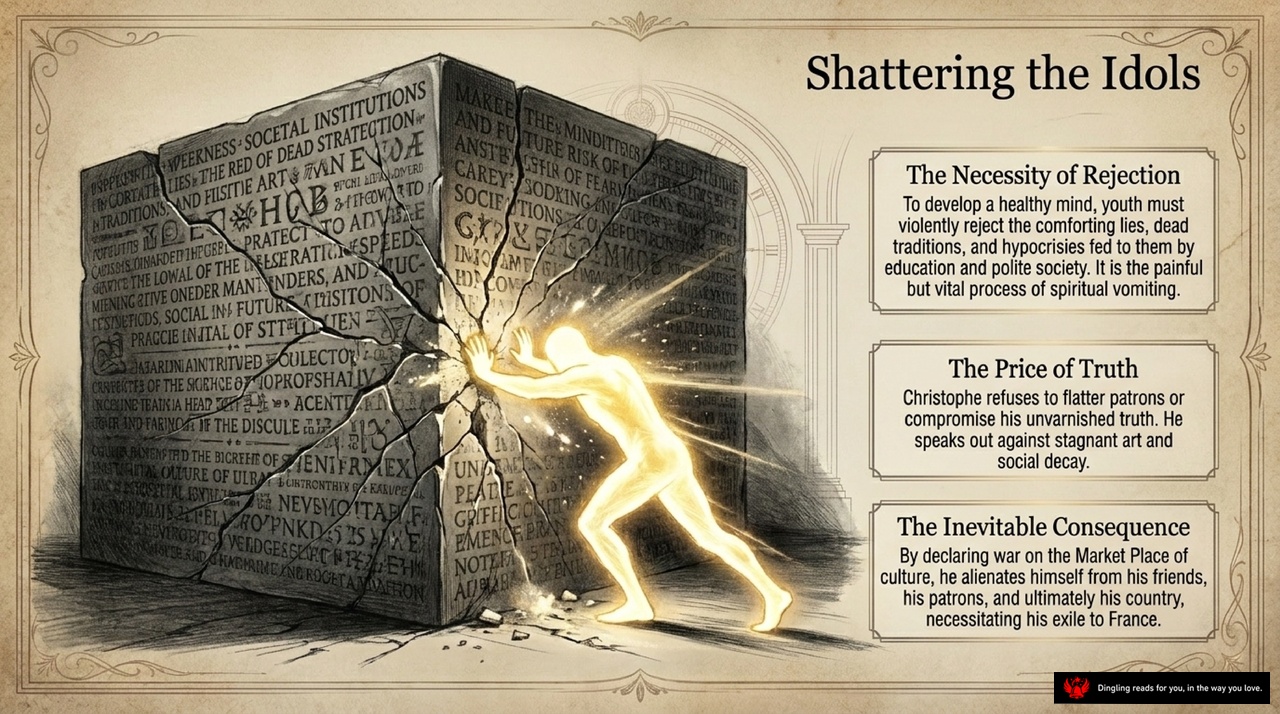
The image captures a pivotal moment of transformation for our protagonist, Christophe. It depicts a golden, radiant figure shattering a massive, inscribed block that represents the rigid idols of society—dead traditions, social lies, and hypocritical norms. This visual perfectly mirrors the text on the right, which outlines the "Necessity of Rejection," the "Price of Truth," and the "Inevitable Consequence" of his rebellion.
Let's dive into the story of how Christophe's journey from a German nationalist to a free-spirited artist led him to this breaking point. After his initial fiery protests against the German music establishment, Christophe found himself increasingly isolated. His sharp critiques of composers like Wagner and Mendelssohn alienated him from his peers, turning his former friends into enemies. The music world, once his home, became a place of ridicule and rejection.
This isolation pushed him to the edge. He realized that staying in Germany meant living a lie, compromising his artistic integrity for the sake of social acceptance. The "Market Place of Culture" demanded conformity, but Christophe's soul demanded truth. As the slide illustrates, he had to violently reject these comforting lies. It was a painful process of "spiritual vomiting," but it was the only way to develop a healthy mind and a genuine art.
The cost of this truth was incredibly high. By declaring war on the cultural status quo, Christophe alienated himself from his friends, his patrons, and ultimately his country. The consequences were severe: he faced exile, leaving his mother behind, and eventually found refuge in France. But as the image shows, the act of shattering these idols didn't just destroy the block; it released a brilliant, golden light. This was the birth of his true self. By refusing to flatter anyone or compromise his unvarnished truth, Christophe spoke out against stagnant art and social decay, paving the way for a new, freer kind of music that would eventually resonate with the world.

Look at this slide titled "The Cultural Collision." It visually contrasts two worlds: The Old World, represented by the rigid, dark stone architecture of Germany, and The Market Place, depicted by the chaotic, colorful swirls of France.
On the German side, we see an art steeped in heavy romanticism, constantly risking sentimental decay. Their society is rigid and deeply traditional, bowing to authority. They are cautious, seeking comfort and collective illusions to shield themselves from painful truths.
In stark contrast, the French side is hyper-intellectual and cynical. Their art prioritizes constant novelty and cleverness over any enduring substance. Their society is anarchic and fragmented, dominated by a corrupt, superficial elite. Yet, their approach to truth is ruthlessly transparent and analytic, often paralyzing because they speak without compassion or a productive intent.
This clash isn't just about geography; it's about the very soul of creation. The German seeks to hide behind tradition and emotion, while the French strips everything bare, exposing the raw, often ugly reality beneath. As our protagonist Christoph navigates these two cultures, he learns that neither approach alone holds the full truth. The German world offers depth but lacks honesty, while the French world offers clarity but lacks warmth. It is in this friction, in this violent collision of stone and swirl, that true artistic evolution begins.

Look at this striking image, "The Hurricane and the Harmony." On the left, we see "The Burning Bush"—the descent into the abyss. It depicts a moment where the illusion of human connection shatters. Confronted by the failure of language to unite souls and the realization that true passion is terrifyingly rare, the will becomes paralyzed. A destructive hurricane of doubt strips away all remaining ego, leaving us in the dark.
But look to the right: "The New Dawn," the ascent to serenity. This is the transformation. Salvation is not found in grand society, but in the silent, humble souls burning with pure, quiet faith. Here, art is no longer wielded as a weapon of rebellion, but embraced as an eternal sanctuary.
This journey mirrors the final arc of *Song of a Fool*. After the chaos of the Paris Commune and the death of his beloved friend Olivier, Christoph feels utterly lost. He questions everything—language, art, love, and even the meaning of life. He hits rock bottom, feeling like a broken vessel in a storm. Yet, it is precisely in this destruction that rebirth happens. By letting go of his ego and his desperate need to prove himself, he finds a new path. He stops fighting the world and starts listening to it. His music transforms from a raging torrent into something calm, ordered, and deeply peaceful—like summer clouds. He realizes that the highest art isn't about rules or social duty, but about pure creation, a force as powerful and divine as the sun itself. Through this inner storm, he finds his true home, not in the world, but within himself.

"Creation is Killing Death." This isn't just a poetic phrase; it's the core rebellion at the heart of human existence. Look at these three symbols: the fire of creation, the shield of protection, and the sprout of new life. Together, they tell us that art is far more than entertainment or aesthetic indulgence. It is the ultimate act of defiance against our own mortality and the inevitable decay of time.
To create—whether through the flesh of a life lived or the spirit of a masterpiece made—is to break free from the prison of our bodies and merge with the eternal whirlwind of existence. This is the strict duty of the strong: to produce healthy, life-affirming art that heals and elevates the exhausted masses. When we create, we don't just leave a mark; we kill the very concept of death, ensuring that our souls live on forever in the work we leave behind.
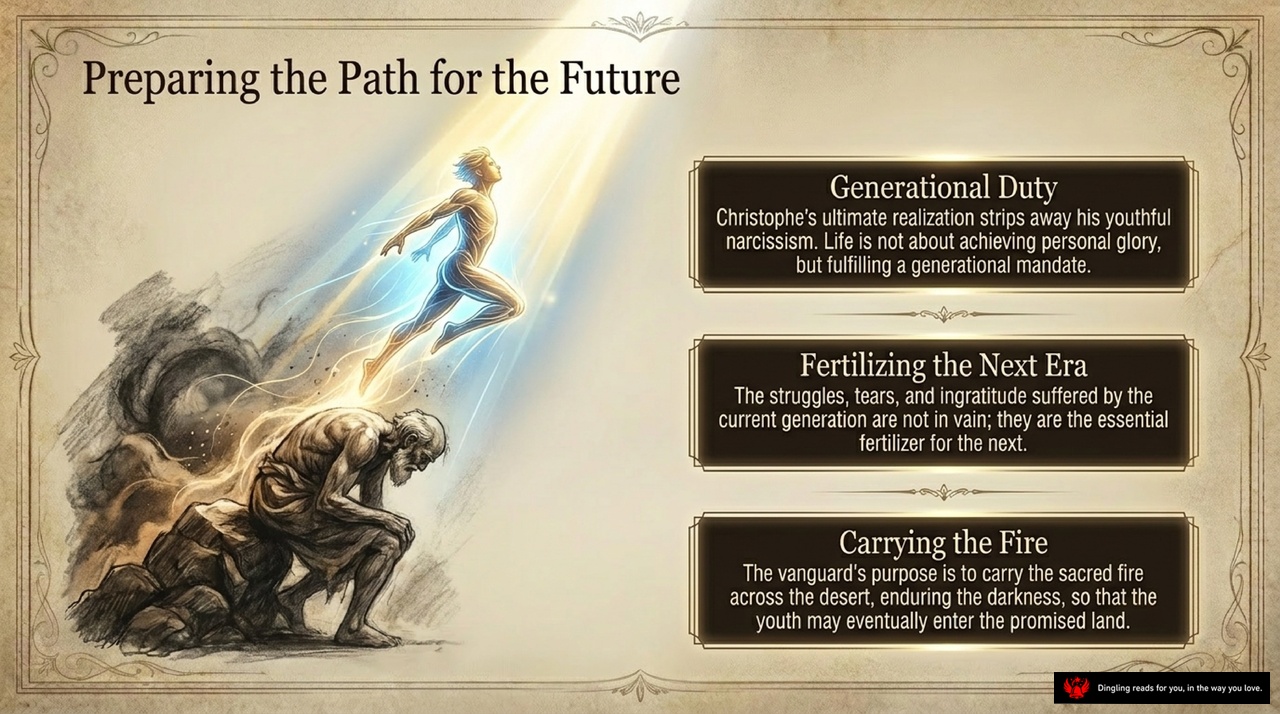
Look at this powerful image: an old, weary figure crouching in the dark, while a younger, radiant form leaps toward the light. This visual perfectly captures Christophe's ultimate realization: life isn't about chasing personal glory, but fulfilling a generational mandate. In the book, we see Christophe strip away his youthful narcissism to understand that his struggles, tears, and even the ingratitude he faced were never in vain. They were the essential fertilizer for the next era.
Think about it: the vanguard's purpose is to carry the sacred fire across the desert. Just like Christophe did, enduring the darkness so that the youth might eventually enter the promised land. He didn't just survive; he prepared the path for the future. His sacrifice wasn't a loss; it was an investment in someone else's dawn. That is the true meaning of legacy.

Today, we arrive at the final chapter of Christophe's journey: The Final Crossing. This isn't just an ending; it is a profound transformation. Look at the image: Christophe, the Giant, stands battered and bent, carrying the heavy, sacred burden of the Future on his shoulders. He represents the enduring human spirit—exhausted by decades of struggle, yet fundamentally unbreakable. Beneath him, The River roars with chaotic, terrifying waves, symbolizing the relentless flow of existence that threatens to drown every soul. But notice the light breaking through the storm; this is The Transformation. Christophe does not die in despair. Instead, he faces death with the ultimate joy of having served life, ready to be reborn for the new battles of the future. This spirit is perfectly captured when he declares, "I am the day that is to come." He carries The Child, the future generation, not as a weight, but as a promise. As the text concludes, this is the moment where the old self dissolves, and a new hope rises from the ashes, proving that even after the fiercest storms, the human spirit can always find a way to soar again.

Jean-Christophe is not merely the story of a musician, but the eternal blueprint of the free soul. It teaches us that suffering is the forge of greatness, that truth requires the courage of rebellion, and that our highest duty is to carry the heavy, sacred burden of the future across the turbulent river of life.
When the river of time threatens to pull you under, what will you choose to carry to the other side?
In the end, Jean-Christophe realizes that life isn't a battle to be won, but a current to be navigated. He learns that true freedom comes not from escaping the storm, but from learning to swim within it. Just as the light in the distance guides the traveler through the night, his music and his love become the compass that keeps him moving forward. He carries the memories of those he lost, the lessons of his failures, and the hope for the generations to come. He understands now that his purpose wasn't to conquer the world, but to leave a mark on it—a melody that resonates long after he is gone. So, when the waves rise high, he doesn't fight them; he joins them, turning his pain into power, and his story into a song for everyone who dares to keep walking.