
Journey to the West: Complete Chapter-by-Chapter Summary
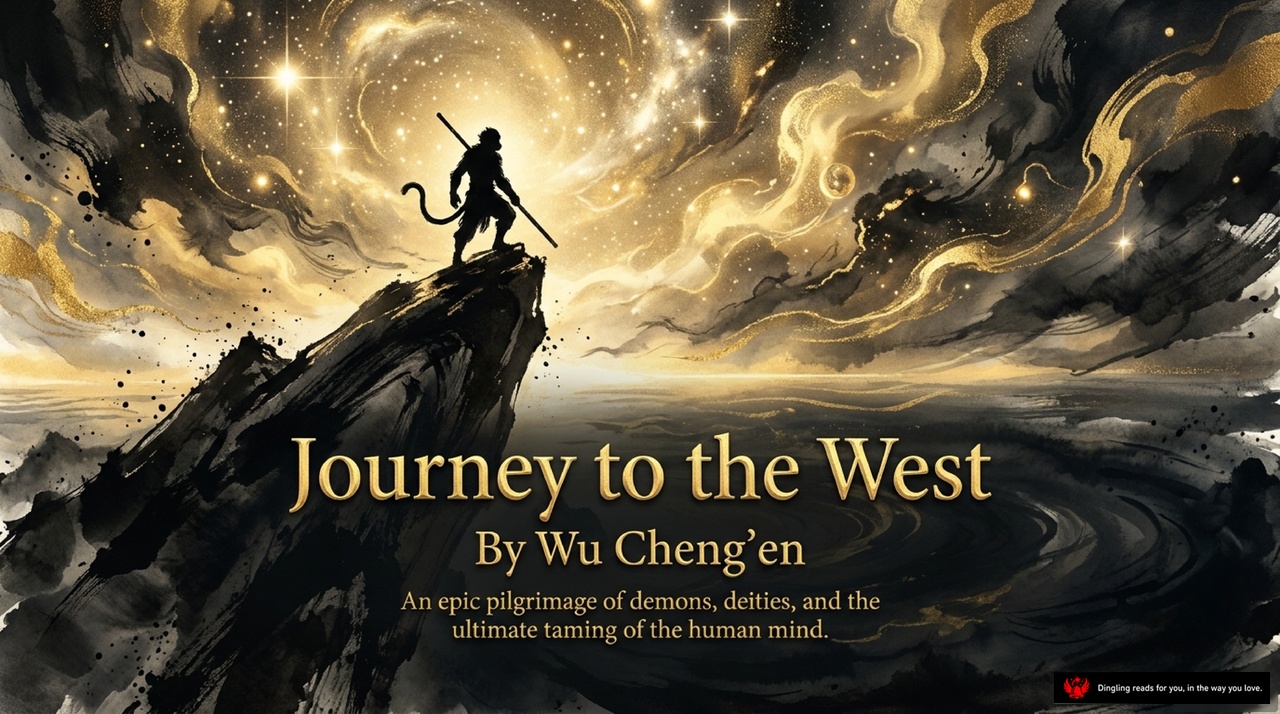
Welcome to our journey into the legendary tale of *Journey to the West* by Wu Cheng'en. Picture this: a lone, silhouetted figure standing atop a jagged peak, gazing out over a swirling cosmos of gold and ink-black clouds. This is Sun Wukong, the Monkey King, holding his iconic staff against a backdrop of ancient myth and celestial power.
This image captures the very essence of the story—an epic pilgrimage filled with demons, deities, and the ultimate taming of the human mind. It's not just a fantasy adventure; it's a profound exploration of destiny, rebellion, and the long road to enlightenment. From the moment a stone monkey leaps into the waterfall to become the "Beautiful Monkey King," to his celestial rise as the "Great Sage Equal to Heaven," and finally his humbling beneath the Five Elements Mountain, every chapter is a lesson in growth.
As we dive into this timeless classic, we'll see how a chaotic, untamed spirit learns discipline, how greed and pride are conquered, and how a team of unlikely heroes overcomes impossible odds. Get ready to witness the transformation of a stone into a saint, and the birth of one of the greatest heroes in Eastern literature.
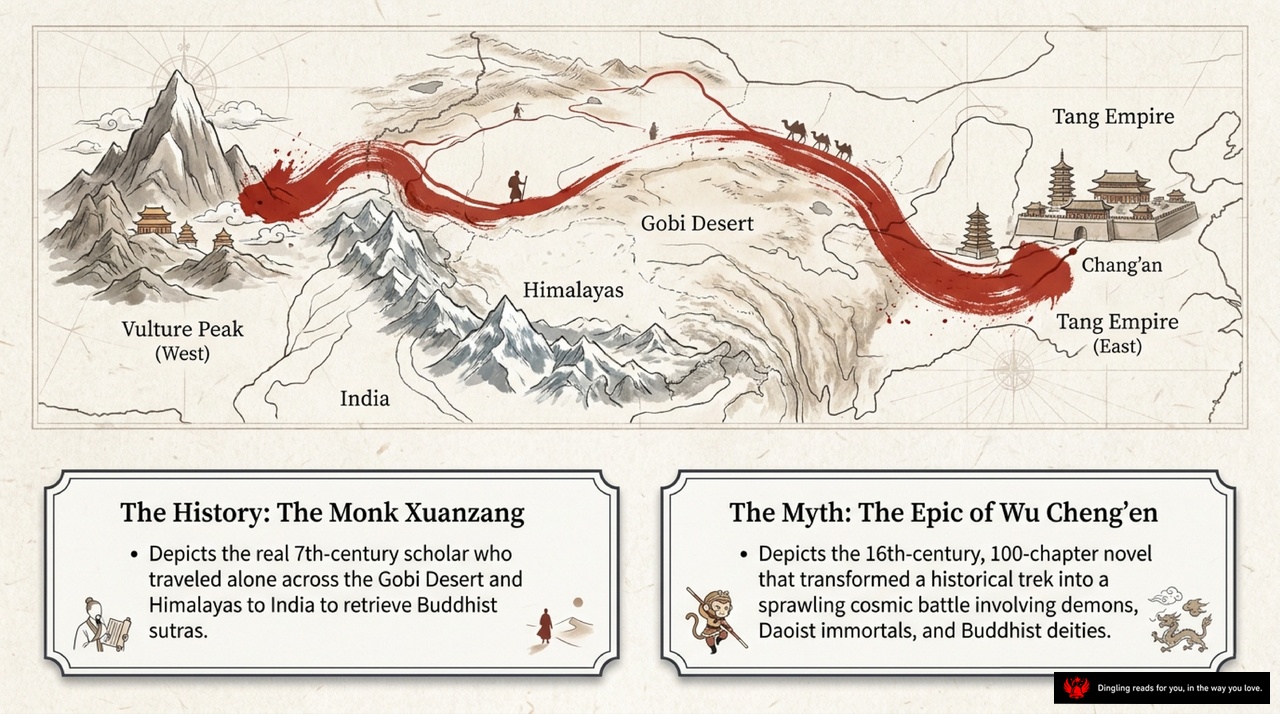
Look at this map tracing the legendary journey from Chang'an to Vulture Peak. On the left, we see the historic reality: the 7th-century monk Xuanzang. He wasn't chasing magic; he was a scholar risking his life alone across the treacherous Gobi Desert and the freezing Himalayas to retrieve Buddhist sutras from India. It was a grueling, solitary trek driven by pure faith.
But on the right, the story transforms into the myth we all know: *The Epic of Wu Cheng'en*. Written in the 16th century, this novel takes that historical journey and blows it up into a sprawling cosmic battle. Suddenly, we have demons, Daoist immortals, and Buddhist deities fighting for control. The quiet scholar becomes a battle-hardened hero, and the simple pilgrimage turns into an epic saga of gods and monsters. This slide perfectly captures the magic of the story: it starts as a real-life act of devotion and evolves into the timeless fantasy that defines Chinese culture.

The birth of the Spiritual Root begins with chaos, forged from a magic stone nourished by the seeds of Heaven and Earth since the creation of the world. This stone, shaped by the cycles of the sun and moon, eventually hatches as a stone monkey, representing pure, unconditioned nature, free from societal or mortal constraints. This untamed primal spirit, born from the essence of heaven and earth, sets the stage for a journey that will redefine destiny.

Look at this split-screen. On the left, we see the peak of mastery: the "72 Transformations" and the "Mastery of Daoist Immortality" taught by Patriarch Subhuti. This is the disciplined side of Sun Wukong—the power of the gods, honed through years of rigorous training. He can turn into anything, fly on clouds, and wield the weight of the universe.
But look at the right side. That's where the story gets dark. The "Ledger of Life and Death." This represents the ultimate human fear: fate. In the original text, Wukong doesn't just accept this ledger; he violently defies it. He breaks into the underworld, grabs the brush, and crosses out every monkey name, screaming, "From now on, my descendants will never be under your control!"
The core insight here is the dangerous duality of his character. He acquires the absolute power of the gods, yet he retains the impulsiveness of a beast. That combination—god-like strength with a wild, untamed heart—is what makes him the ultimate defier of fate. He isn't just fighting monsters; he's fighting the very concept of destiny itself.
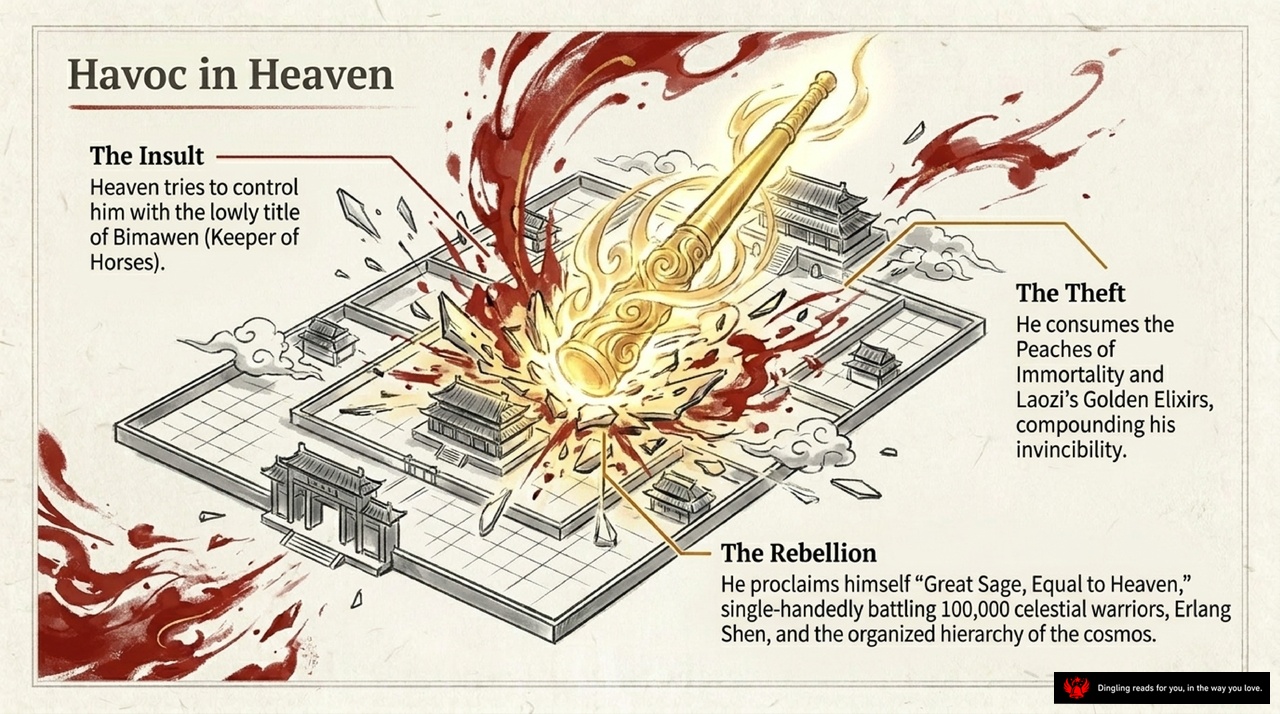
The image captures the chaotic climax of the Monkey King's rebellion, titled "Havoc in Heaven." It breaks down the story into three explosive moments: The Insult, The Theft, and The Rebellion.
First, we see the Insult. Heaven tries to control him with the lowly title of Bimawen, or Keeper of Horses. This is the final straw for a being who was born from the very essence of the universe.
Next, the image highlights The Theft. He consumes the Peaches of Immortality and Laozi's Golden Elixirs, compounding his invincibility. This act of stealing divine power is what truly breaks the cosmic order.
Finally, we see The Rebellion. He proclaims himself "Great Sage, Equal to Heaven," single-handedly battling 100,000 celestial warriors, Erlang Shen, and the organized hierarchy of the cosmos. The illustration vividly shows him smashing through the celestial palace, leaving destruction in his wake. This isn't just a fight; it's a declaration that no one is above him.
The image captures a pivotal moment in the journey: the Fiery Mountain. At first glance, it looks like an endless inferno, a place where nothing can survive. But the real challenge here isn't the fire itself; it's the source of that fire. The story reveals that this blazing heat is the leftover flame from the alchemy furnace when the Great Sage made his chaotic escape to heaven. To extinguish it, they need a single, magical item: the Bajiao Fan, held by Iron Fan Lady.
But getting the fan proves impossible. Iron Fan Lady is not just a demon; she is the wife of Bull Demon King, and her hatred for the Great Sage runs deep because of their past conflict over their son, the Red Boy. When the Great Sage first tries to borrow the fan, she uses it to blow him away thousands of miles. Undeterred, he returns with a special pill that makes him immune to her wind, manages to get the fan, only to discover it's a fake one.
Realizing he needs the real fan, he turns to Bull Demon King. But instead of a simple request, they end up in a fierce battle of transformations. The Great Sage chases Bull Demon King through the sky, turning into a pig, a rooster, and even a white tiger, while Bull Demon King counters with his own tricks, turning into a crab and a golden lion. In the end, with the help of the gods, the Great Sage finally subdues his rival and secures the true Bajiao Fan. With the fire finally extinguished, the path ahead clears, and they can finally continue their journey toward the West.

Welcome back to our journey. We are now at a critical turning point in our story. Look at the image before us: "The Mortal Vessel." This title perfectly captures the tragic yet heroic essence of our protagonist, Sun Wukong.
As the slide illustrates, Wukong is known as "The Golden Cicada"—a reincarnated disciple of the Buddha, yet he remains burdened by his mortal flesh. This duality is the core of his entire struggle. He is surrounded by darkness, representing the demons and obstacles that constantly threaten him, seeking to consume his flesh for their own immortality.
Notice the label "Zero Power." This is a powerful irony. Wukong possesses no martial skills or magic in the traditional sense that would make him invulnerable. In fact, his lack of a permanent, divine form makes him a perpetual target. He is vulnerable, exposed, and constantly hunted by forces seeking to exploit his humanity.
However, look to the right side of the image. Despite being the weakest in terms of physical defense, he possesses "Absolute Devotion." This is what makes him the undisputed leader of the pilgrimage. While others have powers, only Wukong holds the unwavering moral compass required to reach the West. His strength isn't found in his weapon or his transformations, but in his relentless commitment to protecting his master and fulfilling his vow.
So, we see a paradox here: the most vulnerable member of the team is actually its strongest pillar. His journey is about transforming that "Mortal Vessel" into something greater, proving that true power comes not from avoiding death, but from embracing it to serve a higher purpose.

The Journey of the Four: A Psychological Profile of the Quest Team
This slide breaks down the core dynamics of our team: Tang Seng, Sun Wukong, Zhu Bajie, and Sha Wujing. Each character represents a distinct psychological archetype essential for the group's survival.
Starting with Tang Seng, our leader. His origin is a mortal monk, and his weapon is the Staff of Faith. He embodies the element of Earth and serves as the Conscience of the team. While often seen as weak, he is the moral anchor who keeps everyone focused on the ultimate goal, even when tempted by distractions like the daughter of the King of the Daughter Kingdom.
Next is Sun Wukong. Born from arrogance and rebellion, he is the restless mind of the group. His weapon, the Golden Cudgel, represents the element of Fire. As the powerhouse, he handles all the fighting but struggles with impatience. His journey is about channeling that raw energy into protection and wisdom, transforming from a rogue monkey into a disciplined protector.
Then we have Zhu Bajie. His origin stems from gluttony and lust, marking him as the embodiment of physical appetites. Represented by the element of Wood, he carries the Nine-Tooth Iron Rake. Bajie provides comic relief and human flaws, reminding the team of the struggles of everyday life. His role is to balance the group's intensity with a touch of realism, though he often needs guidance to stay on the path.
Finally, Sha Wujing. His origin is carelessness, having been an exiled deity, which translates into the archetype of sincerity and ignorance. He wields the Crescent-Moon Shovel and represents the element of Water. Sha is the silent, reliable backbone. He never complains, always protects Tang Seng, and provides the stability the team desperately needs.
Together, these four elements—Earth, Fire, Wood, and Water—create a complete system. The Conscience guides the Restless Mind, the Physical Appetites are managed by Sincerity, and all of it rests on the foundation of Faith. It's not just about fighting monsters; it's about balancing these internal forces to achieve enlightenment.

The Taming of the Mind Monkey isn't just a story about a monkey; it's a mirror for our own inner battles. Look at this cycle: Wukong represents the wild, chaotic mind—powerful, restless, and capable of endless transformation, yet prone to violence. Tang Seng is the conscience, the moral compass that constantly chants the sutra to curb that chaos. And the Golden Headband? It's the ultimate discipline, tightening painfully whenever the mind strays from the path.
The true epic here isn't about slaying physical monsters or climbing mountains. It's about that internal struggle to yoke the limitless power of the mind to the moral direction of the soul. Every demon they faced was just a projection of their own uncontrolled impulses. Only by mastering the mind monkey could they ever hope to reach enlightenment.
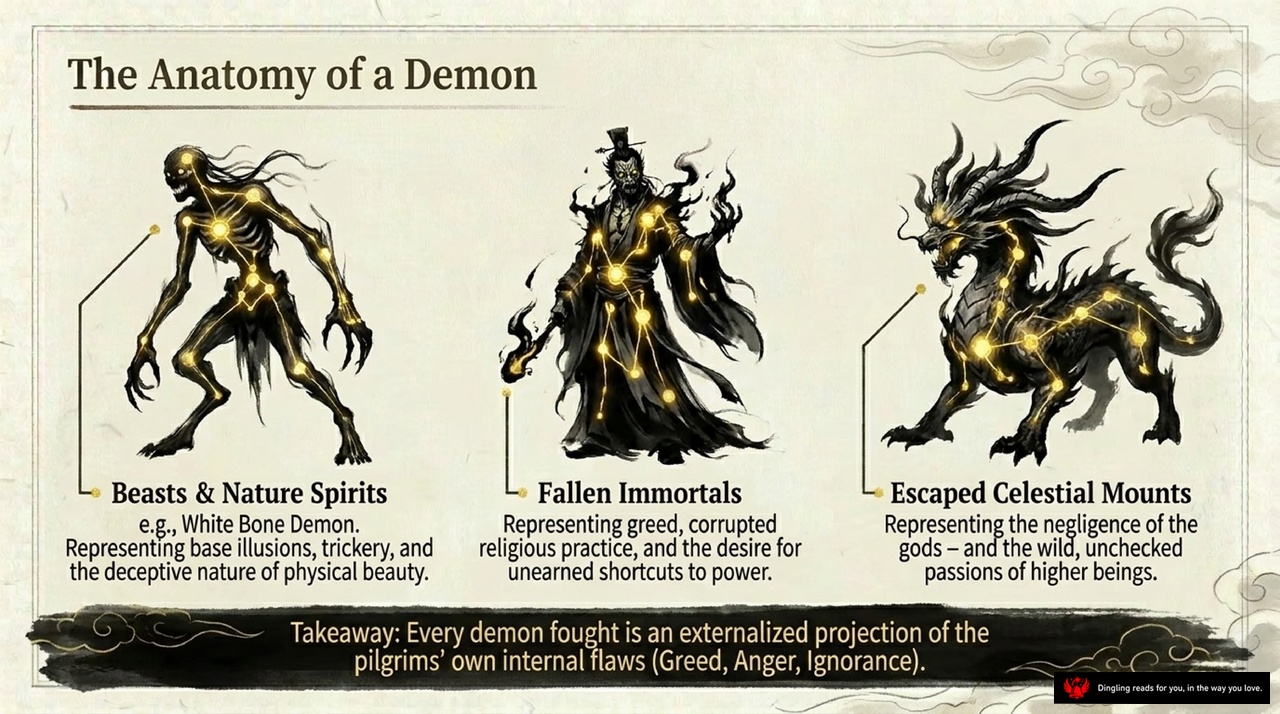
Today's slide breaks down the "Anatomy of a Demon," revealing that every monster the pilgrims fight is actually a mirror reflecting their own internal flaws. Look at these three categories: first, the "Beasts & Nature Spirits," like the White Bone Demon, which represent base illusions and the deceptive nature of physical beauty. Second, the "Fallen Immortals," such as the Bull Demon King, embodying greed, corrupted faith, and the desperate desire for unearned shortcuts to power. Finally, the "Escaped Celestial Mounts," like the Golden Horned Beast, symbolizing the negligence of the gods and the wild, unchecked passions of higher beings.
But here is the core takeaway: every demon fought is an externalized projection of the pilgrims' own internal flaws—Greed, Anger, and Ignorance. When Tang Monk hesitates or doubts, he summons monsters of fear. When Sun Wukong acts rashly, he creates chaos. When Zhu Bajie gives in to temptation, he invites greed. The demons aren't just out there to be killed; they are the shadows we carry within ourselves. True victory isn't about defeating the monster in front of you, but about conquering the weakness inside you.
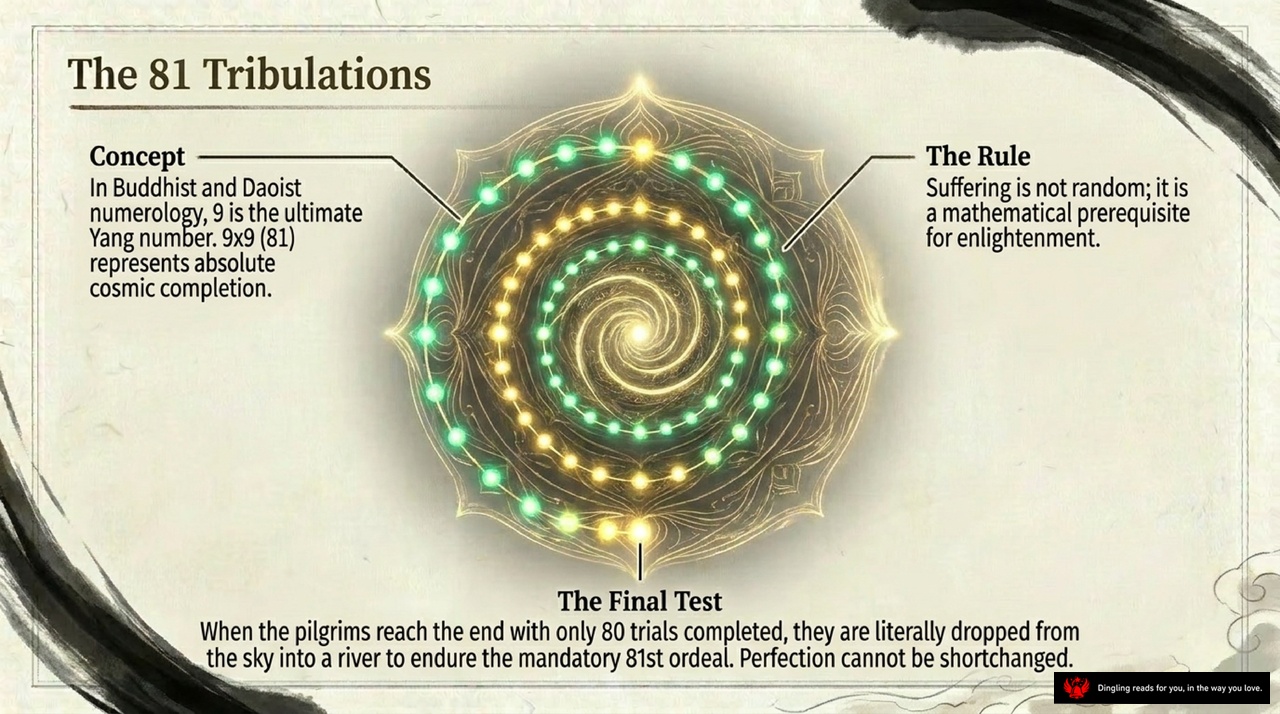
The journey of the Eighty-One Tribulations isn't just about numbers; it's a profound mathematical law of the universe. In the ancient wisdom of Buddhism and Daoism, the number nine represents the ultimate Yang energy, the peak of cosmic power. When you multiply nine by itself—9 times 9—you get 81. This isn't a random coincidence; it signifies absolute cosmic completion.
The image illustrates this perfectly: suffering is never accidental. It is not chaos; it is a precise, mathematical prerequisite for enlightenment. Just as a spiral must complete its full rotation to reach the center, the pilgrims must endure exactly 81 trials to achieve perfection. There is no room for shortcuts.
The final test is the most brutal proof of this rule. When the pilgrims reach the very end with only 80 trials completed, they aren't simply stopped; they are literally dropped from the sky into a raging river to endure that mandatory 81st ordeal. It is a harsh reminder that perfection cannot be shortchanged. You cannot skip the pain because you are close to the finish line. You must pay the full price of the journey to earn the ultimate reward.
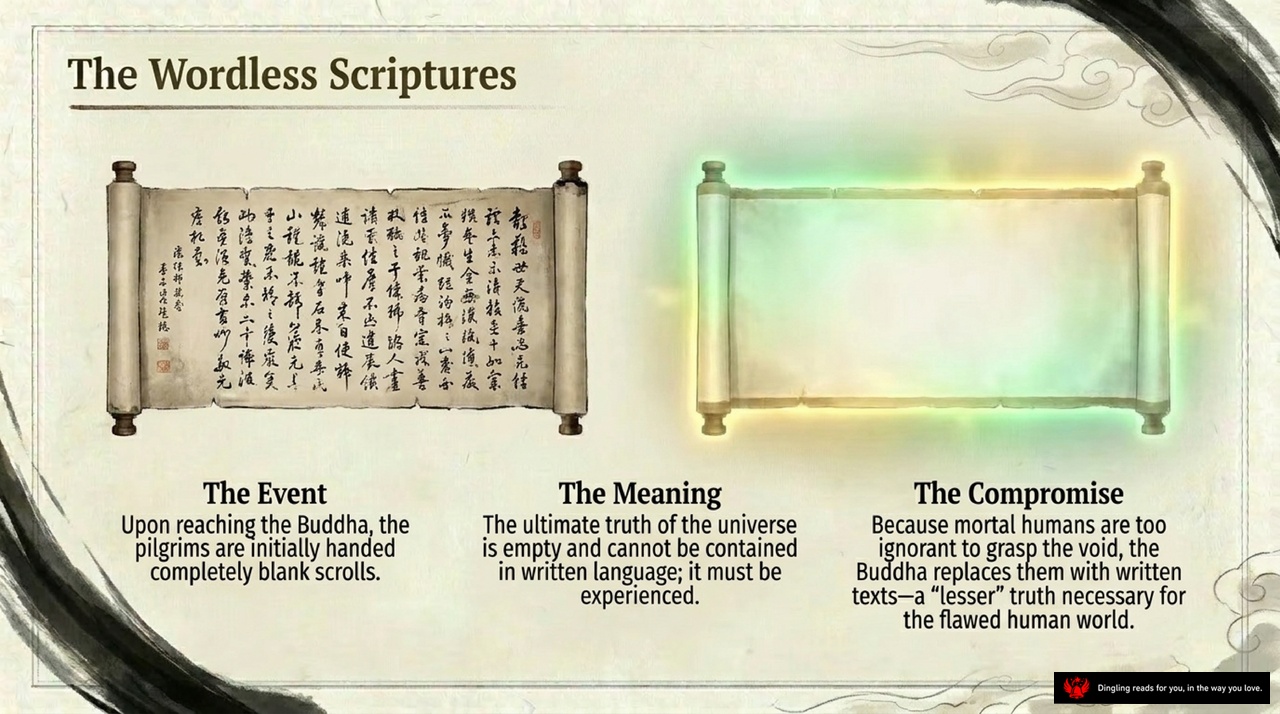
Picture shows two scrolls: one filled with ancient calligraphy, labeled "The Event," and one glowing blank, labeled "The Meaning." Below, it explains "The Compromise."
Let's dive into this profound concept of "The Wordless Scriptures."
In the beginning, when the pilgrims finally reached the Buddha, they were handed something unexpected—not a book, but completely blank scrolls. This wasn't a mistake; it was the ultimate truth. The Buddha taught them that the deepest reality of the universe is empty, vast, and beyond the limits of written language. You cannot capture the infinite in a few ink strokes; the truth must be experienced, not read.
But here lies the human dilemma. We are mortal, flawed, and often too ignorant to grasp the void on our own. We crave answers, structures, and stories we can hold onto. Because of this, the Buddha made a profound compromise. He replaced those blank scrolls with written texts. These scriptures are what we call "lesser truths"—a necessary, simplified version of reality designed specifically for the imperfect human world.
So, while the written word is our guide, we must remember that it is just a map, not the territory itself. The real journey begins when we step beyond the text and experience the silence behind the words.

The image illustrates the fascinating concept of "Syncretism of the Three Teachings," showing how Confucianism, Daoism, and Buddhism intertwine like a complex, inseparable knot. Confucianism represents the foundation of societal order, emphasizing duty, loyalty to the Tang Emperor, and filial piety. Daoism contributes the cultivation of vital energy, alchemy, and harmony with natural forces, seeking immortality. Buddhism brings the concepts of karma, reincarnation, and the ultimate goal of enlightenment. The central synthesis highlights that *Journey to the West* serves as a masterclass in integrating these often-competing ideologies into a single, unified cultural blueprint. This fusion reflects a unique Chinese worldview where spiritual paths, social responsibilities, and natural laws are not separate tracks but woven threads in the same tapestry, creating a holistic vision of life and destiny.
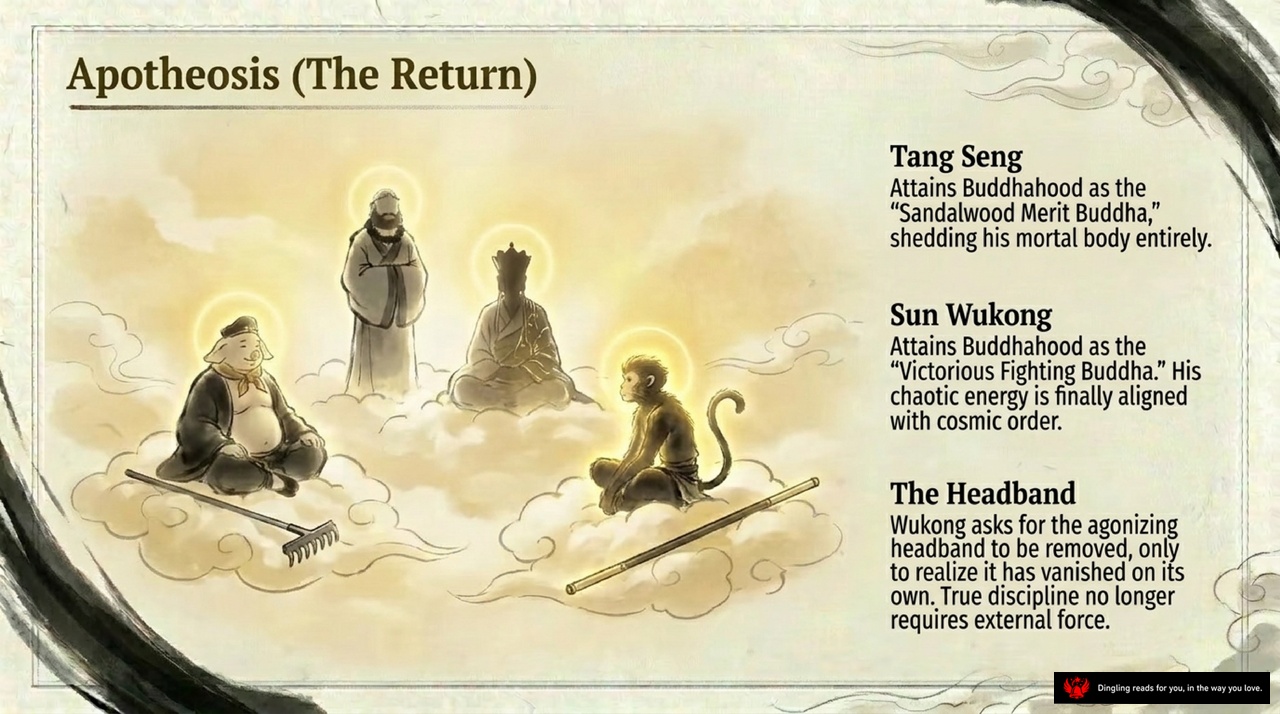
Apotheosis, or simply put, the ultimate return. After centuries of wandering, fighting, and surviving, the journey finally reaches its sacred conclusion. Look at the image: we see Tang Seng, Sun Wukong, and the others, all bathed in a golden light, having transcended their mortal forms. Tang Seng has fully shed his human body to become the Sandalwood Merit Buddha, while Sun Wukong, the Victorious Fighting Buddha, has finally aligned his chaotic, untamed energy with the cosmic order.
But the most profound transformation belongs to Wukong himself. Remember the agonizing headband that once controlled him? In this final moment, he asks for it to be removed, only to realize it has vanished on its own. This is the true meaning of discipline: it no longer requires external force. When you master yourself, no chains are needed. The journey is over, but the growth is forever.

The journey to the West isn't about crossing mountains and rivers; it's a harrowing pilgrimage to conquer the demons within our own minds. If your life is the journey, what is the golden headband you must outgrow to finally set yourself free?