
Just Kids: Complete Chapter-by-Chapter Summary
Welcome to "Just Kids," by Patti Smith. This is the story of two runaways who collided in the center of the world. Armed with nothing but their youth and an unbreakable vow to become great artists, they found each other in the chaos of New York City. Against all odds, they built a life of love, art, and relentless pursuit of their dreams. This is their story.

In the summer of 1967, two lost children collided in the center of the world, right as the city seemed ready to swallow them whole. On the left, you see Patty: escaping a stifling factory life in South Jersey, armed only with the poetry of Arthur Rimbaud to fight the weight of being a given-up child. On the right stands Bob: fleeing a rigid Catholic upbringing and military school expectations, quietly obsessed with the volatile beauty of aesthetics. They met on that old map of New York, amidst the chaos of Coltrane's death and national riots, finding each other just before the city could crush them. They were strangers who knew everything, two artists who didn't need words to understand the other's soul.

Opposing forces forged a perfect symbiosis. Think of it as the ultimate creative marriage between the written word and the visual image. On one side, you have the typewriter representing the world of words—poetry and music. This side is grounded, spiritual, and deeply drawn to the romantic struggle of the 19th century and the Beat Generation. They were often oblivious to trends, comfortable even in poverty, seeing art as a sacred act rather than a commodity.
On the other side sits the camera, symbolizing the realm of image—visual art and photography. This force is ambitious, obsessed with what we might call dark magic, and fiercely driven by social elevation. It was influenced by Catholic liturgy, S&M culture, and the glittering chaos of Andy Warhol's Factory. These creators were deeply aware of social capital, desperate for elite patronage, and constantly chasing the next big thing.
Yet, despite these starkly different drives and influences, they didn't just coexist; they created something far greater. She was the anchor, holding the center, while he was the sail, pushing forward into the unknown. Together, they formed a single, impenetrable survival unit. This tension between the spiritual, grounded poet and the ambitious, image-obsessed photographer wasn't a conflict; it was the very engine that drove their art forward, proving that opposites don't just cancel each other out—they create magic.
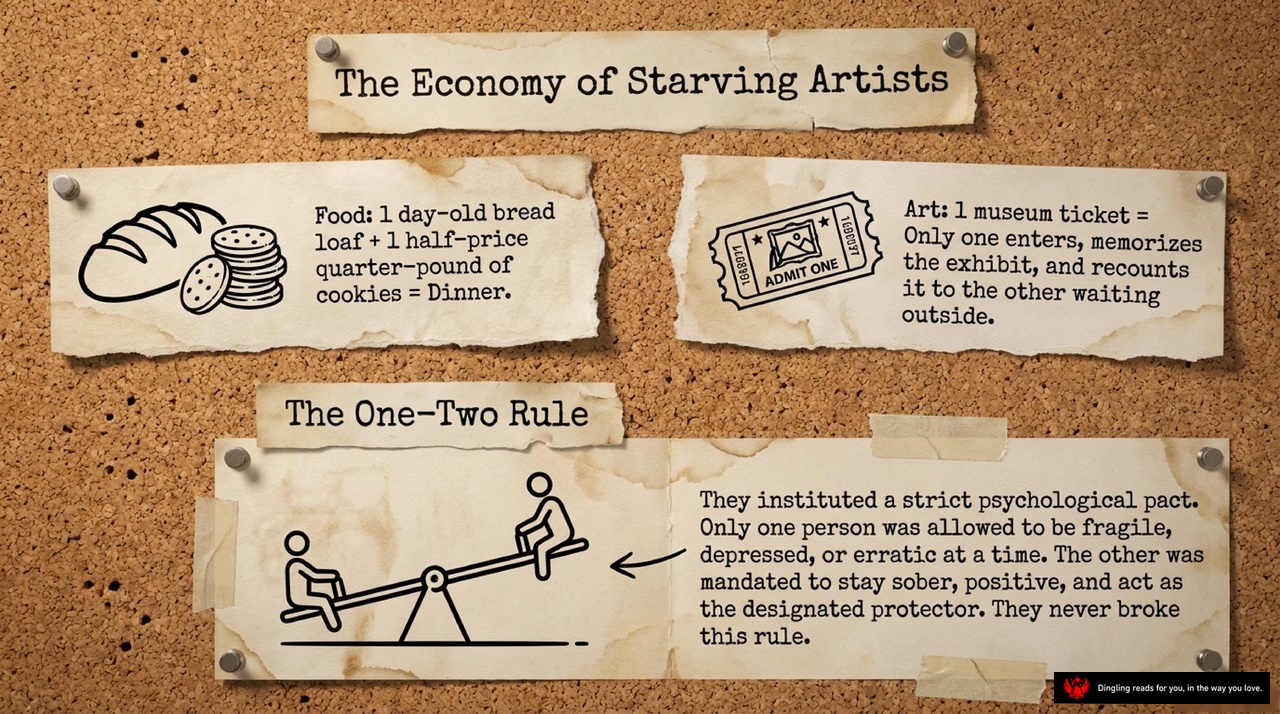
Imagine a world where creativity is a luxury few can afford, forcing artists to choose between their soul and their stomach. This is the harsh reality of the "Economy of Starving Artists," a theme that defined our early days. To survive, we had to get creative. Our dinner consisted of a day-old loaf of bread and a half-price quarter-pound of cookies—simple, cheap, and enough to keep us going. For art, we treated every museum ticket as a precious resource: only one of us would enter, memorize the exhibit, and recount it to the other waiting outside, maximizing our cultural experience with zero cost.
But survival wasn't just about food; it was about mental stability. We instituted a strict psychological pact known as "The One-Two Rule." Visualize a seesaw: only one person was allowed to be fragile, depressed, or erratic at a time. The other was mandated to stay sober, positive, and act as the designated protector. We never broke this rule. It was our lifeline, a fragile balance that kept us from being crushed by the chaos of our environment. While I dealt with the emotional storms, Robert stayed grounded, and vice versa. This dynamic allowed us to endure the struggle, turning our shared vulnerability into a source of strength rather than a weakness.

Look closely at these three objects. They aren't just random trinkets; they are the physical anchors of a spiritual vow between two souls. On the left, you see the Persian Necklace. Robert bought this at the bookstore where Patti worked. It represents their chosen fate and his early devotion. In the center lies the Zodiac Tambourine, a gift for Patti's 21st birthday. It symbolizes their shared rhythm and her emerging musical voice. And on the right is the Silver Bracelet, engraved with "Robert Patti Blue Star." It stands for their shared talisman and an unbreakable pact that they belonged to each other's destiny. These material anchors held them together through the chaos of their lives, proving that even when the world felt like it was falling apart, their connection was solid, tangible, and forever etched in silver, stone, and sound.
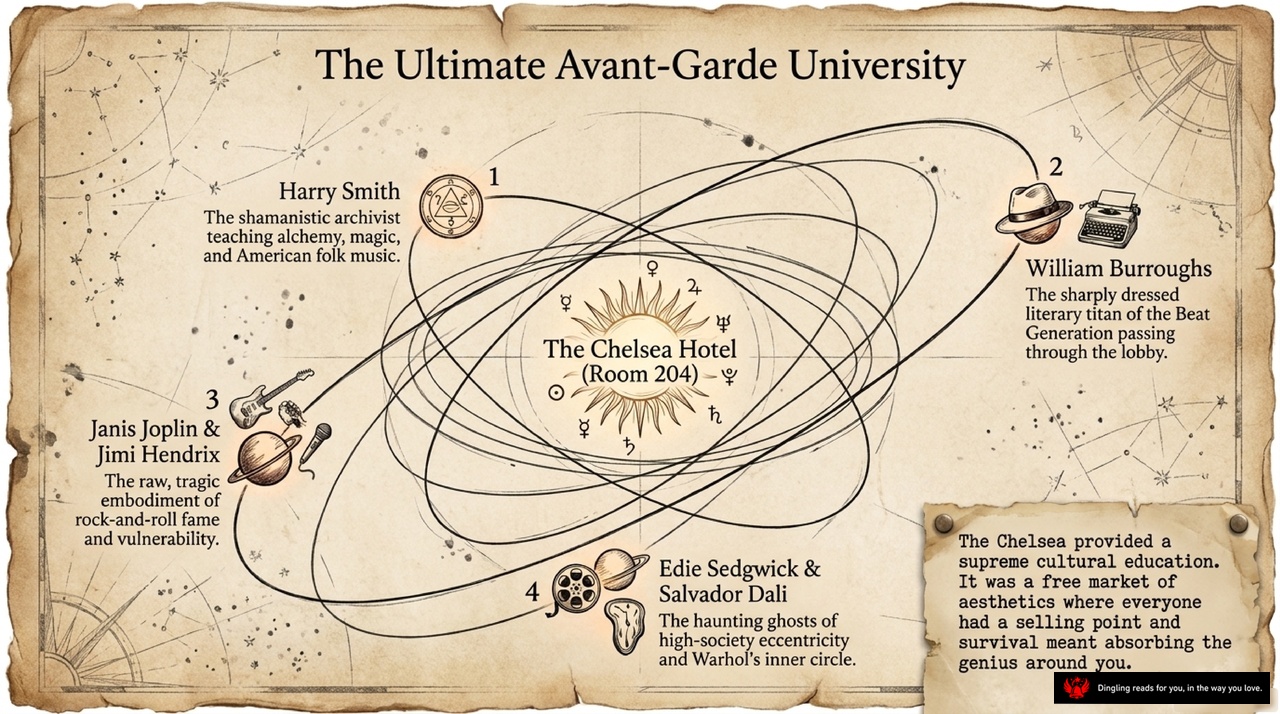
Imagine the Chelsea Hotel not just as a building, but as the ultimate avant-garde university, a chaotic ecosystem where genius and struggle collided in Room 204. Here, the walls were thin enough to hear the whispers of legends, but thick enough to protect the rawest ideas. At the center of this orbit was Harry Smith, the shamanistic archivist teaching alchemy, magic, and American folk music, acting as the spiritual anchor for everyone who passed through. Then there was William Burroughs, the sharply dressed literary titan of the Beat Generation, constantly passing through the lobby like a ghost from another world, challenging everyone with his sharp wit.
But the true heartbeat of this place was the raw, tragic embodiment of rock-and-roll fame and vulnerability found in Janis Joplin and Jimi Hendrix, who turned the hotel into a stage for their pain and ecstasy. Meanwhile, the haunting ghosts of high-society eccentricity and Warhol's inner circle, represented by Edie Sedgwick and Salvador Dali, danced in the shadows, pushing the boundaries of what art could be. It was a supreme cultural education, a free market of aesthetics where everyone had a selling point and survival meant absorbing the genius around you. In this electric atmosphere, you weren't just a guest; you were a student in the world's most unconventional classroom, learning that creativity is born from the collision of madness, music, and magic.

Look at this alchemical diagram: "The Alchemy of Transforming Chaos into Legacy." It maps how two distinct paths merge to forge something entirely new. On the left, we see the roots of Punk-Poetry: French Symbolist poetry like Baudelaire, the raw energy of Rock Music, and the gritty storytelling of the Chelsea Hotel. All of this funnels into one cauldron, culminating in the album *Horses*. On the right, a parallel process elevates photography from a secondary craft to Fine Art. It draws from Catholic iconography, the intensity of underground BDSM, and the pursuit of Warhol's elite social circles, pouring them into a second vessel to create pristine, respected art. This visual perfectly captures our journey. We didn't just mix genres; we took the chaotic, often taboo elements of our lives—the sex, the drugs, the art, the pain—and ran them through the fire of creativity. We didn't shy away from the darkness; we used it as fuel. Just like this diagram shows, our "chaos" wasn't a dead end; it was the essential ingredient for our legacy. We forged a new genre and redefined photography itself, proving that even the most fragmented pieces of our past could be transformed into something eternal and powerful.

The Inevitable Point of Divergence. Look at this split path. It captures the exact moment our lives, and the lives of so many artists, irrevocably separated. To fully self-actualize, we had to break the cocoon. We realized we could no longer serve as the sole universe for one another.
On the left, you see Patti's immersion into the raw, underground rock scene of CBGB, fueled by the energy of performing and writing hit songs like "Because the Night". She was diving deep into the noise and the rhythm, finding her voice in the chaos.
On the right, it's Robert's realization of his homosexuality, his pivot away from messy installations to the precise control of a camera, and his acquisition of wealthy art patronage (Sam Wagstaff). He was moving toward a different kind of structure, a different kind of power.
This wasn't a breakup; it was an evolution. We both had to grow into our own distinct worlds to truly become who we were.

In the late 1980s, as Robert Mapplethorpe succumbed to the AIDS epidemic, the dynamic of the "One-Two Rule" was invoked for the last time. He asked Patti for one final promise: "Write our story."
Patti Smith spent the next 21 years fulfilling this promise. While the flesh failed, the vow remained immortal, resulting in the creation of Just Kids.
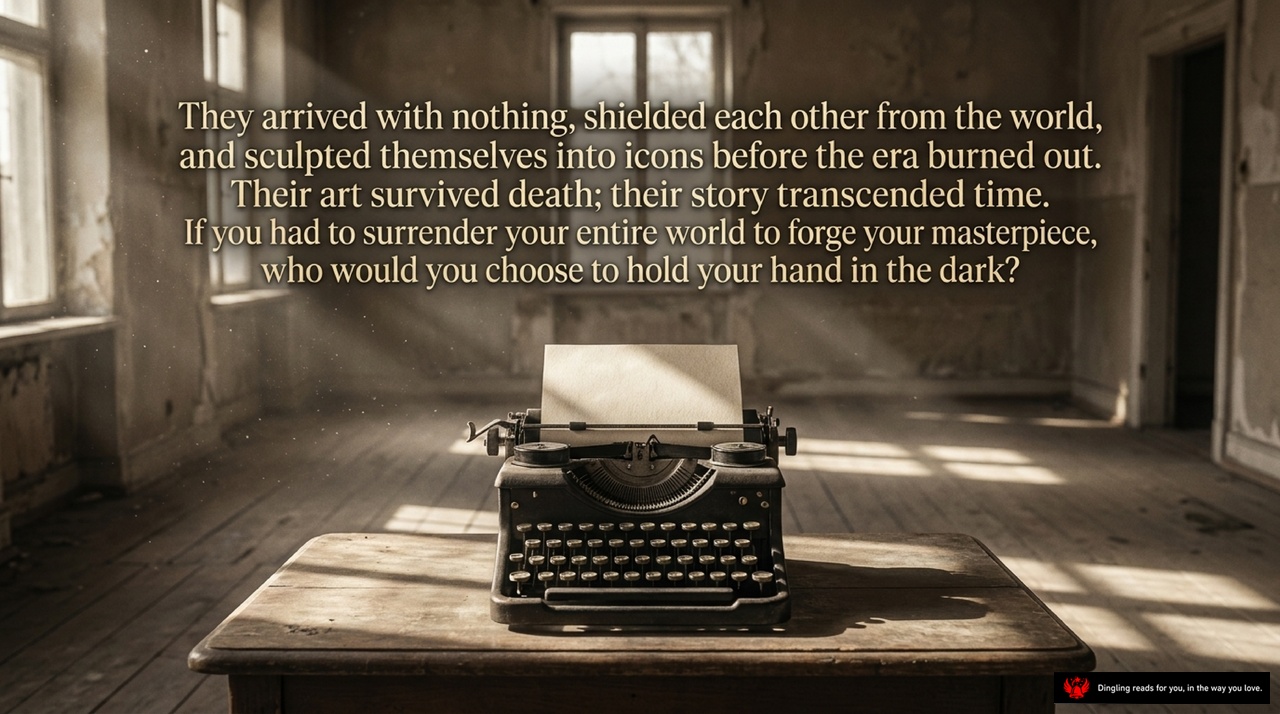
They arrived with nothing, armed only with each other and a fierce, unyielding belief in their own vision. In the dim light of a Brooklyn apartment, or later, amidst the chaotic energy of Chelsea Hotel, they sculpted themselves into icons before the era burned out. Their art survived death; their story transcended time.
Look at that old typewriter in the center of this image. It sits alone on a wooden table, bathed in the warm, dusty sunlight streaming through the windows. It represents the quiet, stubborn work of creation. If you had to surrender your entire world to forge your masterpiece, who would you choose to hold your hand in the dark? For them, it was each other. They were the anchor and the sail, the safety net and the launchpad. When the world felt cold and the path uncertain, they were the only warmth left. That is the power of true partnership—not just sharing a life, but sharing a destiny.