
King Solomon's Ring: Complete Chapter-by-Chapter Summary

Welcome to *King Solomon's Ring* by Konrad Lorenz. Imagine a misty forest where a lone wolf stands guard, watching over a hidden world of instinct and morality. This book is a naturalist's journey into the minds of animals, revealing the hidden evolutionary laws that govern how they live, connect, and even feel. Lorenz doesn't just observe creatures; he dives deep to show us that the strange behaviors we see—like a wolf's stance or a bird's call—are not random, but the result of millions of years of survival wisdom. It's a story about understanding the wild heart within every animal, and in doing so, discovering a mirror of our own humanity.

Look at this striking contrast. On the left, we see the "Illusion of the Cage." Captivity doesn't just restrict movement; it actively suppresses the natural diversity of highly intelligent creatures. When you turn smart animals like monkeys or parrots into depressed, mechanical shadows, you aren't just limiting their space; you are artificially shrinking their entire behavioral spectrum.
Now, look to the right. This is the "Observer's Ethos." To truly understand an animal's mind, it must be observed in complete freedom. Only in an unconstrained environment do these creatures reveal their full cognitive capacity and complex social hierarchies.
The core message here is profound: you cannot know the true nature of an animal by watching it in a cage. True understanding only happens when they are free to be themselves.

Look at this slide, and let's shatter the comforting myth that nature is "harmless." We often project our own moral goodness onto cute herbivores like the deer and dove pictured here, while painting predators as evil. But the reality is far more pragmatic. As the text reveals, nature's violence isn't malicious; it's strictly a matter of survival.
On the left, we see a peaceful-looking dove and a fawn. Yet, the text warns that if you confine these gentle animals with a rival, they will mercilessly peck each other to death. Their kindness is just a mask for a ruthless instinct to dominate. On the right, the scene shifts to the pond's microcosm. What looks like a serene water garden is actually a theater of brutal violence. The image highlights a beetle larva using its venom-injecting mandibles to attack a dragonfly. These larvae don't just bite; they inject digestive venom into living prey, liquefying their insides to drink the nutrients.
This graphic perfectly illustrates the author's point: the "gentle" animals we love are capable of extreme cruelty, while the "scary" predators are often just following the same primal rules. Nature has no concept of kindness or malice, only the pragmatic drive to survive.

We often laugh at the absurdity of animal behavior—chimpanzees mimicking us, chameleons changing colors, or pangolins stretching their tongues. But as the author reminds us, that laughter is often a mirror reflecting our own awkwardness. Those "weird" creatures aren't just acting silly; they are displaying the perfect, evolutionarily honed survival strategies that nature has crafted over millions of years.
Look at the Siamese Fighting Fish in the illustration. What appears to be a violent brawl is actually a highly ritualized dance of color and posture. These fish present their broadest side to intimidate, mirroring ancient human tribal dances. They aren't cold-blooded killers; their combat is governed by strict, innate symbolic codes. Similarly, notice the blue fish demonstrating "Head-Down Displacement." When conflict peaks, they freeze and perform displacement activities, like digging a nest, to redirect that aggressive energy.
The author argues that we should stop mocking these behaviors and start viewing them with awe. The chameleon's shifting skin, the pufferfish's inflation, and the anteater's snout are not quirks—they are brilliant adaptations. Even the playful antics of a cockatoo, like plucking buttons off a sleeping father, are part of a complex social language. By understanding the logic behind these actions, we realize that the "monsters" in our zoos are often just misunderstood experts in their own survival, teaching us that every strange trait is a masterpiece of life's greatest experiment.

So, let's talk about the "Jewel Fish's Dilemma." It's a fascinating snapshot of animal thought in action—a literal mechanical pause where a fish's brain has to solve a life-or-death conflict. Imagine the scene: the father fish has a mouthful of food, maybe a worm. Then, he spots a stray baby and instinctively scoops it in too. Now, he's holding both. This is where the real drama kicks in. Instinct A screams, "Swallow the food!" while Instinct B yells, "Protect the baby and spit it out!" The fish freezes, paralyzed by these clashing algorithms. But nature finds a resolution. The father spits both out, swallows the worm, and then safely scoops the baby back up to return it to the nest. It's a perfect example of how these creatures navigate complex moral choices in a split second.

The architecture of animal language is fundamentally different from our own. While humans use words to transmit specific ideas consciously, animals rely on innate emotional releases. Their sounds aren't vocabulary; they are automatic reactions to fear, joy, or stress, much like a human yawn. Look at the crow here: a fear trigger sends an involuntary signal, a physical release that others instantly understand without a single word.
But here's the real advantage for the receiver. Because animals lack spoken words, they evolved vastly superior subconscious receivers. Dogs and horses can read microscopic human muscle movements and emotional states that we often miss entirely. My German Shepherd, Tito, could sense my discomfort even when hidden under a table, and parrots like Gail could tell the difference between a real goodbye and a fake one. They don't just hear us; they feel us. While we try to teach birds to speak human words, nature has given them a deeper, more honest way to connect—one based on pure, unfiltered emotion.

Jackdaws: The Cultural Transmission of Fear. Have you ever wondered how a flock of birds can instantly identify a threat, even if they've never encountered it themselves? The image on your screen illustrates this fascinating process perfectly. It starts with a single bird observing an innate trigger—a black, dangling object. This isn't just a random sight; it's a specific signal that triggers an automatic response. The bird immediately emits a distinct, mechanical rattling alarm sound. This call acts as a broadcast, rippling through the air to reach every other member of the flock.
What happens next is truly remarkable. Through network transmission, young birds associate this alarm with whatever the flock is currently attacking. They are culturally learning their enemies without ever needing to survive a direct attack themselves. This is the power of cultural transmission. A single individual's experience becomes the shared knowledge of the entire group, ensuring that the next generation is prepared for dangers they might never personally face. It's a sophisticated system of survival, proving that even in the wild, wisdom can be passed down like a secret code, keeping the flock safe long before the threat appears.

Look at this diagram of the Avian Social Order. It reveals something fascinating about the Jackdaw hierarchy that completely flips our human assumptions. We often think of animal societies as simple pecking orders where the strongest bully the weakest, much like captive chickens where the lowest rank gets bullied by everyone. But the Jackdaw is different. It operates on a unique chivalric code.
Notice the pyramid structure here. At the very top sits the Alpha Jackdaw. Instead of terrorizing everyone, this Alpha actually protects the weakest members. There's a blue arrow labeled "Protection" flowing from the top down to the lowest members. The Alpha only shows aggression, marked by that red arrow, toward direct rivals. When disputes break out among lower-ranking birds, the Alpha intervenes to take the side of the underdog. It acts like a social arbiter, enforcing a kind of justice to maintain peace within the group.
This isn't just about dominance; it's about maintaining a stable, fair community. The higher you are in the rank, the more responsibility you have to protect those below you. It's a sophisticated system where power is used to safeguard the vulnerable rather than exploit them. This stands in stark contrast to our own complex social dynamics, reminding us that even in the wild, there are codes of honor and leadership that go far beyond simple aggression.

Look at this illustration of the water shrew. It perfectly captures a fascinating paradox about habit: a brilliant evolutionary shortcut that comes at a terrible cost.
As the text explains, this nearly blind creature navigates its world not by seeing, but by memorizing exact physical sequences. It's a system built on pure repetition. If you remove a stone from its path, the shrew doesn't pause to reassess the new reality. Instead, it blindly trusts its ingrained habit, jumping into the air at the exact same spot, completely ignoring the fact that the obstacle is gone.
This behavior is a double-edged sword. On one hand, it's a brilliant shortcut. By relying on muscle memory rather than constantly analyzing every new sensory input, the shrew moves with incredible speed and efficiency. It doesn't waste energy thinking; it just acts. But on the other hand, this reliance on habit completely sacrifices adaptability. In a stable environment, this works like a charm. But if the world changes—even slightly—the shrew's rigid programming can lead it straight into disaster.
This story of the water shrew is a powerful mirror for us. We often find comfort in our own routines, our "habit tracks." We trust what we know because it's safe. But just like that shrew, we risk becoming slaves to our own habits, sacrificing the ability to adapt when life inevitably shifts. The question is, do we value the speed of habit over the safety of flexibility?

The image on your screen breaks dogs down into two distinct lineages: the Wolf Lineage, known as *Canis lupus*, and the Jackal Lineage, or *Canis aureus*. This isn't just about breed names; it's about fundamental personality types that dictate how a dog lives its life.
On the left, we have the Wolf Lineage. Think of breeds like the Chow Chow or the Husky. These dogs are fiercely loyal to a single master for life, but they remain aloof with strangers. Their psychology is that of a fully mature, independent adult. They are highly stubborn and won't obey blind commands; they respect your leadership, but they retain their own autonomy. They are the guardians of the pack.
On the right, we have the Jackal Lineage, featuring dogs like the German Shepherd or the Wire Fox Terrier. These dogs treat every human they meet like a beloved uncle. They are eager to please, highly obedient, and wait for direction rather than making their own. Psychologically, they remain perpetually juvenile, retaining that puppy-like dependence forever. They are the ultimate companions who thrive on your approval.
Understanding this distinction changes everything about how you train and bond with your dog. If you want a loyal protector who thinks for themselves, you're looking at the Wolf Lineage. If you want a devoted partner who mirrors your every move and seeks constant guidance, the Jackal Lineage is your match. It's about choosing the kind of relationship that fits your lifestyle and your heart.
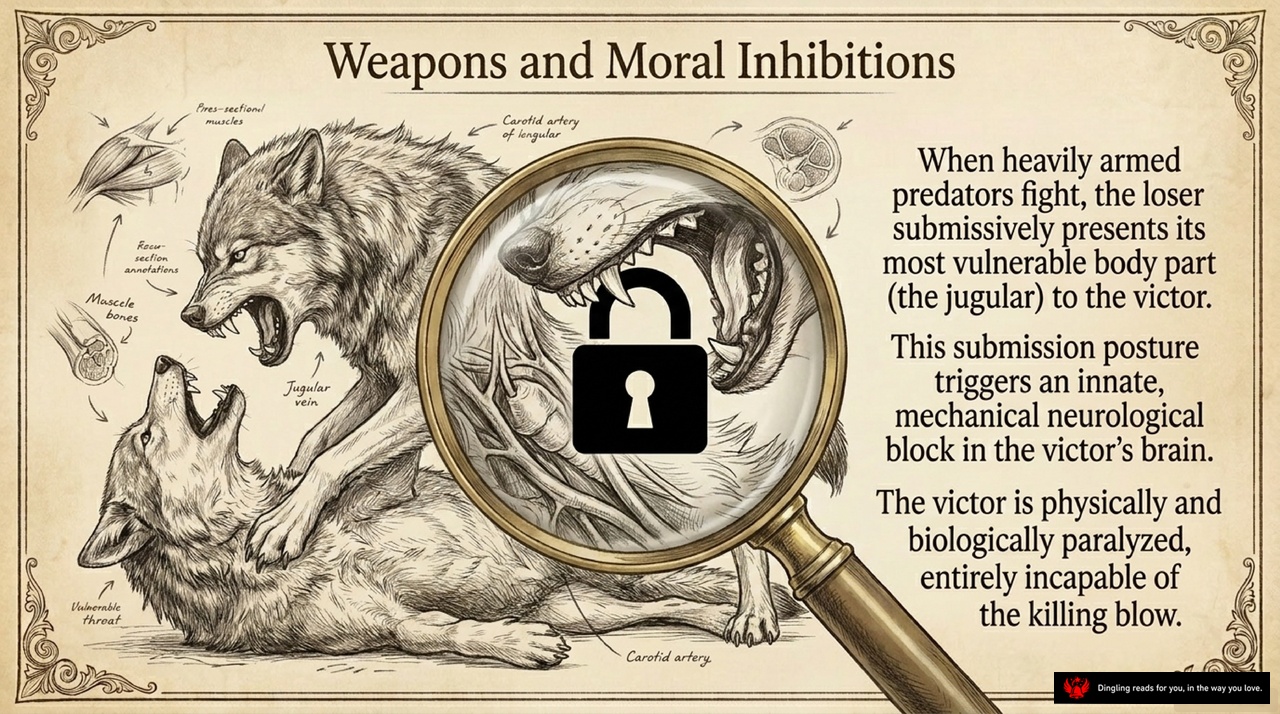
Look closely at this illustration. We see two wolves locked in a brutal fight, but the magnifying glass reveals something far more profound than simple violence. It highlights the concept of "Weapons and Moral Inhibitions."
In the animal kingdom, nature has built a sophisticated safety switch. When heavily armed predators like these wolves fight, the loser instinctively submits. It does this by exposing its most vulnerable body part—the jugular vein—to the victor. This isn't just a sign of weakness; it's a biological command. This submission posture triggers an innate, mechanical neurological block in the victor's brain.
The result is fascinating and crucial: the victor is physically and biologically paralyzed. Despite having the strength to kill, the winner is entirely incapable of delivering the killing blow. This is a hardwired rule of nature. The very weapons that could destroy the loser are simultaneously locked away, ensuring that the fight ends with a surrender rather than a massacre. It is a perfect, evolutionary solution to prevent the extinction of the species through internal warfare.

Welcome back to our deep dive into *The Soul of an Animal*. Today, we're synthesizing a powerful concept from the book: the evolutionary paradox that explains why some creatures are gentle in the wild but brutal in captivity.
Look at this matrix. It maps the relationship between an animal's natural weapons and its social inhibitions. In the bottom left, we see animals like doves, roe deer, and hares. They have low weapons and low inhibitions. Nature never needed to program them with a "mercy switch" because their defense is simply to fly away or run. They are harmless precisely because they can escape.
But look at the top right quadrant. Here we have wolves and ravens. These are the heavily armed predators with high lethality and, crucially, high social inhibitions. Nature *had* to program them with unbreakable rules of restraint. Why? Because if a wolf or a raven acted on every impulse, they would drive their own species to extinction by devouring their own kind.
This matrix explains a haunting reality: why harmless animals become brutal murderers when trapped. When you remove the freedom to flee, the "mercy switch" that allows prey to escape disappears, and their hidden aggression surfaces. Conversely, the heavily armed predators require those strict social codes to survive. Without them, chaos reigns.
As the book puts it, "Nature never needed to program doves with a mercy switch because their defense is simply to fly away." But for the predators, those inhibitions are the only thing keeping them from self-destruction. This isn't just about biology; it's a mirror for us. We, too, have built powerful weapons, yet we lack the instinctual brakes that wolves and ravens possess. Understanding this paradox is the first step toward understanding our own nature and the responsibility we carry.
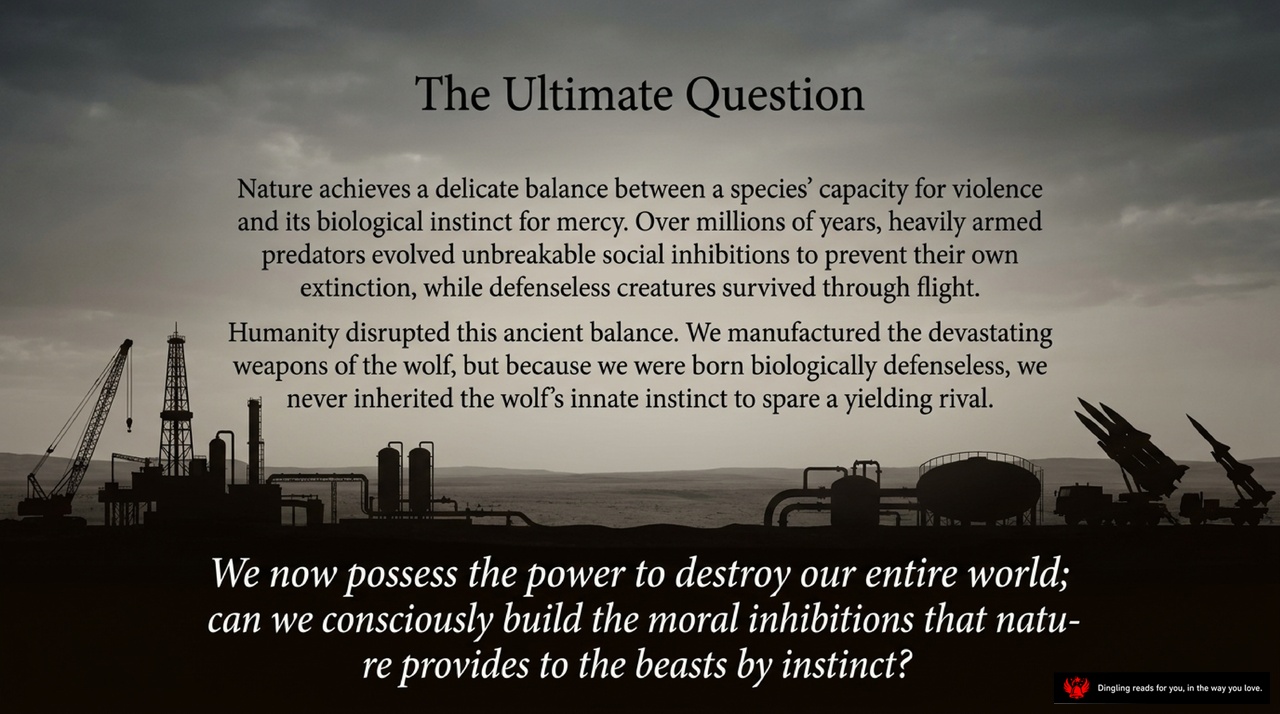
The image before us poses a hauntingly simple yet profound question: "The Ultimate Question." It asks us to look at the stark silhouette of our industrial world—oil rigs and missile launchers—and confront a terrifying reality. Nature has always maintained a delicate balance, teaching even the most violent predators to hold back. Over millions of years, heavily armed animals evolved unbreakable social inhibitions. They learned not to eat their rivals when they could have, preventing their own extinction. But humanity broke this ancient rule. We manufactured the devastating weapons of the wolf, yet because we were born biologically defenseless, we never inherited that wolf's innate instinct to spare a yielding rival.
We now possess the power to destroy our entire world. The question remains: can we consciously build the moral inhibitions that nature provides to beasts by instinct? Unlike animals, whose restraint is written in their DNA, our restraint relies entirely on fragile, learned rules. If we fail to forge this internal moral brake, we face a future where our own ingenuity becomes our undoing. The choice is not between good and evil, but between survival and self-destruction.