
Kitchen confidential_ adventures in the culinary underbelly(Anthony Bourdain,2000): Complete Chapter-by-Chapter Summary
Hey everyone, let’s get into something unapologetically real today—Kitchen Confidential by Anthony Bourdain. This isn’t your glossy, recipe-filled food book. Bourdain yanks back the curtain on the professional kitchen’s chaotic, brilliant, and deeply scarred underbelly. No filters, no sugarcoating—just the raw, unvarnished truth about what really goes down behind those restaurant doors. It’s wild, it’s intense, and it’s gonna make you see dining out in a whole new light. Let’s dive into this unfiltered ride.
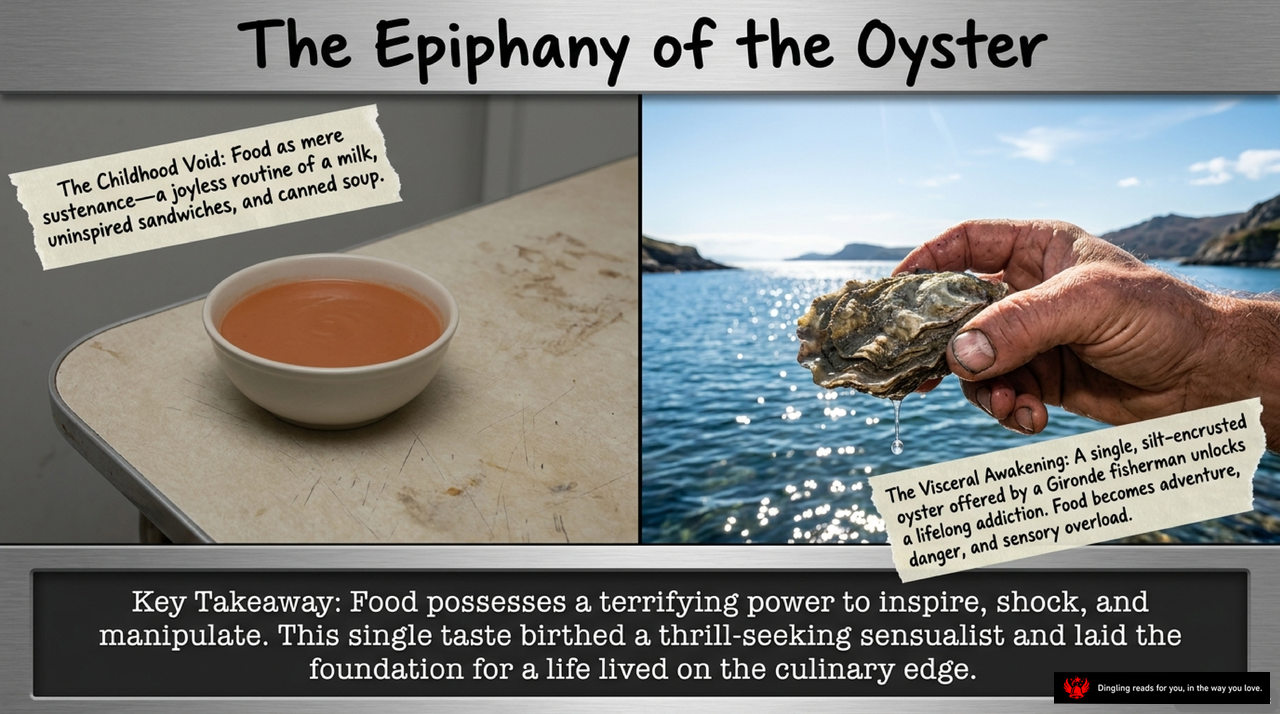
Let me paint a picture of my childhood food life—think the opposite of exciting. It was a joyless routine: cold milk from the fridge, sandwiches with boring fillings that tasted the same every day, and canned soup that came out of a can looking and tasting like nothing special. That’s the childhood void we’re talking about—food as mere sustenance, no spark, no joy, just something to get through the day.
Then came that summer when my family stayed in an oyster village along the Gironde coast in France. The neighbors were all fishermen, and one early morning, a guy named Saint-Julien invited me out on his boat. When we got back, he handed me a big, silt-encrusted oyster right from the bay. He pried it open with his knife, and I didn’t even think twice—I slurped it down in one go.
That taste? It was like nothing I’d ever experienced. Briny, sweet, with a hint of the sea’s wildness, and a texture that made my tongue tingle. It wasn’t just food—it was a visceral awakening. I felt like I’d been missing out on something huge my whole life. My parents hesitated, my brother backed away, but I was hooked right then and there.
That one oyster unlocked a lifelong addiction. Food wasn’t just fuel anymore; it became adventure, danger, sensory overload. I started hanging around the local oyster stalls, learning to shuck them myself, and even sneaking beer while I ate (don’t tell my parents). Every bite felt like a new discovery, a chance to push my senses further.
And that’s the key takeaway here: Food has this terrifying power to inspire, shock, and manipulate. That single oyster taste birthed a thrill-seeking sensualist in me, and laid the foundation for a life lived on the culinary edge. I was hooked, and I’ve never looked back—every meal since has been a chance to find that next big jolt.
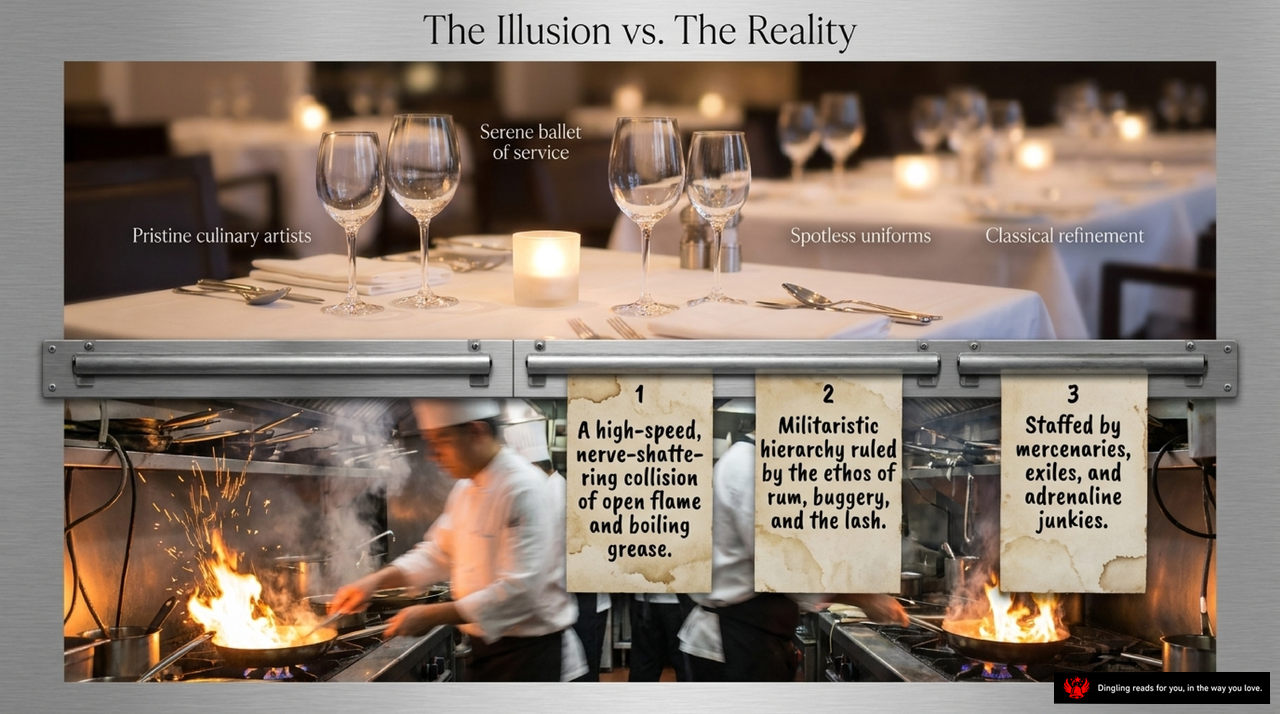
Ever step into an upscale restaurant—white linens, crystal glasses, servers gliding so smoothly they look like they’re dancing—and think, “This place is a picture of perfection”? That’s the illusion. The reality? It’s a wild, chaotic ride behind those swinging kitchen doors.
Up front, you see the “pristine culinary artists” in crisp, spotless uniforms, a “serene ballet of service” that oozes classical refinement. But back in the kitchen? It’s a high-speed, nerve-shattering collision of open flame and boiling grease. Imagine a room where every second counts, where pans sizzle so loud you can barely hear yourself think, and where one wrong move can send a dish crashing to the floor.
This world runs on a militaristic hierarchy—ruled by an ethos that’s part rum, part chaos, and part tough love (the kind that makes you step up or get out). The crew? A mix of mercenaries who show up for the paycheck and never miss a beat, exiles who couldn’t hack the 9-to-5 grind of regular jobs, and adrenaline junkies who live for the rush of a packed Friday night. These are the folks who don’t fit into the “normal” world—they find their tribe in the heat and noise of the kitchen.
They speak their own language (ever heard someone yell “86 that dish” or “fire the steak”?), laugh at jokes that would make your grandma blush, and turn raw ingredients into something amazing even when the pressure is through the roof.
So next time you take a bite of that perfect meal, remember: the illusion of elegance comes from a team of people working their tails off in a kitchen that’s anything but serene. It’s messy, it’s loud, and it’s absolutely real.
Let me take you back to my CIA days—not the spy agency, the Culinary Institute of America. Back then, it was all old-school French techniques, strict rules, and Chef Bernard yelling so loud you’d think he was trying to wake the dead. But the real chaos started when I teamed up with Dimitri for Mario’s private garden party.
We decided to go all out with classic French dishes—meat pies, pâtés, you name it. To pull off three straight days of non-stop prep, we relied on way too much cocaine and amphetamines. Dimitri was obsessed with perfection: he wanted to carve a Rousseau-style jungle into a ham, dot mushrooms with tiny circles, and once even suggested arranging a bass to look like Moses parting the Red Sea. I talked him out of that one, thank God. By the end, we were covered in aspic, passed out on the couch, and woke up covered in flies. Total disaster, but man, those dishes were perfect.
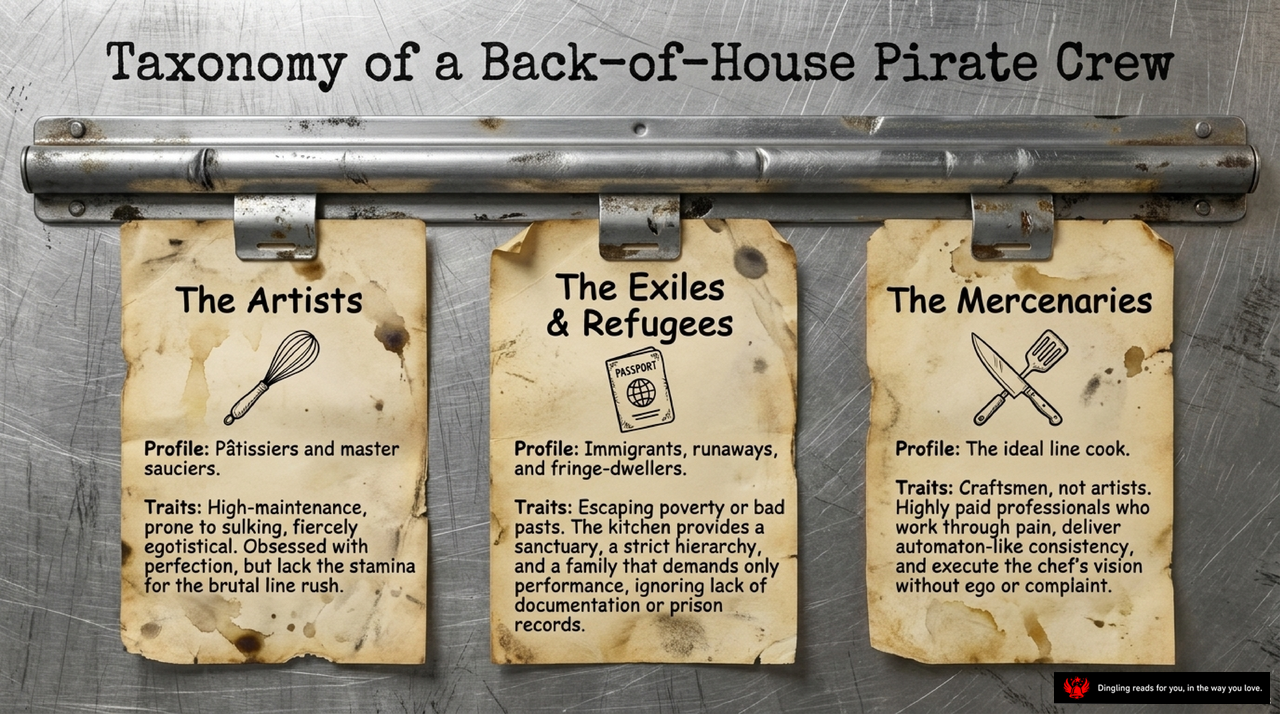
Now, let’s talk about kitchen people—three types, right? First, the Artists: pâtissiers and sauciers who’re geniuses but high-maintenance. They’ll sulk if their sauce isn’t exactly right, and forget about them during a rush—no stamina. Then the Exiles and Refugees: immigrants, runaways, folks escaping bad pasts. The kitchen’s a sanctuary for them—strict hierarchy, no questions about papers or records. And my favorite: the Mercenaries. These line cooks show up on time, do the work, no ego. They’re craftsmen, not artists, and execute the chef’s vision without complaining. You want a reliable team? Hire mercenaries.
Oh, a rule you never break: Mise-en-place. Your station’s your zone—don’t touch someone else’s prepped ingredients, salt, or tools. A messy station means a messy mind, and I’ve seen chefs lose it over a messed-up meez.
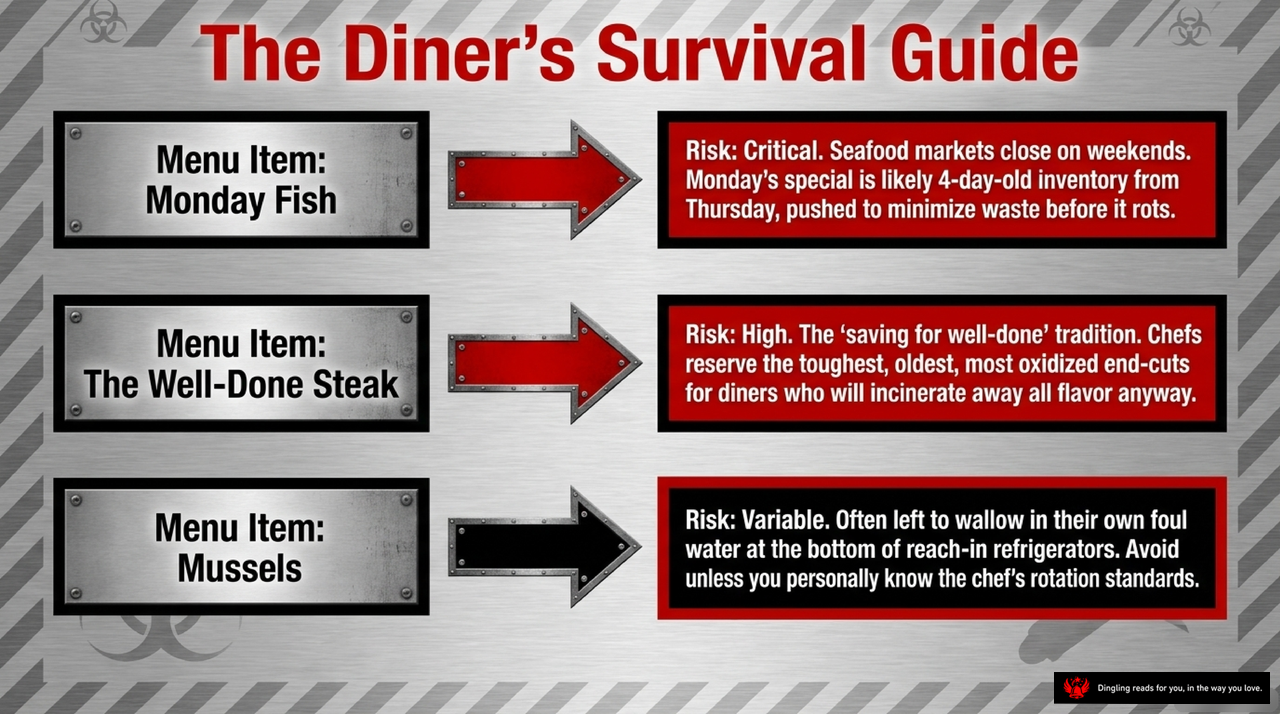
One last tip: Skip fish on Monday. Most restaurants get fish Thursday/Friday, sell it over the weekend, and whatever’s left goes to Monday. Unless you’re at Le Bernardin, it’s probably not fresh. Trust me, I’ve been there.
Kitchen life’s messy, chaotic, full of characters—but that’s why I love it. Every day’s an adventure, and you never know what’s next.
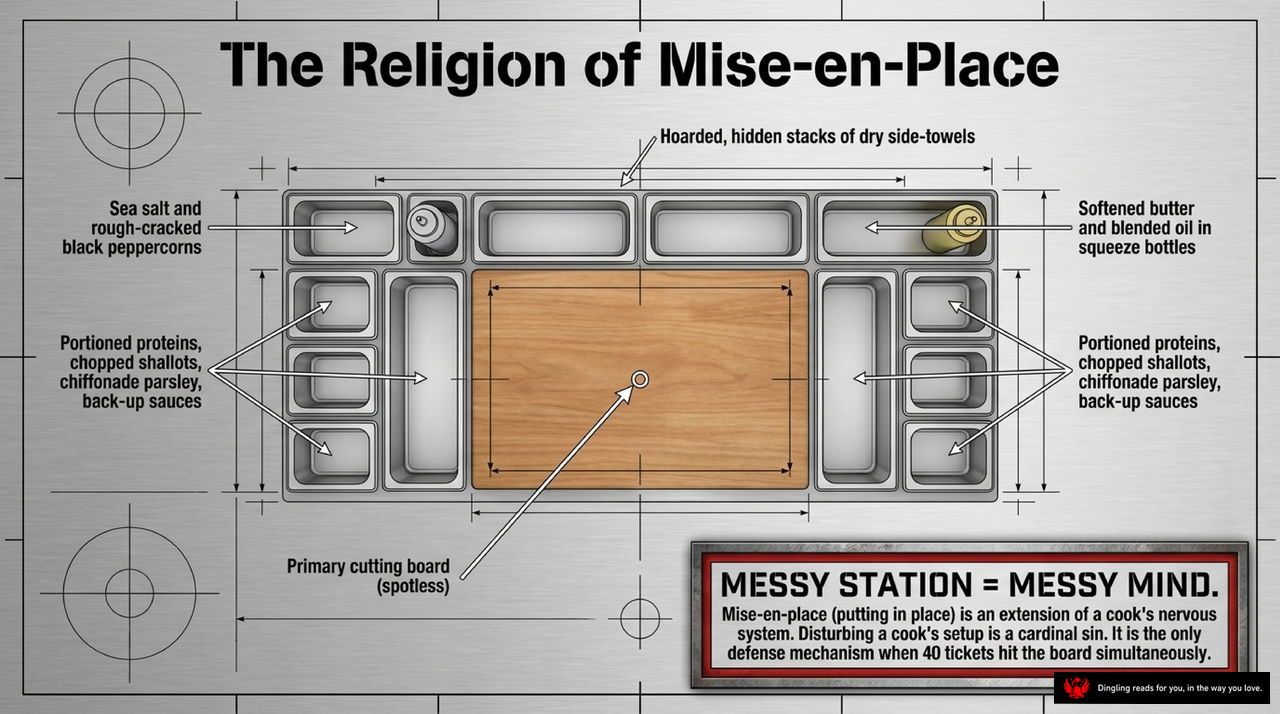
Let’s dive into the religion of mise-en-place—this isn’t just some fancy French jargon; it’s the beating heart of every pro kitchen. Look at this station diagram: every single thing has its purpose and place. Sea salt and rough-cracked pepper right where you can grab ’em without thinking, portioned proteins and chopped shallots prepped and ready to go, softened butter in squeeze bottles for quick, precise drizzles, and that spotless primary cutting board? It’s non-negotiable.
And those hoarded dry side-towels? Pros know wet ones burn your hands when you reach for a hot pan, so they stash extra dry ones like they’re hiding a secret weapon.
Now, that red box says it all: Messy Station = Messy Mind. This isn’t just a catchy slogan—it’s a hard truth. Mise-en-place is an extension of a cook’s nervous system. When 40 tickets hit the board all at once, your setup is your defense. You don’t have time to rummage for a spice or fumble with a cluttered cutting board.
Here’s a cardinal rule: never touch someone’s meez—their personal setup. It’s like walking into someone’s office and rearranging their desk without asking. Disturbing a cook’s setup is a sin in the kitchen world.
Every element here matters: the pre-portioned ingredients, the organized tools, the clean space. It’s not about being OCD; it’s about survival. When the kitchen gets loud, the flames get high, and the orders stack up, your mise-en-place keeps you grounded. It’s how you turn chaos into a smooth, efficient dance.
So next time you see a chef’s station looking like a well-oiled machine, remember—it’s not just tidy. It’s their religion, their armor, and their way of making sure every dish comes out perfect, even when the heat is cranked up to 11.
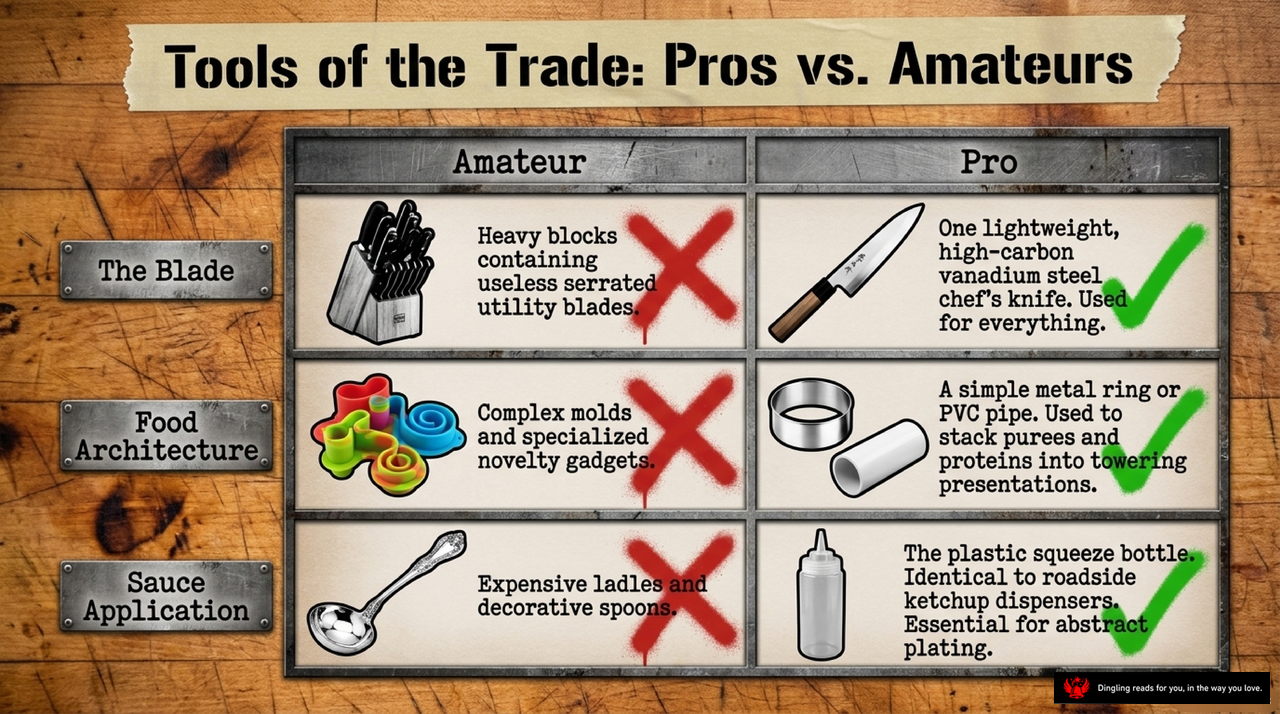
Let’s dive into Tools of the Trade: Pros vs. Amateurs—because the gear you choose isn’t just about looking cool; it’s about working smarter, not harder.
First, The Blade. Amateurs often stock up on those heavy knife blocks crammed with useless serrated utility blades that dull after two uses. But pros? We swear by one lightweight, high-carbon vanadium steel chef’s knife. Why? It does everything—chop veggies, slice steak, mince garlic, even break down a chicken. You don’t need a dozen blades cluttering your counter; just one well-sharpened chef’s knife is your right hand in the kitchen.
Next, Food Architecture. Amateurs love fancy molds and novelty gadgets to make their food look “professional,” but those things are more trouble than they’re worth. Pros keep it simple: metal rings or even PVC pipes. We use these to stack purees and proteins into those tall, eye-catching presentations you see at nice spots. No complicated tools—just a basic ring and a steady hand to build layers that wow.
Then there’s Sauce Application. Amateurs might splurge on expensive ladles or decorative spoons, but they’re messy and imprecise. Pros reach for the humble plastic squeeze bottle—the same kind you see at roadside hot dog stands for ketchup. These are game-changers for abstract plating: you can drizzle sauce in clean lines, dot it perfectly, or create intricate designs without smearing. It’s cheap, easy to clean, and essential for getting that polished look.
At the end of the day, being a pro isn’t about having the fanciest gear—it’s about knowing which tools actually work. Simplicity and functionality always beat flashy gadgets. So next time you’re in the kitchen, ask: is this tool helping me, or just collecting dust? Pros keep it simple, and that’s why we get the job done right.
Alright, let’s cut through the fluff and talk about what it really takes to survive—and thrive—in the culinary world. If you’re considering a career switch to cooking, let’s start with a reality check: Most cooking school grads bolt after their first week in a real kitchen. Why? Because it’s nothing like the glossy food shows. No 9-to-5 schedules, no weekends off, and forget the office-style dignity you might be used to. You’ll be pushed hard, and if you’re not fully committed, you’ll drag your team down.
But if you’re dead set on this path? Here are the non-negotiable rules I’ve learned over 25 years:
First, go all in. No half-measures. This is like joining the military—either you follow orders and learn to lead, or you get out. Second, learn Spanish. Most line cooks and prep staff speak it, and it’s not just about communication—it’s respect. You’ll earn their trust faster, and that’s everything in a tight kitchen.
Third, never steal. Not from the restaurant, not from suppliers. Stealing ruins your reputation, and once you take that shortcut, you’re done. Fourth, be on time—always. Punctuality is the first test of your professionalism. Fifth, no excuses. If you mess up, own it. Blaming others makes you look weak and untrustworthy.
And unless you’re bleeding out or a close family member is gone, don’t call in sick. The kitchen can’t afford to be short-staffed. Also, stay sharp: laziness, slowness, or being messy will get you shown the door faster than a burnt steak.
Lastly, keep a sense of humor. This job is chaotic, and if you can’t laugh at the spills, the burns, and the occasional kitchen drama, you’ll burn out fast. Every scar on your hands tells a story, and every rule here is meant to keep you standing in that kitchen for the long haul. Now, who’s ready to roll up their sleeves?
(Word count: ~390)
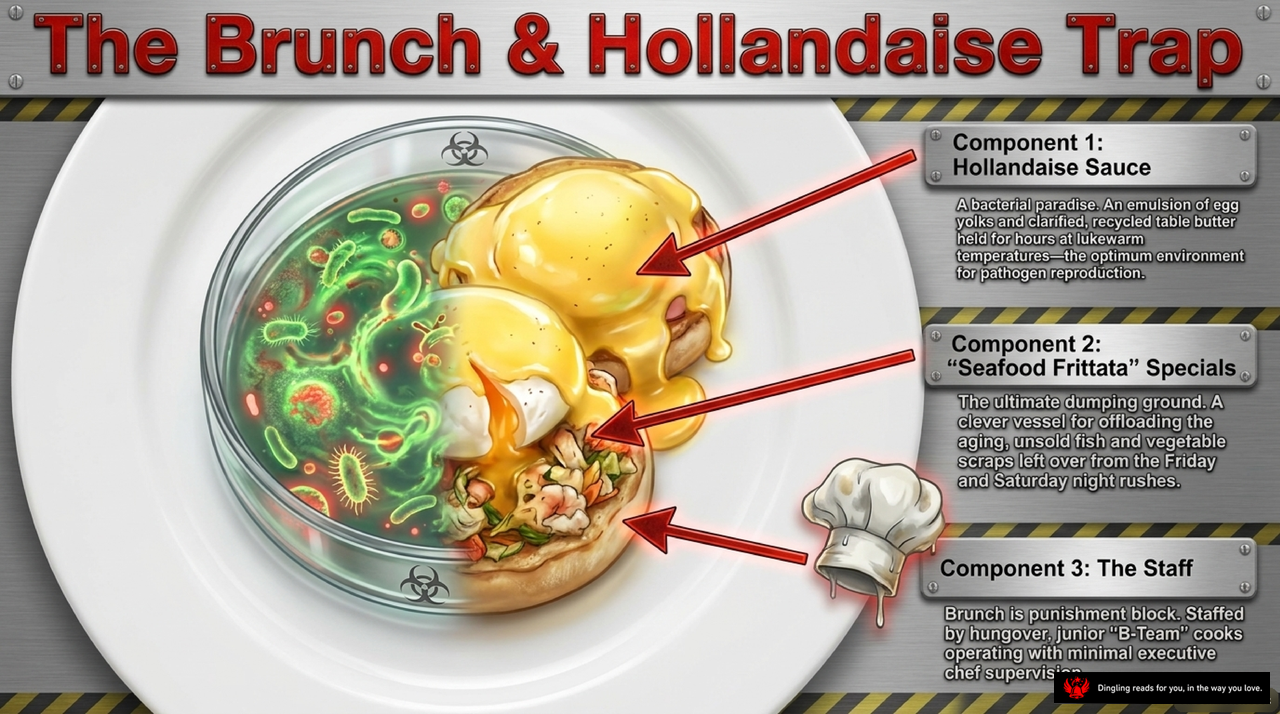
Alright, let’s dive into a brunch secret you might not want to hear—but definitely need to know: The Brunch & Hollandaise Trap.
First up, that velvety Hollandaise sauce you can’t resist slathering on your eggs Benedict? It’s a total bacterial paradise. Think about it: egg yolks mixed with clarified butter, kept at that lukewarm sweet spot where pathogens multiply like wildfire. That creamy goodness isn’t as innocent as it looks—you’re basically eating a germ-friendly environment on your plate.
Then there’s the “Seafood Frittata Special” that’s always front and center on the brunch menu. Sounds like a fancy, fresh treat, right? Wrong. It’s the kitchen’s go-to dumping ground for leftover seafood and veggies from the Friday and Saturday night rushes. They’re just trying to get rid of old stuff before it spoils—so that “special” is really a clearance sale on last weekend’s scraps. You never know what’s hidden in there.
And let’s not forget who’s behind the stove cooking your brunch. Brunch shifts are like punishment blocks in most kitchens. You’ve got hungover junior “B-team” cooks—usually the ones who drew the short straw—working with almost no supervision from the head chef. When you combine tired, unmotivated staff with leftover ingredients and a germ-friendly sauce? That’s a recipe for a potential stomachache (or worse).
So next time you’re scanning the brunch menu, maybe think twice before ordering that Hollandaise-drenched dish or the seafood frittata. Your gut will probably thank you later.
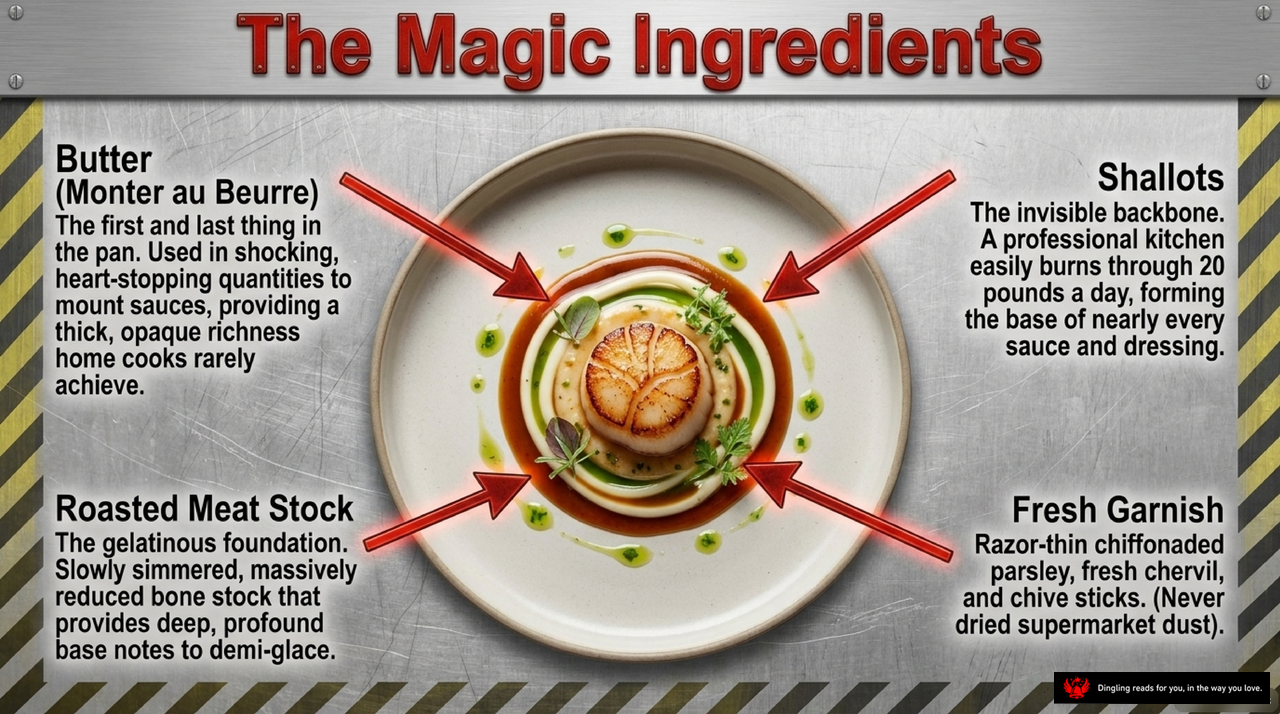
Ever taken a bite of a restaurant dish—say, that perfectly seared scallop with the silky, glossy sauce—and thought, “Why can’t I get this right at home?” The secret isn’t some top-secret recipe or a fancy tool. It’s in the four magic ingredients pros swear by, the ones you see on this slide.
First off: Butter, or Monter au Beurre as the pros call it. It’s the first thing that hits the pan and the last thing that goes into the sauce. Home cooks often hold back on butter, but pros use it in shocking, heart-stopping quantities. That’s how they achieve that thick, opaque richness you can never quite replicate with a little pat—no skimping allowed here.
Then there are shallots, the invisible backbone of almost every sauce and dressing. A busy pro kitchen can burn through 20 pounds of these a day. They add a sweet, subtle onion flavor that doesn’t overpower the dish—think of them as the quiet hero that ties all the flavors together without stealing the show.
Next up: Roasted meat stock, the gelatinous foundation. This isn’t your average store-bought bouillon cube. Pros slow-simmer bones for hours, then reduce the stock down to a concentrated liquid that gives demi-glace its deep, profound base notes. It’s the umami punch that makes every bite feel layered and complex, like a flavor hug.
And finally, fresh garnish—razor-thin chiffonaded parsley, fresh chervil, chive sticks. No dried, dusty herbs from the supermarket shelf here. That fresh, bright pop cuts through the richness of the butter and stock, making the dish feel balanced and alive, like a breath of fresh air in every bite.
These four ingredients aren’t flashy, but when used the way pros do? They turn a good home-cooked meal into something that tastes like it came from a five-star kitchen. It’s the little, intentional choices that make all the difference.
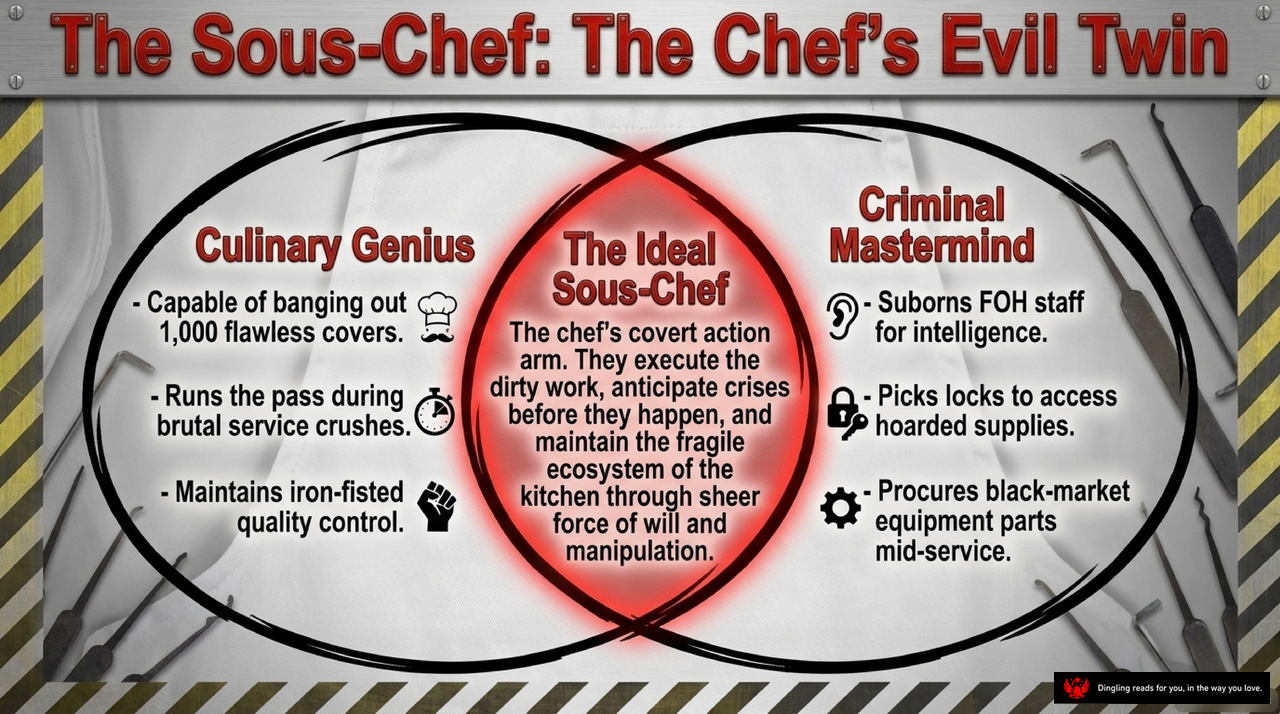
Let’s talk about the sous-chef—you know, the chef’s evil twin, right? This guy isn’t just a sidekick; he’s the kitchen’s covert action arm. He’s got two sides to him, like a culinary Jekyll and Hyde.
On one hand, he’s a total culinary genius. We’re talking someone who can bang out 1,000 flawless covers without breaking a sweat, run the pass during those brutal service crushes when every order’s piling up, and keep quality control on lock with an iron fist. My old sous-chef Steven? He once sliced his palm open cutting frozen meat, got 10 stitches, and was back on the sauté station 90 minutes later, handling 150 orders single-handed. That’s the genius side.
But then there’s the criminal mastermind part. Need a missing fridge key? He’ll take the door off its hinges. Out of blender parts mid-service? He’ll trade a bag of onions from another restaurant for a used one. Want intel on what the front of house is saying? He’ll buy the secretary a coffee and get all the dirt. He can pick locks to get to hoarded supplies, score black-market equipment parts when you’re in a bind, and even suborn FOH staff for info.
This guy is your secret weapon—he does the dirty work, anticipates crises before they blow up, and keeps the whole kitchen ecosystem running with sheer will and a little manipulation. You don’t just hire a sous-chef; you get a partner who’s part chef, part spy, and all essential. Without him, the kitchen would fall apart faster than a overcooked soufflé. He’s the glue that holds the chaos together, and let’s be real—you couldn’t run a serious kitchen without this kind of evil twin by your side.
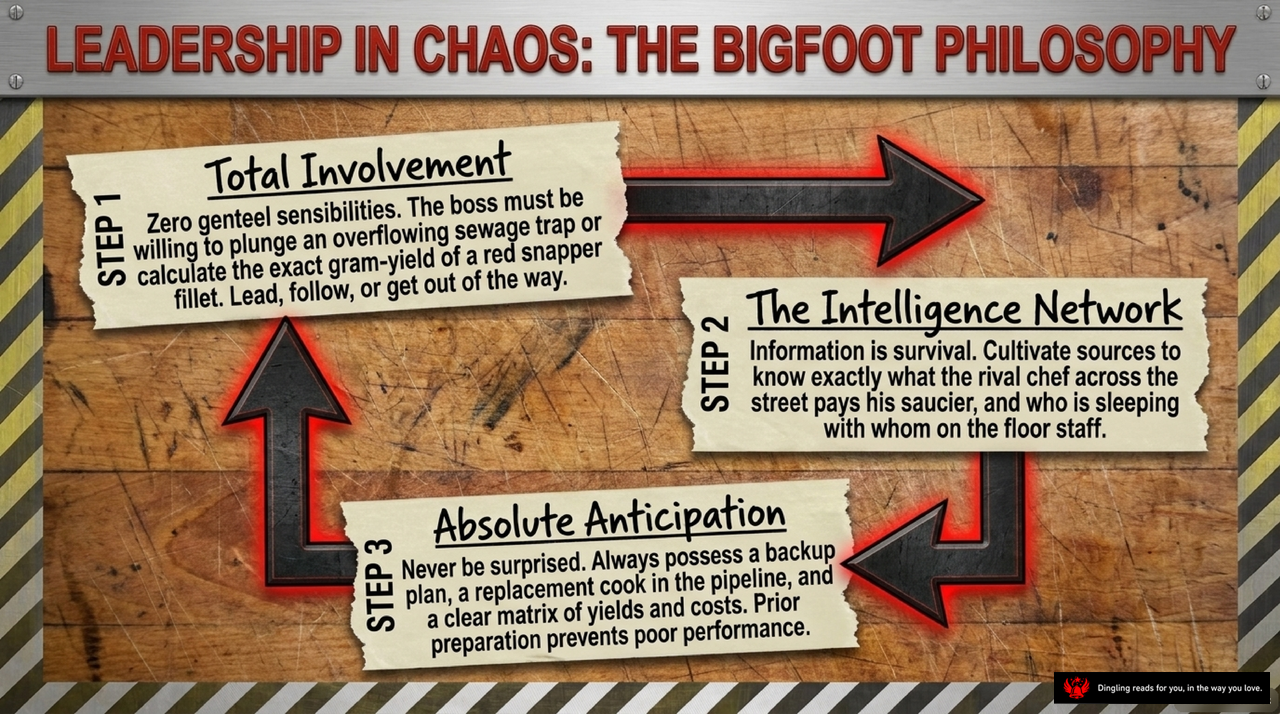
Let’s talk about how to thrive when everything feels like it’s falling apart—using what I call the Bigfoot Philosophy. This isn’t some fancy MBA theory; it’s street-smart wisdom from someone who’s been in the trenches.
First up: Total Involvement. Forget the idea that leaders sit back and delegate the messy stuff. Bigfoot’s rule here is no genteel sensibilities—you’ve got to get your hands dirty. That means plunging an overflowing sewage trap in the middle of a dinner rush if that’s what it takes, or calculating the exact gram yield of a red snapper fillet to make sure you’re not wasting money. There’s no “that’s not my job” here. You either lead, follow, or get out of the way—simple as that.
Next, The Intelligence Network. In chaos, information is survival. You need to know everything: how much the chef across the street pays their saucier (so you can keep your team from jumping ship), or who’s having a secret fling on the floor staff (to head off drama before it derails service). It’s not about being nosy—it’s about staying one step ahead. Cultivate sources, listen more than you talk, and keep your ear to the ground.
And finally, Absolute Anticipation. Bigfoot says you should never be surprised. Always have a backup plan: a replacement cook ready in case someone calls in sick, a clear matrix of yields and costs so you know your numbers cold, and a Plan B for when the power goes out or a supplier flaks. Remember that old saying? Prior preparation prevents poor performance. Chaos doesn’t care if you’re ready—but if you’ve planned ahead, you can turn it to your advantage.
These three steps aren’t just for kitchens. They work for any chaotic environment—whether you’re running a small business, leading a team, or just trying to keep your life on track. It’s about being present, informed, and ready for anything. That’s the Bigfoot way.
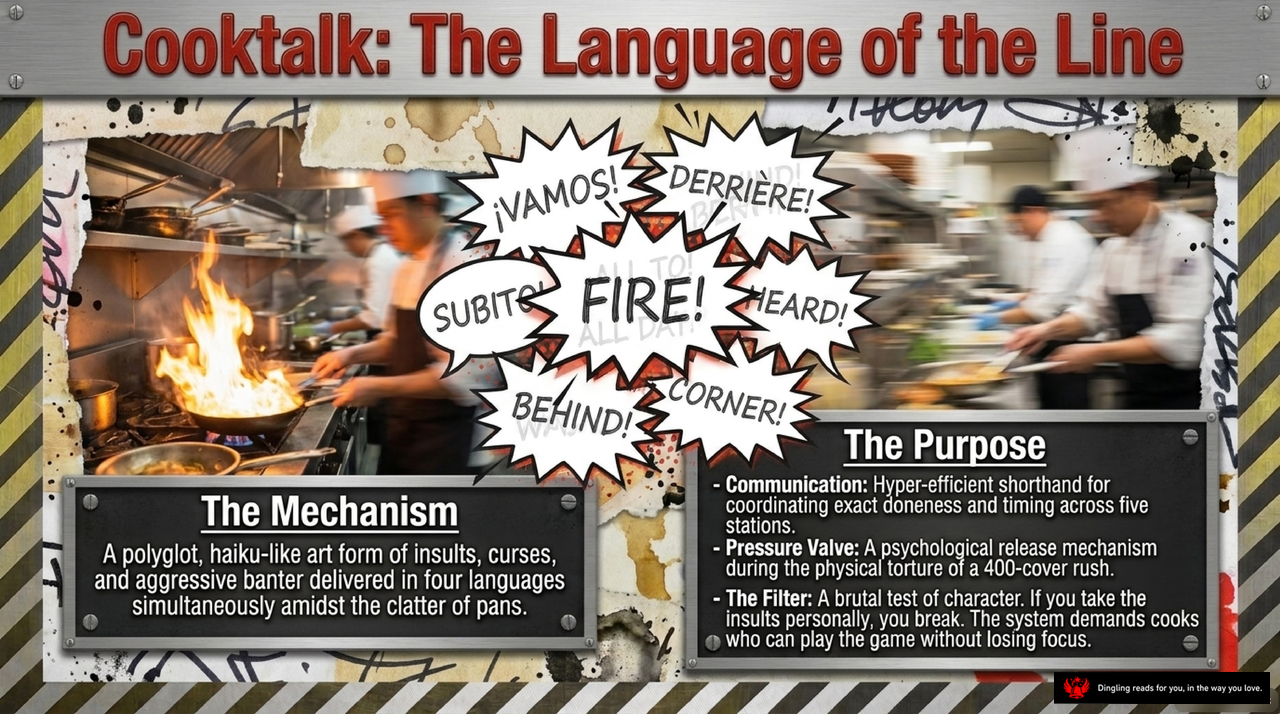
Let’s dive into Cooktalk—the wild, chaotic language of the kitchen line that’s like nothing else you’ve ever heard. It’s this polyglot, haiku-like art form: insults, curses, and aggressive banter all flying around in four languages at once, right in the middle of clanging pans and sizzling stoves. Think of it as a secret code only line cooks understand—raw, unfiltered, and weirdly poetic.
Now, why does this messy language exist? Three big reasons. First, it’s hyper-efficient shorthand for communication. When you’ve got five stations all working in sync, you need to coordinate exact doneness and timing fast. No time for long sentences—just quick, sharp phrases that cut through the noise.
Second, it’s a pressure valve. Imagine a 400-cover rush: the heat’s cranked up, orders are piling up, and every second counts. That banter? It’s a psychological release. You can’t scream at the customers, so you yell playful insults at your teammate instead—it keeps you from cracking under the physical and mental torture of the rush.
Third, it’s a filter—a brutal test of character. If you take those insults personally? You break. The system demands cooks who can play the game without losing focus. You’ve got to laugh off the “cabrone” or the “suck my dick” jokes (which, by the way, usually just mean “wait a sec”) and keep moving.
So next time you hear a line cook yell “Fire!” or “Heard!”—know that it’s not just chaos. It’s a well-oiled machine, a way to survive the madness, and a rite of passage for anyone who’s ever stood behind a hot stove. Cooktalk isn’t just language—it’s the heartbeat of the kitchen.
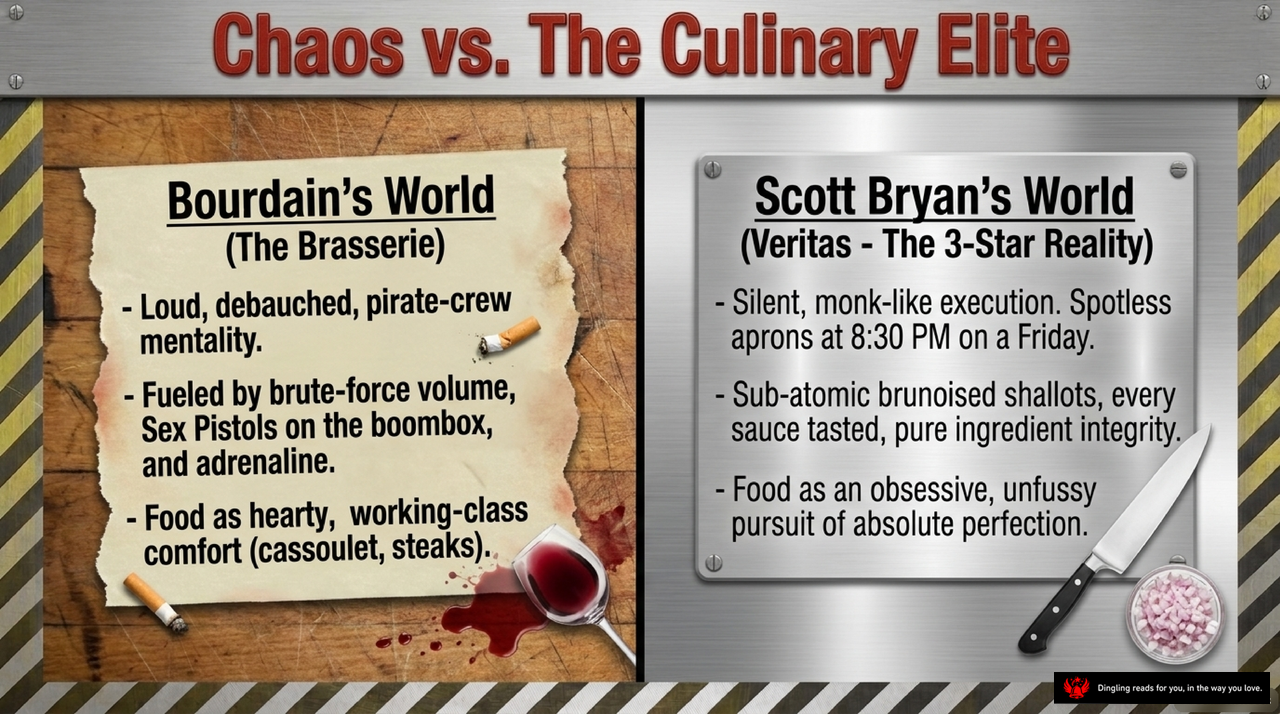
Let’s dive into two culinary universes that are polar opposites: Chaos vs. The Culinary Elite.
First up, my corner at The Brasserie. Picture this: a kitchen where the volume is cranked to 11, the Sex Pistols blare from the boombox, and the crew moves with the energy of a pirate ship mid-battle. We’re fueled by brute-force volume, adrenaline, and a “no prisoners” attitude—messy, loud, debaucherous, and unapologetically real. Our food? Hearty working-class comfort: slow-simmered cassoulet that’s been bubbling for hours, steaks with a crust that crackles when you cut into them, the kind of dishes that make you want to lick the plate clean. It’s not pretty, but it’s honest.
Now contrast that with Scott Bryan’s Veritas, a three-star temple of precision. Step into his kitchen, and the first thing you notice is the silence—monk-like, focused, almost reverent. Even on a Friday night at 8:30, when most kitchens are descending into controlled chaos, his team’s aprons are spotless. Every shallot is brunoiséd to sub-atomic perfection, every sauce is tasted and tweaked until it hits exactly the right note. Scott’s approach? Food as an obsessive, unfussy pursuit of absolute perfection. No flashy plating, no gimmicks—just pure ingredient integrity, executed with the kind of care that borders on devotion.
These two worlds couldn’t be more different, but they share one core truth: passion. Whether you’re yelling over the clatter of a brasserie or moving silently in a three-star kitchen, you’re putting your whole self into the dish. The chaos has its thrills, but Scott’s precision? It’s a masterclass in respect for the craft. At the end of the day, it’s not about noise or silence—it’s about being honest with the food, and that’s the magic of cooking. There’s no one “right” way to do it; you can be the pirate or the monk, as long as you mean it.
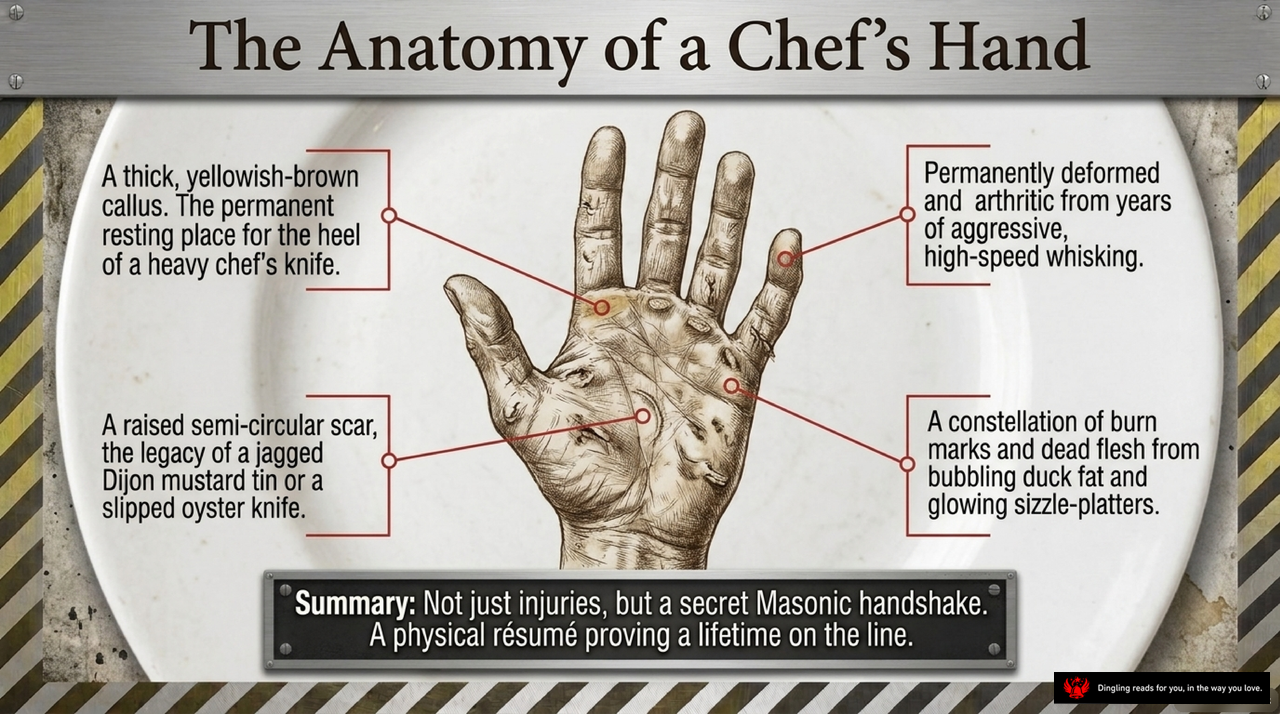
Look at this hand—this isn’t just a hand. It’s a chef’s unwritten resume, etched in calluses and scars like a map of every shift, every burn, every knife slip that didn’t take us out of the game. Let’s break it down.
First, that thick, yellowish-brown callus on the palm? That’s from years of resting the heel of a heavy chef’s knife there, chopping through mountains of onions, carrots, and celery before the sun even comes up. It started as a blister, then a hard spot, then a permanent part of who we are—our built-in cushion for the daily grind.
Then there’s that raised semi-circular scar. Maybe it’s from a jagged Dijon mustard tin we fumbled with in a rush, or a slipped oyster knife when we were tired and trying to keep up. One split-second mistake, and suddenly you’ve got a story to tell over late-night beers with fellow chefs.
Notice that finger that’s a little bent, maybe even arthritic? Blame the high-speed whisking—hours of whipping cream, egg whites, or hollandaise until your arm aches. Your hands don’t forget that repetition; they carry it with them forever.
And those burn marks? A constellation of tiny scars from bubbling duck fat splattering onto your wrist, or grabbing a glowing sizzle-platter without a towel (we’ve all done that, don’t lie). Dead flesh peels away, new skin grows back, and you keep going—because the line’s still moving.
But here’s the thing: These aren’t just injuries. They’re a secret Masonic handshake. When two chefs meet, we glance at each other’s hands and know immediately—you’ve been in the trenches. You’ve stood the heat, you’ve put in the 18-hour days, you’ve survived the chaos. This hand is a physical resume, proving a lifetime on the line.
Every scar, every callus, every bent finger—they’re not flaws. They’re badges of honor. They tell the story of every dish we’ve crafted, every service we’ve crushed, every late night we’ve spent chasing that perfect bite. This is what it means to be a chef. This is our story, written on our hands.
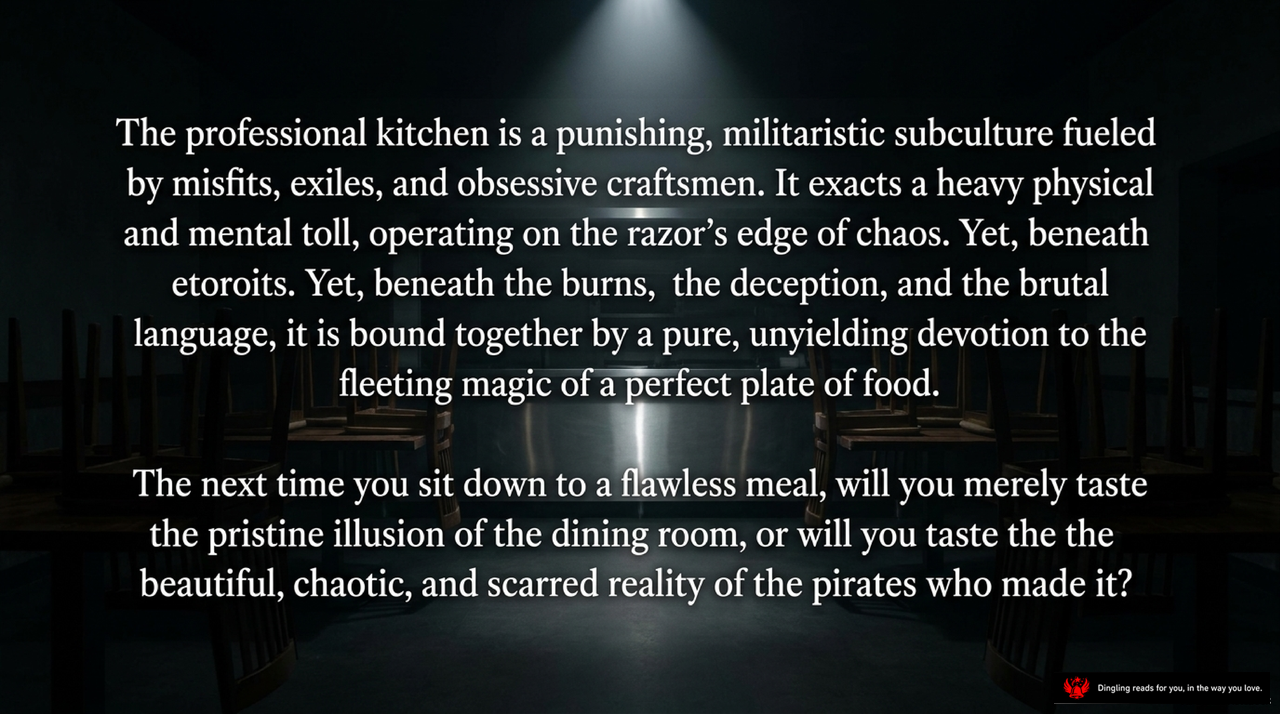
Let’s talk about what really goes on behind those swinging kitchen doors. The professional kitchen isn’t just a place where food gets plated—it’s a punishing, militaristic subculture. It’s full of misfits who don’t fit the 9-to-5 mold, exiles from other lives, and obsessive craftsmen who breathe their work.
This world takes its toll: physical scars from burns and cuts, sore feet from 12-hour shifts, and the mental weight of constant pressure to perform when every order feels like a race against chaos. But here’s the secret glue holding it all together—beneath the rough language, the occasional shortcuts, and the chaos—there’s a pure, unyielding devotion to that fleeting magic of a perfect plate.
You know that bite of food that makes everything else fade? The steak seared just right, the pasta with sauce that tastes like it’s been simmered for hours? That’s the magic they’re chasing, even when it means sacrificing sleep, comfort, or their own well-being.
So next time you sit down to a flawless meal—maybe at a fancy restaurant or a neighborhood spot that hits just right—will you only taste the pristine illusion of the dining room? The soft lights, the clean tablecloths? Or will you pause and taste the reality behind it? The chaos, the scars, the late nights, the “pirates” in the kitchen who fight, create, and pour their everything into that one plate.
It’s easy to forget the human story behind the food. But once you do, every bite tastes a little richer, a little more meaningful—because you’re not just eating a meal. You’re tasting the heart and soul of the people who made it.