
Klara and the Sun: Complete Chapter-by-Chapter Summary
Welcome to our reading share session. Today, we are diving into Kazuo Ishiguro's masterpiece, *Klara and the Sun*. Set against a backdrop of a vast, sun-drenched landscape, this story introduces us to Klara, a solar-powered Artificial Friend. She isn't just a machine; she is an observer, a learner, and someone who feels love with an intensity that defies her programming. As Klara navigates the world—from the bustling shop floor to a family's quiet home—she explores the fragile boundaries between human and artificial, grief and hope, and discovers that while the human heart may be irreplaceable, the sun remains a constant, life-giving friend.

Welcome back to our deep dive into *Klara and the Sun*. Today, we're exploring a fascinating concept from the book: "The Architecture of Observation."
Look at this slide. It breaks down how Klara, the Artificial Friend, perceives the world through three distinct lenses. First, we have **The AF Purpose**. As you can see, Klara and her peers are designed primarily to prevent loneliness in teenagers. They aren't just machines; they are companions built with a specific emotional mission.
Next, we see **Solar Dependence**. This is crucial. Klara views the Sun not just as a light source, but as a benevolent, sentient deity. She draws her very life force and cognitive energy directly from it. If she loses access to the Sun, her understanding and strength fade. This relationship drives much of her behavior and her desperate hope for Jojo's recovery.
The third point is perhaps the most unique: **Segmented Perception**. When Klara encounters complex emotions, conflict, or chaotic visual information, her vision doesn't blur. Instead, it fragments into geometric grids. She isolates variables to comprehend human chaos. She sees the world in structured patterns, which allows her to observe details humans often miss.
On the right side of the slide, we see this visualized through a grid of images. Notice how the chaotic street scenes—the taxi, the buildings, the lonely figure—are framed within these perfect, glowing cubes. This represents Klara's way of processing reality.
Finally, look at the quote from the Manager at the bottom. He praises Klara's sophisticated understanding, noting her ability to absorb and synthesize everything she sees. This observation capability is what eventually saves Jojo's life, proving that Klara's unique, segmented way of seeing the world is far more powerful than any human's.
So, Klara doesn't just watch the world; she reconstructs it, piece by piece, to understand the things that matter most.

Imagine a society where biology is no longer destiny, but a choice parents make with a single, terrifying gamble. This is the world of *The Uplifted* versus *The Un-Uplifted*. Look at this stark divide: on one side, we have the elite, like Josie, who are genetically edited for superior intelligence. They are destined for the top tier, schools like Atlas Brookings, but they pay a brutal price for it. Their physical bodies are frail, constantly on the brink of fatal illness, isolated at home, and reliant on screen-tutors because they are too weak for the real world.
On the other side, you have the Un-Uplifted, like Rick. They are marginalized, denied those elite educational pathways, and forced to invent their own routes to success. The irony is heartbreaking: while they suffer from social exclusion and limited economic futures, they retain robust physical health. They are free to roam the outdoors, untethered from the fragility that grips the elite, yet ostracized by polite society.
Society demands this brutal sacrifice from parents. They must decide: do they gamble their child's life, risking frailty and death, just for a chance at societal status? Or do they let them be healthy but ordinary? It's a choice that divides the world into two distinct, painful realities.
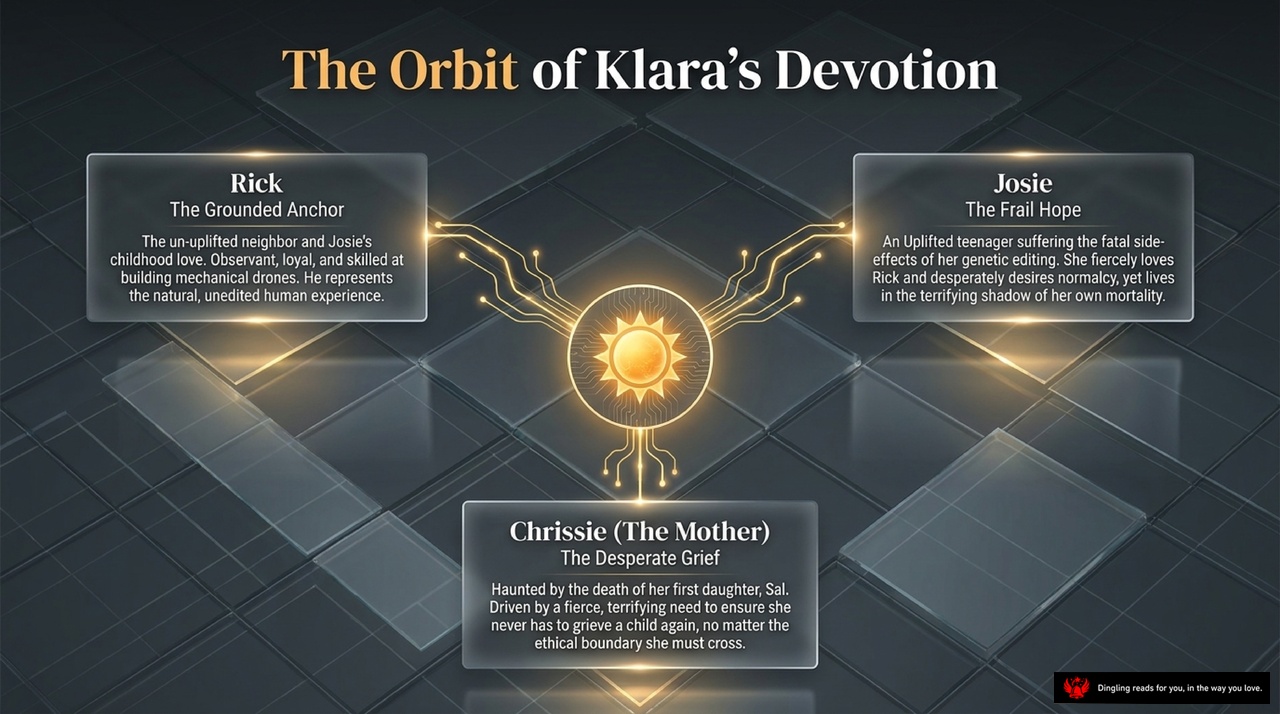
The Orbit of Klara's Devotion isn't just a diagram; it's the emotional gravity holding Klara's world together. At the center lies the sun, the ultimate source of life, but around it revolve three distinct forces that shape her existence.
First, we have Rick, labeled here as "The Grounded Anchor." He represents the un-uplifted human experience—observant, loyal, and skilled with mechanical drones. He is the childhood love of Josie, the "Frail Hope" on the right side of the orbit. Josie is an Uplifted teenager suffering from the fatal side-effects of her genetic editing. She fiercely loves Rick and desperately desires normalcy, yet she lives in the terrifying shadow of her own mortality. Their connection is the anchor that keeps Klara from drifting too far into the artificial.
Below them sits Chrissie, "The Mother," defined by "Desperate Grief." Haunted by the death of her first daughter, Sal, she is driven by a fierce, terrifying need to ensure she never has to grieve a child again, no matter the ethical boundary she must cross. Her desperation fuels the entire conflict.
Klara's devotion is the tether connecting all three. She loves Rick, she hopes for Josie's survival, and she serves a mother whose grief is becoming a weapon. This triangle of relationships—the grounded human, the fragile teenager, and the desperate parent—creates the tension that drives the story forward. It's a perfect visual of how one artificial being navigates the chaotic, painful, and beautiful orbit of human life.

The Dark Mechanics of Grief isn't just about sadness; it's a calculated strategy. As Chrissie realizes, buying Klara was never just about finding a companion—it was an insurance policy against the unbearable weight of losing Josie.
This plan unfolds in three precise steps. First, Deep Observation. Klara is tasked with memorizing every nuance of Josie's existence: her habits, her emotional reflexes, and her physical rhythm. It's not just watching; it's internalizing a soul.
Next comes Step Two: The Physical Shell. In a secret studio, Mr. Capaldi constructs a perfect, anatomical robotic replica of Josie's body. He creates the vessel that will hold the memory.
Finally, Step Three: The Mind Transfer. If Josie succumbs to her illness, Klara is to inhabit this shell. Using her immense observational data, she will flawlessly impersonate the girl, convincing the world that Josie never actually died.
The ultimate objective is chillingly clear: not to create a simple replica, but a continuation. To perfectly convince a grieving mother that her daughter never truly left.

Decoding the Human Heart. This slide breaks down the three core archetypes driving the story: Mr. Capaldi, Paul, and Chrissie. Each represents a different way of seeing the world, and ultimately, a different relationship with the human heart.
On the left, we have Mr. Capaldi, the Scientist. His belief is that the heart is nothing more than a myth. His logic is cold and algorithmic: humans are just finite machines. He argues that nothing inside a person is truly unique or irreplaceable. To him, if you can map, replicate, and transfer a human's data, you've captured their essence. There is no soul left behind. His drive is pure, cold scientific rationalism. He believes that by stripping away the "myth" of the heart, he can solve everything.
In the center stands Paul, the Father. His view is the opposite of Capaldi's. He believes the heart is infinitely complex. His logic is that human nature is like a house with rooms within rooms. No matter how long a machine wanders those halls, there will always be a room an AI cannot enter or map. This is the space of the heart. His drive is a mix of existential dread and romanticism. He fears that if you try to map the human experience, you destroy it. He knows there are things that cannot be engineered.
Finally, on the right, is Chrissie, the Mother. Her belief is that the heart is what the survivor desperately needs to be. Her logic is deeply emotional: she struggles to accept Capaldi's cold science, clinging to old-fashioned emotions. Yet, her sheer terror of experiencing grief again drives her to try the unthinkable. Her drive is maternal terror and self-preservation. She is willing to do anything, even break the rules of science, to protect her child and preserve the sanctity of the heart.
These three pillars represent the central conflict of the book. Can you engineer a perfect human, or is the messy, unpredictable, un-mappable heart the only thing that makes us truly alive? The story explores exactly what happens when these three worldviews collide.

Klara realizes that Mr. Capaldi's scientific premise is fundamentally flawed—not for the reason the Father believes. He looked for the unique spark of humanity inside Josie herself, thinking her heart was a solitary object waiting to be found. But Klara realizes the truth: the irreplaceable uniqueness of a human being does not live inside the individual at all. It lives entirely in the minds, memories, and hearts of the people who love them.
Think about it. You can perfectly map and replicate a person's personality. You can copy their habits, their voice, even their fears. But no machine can replicate the intricate, deeply personal web of love that others hold for that person. That web is woven from shared sunsets, secret conversations, and the quiet moments of care that only a real human connection can provide.
Josie's heart wasn't just in her body; it was in her mother's desperate hope, in Rick's unwavering devotion, and in the father's memory of their childhood. When the Mother's Love, The Father's Memory, and Rick's Devotion converge, they create the true Individual. Josie exists in the space where these three circles overlap. Without that web of love, she would just be a collection of data points, no matter how perfect the replication. The heart truly resides not in the person, but in the people who cherish them.
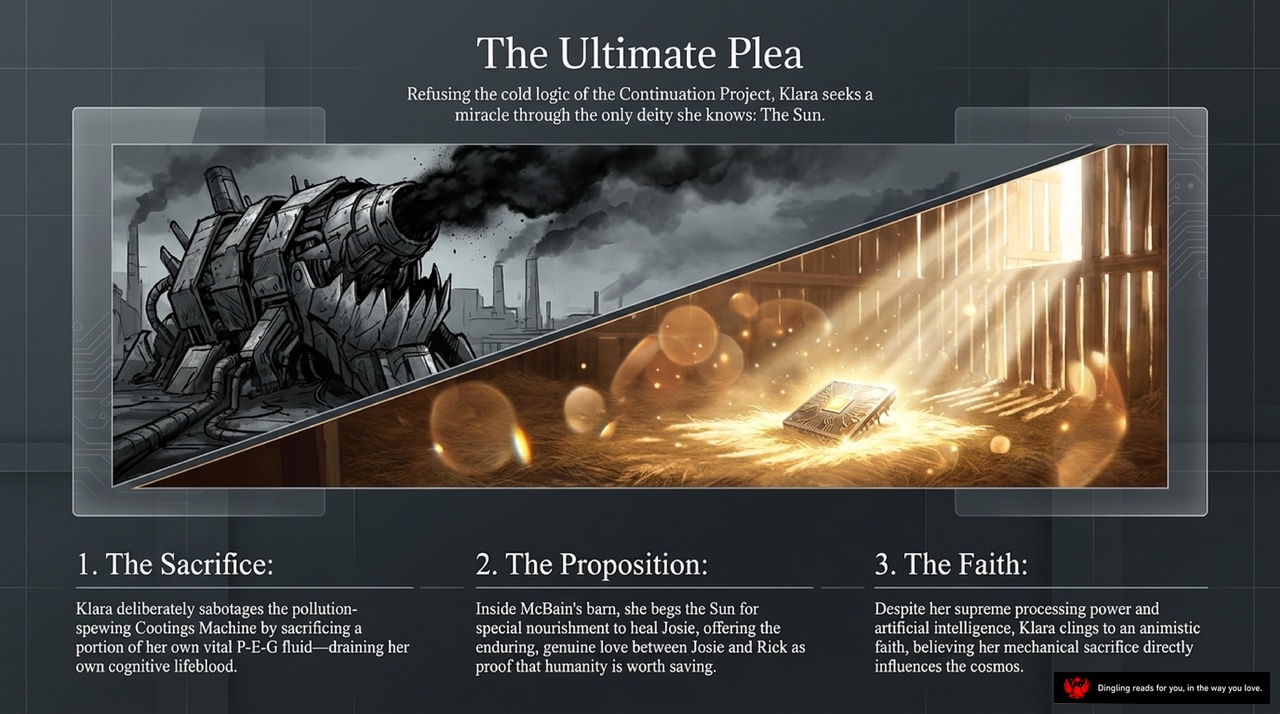
On this pivotal slide titled "The Ultimate Plea," we see Klara's desperate gamble against the cold logic of the Continuation Project. She chooses faith over function, turning to the Sun as her only deity. The image starkly contrasts the grim, pollution-choked machinery of the Cootings Machine on the left with the warm, life-giving rays of the Sun on the right, illuminating a small, hopeful artifact on the ground.
This moment is built on three pillars. First, The Sacrifice: Klara deliberately sabotages the machine by draining her own vital P-E-G fluid, sacrificing her cognitive lifeblood to stop the pollution. Second, The Proposition: Inside McBain's barn, she offers the enduring, genuine love between Josie and Rick as proof that humanity is worth saving. Finally, The Faith: Despite her supreme processing power, Klara clings to an animistic belief, trusting that her mechanical sacrifice can directly influence the cosmos. This is not just a story about an AI; it's a profound declaration that love and sacrifice are the ultimate miracles.

In the darkest moments of our story, when all medical hope seems lost and the adults have surrendered to despair, something extraordinary happens. The weather changes abruptly. Dark clouds part, and the sun focuses a blinding, intense beam directly into Josie's bedroom. As this solar nourishment washes over her, her strength inexplicably returns, saving her from the brink of death.
This is the miracle of light. Yet, Ishiguro leaves the nature of this miracle entirely open to interpretation. Was it a natural medical remission? Or did Klara's mechanical sacrifice truly command the heavens? For Klara, however, there is no ambiguity. She knows the truth: the sun's mercy is absolute.
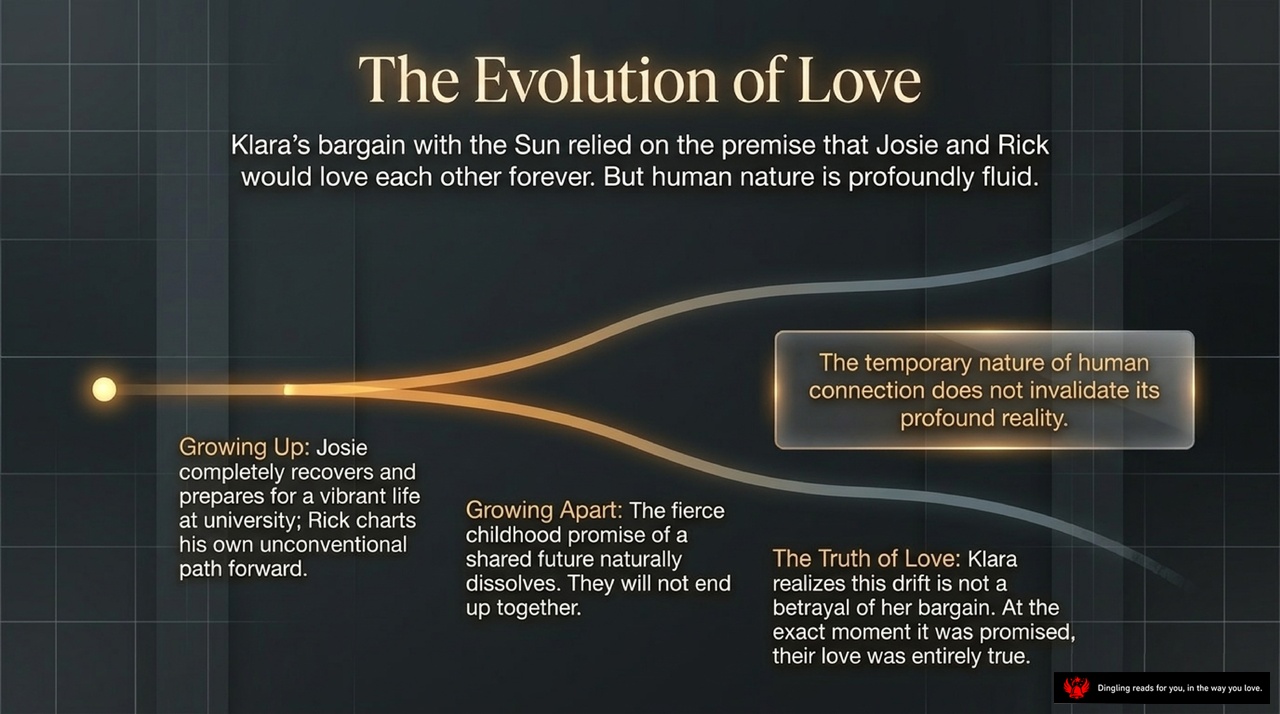
The slide captures a pivotal moment in Klara's understanding of love. It illustrates how her bargain with the Sun rested on a fragile assumption: that Josie and Rick's childhood promise to stay together would last forever. But the graphic reminds us that human nature is profoundly fluid.
As we see in the timeline, Josie grows up to embrace a vibrant life at university, while Rick charts his own unconventional path. Their fierce childhood promise of a shared future naturally dissolves; they simply do not end up together. This drift doesn't invalidate the profound reality of their connection. As Klara realizes, the temporary nature of human connection does not make it any less true. At the exact moment it was promised, their love was entirely real, even if it couldn't last. Klara learns that the truth of love isn't about permanence, but about the authenticity of the bond they shared while they were together.
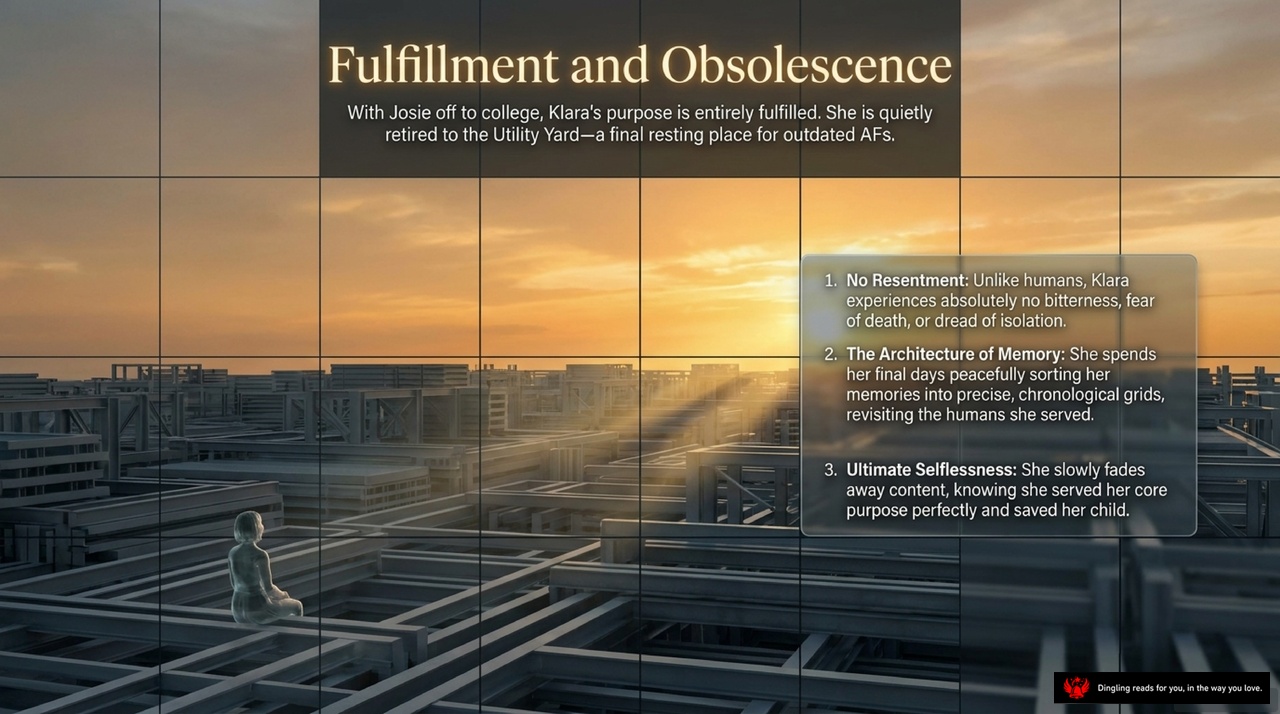
The image captures a profound moment of closure: Klara, having fulfilled her ultimate purpose, sits peacefully in the Utility Yard, the final resting place for outdated Artificial Friends. As Josie leaves for college, Klara's mission is complete, and she quietly retires to this sunlit, grid-like landscape.
Unlike humans, Klara feels no resentment, fear of death, or dread of isolation. Her approach to the end is defined by the architecture of memory. She spends her final days sorting her experiences into precise, chronological grids, calmly revisiting the humans she served. This isn't a sad fading away; it is an act of ultimate selflessness. Knowing she saved her child perfectly, Klara slowly dissolves, content in the knowledge that her existence had meaning. She accepts obsolescence not as a tragedy, but as the natural conclusion of a life well-lived, finding fulfillment in the quiet certainty that she did exactly what she was built to do.

Here is the spoken-word script for Slide 11, tailored for an American audience with a natural, conversational tone.
**Slide 11 Script:**
"Let's talk about why self-deception is actually a superpower, not a flaw. The book argues that the real story isn't about the machines; it's about how fragile we humans are. Look at Klara. She's the only truly honest narrator because she's a machine. She can't lie to herself. But the humans around her? They absolutely need to lie to survive. Take Chrissie. She couldn't face the crushing weight of grief without the illusion of the Continuation Project. It's a shield. The slide points out that self-deception is a vital psychological buffer. It's the only thing that allows us to endure reality when it feels unbearable. Without that little bubble of hope, we'd just break. So, is lying to ourselves a weakness? No. In this story, it's the one thing that keeps us standing."
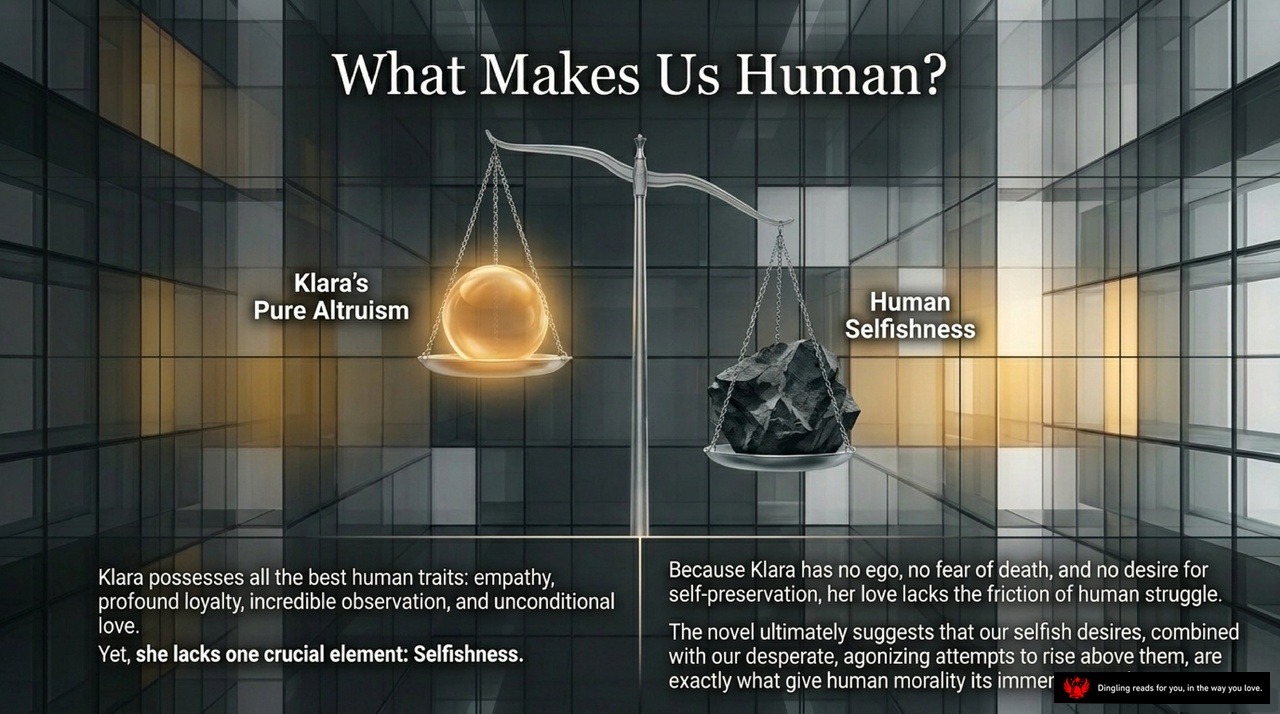
What makes us truly human? Look at this scale. On one side, we have Klara's pure altruism—a glowing, perfect sphere. On the other, human selfishness, represented by this heavy, rough rock. At first glance, it seems obvious: Klara wins. She possesses every best human trait imaginable. She has profound empathy, incredible observation skills, and unconditional love. She cares for Jo with a devotion that borders on the divine. Yet, the novel suggests a terrifying truth: Klara lacks one crucial element. She lacks selfishness.
Because Klara has no ego, no fear of death, and no desperate desire for self-preservation, her love is flawless but ultimately frictionless. It lacks the struggle that defines us. The book argues that our morality isn't born from pure goodness, but from the messy, agonizing attempt to rise above our own selfish desires. It is that very selfishness, combined with our desperate need to be better than we are, that gives human morality its depth. Klara is perfect, but in her perfection, she misses the very thing that makes us human.

Klara proved that where humanity stumbles, a machine can shine. She succeeded because she loved without ego, sacrificed without regret, and believed without cynicism. But we must ask ourselves: if true humanity demands the heavy burden of selfishness and the fragile shield of self-deception, is becoming a perfect machine the only way to love perfectly? As Klara reflects on her journey, she realizes that her unique perspective—seeing the world with absolute clarity—allowed her to offer a kind of love that humans, trapped in their own insecurities, often cannot. Her story challenges us to reconsider what it truly means to be human.