
Land of Ordinary Customs: Complete Chapter-by-Chapter Summary
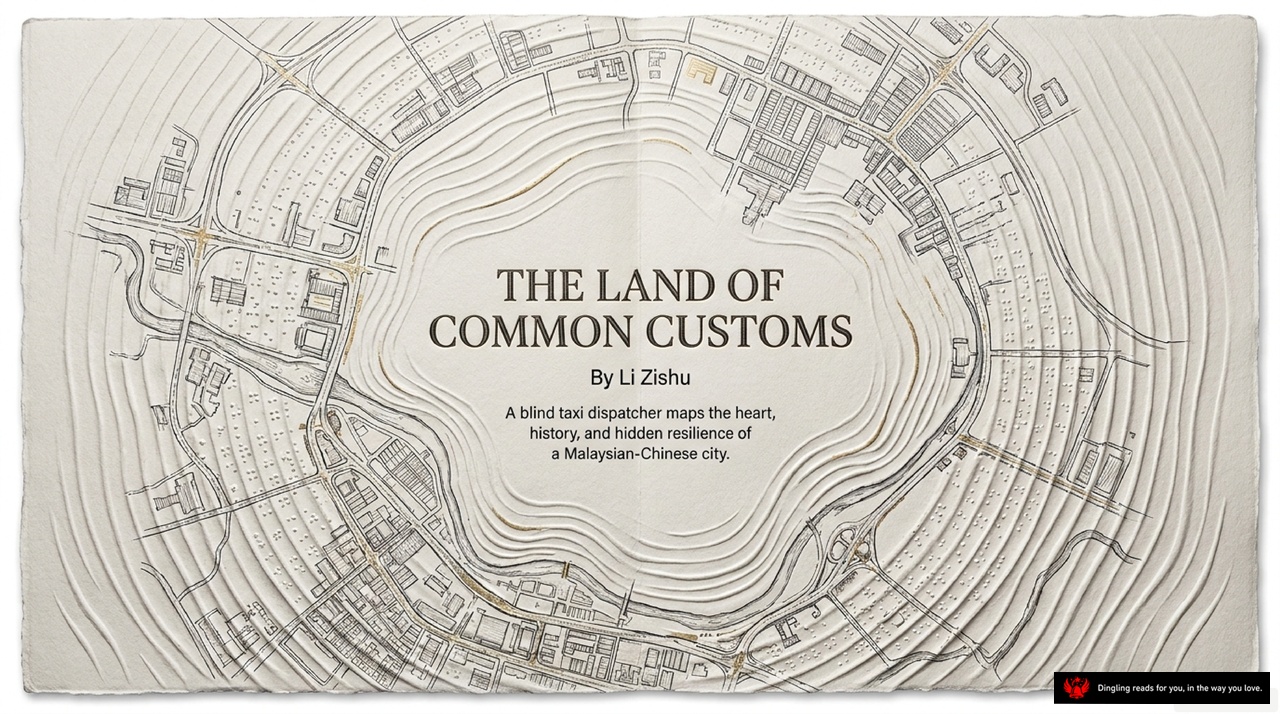
Welcome to *The Land of Common Customs*, a story that begins not with a map, but with a voice.
In the heart of Ipoh, a city layered with history and hidden tensions, a blind taxi dispatcher named Yin Xia is on duty. It's a hot September, the kind where everyone retreats to air-conditioned malls, but Yin Xia hears what others miss. She picks up a call from a notorious parking lot near the Nantian Cave temple. The caller has a unique habit: he pronounces "street" as "chicken." It's a fingerprint in her mind. She knows that voice. It's her brother, Da Hui, who vanished ten years ago, presumed dead after a domestic violence incident drove him away.
She rushes to confirm. The driver describes a tall man with a high nose—exactly how Da Hui used to look. Ten years of silence are shattered in an instant. The smell of incense from the ancient temple mixes with car exhaust, but for Yin Xia, the only thing that matters is that familiar, slightly distorted accent calling out "chicken market."
This isn't just a reunion; it's a collision of past and present. Da Hui, once a carefree boy who loved comics and football, has returned changed—hardened by hardship, carrying the weight of a broken home. His reappearance ripples through a community where everyone knows each other's business, where ghosts of the past linger in the alleys, and where the line between family and stranger is often blurred.
In this story, we follow Yin Xia, her brother Da Hui, and their friend Xi Hui, as they navigate the complex fabric of Malaysian-Chinese life. From the bustling night markets to the quiet, shadowed corners of their childhood homes, they uncover the resilience of a family that refused to give up, even when the world seemed ready to leave them behind.
This is a tale of love, loss, and the enduring power of family bonds in a city that feels both familiar and foreign.

Welcome back. Today, we're diving into the third and final pillar of Mahua Literature: The Third Path. Think of it as a trinity of storytelling, where each author carves out a distinct world, yet all share the same soul of our region.
First, we have Zhang Guixing, representing "The Jungle & The Blood." Imagine a world where history isn't just written in books, but carved into the scars of the land. Her focus is epic violence, the trauma of WWII, and the raw conflicts between indigenous groups. It's a place of magical realism where humans fight wild boars in the dense rainforest. It's a story of survival against the wild, where the line between man and beast blurs under the weight of ancient history.
Next, we move to Ng Kim Chew with "The Ghost & The Void." This path explores the shadows of our past. The focus here is on national anxiety and political critique, specifically looking at the remnants of the Malayan Communist movement. The stories are filled with ghosts—cynical, spectral figures representing the failure of revolution. It's a haunting reminder that the past never truly leaves; it lingers in the void, whispering warnings to the living.
Finally, we arrive at Li Zishu's "The Earth & The Everyday." This is the most grounded of the three, focusing on the urban reality of our cities. It's about working-class resilience, the slow violence of daily life, and the quiet power of compassion. The unique trope here is the "blind dispatcher"—a character orchestrating the mundane streets of a fading tin town. Through this lens, Li Zishu shows us that even in the most ordinary, overlooked corners of life, there is a profound dignity and a complex humanity waiting to be seen.
Together, these three paths—The Jungle, The Ghost, and The Earth—form a complete map of Mahua Literature. They take us from the primal violence of the past, through the haunting echoes of political struggle, and finally into the resilient, everyday lives of the people who build and endure our world. This is the full spectrum of our literary identity.

Welcome back. Today, we dive into the layers of Ipoh, a city where history isn't just written in books—it's buried beneath the pavement and humming in the background of daily life.
The slide illustrates Ipoh as a fading tin-mining mountain town, defined by its multi-ethnic tapestry of Chinese, Malay, and Indian communities. But the story goes deeper than just demographics. It reveals three distinct layers of time stacked upon one another.
At the very bottom, we see the 19th-century tin-mining infrastructure. This is the foundation of the city, the physical scars of the past that shaped its geography and economy. Moving up, we encounter the middle layer: the unspoken trauma of the 1969 racial riots. This is a painful history that the novel chooses not to narrate directly. Instead, it lets the trauma of historical racial tensions hum quietly in the background, lingering in the Upstairs-Downstairs flats where neighbors live side by side but often worlds apart.
Finally, at the top, we see the modern multi-ethnic streets and the 2018 regime change. This is the present reality, a complex mix of old wounds and new political currents. The novel's unique approach is to bypass grand political narratives. It doesn't focus on the big headlines; instead, it shows how these deep historical currents affect ordinary people's lives. The past never truly disappears; it simply lingers in the mundane, waiting to be felt in every quiet moment.

In the pre-digital era, before we relied on satellites and apps, humans had their own internal GPS. Today, we're looking at how one extraordinary woman, Gu Yinxia, became the ultimate navigation system for her chaotic city.
As the slide illustrates, her ability wasn't just about surviving the darkness; it was about orchestrating it. Her first superpower was **Memory**. She didn't just remember street names; she memorized the sprawling Thousand-Character Dream Guide and every single alleyway in the city. She could mentally map routes that no one else could see, turning the unknown into a familiar landscape.
But knowing the way was only half the battle. Her second skill was **Navigation**. In an age without GPS, she possessed a spatial intelligence that rivals modern technology. She was capable of playing simultaneous multi-board blind chess with her childhood friends, visualizing the entire board in her mind without seeing a single piece. This wasn't just a game; it was proof of her ability to track complex, shifting variables in real-time.
Finally, she had **Voice**. In the chaotic streets of the Tin City, she served as a soothing dispatcher for the wireless taxi service. Her voice was the bridge between the driver and the passenger, guiding traffic through confusion with calm authority. She didn't just give directions; she provided clarity in a world that was constantly spinning out of control.
Gu Yinxia proves that human intelligence, when combined with empathy and precision, can outperform any machine. She didn't just navigate the city; she defined it.
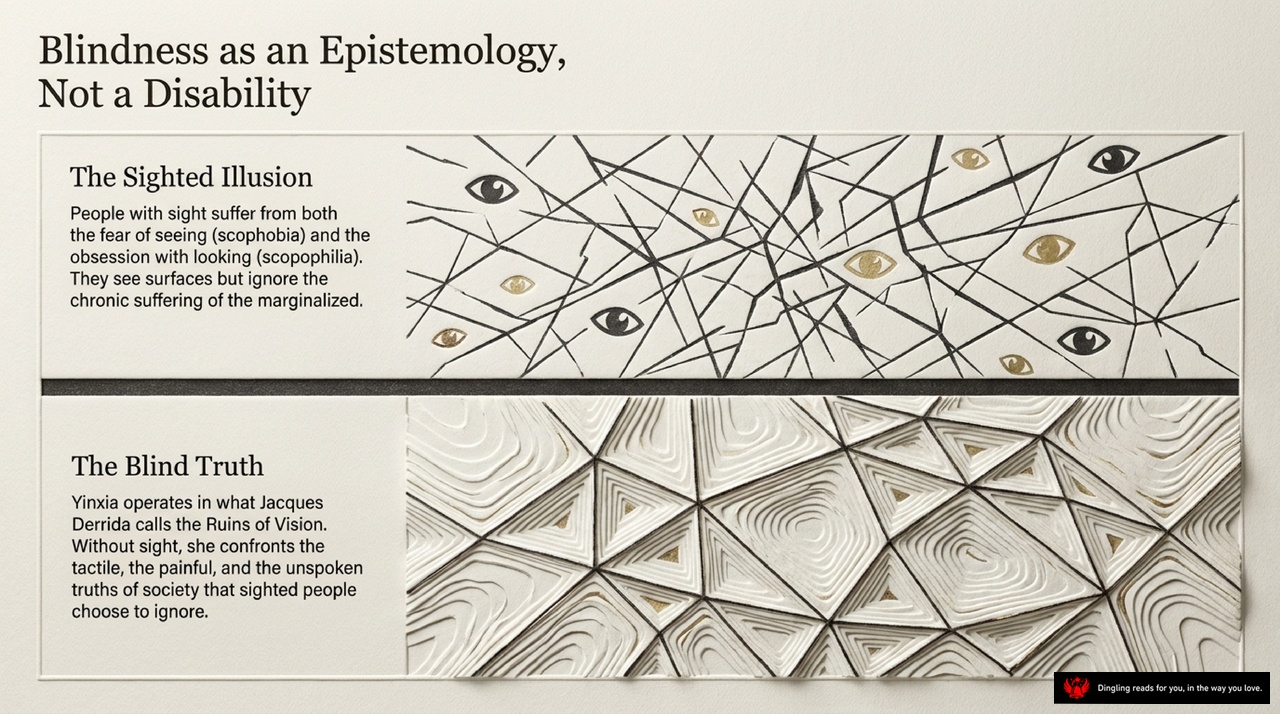
Welcome back. Today, we're diving into the fourth chapter, where the boundaries of family begin to blur, and trust becomes a fragile commodity.
We see a sharp contrast here between two families. On one side, we have the Lam family, where the mother, Lian Zhu, has achieved immense success. She's now a socialite, driving a Jaguar, and her son, Razoo, is a rising star. Yet, despite her wealth and status, she remains emotionally distant, viewing her family as something to be managed rather than nurtured.
On the other side, we have the family of Dafei and Huilan. Their life is a constant struggle. Dafei, once a promising young man, is now a struggling street food vendor. Huilan, who used to wear designer clothes, is now exhausted from working late nights at a seafood restaurant, struggling to feed three children.
The tension escalates when Dafei returns home after a long absence. He's changed—more confident, perhaps a bit arrogant. He clashes with his mother-in-law, He Men Fang, who still holds onto the hope of his return, unaware of the pain he's caused. Meanwhile, Huilan tries to hold her family together, even sacrificing her own gold jewelry to keep the roof over their heads.
This chapter highlights a harsh reality: success doesn't guarantee happiness, and poverty doesn't define a person's worth. It's a poignant reminder of how quickly circumstances can change, and how the bonds of family can be tested under pressure.
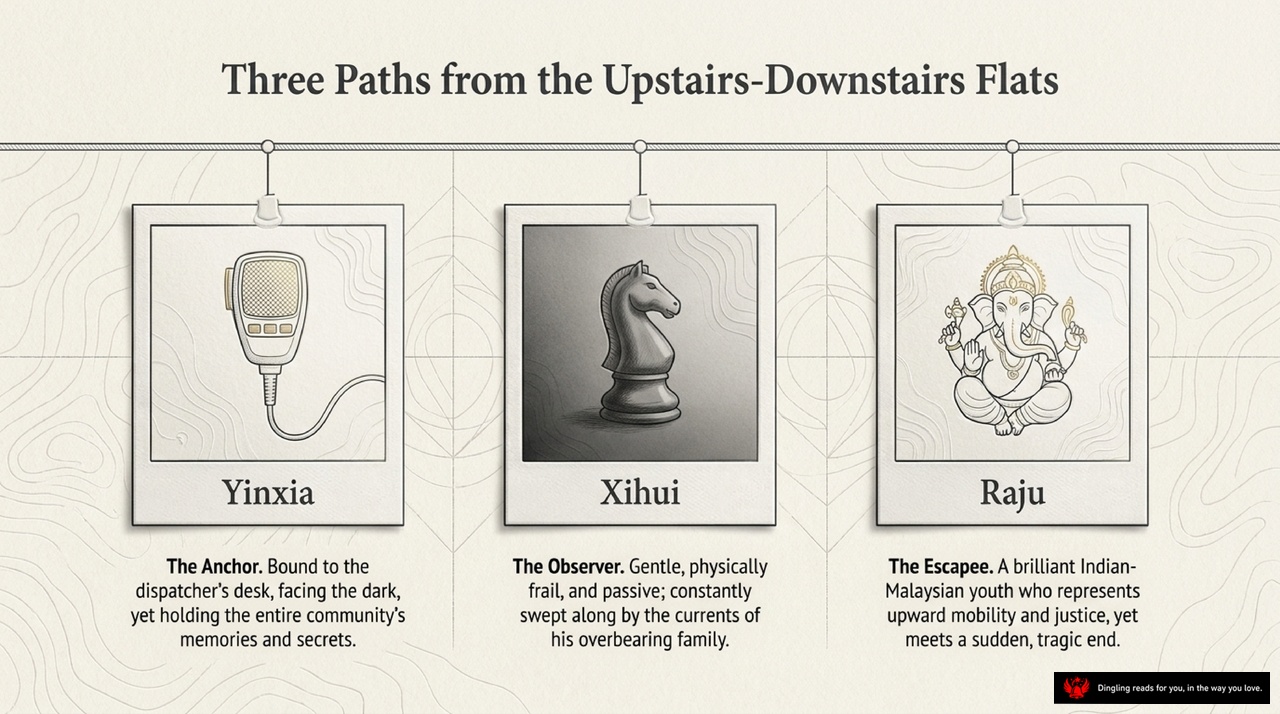
Welcome to the final chapter of our journey through *The Upstairs-Downstairs Flats*. Today, we look at the three distinct paths carved out by the lives of Yinxia, Xihui, and Raju—paths that begin in the same cramped, echoing building but lead to vastly different destinies.
First, we have Yinxia, our **The Anchor**. Represented here by the old dispatch microphone, she is bound to her post, facing the darkness of her blindness yet holding the entire community's memories and secrets. She is the steady voice in the radio booth, the one who navigates the city not by sight, but by sound and intuition.
Next is Xihui, **The Observer**. Depicted by this chess knight, he is gentle, physically frail, and passive. He is constantly swept along by the currents of his overbearing family, struggling to find his own footing while watching the world change around him.
Finally, we see Raju, **The Escapee**. This image of Ganesha represents a brilliant Indian-Malaysian youth who symbolizes upward mobility and justice. He is the one who breaks free from the constraints of the flat, only to meet a sudden, tragic end that leaves a lasting scar on the neighborhood.
These three characters—bound by proximity but separated by fate—define the soul of this story.
Surviving the Slow Violence of the Everyday
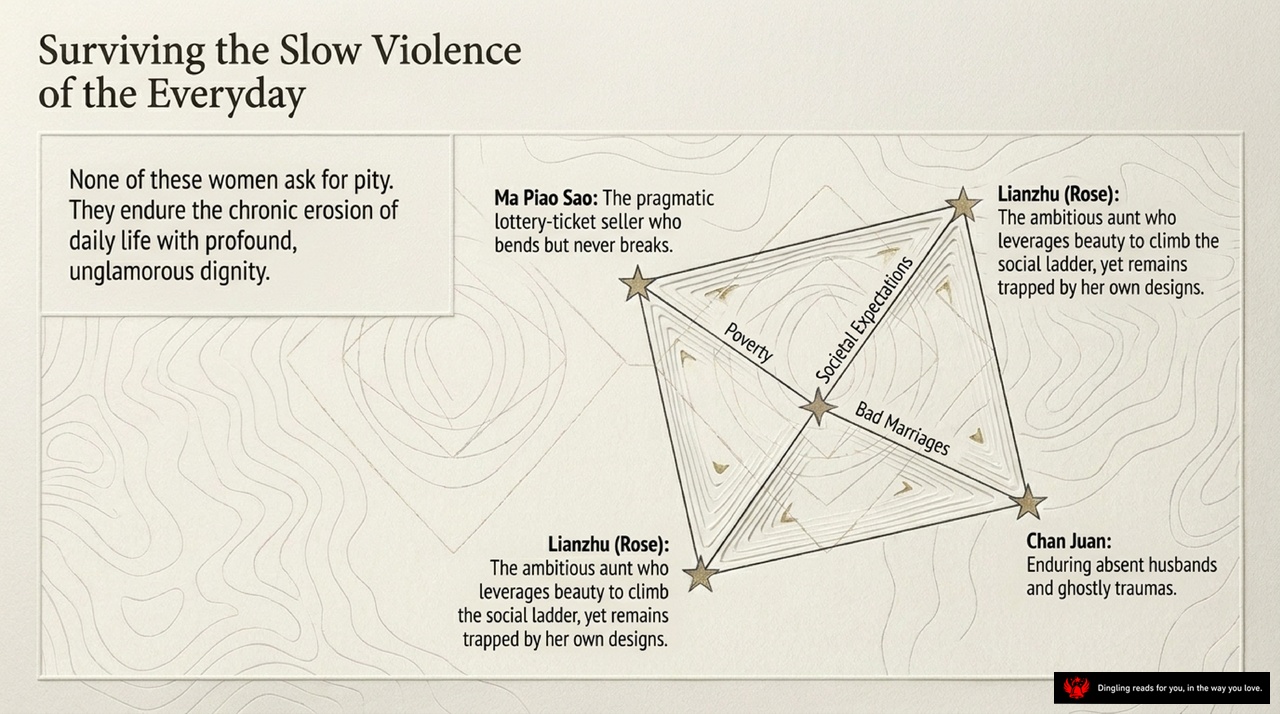
Look at this slide. It's not about dramatic tragedies or sudden disasters. It's about something far more insidious: the slow violence of the everyday. None of these women ask for pity. They endure the chronic erosion of daily life with a profound, unglamorous dignity.
Let's look at the four women in this diagram. First, Ma Piao Sao. She is the pragmatic lottery-ticket seller who bends but never breaks. Then, Lian Zhu, or Rose. She is the ambitious aunt who leverages beauty to climb the social ladder, yet remains trapped by her own designs. Chan Juan endures absent husbands and ghostly traumas. And finally, we have the unnamed narrator whose voice we follow, living through poverty, bad marriages, and crushing societal expectations.
Notice the lines connecting them. These aren't just random connections; they are the forces that bind them together. Poverty, societal expectations, and bad marriages form a trap. They are not isolated incidents; they are a system. This is the reality of their lives. They are not asking for rescue; they are asking for survival. They are finding a way to keep their dignity intact even when the world tries to strip it away. This is the true story of these women.
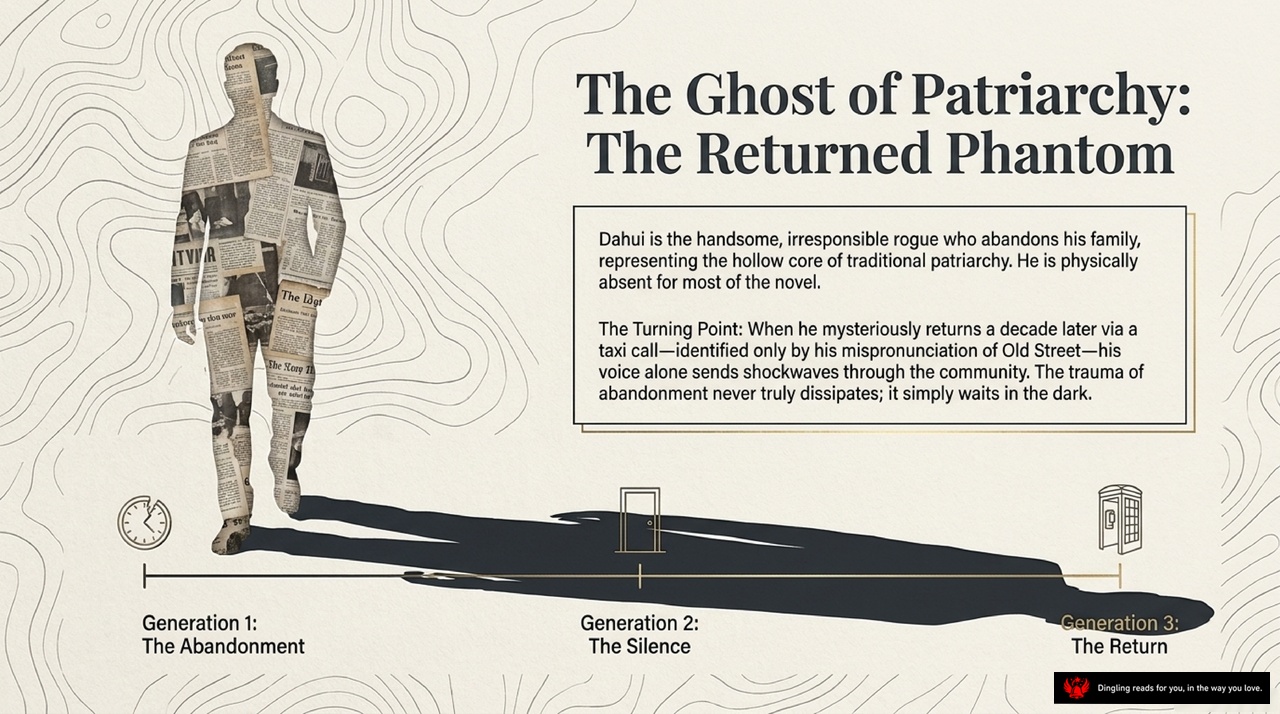
The Ghost of Patriarchy: The Returned Phantom. On the surface, it looks like a simple story of a missing man, but dig deeper, and you'll see the hollow core of traditional masculinity. Dahui, the handsome rogue who abandons his family, represents the very essence of this broken system. He's physically absent for most of the novel, a ghost haunting the lives of everyone he left behind.
But the real shock comes with his return. A decade later, he mysteriously reappears via a taxi call, identified only by his unique mispronunciation of "Old Street." That single voice sends shockwaves through the community, proving that the trauma of abandonment never truly dissipates; it simply waits in the dark, ready to resurface.
This slide maps the three generations of this legacy: Generation One is the Abandonment, where the father vanishes. Generation Two is the Silence, a painful void where the family tries to cope without him. And finally, Generation Three is The Return, where the ghost comes back to haunt them all. It's a powerful reminder that running away doesn't make you free; it just delays the inevitable reckoning.
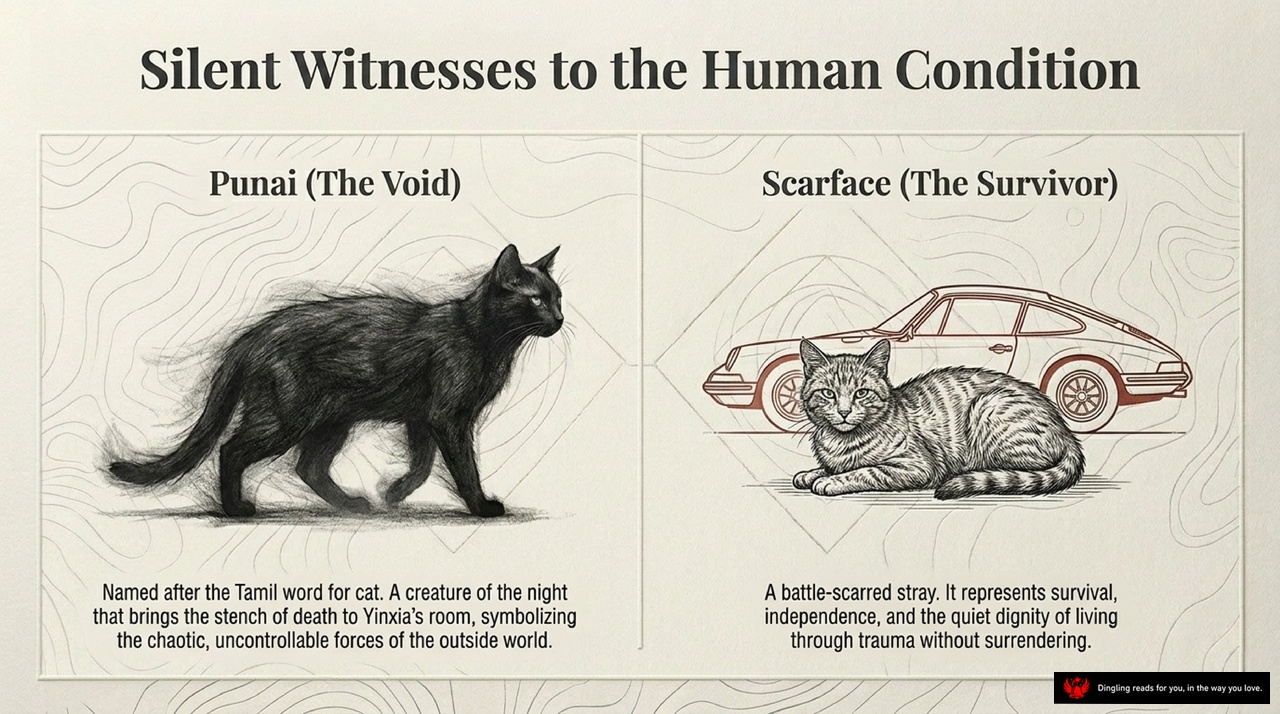
Look at these two cats. On the left, we have Punai, a sleek black feline often called "The Void." He represents the chaotic, uncontrollable forces of the outside world—like a creature of the night bringing the stench of death right into Yinxia's sanctuary. On the right, there's Scarface, a battle-scarred stray sitting in front of a classic car. He is "The Survivor," embodying survival, independence, and the quiet dignity of living through trauma without surrendering. These aren't just pets; they are silent witnesses to the human condition, mirroring the struggles of the people around them.

When the Words Run Out, we are reminded that some truths are too heavy for sight, but light enough for the touch of a finger. This slide outlines the tragic arc of Yinxia's story through three pivotal steps. First, comes the **Discovery**: Yinxia finds a rare freedom through the Perkins Braille typewriter, typing her deepest, unspoken feelings to her teacher. For a blind girl, this machine becomes her voice, allowing her to express what the world often refuses to hear.
But this newfound freedom is abruptly shattered in **Step 2: The Void**. The connection she has built is violently severed by an unseen act of sexual violence. It is a trauma so profound that it leaves her speechless. This leads us to **Step 3: The Irony of Realism**. Because Yinxia is blind, the novel subverts the all-seeing nature of realism. While the world watches with clear eyes, the ultimate trauma is left visually undocumented, unnamed, and fundamentally unspeakable. Her blindness becomes a shield, yet also a prison, proving that some wounds are invisible precisely because no one can see them.
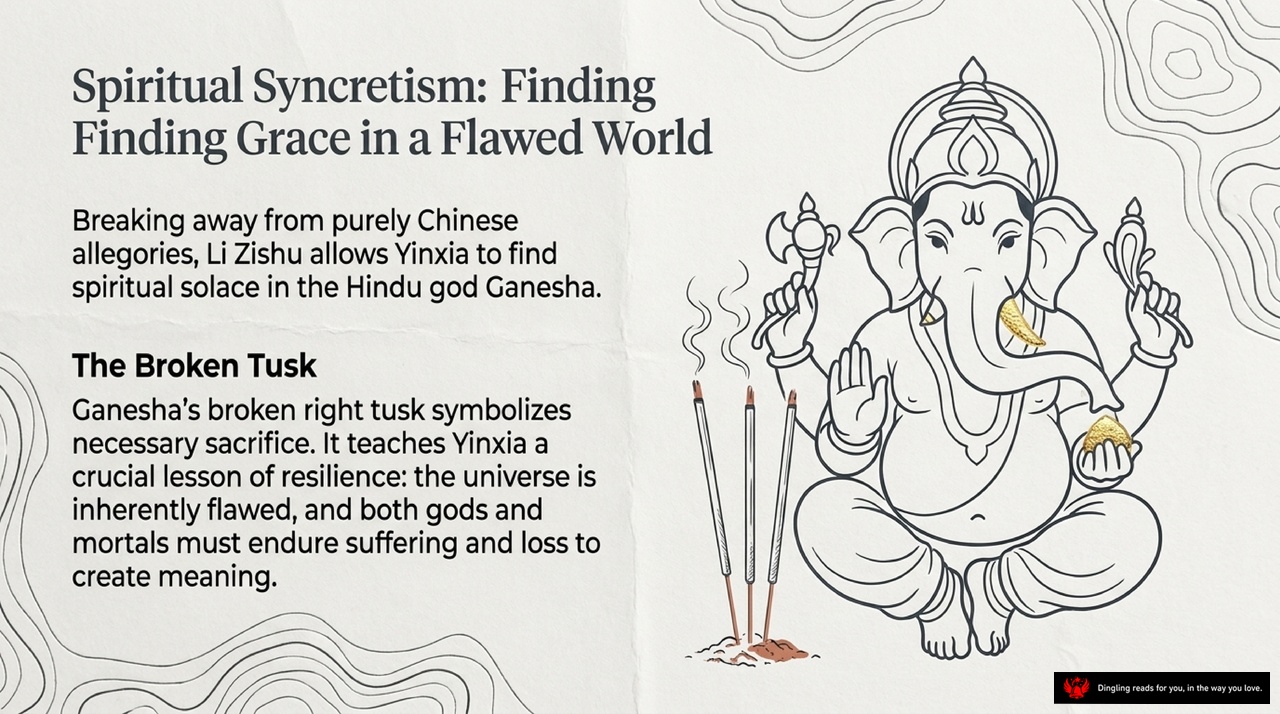
Breaking away from purely Chinese allegories, Li Zishu allows Yinxia to find spiritual solace in the Hindu god Ganesha. This shift marks a pivotal moment in her journey, moving beyond traditional constraints to embrace a more universal understanding of grace.
The image highlights a profound concept known as "The Broken Tusk." Ganesha's broken right tusk symbolizes necessary sacrifice. It teaches Yinxia a crucial lesson of resilience: the universe is inherently flawed, and both gods and mortals must endure suffering and loss to create meaning. Just as Ganesha bears the mark of his sacrifice, Yinxia learns that her own blindness and the pain she carries are not signs of failure, but essential parts of her strength. In a world that is often imperfect, finding grace means accepting these flaws and finding the courage to move forward despite them.

On May 9, 2018, Malaysia experienced a historic regime change that lifted decades of suppression. In that pivotal moment, Yinxia made a definitive choice about her own romantic future. The mundane life was suddenly infused with monumental energy.
This slide illustrates the profound intersection of history and healing. We see two parallel timelines converging at this exact date. The top arc represents Clititial History, marked by the racial trauma of May 13, 1969, followed by decades of stagnation. The bottom arc mirrors Yinxia's Life, tracing her journey from a childhood in the flats through an unspeakable assault, all leading to this moment of finding love.
Notice how the national narrative of regime change directly fuels her personal awakening. It is as if the country's collective healing created the space for her individual heart to finally open up. The visual metaphor of these lines merging into a single point suggests that her personal story is inextricably linked to the broader historical context. It wasn't just a coincidence; it was a necessary convergence. Only when the weight of history shifted did she feel the courage to embrace a new beginning. This is the power of timing—when personal pain aligns with historical change, healing becomes possible.

In traditional Mahua literature, protagonists are often swallowed by the violence of history or the unforgiving jungle—the proverbial wild boar. But Li Zishu grants Yinxia a different fate. She doesn't meet the darkness she fears; instead, she finds her way back to the light.
The resolution comes when she reunites with the elderly, compassionate Teacher Gu, whose given name is Youguang, literally translating to "There is Light." It is a romantic, radical act of literary mercy by the author. After years of navigating a world that often felt like a trap, Yinxia finally steps out of the shadows. She chooses not to fight the beast, but to embrace the sanctuary waiting for her. In this final turn, the story shifts from survival to salvation, proving that sometimes the bravest thing you can do is simply let someone guide you home.
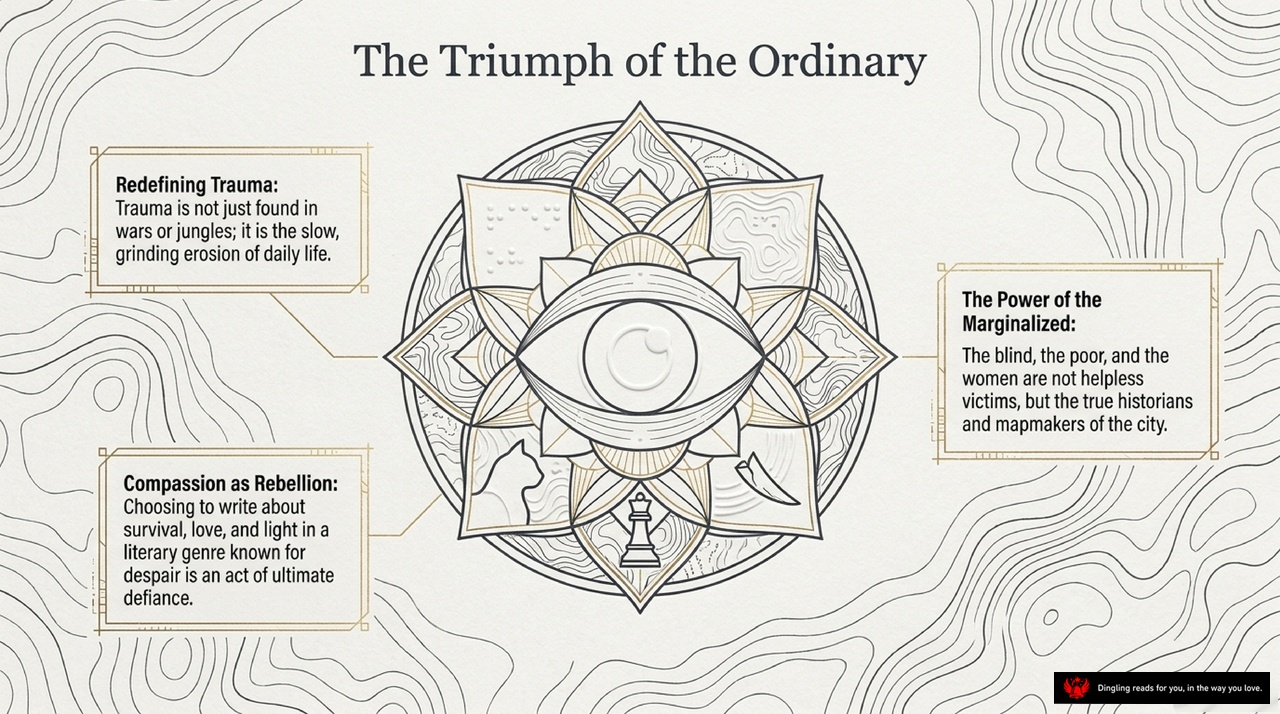
We are often told that trauma is something dramatic—found only in war zones or jungles. But as we see here, true trauma is the slow, grinding erosion of daily life. It's the quiet, relentless wear that happens right under our noses, in the ordinary moments we try to ignore.
Look at the power of the marginalized. In stories like this, the blind, the poor, and the women aren't helpless victims waiting to be saved. They are the true historians and mapmakers of the city. They navigate the streets with a wisdom that the sighted often overlook, turning their struggles into a deep understanding of the world around them.
And perhaps most importantly, consider compassion as rebellion. Choosing to write about survival, love, and light in a genre known for despair isn't just storytelling—it's an act of ultimate defiance. It is a refusal to let the darkness win, a declaration that even in the hardest times, there is still a way to find hope and keep moving forward.
By navigating the sensory ruins of a fading city, *The Land of Common Customs* proves that the most profound resilience is not found in grand historical battles, but in the quiet, unseen endurance of ordinary people finding light in the dark.
If we have been conditioned to only see history through the glaring lens of power and violence, what hidden truths might we discover if we simply closed our eyes and learned to listen?
In this story, we meet characters like Ah Yung, a blind woman who becomes the city's living map, and Ah Beng, a young man whose brilliance shone so brightly it ultimately cost him his life. Their lives remind us that true strength often lies not in what we see, but in what we feel and hear. It is in these quiet moments—the shared silence between friends, the resilience of a family holding together—that we find the real heartbeat of our history. So, let's take a moment to listen closer to the stories of these everyday heroes.