
Learn Like a Leader: Complete Chapter-by-Chapter Summary

Welcome to the book club session for "Learn Like a Leader." Today, we're diving into a masterclass playbook by Marshall Goldsmith, Beverly Kaye, and Ken Shelton. This book distills the core philosophies of world-renowned management gurus into actionable frameworks you can use right away.
Think of leadership not just as solving problems, but as teaching others how to solve them. The book emphasizes that true empowerment comes from giving people the fishing rod, not just the fish. When you focus on building others' independent problem-solving skills, you're planting seeds for long-term growth. While it might feel inefficient to let your team struggle through challenges initially, this approach prevents burnout and builds a team capable of self-iteration.
Furthermore, the authors highlight that teaching is the best way to learn. By becoming a teacher or mentor, you deepen your own understanding and uncover blind spots in your knowledge. Whether through internal training or guiding new hires, this cycle of teaching and learning creates a dynamic environment where everyone evolves together.
Ultimately, this book is about moving from being a "hero" who fixes everything to being a leader who cultivates capability. It's a practical guide for anyone ready to stop giving answers and start asking better questions, fostering a culture where everyone thrives.

Great leadership isn't accidental; it is engineered from the inside out. Today, we are exploring the "Concentric Circles of Executive Mastery," a framework that shows how true capability is built in three expanding layers of structural integrity.
At the very core, we have **Leading Self**. You cannot influence others until you possess radical self-awareness and unyielding internal principles. Think of this as your anchor. If you don't know your own values or admit your blind spots, you can't possibly guide anyone else. It starts with honesty—facing the truth about yourself, even when it's uncomfortable.
Moving outward to the second circle, we have **Leading Others**. This is the structure. Once grounded, the leader builds load-bearing relationships through empathy, empowerment, and a continuous teaching loop. Remember, the best way to learn is to teach. By empowering your team and fostering a culture where everyone shares knowledge, you don't just solve today's problems; you build a team capable of solving tomorrow's challenges independently.
Finally, at the exterior, we arrive at **Leading Through Crises**. With a trusting team in place, you can now navigate paradigm shifts. Instead of fearing disruption, you step back to absorb the shock and leverage it for growth. You become the calm center in the storm, guiding your team through uncertainty rather than trying to control every variable.
Mastering these three layers transforms leadership from a series of lucky breaks into a deliberate, engineered practice. Start with yourself, build your team, and then lead the world.

Teaching others is actually the fastest way to learn yourself. As management legends like Peter Drucker and James Kouzes have proven, when you stand in front of a classroom or a team to explain a concept, you don't just transfer knowledge; you force your own brain to reorganize and deepen your understanding. It's a powerful feedback loop: to teach clearly, you must first master the material yourself, often uncovering gaps in your own knowledge that you never noticed before.
This principle isn't just about academics; it's a core leadership strategy. Think about senior employees mentoring new hires. When they guide others, they aren't just giving answers; they are refining their own methodologies and staying sharp in a changing market. This creates a culture where everyone grows together, turning the team into a self-improving engine rather than a group of people waiting for instructions.
But there's a deeper layer to this "teaching" mindset. It's about spotting potential in others that they haven't seen yet. Great mentors, like the character Mr. Anderson from the book, don't focus on a student's current limitations. Instead, they look at future possibilities and trust them with responsibilities they aren't fully ready for yet. That trust acts as a bridge, helping the individual believe in their own capability and take the first step toward greatness.
Ultimately, the most effective leaders aren't the ones who have all the answers. They are the ones who can ignite a spark in others, asking the right questions and providing the space for people to discover their own solutions. When you shift from being the "hero" who fixes everything to a facilitator who empowers others, you unlock a level of growth and innovation that no amount of direct instruction ever could.
Let's dive into the art of high EQ, where true influence isn't about pretending to be perfect, but about finding the common ground that makes empathy happen naturally. Think about Nathaniel Brandt's breakthrough with a resistant client. He was stuck until he finally admitted his own feelings of frustration and powerlessness. That moment of self-acceptance became the bridge to understanding his client's struggle. When you stop hiding your own imperfections, you create a safe space for others to do the same, and that's when real trust flows.
But here's the key to building that influence: you have to be brave enough to speak up. Too often, we stay silent because we're waiting for the perfect moment or fearing judgment. Elizabeth Pines learned this the hard way at an organic farming conference. Dressed simply in jeans while everyone else wore luxury brands, she felt invisible until Margaret Mead nudged her and said, "Stand up and speak your truth." That one push changed everything. Pines realized she didn't lack ideas; she just lacked the courage to share them. Your voice matters, and the world needs your unique perspective, even if you don't feel like an expert.
Remember, change starts when you stop defending and start listening. Charles DeWier faced a major crisis when executives rejected his project, but instead of arguing, he simply asked, "Tell me what's wrong." By listening without judgment, he turned a potential disaster into a collaborative success. So, when conflict arises, resist the urge to prove you're right. Instead, lean in, listen deeply, and let understanding guide your next move. That's how you turn obstacles into opportunities and build lasting impact.

When we face conflict, our instinct is often to defend ourselves, to prove we are right. But this defensive reaction only fuels the fire, cutting off any real path to resolution. The true breakthrough comes from doing the opposite: hitting the pause button on your argument and turning your full attention to listening. Listening isn't just about hearing words; it's about genuinely understanding the other person's frustration, disappointment, and expectations, making them feel truly seen and respected. This is the first step to dissolving emotional opposition.
Consider the story of Charles Dwyer from Wharton's "Effective Execution" project. When the initiative hit a major trust crisis, with executives expressing deep dissatisfaction, Dwyer didn't panic or make excuses. Instead, he stopped the presentation, looked them in the eye, and simply asked, "I know things aren't going well. Tell me the details." This single act of vulnerability opened the floodgates. The executives poured out their concerns, and Dwyer listened without interrupting. Once the emotions were fully aired, he proposed a new direction, allowing the group to take ownership of the solution. The project was saved.
This experience taught Dwyer a powerful lesson: when conflict arises, stop trying to be the "thrower" of arguments and become the "receiver" of understanding. By listening with sincerity, you transform an adversary into a collaborator. People are often more reasonable than we give them credit for, but only when they feel heard. In leadership, the ability to listen through the noise of conflict isn't a soft skill—it's the ultimate strategy for finding clarity and restoring trust.

In this slide, we're diving into the concept of the "Leverage Point"—the secret to achieving peak performance even when your environment feels rigid or unyielding. Look at that graph: it maps the intersection of your personal mission and passion against the demands of your environment. Most people think they need to wait for the perfect job or the ideal culture to thrive. But the data shows something different. True peak performance happens when you find that specific fulcrum where your internal drive meets external necessity.
The slide highlights three critical steps to mastering this. First, it's about "Finding the Fulcrum." As the story of Charles Garfield's tollbooth operators illustrates, the difference between dying of boredom and hosting a dance party wasn't the job itself, but the leverage point. High performers don't wait for a perfect environment; they identify where their unique mission intersects directly with the baseline demands of their organization.
Second, we move to "Creating the Space." When a leader aligns a specific task with a deeply held personal capability, they create an impenetrable zone of high productivity. It's about transforming a mundane role into a stage for your strengths.
Finally, there's "The Paul Principle." This reminds us that climbing a hierarchy blindly until work loses its joy is a structural failure. True leaders anchor themselves at their unique fulcrum, finding a way to make routine conditions serve a higher personal mandate. By engineering this leverage, you stop fighting the system and start using it to amplify your impact.

When we face conflict, our instinct is often to defend, to prove we're right, and to shut down the other person. But this reaction only escalates the tension. The real breakthrough happens when we press the pause button on that urge to justify ourselves and instead choose to listen. Listening isn't just hearing words; it's an active effort to understand the frustration, disappointment, and expectations behind them. It's about making the other person feel truly seen and respected, which is the first step to defusing emotional opposition.
Consider the story from Wharton's "Effective Execution" project. The team launched with great expectations, only to face immediate backlash from executives who felt their time and money were wasted. Instead of panicking or making excuses, the project lead, Charles DeWaal, stopped the presentation. He looked the executives in the eye and said, "I know things aren't going well. Can you tell me the details?" This simple invitation to speak acted like a pressure valve. The executives poured out their grievances. DeWaal didn't interrupt; he just listened, letting them release their emotions. Once the air cleared, he proposed a new path where the executives could decide the next steps themselves. Within days, they generated concrete improvements, and the project was back on track.
This experience taught DeWaal a powerful lesson: when conflict arises, don't stand against the other side to defend your position. Stand with them to understand theirs. When people feel heard, they often become reasonable. This approach gave DeWaal the confidence to handle future crises with calm. He realized that by dropping the need to be right and embracing genuine listening, he could shift from being a reactive "thrower" of problems to an active "catcher" of solutions. Life rarely goes exactly as planned, but learning to listen in the heat of conflict is the starting point for finding a way forward.

The Truss of Influence is built on three critical pillars: Empathy, Energy, and Expertise. Think of it as the structural framework for a master teacher, not a traditional boss. At the very heart of this truss lies The Mentorship Bond, the glue that holds everything together.
Let's look at the foundation first. True influence starts with recognizing that universal goals like respect and achievement are pursued differently across cultures. To build a load-bearing relationship, you must abandon the one-size-fits-all standardization and instead understand individual blueprints. This is the essence of empathy—seeing the unique path your team member is walking.
Once you have that empathetic base, you need The Catalyst. This is about injecting genuine curiosity and humor into the work. A leader's passion is contagious; it has the power to transform a sterile task into a living drama that commands engagement. When you bring your authentic energy, you stop managing tasks and start inspiring people.
Finally, we reach The Anchor. This is about knowing your own limits. Authentic influence requires zero pretense. It is the willingness to say "I don't know" and operate as a co-learner and facilitator rather than an infallible guru. By admitting what you don't know, you create a safe space for your team to grow without fear of judgment.
When you combine the Foundation of empathy, the Catalyst of energy, and the Anchor of humility, you complete the truss. This structure allows leaders to build relationships that can truly withstand the pressure of complex challenges, fostering a culture where everyone feels seen, energized, and supported.

When we face a crisis, our instinct is to charge forward, to force our logic onto a chaotic situation. This "rigid forward attack" often leads to blind tension and failure. But what if the solution lies in stepping back? Carlos Marin applies the mechanics of Tai Chi and Judo to executive crisis management with a powerful concept called the "Judo Focal Shift." Instead of lunging at the problem, he argues we must structurally step back to expand our strategic field of vision.
This shift begins with "Softening the Eyes." Under pressure, humans naturally narrow their focus, squinting to force logic where there is none. This creates the very blindness we fear. The Judo approach requires us to do the opposite: soften our focus and artificially widen our peripheral vision. This is followed by "The Tactical Retreat." By physically and mentally taking a half-step back, a leader clears their internal space. They stop attacking the crisis with rigid assumptions and instead allow the reality of the environment to fill their senses.
Finally, this retreat leads to "Absorbing Reality." When you step back, you reveal previously invisible strategic options that were hidden by your initial panic. This isn't about giving up; it's about gaining the clarity needed to solve the problem effectively. By shifting from a narrow, aggressive stance to a broad, observant one, leaders can transform a moment of crisis into an opportunity for true strategic breakthrough.

Navigating Paradigm Shock: Defense vs. Discovery. When a deeply held belief is challenged, the system doesn't just stumble; it experiences what Roosevelt Thomas and Charles Dwyer call "Paradigm Shock." Think of it like walking into an airport sink with no basin—your entire mental model of how things work suddenly breaks.
Now, here is the critical fork in the road. On the left, we see the path of the "Defensive Reaction." This is our human instinct during organizational revolt or failure: to defend, justify, and protect our ego. This guarantees failure because it locks us into denial. But on the right, we see the path of "Discovery," which masterful leaders engineer. Instead of defending, they absorb the shockwave. They drop all defenses and simply ask, "Things are broken. Tell me why."
This shift from defense to proactive listening is everything. By listening without prejudice, the leader diffuses panic and engages in "Assumption Auditing." This allows the team to co-create a new paradigm alongside the leader, leading to eventual adaptation. As the slide notes, organizations will violently reject solutions that threaten their foundational paradigms unless they are guided into discovery. So, when reality shifts, don't fight the new world; listen to it, audit your assumptions, and evolve.
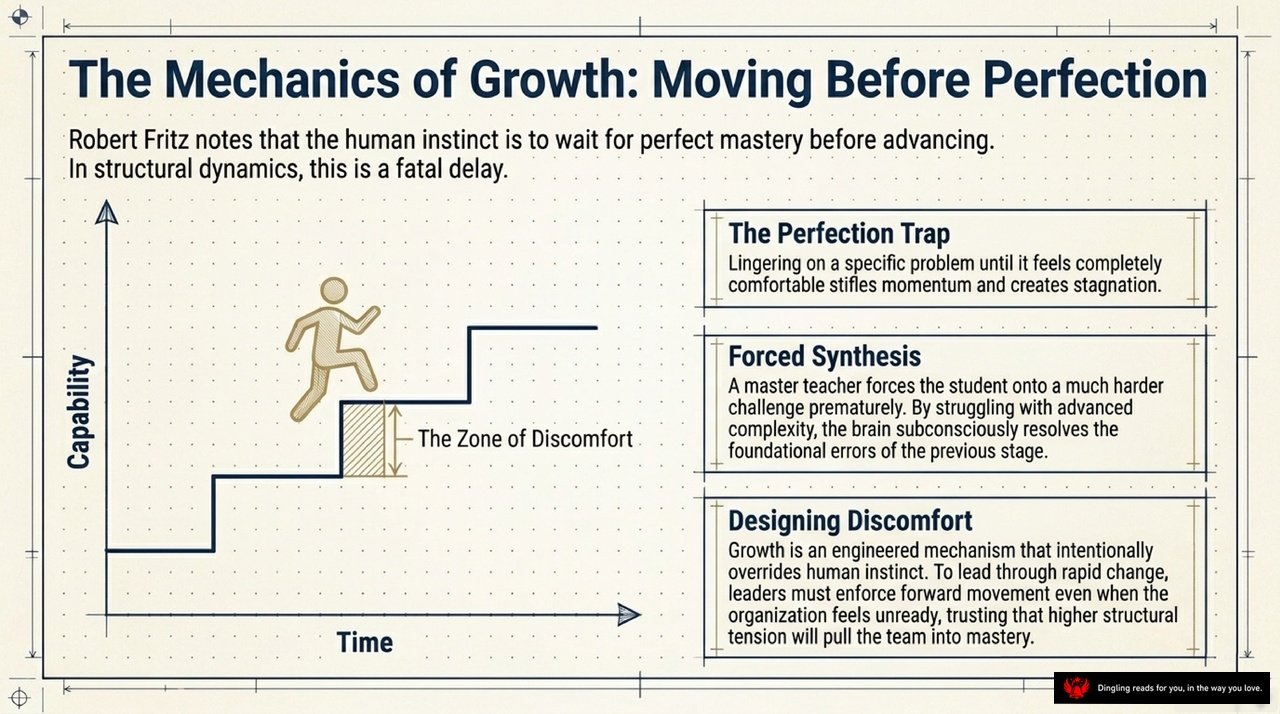
The mechanics of growth often feel counterintuitive because our brains are wired to wait for perfection before moving forward. As Robert Fritz notes, this instinct creates a fatal delay in structural dynamics. Instead of waiting until we feel fully comfortable or ready, true growth happens when we intentionally step into the zone of discomfort before we've mastered the next step.
This concept is often called the "Perfection Trap," where lingering on a problem until it feels completely comfortable stifles momentum and creates stagnation. To break free, we need to embrace what we call "Forced Synthesis." This is the strategy where a master teacher forces a student onto a much harder challenge prematurely. By struggling with advanced complexity, the brain subconsciously resolves the foundational errors of the previous stage. It's like trying to climb a staircase where the next step is already placed, even if you haven't fully mastered the current one.
As leaders, our role is to engineer this discomfort. We must design environments that override human instinct and enforce forward movement, even when the team feels unready. We trust that higher structural tension will pull the team into mastery. Growth isn't about avoiding the dip; it's about trusting that the climb becomes smoother once we've taken the first step into the unknown.

The Leadership Ecosystem is not a linear checklist; it is a continuous, self-renewing loop where mastery is built through three interconnected gears.
First, we start with **The Mirror: Radical Self-Audit**. True leadership begins with the humility to accept external feedback and find our precise point of leverage. We must recognize that our self-perception is often incomplete, like a painting missing corners. By actively seeking 360-degree feedback from peers, subordinates, and clients, we step out of our blind spots and align our internal reality with how others truly see us. This isn't about defensiveness; it's about the courage to face the truth so we can grow.
Next, that internal clarity is exported outward through **The Colleague: Empowering Instruction**. Here, the leader shifts from being the answer-giver to a facilitator who teaches others how to learn. Just as teaching is the best way to learn, empowering your team to solve problems independently builds their capability and trust. You become a catalyst for growth, fostering an environment where everyone can thrive.
Finally, no leader is immune to **The Crucible: Absorbing Paradigm Shocks**. When the environment inevitably shatters old paradigms, you must rely on your team's trust to step back, absorb the shock, and adapt without defensiveness. This crisis forces you back to the mirror, demanding a new level of self-awareness to begin the cycle again.
This ecosystem ensures that wisdom never exists in isolation. It is a dynamic cycle of self-reflection, empowerment, and adaptation, allowing you to navigate uncertainty with resilience and lead with genuine mastery.

Look at this blueprint. It's not just a drawing; it's a declaration that the structure is entirely yours to build. True leadership isn't a lucky break or an innate talent you're handed at birth. It is a discipline constructed through deliberate design. Think of it like architecture. You need the courage to face the unvarnished mirror, the patience to teach rather than dictate, and the rare discipline to step back even when every instinct screams to attack.
We possess the schematics for this transformation. We know the load-bearing weight of empathy and the structural necessity of constant learning. The architecture of a legacy isn't built in grand moments; it is built in the daily, often uncomfortable choices we make when our old paradigms fail.
Here is the critical question the slide poses: If peak performance is found precisely where your deepest principles intersect with the heaviest demands of your environment... what kind of leader are you choosing to build today? Are you building someone who reacts to chaos, or someone who designs for clarity? The blueprint is drawn. Now, it is up to you to pour the concrete and raise the walls.