
Liao-Fan's Four Lessons: Complete Chapter-by-Chapter Summary

Welcome to today's session on *Liao-Fan's Four Lessons* by Yuan Liaofan. Settle in and let's dive into a profound truth that challenges how we see our lives.
The image before us features a majestic mountain rising above the clouds, symbolizing a peak we can reach. The text on the slide tells us: "Destiny is not predetermined; it is created and shaped by your own mind and actions." This is the core message of this ancient wisdom.
Many of us believe that our future is written in stone, that success or failure is just a matter of luck or fate. But Yuan Liaofan's story teaches us the opposite. He was once convinced that his life path was fixed by a mysterious fortune teller, leading him to stop trying and accept whatever came. However, after meeting a Zen master, he realized that while we can't control everything, we hold the power to change our destiny through our thoughts and deeds.
It's a powerful reminder that you are the architect of your own life. By cultivating kindness, reflecting on our actions, and choosing to do good, we can rewrite our story. So, don't wait for fate to act. Start today. Your mind and your actions are the tools you need to shape a better future.

Imagine your life as a perfectly plotted maze, where every step—from your exam scores to your final breath at age 53—is already calculated by fate. This is the "Bound Life," a trap many of us fall into when we believe everything is predetermined. But what if the map itself is a lie?
Consider the story of Yuan Liaofan. For twenty years, he lived exactly as a fortune-teller predicted, convinced that his destiny was unchangeable. He accepted mediocrity as his only option, believing that striving was pointless because the outcome was fixed. This mindset turned him into a passive observer of his own life, devoid of ambition or agency.
However, true awakening happens when we realize that destiny isn't a rigid script, but a probability we can actively rewrite. As Master Yungu wisely critiqued, only ordinary, mundane people are truly bound by fixed destiny. Those with immense goodness or profound malice have the power to alter their mathematical probability. The moment you realize that the self is the architect of the future, you stop waiting for fate to happen and start creating it. Believing entirely in fate reduces you to a spectator, but true agency begins the second you decide that you, not the stars, hold the pen.

Destiny is created by oneself; fortune is sought by oneself. This isn't just a slogan; it's the core of Lesson I: The Architecture of Destiny. Look at this blueprint. The foundation is your physical body—the flesh, blood, and past circumstances we inherit. That part is subject to fixed fate, what the text calls the "Shadow." But the upper structure? That's the moral body. It's built from your conscious choices, your virtues, and your moral logic. This is the part that can communicate with Heaven to transcend fixed fate.
Think about it: if you believe your life is a pre-written script, you become a passive observer, letting your "Shadow" drag you down. But if you realize that your character is self-generated, you become the architect. As the text reminds us, "Heaven's calamities can be avoided, but self-made ones cannot." Your actions today are the bricks for tomorrow's reality. Whether you seek fame, wealth, or peace, the power lies in your own hands. Stop waiting for luck to arrive and start building the moral structure that attracts it.

Imagine a world where your future is written in stone, where every failure and success is just a number in a pre-destined script. For Mr. Liao Fan, this wasn't just a theory; it was his life. He believed a fortune teller had mapped out his entire existence: the exact rank he'd get in the imperial exams, the specific year he'd die, and even the fact that he would never have children. For years, he lived like a clockwork toy, moving only when the gears of fate turned him. He stopped trying, stopped hoping, and simply waited for the script to play out.
But then, a Zen master named Yun Gu changed everything. Instead of accepting his fate as an unchangeable law, Yun Gu challenged him to rewrite it. He taught Liao Fan a radical truth: "Your fate is not written by heaven; it is written by your own heart." The master explained that while our physical bodies are trapped by our past thoughts and actions, our minds have the power to break those chains. If you change your heart, you change your reality. It's not about magic; it's about accountability. Every thought you harbor, every action you take, creates a ripple that either builds your fortune or destroys it.
This is the core lesson we must take away: you are the architect of your destiny. The past is just data, not a sentence. If you feel shame for your past mistakes, if you feel a deep fear of betraying your own conscience, and if you summon the courage to act immediately without hesitation, you can transform your life. Liao Fan didn't just believe this; he lived it. He started doing good deeds, not for fame or reward, but because it was the right thing to do. He realized that true power comes from within, from the choice to be better, to help others, and to take responsibility for every single moment. Your life isn't a fixed track; it's a blank page waiting for your pen to write the next chapter.

Look at this iceberg metaphor. It perfectly illustrates the three depths of true reform. Level 1 is the surface, where we rely on sheer willpower to suppress bad habits. It's exhausting and prone to relapse because the root remains untouched. Level 2 dives deeper into the reason, helping us understand why a habit is harmful and shifting our perspective to diminish the urge. But the real transformation happens at Level 3, the root. This is where we purify our underlying intention. As the slide says, just as a poison tree is killed by cutting its roots, not by plucking its leaves, immediate and absolute resolution comes from within. By aligning our mind with the truth, we stop the source of faults entirely. This is the only way to achieve lasting change, moving from forced suppression to a natural state of being.
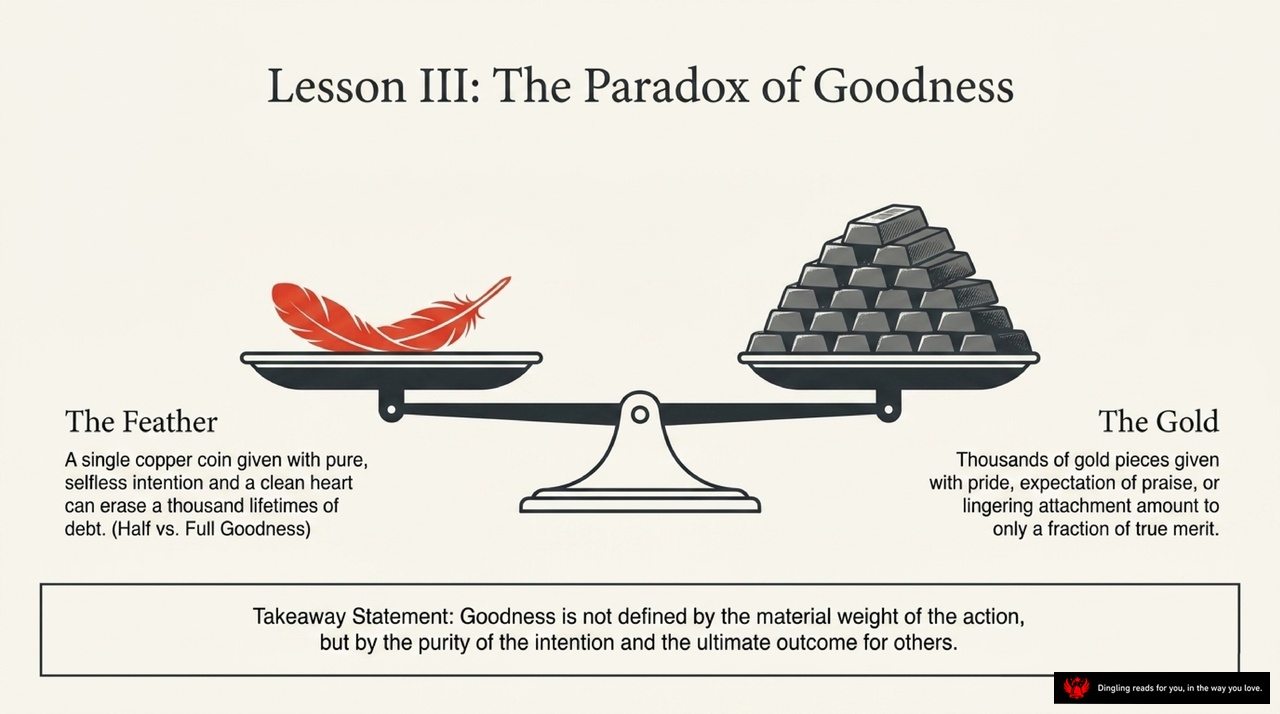
Look at this scale. On one side, we have a single feather representing a small act of kindness done with pure, selfless intention. On the other, a mountain of gold representing thousands of grand deeds done with pride or expectation of praise. The image suggests that the feather can outweigh the gold. This is the core of Lesson III: The Paradox of Goodness.
In our book, this concept is beautifully illustrated through the story of Yao Lifan. Initially, he believed his fate was fixed, much like a puppet on a string. But after meeting Master Yun Gu, he realized that destiny isn't written in stone. He learned that goodness isn't defined by the material weight of the action or the size of the gift, but by the purity of the intention and the ultimate outcome for others.
The text warns us that even if we give thousands of gold pieces with pride or expectation of praise, it amounts to only a fraction of true merit. Conversely, a single copper coin given with a clean heart can erase a thousand lifetimes of debt. This is the difference between half goodness and full goodness. True merit comes from acting without attachment, without seeking recognition, and purely for the benefit of others.
So, the takeaway is clear: Goodness is not defined by the material weight of the action, but by the purity of the intention and the ultimate outcome for others. When we act with a selfless heart, even the smallest gesture carries infinite weight, far surpassing any amount of material wealth given with selfish motives.
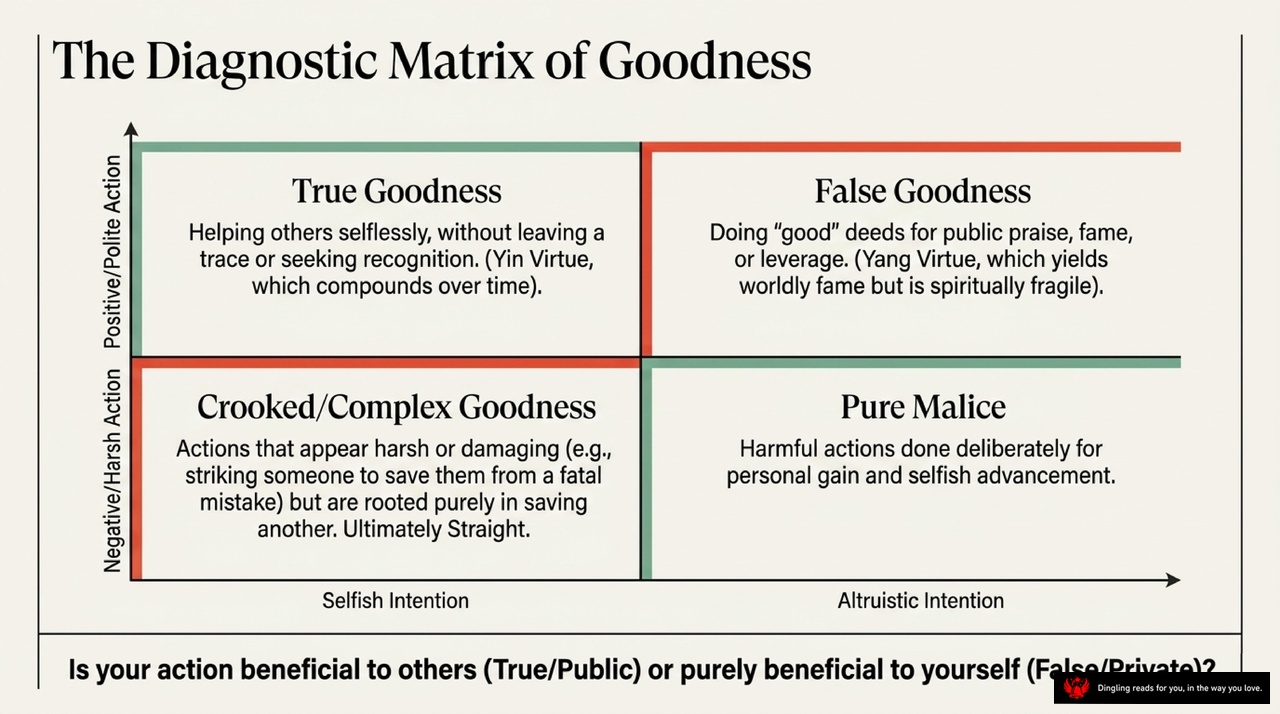
Goodness isn't a simple black-and-white concept. It's a complex landscape where intention meets action. To truly understand where we stand, we need a diagnostic matrix. Look at this framework: it plots every action on two axes. The horizontal axis asks about your intention: is it driven by selfish gain or altruistic care for others? The vertical axis examines your method: is your approach positive and polite, or negative and harsh?
When we combine these, four distinct quadrarts emerge. In the top-left, we find "True Goodness." This is the gold standard: helping others selflessly, without seeking recognition. It's the Yin virtue that compounds over time, building deep spiritual strength. Conversely, the top-right shows "False Goodness." Here, people do good deeds purely for public praise, fame, or leverage. It's the Yang virtue that yields worldly success but remains spiritually fragile.
Now, look at the bottom half. It challenges our common sense. The bottom-left quadrant is labeled "Crooked/Complex Goodness." These actions might appear harsh or damaging on the surface—like striking someone to save them from a fatal mistake—but they are rooted purely in saving another. Ultimately, they are straight. The bottom-right is "Pure Malice," where harmful actions are done deliberately for personal gain.
The core question this matrix asks is simple yet profound: Is your action beneficial to others, or is it purely beneficial to yourself? True goodness isn't just about the result; it's about the purity of your heart and the wisdom of your approach. By understanding these four types, we can diagnose our own behavior and move closer to authentic virtue.
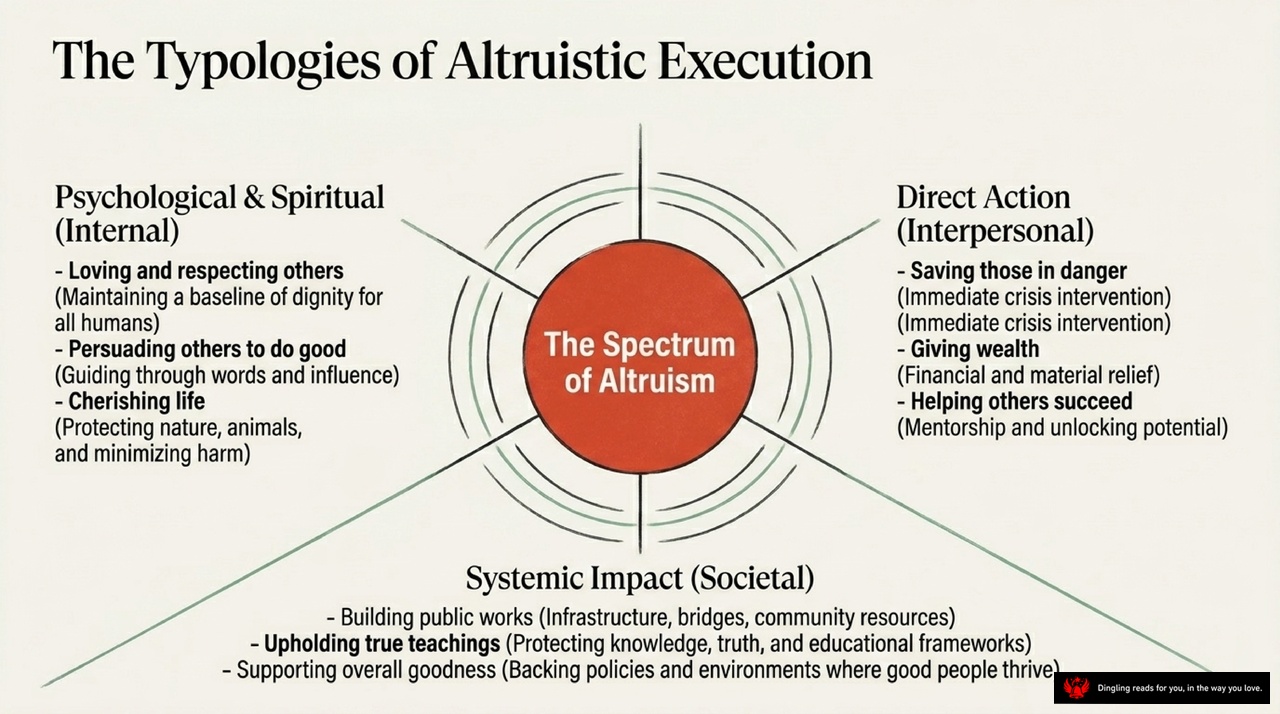
The Spectrum of Altruism isn't just a theory; it's a living map for how we actually impact the world. Look at this diagram. It breaks down the different ways we can execute altruism, moving from the inside out.
On the left, we have Psychological and Spiritual actions. This is the internal work. It's about loving and respecting others, maintaining that baseline of human dignity. It's also about persuading people to do good through influence, and cherishing life by protecting nature and minimizing harm. This is the foundation. Without this mindset, any action we take lacks a soul.
On the right, we see Direct Action. This is where we step out and engage with people. It's about saving those in immediate danger, giving wealth to provide relief, and helping others succeed through mentorship. This is the interpersonal layer of doing good. It's tangible, immediate, and deeply human.
Finally, at the bottom, is Systemic Impact. This is the societal level. It's about building public works like bridges and infrastructure, upholding true teachings to protect knowledge, and supporting policies that allow good people to thrive. This is the big picture. It's about changing the environment so that goodness can flourish on a large scale.
The beauty of this framework is that it shows us there is no single way to be altruistic. You can start by changing your own heart, then help your neighbors directly, and finally work to build a better society. True altruism covers all these dimensions, creating a ripple effect that touches every level of human life.
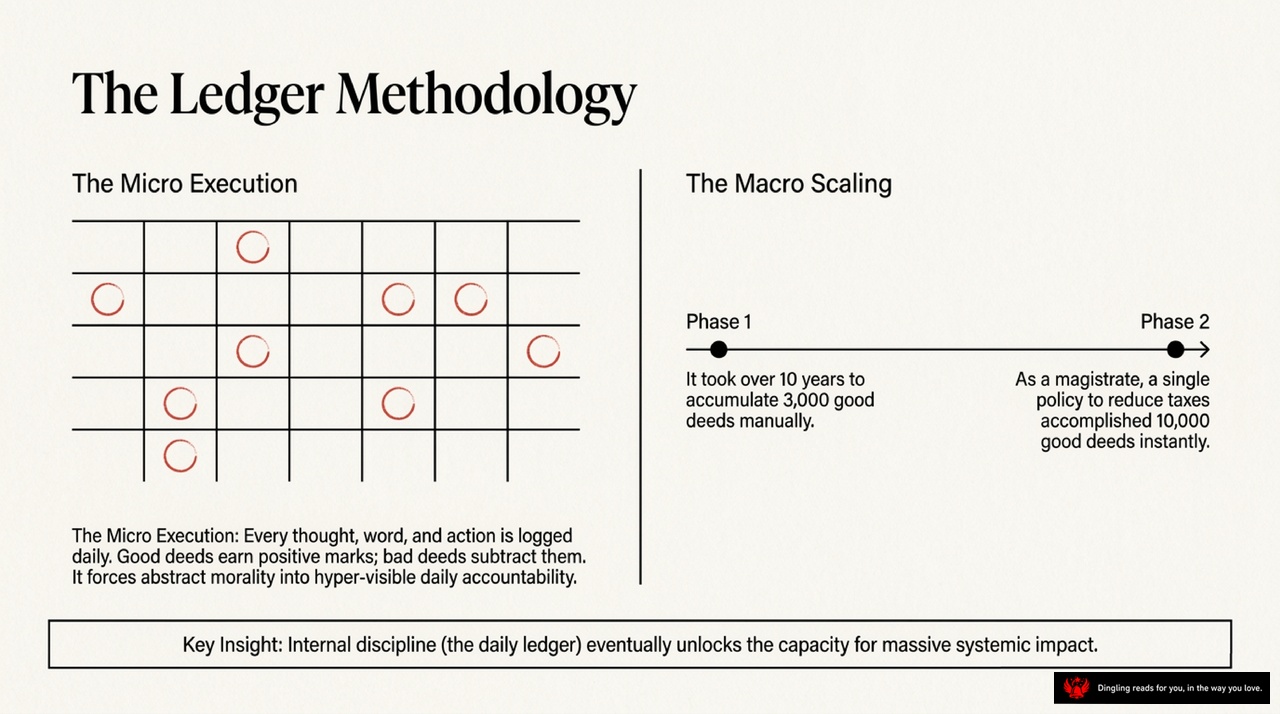
The Ledger Methodology isn't just a metaphor; it's a practical operating system for transforming your life. On the left, we see "The Micro Execution," represented by that grid of red circles. This visualizes the core idea from the text: every single thought, word, and action is logged daily. Good deeds earn positive marks, while bad ones subtract them. It forces abstract morality into hyper-visible daily accountability. Think of it as your personal dashboard, turning invisible character into visible data.
On the right, we move to "The Macro Scaling," showing a timeline from Phase 1 to Phase 2. Phase 1 represents the hard grind: it took over ten years to manually accumulate 3,000 good deeds. That's the slow, deliberate work of internal discipline. But Phase 2 shows the breakthrough. As a magistrate, a single policy to reduce taxes instantly accomplished 10,000 good deeds. This illustrates the key insight at the bottom: internal discipline eventually unlocks the capacity for massive systemic impact.
The lesson is clear. You start by fixing yourself, one small act at a time, just like filling those circles in the grid. But once your character is solid, your influence scales exponentially. You don't just change your own life; you create a ripple effect that touches thousands, turning personal virtue into public good.

Look at this serene landscape: mountains rising gently, a river winding through them, and a vessel waiting at the bottom. This visual perfectly captures the core principle of Lesson IV: The Shield of Humility.
The text reminds us of an ancient truth: Heaven, Earth, and Spirits diminish the arrogant but bless the humble. Why? Because arrogance creates a closed, full vessel that can receive nothing more and actively invites destruction. It's like a cup already overflowing; no new wisdom or fortune can enter.
In contrast, humility is the lowest point—an empty vessel that naturally attracts and retains flowing wisdom, goodwill, and fortune. Think about it: to maintain the destiny you have built, you must operate with the mindset that even if you are highly educated, consider yourself shallow; even if you are wealthy, consider yourself poor. This isn't about self-deprecation; it's about creating space.
When you fill yourself with ego, you block the flow of life. But when you remain humble, you become a channel through which blessings can pass. Humility acts as the final shield to protect all the accumulated virtue you've worked so hard to build. So, before you reach for the next achievement, ask yourself: is my cup empty enough to receive what the universe has to offer?

The Mechanics of Destiny is not a rigid cycle we spin in circles, but a dynamic synthesis where we actively rewrite our own story. Look at this loop: it starts with recognizing agency. We must shatter the illusion of fixed fate and take ultimate ownership of our future. But ownership isn't just about ambition; it's about reform. We need to purify our intentions, using shame, fear, and courage to root out those negative cognitive patterns at their absolute base. Once our mind is clear, we move to execution. This is where we accumulate goodness—utilizing the "Ledger" to perform true, hidden, and systemic altruism for the world. We act with genuine kindness, even when no one is watching. But here is the crucial pivot: true mastery requires humility. We must protect our outcomes by remaining an empty vessel. If we become arrogant, we risk destroying the fortune we've built. By staying humble, we prevent arrogance from sabotaging our progress, which loops back to give us even greater capacity. When we recognize our agency, purify our intent, execute value with humility, and remain open to learning, we don't just follow destiny—we master it.
True transformation isn't a gift from heaven; it's an architecture we build ourselves by reforming our minds, accumulating hidden goodness, and maintaining absolute humility. If your destiny is entirely in your hands, what choices will you make today to shape your tomorrow?
Let's be real: most of us feel like we're just passengers in life, waiting for fate to hand us the steering wheel. But the truth is, the wheel is already in your grip. When we stop blaming the stars and start taking responsibility, something shifts. We realize that our future isn't written in the stars—it's written in our daily choices. Every time we choose kindness over anger, humility over ego, and action over complaint, we are actively rewriting our destiny.
Think about it: if you believe your success is predetermined, why try? But if you believe you have the power to change your story, everything becomes possible. This isn't about ignoring challenges; it's about refusing to be a victim of them. It's about understanding that while we can't control every external event, we always control our response to them. And that response is where the magic happens. So, what's one thing you can do right now to build that new architecture? Maybe it's forgiving someone who hurt you, or helping a stranger without expecting anything in return. Those small acts are the bricks of a better tomorrow. The power to change your life is waiting for you to pick it up.