
Liquid Modernity: Complete Chapter-by-Chapter Summary

Welcome to our deep dive into Zygmunt Bauman's groundbreaking concept: Liquid Modernity. Imagine society not as a solid, unyielding structure, but as a fluid, ever-changing state. Just like the water flowing beneath the rigid concrete grid you see here, our modern world has melted from heavy, fixed institutions into something unpredictable and ceaselessly shifting.
In this fluid state, nothing stays still. Jobs, relationships, and even our identities are no longer permanent; they are temporary encounters. Power has become lighter and more elusive, escaping responsibility rather than enforcing control. We are all involuntary nomads, constantly adapting without a stable home to return to. And consumption? It's no longer just about buying things; it's the main way we build who we are, chasing instant gratification over long-term security.
Bauman argues that while the old "solid" modernity sought order and stability, our current era embraces uncertainty as its normal condition. Everything that was once solid has now dissolved. We've moved from a world of fixed rules to one where we must constantly choose and create our own paths, even as we face deep anxiety about where we're going. This isn't chaos; it's a new logic where speed and flexibility rule, turning everything into something movable, exchangeable, and consumable. We live in a world of infinite possibilities, but also infinite risks.

Defining Liquidity isn't just about water or gas; it's about the very fabric of our modern life. Look at this slide: on the left, an anchor dragged onto a hard, unyielding floor, and on the right, a fluid, digital wave that never holds its shape. This visual perfectly captures the shift we've been discussing.
For over a century, progress was all about melting down old, inefficient traditions to cast new, permanent solids—institutions, classes, and routines. We wanted to build a solid world. But today, the melting continues, and we've thrown away the molds entirely. We have entered the era of Liquid Modernity.
As the text reminds us, "Fluidity is the quality of liquids and gases... they cannot easily hold their shape." The crucial insight here is that to describe fluids, leaving out the dimension of time would be a grievous mistake. Liquidity isn't just a physical state; it's a temporal one. Because everything is constantly moving and changing, nothing can settle into a fixed shape. This is the core of our current reality: a world where the solid structures of the past have dissolved, and we are now navigating a landscape defined by constant flux and uncertainty.

The slide before you captures a fundamental shift in how we understand the world: the transition from "Solid Modernity" to "Liquid Modernity." Think of it as the difference between a heavy, immovable fortress and a fluid, ever-shifting ocean.
On the left, we have **Solid Modernity**, described as "Heavy." Here, power was territorial and conquest-driven, rooted in land and physical boundaries. The economy focused on hardware, heavy industry, and sheer size. Time was a tool used to conquer space, and labor and capital were bound together in a permanent "marriage"—like the lifelong employment of the Fordist era. Social control relied on the Panopticon, a system of constant surveillance. Everything was fixed, predictable, and anchored.
Now, look at the right side: **Liquid Modernity**, or "Light." The logic has completely flipped. Power is now extraterritorial and evasion-driven. Instead of conquering land, the goal is to escape it. The economic focus has shifted from hardware to software, information, and speed. Notice how time no longer conquers space; it annihilates it through instantaneity. Distance and delay have lost their meaning.
This shift has severed the bond between labor and capital. They are now divorced; capital moves instantly, leaving labor behind. Social control has moved from the Panopticon to a Post-Panopticon era, where the strategy is no longer constant surveillance, but rather the ability to escape and disconnect. As the bottom line of this slide states, "Big is no longer better." In this new world, power belongs to the swift, the light, and the unburdened. We have traded the stability of the heavy for the agility of the light, fundamentally changing the rules of survival.

The Illusion of Freedom. Look at this image: a birdcage with its door swinging open, and a stream of blue energy rushing out into the void. It's a powerful visual metaphor for our current reality.
In heavy modernity, we thought emancipation meant escaping the totalitarian grip of "Big Brother" or the suffocating routines of the factory. Today, we are finally free from those rigid structures. But this freedom comes with a terrifying catch: there is no Big Brother watching you anymore. It is now your task to watch yourself.
We have moved from a world where institutions controlled our lives to one where we are entirely responsible for our own fate in a ceaselessly unpredictable world. The cage is open, but the storm outside is relentless. We are the only ones holding the reins now.

In the age of light capitalism, the very nature of work has been upended. We've moved from an era where jobs were lifelong "marriages" between labor and capital to a world defined by the "liquid" individual. The bridge between who we are legally supposed to be and what we can actually do is crumbling.
As the slide illustrates, we face a widening "Individuality Gap." On one side, we have the *De Jure Individual*—the person granted legal freedom. On the other, the *De Facto Individual*, who lacks the actual power to act. The gap between them is "The Agora," or the public space where we used to solve problems together.
But here's the hard truth: that public space is shrinking. Because we've lost our collective safety nets, we are forced to seek "biographical solutions" to systemic contradictions. In other words, we are told that our problems—unemployment, illness, anxiety—are not results of a broken system, but failures of our personal choices. We are given the legal right to self-determination, yet stripped of the resources to control our destinies.
This shift forces us to become "unwilling nomads," constantly adapting to a market that offers no stability. Instead of relying on a community to share the burden, we are pushed to treat our lives as a series of short-term, disposable transactions. We build fragile, temporary connections just to survive, and we reframe our deepest struggles as individual identity crises. We are told to fix ourselves, rather than fixing the structures that are failing us. This is the paradox of our time: we are hyper-individualized, yet deeply alone.

In today's fluid modernity, the very nature of our identity has undergone a radical shift. We no longer shop simply to acquire durable goods for our daily lives; we shop to construct who we are. As the slide suggests, "We Shop, Therefore We Are." Identity has moved from being a given—a fixed inheritance based on rigid social classes or family background—to a task that we must actively perform every single day.
Look at that circular flow of shopping carts and glowing figures. This visualizes our new reality: without stable anchors like traditional communities or lifelong careers, we build our selves through consumption. Every purchase is a vote for the person we want to become. We chase trends that change at lightning speed because, in this era, commitment feels like a liability. If we stay too long with one style or one label, we risk becoming obsolete. So, we must remain easily disposable, constantly swapping our identities to keep up with the rapid pace of the market.
This creates a paradox. While we feel we have the freedom to choose and reinvent ourselves at will, we are actually trapped in a cycle of anxiety. We are forced to continuously "construct" our identity through consumption, never allowed to simply "be." We are no longer the masters of our destiny; we are the permanent customers in a casino where the only way to survive is to keep spending, keep changing, and keep performing. Our identity is no longer a stable home we live in; it is a fleeting task we are always working on, never quite finishing.

Welcome back. Today, we're diving into the very heart of the sociologist's mission in a world that never stops moving.
The image on your screen captures a profound truth: the annihilation of space. We've moved from slow physical limits to conquering space with hardware, and now we are in Phase 3: Instantaneity. As the text reminds us, "When time approaches instantaneity, space loses its value." Speed is no longer just about distance; it is the ultimate weapon.
But what does this mean for our understanding of reality? The core mission of the sociologist is to pierce the barrier of "obvious truths." We live in a world where common sense, rigid rules, and cognitive inertia act like a wall, hiding the vast possibilities of human life. They convince us that certain boundaries are natural limits, when in reality, they are just artificial constructs.
To do this, sociologists must adopt the spirit of the exile. It's not just about physical displacement; it's about maintaining a dual perspective—being both an insider who understands the culture and an outsider who can critically examine it. We need the sensitivity of a poet to spot the possibilities that have always existed but remain invisible.
However, in our fluid modernity, this mission faces unique challenges. People crave a "fundamental shelter," retreating into simplified identities and pre-made value systems to avoid the risk of thinking for themselves. They are told there are "no other options," a phrase that silences resistance and justifies inequality.
This is where the sociologist steps in. We must reject the myth of neutrality. True neutrality is an escape. Our job is to be like a physician diagnosing an invisible social disease. We must reveal the structural roots of suffering, showing individuals that their personal pain is not a fate, but a result of specific social orders. We have to shatter the lie of "no choice" and prove that the world is malleable.
Ultimately, the goal has shifted. In the past, sociology sought to maintain order. Now, in an era of fluidity and uncertainty, our job is to promote autonomy and freedom. We are not here to offer comfort in a shelter; we are here to empower individuals to take responsibility for their lives. By rewriting the narrative of what is possible, we help people realize that the future is not a fixed track, but a canvas they can paint themselves.

Who really holds the reins in today's world? The image on this slide tells a stark story of two very different realities. Look up at the top: private jets cutting through the clouds, connected by a glowing web of smartphones and data. This represents the "Nomads"—the global elite. Their power isn't built on owning land or controlling a factory; it's built on speed and the ability to escape instantly. They rule by disconnecting and moving, leaving problems behind the moment they become inconvenient.
Now, look down at the bottom. It's a monochrome world of concrete walls, barbed wire, and rigid industrial structures. This is "The Tethered." While the elite fly away, the poor and marginalized are locked to the ground. They are trapped by physical borders and local struggles, unable to simply pack up and leave.
This divide defines our liquid world. Power has shifted from holding territory to controlling the flow of capital and information. The elite treat the world as a playground they can enter and exit at will, while the rest of us are stuck in a system we can't easily leave. It's a fundamental inequality not just of wealth, but of mobility itself.

The gears of the old industrial world are rusting and falling apart, while a digital wave surges forward, leaving a solitary figure stranded in its wake. This slide captures the defining tension of our time: "The Divorce of Capital and Labor."
In the era of Solid Modernity, think Henry Ford's time, capital and labor were locked in a rigid marriage. Massive factories acted as the glue, binding workers to companies for life. It was a stable, predictable world where loyalty was rewarded, and the machine and the man moved as one.
But then came the Software Era, ushering in Liquid Modernity. The divorce is final. Today, capital is incredibly light. It can flow across the globe at the click of a button, seeking the lowest cost and highest profit instantly. It no longer needs heavy factories or loyal employees. It is free to flee if things get tough.
Yet, look at the bottom half of the image. Labor is left behind. Unlike capital, workers are still tied to specific locations and physical bodies. They are "stranded." When a company decides to move, it takes the money and the technology, leaving the local workforce with no job and no safety net. This creates a stark new reality: a world where wealth is fluid and global, but work is stuck and local.
This divorce means that the power to shape our lives has shifted entirely. Those who can move with the capital—think of tech founders or investors—hold the keys to the future. Meanwhile, the traditional workforce faces increasing instability, forced to compete globally without the protection of the old industrial structures. We are witnessing the end of the "company man" and the rise of a precarious world where the only currency that matters is the ability to adapt faster than the market can run away.
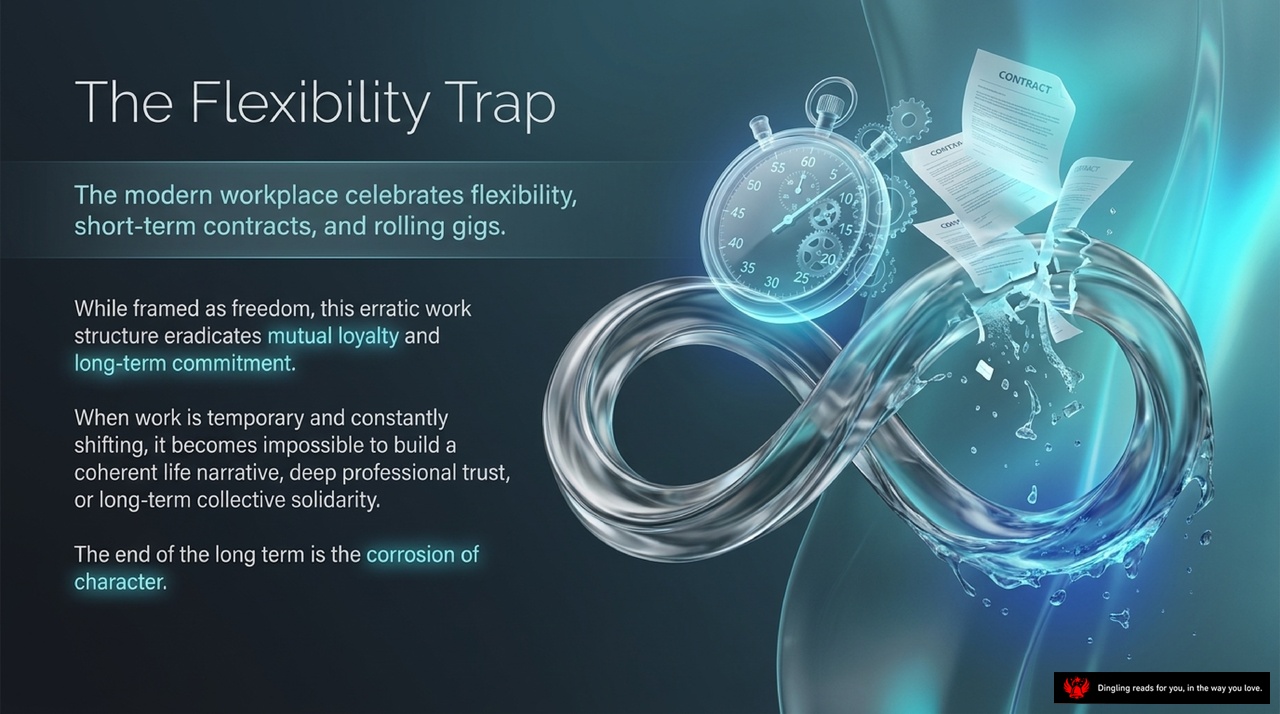
We often hear the modern workplace celebrate flexibility, short-term contracts, and rolling gigs. But look closer at that image of the stopwatch and the breaking contract—it reveals something darker: the Flexibility Trap. While this erratic work structure is framed as freedom, it actually erodes mutual loyalty and long-term commitment. When work becomes temporary and constantly shifting, it becomes impossible to build a coherent life narrative or deep professional trust. Without the stability of the long term, we see the corrosion of character. The end result isn't liberation; it's a cycle where the very flexibility promised to us ends up dismantling the foundations of our professional identity and trust.
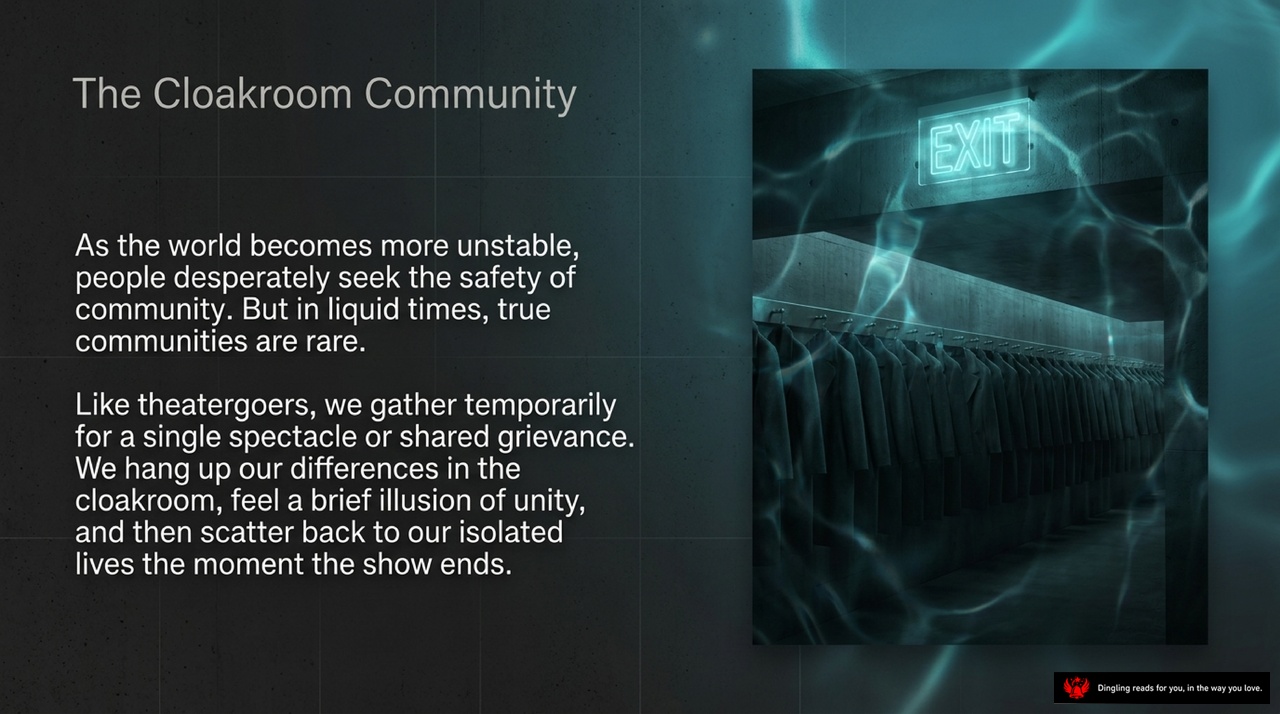
In today's unstable world, we all crave the safety of community, but true belonging is becoming a rare commodity. Think of modern life like a theater where everyone rushes into a cloakroom before a show. We temporarily hang up our differences, our unique backgrounds, and our specific grievances, pretending to be part of a unified crowd. It feels safe, doesn't it? Just for a moment, we share a common illusion of unity.
But the moment the curtain falls, the show ends, and we scatter back to our isolated lives. We take our coats back, reclaim our individual identities, and head home alone. This is the "cloakroom community"—a fleeting gathering based on a single spectacle or a shared complaint, with no real connection afterward. We are constantly seeking a temporary fix for our loneliness, only to find that these connections dissolve as quickly as they form. In this liquid modernity, we are never truly together; we are just briefly, conveniently, and artificially close until the next performance begins.

When the world feels too big and unpredictable to control, our instinct is to build walls. We create gated communities, install security cameras, and draw sharp lines between "us" and "them." We convince ourselves that keeping everyone around us the same—enforcing local sameness—is the only way to protect ourselves from the chaos of global uncertainty.
But this strategy is a trap. As the text reminds us, when we can't control the vast, unpredictable forces of global liquid capitalism, we simply project our anxiety onto physical boundaries. We mistakenly believe that shutting out strangers will save us. In reality, by trying to freeze ourselves in a bubble of safety, we ignore the very fluidity that defines our modern world. We are building a fortress against a world that has no walls, hoping that isolation can shield us from a reality we can no longer hold still.

Synthesis: The Liquid Human Condition. In our modern world, the only constant is change. We've entered a state where society no longer guarantees our path, our jobs, or even our sense of meaning. The systems that once governed us have melted away, leaving us completely alone to navigate a world moving at the speed of light.
This brings us to what we call the Liquid Human Condition. At the center of this reality sits "The Burden of Uncertainty." It's not just a feeling; it's the defining weight of our era. Surrounding this core are six key forces reshaping our lives.
First, we face **Forced Emancipation**. We are told we are free, but that freedom is a trap. We are liberated from stable structures only to be thrown into a chaotic void where we must bear all risks alone.
Second, our identities have become **Disposable**. In a fluid world, who we are is no longer fixed by birth or tradition. Instead, we must constantly choose, create, and discard versions of ourselves. Identity is now a temporary project, easily abandoned when it no longer serves us.
Third, we live in **Cloakroom Communities**. These are temporary groups we join for specific moments—online forums, interest groups, or even fleeting social circles. They offer a sense of belonging, but like a coatroom, we leave our true selves behind once the interaction ends. They provide comfort without the deep, difficult bonds of a real community.
Fourth, our work is now **Fragmented**. The era of the "career" is over. We move from job to job, project to project, with no long-term security. We are forced to adapt constantly, treating our lives as a series of short-term gigs rather than a cohesive journey.
Fifth, we operate with **Nomadic Power**. Power no longer comes from holding territory or institutions. It belongs to those who can move fastest, escape constraints, and seize opportunities before they vanish. Stability is the enemy of the powerful; flexibility is the new currency.
Finally, all of this creates a profound sense of isolation. We are individuals in a system that demands constant adaptation but offers no safety net. We are the architects of our own lives, yet we lack the tools to build anything lasting.
This synthesis captures the essence of our time: a world of infinite choice and zero stability. We are liquid, free, and utterly alone.

We've traded the heavy, stifling cages of the past for a weightless, boundless anxiety that defines our present. In this world, capital flows freely, commitments dissolve instantly, and the burden of survival rests entirely on our own shoulders. But here's the real question: Are we truly free when we are endlessly forced to construct our own certainty in a world that never stops melting?
Think about it. We used to rely on stable structures—jobs, communities, clear identities. Now, everything is fluid. We are forced to become our own architects, constantly building and rebuilding our lives in an environment that refuses to stay still. This isn't just about moving physically; it's about the deep uncertainty in every aspect of our existence. We are no longer passive participants in a fixed system; we are the ones who must constantly adapt, choose, and create our own path, often without a map.
This shift from stability to fluidity has changed everything. We are no longer part of a collective safety net; we are individuals navigating a sea of uncertainty. The freedom we enjoy is also a heavy burden, because the responsibility for our survival and identity lies solely with us. In a world that never stops changing, finding a sense of certainty becomes a constant struggle, and that struggle is at the heart of our modern experience.