
Low-Risk Entrepreneurship: Complete Chapter-by-Chapter Summary

Welcome to a book club session on "Low-Risk Entrepreneurship" by Fan Deng. Today, we're diving into the very foundation of the book.
Look at this cover. It contrasts a rigid engineering blueprint on the left with a dynamic, branching neural network on the right. This visual perfectly captures the book's core promise: moving away from the old myth that "high risk equals high reward." Instead, Fan Deng offers you a structural blueprint for building an anti-fragile business—one that thrives even in uncertainty.
The book argues that you don't need to gamble your life on a high-stakes bet. True low-risk entrepreneurship isn't about avoiding danger; it's about designing a business structure where the downside is capped, but the upside is unlimited. It's about replacing fear with a clear, logical system.
As we move through this series, we'll explore how your childhood shapes your risk tolerance, how your personality acts as an invisible regulator, and most importantly, how to find the right problem to solve. We'll look at why copying others fails, how to build a "secret" that competitors can't replicate, and the power of non-symmetrical trading.
Whether you're a seasoned founder or just starting out, this book provides the tools to build a business that is resilient, scalable, and ultimately, sustainable. Let's begin our journey into the art of low-risk entrepreneurship.

Risk is not a requirement for success; it's actually a symptom of ignorance. Today, we're looking at the stark difference between the "Gambler Myth" and the "Prepared Expert."
On the left, you see the gambler blindly leaping off a cliff, believing that risk and reward are directly proportional. This is the biggest lie in business. True entrepreneurs don't take leaps of faith. Instead, they systematically engineer risk out of the equation through superior capability and knowledge.
Contrast that with the expert on the right. He is walking a tightrope, but he's not gambling; he's prepared. This is the Li Ka-shing Principle. Before dominating real estate, he built plastic flowers. He didn't invest a single cent in property until he fully understood the production, sales, and exact margins of that business. He built a foundation of capability first.
The takeaway is clear: Capability minimizes risk. When you possess deep knowledge and skills, you transform uncertainty into a manageable path. You stop fearing the fall and start mastering the walk.

Welcome back. Today, we're diving into the heart of what makes a business truly resilient. Look at this funnel—it's not just a graphic; it's a blueprint for finding the right problems to solve.
The journey starts at the top. We need to listen for complaints. Don't ignore the negativity; that's where the biggest opportunities hide. Think about how Facebook started from students complaining about finding contacts, or how ride-sharing apps emerged from the frustration of hailing a cab. These aren't just gripes; they are unmet needs waiting to be solved.
But listening isn't enough. We also need to observe the paradox. Like Uniqlo, which solved the conflict between high quality and low price. You have to spot these contradictions in the market. Once you have these clues, you move through the filter layer to find the "True Pain." This is the crucial step. You must differentiate between a minor inconvenience and a desperate, urgent need. A problem must be large enough to sustain a massive market and painful enough to force immediate adoption.
Finally, everything funnels down to The MTP—Massive Transformative Purpose. This is your secret weapon. It's the goal that is so grand it inspires everyone, from your team to your users. Whether it's Google's mission to organize the world's information or helping 300 million people read, having this massive purpose gives you direction and makes every challenge a stepping stone.
So, remember: start with the complaints, spot the paradox, find the true pain, and anchor it all with a massive purpose. That is how you build a business that doesn't just survive uncertainty, but thrives in it.

So, how do you actually build a fortress around your business that no competitor can breach? The answer lies in mastering "The Secret." As the slide defines it, a secret isn't a hidden trick; it's something you can openly explain, yet your competitors simply cannot copy. Think of it as your defensive moat.
Let's break down these six pillars of your moat. First, **Price**. This isn't just about low costs; it's about structural advantages. Like Galanz dominating the microwave market, if your cost structure is fundamentally better, you win. Second, **Brand**. When your brand builds such deep trust that marketing costs drop to zero, you've created an unassailable position. Third, **Resources**. This is about exclusive access to raw materials or intellectual property that others simply don't have.
Then we have **Technology**. This is your hardest barrier. It's not just having a patent; it's owning proprietary algorithms or formulas that define your industry. Fourth, **Operations**. Can you execute in a way that is literally un-copyable? Take Haidilao; their service isn't just about being nice, it's a complex, un-replicable system. Finally, **Users**. This is the power of network effects and that "1,000 True Fans" loyalty base. If your users are so loyal they bring in more users, you have a moat that gets stronger every day.
Remember, without these secrets, you're just playing a game where anyone with enough capital can copy you. Build your moat, and you secure your future.
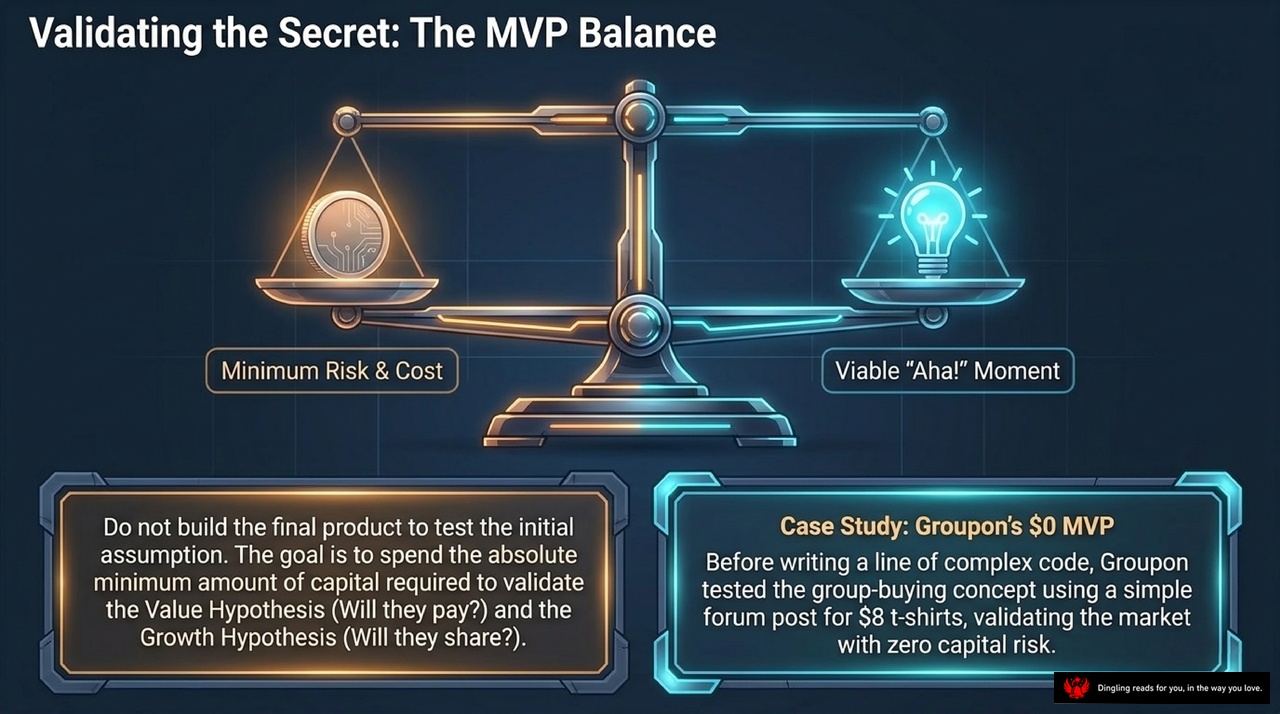
Today's slide breaks down the MVP Balance into two critical weights: Minimum Risk & Cost on one side, and a Viable "Aha!" Moment on the other. This visual perfectly captures the core philosophy of low-risk entrepreneurship: you never build the final product to test an idea. Instead, you spend the absolute minimum capital required to validate two hypotheses. First, the Value Hypothesis—will they actually pay? And second, the Growth Hypothesis—will they share it with others?
Look at the case study on the right: Groupon's legendary $0 MVP. Before writing a single line of complex code, they tested the group-buying concept using a simple forum post for $8 t-shirts. They validated the entire market with zero capital risk. This is the secret to surviving uncertainty. Many founders fail because they build too much too soon, burning cash on features no one asked for. But by balancing minimal cost with a genuine "Aha!" moment, you create a business that is antifragile. You prove the concept first, then scale. It's not about guessing; it's about validating the market's willingness to pay and share before you invest a dime. This balance is your shield against the "barbarians at the gate."
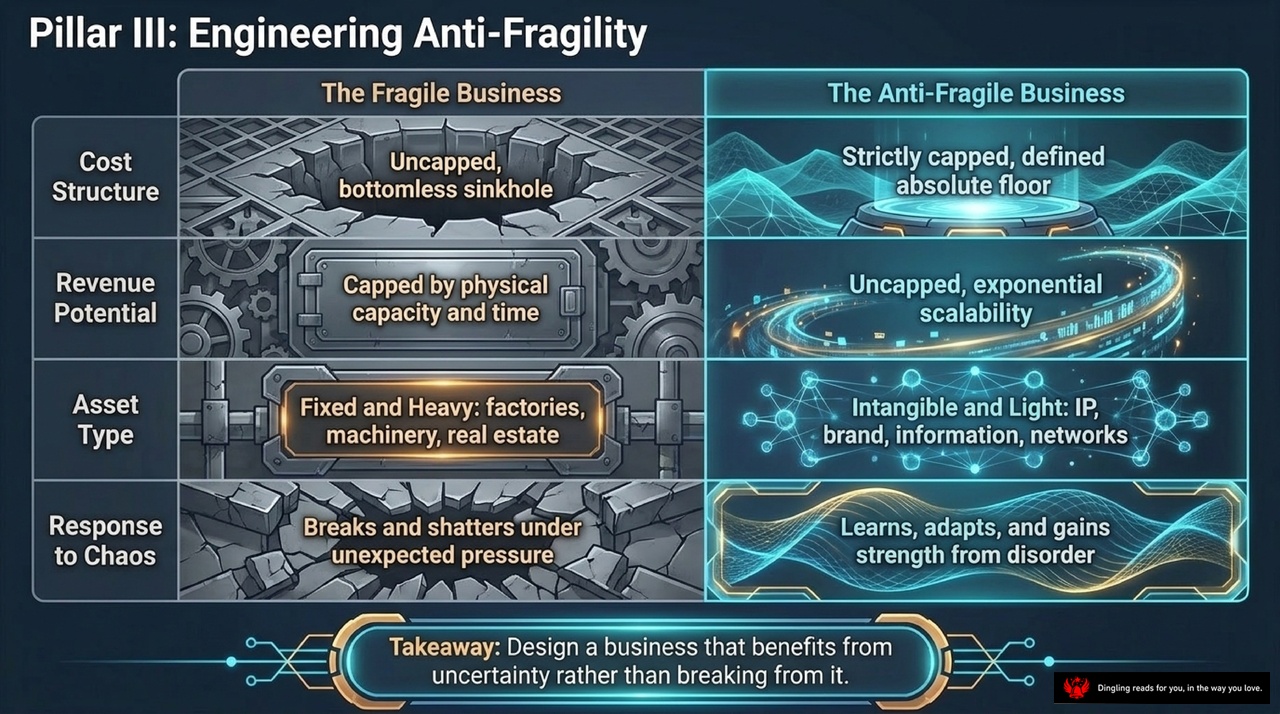
Pillar III: Engineering Anti-Fragility. Look at this comparison between a fragile business and an anti-fragile one. The difference isn't just about surviving shocks; it's about thriving from them.
First, look at the cost structure. A fragile business has an uncapped, bottomless sinkhole. One bad decision can drain everything. In contrast, an anti-fragile business has a strictly capped, defined absolute floor. You know exactly how much you can lose, which gives you the freedom to take smart risks without fear of ruin.
Next, revenue potential. The fragile model is capped by physical capacity and time. You hit a ceiling quickly. The anti-fragile model offers uncapped, exponential scalability. Think software or digital products—your growth isn't limited by how many hands you have.
Then, the asset type. Fragile businesses rely on fixed, heavy assets like factories, machinery, and real estate. These are expensive to build and slow to liquidate. Anti-fragile businesses lean on intangible, light assets: intellectual property, brand, information, and networks. These are easier to replicate and scale globally.
Finally, the response to chaos. When unexpected pressure hits, a fragile business breaks and shatters. An anti-fragile business learns, adapts, and actually gains strength from disorder. Chaos becomes fuel for growth.
The takeaway is clear: design a business that benefits from uncertainty rather than breaking from it. Don't just build a wall to keep problems out; build a system that gets stronger when the storm hits.

The traditional business model looks like a trap: high costs and risks on one side, but your upside is strictly capped. You're playing a game where the worst-case scenario is catastrophic, often leading to that "Valley of Death" of debt. In contrast, low-risk entrepreneurship is a pure asymmetric trade. You mathematically define your absolute floor—the worst case—while leaving your upside potential entirely unconstrained. Think of the ancient philosopher Thales of Miletus. He didn't risk everything; he simply placed low-cost deposits to control olive presses. If the harvest failed, he lost only a tiny deposit. But when the market boomed, he held a monopoly and reaped massive rewards. This is the power of the anti-fragile business. By capping your downside risk, you protect your capital, but by keeping your upside open, you create the possibility for exponential growth. Instead of fearing uncertainty, you design a system where the worst you can lose is manageable, but the best you can gain is limitless. That is the true mathematics of success.

Welcome back. In our previous chapter, we explored how to build an anti-fragile structure for your business. Today, we dive into the heart of that structure: the team.
Look at this slide. It contrasts the "Mechanical Team" with the "Biological Team." This isn't just about organizational charts; it's about two completely different philosophies of how humans work together.
On the left, you see the Mechanical Team. It's built on a Newtonian paradigm—predictable, calculable, and rigid. Think of it as a machine. The structure is a top-down hierarchy, led by a single Commander who controls every gear. In this world, mistakes are punished. Fear is the fuel. And ultimately, this creates fragility. If one gear breaks, the whole machine stops.
Now, look at the right side. This is the Biological Team. It operates on a Darwinian paradigm: emergent and adaptable. Instead of gears, you have neurons—individuals connected in a decentralized, organic ecosystem. Here, leadership isn't a commander; it's a Gardener. The Gardener doesn't control the plants; they create the soil and sunlight, letting the team grow naturally. Crucially, this model allows for bounded mistakes. It views errors not as failures to be punished, but as essential data for learning. This creates anti-fragility. When challenges hit, the team doesn't just survive; it gets stronger.
The core insight at the bottom of the slide is profound: "The stability of the mother system relies on the engineered instability and autonomy of its sub-systems."
In a mechanical team, stability comes from control. But in a biological team, true stability comes from giving your team members the freedom to fail, to experiment, and to evolve. When you empower individuals to be autonomous, the entire organization becomes resilient enough to handle any storm. Don't try to build a machine; cultivate an ecosystem. That is the key to lasting success.

Look at this visual representation of what it takes to build a truly intelligent team. We often think that making a group smart means micromanaging every detail, but the data suggests the opposite. Real, brilliant team behavior emerges not from control, but from simple, shared rules. Think of these as the "Three Lines of Code" that act as the operating system for your collective intelligence.
First, your team needs a line of code dedicated to contributing to society. You must anchor the group in a purpose that is larger than just profit. When the mission transcends the paycheck, people naturally align their efforts toward something meaningful, creating a level of focus that money alone can't buy.
Second, you need a line of code for lifelong growth. This means you must reward a growth mindset over fixed intelligence. If you celebrate learning and iteration, your team stops fearing failure and starts treating mistakes as data. This creates an environment where everyone is constantly upgrading their skills, making the whole group smarter over time.
Finally, the third line of code is continuous experimentation. Your team must be encouraged to step out of their comfort zones and aggressively test new frontiers. Innovation doesn't happen in a safe, static room; it happens when you are willing to try things that might not work.
When you embed these three principles—purpose, growth, and experimentation—into your culture, you stop managing individuals and start leveraging the power of the group. You create a system where complex, brilliant behavior happens automatically, simply because everyone is playing by the same, powerful set of rules.
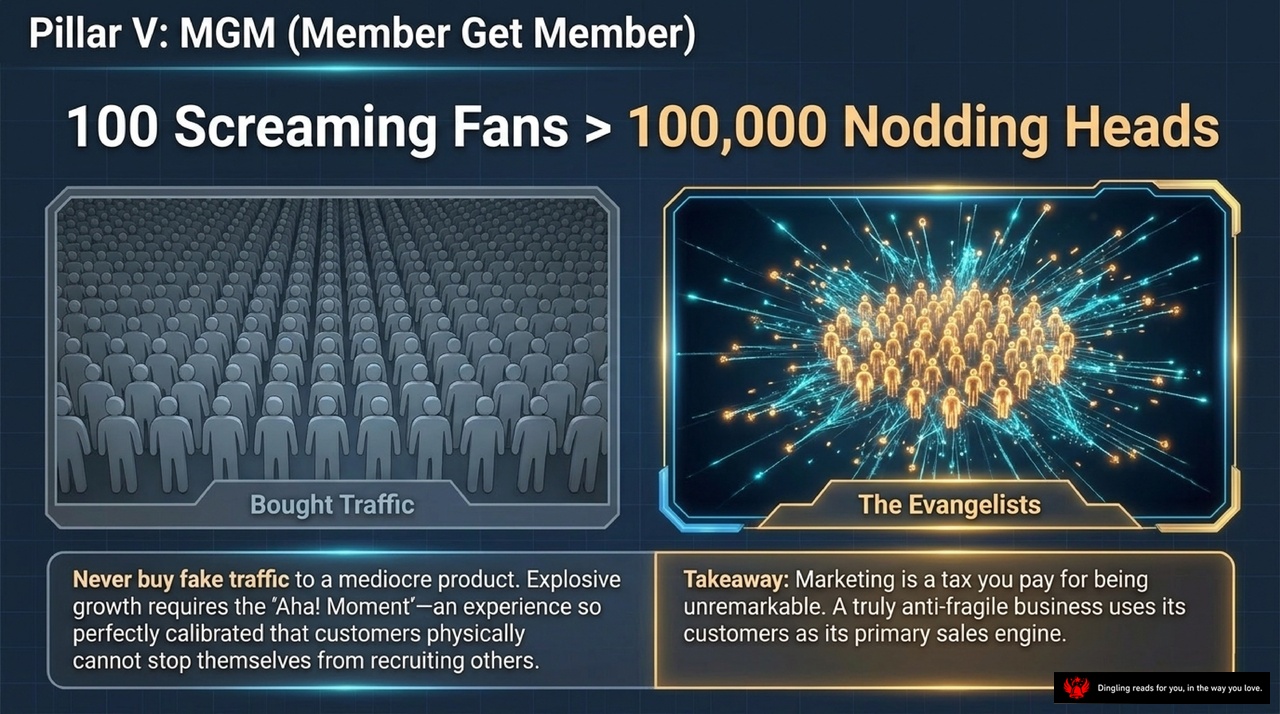
So, let's talk about the real secret to explosive growth. Look at this slide: it's all about shifting from buying fake traffic to building true evangelists. The core message here is simple but powerful: 100 screaming fans are worth way more than 100,000 nodding heads.
On the left, you see "Bought Traffic." This represents the mediocre product approach where you just buy ads. It's like paying a tax for being unremarkable. If your product isn't amazing, you can't just force growth; eventually, the market will reject you.
But on the right, we have "The Evangelists." These are your screaming fans—the people who physically cannot stop themselves from recruiting others. This is the MGM model, or Member Get Member. Explosive growth doesn't come from spending money on ads; it comes from creating an "Aha! Moment." When your product is so perfectly calibrated that users feel a genuine breakthrough, they become your primary sales engine. They turn into evangelists who naturally spread the word.
Remember, a truly anti-fragile business doesn't rely on external funding or paid traffic. Instead, it uses its satisfied customers as its core growth strategy. So, stop chasing empty numbers and start obsessing over that one moment where your customer screams, "This is exactly what I needed!" That's how you build a business that grows itself.
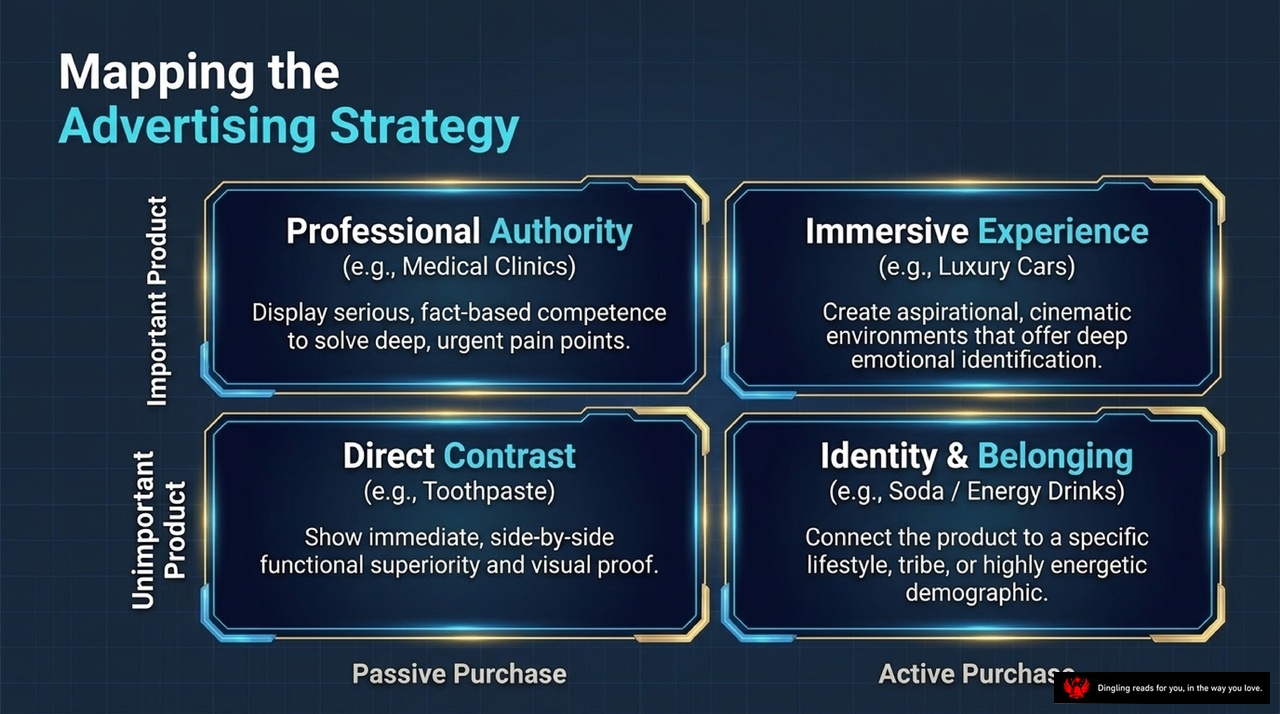
Mapping the Advertising Strategy isn't just about making things look cool; it's about aligning your product's importance with the right psychological hook. Think of your business as sitting on one of four quadrants.
If you're selling something truly vital—like medical clinics—you need to build **Professional Authority**. Show serious, fact-based competence. People don't buy life-saving advice from a personality; they buy it from an expert who solves deep, urgent pain points.
On the other hand, if you're selling luxury cars or high-end experiences, the game changes. These are **Immersive Experiences**. You aren't selling specs; you're selling a dream. Create cinematic environments that offer deep emotional identification. Let the customer live the life they want before they even buy the product.
Now, flip the axis. What if your product feels "unimportant" in the grand scheme? Think toothpaste or soda. Here, you have two distinct paths. For daily essentials, use **Direct Contrast**. Show immediate, side-by-side functional superiority with visual proof. No fluff, just clear evidence that yours works better than theirs.
But for lifestyle products like energy drinks, tap into **Identity & Belonging**. Connect your product to a specific tribe, a cool lifestyle, or a high-energy demographic. People don't just buy the drink; they buy into the group that drinks it.
Finally, look at the bottom axis: Passive versus Active Purchase. Important products often drive passive purchases where people need you to solve a crisis. Unimportant products drive active purchases where people are hunting for identity or fun. Mastering this map ensures you're not just shouting louder, but speaking directly to the human heart and mind.
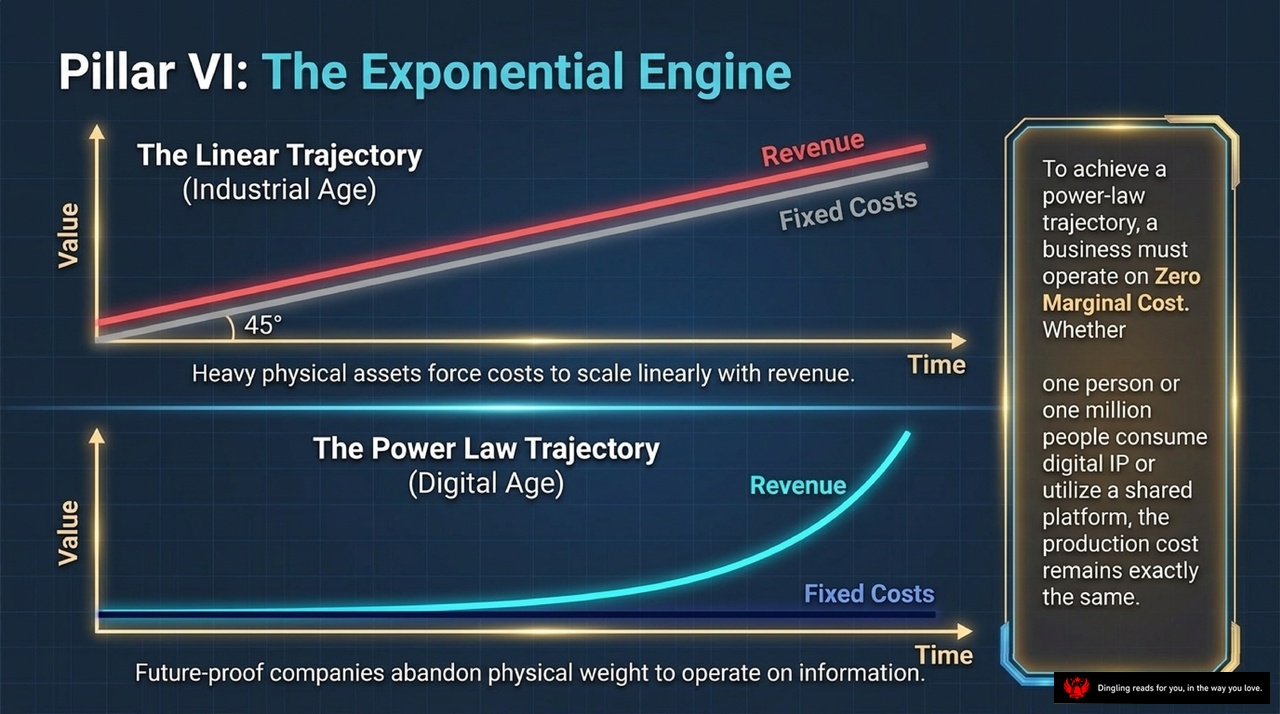
Look at this chart: Pillar Six, The Exponential Engine. It contrasts two worlds. The top graph shows the Linear Trajectory of the Industrial Age, where revenue and fixed costs grow in a straight line at a 45-degree angle. Heavy physical assets force costs to scale linearly with revenue. But the bottom graph reveals the Power Law Trajectory of the Digital Age. Here, revenue curves upward exponentially while fixed costs stay flat. This is the future-proof model.
To achieve this power-law trajectory, a business must operate on Zero Marginal Cost. Whether one person or one million people consume digital IP or utilize a shared platform, the production cost remains exactly the same. Future-proof companies abandon physical weight to operate on information. While the Industrial Age is trapped in linear growth, the Digital Age leverages the exponential engine to scale infinitely without adding proportional costs. This shift from physical assets to information is the key to unlocking massive, unstoppable growth.
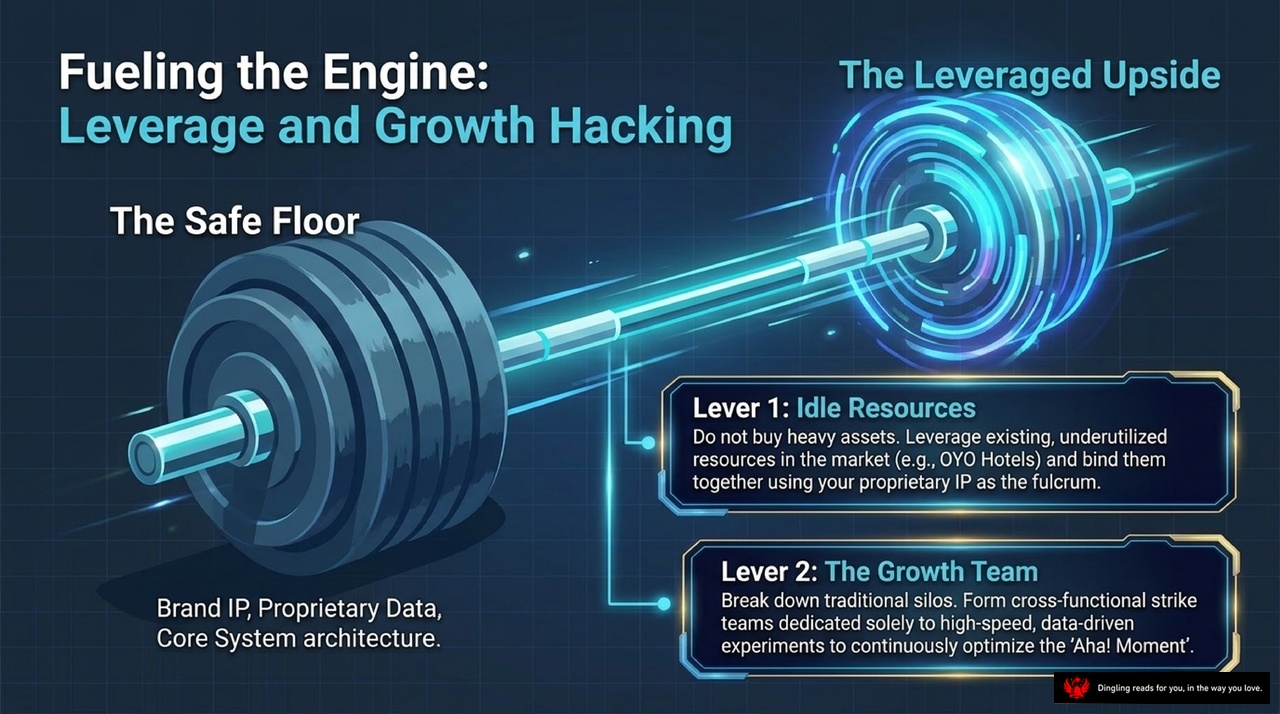
Look at this barbell. On the left, we have "The Safe Floor"—your brand IP, proprietary data, and core system architecture. On the right, "The Leveraged Upside," where growth explodes. This is the essence of fueling your engine: leverage and growth hacking.
First, let's secure that safe floor. Instead of buying heavy assets that trap your cash, leverage idle resources in the market. Think of how OYO Hotels operates without owning a single property. You bind these underutilized assets together using your proprietary IP as the fulcrum. This keeps your base costs low and your risk contained.
But a strong base isn't enough; you need that explosive leverage on the right side. This comes from two specific levers. The first is "Idle Resources." Don't just own everything; use what already exists. The second, and perhaps the most critical, is "The Growth Team." You must break down traditional silos. Form cross-functional strike teams dedicated solely to high-speed, data-driven experiments. Their mission? To continuously optimize that "Aha! Moment" for your users.
When you combine a rock-solid safe floor with a relentless growth team obsessed with experimentation, you stop guessing and start scaling. You build an engine that runs on leverage, not just capital.
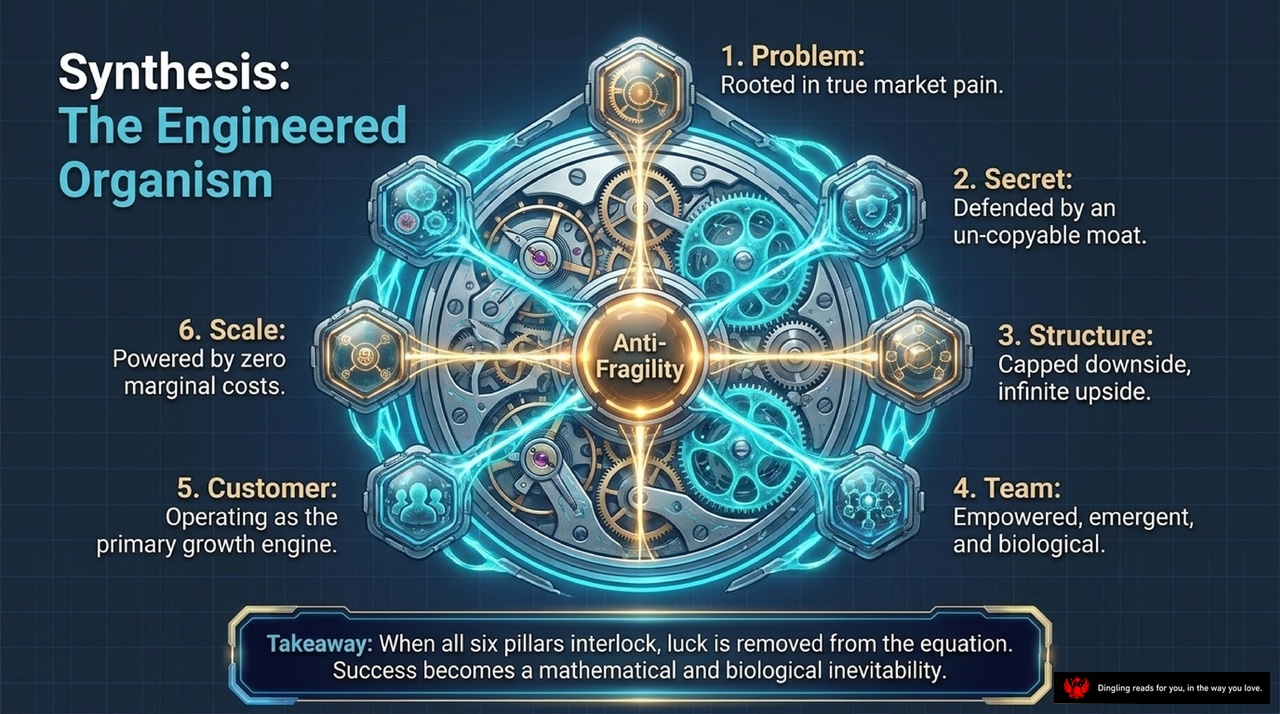
Imagine a world where success isn't a matter of luck, but a mathematical inevitability. This is the power of what we call "The Engineered Organism." When you align six specific pillars, you stop gambling on the market and start building a business that thrives on chaos.
First, your **Problem** must be rooted in true market pain, not just a fleeting trend. Your **Secret** is an un-copyable moat—whether that's a unique resource, a proprietary technology, or a brand so strong it becomes a cultural icon. This protects you when competitors try to follow.
Next, look at your **Structure**. It needs to have capped downside and infinite upside. Think of it like a barbell strategy: you protect your capital so you never go bankrupt, while leaving room for massive, exponential growth. Your **Team** shouldn't be a machine of cogs and gears, but a biological ecosystem where individuals are empowered to emerge and adapt on their own.
Crucially, your **Customer** must be your primary growth engine. You don't buy ads; you build products so good that your users become your sales force. Finally, you achieve massive **Scale** by leveraging zero marginal costs, allowing your business to grow infinitely without proportionally increasing your costs.
Here is the takeaway: When these six pillars interlock, luck is removed from the equation. You create a system where success becomes a biological inevitability. That is the essence of the engineered organism.
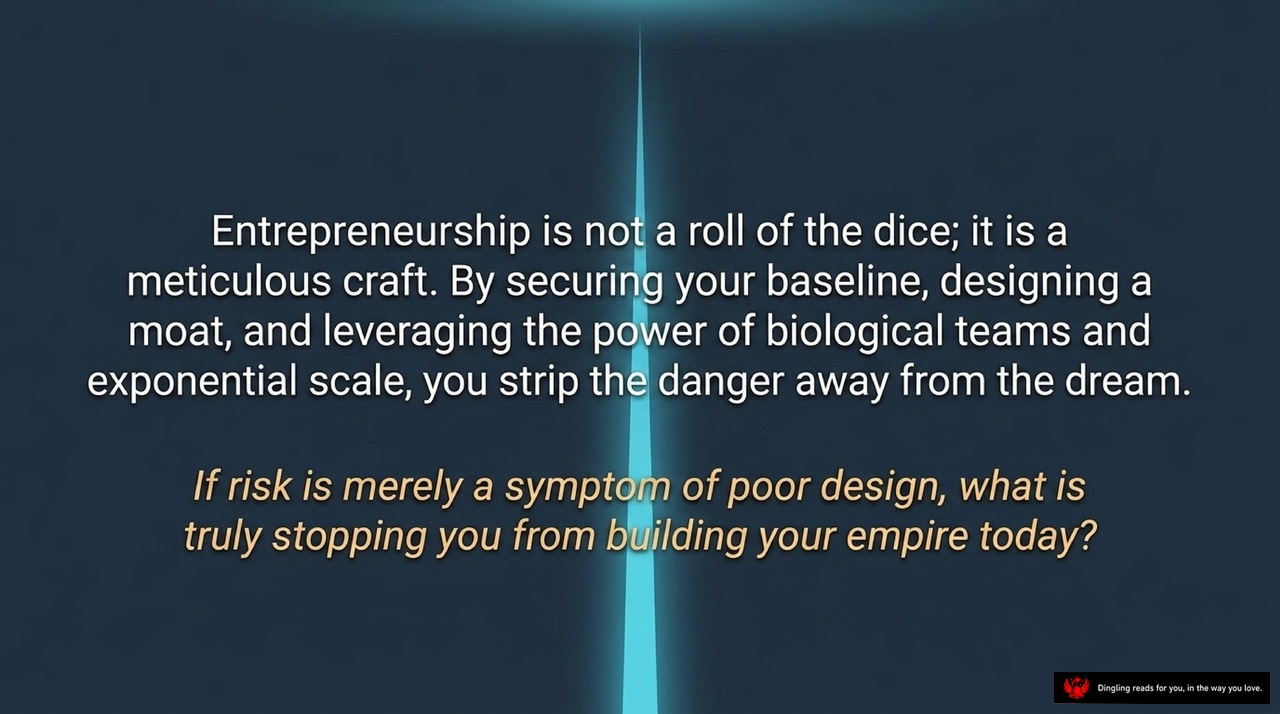
Entrepreneurship isn't about rolling the dice; it's a meticulous craft. By securing your baseline, designing a moat, and leveraging biological teams, you strip danger away from the dream. But what truly stops you?
If risk is merely a symptom of poor design, ask yourself: what is really holding you back today?
The answer often lies in your mindset. Many founders fail because they confuse fragility with strength. A strong company survives shocks, but an antifragile one grows from them. Think of a ping-pong ball bouncing higher after hitting the floor—that's antifragility.
Your secret weapon is your "moat." It's not just a moat; it's the unique advantage you can't easily replicate. Whether it's your brand, your operations, or your people, this secret is your shield against competitors.
And remember, the best way to build a resilient empire is to design for asymmetry. You want a setup where your upside is unlimited, but your downside is capped. This is how you turn uncertainty into your greatest ally.
So, if you've been paralyzed by fear, reframe it. Risk isn't a wall; it's a signal that your design might need tweaking. Stop waiting for perfect conditions. Start building your empire today, with a structure that thrives in chaos.