
Ludwig Wittgenstein: Complete Chapter-by-Chapter Summary
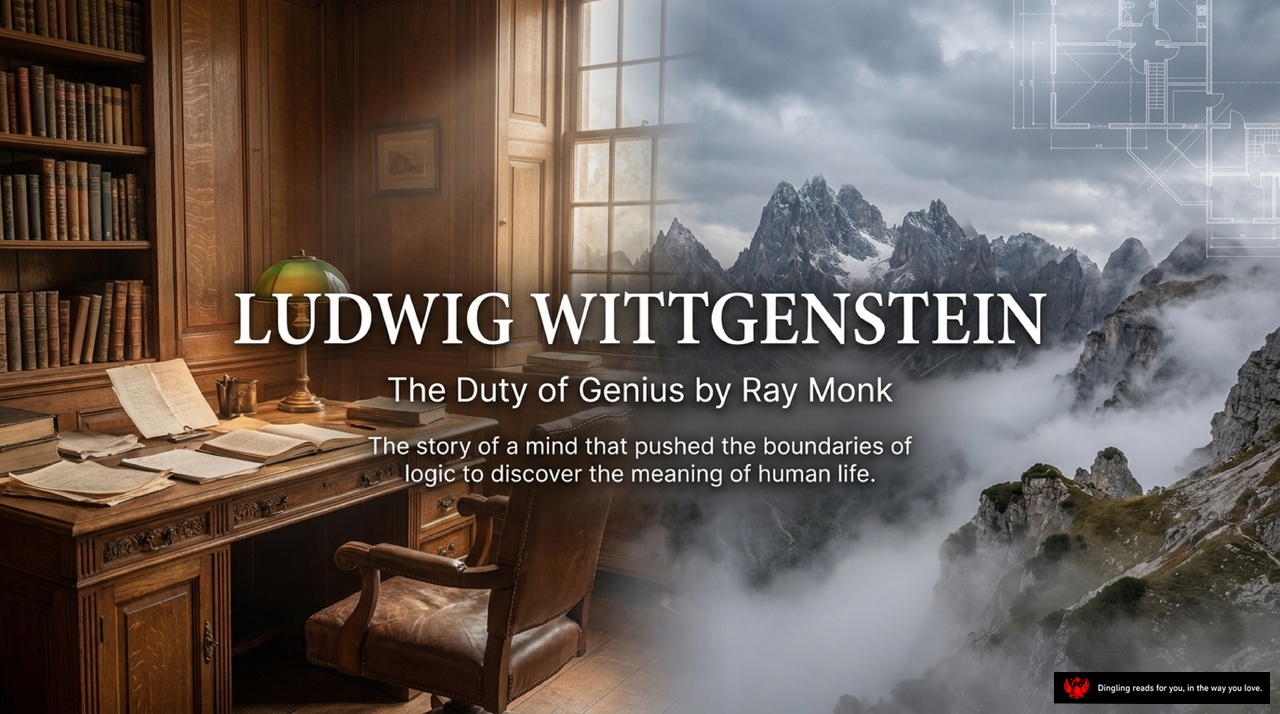
Welcome to our book club session. Today, we are diving into a story about a mind that pushed the boundaries of logic to discover the meaning of human life. Our focus is on Ludwig Wittgenstein, the subject of Ray Monk's powerful book, *The Duty of Genius*.
Imagine a brilliant mind trapped in a paradox. From a young age, Wittgenstein was obsessed with a simple yet impossible question: Why tell the truth when lying would benefit you? This wasn't just an academic curiosity for him; it was a life-or-death struggle. Unlike other philosophers who sought certainty, Wittgenstein was pulled into philosophy by these unanswerable puzzles. He felt that until he found a satisfactory answer, he could not live his daily life in peace.
The image you see captures this duality perfectly. On one side, we have the warm, wooden study—a symbol of his early life in Vienna, a home filled with books, music, and high expectations from a father who wanted him to be an industrialist. On the other side, the rugged, misty mountains represent the vast, untamed wilderness of his philosophical mind and the harsh realities he would face.
Wittgenstein's journey was a constant battle between two worlds. He was raised in a wealthy, assimilated Jewish family in Vienna, yet he felt deeply alienated by his own nature. Influenced by thinkers like Schopenhauer and the controversial Otto Weininger, he became obsessed with the idea of becoming a genius. To him, the core of genius was radical honesty with oneself. This drive led him to reject his father's plans for an engineering career, even though he excelled in mechanics. Instead, he was consumed by the desire to solve the riddles of existence.
He eventually met Bertrand Russell, who recognized his raw talent and urged him to abandon engineering for philosophy. This moment was a turning point. Russell saw a pure, burning passion in Wittgenstein that he had not seen before. Yet, even with this mentorship, Wittgenstein remained tormented. He felt that traditional logic was insufficient to capture the deepest truths of life.
His journey took him from the elite circles of Cambridge to the freezing, lonely landscapes of Norway. There, in the remote village of Schotten, he wrote his first major work, *The Logical Investigations*. It was here that he realized a crucial distinction: some things can be clearly said, while other profound truths—like ethics and the meaning of life—can only be shown, never stated.
But the war changed everything. When World War I broke out, Wittgenstein volunteered for the Austrian army. He didn't fight for patriotism; he fought to face death and find a new purpose. The horrors of the battlefield shattered his previous philosophical framework. He realized that the world's meaning was not something he could find within the world itself. Instead, he concluded that the meaning of life lies outside the world, in a realm that language cannot touch.
This realization birthed his masterpiece, *Tractatus Logico-Philosophicus*. In this book, he famously argued that there are limits to what can be said. We can describe facts and the structure of the world, but we cannot speak about values, God, or the essence of life. To do so would be to misuse language. Therefore, the only proper response to these deepest truths is silence.
The split between the world of facts, which we can describe, and the world of values, which we can only feel, defined his early philosophy. But even as he wrote this masterpiece, Wittgenstein was already questioning it. He felt that his own words were too rigid, that they were trying to capture the ineffable with tools that were simply not up to the task.
So, as we look at this image of the scholar and the mountain, remember that Wittgenstein's life was a journey from the comfort of the study to the silence of the mountains. He sought to build a logical structure for the world, only to realize that the most important parts of our lives—our love, our morality, our sense of the divine—exist beyond the reach of logic.
His story is a reminder that sometimes, the most profound answers come not from finding the right words, but from knowing when to stop speaking and simply listen to the silence. That is the duty of genius.

Look at this slide, titled "The Laboratory of Self-Destruction." It paints a stark picture of Ludwig Wittgenstein's origins. On the left, we see the grand architecture of Vienna—the cultural capital where he was raised. But on the right, the story takes a dark turn.
The text here highlights a crucial tension. First, "The Environment." Wittgenstein grew up in one of Europe's wealthiest, most cultured families. The great minds of his time—Brahms, Mahler, and Klimt—were regular guests. He was surrounded by brilliance. Yet, this wasn't a nurturing paradise; it was a pressure cooker.
The slide calls this "The Shadow." It describes a family plagued by an absolute, uncompromising drive that ended in tragedy. Three of his four brothers—Hans, Rudolf, and Kurt—all committed suicide. Their deaths were a direct result of their father's crushing expectations and their inability to meet them. Hans, a musical genius, was forced into business and vanished, likely by his own hand. Rudolf rebelled and took his life in Berlin. Kurt's suicide was the final blow to their father, Karl, leaving Ludwig as the sole survivor of the male line.
This family trauma shaped Ludwig's core character. The slide points to "The Core Trait." Around age eight, young Ludwig paused in a doorway and asked a terrifying question: "Why tell the truth if lying is advantageous?" At that moment, he saw no reason to be honest. But this moment birthed his lifelong, terrifying obsession with absolute honesty. He became a man who could not tolerate the gap between what is and what is said.
So, we see the paradox clearly here. He was born into a laboratory of high culture and wealth, yet he was raised in a place of self-destruction. The brilliance of Vienna and the tragedy of his family collided within him, forging a philosophy that would eventually try to solve the very problem that haunted his childhood: how to say things exactly as they are, without the lies that the world demands.

Imagine a world where the very act of thinking is a machine, a complex system of gears and logic gates. This slide captures the essence of Ludwig Wittgenstein's early life, visualizing his mind as an intricate engineering blueprint. We see the transition from mechanics to metaphysics, a journey that started when he was just a boy, stopping at a door to ponder why we tell the truth when lying would benefit us. This wasn't just a childhood question; it was the spark that ignited a lifelong obsession with the logical foundations of reality.
The diagram illustrates his pivotal shift. In 1908, he studied aeronautical engineering in Manchester, designing propellers with precise aluminum alloys and calculating RPMs, yet his true passion lay elsewhere. He was driven by a wild life trying to burst forth, a force that pulled him away from the physical world of engines and into the abstract realm of logic. By 1911, he arrived in Cambridge to study under Bertrand Russell, making a radical pivot from engineering to the philosophy of logic. Russell immediately recognized a genius in him, someone driven by an intense need to solve the ultimate contradictions of the universe.
This image perfectly encapsulates the tension that defined his early years. On one side, we have the tangible, mechanical world of his engineering studies, with its clear parameters and materials. On the other, we see the complex, interconnected web of logical propositions and philosophical inquiries. Wittgenstein aggressively sought to solve these logical puzzles, even arguing stubbornly with Russell over whether empirical reality could truly be known. He wasn't just building machines; he was trying to build a new understanding of the world itself, a project that would eventually lead him to write one of the most influential philosophical works ever penned.

The image behind us isn't just a map; it's a battlefield from the First World War, a place where the ground itself seemed to swallow men whole. In the center, we see a powerful quote by Schopenhauer: "The urge to reflect on philosophy comes from the recognition of death and the misery of life." This wasn't just abstract theory for Ludwig Wittgenstein; it was a daily reality.
Look at the text at the bottom. Under "The Front Lines," it tells us he didn't just fight for his country; he volunteered for the Austrian army and deliberately requested the most dangerous front-line combat. Why? To test his spiritual resolve in the face of death. He wasn't running away from the horror; he was walking straight into it, hoping that confronting the end would give him a new beginning.
This experience triggered a profound shift, as noted on the right side of the slide. Deeply influenced by Tolstoy's "The Gospel in Brief," his rigid logic merged irrevocably with ethics and mysticism. Before the war, Wittgenstein was obsessed with logic puzzles, trying to build a perfect system for reality. But the trenches changed everything. He realized that logic couldn't explain the most important things—like why we suffer or what gives life meaning.
It was in the mud and blood of the Austrian front that his famous book, *The Tractatus Logico-Philosophicus*, was born. He realized that while we can talk about facts and objects, we cannot talk about the meaning of life, ethics, or God. These things are "ineffable"—they can't be said; they can only be shown. The misery of the war taught him that the limits of our language are the limits of our world, and that the deepest truths lie right beyond what we can speak. The war didn't just break him; it gave him the clarity to see the world in a completely new way.

In 1929, Ludwig Wittgenstein returned to Cambridge, and the atmosphere was electric. John Maynard Keynes famously joked that "God had arrived," warning his friends not to talk to Wittgenstein for more than a few hours at a time, lest they be drained of their own energy. While Keynes welcomed him back with open arms, Wittgenstein found himself out of place among the Bloomsbury Group, finding their casual discussions about sexuality unbearable.
His closest companion during this period was Frank Ramsey, a brilliant young philosopher who became his most trusted intellectual partner. They spent hours debating the foundations of mathematics. However, Ramsey's criticisms eventually led Wittgenstein to realize that his earlier work in *The Tractatus* was flawed. He began to question the idea that language simply mirrors reality, a concept he had previously championed.
This period marked a profound turning point. Wittgenstein started to develop what we now call his "later philosophy." He introduced the concept of "language games," arguing that language doesn't have a single, universal essence. Instead, different types of language—like giving orders, telling jokes, or reporting events—function like different games, connected by "family resemblances" rather than a shared core definition.
He also shifted his focus from logic to the actual use of words in everyday life. He believed that many philosophical problems arise simply because we misunderstand how language works. His goal was no longer to build a perfect logical system, but to "clear the ground" by showing how our language often traps us in confusion. He famously declared that philosophy isn't about constructing theories, but about "showing the fly the way out of the fly bottle."
Despite this intellectual breakthrough, his personal life was turbulent. He struggled with feelings of inadequacy and even considered writing an autobiography to confront his own "unheroic" nature. Yet, he remained fiercely committed to his new method, eventually moving to a small village in Wales to focus on writing what would become *Philosophical Investigations*, the book that would redefine the landscape of 20th-century philosophy.

The slide breaks down the fundamental divide in Wittgenstein's early philosophy: the difference between what we can say and what we must show. On the left, we see a rigid tree structure representing "What can be said." This is the realm of structural facts—things like "The book is on the table." Language here acts as a logical picture of reality, mapping out the world's facts. But on the right, there is a blinding light representing "What must be shown." This covers the logical form of the world, absolute values, ethics, and art. These things cannot be spoken about; they can only be lived and experienced.
This creates a profound irony, which the slide highlights at the bottom. Wittgenstein's own masterpiece, *The Tractatus*, was a paradoxical attempt to say what could only be shown. He famously called his work a ladder—one that we must climb to see the truth, only to throw away afterwards. It is a brilliant, self-destructive move: using language to point beyond the limits of language itself.

The final chapter of Ludwig Wittgenstein's life wasn't defined by grand theories or academic titles, but by a quiet, almost desperate search for peace in a world he felt had lost its soul. By the late 1940s, Wittgenstein was deeply disillusioned. He saw the post-war world as a place where science had replaced spirituality, where humanity was running straight toward disaster, blind to the moral cost of its progress. He felt that the very language of philosophy had become a trap, a "glass paper" covering the living world and preventing us from seeing reality clearly. To him, the only real solution wasn't another book or a new logical system, but a profound spiritual transformation—a way to strip away the illusions of civilization and reconnect with something authentic.
This inner turmoil was mirrored by a turbulent personal life. In 1946, he fell deeply in love with a young medical student named Ben Richards. It was a relationship that offered him a glimmer of hope, yet it terrified him. He couldn't handle the uncertainty, fearing that Ben would leave him just as his previous partners had. He was paralyzed by anxiety, oscillating between the desire to love and the fear of loneliness. He even questioned if his love was a betrayal of his late friend, Francis Skinner, adding another layer of guilt to his already heavy heart.
Eventually, unable to bear the suffocating atmosphere of Cambridge, Wittgenstein made the bold decision to resign from his prestigious professorship. He fled to Vienna, only to find the city occupied by Russian soldiers and in ruins, a sight that filled him with anger and despair. He then moved to Ireland, first to a hotel in Dublin, and finally to a remote farmhouse in Wicklow. It was there, in the silence of the countryside, that he found the focus he craved. He walked the fields, carried his notebook, and wrote furiously in the ditches, completely unaware of the world around him.
However, the peace was fragile. Health issues, nervous tension, and the noise of a mischievous child in the house drove him away again. He ended up in another isolated farmhouse in Connemara, where neighbors viewed him as a madman. It was there, with only one loyal helper named Tommy, that he truly found his rhythm. His mind was sharp, focused on the nuances of "seeing as"—how we interpret the same object differently depending on our perspective, much like seeing a drawing as either a rabbit or a duck. He realized that understanding humor, music, and even philosophy required immersion in a specific "form of life," not abstract rules.
In 1949, he traveled to the United States to visit his student Norman Malcolm. The discussions were intense and fruitful, but fate had other plans. Shortly after returning to England, Wittgenstein was diagnosed with prostate cancer. Facing the end, he refused aggressive treatment, choosing instead to face his mortality with a strange, stoic calm. He spent his final days in Oxford, with his friend G.E. Moore's daughter, and later in Cambridge. In the last two months of his life, he wrote the bulk of *On Certainty*, exploring the limits of doubt and asserting that our language and logic must be rooted in the certainty of our daily practices.
When his time finally came on April 29, 1951, at the age of 62, Wittgenstein asked his nurse, Mrs. Bevan, to tell his friends he had lived a very good life. He passed away peacefully, and his funeral was held according to Catholic rites, reflecting his lifelong pursuit of ethical piety and reconciliation with the divine, even though he never fully believed in the dogmas of the church. His journey ended not with a bang, but with a whisper, leaving behind a legacy that challenges us to look beyond the noise of our times and find the truth in the simple act of living.

Welcome back to our journey through Wittgenstein's life. Today, we stand at a pivotal moment: 1929. It's the year Ludwig returns to Cambridge, but not just as a guest—he returns as a challenger. The slide captures this perfectly with the title, "The Return and the Clash."
On the left, you see "The Fame." In 1929, Wittgenstein comes back to Cambridge. Why? Because the philosophers of the Vienna Circle had championed his earlier masterpiece, the *Tractatus*, as a manifesto to destroy metaphysics. They loved it. They wanted to use his logic to banish all that "nonsense" from philosophy. But here is the twist, the "Misunderstanding" shown in the center of our graphic. Wittgenstein realized they had entirely missed his point. They valued the "facts"—the empirical data, the scientific statements. But Wittgenstein? He believed the "unsayable" things—ethics, meaning, the mystical—were the only things that truly mattered.
The image beautifully illustrates this divide. On one side, we have "The Vienna Circle's Logical Positivism," represented by those rigid, geometric lines. It's structured, cold, and focused on what can be said. On the other side, "Wittgenstein's Mysticism," depicted in that warm, fluid watercolor. It's about what lies beyond the boundaries of language. The lightning bolt crashing between them symbolizes the clash. The positivists thought they had solved philosophy; Wittgenstein realized they had only solved the wrong problem.
This realization was the "Pivot." To clear up this profound confusion, he realized he had to dismantle his own masterpiece and reinvent philosophy from scratch. He couldn't just refine the *Tractatus*; he had to burn it down to build something new. This moment of returning to Cambridge wasn't a victory lap; it was the start of his second, and arguably more influential, philosophical life. He was ready to show the world that philosophy isn't about building a theory, but about clearing the ground so we can see the world clearly again.

The Organic Canvas. Look at this image. It's not just a diagram; it's a map of a philosophical revolution. The watercolor circles represent a shift from rigid structures to living, breathing reality.
In the center, we see the "Blue & Brown Books." These were his transitional lectures in Cambridge. Here, Wittgenstein systematically dismantled his own past search for hidden logical structures. He realized that language isn't a rigid, crystalline mirror reflecting reality. Instead, as the text on the left tells us, language is a living part of human behavior. It's organic, messy, and full of life.
This realization led to his "New Goal," written on the right. Philosophy is no longer a desperate search for absolute truth. Instead, it becomes a therapy designed to cure the mind of linguistic confusions. He wanted to show the fly the way out of the fly-bottle.
Imagine a fly trapped in a jar, buzzing against the glass, unable to see the open door. That was the old philosophy—trapped by our own words. Wittgenstein's mission was to show the fly how to fly. He wanted to liberate us from the confusion we create by misusing language, helping us see the world clearly for the first time.

Meaning is use. This simple phrase captures the heart of how language actually works in our daily lives.
Look at the tools in this box. A hammer, a saw, a ruler, a brush. We don't define these objects by looking at their abstract "essence." You can't understand what a hammer is just by staring at it in a museum. You understand it by watching what it does. It drives nails. That is its meaning.
Wittgenstein taught us that words are exactly the same. They aren't fixed, logical definitions waiting to be discovered. They are practical tools we use to navigate the messy, real world of human interaction.
Think about how we use these tools. When we give orders and commands, we are using language like a ruler or a hammer—direct and functional. When we measure and describe reality, we are using it to build a shared understanding of the world, much like using a level to ensure things are straight. And when we express emotions and form bonds, we are using language to connect with each other, creating the invisible glue of human relationships.
The insight here is profound: you cannot understand what a tool is by looking at its parts. You must see the work it does. If you stop using a word, it loses its meaning. If you stop interacting with people, your language stops working. Meaning isn't something hidden inside a dictionary; it's the action of using words to get things done, to describe what we see, and to connect with one another.
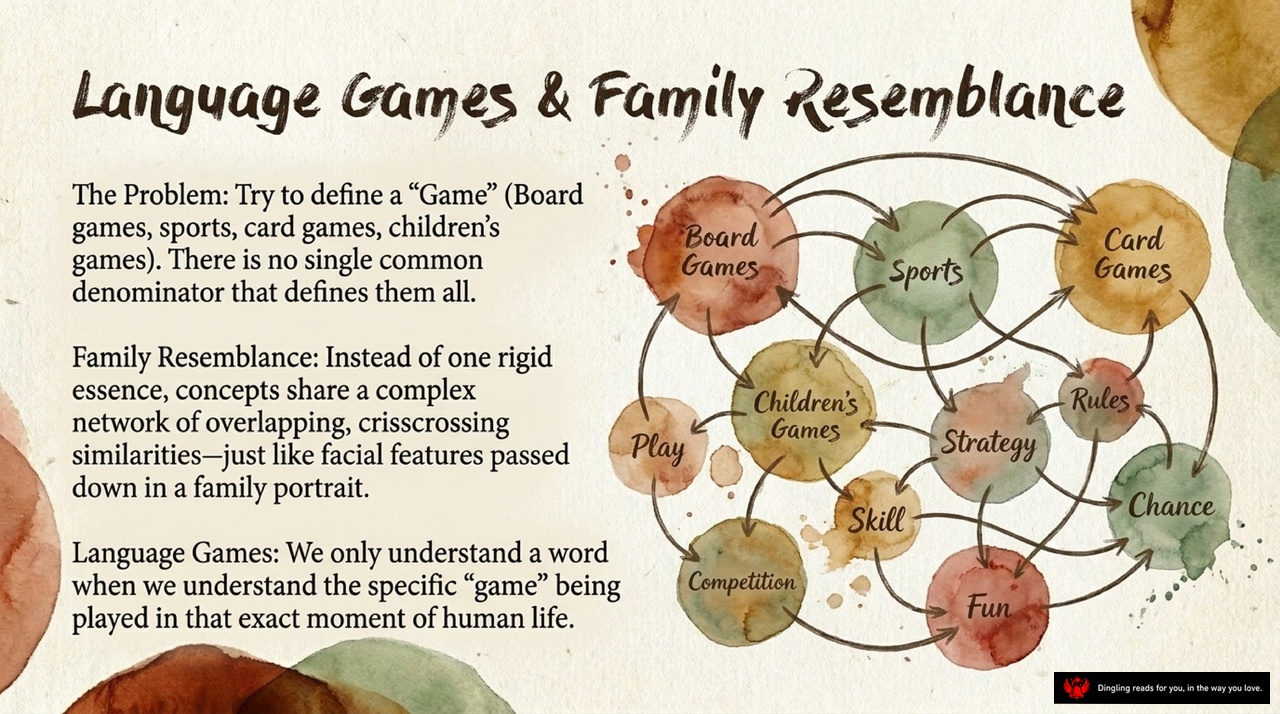
Imagine you try to pin down exactly what makes something a "game." Is it board games? Sports? Card games? Kids' games? You'll quickly hit a wall because there is no single common denominator that defines them all. It's frustrating, isn't it? We keep looking for one rigid essence, but that's where we get stuck.
Instead, let's look at it differently using what we call "Family Resemblance." Think of it like a family portrait. No single facial feature—like a nose or eyes—is shared by every single member, yet we still recognize them as a family because of a complex network of overlapping, crisscrossing similarities. Some share the eyes, others the smile, and others the jawline. The concept of a "game" works the same way. It's not one thing; it's a web of connections involving play, competition, strategy, skill, rules, chance, and fun.
This idea transforms how we understand language itself. We only truly understand a word when we understand the specific "game" being played in that exact moment of human life. Language isn't a set of abstract definitions; it's a living practice, a game we play together. Just like you can't define "game" by a checklist, you can't define meaning without seeing it in action. It's about the specific context, the specific rules, and the specific fun of the moment. That's the power of seeing language not as a static system, but as a family of practices.

Today, we witness the most dramatic transformation in the history of philosophy: the paradigm shift of Ludwig Wittgenstein. Look at the screen. On the left, we have the "Early Wittgenstein," and on the right, the "Later Wittgenstein." It is a stark contrast, almost like two different people.
In his early days, Wittgenstein was obsessed with finding a single, perfect truth. His core text was the *Tractatus Logico-Philosophicus*, where he believed language was a strict, logical picture of facts. He imagined philosophy's role as discovering the ultimate logical structure of the universe, much like finding the perfect formula. His key metaphor was "The Flawless Crystal"—a world that was pure, orderly, and perfectly defined.
But then, everything changed. As shown on the right side of our slide, the "Later Wittgenstein" emerges. His core text shifts to *Philosophical Investigations*. Suddenly, his view of language transforms from a rigid picture into a diverse toolbox of human activities. He realized that words don't have one fixed meaning; they have different uses depending on the context. Consequently, the role of philosophy changes completely. It is no longer about building a grand theory, but about curing the mind of linguistic confusions. His final metaphor becomes "The Messy Riverbed"—a world that is fluid, messy, and full of life, not a crystal.
This shift represents moving from a desire for absolute certainty to an acceptance of human complexity. From the flawless crystal to the messy riverbed, Wittgenstein taught us that the only way to understand the world is to look at how we actually use our language in our daily lives.

The Final Years: Life as Action.
Imagine standing at the very end of a life, not in retirement, but in the thick of global conflict and profound solitude. This is where Ludwig Wittgenstein found his final clarity.
In 1940, driven by a desperate need to contribute something real, he made a radical choice. He abandoned his prestigious professorship at Cambridge and disappeared into the anonymity of Guy's Hospital in London, working as a dispensary porter. It was a stark shift from the elite academic world, a deliberate act of humility.
But his journey didn't stop there. Seeking the isolation necessary to finish his magnum opus, *Philosophical Investigations*, he retreated to a remote, windswept cottage in Ireland. It was here, amidst the silence of the countryside, that he wrote the final passages that would redefine his philosophy.
His conclusion was powerful and counterintuitive. Wittgenstein argued that our most fundamental beliefs aren't derived from pure logic or abstract reasoning. Instead, they stem from the unthinking, practical actions of our daily lives. As he famously quoted Goethe, "In the beginning was the deed." For Wittgenstein, certainty wasn't something you prove; it was something you do. He spent his final years living proof of his own philosophy, showing that the foundation of our world lies not in what we think, but in what we do.
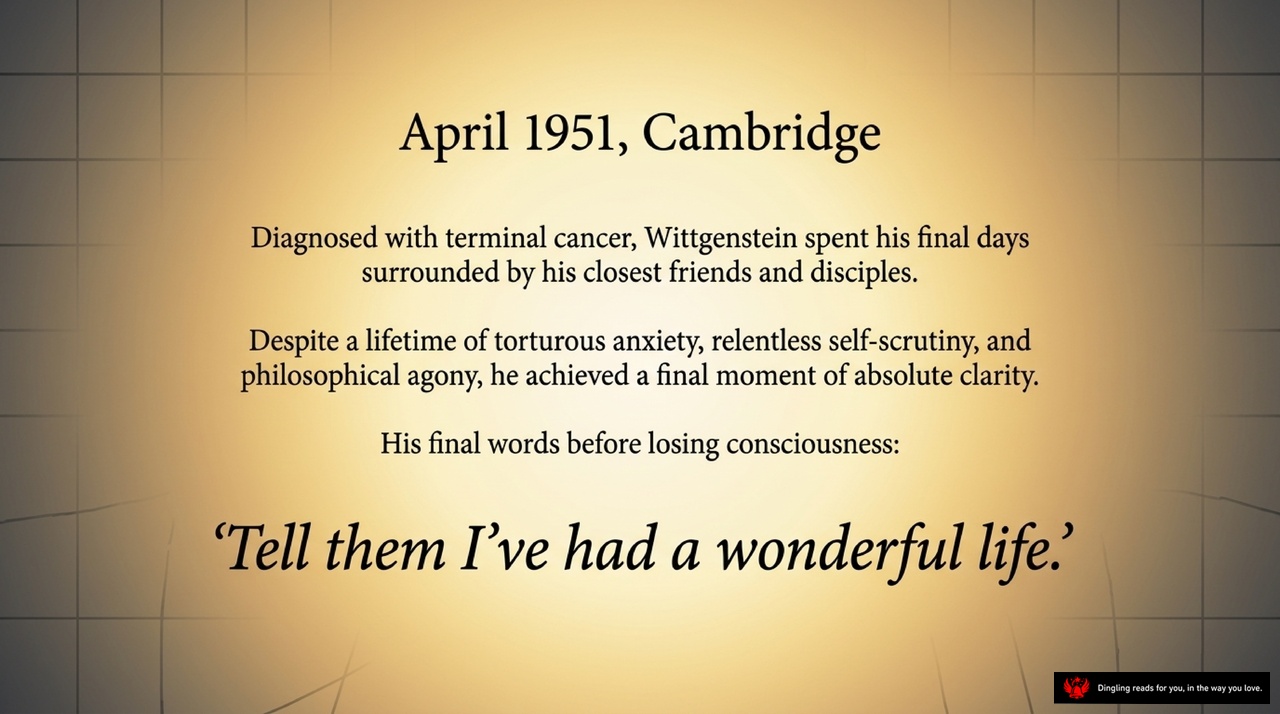
In April 1951, in the quiet, golden light of Cambridge, Ludwig Wittgenstein faced the end. Diagnosed with terminal cancer, he spent his final days surrounded by the friends and disciples who had walked this difficult path with him. But this wasn't just a story about a dying man; it was the conclusion of a life defined by an unrelenting, almost torturous search for truth. For decades, Wittgenstein had lived under the weight of relentless self-scrutiny, battling deep-seated anxiety and philosophical agony. He had been a man who could not stop questioning, who felt that peace was impossible until every puzzle was solved.
Yet, in his very last moments, something remarkable happened. After a lifetime of struggle, he achieved a moment of absolute clarity. The pain, the doubt, and the endless internal battles seemed to dissolve into a profound sense of peace. As he was about to lose consciousness, he turned to those around him and gave them one final, powerful instruction: "Tell them I've had a wonderful life."
It's a staggering statement coming from someone who spent so much of his life feeling that he was failing. But in that final breath, he found the answer he had spent a lifetime looking for. It reminds us that a life of intense struggle and relentless questioning can still be a life of profound value.

Ludwig Wittgenstein didn't just change philosophy; he dismantled the entire scaffolding we used to build it. For centuries, thinkers chased a rigid, absolute truth, trying to pin down the world with perfect definitions. Wittgenstein shifted the focus entirely. He argued that the limits of our language are simply the limits of our world.
Look at that quote on the screen: "What parts of your world are you failing to see simply because you lack the words to play the game?"
Think about that for a second. If you don't have the vocabulary for a concept, does that mean the concept doesn't exist? Or does it mean you just can't access it? Wittgenstein taught us that philosophy isn't about finding hidden secrets or grand theories. It's about clearing away the confusion we create with our own language. He wanted us to stop looking for answers that don't exist and start paying attention to the organic, messy reality of how we actually live and speak.
So, the next time you feel stuck in a philosophical debate or can't quite explain something you feel deeply, ask yourself: Are you missing the truth, or do you just lack the words to play the game?