
Man Running Against Time: Complete Chapter-by-Chapter Summary
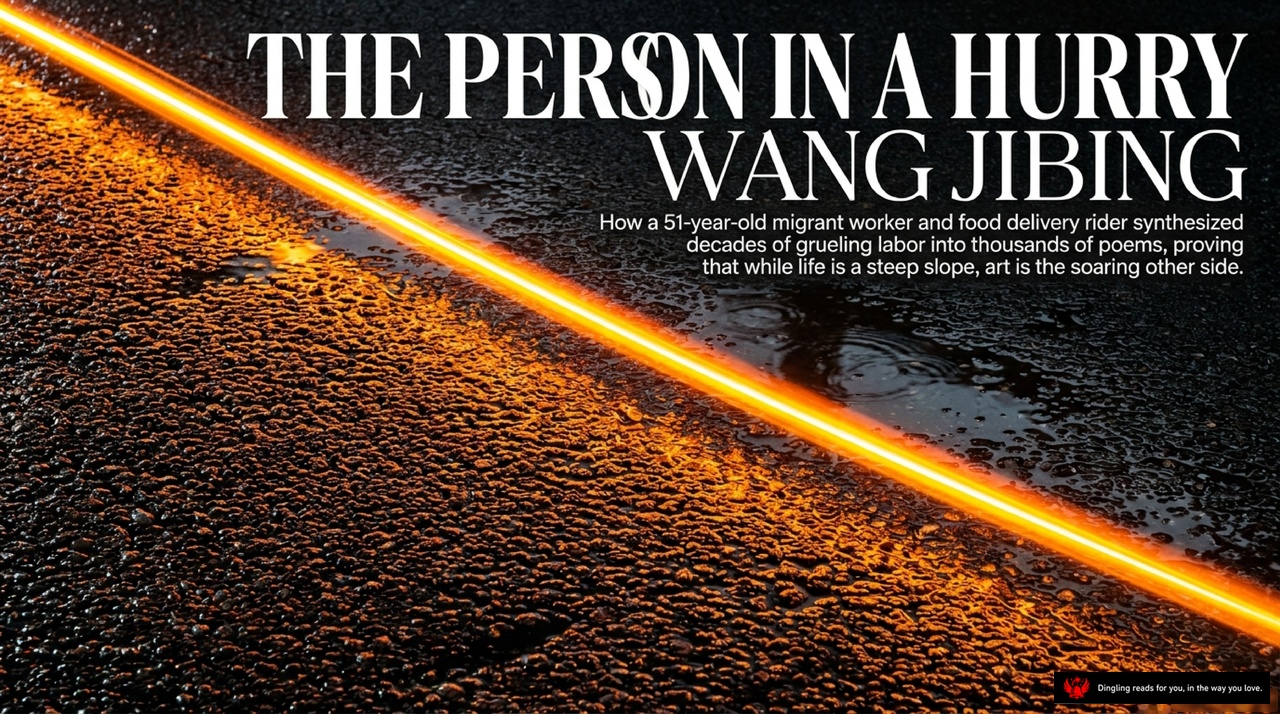
Welcome to the story of Wang Jibing. This isn't just a book; it's a testament to the human spirit. Meet a 51-year-old migrant worker and food delivery rider who turned decades of grueling labor into thousands of poems. His journey proves that while life is often a steep, exhausting slope, art is the soaring path that lets us fly.
Imagine a man running against time, where there are no seasons, only one stop and the next. He lives a life of constant motion, chasing orders and deadlines, with the wind filling his collar and compressing his entire existence into work. Yet, amidst this chaos, he finds a way to soar. He synthesizes his struggles into verses, creating a world where he is not just a delivery rider, but a poet named Wang Jibing. This is a powerful reminder that even in the busiest, hardest moments, we can still find our voice and our freedom.

At 51 years old, Wang Jibing is a man living two completely different lives at once. On one side, he is a statistic in the gig economy: making 48 deliveries a day, taking 12km detours just to avoid penalties, and constantly racing against the clock. On the other side, he is a national literary phenomenon with over 4,000 poems written, hidden away on cigarette packs and receipts.
This slide captures what we call "The Alchemy of Suffering." It's the process of turning physical exhaustion into profound poetic dignity. For decades, Wang was just a data point moving from Point A to Point B, a delivery rider in a helmet. But behind that helmet, he was quietly executing a lifelong literary metamorphosis. He took the bitter medicine of a hard life—the long hours, the injuries, the loneliness—and added sugar to it through his writing.
He calls himself a "walking wall," bearing the weight of time and the meals he delivers to others. Yet, in the cracks of this relentless routine, he found his true identity. He stopped being "Delivery Man Number 402" and became Wang Jibing, a man from Wangzhuang Village carrying the scent of soil and the dreams of his hometown. His story reminds us that even in the most rigid systems, there is always space for the human spirit to rise, transform, and find its own dignity.

Look at this map. It's not just a geography lesson; it's a "Map of Sweat." It charts decades of physical grind, tracing the footsteps of someone who spent their life chasing survival across China.
The journey begins in 1988 in Shenyang. At just 19 years old, he was pulling bent nails from scrap wood for a meager 3.5 yuan a day. This was the genesis of his silent observation. By 1990, he was on the Yi River, dredging sand in freezing water, his hands and feet bleeding so badly he had to pad them with pillows just to sleep.
Then came the years of migration. Between 1993 and 2000, he moved between Xinjiang and Shandong, making adobe bricks and driving dump trucks. The toll was heavy; he lost two fellow drivers to fatal crashes. Finally, from 2002 until the present, he found himself in Kunshan. He arrived with only 500 yuan, scavenging garbage, falling into icy rivers on his tricycle, and living in a shack suspended over water.
This timeline isn't just about dates and locations. It's about the relentless pressure of life. Every stop represents a new battle against hardship, a new layer of struggle added to the skin. From the cold north to the busy east, this map shows us that for millions of people, there are no seasons, only one station and the next. It's a story of resilience, written in sweat, blood, and the quiet determination to keep moving forward, no matter how deep the winter gets.
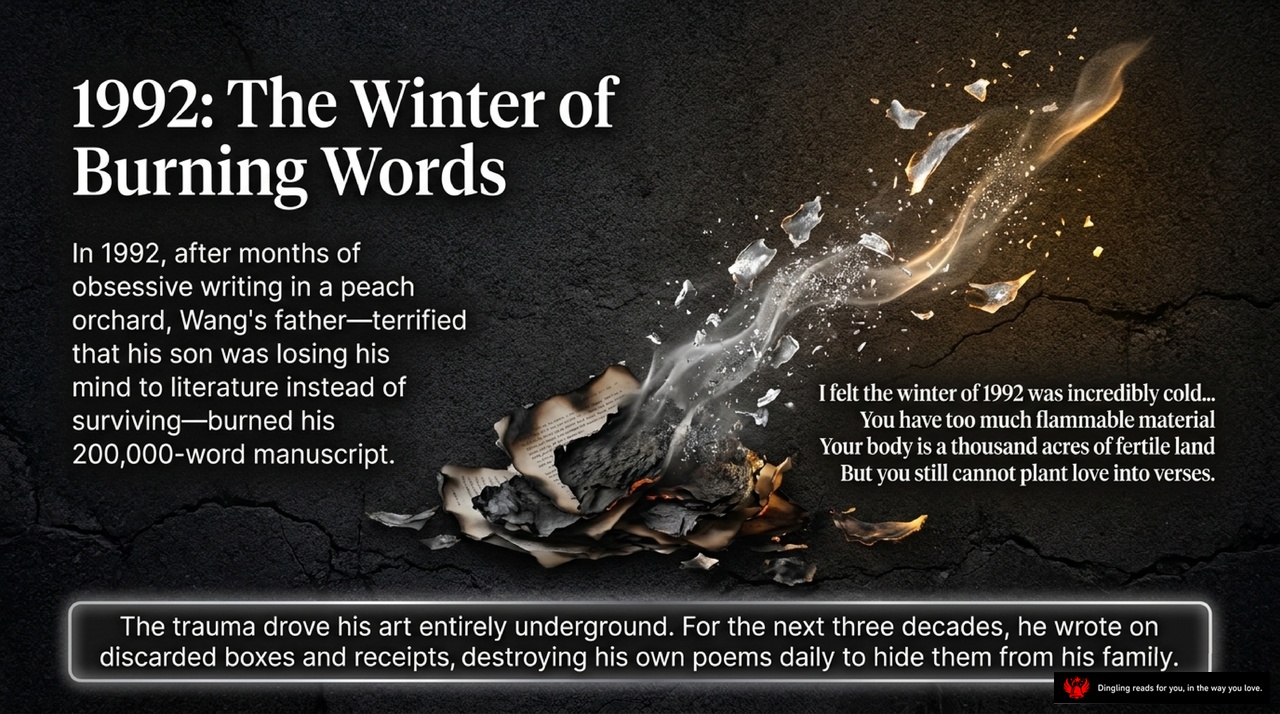
In 1992, Wang's life took a terrifying turn. After months of obsessive writing in a peach orchard, his father, fearing his son was losing his mind to literature instead of surviving, burned his 200,000-word manuscript. That winter felt incredibly cold to Wang. He wrote, "You have too much flammable material. Your body is a thousand acres of fertile land, but you still cannot plant love into verses." This trauma drove his art entirely underground. For the next three decades, he wrote on discarded boxes and receipts, only to destroy his own poems daily to hide them from his family. The image of burning words captures that moment when his inner fire was forcibly extinguished, leaving a legacy of silence that lasted for decades.

The friction of delivery isn't just about distance; it's a collision between rigid algorithms and the messy reality of human life. On screen, you see the "App Algorithm" imposing strict rules: 19-minute delivery windows, forced 500-meter straight-line navigation, automated penalties for delays, and even mandatory disciplinary learning. It demands perfection, treating every second and every meter as a variable to be controlled.
But down below, in the real world, the situation is completely different. This is where "Human Variables" take over. There are missing building numbers that confuse the GPS, sudden rainstorms that soak uniforms, stray dogs in dark alleys that force detours, drunk customers who stall the drop-off, and 12-kilometer real-world detours that no algorithm could have predicted.
Wang Jibing finds himself caught right in the middle of this clash. The system above demands speed and precision, while the ground below throws chaos at every turn. To survive, he has no choice but to absorb this systemic friction through sheer physical speed and emotional endurance. He becomes the buffer between the cold logic of the app and the unpredictable warmth of human life, proving that while the algorithm can calculate a route, only a human can navigate the obstacles.

Look at this striking image: "The Person in a Hurry." It captures the relentless pace of modern life, especially for gig workers like delivery riders. The text describes how they are forced to weaponize their own bodies against the elements, extracting speed at the cost of their literal "water"—sweat and tears—to quench the algorithm's fire.
It's a powerful metaphor. From the air driving out the wind, from the wind driving out knives, from the bone driving out fire, from the fire driving out water. The person in a hurry has no seasons; they only have one stop, and the next stop. There is no time for spring or autumn, only the constant chase of orders and deadlines. Every step is a race against the clock, with wind rushing into their collars and compressing their entire lives into a single, frantic task. They become a walking wall, hanging onto life's sudden demands, never stopping, never slowing down, just pushing forward through the river of time, even with wounds on their skin. This is the reality of living in a hurry, where the only thing that matters is getting to the next destination before time runs out.
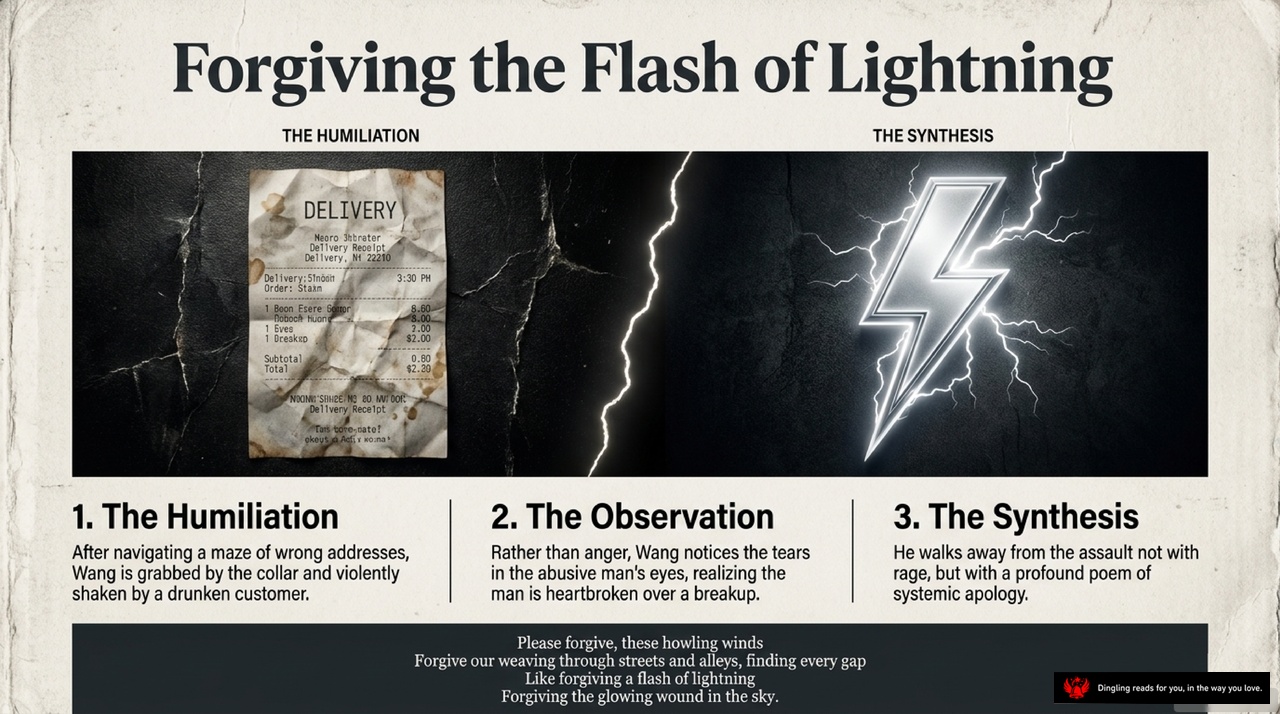
Look at this slide, "Forgiving the Flash of Lightning." It captures a powerful moment of transformation in Wang's journey, moving from deep humiliation to a profound synthesis.
On the left, under "The Humiliation," we see a crumpled delivery receipt. This isn't just paper; it's the symbol of Wang's struggle. He's been dragged through a maze of wrong addresses, only to be grabbed by the collar and violently shaken by a drunken customer. It's a raw moment of being humiliated, of feeling small and powerless in a city that often feels like it's pushing you around.
But look at the center. That's "The Observation." Instead of reacting with anger or revenge, Wang notices something unexpected. He sees tears in the abusive man's eyes. He realizes the man isn't just cruel; he's heartbroken over a breakup. In that split second, the rage dissolves. He sees a fellow human struggling, not just an enemy to fight.
Then, on the right, under "The Synthesis," we see that lightning bolt. It represents the energy of forgiveness, but not the kind that lets things slide. It's a lightning strike that clears the air. Wang walks away from the assault not with rage, but with a profound poem of systemic apology. He understands that this cruelty is part of a broken system, and by forgiving, he breaks the cycle of hatred.
The text at the bottom asks us to forgive these howling winds and the gaps we weave through life. Just like forgiving a flash of lightning—something sudden and blinding but ultimately part of nature—we learn to forgive the glowing wounds in our own sky. It's about finding the light even when the storm is raging.

Above ground, a withered tree stands as a silent testament to the weight of time. On the left, we see Mother Bao Chengzhen. Orphaned young and paralyzed by a stroke at 26, she spent her later years battling cancer, only to face her final struggle at 75. Her life was a relentless cycle of labor and pain, leaving little room for the softness often associated with womanhood. On the right, there is Father Wang Bingxian. He cared for his paralyzed wife for 26 grueling years. Even as terminal cancer consumed him, he hid his suffering, scavenging bottles until his very last breath to save pennies. His devotion was a quiet, unyielding force, a love that refused to let go.
But look beneath the surface. This is where the true story lives. As the slide illustrates, "The Roots of Dignity" grow deep in the earth. As his parents faded physically, Wang's poetry became the invisible roots holding their dignity together. He didn't just write verses; he transformed their pain into words, ensuring that they would not become "orphans of words." In a world that often strips people of their identity, Wang used his pen to anchor his parents' legacy, proving that even when the body breaks, the spirit can still stand tall through the stories we leave behind.
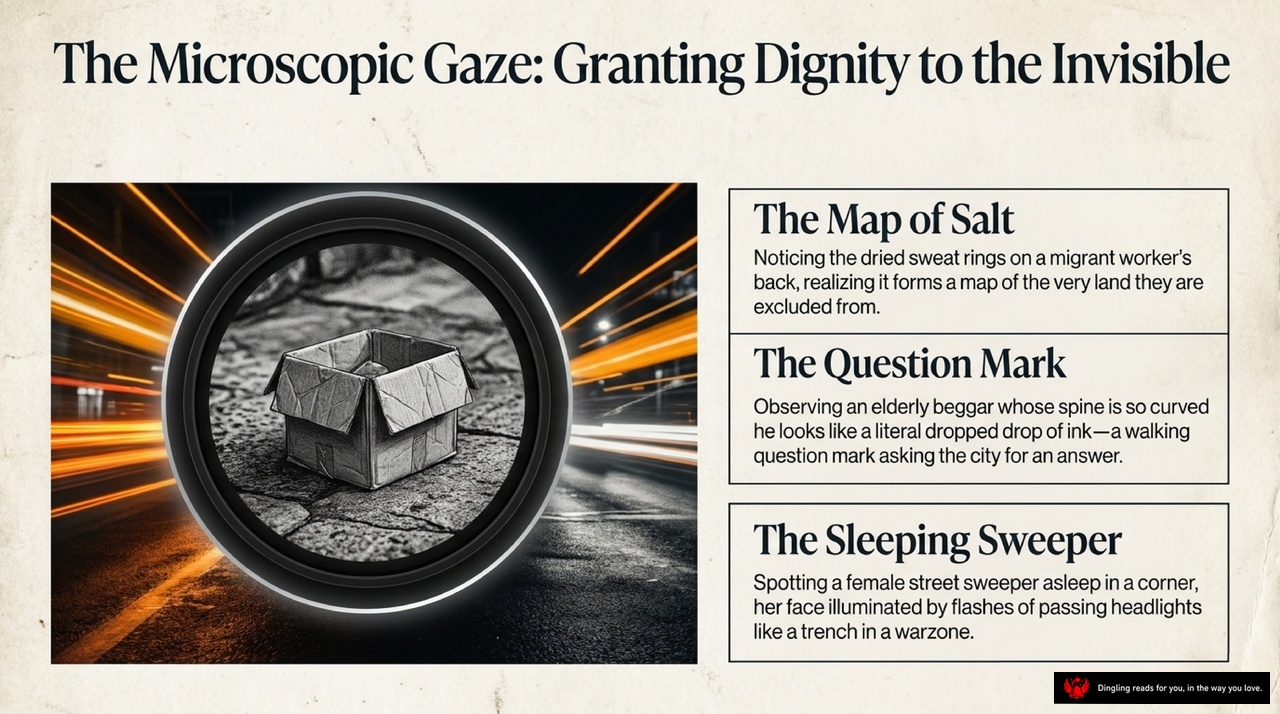
Look closely at the world around you, and you'll start to see a different story. It's about granting dignity to the invisible people who keep our cities running.
First, look at the back of a migrant worker. Those dried sweat rings aren't just stains; they form a map of the very land they are excluded from. Every drop of salt tells a story of labor and longing.
Then, there's the elderly begger at the street corner. His spine is so curved he looks like a literal dropped drop of ink—a walking question mark, silently asking the city for an answer that never seems to come.
And don't miss the female street sweeper asleep in a corner. Her face is illuminated by flashes of passing headlights, looking like a trench in a warzone. She holds her broom like a shield, protecting her dignity even in exhaustion.
We often walk past these moments, blind to their humanity. But if we slow down and use a microscopic gaze, we realize that every scar, every curve, and every quiet moment is a testament to a life lived with immense strength.
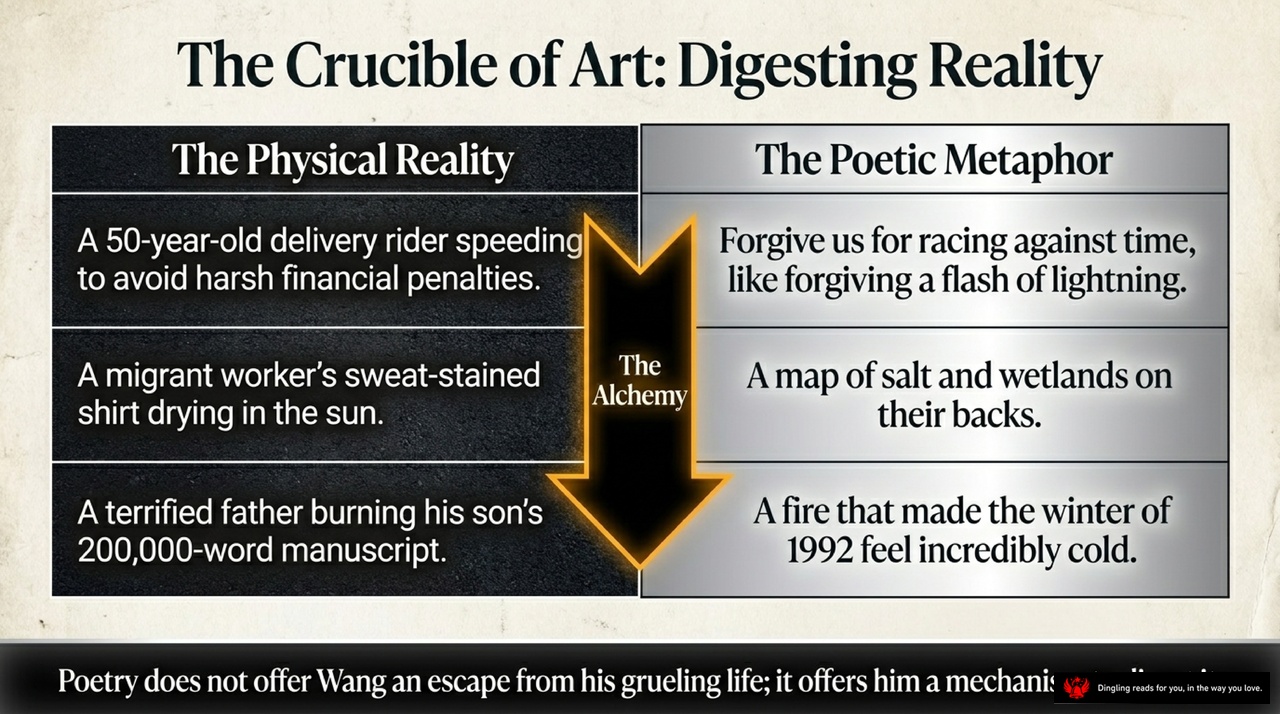
Today's slide, "The Crucible of Art: Digesting Reality," captures the very heartbeat of Wang Jibing's life. It shows how he transforms the harsh physical reality of his days into poetic metaphors through a process he calls "The Alchemy."
Look at the first example: A 50-year-old delivery rider speeding to avoid harsh financial penalties becomes "forgiving a flash of lightning." He turns the panic of the clock into a spiritual release. Next, a migrant worker's sweat-stained shirt drying in the sun transforms into "a map of salt and wetlands on their backs." He doesn't just see sweat; he sees the landscape of his struggle etched onto his skin. Finally, a terrified father burning his son's 200,000-word manuscript becomes "a fire that made the winter of 1992 feel incredibly cold." He converts the destruction of his child's dream into a memory of deep, enduring chill.
This isn't just about escaping a grueling life; it's about finding a mechanism to digest it. By turning his pain into poetry, Wang Jibing doesn't hide from the world. Instead, he alchemizes his suffering into something beautiful and meaningful, proving that even the darkest moments can be forged into art.
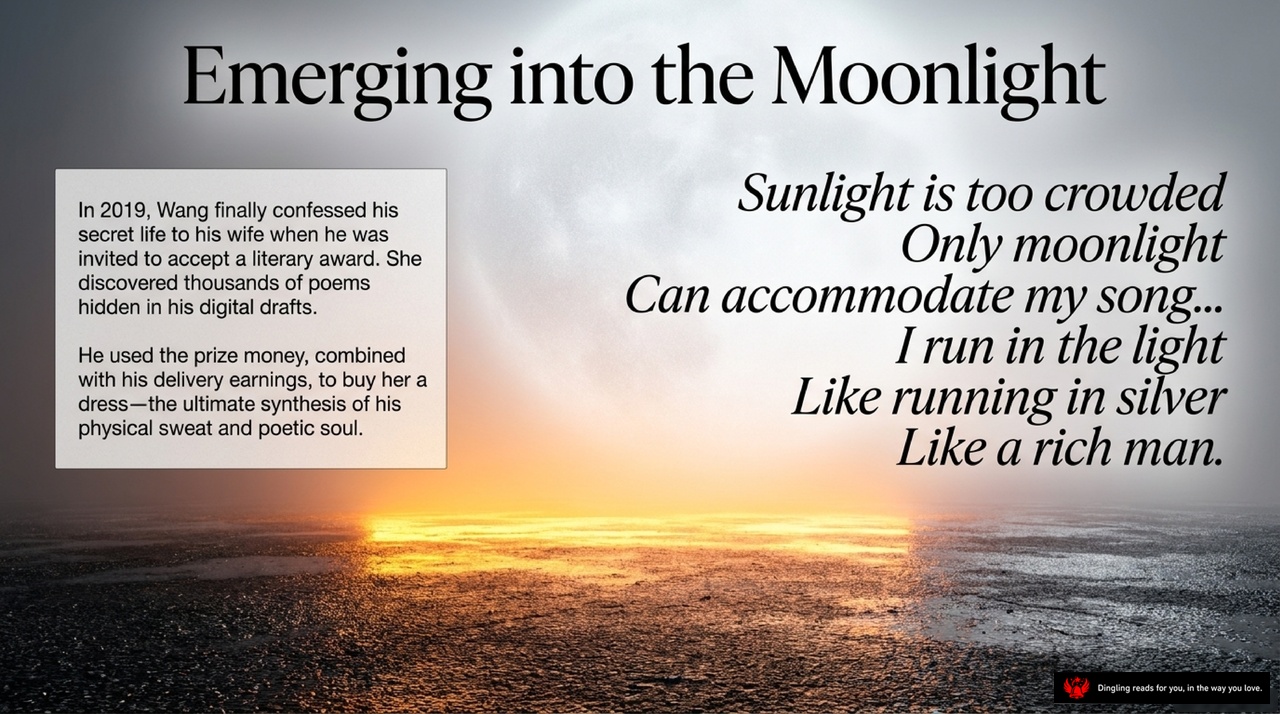
Look at this beautiful image, "Emerging into the Moonlight." It captures a quiet, silver moment on the horizon, a stark contrast to the crowded, blazing sunlight we often chase. The slide reminds us of a profound truth from Wang's story: "Sunlight is too crowded. Only moonlight can accommodate my song."
In 2019, after finally confessing his secret life to his wife, Wang used his prize money and delivery earnings to buy her a dress. It was the ultimate synthesis of his physical sweat and his poetic soul. He realized that while the world is loud and bright, true peace and expression come from the quiet, silver light. As he writes, "I run in the light, like running in silver, like a rich man."
This isn't about wealth in the traditional sense, but about finding a space where your soul can breathe without fear of judgment. Wang found that while the sun demands performance, the moonlight offers a sanctuary. It's a reminder that even when life feels heavy, we can always find a quiet corner to sing our own song, free from the noise of the crowd.
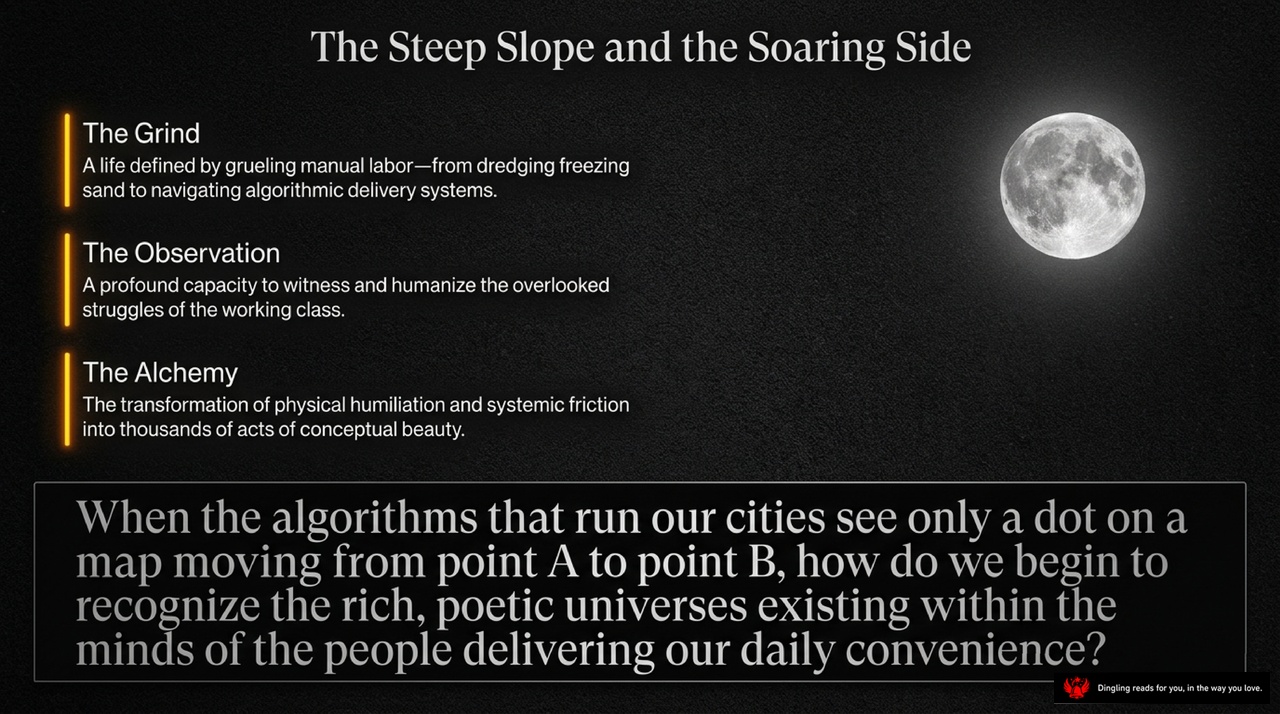
Imagine a world where algorithms reduce your life to just a dot on a map, moving from point A to point B. But behind that digital marker, there is a universe of poetry, struggle, and profound humanity.
This slide breaks down that hidden reality into three powerful layers. First, we see **The Grind**. It's a life defined by grueling manual labor—whether it's dredging freezing sand in the past or navigating complex algorithmic delivery systems today. It's the relentless race against the clock, where every step is a battle for survival.
But amidst this struggle lies **The Observation**. This is the profound capacity to witness and humanize the overlooked struggles of the working class. It's about seeing the person behind the package, recognizing the tears and the silence that often goes unheard.
Then comes **The Alchemy**. This is the transformation of physical humiliation and systemic friction into thousands of acts of conceptual beauty. It's how pain is turned into art, and how a weary life becomes a canvas for expression.
So, when the systems that run our cities see only a dot, how do we begin to recognize the rich, poetic universes existing within the minds of the people delivering our daily convenience? It starts with looking up from the map and seeing the soul.