
Man's Search for Meaning: Complete Chapter-by-Chapter Summary
Welcome to our deep dive into Viktor E. Frankl's timeless masterpiece, *Man's Search for Meaning*. Set against a backdrop of darkness and a single, piercing beam of light, this slide captures the very heart of Frankl's message. He tells us that humanity's primary drive isn't the pursuit of pleasure, but the unyielding quest for meaning. Born from the crucible of the Holocaust, this book is a profound psychological revelation. It teaches us that even when everything is taken from us—our home, our freedom, our loved ones—we still possess the last of the human freedoms: the ability to choose our attitude in any given set of circumstances. It's a reminder that while we cannot control what happens to us, we can always choose how we respond, and in that choice, we find the power to transform suffering into triumph.
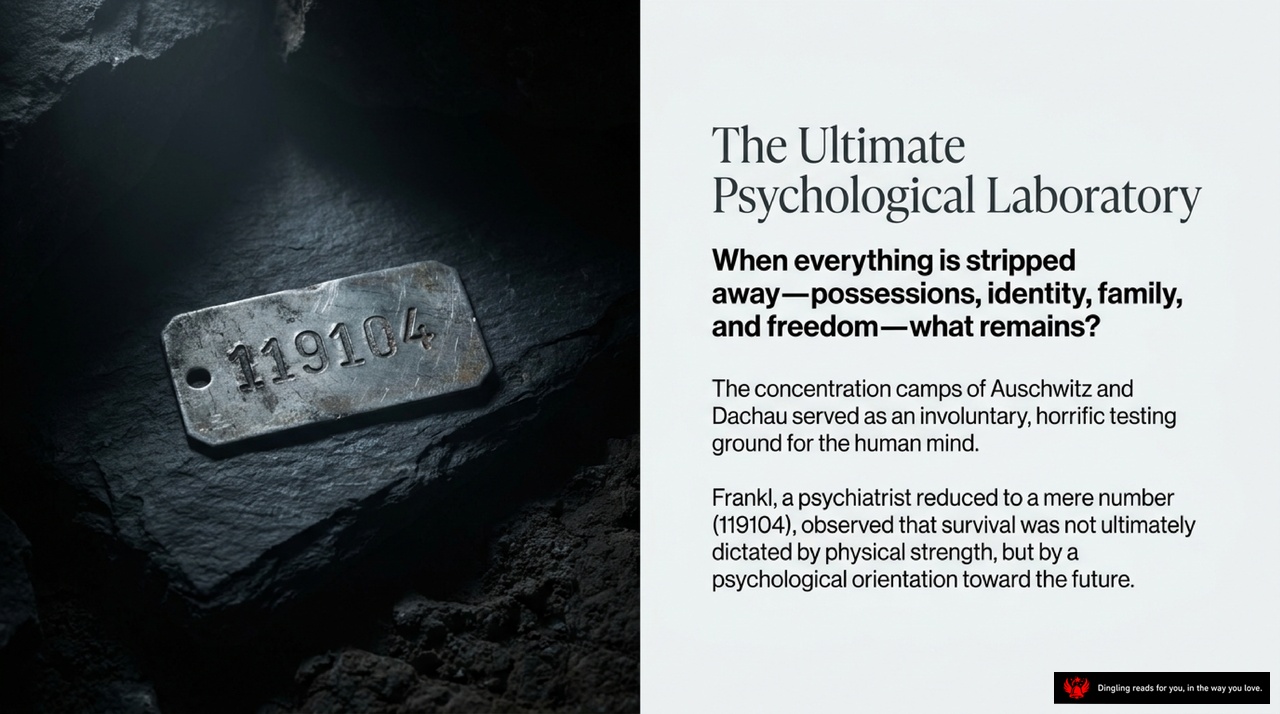
Imagine a number tattooed on skin: 119104. This isn't just an ID; it's the erasure of a man, a doctor, a father, a person. In the shadows of Auschwitz and Dachau, humanity was stripped down to its barest elements—possessions, identity, family, freedom. What remains?
This slide calls the camps "The Ultimate Psychological Laboratory." It wasn't a lab designed by scientists, but a horrific, involuntary testing ground where the human mind faced its absolute limits. When everything is taken away, survival stops being about physical strength and becomes entirely about psychology.
Viktor Frankl, the psychiatrist who became number 119104, discovered a terrifying truth: you don't survive because you are strong; you survive because of your orientation toward the future. If you have no future, you have no reason to live, and the body follows suit. But if you can hold onto a future—a goal, a loved one, a book to finish—that single thread of hope becomes the anchor that keeps you from drowning in the despair of the present. The number on the tag represents what was lost, but the choice to look forward is what was saved.

Imagine a timeline stretching across the darkness of the human mind, mapping the terrifying journey of psychological survival. Today, we are looking at a graph that isn't just data, but the heartbeat of a prisoner's soul. It shows three distinct phases, moving from the chaotic spikes of shock to the flatline of apathy, and finally, to the explosive fragmentation of disillusionment.
Let's start at the beginning, where the line is jagged and erratic. This is Phase 1: Shock and the Illusion of Reprieve. It happens right at the initial entry. Think of being crammed into a cattle car, 1,500 people squeezed into a space built for 200. There's no time to process reality; there's only a desperate, irrational hope that you might be spared at the last second. Fear is the dominant emotion here, a raw, unfiltered spike that defines the first moment of survival.
But as the graph flattens out, we enter Phase 2: Apathy and Emotional Death. This isn't a failure of the human spirit; it's a necessary defense mechanism. To survive the extreme environment, the mind has to shut down. Emotions flatline to shield the mind from being overwhelmed. You stop caring when a fellow prisoner is beaten for a fever, or when a doctor pulls a frozen toe from a child's foot. You shrink back to primitive, animalistic survival needs. You become numb, indifferent, and cold, because feeling anything else would mean breaking.
Finally, the line spikes upward again, but this time it shatters into golden fragments. This is Phase 3: Depersonalization and Disillusionment. This phase often follows liberation. Freedom feels unreal, almost like a dream you can't quite believe in. Many survivors suffer from profound bitterness upon discovering a world that simply cannot understand their trauma. They are no longer the people they were before; they are fragmented, struggling to reconcile their past with a present that feels alien.
This visual story reminds us that survival is not a straight line. It is a complex process of shock, numbness, and finally, a painful reintegration into a world that no longer feels like home.

Look at this powerful image: two massive stone walls labeled "STIMULUS" and "RESPONSE," split apart by a blinding beam of light. This visual perfectly captures Viktor Frankl's most profound discovery: the last human freedom.
Frankl realized that while you cannot control your environment—the stimulus—you possess an inviolable freedom in the space between what happens to you and how you react. That gap is where your power truly lives. As he famously stated, "Everything can be taken from a man but one thing: the last of the human freedoms—to choose one's attitude in any given set of circumstances."
Think about your own life. You can't always choose the traffic, the market crash, or the unexpected news. But you can always choose your response. You can choose to be defeated by the situation, or you can choose to find meaning within it. In the darkest conditions imaginable, that choice remains yours. It is the ultimate freedom that no external force can ever take away.
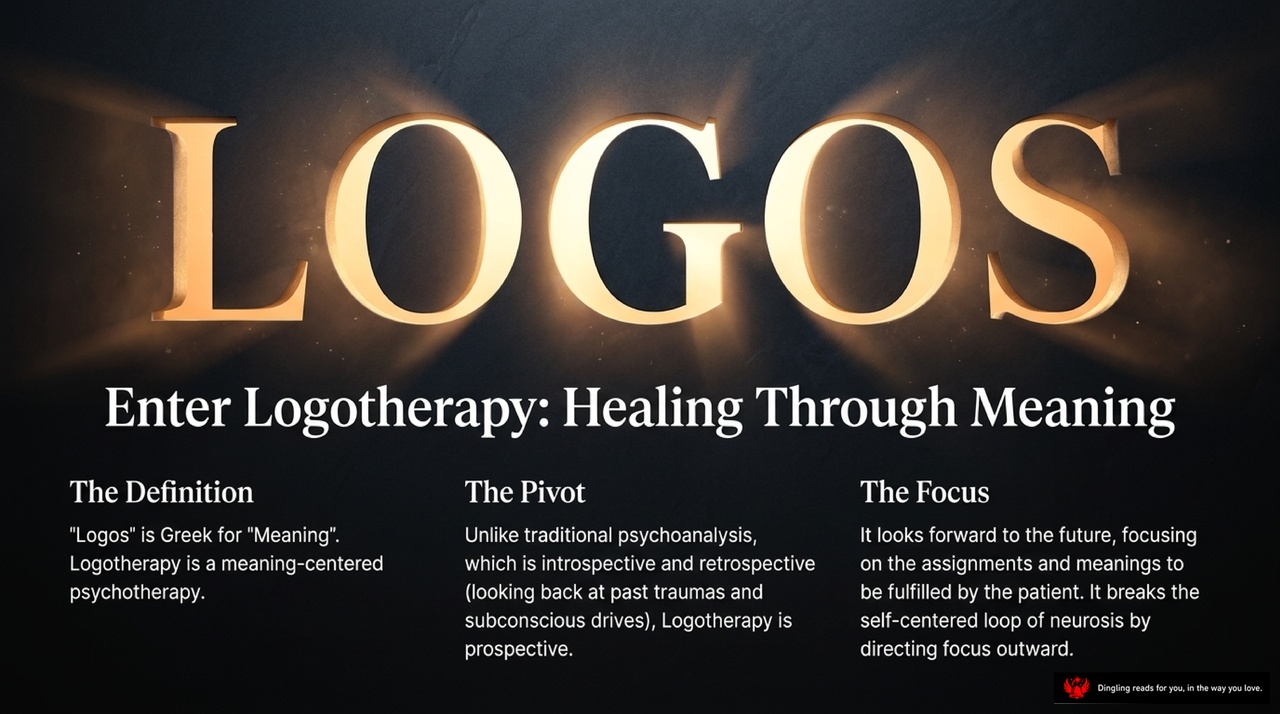
Welcome to the core of Logotherapy. As we dive into this slide, notice the three pillars that define this unique approach: The Definition, The Pivot, and The Focus.
First, let's look at the definition. "Logos" comes from the Greek word for "Meaning." Unlike therapies that focus on fixing symptoms, Logotherapy is entirely meaning-centered. It operates on a powerful belief: that the primary motivation in human life is not just to survive or feel good, but to find a reason to live.
Now, look at the pivot. This is where Logotherapy truly breaks from tradition. Traditional psychoanalysis often looks backward, digging deep into past traumas and subconscious drives to understand why we are the way we are. It's introspective and retrospective. But Logotherapy flips the script. It is prospective. Instead of getting stuck in the past, it looks forward to the future. It focuses on the assignments and meanings that are yet to be fulfilled by the patient.
Finally, this forward-looking stance changes everything about the focus. By directing our attention outward toward future goals rather than inward toward our own neuroses, Logotherapy breaks the self-centered loop of anxiety. It helps us escape the paralysis of the present by giving us something to strive for tomorrow.
In essence, Logotherapy teaches us that we don't need to heal before we can move forward; we move forward to heal. It's about finding the "why" that sustains us through the hardest moments, turning a struggle for survival into a journey of purpose.
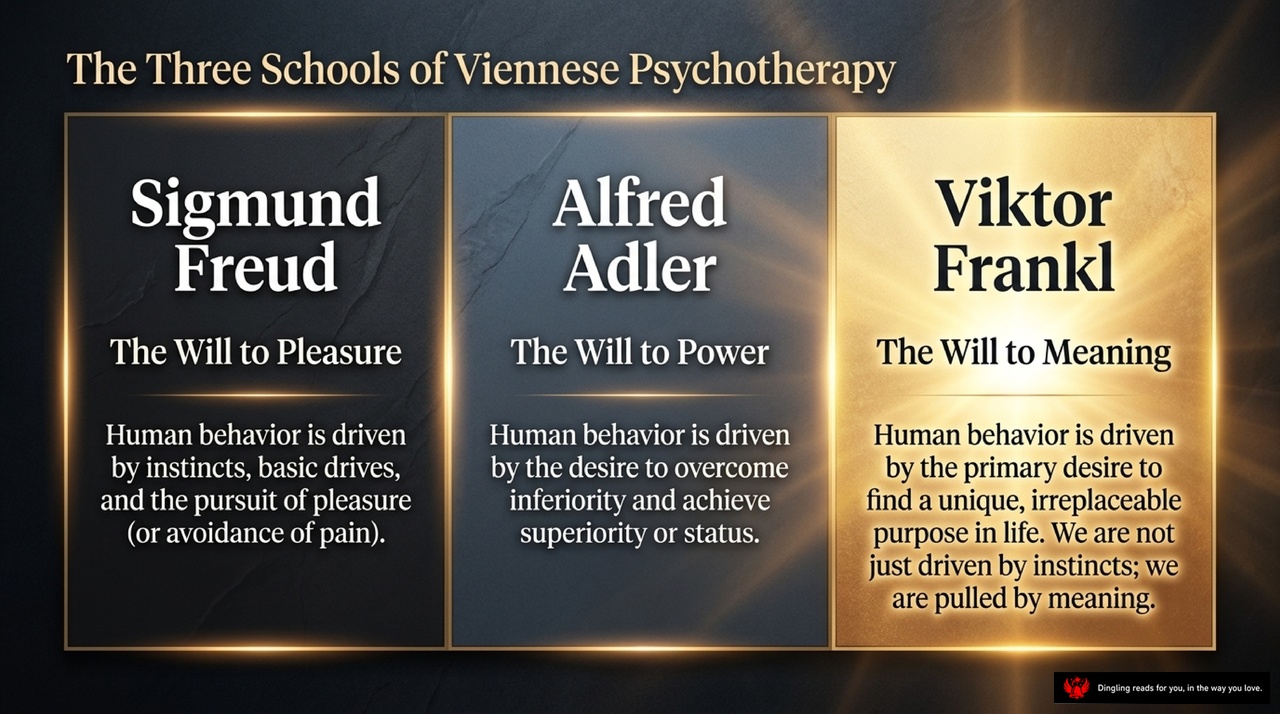
Welcome back to our deep dive into Viktor Frankl's life-changing philosophy. Today, we're exploring the very foundation of his approach: the search for meaning. Frankl argues that the primary drive in human life isn't pleasure or power, but the pursuit of meaning. It's not a vague dream; it's a biological necessity. In fact, statistics show that the vast majority of people would give their lives for something or someone they love.
But what happens when that search for meaning is blocked? Frankl introduces a critical concept: "noogenic neurosis." Unlike traditional neuroses caused by instinctual conflicts, this stems from a crisis of meaning. When we can't find a reason to live, we crumble. Frankl shares a powerful story of a high-ranking diplomat who suffered from severe anxiety. Traditional therapy blamed his father, but it failed. Only when the diplomat realized his job held no personal meaning did his symptoms vanish. He found his true calling and was healed.
This is the core of Frankl's "Absolute Commandment": live as if you are experiencing life for the second time, learning from your past mistakes. He believes we aren't here to seek comfort, but to answer life's questions. Life isn't a puzzle to solve; it's a series of challenges asking us, "What is your response?" We must take responsibility for our answers. Whether it's a career, a relationship, or simply enduring suffering with dignity, the meaning is always found outside ourselves, in our connection to others and our contribution to the world. So, don't ask what life's meaning is. Instead, ask yourself: what does life expect from you right now?

The Modern Malady: The Existential Vacuum. Look at this diagram. We're facing a crisis that isn't about money or status, but about something far deeper: a void in our souls.
The diagnosis is clear. In the modern era, we've lost our basic instincts that tell us what to do, and the traditions that told us what we should do. Without these anchors, we drift.
The symptom? It's often called "Sunday Neurosis." That's the feeling of profound depression and emptiness that hits when the distractions of the busy workweek finally stop. Without instinct or tradition, we don't know what we want to do. The week is over, the noise fades, and suddenly, the silence is deafening.
What's the result? This vacuum is the root cause of mass addiction, aggression, and depression. When the will to meaning is frustrated, we settle for the pursuit of pleasure or power just to fill the hole. We trade depth for distraction.
But here's the truth from Viktor Frankl's experience in the camps: the opposite of suffering is not pleasure, it's meaning. In the darkest moments of his life, when everything was taken away, Frankl found that the only thing he could control was his attitude toward his suffering. He realized that life is not a problem to be solved, but a task to be met.
When you find your "why," you can survive almost any "how." Whether it's a child waiting for you, a book you must finish, or simply loving another person, that purpose becomes your shield. Don't just chase happiness or success; chase meaning. Because when you have a reason to live, you can endure almost anything.
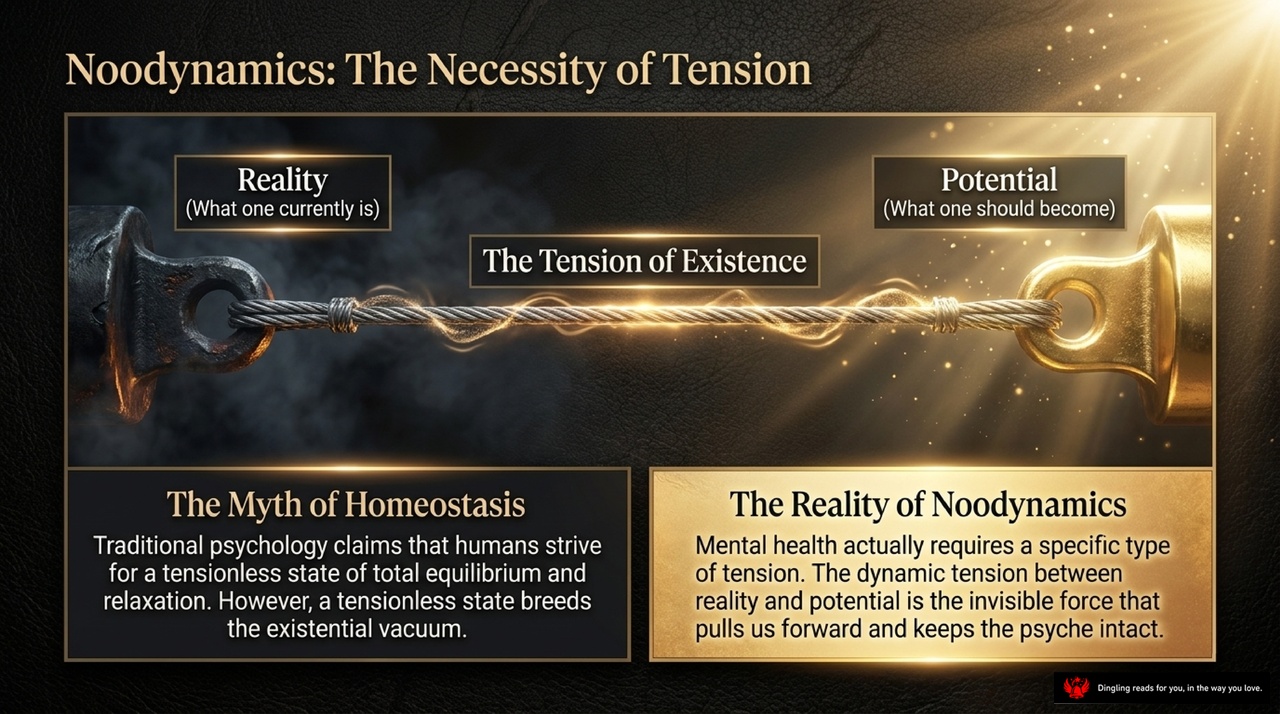
Noodynamics: The Necessity of Tension. Look at this image of the cable stretching between the dark anchor of "Reality" and the golden hook of "Potential." This visual perfectly captures the core argument of Viktor Frankl's work: that mental health isn't about finding a state of total relaxation, but about embracing the tension between who we are and who we want to become.
Traditional psychology often sells us the myth of homeostasis—the idea that humans strive for a tensionless state of total equilibrium. But Frankl argues that a tensionless state breeds an existential vacuum, a spiritual void that can be far more dangerous than any external conflict. Instead, the reality of Noodynamics shows us that mental health actually requires a specific type of tension. The dynamic pull between our current reality and our future potential is the invisible force that keeps our psyche intact.
Think about the survivors of the camps Frankl described. They didn't survive because they achieved a state of calm; they survived because they had a goal. Whether it was a book to rewrite, a child to raise, or a wife to reunite with, that "Potential" acted as an anchor against the crushing weight of "Reality." As Frankl famously noted, those who know why they are living can survive almost anything. That knowledge creates the necessary tension, the "spiritual motor," that drives us forward. Without that gap between what is and what should be, we lose our direction, and eventually, our will to live. So, don't seek to eliminate the tension. Embrace it, because that struggle is exactly where your life's meaning is waiting to be found.
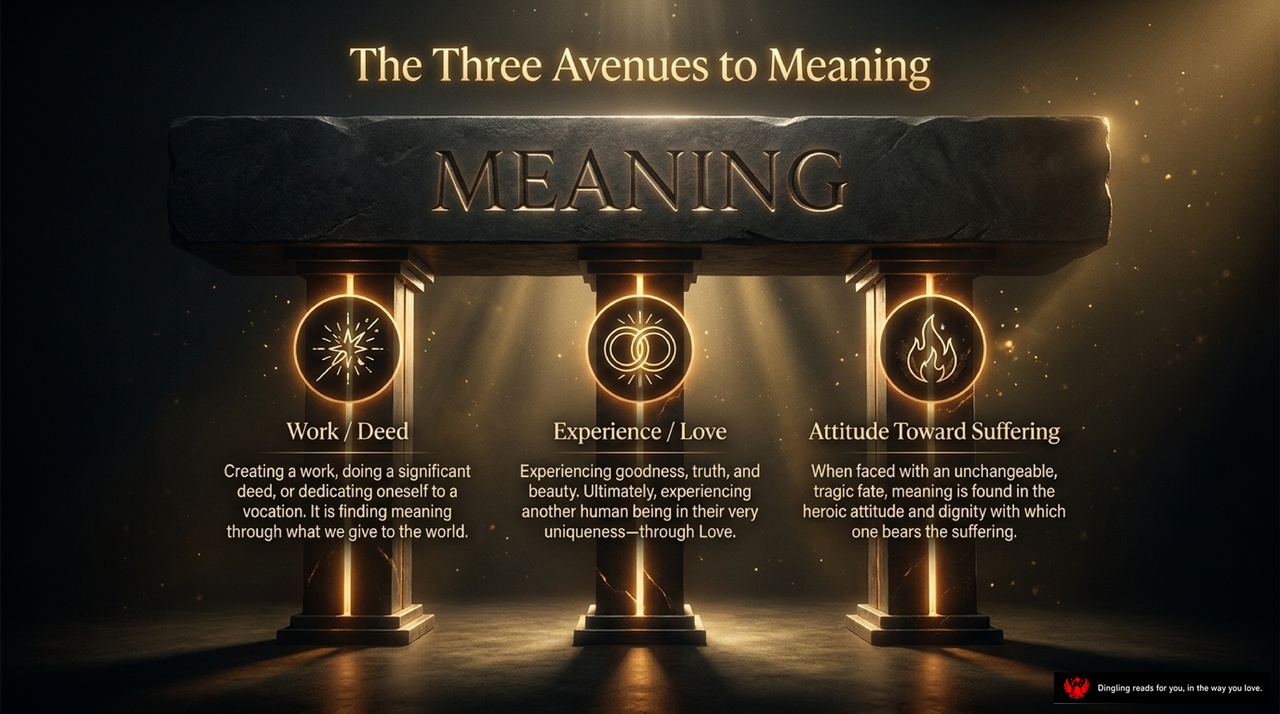
The image presents a powerful visual metaphor for Viktor Frankl's core philosophy: "The Three Avenues to Meaning." At the top, the word "MEANING" rests on a heavy stone beam, supported by three glowing pillars, each representing a distinct path to finding purpose in life.
First, we see "Work / Deed." This pillar represents finding meaning through creating something or doing a significant deed. It's about dedicating oneself to a vocation and discovering purpose through what we give to the world. Whether it's writing a book, solving a problem, or simply helping someone, the act of contributing creates a sense of value.
Next is "Experience / Love." This avenue suggests that meaning is found by experiencing goodness, truth, and beauty. But most profoundly, it's about experiencing another human being in their uniqueness. Through love, we connect with the essence of others, and in doing so, we find our own meaning. It's not just about receiving love, but about seeing the potential in others and affirming their existence.
Finally, there's "Attitude Toward Suffering." This is perhaps the most profound pillar. Frankl teaches us that when faced with unavoidable tragedy or an unchangeable fate, meaning is found in the heroic attitude we adopt. It's about the dignity with which we bear our suffering. We cannot choose our experiences, but we always have the freedom to choose our response. By transforming pain into something meaningful, we reclaim our humanity even in the darkest moments.
Together, these three avenues show that meaning isn't something we find passively; it's something we create actively through our work, our connections with others, and our response to life's inevitable challenges.
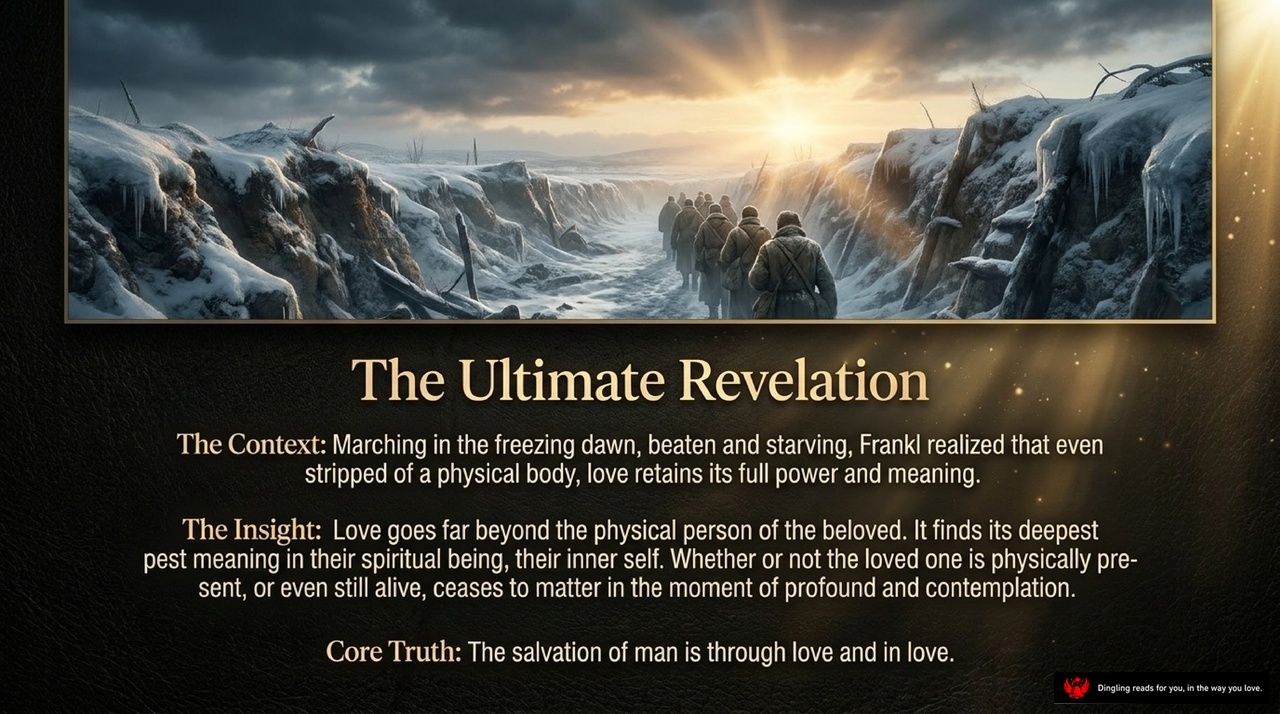
In the freezing dawn of the camps, as Frankl and others marched toward an uncertain fate, stripped of dignity and starving, he realized a profound truth: love retains its full power even when the physical body is gone. This is the ultimate revelation. Love transcends the flesh of the beloved; it finds its deepest meaning in their spiritual being, their inner self. Whether the loved one is physically present or has passed away ceases to matter in the moment of profound contemplation. The salvation of man is through love and in love. It is this spiritual connection that allowed Frankl to touch happiness even in the darkest hours, proving that as long as the heart remembers, the soul remains free.

So, we arrive at a profound concept: Tragic Optimism. It's the ability to stay optimistic not by ignoring the darkness, but by facing the "Tragic Triad" of human existence—pain, guilt, and death—and extracting meaning from them.
Let's look at how this works. First, consider pain. Instead of just suffering, we transform unavoidable suffering into a triumphant human achievement. Think about it: when we endure hardship and find a reason to keep going, that struggle itself becomes a victory.
Next is guilt. Rather than being paralyzed by our mistakes, we derive from them the opportunity to change for the better. Every error becomes a lesson, a pivot point to become a better version of ourselves.
Finally, there is death. We utilize the brief, transitory nature of life not as something to fear, but as an incentive to take responsible, immediate action. The fact that our time is limited is what makes every moment precious and every choice matter.
Optimism cannot be commanded; you can't just force yourself to be happy. But meaning can be extracted from tragedy. By reframing these three inevitable realities, we don't just survive the hard times—we find a deeper, more resilient way to live.
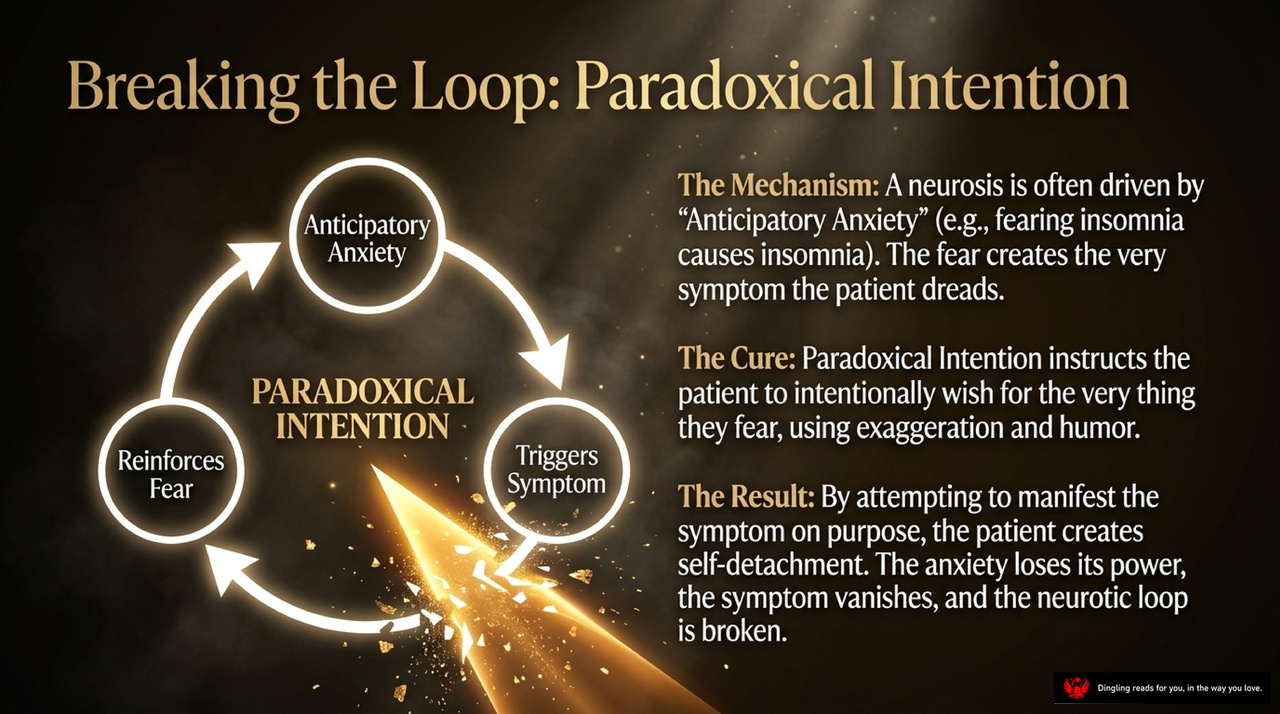
Breaking the Loop: Paradoxical Intention
Look at this diagram. It visualizes a vicious cycle that traps us in anxiety. It starts with "Anticipatory Anxiety"—that terrifying feeling of fearing the very thing we dread, like worrying about insomnia and thus creating it. This fear triggers the symptom, which in turn reinforces the fear, spinning us in an endless loop.
But here is the breakthrough: Paradoxical Intention. Instead of fighting the symptom, we intentionally wish for it. We exaggerate our fear and even joke about it. By trying to manifest the symptom on purpose, we create a crucial psychological distance, or self-detachment. Suddenly, the anxiety loses its power because we are no longer its victims; we are the ones controlling the situation. The symptom vanishes, and the neurotic loop finally breaks. This isn't just theory; it's a powerful tool to reclaim control when your mind feels hijacked by fear.
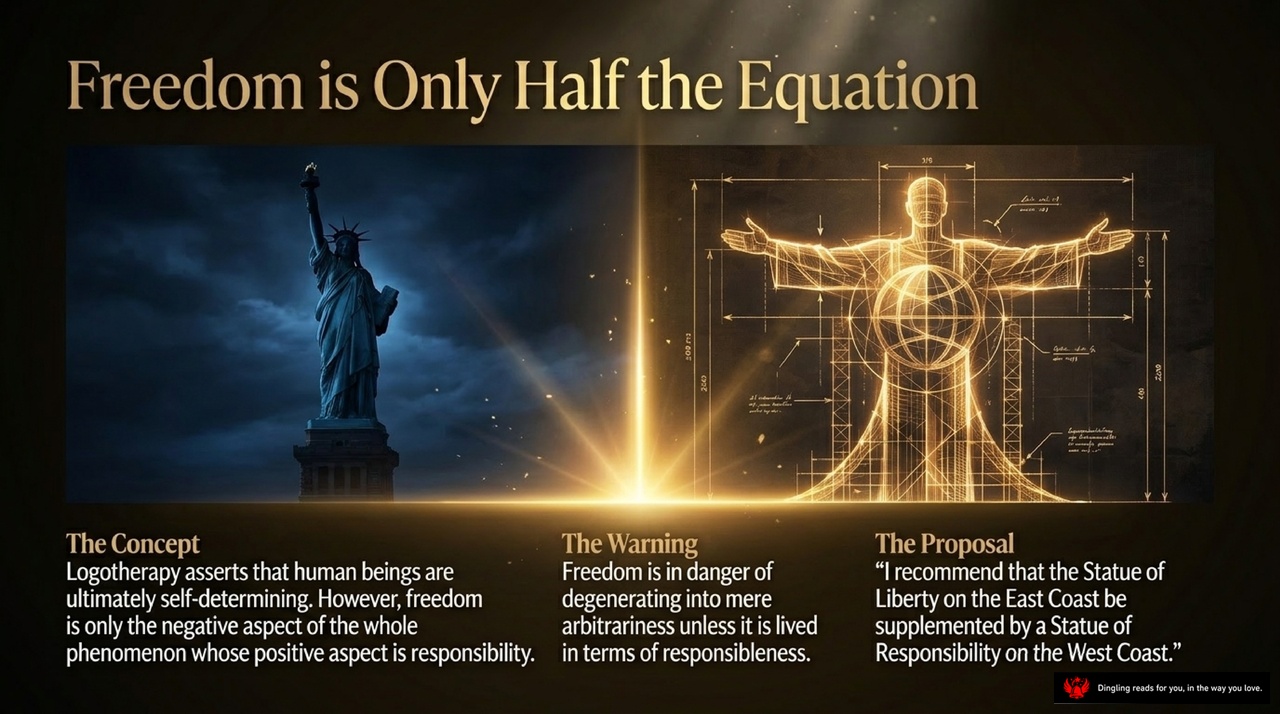
Freedom is only half the equation. Look at the Statue of Liberty on the left—a global symbol of liberty. But on the right, we see a blueprint of responsibility, the missing half of our humanity. Logotherapy teaches us that while we are ultimately self-determining, freedom without responsibility is dangerous. It can easily degenerate into mere arbitrariness. That is why I propose a powerful idea: if the East Coast has the Statue of Liberty, the West Coast must have a Statue of Responsibility. Without this balance, freedom becomes chaos. True freedom isn't just about doing what you want; it's about the courage to take ownership of your actions. When you embrace responsibility, you stop being a victim of circumstances and start becoming the author of your own life. This is the only way to anchor your freedom and find lasting meaning.

Look at this striking split: on the left, a calendar tearing itself apart into a vortex, representing the Pessimist who watches time vanish with fear and sadness, fixated on the vanishing possibilities of youth. On the right, a glowing, ancient book standing firm, symbolizing the Optimist who neatly files every torn page, building an immortal archive of their life.
The core insight here is profound: instead of dwelling on impossible possibilities, the true optimist has realities—deeds done, loves loved, and sufferings bravely borne. Nothing can be undone, and therefore, nothing can be stolen from the past. While the pessimist mourns what life *could* have been, the optimist treasures what life *has been*. As the slide reminds us, "Having been" is the surest kind of being. In a world obsessed with the future, the greatest act of courage is to honor the past, turning our scars into a library of wisdom rather than a graveyard of regrets.

We must fundamentally shift our perspective. It does not matter what we expect from life, but rather what life expects from us. We are not the ones asking the meaning of life; we are the ones being interrogated. Life asks the questions, and we can only answer by answering for our own lives—through responsible action.
When life demands its meaning from you, what will your answer be?