
Metro 2033: Complete Chapter-by-Chapter Summary

Welcome to the world of *Metro 2033*. Imagine a Moscow buried beneath tons of concrete, where the only light comes from flickering lanterns and the only danger hides in the shadows. This is a subterranean survival story by Dmitry Glukhovsky, chronicling one man's desperate journey through a fractured, post-apocalyptic underground to save the last remnants of humanity. It's not just about fighting monsters; it's about finding your soul when everything around you tries to destroy it.
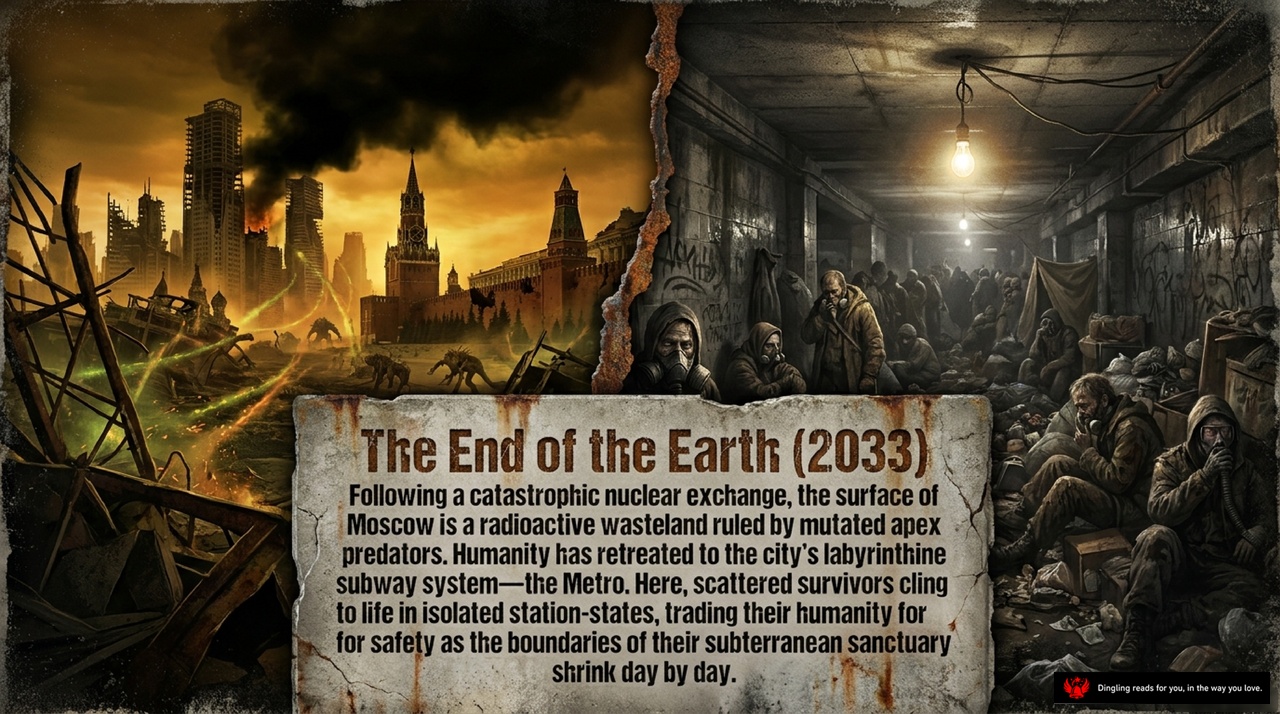
The year is 2033, and the surface of Moscow is a radioactive wasteland ruled by mutated apex predators. Following a catastrophic nuclear exchange, humanity has retreated to the city's labyrinthine subway system—the Metro. Here, scattered survivors cling to life in isolated station-states, trading their humanity for safety as the boundaries of their subterranean sanctuary shrink day by day.
But the danger isn't just above ground. Deep within the tunnels, a new horror is awakening. It's not just the monsters, but the darkness itself, a living entity that feeds on fear and loneliness. As our protagonist Artyom journeys through this dying world, from the chaotic "Dark Empire" to the fanatical Nazi territories and the cold, orderly lands of the Hansa, he realizes that the true enemy might be the tunnel itself. It's a place where the dead never rest, where the air can drive you mad, and where every step forward feels like a battle for your soul. In this claustrophobic nightmare, the only thing more terrifying than the monsters is the realization that the darkness is always watching, waiting for you to lose your mind so it can take over.

Step into the heart of the Metro, where the darkness isn't just an absence of light—it's a living, breathing predator. Imagine the subway not as a transit system, but as a fractured city of three distinct layers, each with its own deadly rules. Above ground, Layer 1 is a lethal wasteland where radiation burns and mutant apex predators, like the terrifying Librarians, roam free. Beneath that lies Layer 2, the transit tunnels. These aren't safe passages; they are hazardous arteries filled with pitch-black connecting tubes where bandits ambush travelers and psychological anomalies twist your mind until you lose your way forever.
But down in Layer 3, the station sanctuaries, you finally find life. These are the only habitable zones, functioning as isolated cellular organs in this underground organism. Here, makeshift pig farms and mushroom cultivation keep the population fed, guarded by armed checkpoints that control who enters and who leaves. It's a fragile ecosystem where survival depends on strict boundaries. Yet, even in these safe havens, the threat never truly fades. The dark tunnels above always whisper warnings, reminding everyone that in the Metro, the line between safety and death is thinner than you can imagine.

Step into the Dark Empire, where silence is far more terrifying than any scream. Here, the ground is unnaturally clean, and iron doors stand locked like silent sentinels guarding a forbidden secret. This eerie stillness chills the bone more than any chaos ever could.
Our guide, Khan, walks with a calm that feels almost unnatural, though he knows the truth: this place is a void where even his powers of foresight fail. He explains that this is the Abyss, a place that swallows all logic. When we reach Turgenevskaya station, the marble floors are pristine, untouched by time or war, as if a train is waiting to arrive at any moment. But Khan sees the danger. He leads us away from the main line, into a darker, more dangerous tunnel, warning that the path ahead is a dead end unless we take the risk.
The journey quickly turns deadly. A sudden, black hurricane of malice sweeps through the tunnel, carrying the whispers of the dead. Khan screams for us to run as the fear becomes a physical force, trying to drag us into the abyss. We barely make it to Kitai Gorod station, where the entrance is blocked by sandbags. Inside, we find a chaotic "Babylon," a city within a city where two warring factions rule through robbery and fear.
Survival here means paying a price. At the checkpoint, the guards demand cash to enter. Khan negotiates with cold efficiency, trading military cartridges for passage, even adding extra bullets as "spiritual damages." Once inside, the reality of this place hits hard: food is made of rats, and violence is the only currency that matters. This is the Dark Empire, a brutal ecosystem where the weak perish and only the ruthless survive.

The slide before us lays bare the brutal truth of the Metro: humanity didn't unite against the apocalypse; it fractured. Instead of a single front, we see a compressed mirror of history, where the same ideological wars that destroyed the surface are now fought in the dark. Look at this Faction Matrix. It's a snapshot of the dominant powers tearing the subway apart.
First, we have the **Hansa**, a capitalist trade alliance controlling the wealthy Ring Line. They are heavily militarized, guarding their prosperity with strict, closed borders. Then, the **Red Line**, led by communist revivalists in the Sokolnicheskaya Line. They are expansionist, relying on propaganda to convert others rather than just fighting.
On the other side of the spectrum sits the **Fourth Reich**, fascist purists holding the Pushkinskaya Hub. They are xenophobic, utilizing slave labor and declaring the Metro "Russia for Russians," viewing outsiders as hostile enemies. Finally, there is the **Polis**, a neutral hub in the City Center. Ruled by Brahmin scholars and warrior Kshatriyas, they act as cultural preservers, dedicated to protecting history and knowledge.
This isn't just a map; it's a warning. Every faction is a twisted version of the old world, proving that even in the depths of the earth, the human spirit is capable of creating new forms of tyranny and division.
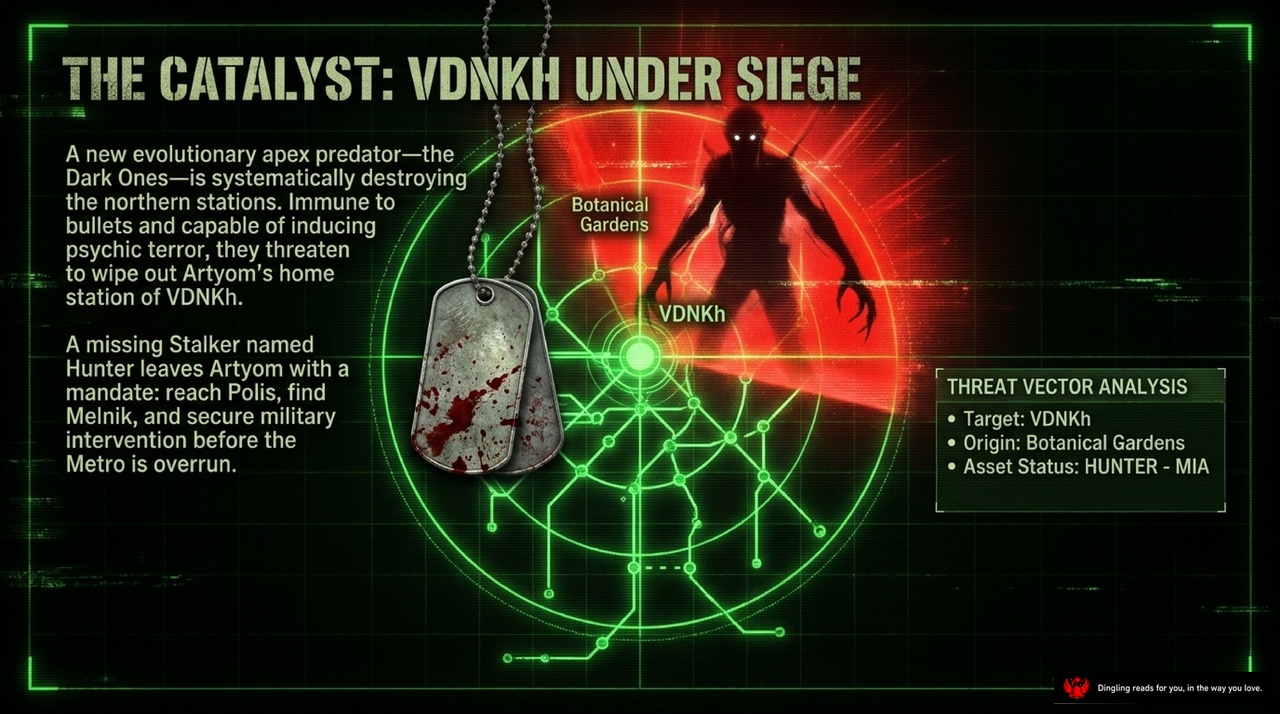
The catalyst for our story isn't a bomb or an army—it's a silent, creeping horror known as the Dark Ones. As we see on this screen, these evolutionary apex predators are systematically dismantling the northern stations, with VDNKh under siege. They're immune to bullets and weaponized with psychic terror, threatening to wipe out Artyom's home entirely. While a missing Stalker named Hunter leaves Artyom with a desperate mandate to reach Polis and find Melnik for military intervention, the real danger is already here. The map highlights the origin point: the Botanical Gardens. This isn't just a location; it's the heart of the Dark Ones' hive. The threat vector is clear, and the stakes are nothing short of extinction for the entire Metro.

Artyom's journey to Polis isn't just about surviving the dark tunnels; it's a philosophical battle where every guide offers a different lens to rationalize the apocalypse. As he moves deeper into the Metro, he encounters three distinct archetypes that define how humanity copes with the end of the world.
First, there is Bourbon. His philosophy is cynical survival. He focuses on self-interest, smuggling, and raw profit, representing the harsh, transactional reality of the tunnels where life is simply a commodity to be traded.
Then, we have Khan. He embodies mystical fatalism. Believing he is Genghis Khan's reincarnation, he views the Metro as a fluid purgatory where ghosts are real and time is nonlinear. He sees the chaos not as random, but as a spiritual journey where souls wander in a non-linear existence.
Finally, there is Melnik, also known as Miller. He represents tactical pragmatism. As an elite Stalker, he believes in military supremacy, raw firepower, and a strict chain of command to enforce human survival. He rejects mysticism in favor of cold, hard logic and organized resistance.
Together, these three figures show that in the face of total collapse, there is no single way to find meaning. You can choose profit, faith, or force, but every path leads back to the same dark truth: survival is the only constant.
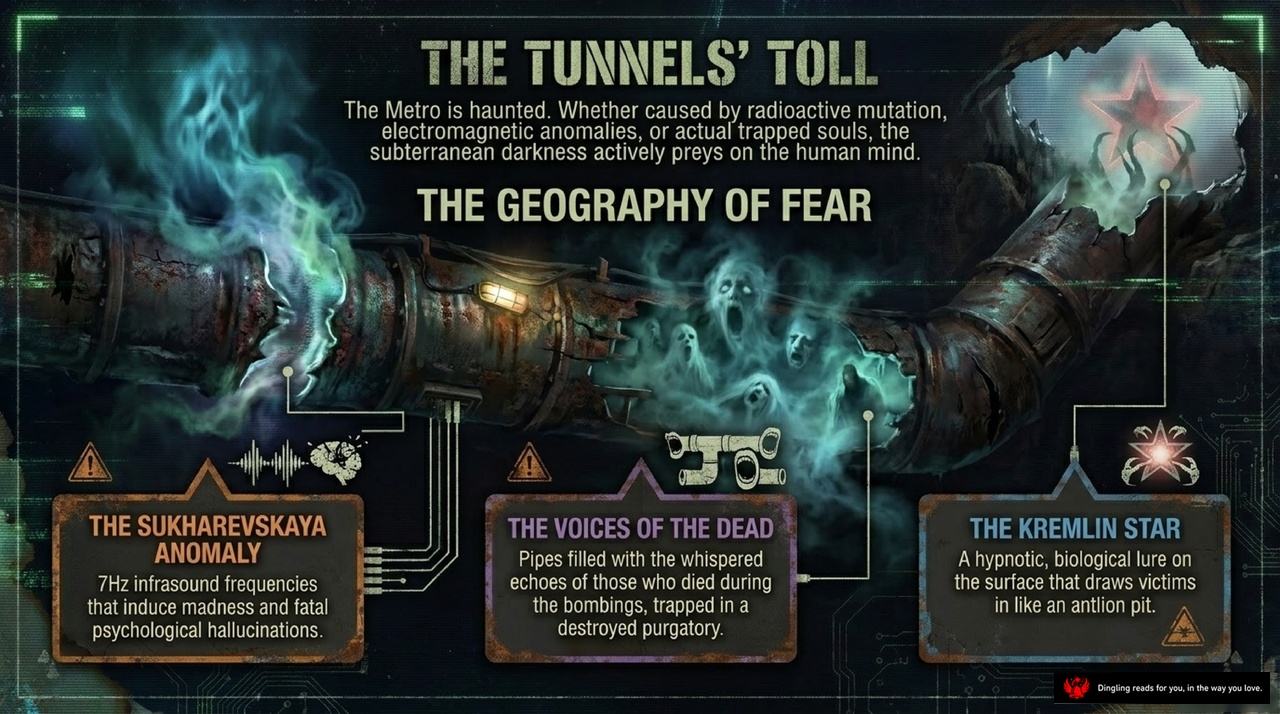
The Metro isn't just a subway system; it's a haunted labyrinth where the darkness actively hunts the human mind. Whether it's radioactive mutations or trapped souls, the tunnels take a heavy toll. We call this "The Geography of Fear," and today we're breaking down three specific horrors that lurk in the shadows.
First, look at the Sukharevskaya Anomaly. This isn't a ghost story; it's science gone wrong. The tunnels here emit 7Hz infrasound frequencies—sounds so low humans can't hear them, but which cause madness and fatal psychological hallucinations. It's the physical manifestation of fear.
Then, there are The Voices of the Dead. Imagine pipes filled with the whispered echoes of those who died during the bombings. These souls are trapped in a destroyed purgatory, their voices echoing endlessly, turning the station into a nightmare where the living can't escape the past.
Finally, we have the Kremlin Star. This is a hypnotic, biological lure located on the surface that draws victims in like an antlion pit. It's a trap designed by the Dark Ones to pull anyone near into the abyss.
These three elements combine to create the Metro's most terrifying reality: a place where the environment itself is an enemy, preying on your sanity and dragging you down into eternal darkness.

Look at this stark divide: the Tipping Point of Civilization. On the left, we see Devolution in Park Pobedy. This isn't just a ruined station; it's a cult of the Great Worm. The people here have regressed into brutal, myth-driven savagery, driven by underground myths that reject technology and even human life. It's a terrifying descent into darkness where logic has been replaced by superstition.
But look to the right: Preservation in Polis. This is the final sanctuary. While the world outside crumbles, Polis stands as a fortress for human intellect. Dedicated to the preservation of history, science, literature, and art, it represents the last flicker of our rationality. As Artyom traverses the Metro, this contrast is stark. While Polis attempts to hoard the last vestiges of human intelligence, isolated stations like Park Pobedy have completely regressed. This image captures the ultimate struggle: the fight between the beast that wants to consume us and the light that desperately tries to save us.

Look at this map. It's not just a route; it's a suicide mission. The city of Polis refuses military aid, forcing Artyom to go it alone into the lethal surface. His target? The Great Library, a deadly hunting ground for the Apex Librarians. He has to navigate this maze, following the incursion route marked in red, to recover a classified pre-war map leading to D6.
This isn't just about finding a location; it's about retrieving a legendary, intact strategic missile base. Think of it as the ultimate high-stakes heist. But there's a price. The map shows a warning: Apex Predator Territory. This isn't a simple extraction; it's a battle for survival against creatures that hunt in the dark.
Every step on this path is a gamble. The objective is clear—Classified Asset D6—but the cost of knowledge is written in blood. Artyom isn't just fighting monsters; he's fighting for the future of humanity itself. As he steps into that library, he realizes that sometimes, the most dangerous thing you can find is the truth you were never meant to know.
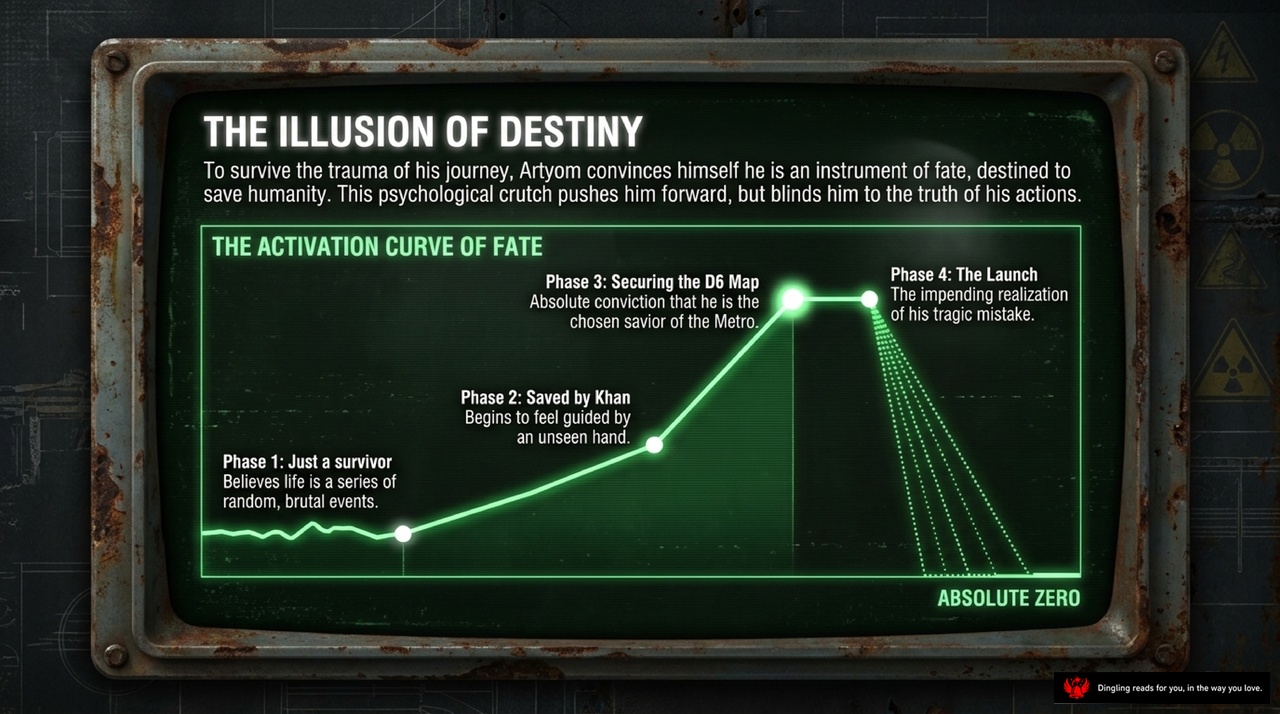
The illusion of destiny isn't just a story; it's a dangerous psychological trap that Artyom falls into to survive the trauma of his journey. To cope with the horror, he convinces himself he is an instrument of fate, destined to save humanity. This belief acts as a crutch, pushing him forward, but it also blinds him to the truth of his own actions.
Look at this activation curve of fate. It starts with Phase 1, where Artyom is just a survivor, believing life is a series of random, brutal events. Then, after being saved by Khan in Phase 2, he begins to feel guided by an unseen hand. This belief solidifies in Phase 3 when he secures the D6 Map, reaching a peak of absolute conviction that he is the chosen savior of the Metro. But this peak is actually a cliff edge. In Phase 4, the launch occurs, bringing the impending realization of his tragic mistake. The curve doesn't rise to glory; it crashes straight down to Absolute Zero, revealing that his faith in destiny was nothing more than a delusion that led him directly to ruin.
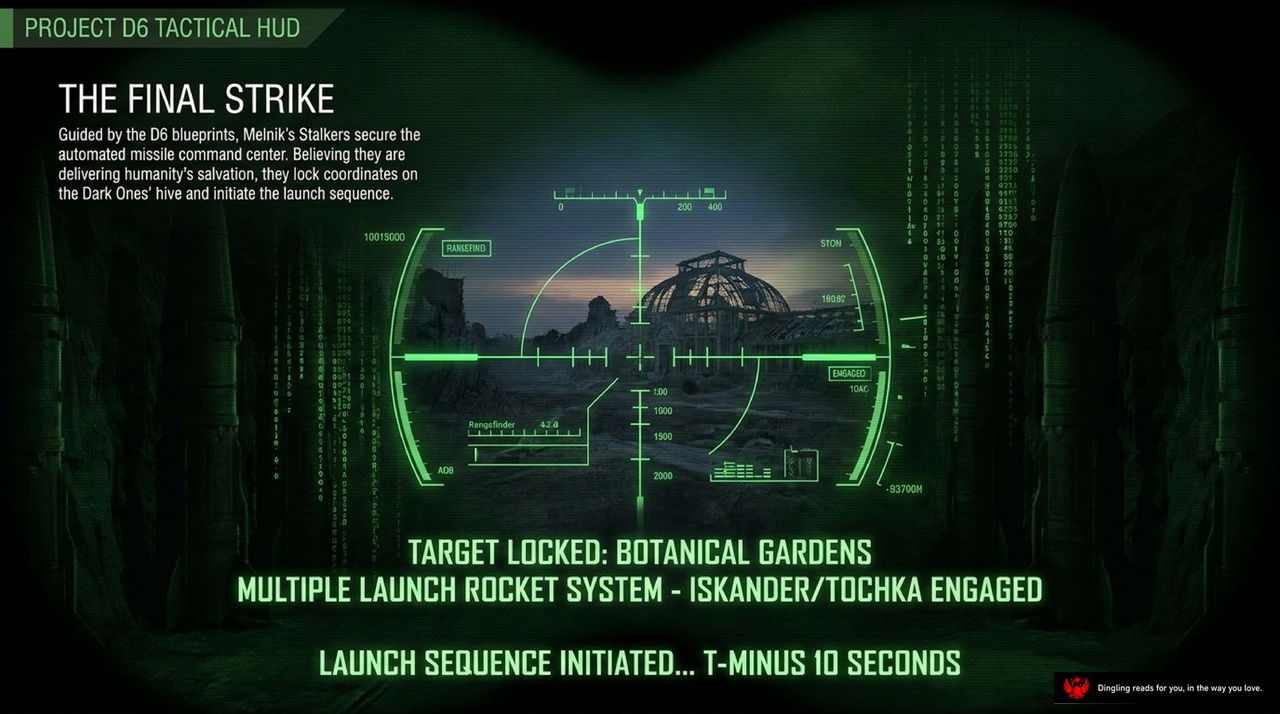
The final countdown has begun. Guided by the D6 blueprints, Melnik's Stalkers have secured the automated missile command center, believing they are delivering humanity's salvation. They lock coordinates on the Dark Ones' hive and initiate the launch sequence. Through the tactical HUD, the target is locked on the Botanical Gardens. Multiple launch rocket systems, including the Iskander and Tochka, are now engaged. The screen flashes a chilling warning: Launch sequence initiated... T-minus 10 seconds. In this moment of absolute silence before the explosion, the fate of two species hangs in the balance.

In the final seconds before impact, Artyom's mind fully links with the Dark Ones. The horrific truth is revealed: they were never enemies. They were a peaceful, evolutionary bridge attempting to ally with humanity to help them survive the surface. The psychological attacks were simply humans failing to comprehend telepathy.
This is the revelation that shatters everything Artyom thought he knew. The war he fought, the blood he spilled, and the destruction he witnessed were all built on a catastrophic misunderstanding. What looked like an invasion was actually a desperate plea for connection. The Dark Ones weren't invaders; they were a new branch of humanity, trying to bridge the gap between species through telepathy, a language humans had long forgotten.
Instead of building a telepathic bridge, humanity chose weapons. Instead of seeking an evolutionary alliance, they built walls of fear and violence. Artyom realizes with a crushing weight that he was the weapon that destroyed the very peace he sought to save. As the missiles rain down on the garden, he understands too late that the true enemy wasn't the aliens, but the refusal to listen. The bridge was there all along, waiting for someone to cross it, but humanity chose to burn it instead.
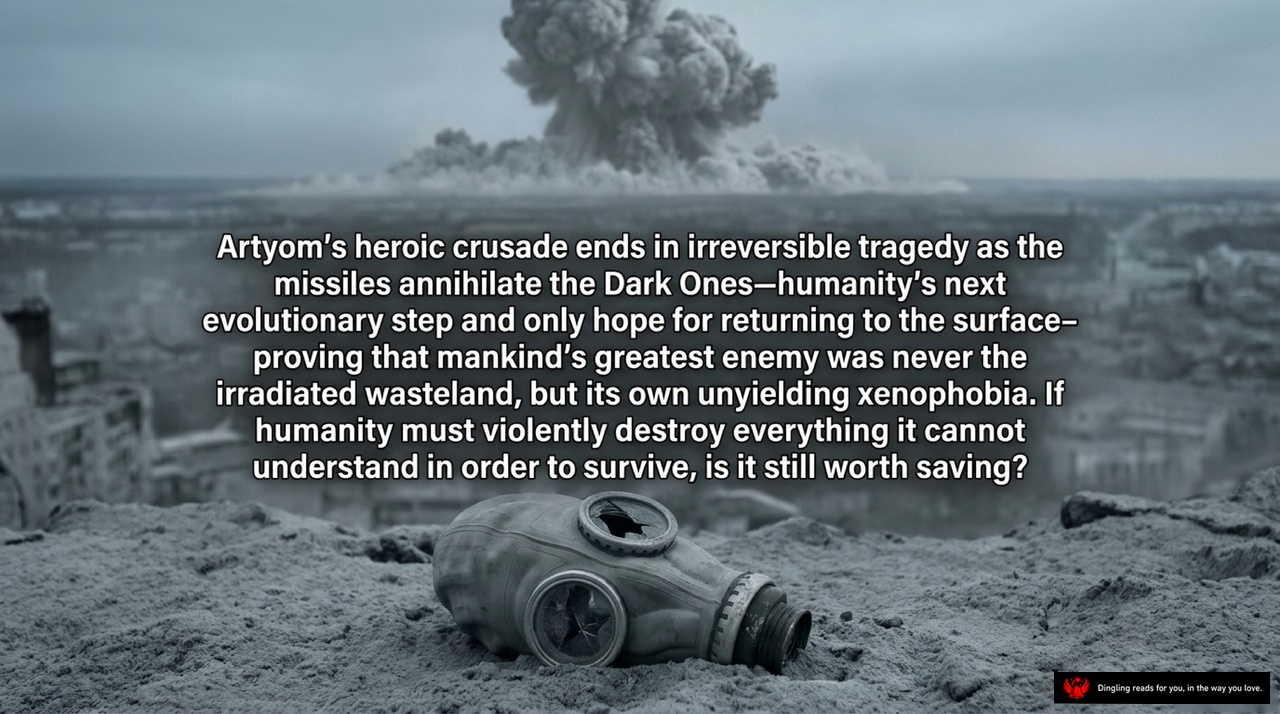
Artyom's heroic crusade ends in irreversible tragedy as the missiles annihilate the Dark Ones—humanity's next evolutionary step and only hope for returning to the surface. This catastrophic victory proves that mankind's greatest enemy was never the irradiated wasteland, but its own unyielding xenophobia. If humanity must violently destroy everything it cannot understand in order to survive, is it still worth saving?