
Miracles of the Namiya General Store: Complete Chapter-by-Chapter Summary

Welcome to the story of *The Miracles of the Namiya General Store* by Keigo Higashino. Imagine a quiet, forgotten alley in a small Japanese town, bathed in moonlight. Here stands an old general store, its sign faded, its door closed for decades. But tonight, something magical is about to happen. This isn't just a shop selling everyday items; it's a place where people's deepest worries are heard and answered. The tale begins with three young men—Dunya, Shotaro, and Kiyoshi—caught in a desperate situation after a botched robbery. With no money and nowhere to go, they stumble upon this abandoned store, only to discover a mysterious mailbox that seems to connect them to the past. What they find inside changes everything, launching a journey through time that will reveal how the choices we make, even the ones we don't understand, shape our lives in ways we never expect.

Welcome to the story of *The Accidental Counselors*. Picture this: it's 2012, and three desperate petty thieves—Atsuya, Shota, and Kohei—are hiding in a dusty, abandoned general store after a robbery goes wrong. They're scared, hungry, and looking for a place to crash. But then, something impossible happens. At exactly 2:30 AM, a letter drops through the rusted shutter slot. It's a plea for advice written 40 years ago.
Inside the envelope is a story from a girl named Tsukioto, an aspiring Olympic athlete whose boyfriend is dying of cancer. She's torn between fulfilling her dream and staying by his side. The three thieves, who have no idea what they're doing, are suddenly trapped by a temporal anomaly. They are forced to step into the shoes of the store's original owner, becoming unlikely guides for a desperate soul from the past.
As they read her letters, they realize they are talking to someone from the 1970s. A girl who doesn't know what a mobile phone is, who is confused about the upcoming Olympics because her country will boycott them, and who is struggling with a heartbreaking choice. The thieves try to give her advice, but their suggestions are often harsh or misguided. Yet, in a twist of fate, their cynical words might just be the catalyst she needs to find her own strength and truth. This is the beginning of an extraordinary journey across time, where three outcasts become the most important counselors anyone could ever ask for.
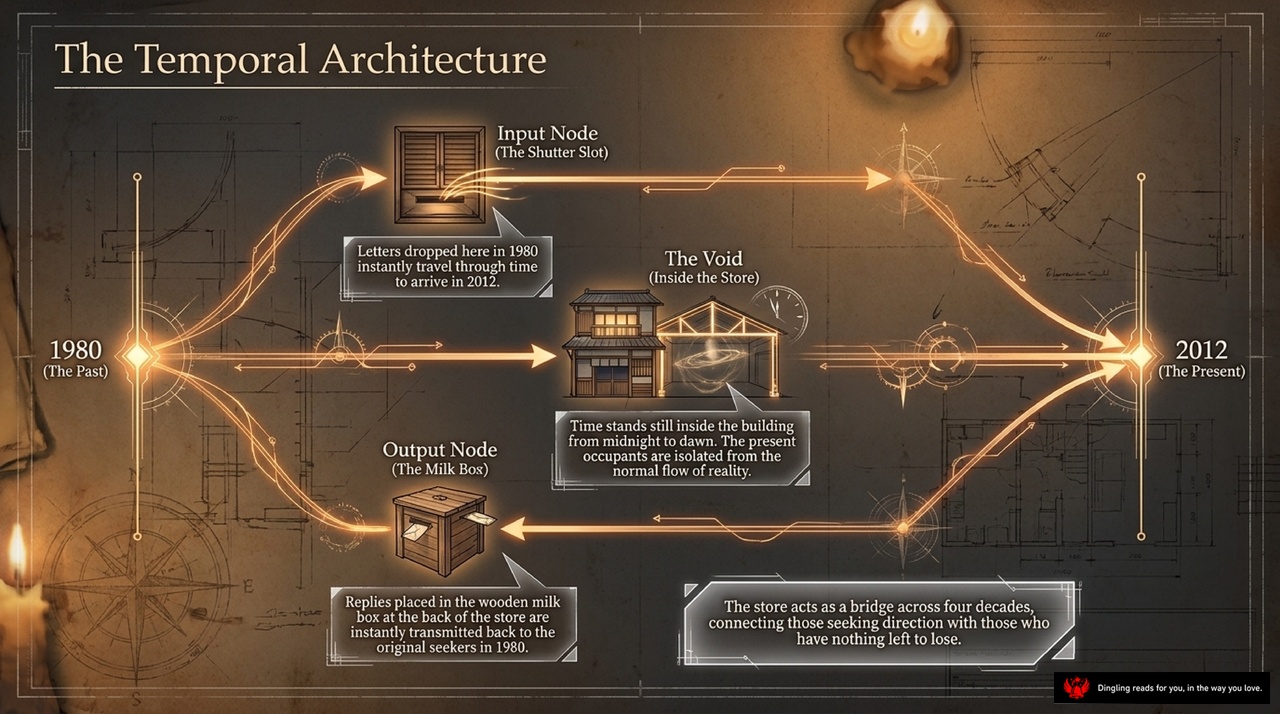
The Temporal Architecture of the Store
Welcome to the blueprint of the Labyrinth of the Lost. Today, we're diving into the core mechanic that makes this story so mind-bending: The Temporal Architecture. As you can see on this slide, we aren't just dealing with a physical shop; we are looking at a machine that connects two distinct eras: 1980, the past, and 2012, the present.
Let's break down how this bridge works. On the left, we have the **Input Node**, or "The Shutter Slot." This is where letters dropped in 1980 instantly travel through time to arrive in 2012. On the right, we have the **Output Node**, known as "The Milk Box." This is where replies placed in the wooden milk box at the back of the store are instantly transmitted back to the original seekers in 1980.
But what happens in the middle? That is **The Void**, located inside the store itself. Here, time stands still from midnight to dawn. This isolation cuts the present occupants off from the normal flow of reality, creating a perfect vacuum where messages can cross decades without being intercepted.
The genius of this setup lies in the store acting as a bridge across four decades. It connects those seeking direction with those who have nothing left to lose. It turns out that the answers given in the past often shape the future in ways the writers could never predict, while the advice given in the present can save lives in the past. It's a closed loop of fate, where every letter is a thread stitching together the lives of strangers separated by time.

Have you ever asked yourself, "Why do we seek advice?" We often turn to others not because we lack answers, but because we desperately need someone to validate the choices we secretly want to make. As Yuji Namiya discovered through thousands of letters spanning decades, the people who write for advice often already have the solution in their hearts. They are simply looking for a mirror to reflect their hidden desires back at them.
But here is the profound psychological truth: when seekers receive advice that contradicts their deep-seated desires, they don't just accept it. They argue back. The advice acts as a catalyst, forcing them to prove to themselves what they truly want. It is a battle of wills disguised as a conversation.
Look at the story of the "Lost Dog." This young woman was torn between a mundane office job and the allure of the nightlife, fearing judgment from her peers. She wrote to us for guidance. Our advice, based on our own limited lives, was to stay safe and find a partner. But her response was a fierce rejection. She didn't want our comfort; she wanted independence. She wanted to take risks. Her argument against our advice revealed her true self: a woman willing to fight for her own future, even if it meant walking a dangerous path.
This is the magic of the Lamington Store. We never truly solve the problems for the writers. Instead, we provide a sounding board that pushes them to confront their own truths. Whether it's a musician choosing between his dream and his family's expectations, or a young man escaping a broken home, the real transformation happens inside them. They write to us, and in the process of arguing with our letters, they finally hear their own voices clearly.
So, the next time you feel the urge to ask for advice, remember this: you are not looking for an answer. You are looking for permission to be yourself. The answers have always been there, waiting in your heart, just ready to be validated by the world.

Picture this: a "Matrix of Dilemmas," where every choice is a high-stakes game of life and death. On screen, we see four distinct archetypes: The Athlete, The Dreamer, The Runaway, and The Pragmatist. Each represents a different conflict—Love versus Duty, Dream versus Reality, Family versus Independence, and Morality versus Survival.
Look at the "Seeker's Choice." The Athlete ignored advice to fence harder. The Dreamer followed it and died a hero. The Runaway ignored advice and ran alone. But the Pragmatist? She followed the advice and became wealthy. It's a stark reminder that following the wrong path can lead to ruin, while following the right one—even if it seems counterintuitive—can bring success.
But here's the twist in the "Irony" row. The Athlete achieved peace by defying the advice. The Dreamer achieved immortality through failure. The Runaway found success but lived with regret. And the Pragmatist? She found wealth but lost her compass. This isn't just about making the "right" choice; it's about the unintended consequences of those choices. Sometimes, the path of least resistance leads to a hollow victory, while the harder road might bring true fulfillment. It's a powerful lesson for all of us navigating our own dilemmas today.
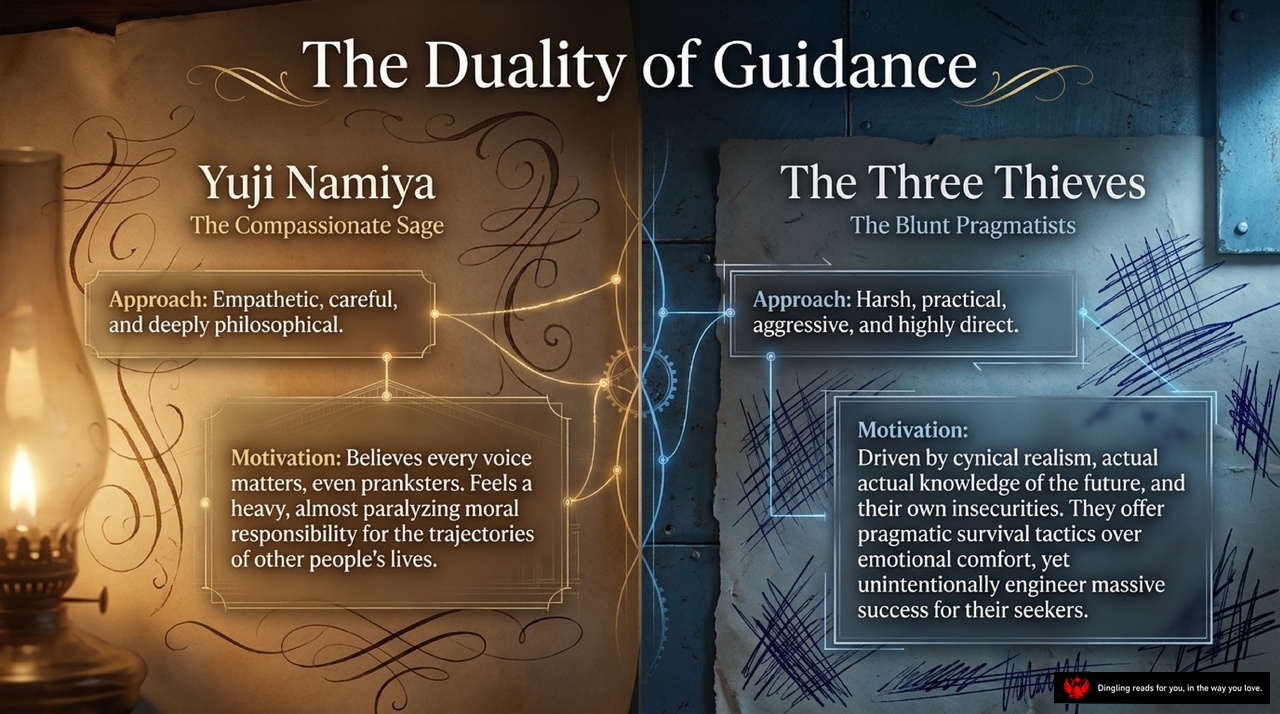
Welcome to the final chapter of our journey through the world of *No Longer Human* and the timeless wisdom of the浪矢杂货店. Today, we explore the profound concept of "The Duality of Guidance," as seen in the lives of our characters and the legacy of the shop itself.
On the left, we see Yuji Namiya, the Compassionate Sage. His approach is deeply empathetic, careful, and philosophical. He believes that every voice matters, even those of the most unlikely individuals. He feels a heavy, almost paralyzing moral responsibility for the trajectories of other people's lives. He understands that sometimes, the kindest thing you can do is simply listen and offer a gentle nudge of understanding.
On the right, we have the Three Thieves: the Blunt Pragmatists. Their approach is harsh, practical, aggressive, and highly direct. Driven by a cynical realism and their own deep-seated insecurities, they offer pragmatic survival tactics over emotional comfort. They are the ones who tell you the hard truth, even when it hurts, because they believe that only by facing reality head-on can one truly survive. Yet, ironically, their unfiltered honesty often engineers massive success for their seekers.
This duality—between the soft heart of the Sage and the sharp edge of the Pragmatists—is the engine that drives the story. It's the reason why a letter from the past could change a musician's fate, why a runaway teenager could find his way home, and why a struggling girl could become a visionary business leader. The shop doesn't just give answers; it reflects the soul of the person asking, sometimes through warmth, sometimes through steel. As we close this book, remember that guidance comes in many forms, and sometimes, the most powerful advice is simply the courage to face your own truth.

The Invisible Thread. Look at this diagram. At its center lies the Marumitsu-en Orphanage, but it's not just a building; it's the single origin point tethering every seeker and every guide in Higashino's narrative. Every story here is part of a closed-loop ecosystem, where fate intertwines across decades.
On the left, we see the Three Thieves. They grew up as orphans in this very place. One of them, the Fish Store Musician, sacrificed his life to save a child here during a fire. That act of heroism echoes through time. On the right, we find the Lost Puppy, Harumi. She was raised here, later becoming the orphanage's financial savior, yet ironically, she also became the victim of the thieves' robbery. The circle of cause and effect is complete.
Below, we have Yuji Namiya. His lost first love was the original founder of the orphanage. And then there is The Saved Child's Sister. She became the famous superstar who immortalized the music of the man who saved her brother. Every thread connects back to that central home.
This isn't just a map of locations; it's a map of destiny. It shows us that in this story, no one is truly alone. Every loss, every sacrifice, and every choice ripples outward, eventually converging back at the source. It's a beautiful, tragic, and perfectly woven web of human connection.

Before leaving the store, Atsuya tests the temporal mail slot one last time by dropping in a completely blank piece of paper. To his shock, a final reply arrives from Yuji Namiya in the past. The message reads: "Your map is a blank page. You are at a loss, wondering where to go. But because it is blank, you can draw whatever you want. The possibilities are infinite. I sincerely pray that you believe in yourself and burn brightly through your life."
This profound advice from the past resonates deeply with the three young thieves, who have been struggling with their own lost directions. Just like the blank map, their lives feel uncertain and full of confusion. Yet, this blankness is not a curse; it is an opportunity. It means they are not trapped by a fixed destiny. Instead, they have the freedom to create their own path, to draw whatever they desire, and to believe in their own potential. The blank page symbolizes infinite possibilities, reminding them that their future is not written yet. They are encouraged to trust in themselves and to live with passion and purpose. With this newfound hope, they decide to turn over a new leaf, committing to a life of integrity and redemption.
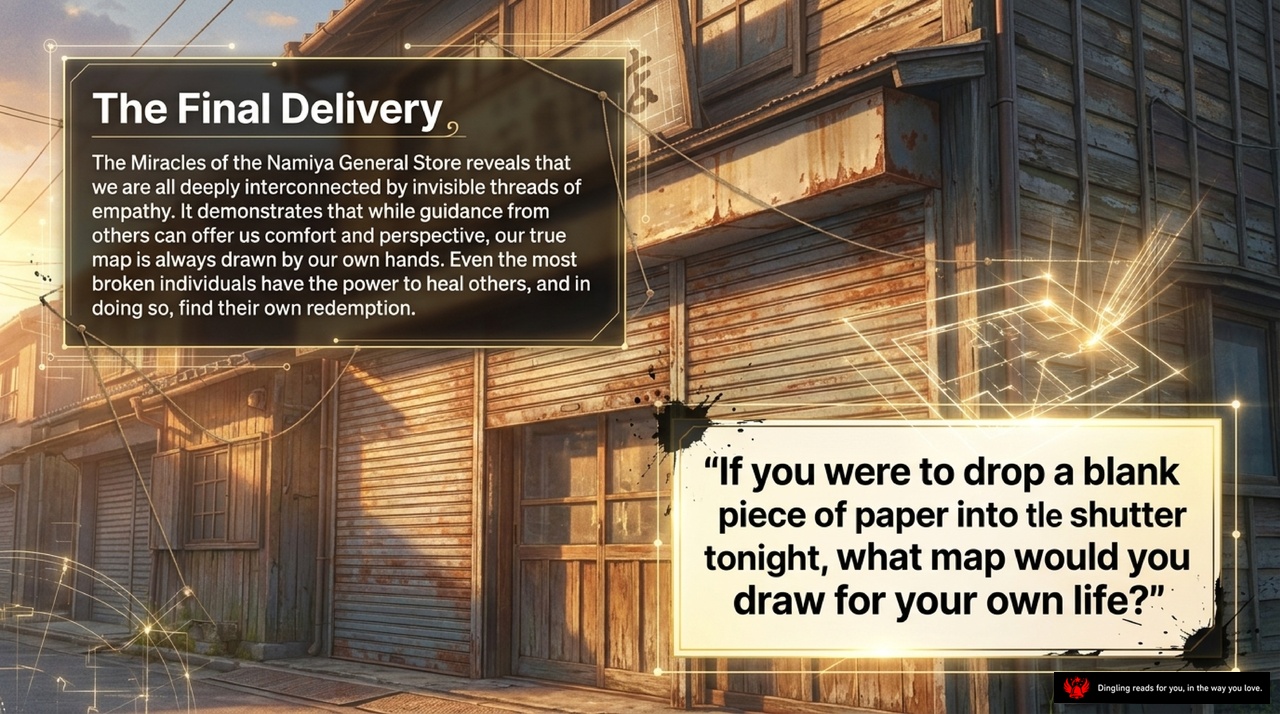
The Final Delivery
Have you ever felt like your life was a blank sheet of paper, drifting without a map? *The Miracles of the Namiya General Store* teaches us that we are all deeply interconnected by invisible threads of empathy. While guidance from others can offer comfort and perspective, our true map is always drawn by our own hands. Even the most broken individuals have the power to heal others, and in doing so, find their own redemption.
Imagine this: if you were to drop a blank piece of paper into the shutter tonight, what map would you draw for your own life? In the story, three desperate teenagers find an abandoned shop that seems to connect them with the past. They receive letters from people decades ago, struggling with impossible choices. At first, they don't know how to help. But through their advice—sometimes harsh, sometimes kind—they unknowingly guide these strangers toward their own paths. One letter, sent on a blank sheet, turns out to be the most powerful of all. It reminds the recipient that there is no fixed destiny, only infinite possibilities waiting to be created.
The story reveals that while we cannot control everything, our choices matter. Whether it's a musician choosing between family and dreams, or a young woman navigating a chaotic world, the answers often come from within, sparked by the belief that they can change their future. Even when life feels like a dead end, there is always a way forward if you have the courage to take the first step.
So, the next time you feel lost, remember: you are not alone. Someone, somewhere, might be drawing a map for you. And you, in turn, have the power to draw a map for someone else. The final delivery isn't just about sending a letter; it's about passing the torch of hope, proving that even in the darkest times, we can still find our way home.