
My Country and My People: Complete Chapter-by-Chapter Summary

Welcome to this special session on "My Country and My People" by Lin Yutang. Today, we are stepping into a profound exploration of the Chinese spirit, where survival is often secured not through force, but through the quiet art of passive resistance.
As we look at the misty mountains in our image, we see a landscape that mirrors the book's core thesis: in China, common sense frequently supersedes rigid logic, and the mundane, everyday art of living reigns supreme. This isn't about grand, abstract theories; it's about how people actually navigate life, find joy in the ordinary, and maintain harmony amidst chaos. Lin Yutang invites us to understand that the Chinese soul finds its deepest strength not in conquering the world, but in mastering the art of living within it.

The Foundational Divide: North vs. South. This isn't just about geography; it's about two distinct souls living under one culture. Imagine the North as the Norman conquerors—tall, robust, and hardy, fueled by wheat and pungent onions. They are simple-minded yet earnest, carrying a natural humor and a combative spirit. Historically, they are the founders of dynasties, the military leaders, and the bandits who shape the empire's destiny.
Contrast that with the South, the Mediterranean inhabitants of the Chinese psyche. They are slender, refined, and physically delicate, thriving on rice and sweet lotus. Their temperament is clever and sophisticated, yet often passive and intellectually restless. They are the creators of art, the poets, the merchants, and the scholars who define the nation's soul.
This contrast is everywhere. Listen to the music: the heavy, rhythmic tones of the Shaanxi songs versus the weeping, fluid melodies of Suzu. Look at the poetry: the rugged, warlike verses of the North that inspire armies, against the delicate, melancholic lyrics of the South that whisper of deep sorrow. Even the physical features tell a story. Northerners are built for battle, while Southerners are built for intellect and elegance.
But here is the crucial insight: to truly understand the Chinese people, you must understand how these contrasting temperaments have been assimilated into a single, unified culture. It is this unique fusion of the warrior's strength and the scholar's grace that gives China its enduring vitality.

Imagine a cycle that has defined the rhythm of a civilization for eight centuries. This isn't just a timeline; it's a heartbeat. Look at this infinity symbol. It represents the "800-Year Pulse of Survival," a fascinating loop where China doesn't break under pressure, but rather transforms through it.
The cycle begins with **Peace and Unity**. For four to five hundred years, a powerful dynasty rises, establishing order and building monumental engineering works that unify the culture. It's a golden era of stability. But nature abhors a vacuum. Eventually, internal decay sets in. **Decay and Civil War** follow as moral machinery corrodes from within, leading to factionalism and chaos. The center shifts, and the old order fractures.
This is where the magic happens. Instead of retreating or fighting to the death, the civilization embraces **Conquest and Oppression**. Northern tribes or foreign invaders breach the defenses. Historically, this might seem like a tragedy, but this graphic reveals the secret to China's endurance: survival isn't about repelling conquerors; it's about absorbing them. The physically degenerated native population is revitalized by the injection of fresh blood from the invaders.
Finally, we reach **Assimilation and New Blood**. The conquerors are culturally absorbed, and their new vitality sparks a cultural renaissance. This cycle repeats, creating a continuous loop of renewal. As the text at the bottom states, "Physical degeneration is countered by systematic biological grafting." This ability to digest foreign elements and turn them into strength is the ultimate reason why this civilization has survived for millennia, constantly evolving while maintaining its core identity.

Look at this slide titled "The Paradox of 'Mellowness'." It breaks down how a single Chinese trait can be seen as either a cultural virtue or a political vice, depending entirely on the context.
First, we have "Patience." On the positive side, it's a supreme tolerance that allows families to survive harmoniously in crowded, inescapable units. But flip that same patience, and it becomes a political vice: a morbid capacity to endure tyranny, extortion, and misrule as if they were just natural laws of the universe.
Next is "Indifference." Cultivated as a self-protective social attitude, it teaches us to "sweep only the snow before your own door." However, when taken to the extreme, this indifference creates a total absence of public spirit, preventing the formation of civic organizations and legal reform.
Finally, we see "Old Roguery." On one hand, it's Daoist wisdom that sees through the vanity of human ambition, promoting deep inner peace. On the other, it transforms into a cynical, paralyzing apathy that mocks youthful enthusiasm and actively sabotages social progress.
So, the lesson here is clear: these qualities aren't inherently good or bad. They are double-edged swords. What makes us resilient and peaceful can also make us passive and helpless when it comes to fighting for change.
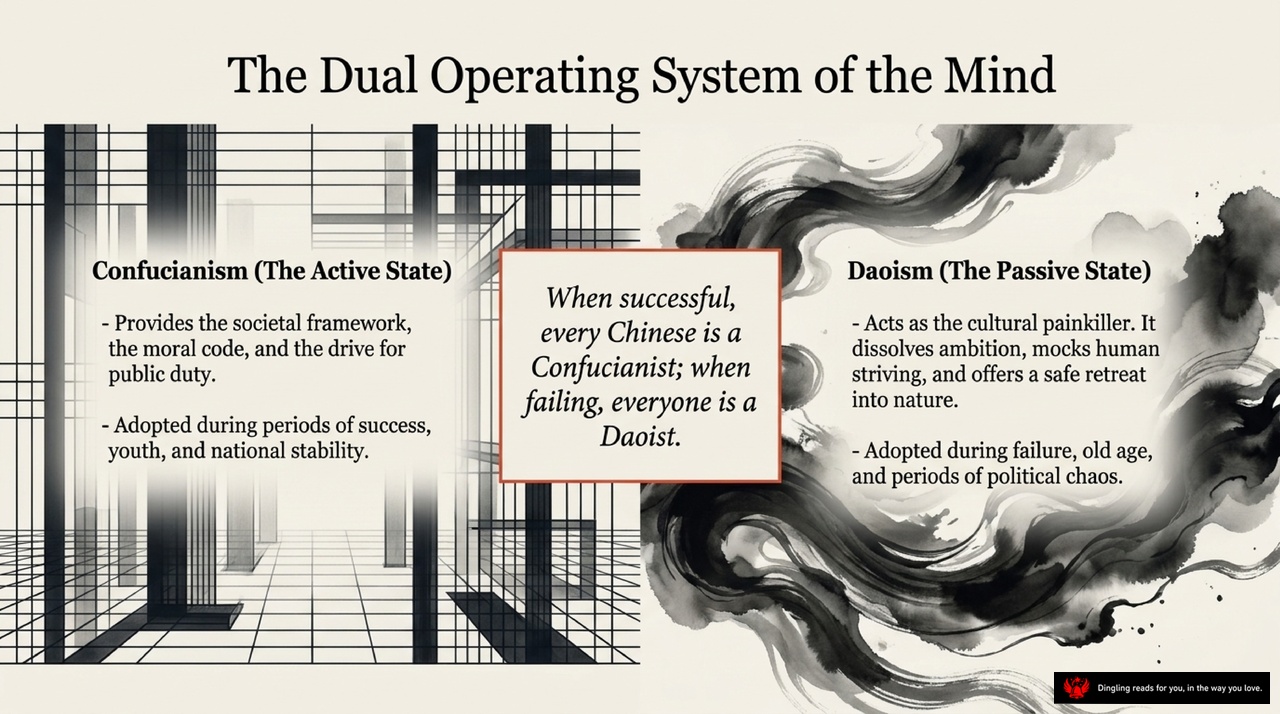
Today's slide explores a fascinating psychological duality that deeply shapes the Chinese character: the mind operates on two distinct systems, mirroring the ancient philosophical divide between Confucianism and Daoism.
On the left, we see **Confucianism**, labeled as the "Active State." This is the societal framework that drives us forward. It provides the moral code, the sense of public duty, and the ambition to succeed. As the text suggests, this mindset is adopted during periods of success, youth, and national stability. When things are going well, every Chinese person leans into this Confucianist mode, embracing structure and striving for achievement.
On the right, the image shifts to flowing ink, representing **Daoism**, or the "Passive State." The central quote on the slide is striking: "When successful, every Chinese is a Confucianist; when failing, everyone is a Daoist." This isn't a contradiction; it's a survival mechanism. When life hits a wall—during failure, old age, or political chaos—Daoism acts as a cultural painkiller. It dissolves ambition, mocks human striving, and offers a safe retreat into nature. Instead of forcing things, it teaches us to flow with the current.
This dual operating system allows for incredible flexibility. You have the drive to build and the wisdom to let go. You have the discipline to work hard and the freedom to rest when needed. It's a dynamic balance that has allowed this civilization to endure through centuries of change, adapting its mindset to the circumstances of the moment.

Today's slide presents a profound shift in how we understand truth and decision-making. Look at that balance scale: on one side sits "Human Nature," or *Qing*, representing our empathy and feelings; on the other, "Eternal Reason," or *Li*, standing for logic and abstract principles. The core message here is simple yet powerful: in the Chinese mindset, reasonableness often outweighs pure logic.
We see this in the rejection of rigid analytical logic. While Western thought often seeks to prove truth through deduction, Chinese philosophy suggests that truth cannot always be fully proven; it is often better hinted at. Pure logic is viewed with suspicion because it tends to fracture the holistic reality of life, ignoring the human element.
This leads us to the standard of *Qingli*, or "human reason." A logical solution is discarded the moment it violates human nature. True wisdom isn't found in cold calculation, but in the equilibrium between absolute reason and deep human empathy. This balance results in what is known as the "Middle Way." To be reasonable is to compromise, to leave room for human error, and to never push an adversary to the absolute edge. It is a philosophy that prioritizes connection and harmony over being strictly right.

Today's slide breaks down how Chinese thought constructs reality: it's built on a "Canvas of Concrete Imagery." Notice the formula here: a magnifying glass plus a grid of arrows equals "Size." This visual metaphor captures a fundamental truth about Chinese philosophy—the absence of abstraction. Instead of using abstract theoretical terms, Chinese thought relies entirely on concrete, visual analogies. We don't just talk about "volume"; we synthesize concepts by combining tangible extremes. That's why we say "Big-Small" for size, "Long-Short" for length, and even use "Is-Is Not" to define right and wrong. These aren't just linguistic quirks; they represent a deep philosophical tradition that remains stubbornly tethered to the physical, observable world. By favoring poetic imagery over rigid scientific classification, Chinese culture keeps its feet firmly planted in the real world, using simple, vivid contrasts to explain the complex nature of existence.

The Family: The Ultimate Social Unit. Look at this diagram. It shows a clear hierarchy: the individual sits at the center, surrounded by the family, and then the state. This visual perfectly captures a core truth about Chinese society: the family is not just a unit; it is the ultimate social structure.
First, notice the denial of individualism. In this system, a person isn't an independent entity. You are merely a fraction of a harmonious familial whole. Your identity is defined by your place in the family tree, not by your personal ambitions.
Second, the family acts as a substitute for religion. Ancestor worship and the relentless drive to continue the family line satisfy the deep human desire for immortality. When the state is unstable, the family becomes the eternal anchor.
Finally, and perhaps most critically, the family is often the root of corruption. It functions as the ultimate unemployment insurance. Nepotism and the embezzlement of public funds aren't seen as civic crimes; they are viewed as virtues of familial loyalty. Public spirit is often viewed with suspicion, seen as interference in family matters. This tight bond between the individual and the family creates a powerful, yet sometimes insulating, force that shapes everything from politics to daily life.

The Trinity of Chinese Society isn't just a theoretical concept; it's the operating system of everyday life. Look at this diagram: it shows how Face, Fate, and Favor completely replace the rigid machinery of Constitutional Law.
First, we have Face. This is the psychological currency of dignity and prestige. It operates above the law, dictating social interactions, sparking wars, and even saving defeated generals through graceful exits.
Next is Favor. This is the reliance on personal grace and connections rather than impersonal justice. It's a society built on the mercy of the powerful rather than the rights of the citizen.
And finally, Fate. This is the fatalistic acceptance of extreme inequality and suffering as natural laws. It breeds immense patience and subdues revolutionary zeal.
Together, these three forces create a unique social order where rigid rules are replaced by flexible, human-centric dynamics.

The image before us is a striking metaphor for the hidden architecture of traditional Chinese society: the "Bureaucratic Banyan Tree." Let's break down this powerful visual.
At the very top, we see the **Canopy**, labeled here as **Privilege**. This is the wide shade that protects the powerful from the harsh realities of the law. It's the safety net for those who have managed to climb into the inner circle.
Beneath that, the roots are depicted as **tangled and far-reaching**. This represents **Nepotism**. The text explains that through marriage and lineage, anyone can find a distant connection to a powerful root to secure favor. It's a complex web of relationships where loyalty to family often outweighs loyalty to the law.
Finally, at the bottom, lies **The Soil**, representing **The Masses**. These are the common people who pay the taxes and provide the nutrients that allow the entire tree to thrive, yet they exist entirely outside its legal protections. They are the foundation, but they receive no shade in return.
The slide concludes with a stark reality: Chinese society has only two true classes. The first is the **Yamen**, or the official class, who enjoy extraterritorial privilege. The second is the tax-paying masses. This visual perfectly illustrates the gap between the protected elite and the working population, a dynamic that defined social life for centuries.

The illusion of the "Gentleman Government" is a powerful concept that exposes a fundamental clash in how we view leadership. On the left, we see the Confucian Ideal, which rests on a simple but risky premise: treat rulers as moral gentlemen. The method relies entirely on their inherent goodness and parental love for the people, assuming that virtue will naturally translate into good governance. However, the result is often a lack of audits, budgets, or boundaries, which inevitably leads to unchecked embezzlement and nepotism. It's a system built on trust, but trust alone rarely protects against corruption.
Contrast this with the Legalist Reality, championed by Han Feizi, shown on the right. His premise is far more cynical: treat rulers as potential scoundrels. Instead of relying on moral whims, the method demands strict, impersonal laws that apply equally to the highest minister and the lowest peasant. Han Feizi argued two thousand years ago that relying on the morality of rulers is a naive illusion. The result? The only viable path to a clean government is through rigid rules and accountability. This comparison highlights a timeless truth: without checks and balances, even the best intentions can lead to disaster, while a system of law ensures fairness regardless of who is in charge.

The Summit: The Art of Living isn't just a title; it's a philosophy of life that invites us to step off the frantic treadmill of modern ambition and find our true north in the quiet moments of existence.
Look at this diagram. It represents a sanctuary—a place where the chaos of the outside world dissolves into harmony. This is the essence of what we call Earthly Humanism. Unlike many cultures that look toward the afterlife or theological mysteries for meaning, Chinese philosophy anchors itself firmly in the here and now. The ultimate goal of all knowledge isn't to conquer the heavens, but to achieve simple, earthly happiness.
Notice how the text highlights "Joy in the Mundane." The highest cultural achievement here isn't technological conquest or industrial dominance. It's the mastery of leisure. It's about the appreciation of a perfect cup of tea, the depth of a friendship, the changing of seasons, and the quiet harmony of a domestic life. This isn't about doing less; it's about savoring more.
Finally, consider "The Wisdom of Old Age." The culture chooses contentment over relentless progress. It embraces the beauty of the present moment rather than the uncertainty of the future. It's like an old man who has seen the futility of restless ambition and realizes that peace is the greatest victory of all. In a world obsessed with the next big thing, this slide reminds us that the art of living is found right here, in the simple, beautiful reality of our everyday lives.

The Enduring Spirit
Look at this ancient pine clinging to the cliffside. It doesn't fight the wind; it bends with it. That is the essence of the Chinese spirit. As this slide reminds us, China has survived millennia not by aggressively conquering the world, but through the patient mastery of the self.
Instead of chasing endless mechanical progress, China anchored its society in the unbreakable bonds of the family. It chose the warmth of common sense over the coldness of absolute logic, elevating the simple, mundane joys of existence above the relentless pursuit of ambition. In doing so, China perfected the ultimate art: the art of living.
In our modern obsession with restless ambition, we often ask ourselves a critical question: Have we conquered the world only to forget how to live in it? The Chinese answer is a resounding no. They found their power not in dominating nature, but in harmonizing with it, turning ordinary life into a masterpiece of peace and contentment.