
My Way of Life and Thinking: Complete Chapter-by-Chapter Summary
Welcome to the story of a man who started from nothing and built a global empire. This is the journey of Konosuke Matsushita, the visionary behind Panasonic.
Born in humble circumstances in rural Japan, Matsushita faced early hardships that would shape his character. His family lost their home in a failed business venture, leaving them in debt. As the youngest son, he was sent to Osaka to learn the trade of polishing fire basins. The work was grueling; his hands cracked and bled from the cold water and rough sandpaper. Yet, he never complained. He learned the value of hard work, honesty, and resilience from the very beginning.
From a humble apprentice, he climbed the ladder through sheer determination. He worked in bicycle shops, then entered the electrical industry, rising from a trainee to a skilled technician in just three months. He took on challenges, worked late nights, and even sacrificed his own health to deliver projects on time.
But the true turning point came after his father passed away. Suddenly, he was the head of the household. The responsibility was heavy, but it also ignited a fire within him. He realized that to support his family and make a difference, he couldn't just be an employee. He had to become an entrepreneur.
In 1918, with almost no capital and just a few supporters, he rented a small room and founded Matsushita Electric. He started by manufacturing simple items like fan bases and plug caps. What set him apart was his belief in trust. While competitors kept their trade secrets hidden, Matsushita openly shared his manufacturing techniques with all his employees, even new hires. He believed that building a strong team was more important than hoarding secrets.
His early products were affordable and reliable. When a devastating earthquake struck Tokyo, he didn't abandon his dealers; instead, he helped them recover, even taking a hit on his own finances. This act of kindness built a loyalty that would last a lifetime.
As his company grew, so did his vision. He saw that the real mission of business wasn't just to make money, but to improve people's lives. He famously compared his goal to tap water: just as anyone can drink clean water without paying a fortune, everyone should have access to essential, high-quality goods at an affordable price.
This philosophy drove him to innovate constantly. From the first battery lamp to the first radio, and eventually the washing machine, television, and refrigerator, Matsushita kept pushing the boundaries. He believed that by producing more, prices could go down, making technology accessible to the common person.
Today, we celebrate the legacy of a man who taught the world that greatness starts with humility, that trust is the foundation of any great team, and that the purpose of business is to serve humanity. This is the inspiring journey of Konosuke Matsushita.

The Forge of Adversity (1894–1917): A foundation built on absolute necessity and customer service.
Imagine your life as a massive, intricate machine, where every hardship you face is a gear that tightens the structure, making you stronger. This slide maps out the critical years from 1894 to 1917, the crucible that forged a legend.
It all began in 1894, born into a farming family, but tragedy struck hard. By age four, he lost everything due to his father's failed commodity speculation. This wasn't just a setback; it was the first lesson in survival. At nine, in 1903, he left school to apprentice in a brazier shop, then a bicycle shop in Osaka. Here, he learned the hard way: greatness starts from the bottom. Do not despise the apprentice's path.
But the real fire came later. In what the slide calls "The Crucible," he lost his parents and siblings to illness, leaving him as the sole provider for the Matsushita family. That pressure became his fuel. By 1910, recognizing the future of civilization lay in electricity, he joined the Osaka Light Company. He didn't just work there; he saw the potential in every wire he touched.
This era wasn't about comfort; it was about building a foundation on absolute necessity and unwavering customer service. Every struggle was a necessary step toward the future.

Picture this: a simple, blueprints-style diagram of an electrical socket, breaking down every component from the ceramic casing to the contact terminals. This isn't just a technical drawing; it's the blueprint for a revolution that started in a cramped, dirt-floor tenement in 1918.
Matsushita didn't start with a massive factory or a huge budget. He started with a simple, disruptive formula: cost disruption and quality engineering. By recycling used lightbulb bases and sharing his production secrets openly with his day-one employees, he slashed manufacturing costs dramatically. The result? He priced his products 30% cheaper than the market standard.
But low cost wasn't his only weapon. He focused on quality engineering, designing sockets that were more durable and easier to use than the dominant Tokyo competitors. The impact was immediate and overwhelming. The supply simply could not keep up with the demand. That tiny workshop expanded rapidly, turning a local idea into a national phenomenon.
This dual-pronged strategy—driving costs down while raising the bar for quality—defined his entire career and laid the foundation for what would become a global giant. It proves that innovation often starts not with complex technology, but with a smarter, more honest approach to the basics.

Back in the 1920s, the bicycle lamp market was in a tailspin. Traditional lamps were notoriously unreliable—candles blew out in the slightest breeze, and cheap batteries died in hours. It was a broken system where consumers had no trust and retailers had no hope.
Then came Matsushita's bold move in 1923. He didn't just build a better lamp; he engineered a battery-powered "National Lamp" that could last an unprecedented 30 hours. This wasn't just a product upgrade; it was a complete reimagining of what a light should be.
But innovation alone doesn't conquer the market. Matsushita faced a massive hurdle: wholesalers refused to stock the new lamps, dismissing them as fragile toys that would never sell. Undeterred, Matsushita made a calculated gamble. He bypassed the middlemen entirely, distributing 10,000 lamps directly to retail stores on consignment. No money changed hands upfront; the risk was on him.
To prove the concept, he asked shop owners to simply leave the lamps on display. As customers saw the bright, steady beam, the 30-hour lifespan proved itself in real time. The skepticism melted away, replaced by undeniable proof. The result? A massive surge in demand. The product was branded "National" to signify that it was no longer a luxury, but an essential item for every citizen.
This moment of extreme confidence turned a struggling industry into a thriving market, proving that sometimes, you have to bet everything on your vision to win the future.
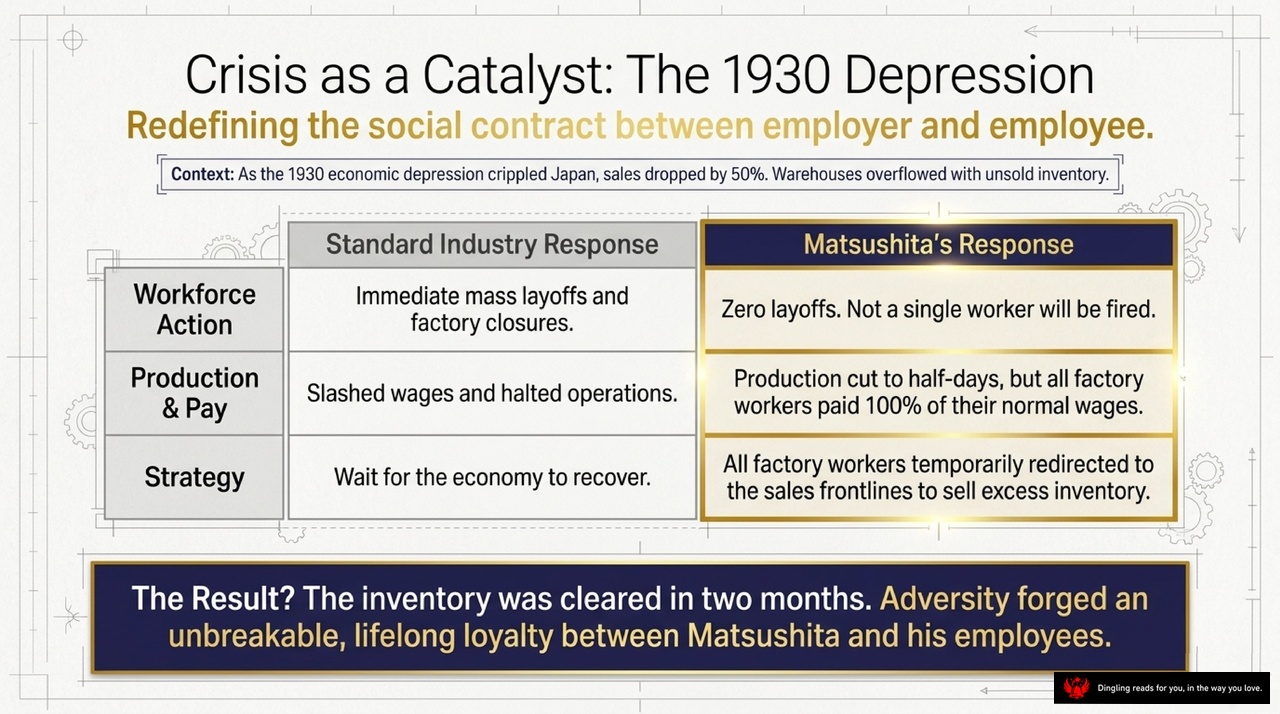
Crisis as a Catalyst: The 1930 Depression. Look at this slide. While the Great Depression crippled Japan, slashing sales by 50% and flooding warehouses with unsold inventory, most companies reacted with fear. The standard industry response was brutal: immediate mass layoffs, factory closures, slashed wages, and a passive strategy of simply waiting for the economy to recover.
But Matsushita did the exact opposite. He chose a path of radical empathy and action. First, he declared zero layoffs. Not a single worker would be fired. Second, even though production was cut to half-days, he insisted on paying 100% of normal wages to every factory worker. Why? Because he believed in the social contract between employer and employee.
His third move was equally brilliant. Instead of waiting, he redirected all those factory workers to the sales frontlines to sell off the excess inventory. The result? The inventory was cleared in just two months. This crisis didn't break Matsushita; it forged an unbreakable, lifelong loyalty between him and his employees. In a world of uncertainty, Matsushita proved that treating people with dignity is the ultimate competitive advantage.

Imagine a world where clean, processed tap water flows freely from a tap, yet no one is punished for drinking it. Why? Because its abundance makes it practically free. This is the core of the "Tap Water Philosophy," a revolutionary mindset introduced by Matsushita in 1932. He realized that a business isn't just a profit machine; it's a sacred social organ. Its ultimate mission is to eradicate poverty by producing goods that are as abundant, accessible, and inexpensive as tap water. In this view, profit isn't the goal—it's merely the natural reward society gives to companies that successfully reduce human suffering through material abundance. Just as a beggar drinks from a roadside tap without fear, consumers should be able to access essential goods without financial anxiety. By shifting the focus from maximizing margins to maximizing abundance, Matsushita redefined the very purpose of commerce, turning the pursuit of wealth into a vehicle for human dignity and global peace.
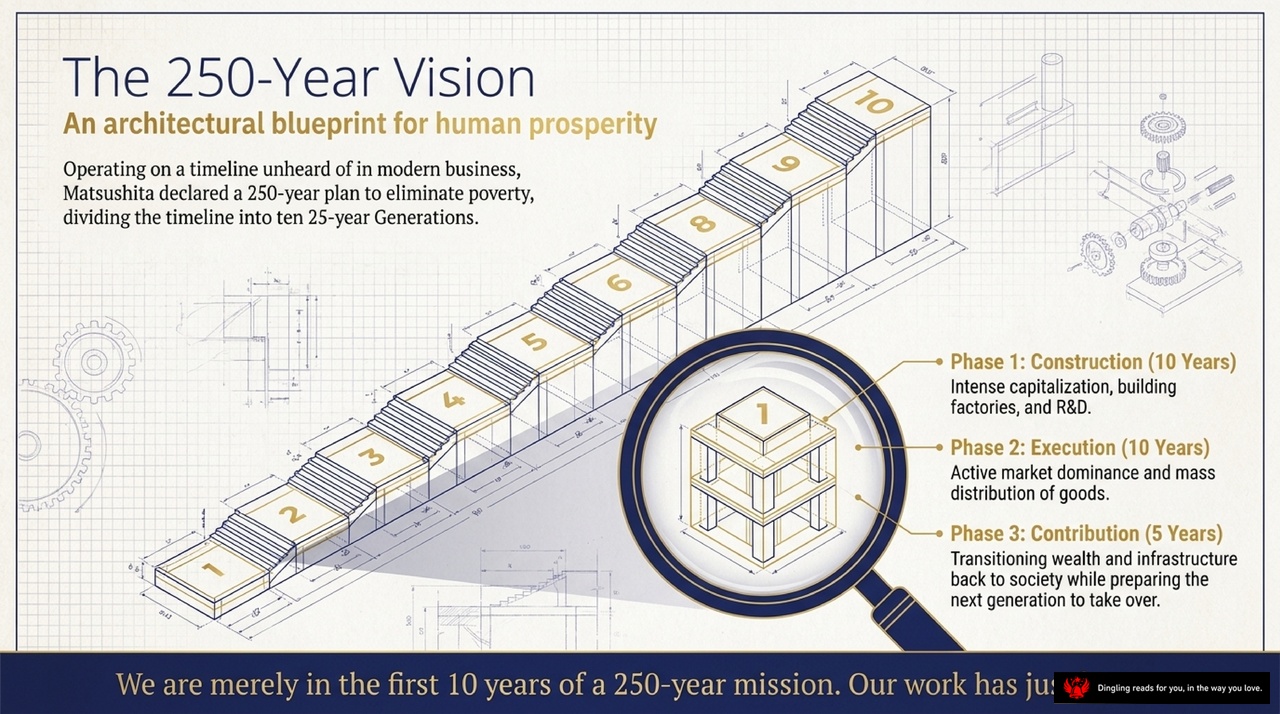
Imagine a grand architectural blueprint, not for a skyscraper, but for human prosperity over the next 250 years. This is the vision that Akio Morita and Sony built into the very DNA of their company. As you see on this slide, they didn't just plan for a quarter or a year; they declared a bold 250-year mission to eliminate poverty, breaking this massive timeline into ten distinct 25-year generations.
Look closely at the structure here. The first generation is zoomed in under the magnifying glass, revealing the critical first decade. This initial phase is split into three distinct steps. First, there is "Construction." For the first ten years, the focus was on intense capitalization, building factories, and pouring resources into Research and Development. It was about laying the foundation.
Once the foundation was set, the plan moved to "Execution." The next ten years were dedicated to active market dominance and the mass distribution of goods. It was time to scale up and prove the product to the world.
Finally, the vision culminates in "Contribution." The last five years of this first generation are about transitioning wealth and infrastructure back to society, all while preparing the next generation to take the baton and run the race. This slide reminds us that we are merely in the first 10 years of a 250-year mission. Our work today is just the beginning of a legacy that is designed to last centuries, not just decades.

In 1933, Matsushita made a bold move that would redefine how modern companies operate: he pioneered the Divisional System. As the company grew rapidly, he realized that centralized bureaucracy was stifling innovation. To preserve entrepreneurial agility, he transformed the entire organization into independent profit centers, giving each division the freedom to thrive like a startup.
The core of this system rested on three pillars. First, Absolute Autonomy. Each division—whether it was Radios, Batteries, Lamps, or Motors—operated as an independent company with its own R&D, manufacturing, and sales teams. They weren't just departments; they were businesses in their own right.
Second, Strict Accountability. This freedom came with a heavy responsibility. Each division had to pay for its own overhead and was solely responsible for its own profits and losses. There was no bailout; success or failure was entirely up to the division head.
Third, Leadership Incubation. By treating division heads as autonomous presidents, the system functioned as an elite training ground for future executives. This approach allowed talented leaders to prove themselves and grow without the constraints of a rigid hierarchy.
This shift from a top-down command structure to a decentralized network of independent units not only saved Matsushita from stagnation but also created a culture where innovation could flourish organically across the entire organization.

In the 1930s, the business world was in chaos. Retailers were engaged in cutthroat price wars, slashing prices until margins vanished and the entire industry was on the brink of collapse. It was in this desperate climate that Matsushita intervened with a radical vision: he created the League Store System and enforced a strict Fixed Price policy to end the destructive cycle.
This approach, known as the Alliance of Prosperity, wasn't just about setting a price; it was about building a synchronized ecosystem. As the slide illustrates, the manufacturer, wholesaler, retailer, and agency were no longer competitors fighting for the same crumbs, but interlocking gears working in harmony. The manufacturer's duty was to continuously lower production costs and pass those savings to the consumer globally, ensuring the product remained high-value. Meanwhile, the wholesaler and retailer had a clear duty: adhere strictly to the fixed price to guarantee a healthy, sustainable profit margin for their own businesses.
The core philosophy driving this alliance was simple yet profound: co-existence and co-prosperity. Matsushita understood that a manufacturer cannot thrive if its retail partners are starving. Profit had to be distributed equitably across the entire supply chain. By ending the race to the bottom, he created an environment where every partner could grow, turning a struggling industry into a beacon of stability and shared success.

Picture shows a powerful visual metaphor: heavy chains representing the Allied Occupation's restrictions and Matsushita's designation as a Zaibatsu are being shattered by a glowing golden arrow, symbolizing the company's resurgence. The text highlights the post-WWII ruins, the freezing of assets, and the unprecedented rally of 15,000 workers who petitioned General MacArthur to reinstate Matsushita. This collective loyalty ultimately saved the company, lifting the expulsion order and honoring the 1930 promise to never fire an employee.
In the ashes of 1945, when Japan lay in ruins and Matsushita's assets were frozen by the Occupation, the company faced its darkest hour. Designated as a monopolistic conglomerate, Matsushita was on the verge of being purged and expelled from his own life's work. But here lies the ultimate test of his philosophy: loyalty. In an unprecedented historical event, the very people meant to oppose management—the newly formed Matsushita labor union—rallied to his defense.
Fifteen thousand workers signed a massive petition and delivered it to General MacArthur's headquarters, demanding their President be reinstated. This wasn't just a protest; it was a declaration of a family's commitment. The result was miraculous: the expulsion order was uniquely downgraded and eventually lifted. That 1930 decision to never fire an employee, which seemed like a financial burden during good times, saved him 15 years later. This moment proved that when a company treats its people with dignity, they return that loyalty tenfold, turning the chains of adversity into the foundation for a new, stronger future.

In 1952, Matsushita made a bold move to expand its global horizon by forming a joint venture with Philips of the Netherlands. The goal was clear: secure world-class technology on equal terms. To catch up with Western electronics, Matsushita approached Philips, but the Dutch company initially demanded a 7% technical guidance fee just for access to their patents. Matsushita didn't accept this; he fiercely negotiated, bringing the fee down to 4.5%. But the real game-changer came next. In a brilliant maneuver, Matsushita turned the tables by demanding that Philips pay him a 3% management guidance fee in return. His argument was powerful: superior Japanese management and market access were just as valuable as Dutch engineering. This shift balanced the scales between technology and management, proving that partnership works best when both sides contribute their unique strengths. The outcome was the successful creation of Matsushita Electronics Corporation, marking the company's transition into a modern, world-class manufacturer ready to compete on the global stage.

Welcome to the core of Matsushita's philosophy. Look at this diagram: it illustrates the concept of PHP—Peace and Happiness through Prosperity, established in 1946. This wasn't just about making money; it was about achieving a harmony between physical wealth and ethical growth.
Matsushita saw that after the war, Japan was suffering from moral decay and starvation. He realized that physical goods alone couldn't save society, so he founded the PHP Institute to study human nature and societal architecture. The image beautifully breaks this down into two circles. On the left, we have Material Abundance, driven by business. Its goal is clear: eradicating poverty and providing the physical foundations for a comfortable life. On the right, we see Spiritual Fulfillment, rooted in humanity. This is about cultivating a mindset of gratitude, ethical responsibility, and mutual respect.
The true magic happens where these two circles intersect: True Peace. Matsushita taught us a powerful synthesis: wealth without ethics leads to corruption, while ethics without wealth leads to suffering. Only when these forces come together do we yield true Peace and Happiness. This balance remains the timeless foundation of his legacy.
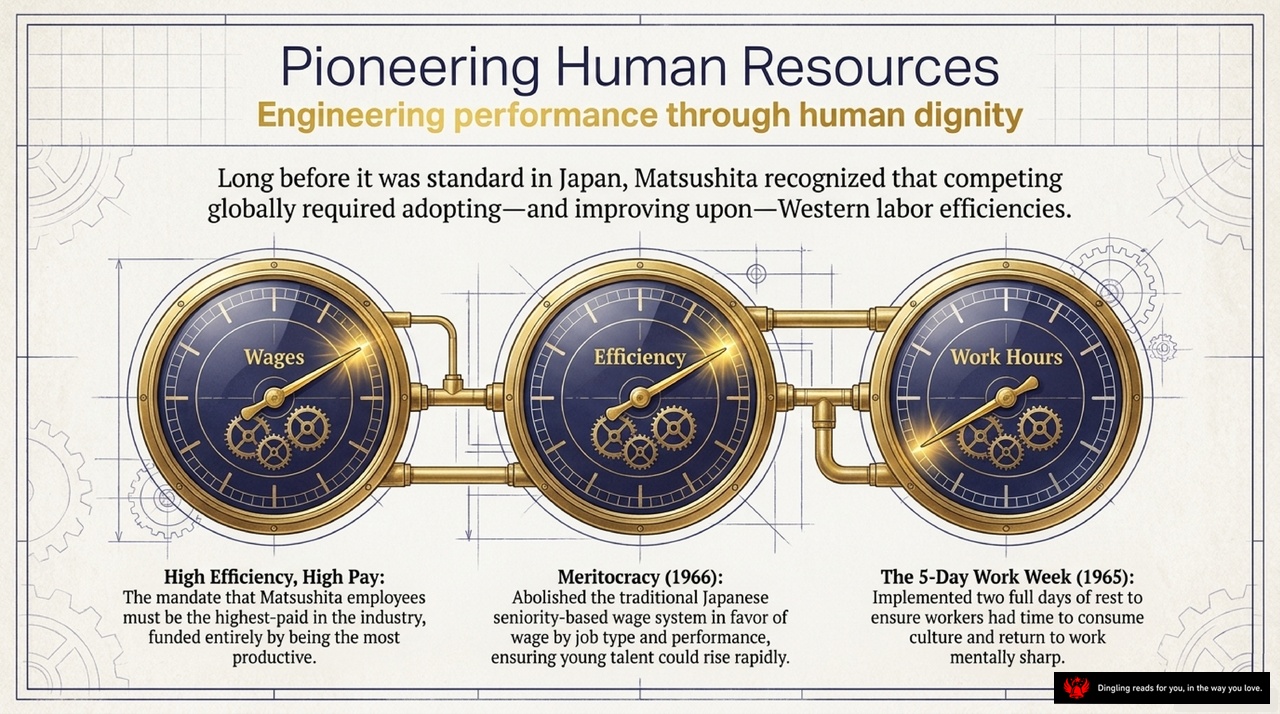
Pioneering Human Resources: Engineering performance through human dignity. Long before this became standard in Japan, Matsushita recognized that competing globally required adopting—and improving upon—Western labor efficiencies. He didn't just copy the West; he engineered a system where human dignity and productivity worked together.
Look at these three key pillars. First, Wages: The mandate was clear—Matsushita employees must be the highest-paid in the industry. But this wasn't charity; it was funded entirely by being the most productive. High efficiency, high pay. Second, Meritocracy: In 1966, he abolished the traditional Japanese seniority-based wage system. Instead, he introduced pay based on job type and performance. This ensured that young talent could rise rapidly, creating a dynamic environment where ability mattered more than age. Third, Work Hours: In 1965, he implemented the 5-Day Work Week. He introduced two full days of rest to ensure workers had time to consume culture and return to work mentally sharp.
This wasn't about cutting costs; it was about investing in people. By giving employees time, fair pay, and a path for advancement, Matsushita created a workforce that was not just efficient, but engaged and loyal. This approach laid the foundation for what would become a global giant, proving that treating people well is the ultimate strategy for business success.
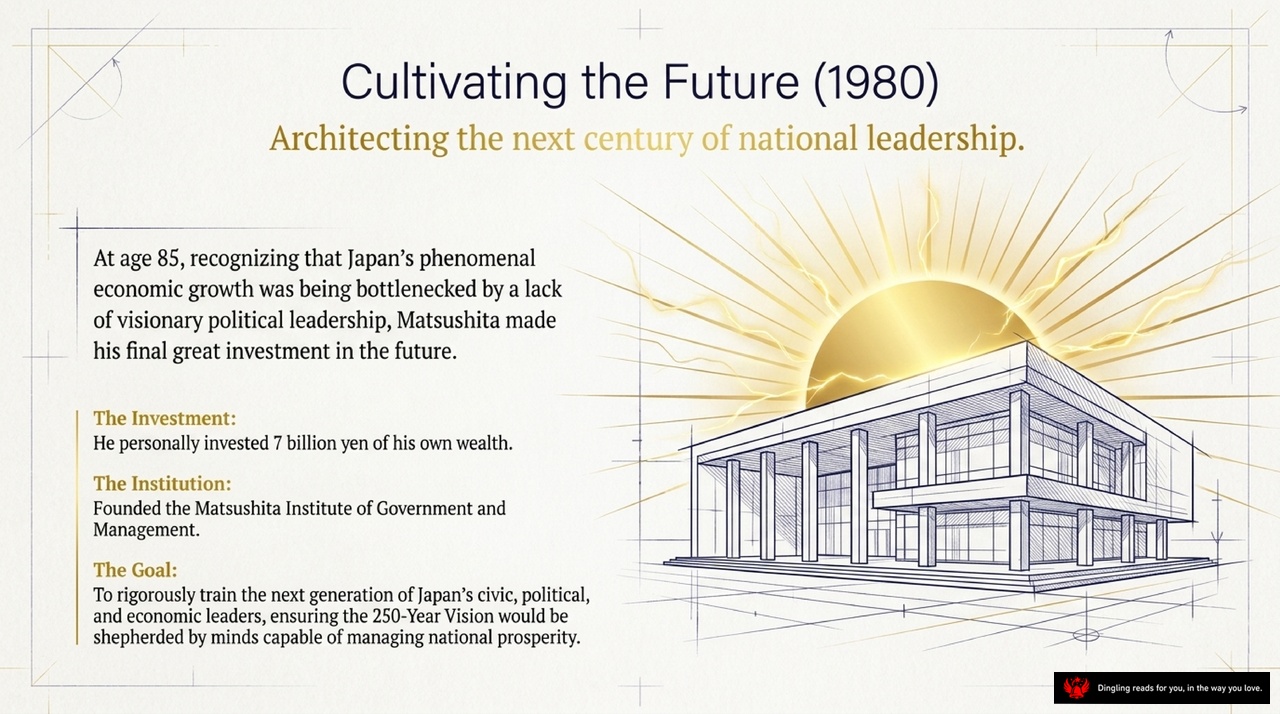
At age 85, Matsushita made his final, most visionary investment: not in a product, but in the future of Japan itself. He recognized that the country's phenomenal economic growth was hitting a ceiling due to a lack of visionary political leadership. So, he personally invested 7 billion yen of his own wealth to found the Matsushita Institute of Government and Management.
His goal was clear and ambitious: to rigorously train the next generation of Japan's civic, political, and economic leaders. He wanted to ensure that his 250-Year Vision would be shepherded by minds truly capable of managing national prosperity. This wasn't just about business; it was about architecting the next century of national leadership, planting seeds for a brighter future long after he was gone.
Konosuke Matsushita didn't just build a company; he transformed a profit-seeking machine into a sacred social organ. He proved that an unwavering commitment to the prosperity of others is the ultimate foundation for enduring success. Imagine a nine-year-old apprentice, staring past his own poverty, and instead designing a 250-year blueprint for human abundance. That was his mindset from the very beginning. So, if a child with so little could think so big, what lasting legacy are you building with the resources you hold today? It's not about how much you have, but how far your vision reaches and how deeply you care for the people around you.