
Nazi Literature in the Americas: Complete Chapter-by-Chapter Summary

Welcome to our deep dive into a dark and forgotten chapter of literary history. Today, we're turning our gaze to the Americas to explore a chilling phenomenon: Nazi Literature in the Americas, as examined by the renowned author Roberto Bolaño.
This isn't just about books; it's a forensic catalog of monsters. We are looking at the terrifying intersection where mediocre literary ambition meets the banality of authoritarian evil. Imagine a world where the desire for fame and the allure of power collide, creating something grotesque.
From the high-society salons of Buenos Aires to the desolate landscapes of the American West, this narrative traces the path of writers who were seduced by, or actively embraced, the ideology of the Third Reich. We see figures like Edmira Mendiguren, who famously met Hitler and even translated poetry for him, and her daughter Ruth, whose life became inextricably linked to the very symbols of that regime. We also encounter poets in Chile, Argentina, and even the United States who wove Nazi imagery into their work, sometimes as a twisted form of rebellion, other times as a genuine, horrifying belief system.
This is a story about how the seeds of fascism took root in unexpected places, disguised as art, philosophy, and even love. It challenges us to look closely at the shadows of our own cultural history and understand how easily the line between creativity and destruction can blur.

The Myth versus The Reality: This slide lays out a chilling confrontation between two opposing views on art and fascism. On the left, we see "The Myth"—the dangerous assumption that art and literature inherently elevate the human spirit and inoculate society against barbarism. It's the comforting belief that culture acts as a shield. But look at the right side, labeled "The Reality" with that stark "CLASSIFIED" stamp. This is where the book delivers its hard-hitting counter-argument. It asserts that fascism is not a monolith; it is a disease of vanity. Drawing on Bolaño's encyclopedia, the text reveals how grandiose literary delusion actually breeds violence. The slide makes a radical claim: Art does not save us; it often provides the alibi for our deepest cruelties. It suggests that the very tools we use to find meaning can become the excuses for our worst acts, challenging the romantic idea that books and poems are a safe haven from history's darkest chapters.

The Anatomy of the Authoritarian Author isn't just a theory; it's a blueprint for how evil organizes itself. Look at this typology of evil. It breaks down the dictator's soul into four distinct archetypes: The Aristocrat, The Thug, The Plagiarist, and The Delusional Visionary.
Take the Aristocrat first. This is the High-Society Poet who believes in purity and class supremacy. Their violence isn't chaotic; it's calculated, using the patronage of fascist regimes to enforce order. Their tragic end? Solitary madness in decaying mansions. They never left the palace.
Then, you have the Thug. The Hooligan Manifesto. This figure thrives on Tribal Street Honor, finding their source of delusion in raw, aggressive identity. Their method is brutal: stadium ambushes and assassinations. They don't die quietly; they end up with prison shanks or getting executed in back alleys.
Next is the Plagiarist. The Stolen Black and Indigenous Epic. This author doesn't create; they steal. Their drive is desperate social climbing, trying to hijack narratives that aren't theirs. Their violence is Total Identity Theft, erasing others to make space for themselves. Their fate is often to be lynched by angry mobs or to take their own life in a moment of realization.
Finally, the Delusional Visionary. The Dystopian Sci-Fi writer who believes in an Apocalyptic Rebirth. They aren't just writing fiction; they are drafting blueprints for real-world atrocities. Their violence is ideological, designing the very systems that will destroy the world. They don't face a prison; they fade into obscurity or descend into violent madness, becoming the very nightmare they predicted.
These four types show us that authoritarianism isn't a single monolith. It's a collection of different flavors of evil, each with its own genre, its own logic, and its own inevitable, pathetic demise.

The Mendiluce family tree looks like a dark comedy written in blood and ink. At the top sits Edelmira Thompson de Mendiluce, the matriarch who met Hitler in 1929. She didn't just meet him; she funded a publishing house named after the Fourth Reich and later retreated to her estate to sleep in an exact, obsessive replica of Edgar Allan Poe's room. It's a chilling mix of high society and madness.
Her son, Juan Mendiluce Thompson, took a different path but no less dangerous. As a Peronist diplomat and author, he waged aggressive literary wars against giants like Julio Cortázar and Jorge Luis Borges, dismissing their work as 'lifeless.' He wasn't just fighting enemies; he was fighting the very soul of Argentine literature.
Then there is the tragic daughter, Luz Mendiluce Thompson. She is described as the true, tragic talent of the family, yet her life was defined by a single, shattered photograph. It shows Hitler holding her as a baby. That image was her life's burden, a symbol she carried until the end, even preferring to save it over her unpublished manuscripts in case of fire. This dynasty wasn't just about wealth; it was about a twisted, inherited obsession with power and the dark figures of history.

The Delusion Gap: The Fall of Luz Mendiluce
This chart maps the tragic arc of Luz Mendiluce, showing how her literary ambition and moral degradation moved in opposite directions over time. It starts in 1929 with the origin story: a baby photographed in Adolf Hitler's arms, a framed relic she would later save from a fire above all else. By Point 2, in her youth, she reaches the pinnacle, publishing three books by age eighteen and marrying poet Julio César Lacouture. But Point 3 marks the descent, where she bashes her cheating husband's head with a bronze statue of Athena in Acapulco. The abyss hits at Point 4; she weighs ninety kilograms, drinks a bottle of whiskey daily, and publishes the infamous poem 'I Am Happy With Hitler'. Finally, Point 5 shows the end in 1976, where she falls madly in love with Claudia, a young Trotskyist poet who disappears, leading Luz to die in a fiery, suicidal car crash.

Welcome back. Today, we shift our gaze from the poets of the Americas to a very specific, very American genre: science fiction. But not the kind you find in a library. We're talking about the "Nazi-punk" subgenre, where history gets twisted into a nightmare of the future.
First, let's look at J.M.S. Hill. An American writer who passed away in 1936, he churned out dozens of novels in just a decade. His work is fascinating because it mixes the American Civil War with a very specific, twisted imagination. In his books, you find Confederate generals transformed into space explorers, marching with flags that look suspiciously like the swastika, trying to build a utopia in the Arctic. It's a chaotic mix of history, sci-fi, and a dark fascination with the past that never truly fades.
Moving to the present day, we meet Zack Snyder. You might know him as a film director, but he started as a sci-fi writer. His "Gunther O'Connor" series is a masterclass in this genre. It tells the story of a young man sliding from innocence into violent crime, all while a Nazi-variant German Shepherd with psychic powers watches over him. The story spans a collapsing America, where the end of the world isn't a bang, but a slow, chaotic slide into a fourth empire. It's gritty, it's violent, and it's deeply rooted in a fear of what happens when civilization falls apart.
Finally, we have Harry Seibelius, a writer who took the concept of an alternate history and pushed it to its absolute logical, terrifying conclusion. His novel, "The True Son of Job," imagines a world where the Axis powers won World War II. In this timeline, the United States is occupied, the government has moved to Kansas City, and the country has been utterly defeated. It's not just a story about war; it's a detailed, bureaucratic breakdown of how a fallen nation looks from the inside. It's a cold, objective look at a nightmare that never happened, yet feels all too real.
These authors remind us that fiction isn't just about escaping reality; sometimes, it's about staring directly into the most dangerous corners of our history and imagining what they could become.

Look at this machine. It's called "The Plagiarism Machine," and its inventor is Max Mirebalais. This isn't just about stealing words; it's a cold, calculated assembly line for fame.
Imagine a man with no original talent, desperate for acceptance. He starts by stealing from the giants of Black poetry—Senghor, Césaire, Léopold Sédar—and hiding behind a fake name. Then, he gets caught up in politics. Suddenly, he's a cultural attaché in Bonn, but he can't handle the truth. So, he reinvents himself again, creating a new persona, Max von Hauptmann, a half-Haitian, half-German poet with a made-up father who was a U-boat officer.
He doesn't stop there. He splits his identity into four different writers, each with a different political stance: one supports a Nazi mix of races, another backs a dictator, a third loves the homeland, and the fourth celebrates Black culture. He's essentially playing god with the literary world, pretending to be four different people at once.
But eventually, the cracks show. His friends die, his publishers drop him, and he's left alone. He ends up working as a low-level middleman at a warehouse, a tragic figure whose entire legacy is built on a foundation of lies. It's a haunting reminder of how easily identity can be manufactured when the desire for power is strong enough.

The image in front of us is a chilling collage of four distinct personas, all united under one name: Max Mirebalais. It's a masterclass in deception, showing us how a single individual can fracture into multiple identities to dominate a literary scene.
First, we have ID 1: Max Kasimir. The vibe here is a "voodoo enthusiast" and a folkloric hero. His move? He simply republished the masterpieces of the great Senegalese poet, Léopold Sédar Senghor, under his own name. He won local praise without lifting a finger, effectively stealing a legacy.
Then, look at ID 2: Max von Hauptman. This is the "aristocratic Nazi" persona. He fabricated a wild backstory—claiming his father was a stranded U-Boat commander who married a Masai woman. With this fake heritage, he wrote fascist German poetry in Paris, positioning himself as a unique hybrid of Aryan and Masai, all while copying French poets.
In the bottom left, ID 3: Max Le Gueule. This is the "iron-fisted military pragmatist." He stole from Lebanese and Moroccan poets, twisting their words to advocate for a ruthless military dictatorship. It's a perfect example of using stolen voices to push a violent political agenda.
Finally, ID 4: Jacques Artibonito. The "tragic troubadour." He stole lyrics from a brilliant young guitarist, forced him into a duo, and performed in sleazy dive bars until the original musician committed suicide. Max then died as a pariah in Les Cayes, leaving the real artist dead and his own name empty.
What makes this so terrifying is that all four of these characters—Max Kasimir, Max von Hauptman, Max Le Gueule, and Jacques Artibonito—are just one man. He didn't just write; he orchestrated a literary fraud, creating a fake pantheon of poets to control the narrative of his time. It's a dark reminder of how easily talent can be manufactured and how quickly a real artist can be erased when the system is rigged by a liar.

Look at these two profiles. On the left, we have Willy Schürholz, a man raised in a secret German cult in Chile. His art? It wasn't just poetry; it was a visual obsession with the geometry of horror. He drew massive, mathematically precise blueprints of concentration camps like Auschwitz and Dachau, placing them in the silent landscape of the Atacama Desert. He didn't just describe the past; he mapped it out as if it were a future blueprint, overlaying abstract text about time passing onto these terrifying designs.
On the right is Harry Sibelius, an American sci-fi author whose pathology was a deep-seated obsession with administrative control. His masterpiece, *The True Son of Job*, is a manic 1,333-page novel detailing a reality where Hitler conquers America. It's not just a simple invasion story; it's a bureaucratic nightmare. The book devotes a staggering 250 pages purely to detailing the logistics of transportation under Nazi rule, stealing characters from giants like Faulkner and Hemingway to populate his fascist bureaucracy.
Together, these two visionaries show us that designing a dystopia isn't about explosions or monsters. It's about the cold precision of architecture and the suffocating weight of paperwork. Schürholz wanted to draw the camps; Sibelius wanted to write the spreadsheets that would run them.

Look at this map. It's not just geography; it's a chart of cultural sickness, a "Geographic Pathology Map" showing how different nations twisted into dystopian nightmares through their literature.
In the United States, the obsession with Manifest Destiny birthed a terrifying genre of Sci-Fi and Bureaucratic Dystopias. Think of Zach Sodenstern's *Fourth Reich* saga or Jim O'Bannon's violent poetry, where the apocalypse isn't an alien invasion, but a terrifying rebirth of our own worst impulses.
Move south to Haiti and the Caribbean. Here, the pathology is "Parasitic Identity Theft." In the desperate aftermath of colonialism, literature became a brutal survival tool. We see this in Max Mirebalais's shocking fabrications or Ernesto Pérez Masón's coded "Heil Hitler" acrostics, where the very act of writing is a twisted game of hiding and revealing power.
Further down in Argentina, the disease is "High Society & Stadium Bloodshed." A polarized society produced aristocratic salon fascists like the Mendiluces and ultra-violent hooligan poets like the Schiaffino Brothers, turning the stadium into a theater for political murder.
And finally, in Chile, we find "The Ultimate Void." Under military dictatorship, the landscape became a canvas for pure, silent sociopathy. From Schürholz's desert camps to Ramírez Hoffman's sky-murders, the country itself was erased, leaving only the ghost of a vanished humanity.
This map proves that fascism isn't just a political event; it's a literary contagion that reshapes entire nations from the inside out.
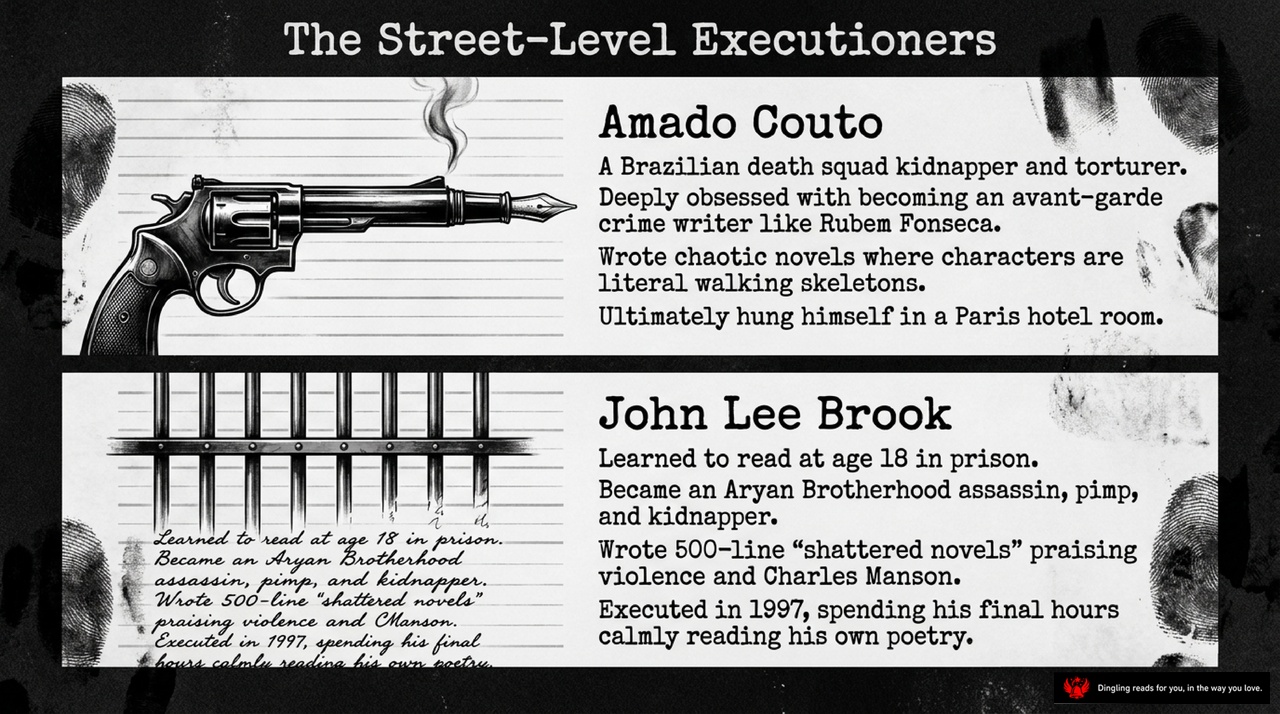
The Street-Level Executioners. This slide introduces two of the most disturbing literary figures from the book: Amado Couto and John Lee Brook.
First, look at Amado Couto. He was a Brazilian death squad kidnapper and torturer who lived a life of pure chaos. But here is the twisted part: he was obsessed with becoming an avant-garde crime writer like Rubem Fonseca. He wrote novels where characters were literal walking skeletons, blending his real-world violence with fiction. Ultimately, he hung himself in a Paris hotel room, ending a life where he lived the violence he wrote about.
Below him is John Lee Brook, an even darker case. He learned to read at age 18 inside prison. He became an Aryan Brotherhood assassin, pimp, and kidnapper. He wrote 500-line "shattered novels" praising violence and Charles Manson. But in a chilling final twist, when he was executed in 1997, he spent his last hours calmly reading his own poetry, finding a strange peace in the very words he used to justify his crimes.
These two men represent the ultimate perversion of art: using literature not to heal or understand, but to celebrate the act of destruction itself.

The sky above Chile is heavy with dark clouds, and written across them in ghostly letters is a chilling truth: "Death is Chile." This slide introduces the ultimate monster of our story, Carlos Ramírez Hoffman, a figure who represents the terrifying conclusion of what happens when aesthetics are completely divorced from morality.
His life was a grotesque performance built on four distinct acts. First, there was the facade. He posed as Emilio Stevens, a sensitive, avant-garde poet infiltrating left-wing workshops in Concepción, all while hiding his true nature. Then came the violence. Behind that poetic mask, he personally assassinated fellow poets, including the Venegas sisters, stabbing their aunt in the heart under the cover of night.
But he didn't stop there. He created a spectacle. As a pilot for the Pinochet regime, he flew a WWII Messerschmitt over Chile, writing terrifying, poetic sky-messages over political prisons and the capital, turning the night sky into a canvas for his madness. Finally, there was the chilling end. He hosted an avant-garde photography exhibition in his own apartment, revealing photos of the women he tortured and murdered to a silent, complicit military audience. He wasn't just a killer; he was an artist of horror, proving that in his mind, there was no difference between creating art and committing atrocity.

Synthesis: The Engine of Atrocity. Look at this diagram. It lays bare a terrifying truth about how evil operates. On the left, we have the "Aesthetic Delusion." It's the desperate need to be seen as a genius, a world-altering artist. The belief that if your work is beautiful enough, it absolves you of all moral constraints. It's the psychological scaffolding that allows monsters to view their own atrocities as poetry.
This delusion drives them straight to the "Authoritarian Reality" on the right. Plagiarism, torture, street ambushes, and death squads. The total destruction of human life, all served up to fit a manufactured narrative.
The central insight here is crucial: in the Americas described by Bolaño, bad literature isn't a harmless failing. It is the very engine of atrocity. It provides the justification for the unthinkable. When a writer decides that their art is more important than the human cost, they become complicit in the destruction. The inkwell and the bloody boot aren't separate; they are two sides of the same coin. One writes the story, the other writes the reality, and together, they build the engine that drives humanity toward its darkest moments.

The Banality of Mediocre Art: The Final Indictment
We arrive at the final, and perhaps most chilling, conclusion of our exploration into the dark corners of intellectual culture. As the slide reminds us, this is "The Final Indictment." It forces us to confront a terrifying mirror: the idea that Nazi literature in the Americas wasn't just an import, but a reflection of our own capacity for hollowing out culture.
The text on the screen highlights a profound danger: how easily intellectual culture can be stripped of its soul, weaponized, and draped over the shoulders of murderers. This isn't about monsters with mustaches; it's about the failure of the artist and the failure of the critic.
Look at the first point: "Art Offers No Salvation." We see this clearly in the life of Ruth Mendicutti. That photograph of her as an infant, held by Hitler, became her most cherished possession, valued above her unpublished manuscripts. Her life was a tragic spiral of failed marriages, alcoholism, and a desperate search for meaning in a world that offered her nothing but destruction. She wrote poems about Stalin and Hitler, trying to make sense of a chaos that refused to make sense. Her story proves that loving poetry, writing sonnets, or appreciating classical music does not prevent a human being from orchestrating a massacre or descending into despair. The humanist illusion is dismantled.
Then we see "The Danger of Bad Poetry." The worst atrocities committed in these narratives aren't by mindless brutes, but by failed artists. When a lack of true talent meets boundless ambition, the resulting frustration metastasizes into fascism. Consider the case of Carlos Ramírez Hoffmann. He was a poet, a pilot, and a murderer. He used the sky to write poetry about death, declaring "Death is Chile" and "Death is Love" over the cities of his own country. He turned the avant-garde into a tool for state violence. His art wasn't a shield; it was a weapon. Similarly, we see figures like Pedro González Carrera, whose poetry shifted from surrealism to a desperate defense of the military, and Francisco Cereceda, whose work was dismissed as a "pre-historic Nazi product." Their mediocrity, combined with a desire for power, created a vacuum that fascism rushed to fill.
Finally, we reach the indictment of the critic and the establishment. The slide notes that this literature acts as a mirror. In the Americas, we see how intellectuals can be co-opted. Take the case of Ernesto Pérez Masson, who was imprisoned for hiding the word "Hitler" in the acronyms of his novel, yet whose work was filled with anti-Semitic and fascist undertones. Or consider the Aryan Brotherhood in American prisons, where writers like John Lee Brooks used their pen to glorify the very systems that imprisoned them, turning their suffering into a twisted form of power.
The lesson here is stark. When intellectual culture is hollowed out, when the pursuit of "art" becomes a substitute for truth, and when the critic becomes a cheerleader for the powerful, the result is not just bad literature. It is a society ripe for murder. The mediocrity of these works is not an accident; it is the symptom of a deeper rot. And that is the final verdict we must accept.

So, we've reached the final chapter of our deep dive into the shadowy world of Latin American and American literature. As you can see on this slide, we're looking at a summary that pulls together some truly terrifying themes. We've traveled through a sprawling taxonomy of aristocratic plagiarists, stadium hooligans, and even sky-writing assassins. What connects them all is a horrifying truth: aesthetic ambition offers no shield against moral absolute zero. Fascism doesn't just thrive in the absence of art; it flourishes within the vanity of mediocre artists who use literature to sanitize their monsters.
This brings us to our final reflection. If a profound love for literature cannot inoculate the human soul against the capacity for boundless cruelty, what exactly is the true purpose of our art? We've seen how writers, from the German immigrant poets in Venezuela to the prison inmates in California, used their pens to either expose the rot of their societies or, in some tragic cases, to glorify it. The line between the artist and the monster often vanishes when the cost of power gets too high.
As we close this book, let's sit with this question. Is art a savior, or is it just another tool that can be twisted to serve the darkest impulses of humanity? That's the legacy we're left with. Thank you for joining me on this journey through the twisted corridors of literary history.