
Neither Here nor There: Travels in Europe: Complete Chapter-by-Chapter Summary
Welcome to *Neither Here nor There*, by Bill Bryson. This isn't just a travel book; it's a hyper-observational journey retracing a youthful backpacking trip through the beautiful, chaotic, and contradictory heart of 1990s Europe.
Think of this as a passport to a time when rules were looser, and the world felt a lot more unpredictable. Bryson takes us from the freezing, polar night of Hammerfest in Norway—where he waited days for the elusive aurora borealis—to the sun-drenched streets of Rome, where chaos is a feature, not a bug. He navigates the bureaucratic absurdity of Swiss visa lines, the overwhelming art of Florence, and the post-socialist economic struggles of Sofia.
It's a story about getting lost, finding your way, and realizing that the most profound discoveries often happen when you're completely out of your depth. Whether he's sneaking through a secret hatch on a ferry or getting scammed by a taxi driver in Italy, Bryson invites you to see Europe not as a map of destinations, but as a living, breathing, and often hilarious adventure.

Back in the UK, I dug out the Kümmerly and Frey maps I bought back in 1972. Those Swiss-printed maps, with their thick paper and bilingual notes, made me feel like a serious traveler again. I spent hours staring at the Thomas Cook European Timetable, trying to plan a route, but I quickly realized Europe doesn't fit into a neat line. There's no real start or finish, and the options are endless. So, I changed my plan and headed straight for Paris.
My first night there, I walked to the Île de la Cité. The streets were quiet, and the warm lights from the windows made the city feel welcoming. I found a small restaurant for dinner and then visited Shakespeare & Company. It was like a cozy nest filled with the smell of old books, and the fact that it wasn't just a souvenir shop felt like a miracle.
The next morning, I woke up to a city that seemed to spring to life instantly. By 8:30 AM, the streets were packed with cars and buses, and the traffic was already a mess. I decided to skip the Louvre this time. Instead, I went to the Musée d'Orsay, which is stunningly beautiful, and then I visited the Pompidou Center. While the Orsay was lovely, the Pompidou felt a bit cold and over-designed, more like an architect's showpiece than a place for people to live.
Later, I traveled to Brussels. It has its ugly sides, with wet garbage and wide boulevards that feel like highways, but there's a treasure hidden away: the Grand Place area. The narrow medieval streets there are full of restaurants and seafood stalls, a rare gem in the city.
From there, I went to Bruges, a medieval city that hasn't changed much in 500 years. I loved the cobblestone streets and the canals, even though it was getting crowded with tourists. I also stopped in Spa, a famous spa town that used to be a royal retreat. The place was full of wealthy German tourists and promoted all sorts of strange cures, but it felt a bit like a war zone. On my way there, I had a bit of an adventure. I tried to go to Dinant, but the train dropped me four kilometers short. I had to walk the rest of the way, and I ended up twisting my ankle and falling against a barn wall. It was a tough day, but it was definitely part of the journey.

Welcome to the heart of Germany, where the landscape shifts from the quiet border towns of Aachen to the bustling industrial energy of Hamburg. In Aachen, the city feels less like a frontier and more like Beverly Hills, with luxury goods lining the streets and a surprising wealth that belies its location. But the true magic lies in its history; walking through the magnificent Aachen Cathedral, you step into the world of Charlemagne, where light filters through stained glass in a way that feels like a spiritual baptism.
Leaving that historic calm, the vibe changes dramatically in Cologne. Here, the massive Gothic cathedral stands alone in a concrete plaza, feeling somewhat isolated, yet its sheer scale is breathtaking. The city buzzes with a mix of modern glass towers and old stone streets, creating a busy, vibrant energy that contrasts sharply with the slower pace of Aachen.
Further east, Hamburg offers a completely different kind of charm. It's a city built on water, where the Elbe River meets the sea, creating a dynamic mix of industrial ports and serene lakes. Walking along the Alster Lakes, you'll find a peaceful urban oasis that feels worlds away from the city's busy docks. It's a place where you can watch sailboats glide across the water or simply sit on a bench and enjoy the light dancing on the surface.
But Hamburg isn't all postcard-perfect views. The city has a reputation for being the center of Germany's "Red Light District," and while the main streets might look ordinary during the day, the nearby Reeperbahn tells a grittier story. You'll see theaters, bars, and adult shops, a stark reminder of the city's complex past. Yet, despite this, Hamburg feels surprisingly relaxed and confident, more like Scandinavia than the often-stereotyped Germany.
As you explore, you'll notice the everyday details that make this country so unique. Women don't shave their underarms, a small but distinct cultural quirk. And while the city has faced its share of challenges, from historical burdens to modern economic shifts, the people are rich, hardworking, and surprisingly friendly. It's a place where you can't help but be drawn in, even if you don't speak a word of German.

Now, let's dive into the heart of Europe's driving culture, where the map of rules gets redrawn every time you cross a border. This slide breaks down four distinct European archetypes based on how they handle the road, revealing a fascinating spectrum from zero rules to extreme rules.
On the left, we have the "Zero Rules" quadrant. First up is Italy, labeled as "Homicidal Driving." The text describes it as a state of pure pandemonium, entirely without a commitment to order. Think of the chaotic scooters weaving through traffic; it's the ultimate free-for-all where the only rule is that there are no rules. Next to it is France, categorized as "Selective Rules" with "Aggressive Driving." Here, the chaos is more tactical. You might see orderly queues that disintegrate instantly the moment a bus actually arrives, or drivers who are polite until they aren't. It's a system of rules that exists only when it suits the moment.
Now, flip to the right side for the "Extreme Rules" quadrant. We have Switzerland, the poster child for "Orderly Driving" through "Extreme Rules." The description paints a picture of spotless lakeside parks and street sweepers utilizing old-fashioned brooms on single leaves. It's about precision down to the last leaf. Across from them is Sweden, also in the "Orderly Driving" zone but driven by "Bizarre Rules" and a "Draconian Order." Here, motorists are mandated to drive with headlights blazing on the sunniest summer afternoons. It's a culture where safety protocols are so rigid they feel almost absurd.
So, what does this tell us? It suggests that across these three centuries of travel, the peoples of Europe reliably live up to their stereotypes. Whether you're navigating the anarchy of Italy, the selective aggression of France, the obsessive cleanliness of Switzerland, or the bizarre safety laws of Sweden, you know exactly what to expect. It's not just about where you are; it's about the invisible code of conduct that governs every corner of the continent.
After nearly a month under the gray, damp skies of Scandinavia, the craving for sun became unbearable. I scrapped my entire itinerary—Germany, Austria, Switzerland, France—and booked a direct flight to Rome. Life, it turns out, is best lived on a whim.
The pull of Rome started in my youth with Fellini's *La Dolce Vita*. I fell in love with the city through the lens of those films: Giancarlo Giannini and Ornella Mutti, Vespa scooters speeding past the Colosseum, and couples chatting by the Trevi Fountain. Those movies gave me a world view, a belief that somewhere beyond my small town, life was vibrant and chaotic.
When I finally arrived, the reality was a mix of shock and delight. My American friend, who had lived here for twenty years, complained about rising prices and crumbling infrastructure. But to me, coming from the expensive, sterile north, Rome felt incredibly cheap. I sat outside in the evening, eating delicious food, and couldn't understand his complaints. "Wait until your pipes burst," he grumbled, which was fair.
But the streets themselves told a different story. Rome isn't built for pedestrians; the crosswalks are suggestions, not rules. Drivers honk, gesture, and eat while driving, treating pedestrians as an inconvenience. Yet, there's a charm to this chaos. It feels like New York, but freer. Italians don't queue; they are always late, and tax evasion is a national sport. Even the warning signs on the train windows reflect this: while other countries say "Do not lean out," the Italian version simply says "Please do not lean out."
This lack of rigid rules extends to their relationship with history. Italy spends only $200 million annually on heritage protection—barely enough to build a single World Cup stadium. Two-thirds of their artifacts are locked in warehouses, unseen by the public. Yet, they live in the moment. They argue passionately about a soccer goal and then laugh it off. They prioritize a good meal, a lively debate, and time with family over grand abstractions.
The city is messy, yes. You'll see people urinating in gardens or parking cars half on the sidewalk. But that roughness is part of the character. It's a place where the ancient ruins are constantly being quarried for cement, and the Pantheon's bronze was stripped for Bernini's canopy. It's a city that loves its past but often sacrifices it for the present.
Leaving Rome, I took the world's slowest train to Naples. The journey was a blur of dusty hills and unfinished buildings. I was tired, hungry, and eventually, I found myself in Sorrento. It was a revelation. Compact and charming, with cliffside hotels and lemon groves, it felt like the perfect escape. I even had the grace to give up my table at a crowded restaurant for a group of loud, wealthy men, and the locals appreciated my kindness.
But the beauty of Italy has a dark side. In Naples, the struggle is visible. The city is plagued by poverty, corruption, and crime. The Vomero district is a labyrinth of squalor, and the streets are filled with garbage and beggars. Yet, even here, there is safety. I walked through the most dangerous areas in Europe, and no one bothered me.
My journey continued north to Florence, expecting romance but finding crowds. The city is overwhelmed by tourism; the Uffizi Gallery is packed, and many masterpieces are locked away. The bridges are choked with vendors selling cheap jewelry, and the streets are filled with homeless people and stray dogs. It's a city of incredible art and profound sadness, where the grandeur of the Duomo contrasts sharply with the grime on the streets.
Finally, I reached Milan, the financial heart of Italy. It's a different beast entirely—fast, modern, and ambitious. The streets are lined with luxury brands, and everyone is rushing to work. But beneath the corporate sheen, there's still a pulse of culture. The Galleria Vittorio Emanuele II is a breathtaking glass-and-iron arcade, and the Duomo, though gray and imposing, is filled with people praying. Milan is a city of contradictions: cold and calculating, yet still capable of moments of quiet reverence for the arts.
From the chaotic warmth of the south to the sleek ambition of the north, Italy proved to be a land of extremes, where the past and present collide in a dazzling, often messy, dance.
After nearly a month under the damp, gray skies of Scandinavia, my soul was screaming for something warmer. I needed sun. I needed to shed those heavy coats and just walk barefoot in a field. So, I scrapped my entire itinerary. No more Germany, Austria, or Switzerland. I bought a ticket and flew straight to Rome, crossing 1,500 miles in a single leap. Life is too short for over-planning; sometimes you just have to follow the impulse.
My obsession with Rome started long ago, back when I was a kid obsessed with Italian cinema. I loved those movies where Giancarlo Giannini and Onella Muti would glide through the streets. I didn't care about the plot; I just wanted to see the background. I wanted to see Vespa scooters zooming past the Colosseum or couples chatting near the Trevi Fountain. Those films built my entire worldview of Italy. If I hadn't seen them, I probably would have spent my whole life in Peoria, thinking that was the whole world.
When I finally arrived, the reality was a mix of chaos and beauty. The streets weren't built for pedestrians; the traffic was a wild, uncontrolled beast. The drivers ignored everyone except the nuns, who seemed to have some invisible force field protecting them. Parking was an art form of pure chaos, with cars half on the sidewalk, but that messiness felt like the city's heartbeat. The Italians didn't care about rules. There was no queueing, everyone was late, and tax evasion was just part of the culture. Yet, somehow, this country with its 48 governments in 45 years managed to become Europe's fifth-largest economy. They focused on the small things: a delicious meal, a fierce debate over a football goal, or just playing with their kids.
But this carefree attitude extended to their heritage, which was heartbreaking. Italy spends only $200 million a year on protecting its monuments—less than what they'd spend on a World Cup stadium. Three-quarters of their artifacts are locked away in dark warehouses, unseen by the public. Even the Colosseum's stone was mined for cement, and bronze from the Pantheon was stripped to make a canopy for St. Peter's Basilica. It felt like a nation that loved its past but couldn't afford to protect it.
I couldn't make it to the museums, so I wandered the streets instead. I saw a man peeing against a tree, a reminder that this place was raw and real. I took the train to Naples, hopping onto a train so slow it felt like a wounded animal. The journey was a blur of unfinished houses and a Gypsy woman crying for money while holding a dirty baby. I gave her some money just to get away from the slobber.
Naples itself was a study in contrasts. It was dirty, crowded, and struggling, with poverty and crime everywhere. Yet, it had a chaotic charm. I escaped to Sorrento, a compact town right on the bay. The air smelled of bread and the sea. I loved it so much I almost decided to stay. I hiked up to Capri, climbing hundreds of steps in the heat, only to find it packed with tourists. But the view from the cliffside at dusk was magical, with the lights of the town twinkling against the moonlit sky.
Eventually, I had to leave the chaos of the south and head north to Florence. I took the world's slowest train, a crawl through the dark countryside that felt like an eternity. When I finally arrived at night, I was exhausted and starving. I checked into a hotel that was expensive and ugly, just to survive.
The next day, Florence was overwhelming. It was packed with tourists, fourteen times more visitors than locals. The historic center felt suffocated by the crowds. The Old Bridge was clogged with people selling cheap jewelry, and the Uffizi Gallery was a maze of long lines and locked rooms. Only 500 out of 2,395 paintings were on display. But even so, it was worth it. Seeing works by Botticelli and Caravago, even if they were hidden away for centuries, reminded me why this city mattered.
I spent four days there, mostly feeling disappointed by the crowds and the grime. Gypsies begging with dirty children, Senegalese vendors blocking the sidewalks, and restaurants that were crowded and rude. It felt like a city that had forgotten how to care for its own people, letting the tourism industry crush its soul. I even got robbed by a young Gypsy girl who stole my travel check in five seconds. It was a harsh reminder that even in the most beautiful places, danger and decay can lurk right beneath the surface.
Finally, I left Florence for Milan, Italy's richest city. I had high hopes, thinking of the fashion giants and the business empire here. But the reality was cold. The city felt more like a corporate hub than a cultural destination. The streets were clean but lifeless, with dead grass and litter. The famous Galleria Vittorio Emanuele II was a beautiful glass-and-steel cathedral of commerce, but there was no real coffee culture here. People walked fast, checking their watches, obsessed with money and meetings.
But then, I found the soul of Milan. The Duomo, the third largest Gothic church in the world, was dark and gray on the outside, but inside, locals were praying with genuine devotion. And the Brera Gallery, half under construction, held masterpieces that were quiet and intimate. Finally, I saw Da Vinci's *The Last Supper*. It was faded and distant, barely visible from twenty-five feet away, but it was still there. Milan was a city split in two: a cold, ambitious commercial machine on the surface, but with a quiet, hidden reverence for art deep in its corners. It was a place where wealth and culture clashed, and only by slowing down could you see the beauty hiding underneath.
Welcome to the final chapter of our journey, where the vibrant chaos of Italy and Switzerland gives way to the intense, unpredictable drama of the Balkans. We're now in Split, Croatia, a city built directly over the ruins of Diocletian's Palace. It's a unique place where ancient Roman history and modern life collide in a labyrinth of narrow streets, creating an atmosphere that feels both timeless and alive.
But let's be honest, this part of the trip was less about scenic beauty and more about a race against time. I had to get to Bulgaria within six days to avoid visa issues, which meant skipping the usual leisurely exploration. The journey to Belgrade was an adventure in itself, involving a dangerous bus ride along a cliffside road where the driver would casually overtake on blind corners, sing loudly, and pretend the brakes were failing. It was a heart-pounding experience that left me terrified but strangely addicted to the thrill.
Once in Belgrade, the city felt like a mix of the old and the new, with its historic fortress overlooking the confluence of two rivers. However, the real challenge lay ahead in Sofia, Bulgaria. The economic situation there was dire, with long queues for basic necessities like bread and milk, and shops often empty of stock. It was a stark contrast to the comfortable, wealthy countries I had visited earlier.
The trip culminated in Istanbul, a city that is equal parts chaotic and breathtaking. From the bustling streets filled with vendors and beggars to the serene quiet of the Hagia Sophia, Istanbul offers a unique blend of Europe and Asia. Yet, despite all the excitement, a sense of homesickness began to creep in. With a pregnant wife waiting back home and overgrown lawns, I realized that no matter how fascinating the world's chaos can be, there is a deep comfort in returning to the familiar. Travel, in the end, is about seeing the world's extremes so you can appreciate the peace of home even more.
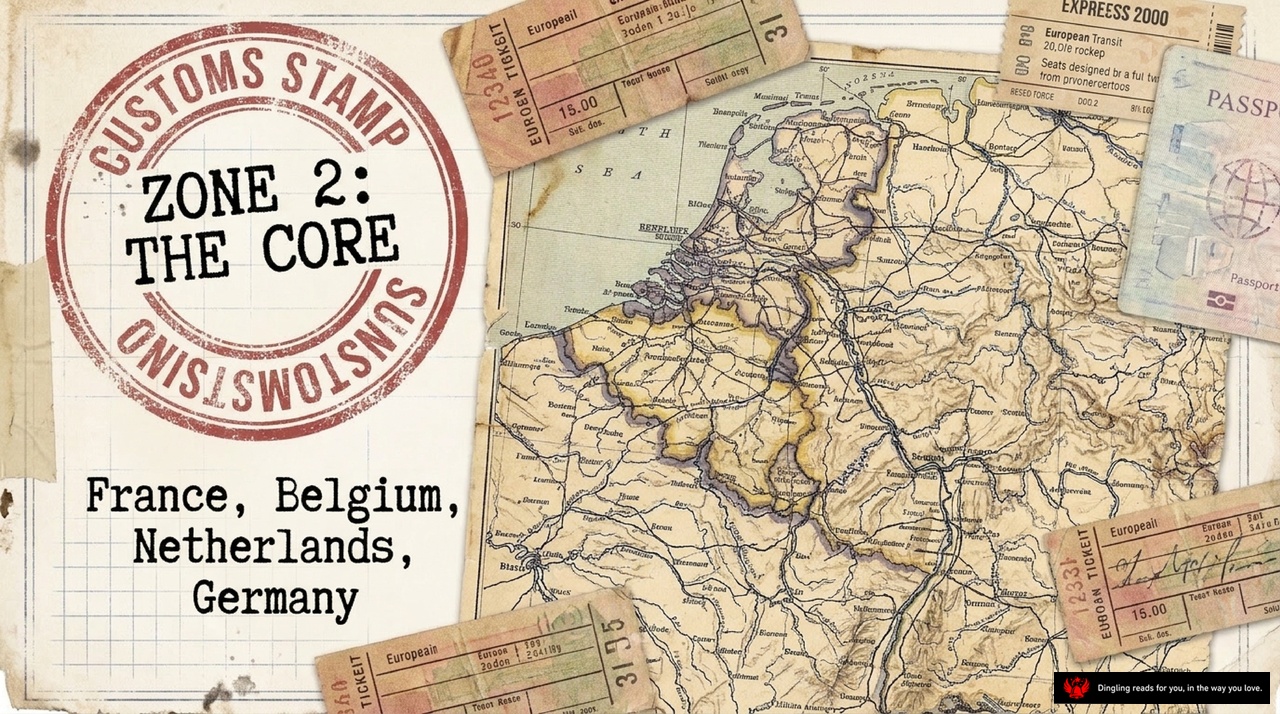
Welcome back to the journey. We are now stepping into what I like to call "Zone 2: The Core"—the beating heart of Europe. If you look at the map, you'll see the stamp right there: France, Belgium, Netherlands, and Germany. This isn't just a geographic cluster; it's a cultural engine where history, art, and a bit of chaotic romance collide.
We left the frozen silence of the far north and are now diving into the vibrant, sometimes overwhelming, middle of the continent. In the Netherlands, I found a city that looked like Beverly Hills—Aachen, Germany, with its luxury shops and pristine Mercedes taxis, yet just twenty miles from a Belgian border. It felt like a secret world where wealth and history coexist without a care. Then there's Cologne, with its massive Gothic cathedral standing alone in a concrete sea, a monument to faith that took nine hundred years to build.
Moving south into Belgium, the country reveals its dual soul. The north is rich, industrial, and speaks Dutch, while the south is lush, culinary, and French-speaking. I remember the tension in Antwerp, where locals would get offended if you couldn't tell a Dutch person from a Belgian. But the charm lies in the contrast: from the quiet, timeless canals of Bruges to the opulent, spa-focused luxury of Spa, where emperors once retired.
Finally, we hit France. Paris, that city that can feel like it hates you until it warms up to you. From the bookish sanctuary of Shakespeare and Company to the aggressive traffic around the Arc de Triomphe, it's a place of contradictions. But it's the cultural differences that make this zone so addictive. The Germans' rigid punctuality, the French' refusal to queue properly, the British' unique way of eating a burger with a knife and fork—it's all part of the fun.
This is the core of Europe, a place where you can get lost in a museum, get stuck in a traffic jam, or fall in love with a city in a single day. It's unpredictable, messy, and utterly captivating.
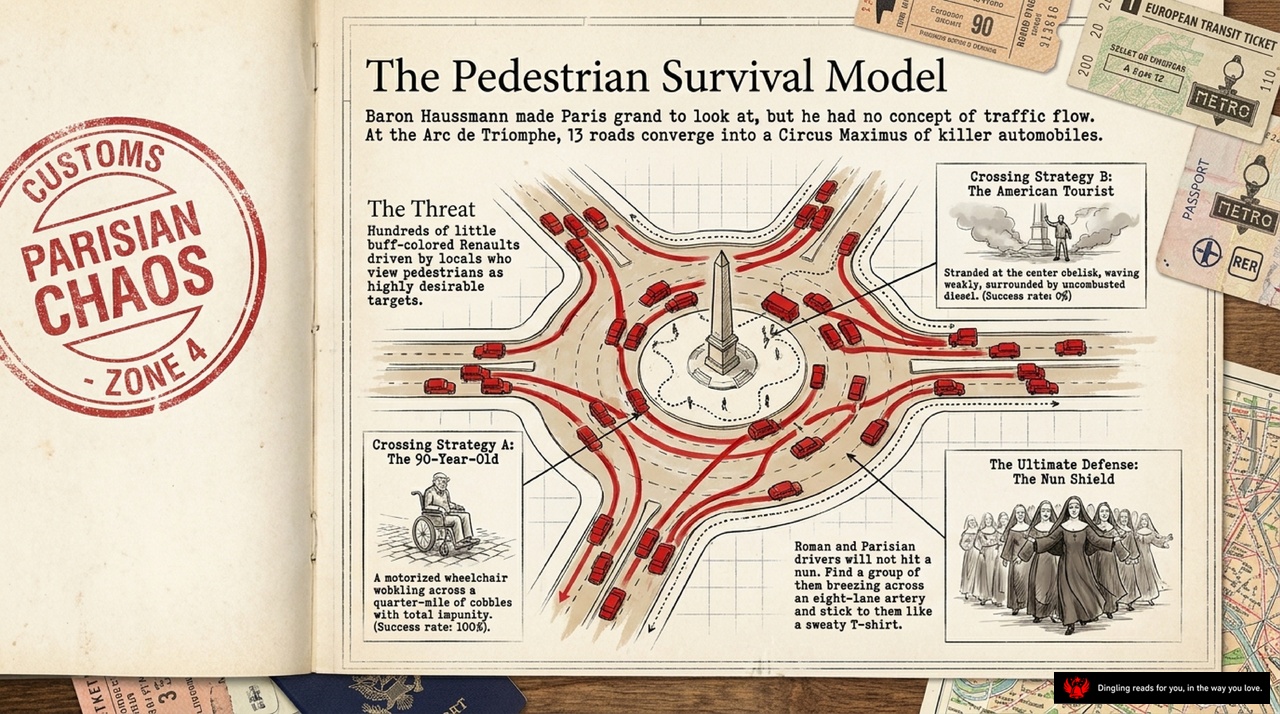
Welcome to the ultimate guide for surviving the chaotic streets of Paris. You might think the city is all romance and art, but for a pedestrian, it can feel like a high-stakes survival game. Take the Arc de Triomphe, where thirteen roads converge into a massive, deadly roundabout. It's a "Circus Maximus" of killer automobiles, designed by Baron Haussmann with zero regard for traffic flow.
In this "Parisian Chaos Zone," you face hundreds of aggressive local drivers in small Renaults who view pedestrians as easy targets. So, how do you cross safely? The book reveals three hilarious strategies. First, there's the "American Tourist," who stands weakly in the center of the circle, waving helplessly. The result? A zero percent success rate. Next is the "90-Year-Old," a motorized wheelchair user who moves so slowly across the cobblestones that drivers simply have no time to react, guaranteeing a one hundred percent success rate. Finally, there is the "Nun Shield." Roman and Parisian drivers have a strange rule: they will never hit a nun. So, if you can find a group of nuns and stick to them like a sweaty T-shirt, you become untouchable. It's a strange, dark, but effective logic for navigating the French capital.
Welcome back to our journey through Europe. We've crossed the Alps and explored the heart of Central Europe, but now we're diving into the chaotic, vibrant, and surprisingly modern reality of the Balkans.
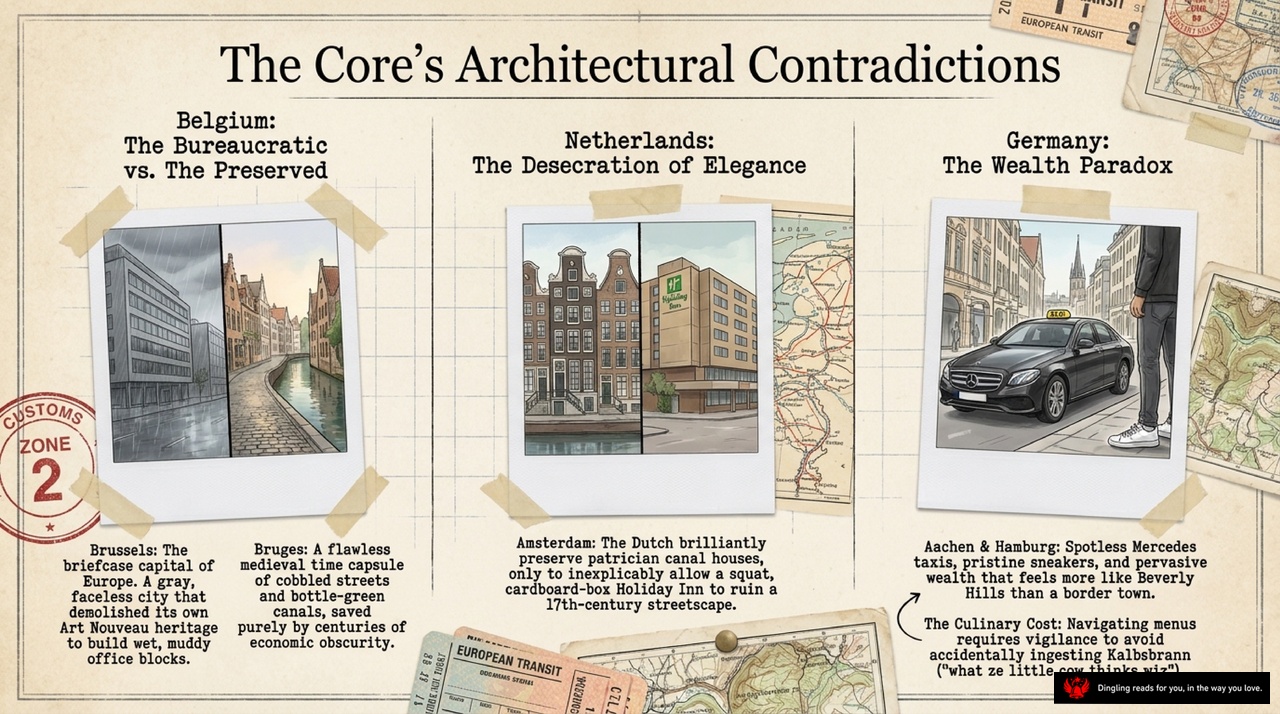
Our current slide, titled "The Core's Architectural Contradictions," highlights a fascinating paradox in modern Europe. While we often think of the continent as a uniform historical tapestry, the reality is far more complex. Look at the three distinct zones we've just explored. First, Belgium presents a clash between the bureaucratic and the preserved. Brussels, the briefcase capital, is a gray, faceless city of office blocks, yet just a short trip away lies Bruges—a flawless medieval time capsule where cobblestone streets and bottle-green canals have been saved purely by centuries of economic obscurity.
Moving east, the Netherlands offers a stark lesson in the "desecration of elegance." Amsterdam brilliantly preserves its patrician canal houses, yet inexplicably allows a squat, cardboard-box Holiday Inn to ruin a 17th-century streetscape. It's a beautiful contradiction that defines the Dutch approach to urban life.
Finally, we see Germany's "wealth paradox." In cities like Aachen and Hamburg, you spotless Mercedes taxis and pristine sneakers coexist with a pervasive wealth that feels more like Beverly Hills than a border town. This isn't just about architecture; it's about how these nations navigate their past and present.
This brings us back to my own experience in the Balkans. Just as these European cities balance their old and new, my journey through the former Yugoslavia revealed a similar tension. I traveled from Split to Sarajevo, navigating narrow roads that clung to cliffs, and eventually to Belgrade, where I watched the sun set over the confluence of the Sava and Danube rivers.
But the true "contradiction" I encountered wasn't in the buildings—it was in the economy. In Sofia, Bulgaria, I saw a city where people had money but couldn't buy bread. I stood in lines that stretched for blocks, watching families wait for hours just to purchase a loaf of bread or a piece of meat. The shops were empty, the shelves bare, yet the people were desperate. It was a surreal scene where the infrastructure of a modern nation had collapsed under the weight of economic crisis.
This experience forced me to reconsider what it means to be a traveler. In the wealthy, polished cities of the north, we see a curated version of history. But in the Balkans, history is raw and immediate. You don't just look at a preserved canal in Bruges; you feel the struggle of a family waiting for groceries in Sofia.
So, as we wrap up this leg of the journey, remember that Europe isn't just a collection of postcards. It's a living, breathing entity where elegance can coexist with decay, where wealth can sit right next to poverty, and where the most profound stories are often found not in the grand museums, but in the quiet desperation of a market queue or the vibrant chaos of a bustling street corner.

Welcome to Zone 3: The Alpine Paradox, covering Switzerland, Austria, and Liechtenstein. Imagine a place where you could literally be in three different countries within a twenty-mile radius, yet the local dialects might make you feel like an alien in all of them. I'm talking about the borderlands of Aachen, Maastricht, and Liège, where the official languages shift constantly, but the people's private dialects flow more easily across national lines than within them. It's a unique experiment in how geography and language intertwine.
Moving deeper into the heart of Europe, we find ourselves in the German-speaking lands, specifically Aachen and Cologne. Aachen feels surprisingly wealthy, almost like a Beverly Hills suburb, with luxury goods and pristine cars, yet it hides a dark history as the first German city liberated by the Allies in 1944. Just down the road lies Cologne, home to the world's largest Gothic cathedral, a massive structure that took nine hundred years to build. Standing there, surrounded by modern glass skyscrapers, you feel the tension between ancient history and rapid modernization.
But the journey doesn't stop there. We cross into the Netherlands and the Nordic countries, where the landscape and culture shift dramatically. In Amsterdam, the city has transformed from a haven of hippie freedom into a place that can feel chaotic and dirty, with garbage floating in the canals and graffiti everywhere. Yet, just a short train ride away in Haarlem, you find a quiet, charming city that offers a peaceful escape. Further north, in Copenhagen, the vibe is youthful and vibrant, with a unique tolerance that allows for things like public nudity in parks, a stark contrast to the strict rules elsewhere.
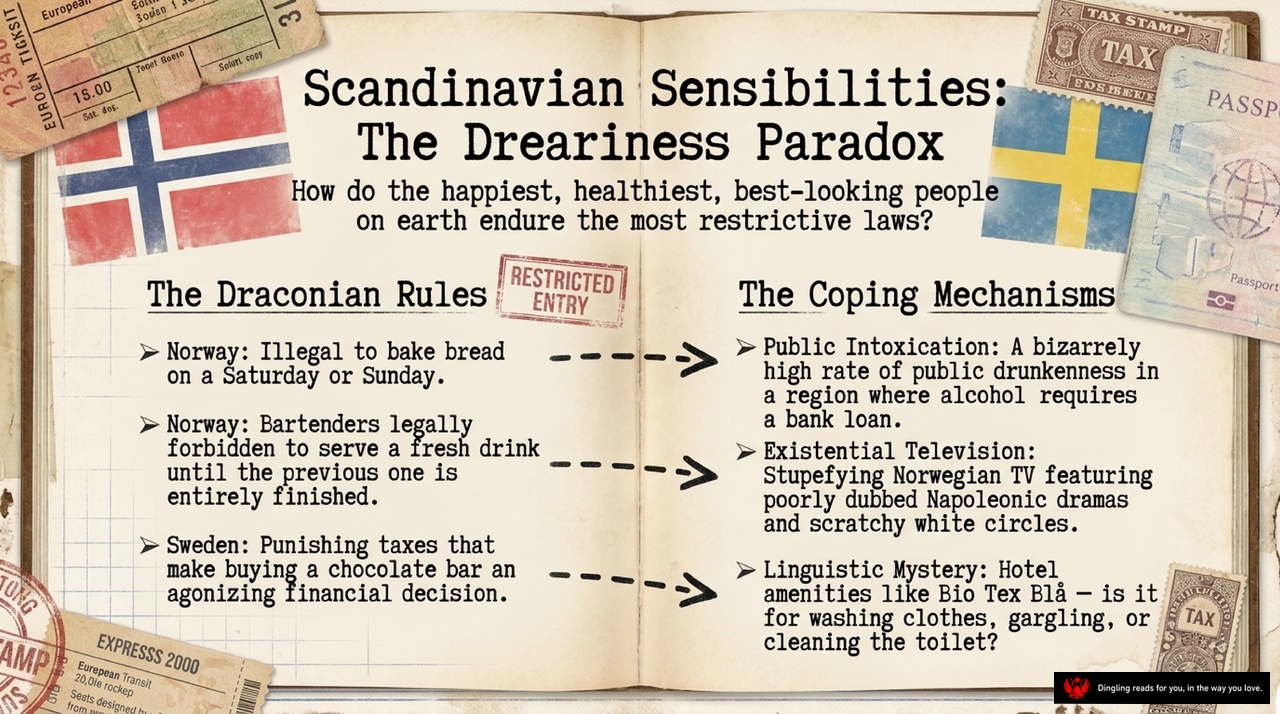
Finally, we reach the Scandinavian north, where high taxes and strict laws create a society that is orderly but sometimes feels cold and distant. In Sweden, you might encounter absurd rules like no baking bread on weekends or the need to keep your car lights on during the day. The trains are slow, the food can be bland, and the people seem reserved, yet there is a strange beauty in the rainy, green landscapes and the historic architecture of cities like Stockholm.
This region, from the wealthy borders of Germany to the strict, rainy streets of Sweden, offers a complex mix of history, culture, and unexpected surprises. It's a place where the rules are often different from what you're used to, and where the beauty lies not just in the scenery, but in the unique way people live their lives.
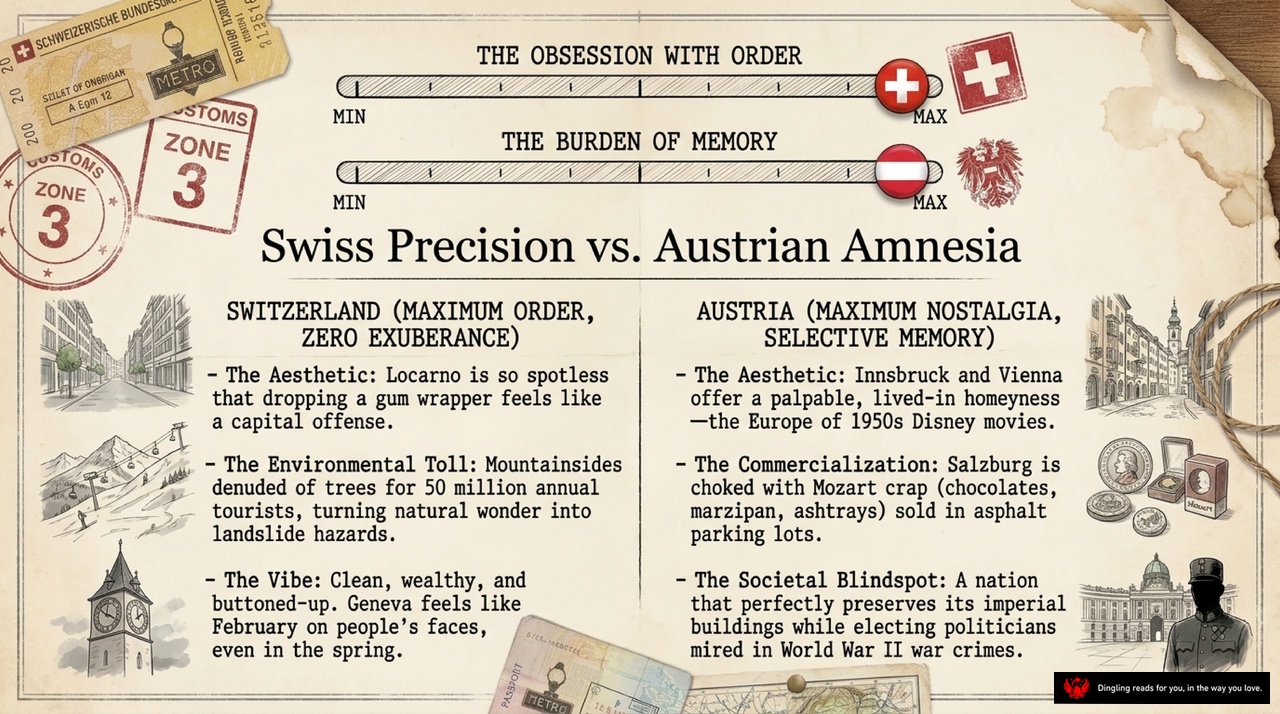
Switzerland and Austria might look similar on a map, but their souls are worlds apart. This slide perfectly captures that divide: Swiss Precision versus Austrian Amnesia.
Look at the top. The obsession with order is maxed out for Switzerland, represented by that crisp red cross. Think of Locarno, where dropping a gum wrapper feels like a capital offense. It's spotless, clean, wealthy, and incredibly buttoned-up. The vibe is like February on people's faces, even in the spring. But there's a heavy price for this perfection. The environmental toll is real; mountainsides are denuded of trees to support 50 million annual tourists, turning natural wonder into landslide hazards. It's a sterile, buttoned-up existence where Geneva feels more like a clock than a living city.
Now, flip to the Austrian side. Here, the obsession with order is at zero, replaced by the "burden of memory." Austria chooses maximum nostalgia and selective memory. Innsbruck and Vienna offer a palpable, lived-in homesickness, reminiscent of 1950s Disney movies. However, this comes with a cost. The commercialization is overwhelming; Salzburg is choked with Mozart-themed chocolates and souvenirs sold in asphalt parking lots. Worse, there's a societal blindspot. Austria perfectly preserves its imperial architecture while ignoring the dark history of World War II. It's a nation that looks pristine on the surface but refuses to fully confront its past.
So, we have two extremes: one nation that is so clean it feels inhuman, and another that is so nostalgic it refuses to grow up. Both have their charms, but both carry a heavy burden—one of silence, the other of selective forgetting.
Welcome to Zone 4: The Southern Chaos. If you think Italy is just about romantic canals and pristine art, think again. We are diving into the wild, unpredictable, and often hilarious reality of the Italian south.
It's a place where the rules of order simply don't apply. In Rome, traffic lights are suggestions, and pedestrians are invisible to drivers who honk and gesture with total impunity. Even the nuns seem to have a secret force field that lets them cross streets safely while everyone else gets run over. Parking is a chaotic art form, with cars blocking sidewalks so completely that the road itself disappears.
But this chaos isn't just about traffic; it's a lifestyle. Italians don't queue; they arrive late; and they prioritize the present moment over any bureaucratic nightmare. You'll see workers arguing fiercely over a soccer goal, only to hug it out immediately after. While other nations spend billions on stadiums, Italy invests a fraction of that into preserving its ancient heritage, leaving treasures locked in warehouses or stolen in the night.
And let's talk about the food and the atmosphere. The contrast between the elegant facade and the gritty reality is stark. In Naples, the streets can be messy, with garbage and homelessness visible, yet there's a raw, unfiltered charm that you just can't find elsewhere. It's a city that feels alive in a way that polished, tourist-friendly cities never do. Even in Florence, where the art is world-class, you might find yourself dodging beggars, dealing with pickpockets, or eating in a crowded, noisy restaurant that feels more like a local hangout than a museum.
This isn't a travel guide for the timid; it's an invitation to embrace the beautiful, messy, and absolutely chaotic spirit of Italy.

Welcome back to our journey through Europe, where the guidebook promises a perfect vacation, but reality often delivers something far more unpredictable. Look at this slide: "The Guidebook Futility Model." It perfectly captures the chaotic truth of traveling in Italy. On the left, we see the polite, structured phrases you might find in a Fodor's guidebook—asking for a bath at midnight or requesting a beach umbrella. But on the right, we see the brutal situations actually encountered: an eight-year-old child picking a pocket in five seconds, screaming bank codes into a broken telephone, or navigating the dangerous streets of Naples without running water.
The intersection between these two circles is what I call "The Guidebook Futility"—the total failure of preparation. In Italy, survival doesn't come from following a map; it comes from embracing the pandemonium. I learned this the hard way in Naples, where the chaos was so intense that my only option was to adapt instantly. Whether it's dodging a speeding Fiat or dealing with a thief who steals your travel checks in seconds, the lesson is clear: in Italy, you don't plan your escape; you learn to dance in the storm.

Welcome to the final chapter of our journey, where the magic of travel hits a very real, very human wall. We've sailed from the icy silence of the North to the chaotic warmth of the South, but as we arrive in Florence, Italy, we find that even the most beautiful cities have a breaking point.
Look at the data on this slide: Florence possesses more treasures than any city in the world—21 palaces, 55 churches, and 20 museums. It is an absolute cultural powerhouse. Yet, despite this immense wealth, the city is buckling under the weight of its own allure. The image of the crowd crushing the Ponte Vecchio perfectly illustrates this crisis. What was once a quiet haven for silversmiths is now an impassable stowage deck, jammed with replica luggage sellers and bewildered tour groups.
The numbers are staggering: there are now 14 tourists for every single local resident annually. This isn't just tourism; it's an invasion. And here lies the tragic economic irony. Despite all the money flowing in, the annual restoration budget is less than $10 million. That is not enough to care for the city. Consequently, 10,000 pieces in the Archaeological Museum have remained uncleansed since the 1966 flood.
The conclusion is stark and heartbreaking: mass tourism is systematically ruining the very beauty it comes to celebrate. When we chase the perfect postcard view, we often leave behind the living soul of the place.

Welcome to Zone 5: The Eastern Frontier, where the map transforms from familiar European lines into a landscape of borders, checkpoints, and intense cultural shifts. As we move east, our journey takes us through Yugoslavia, Bulgaria, and Turkey—regions defined by their complex history and their position at the edge of the known world.
Imagine stepping off a plane in Split, Croatia, only to find yourself navigating a maze of unfinished buildings and winding alleyways that once housed the Roman palace of Diocletian. The air here is thick with the scent of grilling meat and the distant sound of seagulls, a stark contrast to the polished streets of the West. But the real test begins when you try to leave. In Sarajevo, the journey to Belgrade isn't a smooth ride; it's a nerve-wracking adventure on a bus that teeters on the edge of a cliff, driven by a local who treats blind corners and speeding like a game. You're not just a passenger; you're holding your breath the entire way.
Once you reach Belgrade, the city offers a surreal mix of old-world grandeur and Soviet-era echoes. You might find yourself sitting atop a hotel, watching the sun set over the confluence of the Sava and Danube rivers, feeling a strange pang of homesickness amidst the foreignness. But the urgency of your visa ticking down forces you onward to Sofia, Bulgaria. Here, the reality of economic collapse hits hard. You're not looking at postcards anymore; you're witnessing lines of hundreds of people stretching down the streets, waiting for hours just to buy a loaf of bread or a jar of jam. The shops are empty, the shelves bare, and the once-majestic department stores are reduced to selling buttons, cheap toys, and broken parts.
Finally, you arrive in Istanbul, the city that bridges two continents. It's a chaotic symphony of noise, smell, and movement. The air is hot and sticky, and the streets are crowded with vendors, fishermen, and people bargaining for everything from fruit to tickets. Yet, amidst the overwhelming chaos, there is a moment of profound peace when you step into the cool, shadowed interior of the Hagia Sophia. It's a sanctuary in a storm, a place where the noise of the world fades away, and you can finally breathe. But even here, the pull of home becomes undeniable. The thought of your wife, your pregnant child, and the overgrown grass waiting for you in America weighs heavy. You realize that while the world is full of wonders and horrors, the most important place you'll ever be is the one where you belong.

Welcome to the Balkan Disconnect. On the left, we're diving into Yugoslavia, specifically Belgrade, which the book describes as a "bureaucratic labyrinth." The image perfectly captures that frustration with a tangled flowchart of the Sputnik travel agency. It's a nightmare of "Wrong Line 1," "Wrong Line 2," and "Wrong Form," culminating in a baffled clerk asking, "Why on earth..." It's the quest for a simple train ticket that turns into hours of endless confusion.
On the right, the scene shifts to Bulgaria in the 1950s, depicted as a time capsule. The photo shows a dark, quiet street in Sofia, completely untouched by modern neon or fast food chains like McDonald's. This is the aesthetic of a city that feels frozen in time. The economy here is starkly different; a successful shopping trip doesn't yield a luxury bag, but rather a loaf of bread, some ribbon, and a "useful-looking metal thingy." Yet, despite these profound shortages, the people take immense pride in their appearance, strolling down these pitch-black boulevards with effortless style. It's a fascinating contrast between the chaotic bureaucracy of Yugoslavia and the static, almost melancholic stillness of 1950s Bulgaria.

Welcome to the final stop of our journey through Europe: Istanbul. As the map shows, this isn't just a city; it's a "collective delirium" where every sense gets relentlessly tugged and shaken.
Let's look at the three chaotic experiences that define this place. First, the "Visual Assault." Imagine men casually carrying 10-foot-long sofas on their backs through impenetrable crowds. It's a surreal sight that captures the sheer physical chaos of the city.
Then, there's the relentless "Hustle." Every five feet, you face a demand to buy lottery tickets, replica perfumes, or get led into a brother's carpet shop. It's an aggressive, non-stop sales pitch that defines the streets.
Finally, we have the "Epiphany in the Restroom." Picture staring at brown water trickling from a rusty pipe. It forces you to realize the irony of tourism: we spend vast time and money abandoning the comforts of home, only to frantically search for those exact same comforts abroad.
Istanbul is a place where the familiar becomes strange, and the strange becomes a part of daily life.

So, we've reached the crux of the European experience: the paradox of preservation. It's a strange truth that history here is often kept safe only by accident, force, or deprivation, while modern homogenization marches forward with terrifying speed.
Look at these three pillars. First, preservation by obscurity, like Bruges. This medieval gem remained a flawless time capsule simply because its river silted up 500 years ago, effectively saving it from developers. It's a flawless bubble, untouched by the world, preserved because it was forgotten.
Then, preservation by deprivation, take Sofia. It looks so authentically European, free of chain restaurants and neon signs, only because it was crippled by the Iron Curtain. Its charm exists solely because the world couldn't get to it.
But the third pillar is the most dangerous: destruction by affluence. Look at Amsterdam and Florence. Wealth and mass tourism have erected squat, cardboard-box hotels on 17th-century patrician streets. Ancient bridges are being drowned in a 14-to-1 crush of visitors. When money and crowds become the primary drivers, the very history you came to see gets erased to make room for the next tourist.
So, what does it mean to find authentic Europe? The journey reveals a hard lesson: history is fragile, preserved only by accident or force, while homogenization is a choice we make every day.

Europe in 1990 wasn't just a map; it was a continent caught between a storied past and a rapidly homogenizing future. From the freezing isolation of Hammerfest to the relentless pandemonium of Istanbul, the continent was resisting the blurring of borders, stubbornly holding onto deep cultural quirks. But as mass tourism and global capitalism erased the very friction that makes foreign travel exciting, a terrifying question began to emerge: were we witnessing the end of the traveler, leaving behind only the tourist?
I saw this shift everywhere. In Florence, the city's 21 palaces and museums were being treated like theme parks, with tourists crowding every inch while locals struggled to keep up. In Milan, the pursuit of wealth had replaced the poetic soul of the city, leaving behind a landscape of sleek offices and neglected parks. Even in the historic heart of Rome, where I once felt the lazy charm of the streets, I found the same chaotic indifference toward rules and heritage that defined the modern world.
The ticket in my pocket, a relic from a time when travel was about discovery rather than consumption, felt increasingly heavy. We were trading the thrill of the unknown for the safety of the familiar. The friction that once made us grow, the moments of disorientation and wonder, were being smoothed over by a polished, predictable experience. We were becoming tourists, observing life from a distance, rather than travelers, living it. The end of the line wasn't a destination; it was a transformation, and I feared we were all walking toward it, one sanitized itinerary at a time.