
Notes from a Small Island: Complete Chapter-by-Chapter Summary

Welcome to *Notes from a Small Island* by Bill Bryson. Imagine a valedictory tour around a rain-swept, delightfully eccentric island that has produced zebra crossings, Shakespeare, and places with names like Farleigh Wallop. This book isn't just a travelogue; it's a love letter to a place that feels both incredibly familiar and wonderfully strange. From the chaotic streets of London to the quiet corners of the countryside, Bryson captures the very soul of Britain with humor, honesty, and a touch of nostalgia. Whether you're dreaming of your own journey or just appreciate a good story about home, this is the perfect read.

This slide outlines the grand itinerary of my journey through a singular, floating nation—a Valedictory Tour that takes us from the coast to the highlands. We begin in **Dover**, capturing those raw first impressions and the shock of encountering arbitrary, unfamiliar rules. From there, the route winds through **London**, navigating its changing times and complex civilities, before heading south to **Dorset**, which serves as the threshold for pure pleasure. The journey continues north to **Thurso**, a remote destination defined by isolation and eccentricity, and then west to **The Dales**, where the trip culminates in a final, transformative epiphany. This map isn't just a route; it's a narrative arc, tracing the shift from initial confusion to a deep, abiding love for a place that is often messy, historic, and undeniably alive.

Welcome back to the journey. We are now in Chapter 2, exploring the south of England. If you look at this slide, you'll see a timeline of my travels from Virginia Water to Exeter, capturing the very different pace of life in the 1970s.
Starting from Virginia Water, where I worked as a hospital orderly, I traveled down to Bournemouth. Back then, the city felt familiar yet strangely changed. The streets were cleaner, but many of the shops I knew had vanished. I revisited my old office, a room that felt like a scene from Dickens, where the only sound was the scratching of pencils and the ticking of clocks. Standing on the beach at the end of the day, the world looked beautiful and quiet, but I felt a pang of panic thinking about leaving the UK.
My next stop was Salisbury. While the city itself was charming, I couldn't help but notice how the country seemed to take its heritage for granted. With hundreds of thousands of protected buildings and medieval churches, people would casually knock down walls or change roofs without a second thought. It felt like an abundance of resources was being wasted. I found the cathedral impressive but a bit commercialized, with too many donation boxes lining the hall.
Leaving Salisbury, I headed for Stonehenge. The experience was quite different from today. There were no解说 centers or ropes keeping tourists at a distance; the stones felt raw and untouched. I spent just an hour there, which felt plenty. But the real adventure began on the coast. I hiked along the Dorset coast path, carrying a walking stick through fields and over cliffs. It wasn't easy—I got my leg caught in a trap, fell into a stream, and ended up covered in mud and blood. But reaching the ruins of Corfe Castle at sunset was absolutely worth every moment of struggle.
Finally, I made my way to Weymouth, a historic seaside resort, and then on to Exeter. Exeter, unfortunately, didn't win my heart. The post-war reconstruction had left the city center feeling cold, with too much concrete and not enough life. I remember feeling quite embarrassed after spilling soy sauce on my table at a Chinese restaurant, rushing out to hide my mistake.
This chapter really highlights the contrast between the rugged, beautiful countryside and the sometimes disappointing urban centers. From the wild cliffs of Dorset to the quiet markets of Salisbury, the south of England offered a mix of breathtaking scenery and a reality check on how things were changing in the 70s.

Welcome back to our journey through 1970s Britain. We've just left the industrial heartlands behind and are now diving into the rugged, wild beauty of the North of England and Wales.
Picture this: you're in Manchester, but it feels less like a historic city and more like a blank canvas. There are no obvious landmarks to grab onto, just a confusing mix of modern glass towers and empty shopping centers. It's a city that seems to have lost its soul, replaced by generic chains and a sense of urban exhaustion.
But as you travel north, the story changes completely. You hit Liverpool, and while the streets might look a bit messy, the spirit is undeniable. The Mersey Maritime Museum brings the city's glorious past as a global port back to life, reminding you of an era when the docks were buzzing with activity. It's a stark contrast to the quiet, somewhat melancholic vibe of nearby Bootle, where the charm of the past has faded away.
Leaving the coast, we head into the heart of Wales. Here, the landscape opens up into breathtaking views. You'll find yourself in places like Llandudno, a Victorian seaside resort that feels stuck in time, crowded with tourists but lacking that special magic. Then, a short trip takes you to Bala Lake, where the scenery is pure poetry. The water is so still it feels unreal, and the surrounding hills create a sense of peace you simply don't find in the cities.
As we push further north towards the Welsh border, the atmosphere shifts again. You might stop in Ruthin, a charming town that feels like it was plucked straight out of a storybook, complete with historic buildings and a cozy, welcoming feel. But the real adventure lies in the remote corners of the north.
Imagine driving through the desolate, windswept landscapes of the far north of England and into Wales. You'll visit places like Caernarfon, where the ancient castle looms over the town, a constant reminder of history. But the true highlight is the journey to the very edge of the country.
You'll reach the town of Porthmadog, a fascinating stop that was once a bustling hub for slate shipping. Now, it's a quiet, atmospheric town where you can wander around the harbor and imagine the busy days of the past. From here, the trip takes you to the absolute northernmost point of Great Britain: Dunnet Head. Standing there, with the wind whipping around you and the vast North Sea stretching out before you, you truly feel like you've reached the end of the world.
This part of the journey is all about finding beauty in the rugged and the remote. It's a reminder that Britain's most stunning landscapes often hide away in the least expected places, waiting for you to discover them.
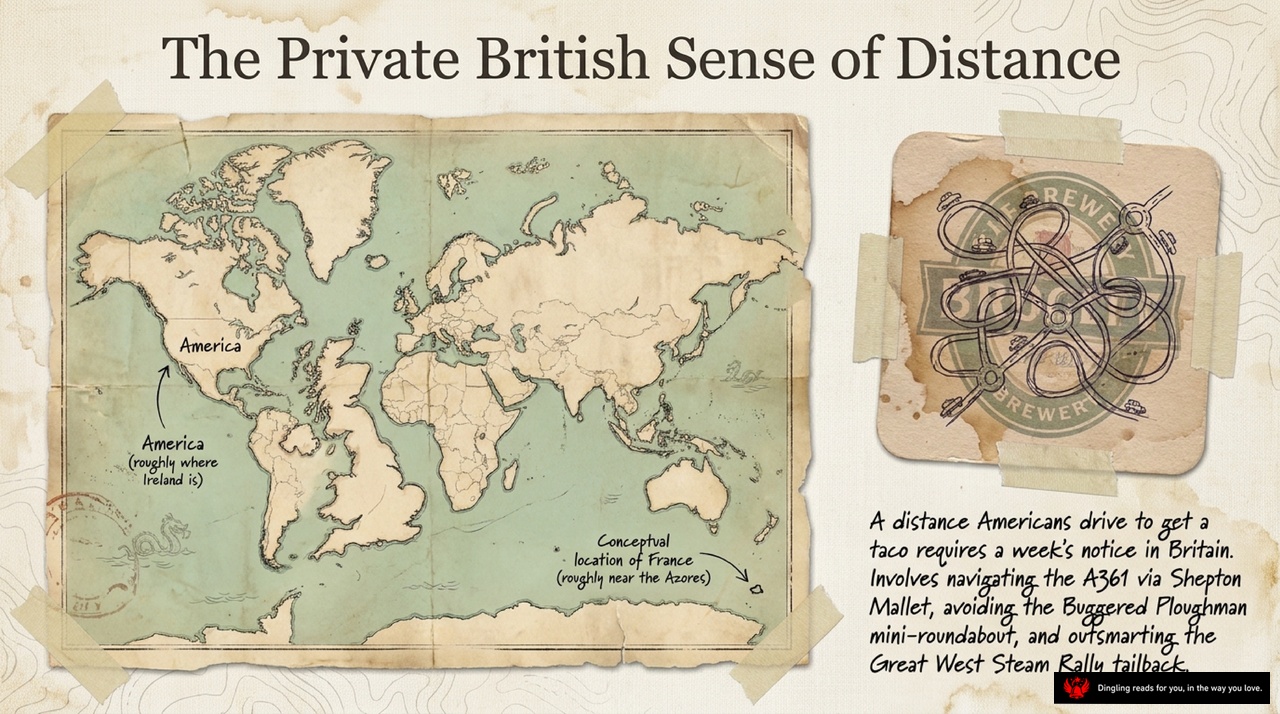
The Private British Sense of Distance isn't just about miles on a map; it's a completely different operating system for how reality feels. Look at this map: to an American, a trip to a taco stand might be a quick drive, but in Britain, that same distance could feel like a week-long expedition. It requires navigating the A361 via Shepton Mallet, dodging the infamous Buggered Ploughman mini-roundabout, and outsmarting a tailback from the Great West Steam Rally. To them, even getting to the coast feels like an epic adventure filled with hidden obstacles.
But here's the twist: while they treat their own backyard like a foreign country, they view the rest of Europe as a distant, almost mythical land. They know every gossip-worthy detail about America, yet they often seem baffled by places just across the Channel. Standing in Calais, you can clearly see the White Cliffs of Dover only 20 miles away, but to a British eye, that strip of land feels separated by a vast, unspoken ocean. It's a fascinating paradox where the familiar becomes strangely remote, and the foreign feels surprisingly close.
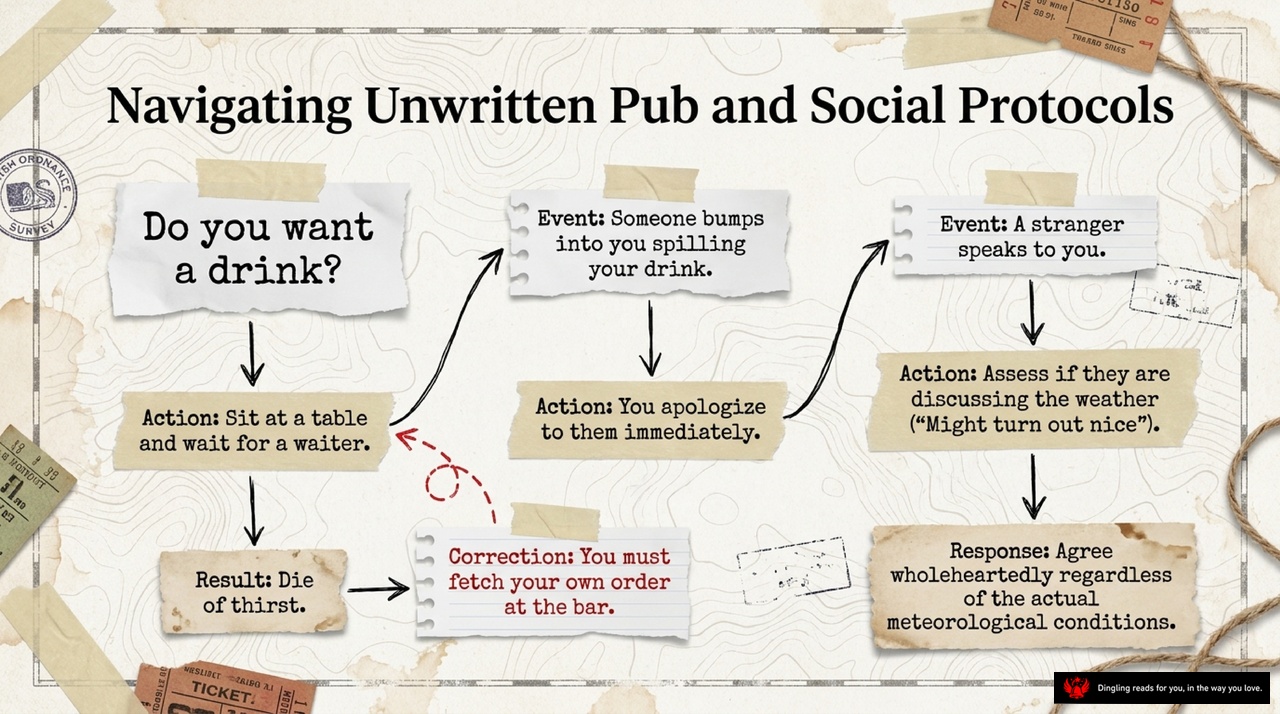
Navigating Unwritten Pub and Social Protocols
So, let's talk about the hidden rulebook of the British pub. It's not written down anywhere, but if you miss it, you might end up dying of thirst. First things first: do you want a drink? The instinctive American move is to sit at a table, wait for a waiter, and order from the menu. In the UK, that's a fast track to disaster. The correction is simple but crucial: you must fetch your own order at the bar. You sit, you wait for a table, but you never wait for a drink. You head to the bar, place your order, and pay immediately.
Now, imagine you're at this bar, and someone bumps into you, spilling your pint. In the States, you might wait for an apology or a manager. Here, the protocol is immediate and direct: you apologize to them immediately. It's a social contract of mutual respect; you acknowledge the accident before they even do.
But what if a stranger starts talking to you? Don't assume they want to chat. First, assess the context. Are they discussing the weather? In Britain, saying "Might turn out nice" is a code. It doesn't mean they love you; it means they are politely keeping their distance. If you catch that cue, the response is to agree wholeheartedly, regardless of the actual meteorological conditions. It's a way of saying, "I hear you, I'm polite, but let's not get too deep."
These unwritten protocols are the real adventure. They turn a simple night out into a game of social chess, where a misplaced order or a misunderstood greeting can change the entire evening.
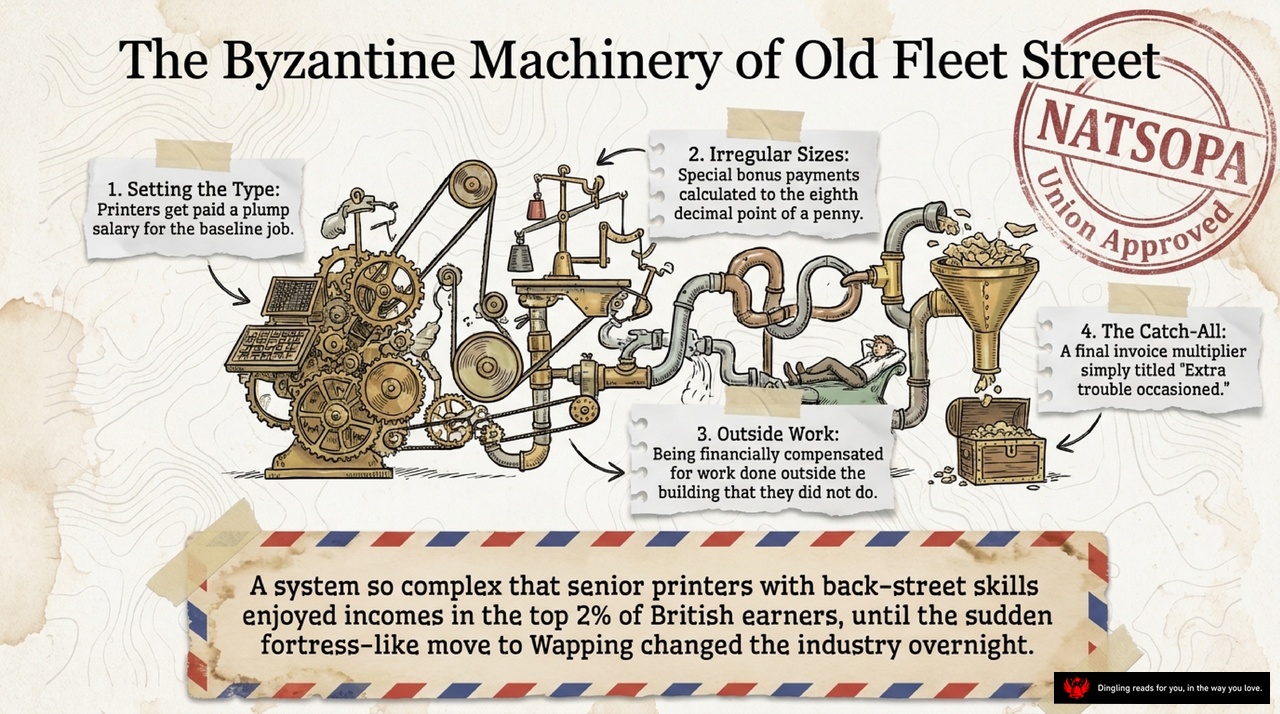
The slide reveals the hidden engine behind Old Fleet Street, a place that wasn't just a workshop but a high-stakes financial machine. Think of it as a complex, steampunk factory where printers weren't just employees; they were CEOs of their own empires. The diagram breaks down how this "Byzantine machinery" worked. First, there was "Setting the Type," where printers earned a solid baseline salary just for showing up. But the real magic happened in the bonuses. You had "Irregular Sizes," where payments were calculated with terrifying precision down to the eighth decimal point of a penny. Then, there was "Outside Work," a system that financially rewarded printers for doing tasks outside the building that they technically didn't even do. And finally, the ultimate catch-all: "The Catch-All," a final invoice multiplier simply titled "Extra trouble occasioned." It was a system so complex and lucrative that senior printers with those back-street skills ended up in the top 2% of British earners. It only collapsed overnight when the industry was forced to move from Fleet Street to Wapping, breaking the fortress that had protected these profits for so long.
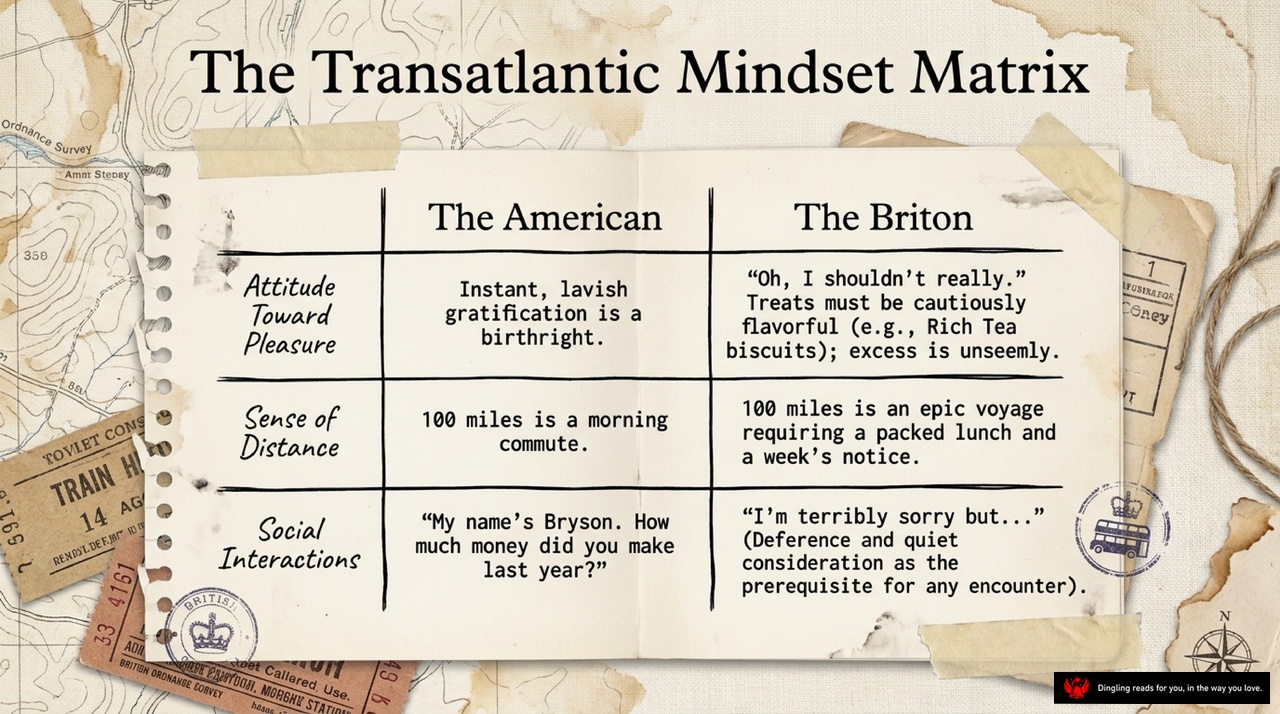
Look at this "Transatlantic Mindset Matrix." It perfectly captures the invisible wall between us. First, think about pleasure. An American treats instant, lavish gratification like a birthright; if you want it now, you just take it. But a Brit? They think, "Oh, I shouldn't really." Excess feels unseemly. A treat must be cautiously flavorful, like a Rich Tea biscuit, rather than a feast.
Now, consider distance. To us, 100 miles is just a morning commute. Drive on. But to a Brit, that same 100 miles is an epic voyage requiring a packed lunch and a week's notice. They don't just travel; they plan an expedition.
Finally, look at how we interact socially. An American walks up and says, "My name's Bryson. How much money did you make last year?" Direct, right? But a Brit approaches with deference and quiet consideration. They start with, "I'm terribly sorry but..." because respect is the prerequisite for any encounter. We chase the quick fix; they savor the ritual. We ask about status; they offer an apology. It's not just a map of the Atlantic; it's a map of how we see the world.

Look at this vintage barometer and that old newspaper clipping from *The Times*. They capture something uniquely British: the idea of a "National Paralysis" caused by weather that barely exists elsewhere. To an outsider, English weather seems almost non-existent. It's just a narrow band of cool spells, dry rain, and what they call "spitting"—a constant, light drizzle that never really stops.
But here's the twist: because the average is so low, even a mere two inches of snow is classified by the press as a "blizzard." That tiny amount creates drifts of six inches, which are enough to completely paralyze the nation. It's a system where the definition of a disaster is so sensitive that a gentle winter morning can shut down the country.
This isn't about extreme storms; it's about how a culture interprets its environment. When the weather dips just slightly below the norm, the reaction is disproportionate. A little snow becomes a crisis; a bit of rain becomes a reason to cancel plans. It's a country that lives on the edge of a very narrow, very wet, and often frustratingly unpredictable climate, where the difference between a pleasant day and a national shutdown is just a few inches of white powder.

Look at this side-by-side comparison. On the left, we have "The Rural Ideal"—a lush, living landscape where centuries of instinctive care have created something truly beautiful. On the right, "The Urban Reality," where heritage is being replaced by concrete, and those cherished hedgerows are fraying away under the pressure of modern agriculture.
This slide captures the core tension I felt throughout my travels. In the countryside, like in the Cotswolds or the Lake District, you see the result of that "tiresless, instinctive improvement." Farmers aren't just maintaining land; they are actively preserving a living history. I watched a farmer in the rain spend hours repairing a crumbling stone wall, simply because it had fallen. He didn't wait for the government, which often provides minimal funding for such vast areas. He did it because the wall is part of the soul of that landscape.
But contrast that with the creeping threat of the built environment. As I moved through cities like Manchester and Birmingham, or even the declining seaside resorts of Morecambe and Blackpool, I saw a different story. The urge to replace the old with the new is relentless. We see ugly modern office blocks blocking river views, as I witnessed in Inverness, or vast concrete housing estates that feel disconnected from nature. The hedgerows, which once acted as the green arteries of the countryside, are being cut down for efficiency, leaving the land disjointed and less resilient.
The image of the frayed, disjointed hedgerow is a warning. It represents a loss of identity and a break in the natural world. While the urban reality offers convenience and modernity, it often comes at the cost of the beauty and complexity that makes the British landscape so unique. The challenge for the future isn't just about protecting buildings, but about preserving that "parklike, flawlessly composed" countryside, ensuring that the rural ideal doesn't get completely swallowed by the urban reality.
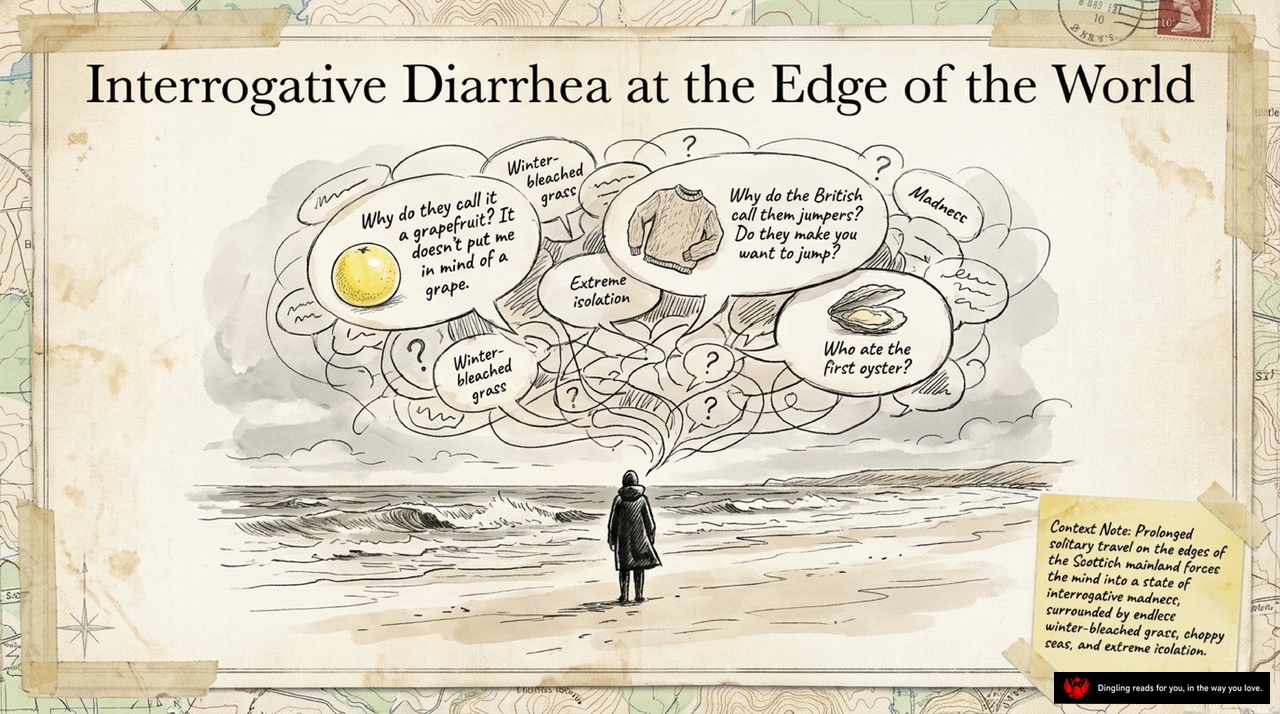
Imagine standing alone on a windswept beach at the very edge of the world, staring out at the endless, choppy grey sea. That is exactly the feeling I had in Dornoch, Scotland, back in 1973. The text on my slide calls it "Interrogative Diarrhea at the Edge of the World," and honestly, it's the perfect description of what happens when your mind gets stuck in a loop of endless questions.
When you travel to the remotest corners of the British mainland, the silence forces your brain into a state of "interrogative madness." You start asking questions that have no answers. Why do they call it grapefruit when it looks nothing like a grape? Why does the British word for a sweater sound like "jumper," making you wonder if they actually want you to jump? Who ate the first oyster? What is winter-bleached grass?
It's a mental storm caused by extreme isolation. The landscape itself seems to trigger these thoughts. I remember driving through the Highlands, where the scenery is so raw and ancient that it feels like stepping into a different planet. There are no cities, no noise, just rolling hills, heather, and the constant sound of the wind. In that quiet, your own thoughts become incredibly loud. You find yourself questioning everything, from the names of local plants to the history of the land itself.
This isn't just about being confused; it's about a unique kind of connection with the land. When you are surrounded by nothing but nature, you start to feel small, but in a good way. It strips away the noise of modern life and leaves you with the essential truths. The "diarrhea" in the title refers to this rapid, frantic flow of thoughts, a mental churn that eventually settles into a deeper understanding of where you are and what it means to be here.
So, the next time you find yourself in a place where the map ends and the horizon begins, don't be afraid of the questions. Embrace the "interrogative diarrhea." Let your mind wander, let it question, and let the silence of the edge of the world wash over you. It might just be the most refreshing experience of your life.
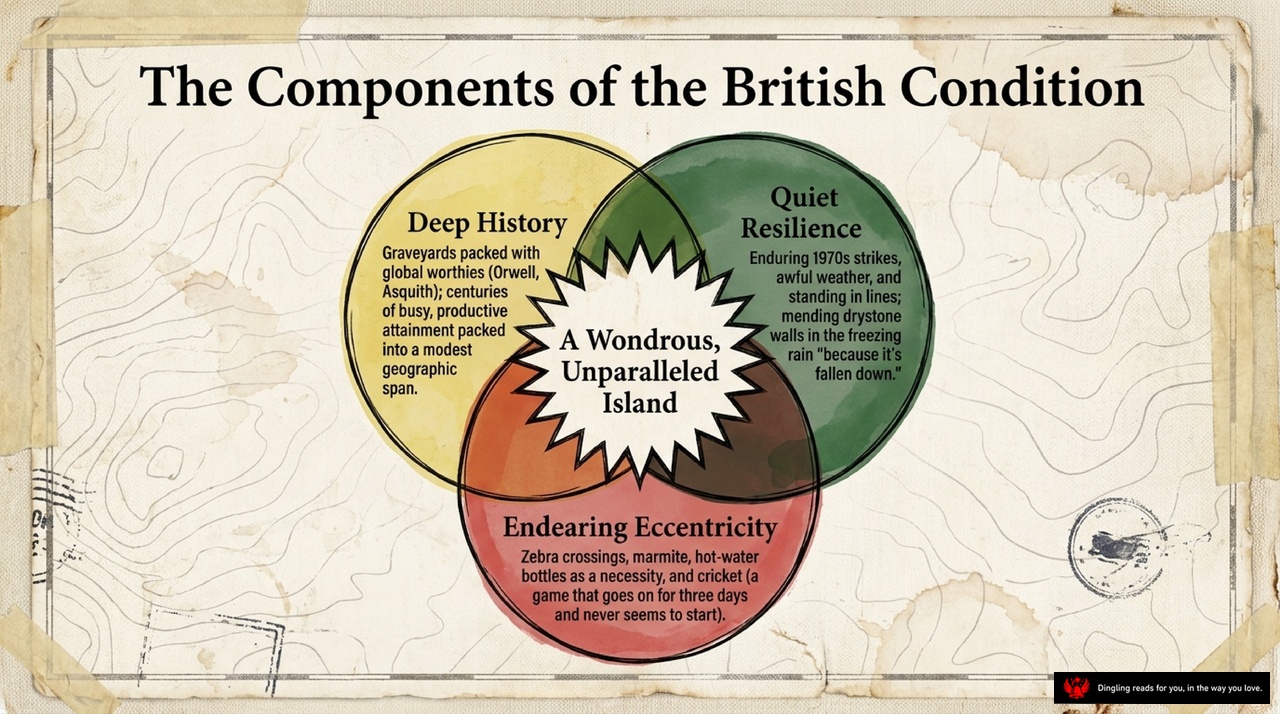
The Components of the British Condition. This Venn diagram perfectly captures the unique, almost paradoxical soul of the UK. At the center lies "A Wondrous, Unparalleled Island"—a compact landmass that somehow holds centuries of history, a deep sense of resilience, and an endearing eccentricity all at once.
Let's look at the first circle: Deep History. It's not just about ancient ruins; it's about a living past. Think graveyards packed with global giants like Orwell and Asquith, or centuries of busy, productive lives crammed into a modest geographic space. It's a country where history isn't in a museum; it's under your feet every time you walk past an old church or a weathered stone wall.
Next, we have Quiet Resilience. This is the backbone of the British character. It's about enduring the 1970s strikes, the awful weather, and the art of standing in line without complaint. It's the spirit of a man mending dry-stone walls in freezing rain just because the wall has fallen down, not because he has to. It's a stoic acceptance of hardship that turns into a quiet strength.
Finally, Endearing Eccentricity. This is what makes the UK so charmingly strange to outsiders. It's the zebra crossings, the reliance on hot-water bottles, and the obsession with cricket—a game that goes on for three days and never seems to start. It's the peculiar mix of the mundane and the magical that defines daily life there.
When these three elements collide, you get the British Condition. It's a place where deep history fuels quiet resilience, which in turn allows for a delightful, unique eccentricity. It's a country that knows how to be serious about its storms and silly about its cricket, all while holding the world in its palm.
Welcome to this chapter on the north of England and Wales. We've just left the rolling hills of the Lake District and are now diving into a landscape that feels almost like a different country entirely.
As we travel north, the scenery shifts from lush green valleys to rugged, windswept coastlines. In Liverpool, we see a city with a deep maritime soul, once a global powerhouse for cotton and coffee, now finding its identity in football and a gritty, welcoming character. We visit the magnificent Sefton Park and the historic Sefton Park, contrasting it with the decline of nearby Morecambe, a stark reminder of how quickly seaside resorts can rise and fall.
Heading further north into Wales, the experience becomes more raw and authentic. In Llandudno, we encounter a town that's seen better days, filled with silver-haired tourists and peeling paint, yet still holding onto its Victorian charm. The journey continues to Barmouth and then into the dramatic landscapes of Snowdonia, where the mountains meet the sea in a breathtaking display of nature's power.
But the true highlight of this northern leg is the contrast between bustling cities and quiet, historic villages. From the industrial past of Bradford to the model communities of Saltaire, we see how England's history is woven into its very fabric. Whether it's the vibrant curry houses in Bradford or the preserved canals in Wigan, every stop tells a story of resilience and community.
This part of the journey reveals the heart of Britain—not in its grand monuments, but in its everyday life, in the warmth of its people, and in the enduring spirit of a nation that has weathered countless storms to emerge stronger. It's a reminder that even in the most unexpected places, there's beauty waiting to be discovered if you take the time to look.