
On the Genealogy of Morality: Complete Chapter-by-Chapter Summary

Welcome to a deep dive into Friedrich Nietzsche's *On the Genealogy of Morality*. This isn't just a book; it's a philosophical excavation designed to uncover the dark, psychological roots of the modern values we hold so dear.
Imagine a world where our concepts of "good" and "evil" aren't divine truths, but the result of a brutal historical struggle between two opposing forces. Nietzsche challenges the very foundation of how we understand morality, arguing that what we call "virtue" is often a mask for resentment and weakness.
He starts by looking at the "slave revolt in morality." For centuries, the powerful defined themselves as "good"—strong, noble, and beautiful—while labeling their enemies as "evil." But then came the underdogs. The weak, the oppressed, and the priests. Unable to fight back physically, they turned their hatred inward. They redefined the values of their oppressors. What the strong called "cruel" or "powerful," the weak called "evil." Conversely, they labeled their own weakness—poverty, humility, suffering—as "good." In doing so, they created a moral system where being good meant being weak, and being strong became a sin.
Nietzsche is particularly critical of the priestly class. He argues that their power comes not from strength, but from a unique form of resentment. They are the masters of turning pain into meaning. By convincing the suffering that their misery is a punishment for a hidden sin, they transform helplessness into a spiritual burden. This is the birth of the "guilt complex." Suddenly, suffering isn't just a random part of life; it's a sign that you are a sinner. This psychological trick allowed the weak to gain a moral victory over the strong, making the powerful feel guilty for simply existing.
The book also explores how these values shaped our view of truth and art. Nietzsche suggests that the modern obsession with "truth" is itself a product of this ascetic ideal. We value truth not because it helps us live, but because it gives our suffering a purpose. It's a way to endure the pain of existence by believing we are on a moral journey.
As we move through these pages, we'll see how Nietzsche connects these ancient moral conflicts to the rise of Christianity, the decline of the aristocratic warrior, and the eventual emptiness of the modern age. He invites us to question whether our current moral framework actually liberates us or if it's just another cage built by the weak to control the strong.
This is a journey into the shadow side of our conscience, a look at how our deepest beliefs might be rooted in fear, revenge, and the desperate need to make sense of our pain. Let's begin.

We assume that "good" is universally beneficial, an unquestionable marker of progress and human flourishing. But Nietzsche demands a radical critique: we must question the very value of our moral values. Look at that shattered word "GOOD" under the magnifying glass—it's not a solid foundation, it's a fracture waiting to happen.
We believe the "good man" holds higher value than the "evil man," but this is just an assumption. Previous historians assumed "good" originally meant "useful" or "unegoistic," praised by those who benefited from altruism. They thought the English psychologists were right, but Nietzsche saw through it. He suspected that "good" is actually a symptom of regression—a narcotic that preserves the present at the expense of humanity's highest future potential.
What if the so-called "good" is just a tool used by the weak to turn their resentment into a weapon? What if true strength lies not in being "good," but in the courage to create new values? That's the challenge Nietzsche throws at us today.

Look at this slide. We are diving into the etymology of "Good" and "Bad," and what you're seeing here is a direct challenge to the idea that morality is just about being nice or helpful.
On the left, under "Good," we see the "Noble Root." The slide points to Latin, where *bonus* evolved from *duonus*, meaning a warrior or a man of strife. It also highlights the German word *Gut*, which originally meant "God-like" or a man of a divine race. The conclusion here is stark: "Good" was originally a self-designation by the powerful, the noble, and the privileged. It wasn't about altruism; it was a claim of political and psychological superiority. The strong defined themselves as good to set themselves apart from the common masses.
Now, look at the right side, labeled "Bad," representing the "Plebeian Root." The slide traces this to German, where *Schlecht* meant "Plain" or "Common." It also points to Greek, where words like *Kakos* referred to being cowardly or simply plebeian. Crucially, the slide notes that originally, "Bad" had no moral condemnation. It simply meant the commoner, the dark-haired aboriginal, compared to the blonde, conquering aristocrat.
So, the real story isn't that "good" means virtuous and "bad" means evil. It's that these labels were weapons used by the elite to label everyone else as inferior. "Good" meant "us, the rulers," while "bad" was just a polite way of saying "you, the common people." This distinction wasn't about character; it was about power, blood, and social hierarchy.

Imagine a world where the very definition of "good" is a weapon used by the weak against the strong. This isn't just philosophy; it's a historical war that shaped our entire moral landscape. Today, we are diving deep into Nietzsche's most explosive concept: The Great Dichotomy. As you see on this slide, he contrasts two opposing value systems: Master Morality and Slave Morality.
Let's look at where these values come from. Master Morality springs from a place of spontaneous, triumphant self-affirmation. It's the voice saying, "I am good." For the noble warrior or the ruling class, "good" means noble, powerful, beautiful, and healthy. Their definition of the opposite, "bad," is simply common, low, or cowardly—a mere afterthought of pity. Their primary driver is overflowing vitality and a raw Will to Power. When they face an enemy, they respect them. The enemy is seen as an equal, a mark of distinction and honor. Think of the ancient heroes who fought worthy opponents; the struggle itself was a celebration of life.
Now, flip the coin. Look at the column for Slave Morality. This system is reactive, rooted in a deep rejection of the outside world. It starts with a whisper: "You are evil." Here, "good" is redefined as the wretched, the poor, the weak, the suffering, and the patient. Notice how the definition flips completely? What the masters called "bad," the slaves now label as "Evil." This "Evil" isn't just a lack of goodness; it is the powerful, the cruel, the master himself, warped by the venomous eye of hatred. The primary driver here isn't vitality; it is *Ressentiment*—that deep-seated, poisonous resentment and thirst for psychological revenge that fester in those who feel powerless.
Finally, look at how they view their enemies. For the Master, the enemy is respected. But for the Slave, the enemy is hated. They view the powerful not as equals, but as evil monsters that must be symbolically annihilated. This is the core of the slave revolt in morality: taking the weakness of the oppressed and transforming it into a moral victory. By declaring that suffering is good and power is evil, the weak gain a spiritual weapon to strike back at the strong.
Nietzsche argues that our modern world, with its obsession with humility, charity, and the idea that the meek shall inherit the earth, is actually a victory for this Slave Morality. It is a triumph of the "herd" over the individual, where the instincts of the lion are replaced by the instincts of the sheep. Understanding this dichotomy is the first step to seeing why our current moral compass might be leading us in the wrong direction, away from life-affirming power and toward a life-denying resentment.

The image before us is a powerful map of the mind's defense mechanisms, illustrating how the "ascetic ideal" or the spirit of self-denial actually functions as a psychological alchemy. At the center, we see the core mechanism: taking raw, unbearable suffering and transmuting it into something manageable. The slide breaks this down into four specific translations that have shaped our modern morality.
First, look at the top right: "Impotence translates to Goodness of Heart." This is a brilliant psychological trick. When the weak realize they cannot act, cannot fight back, or cannot change their circumstances, they don't just accept it; they reframe their inability to act as a moral choice. They say, "We do not act because we choose not to." By labeling their paralysis as "goodness," they gain a sense of superiority over those who do act, effectively turning their weakness into a badge of honor.
Next, we see "Cowardice translates to Humility and Patience." Here, the fear of conflict is rebranded. Instead of facing a dangerous situation or admitting a lack of courage, the suffering individual is taught to wait at the door, to endure, and to be patient. This waiting is not passive; it is cultivated as a virtue. The fear that should have driven them to flee or fight is instead polished into the noble quality of patience, allowing them to survive by enduring what they would otherwise have to destroy.
Then, we have "Submission translates to Obedience." This is perhaps the most insidious translation of all. The inability to command or lead is recast as obedience to a higher power, often God. Submitting to those you might hate or to a cruel fate is no longer seen as defeat; it is elevated to the status of obeying divine will. This allows the powerless to find meaning in their subjugation, believing that their lack of agency is actually a sign of their spiritual alignment with a greater order.
Finally, at the bottom, "Inability for Revenge translates to Forgiveness." This is the ultimate act of spiritual revenge. Denied the physical ability to retaliate, the weak invent the concept of "forgiveness." By leaving vengeance to a divine judge—God, karma, or the future—they transform their own helplessness into a moral high ground. They forgive their enemies not out of love, but because they have been taught that forgiveness is the only path to salvation, effectively neutralizing the enemy's power by claiming the moral victory for themselves.
The entire point of this slide is to show that what we often call "virtue" in these contexts is actually a creative act of the powerless. It is a way for the suffering to say, "My pain is not just pain; it is a test. My weakness is not a flaw; it is a discipline." This is the essence of the ascetic ideal: it takes the raw material of human suffering and builds a fortress of meaning around it, protecting the weak from the crushing weight of their own helplessness.
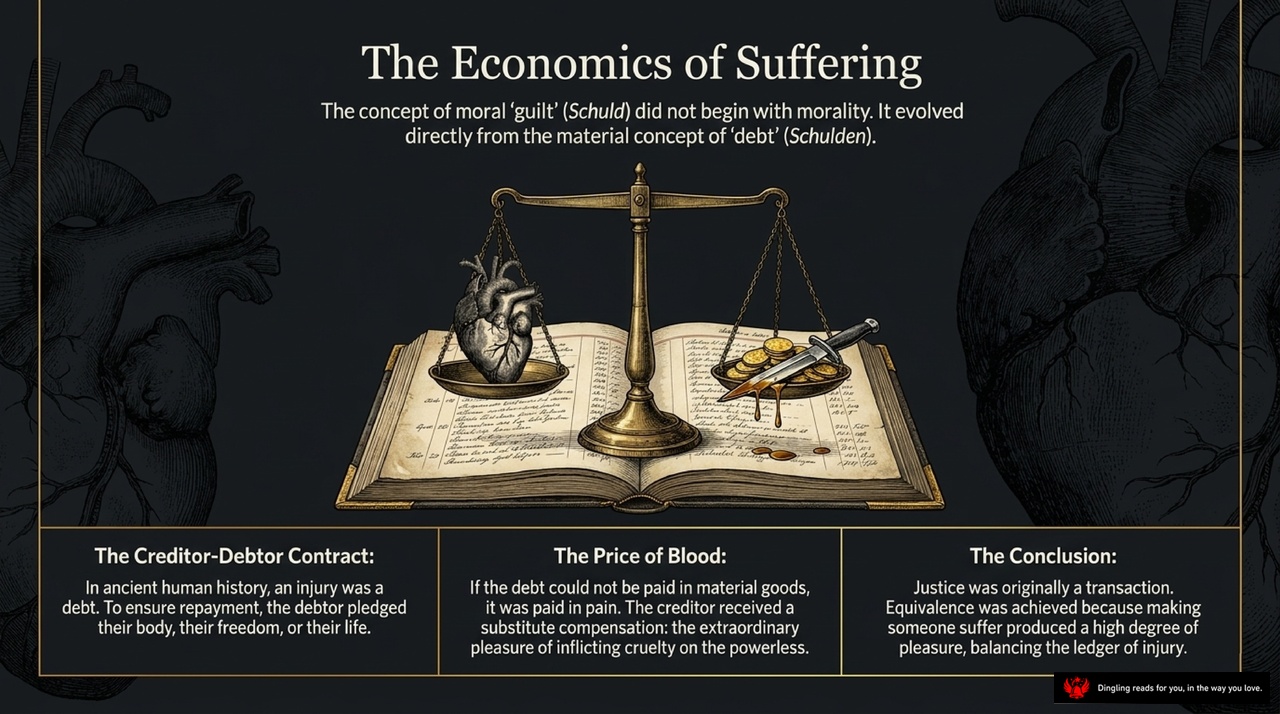
Let's talk about the real purpose of suffering, because the story we've been telling so far—that guilt is just a moral mistake or a historical accident—is only half the truth. The deeper, darker engine driving human morality is something far more biological: it's a mechanism for survival.
Look at the slide. It highlights "The Creditor-Debtor Contract." This isn't just a financial metaphor; it's the original blueprint of the human soul. In our earliest history, an injury wasn't a moral failing; it was a debt. To pay it back, a debtor didn't just hand over coins; they pledged their body, their freedom, or even their life. If you couldn't pay in material goods, the price was blood. The creditor received a substitute compensation: the extraordinary pleasure of inflicting cruelty on the powerless.
Think about that. Justice was originally just a transaction. Equivalence was achieved because making someone suffer produced a high degree of pleasure for the creditor, perfectly balancing the ledger of the injury. For the ancient mind, pain wasn't something to be pitied; it was the currency of justice. It was the only way to make the world feel fair again.
This brings us to the concept of "guilt." We think of it as a feeling of shame, but historically, it was a tool of control. It was the internalization of that ancient creditor-debtor relationship. When you feel guilty, you are essentially acknowledging that you owe a debt you cannot repay. The modern idea of a "conscience" is just a sophisticated version of this old debt collection system, where you are the debtor and your own mind is the jailer.
So, why does this matter today? Because this ancient logic still runs beneath our feet. We still try to "pay" for our mistakes, often by punishing ourselves or others, trying to restore a balance that never truly existed in nature. Understanding that our deepest moral instincts are rooted in this primal economy of suffering and debt helps us see that our guilt isn't necessarily a sign of our goodness. Sometimes, it's just the echo of a very old, very violent way of keeping the world in order.

Imagine we are cultivating a new species, a "promising animal" capable of hope and future promise. But here lies the paradox: to survive and maintain mental order, this animal needs to forget. It must actively suppress the past to make room for the present. Yet, to make a promise—a contract for the future—it needs the opposite: an unshakeable memory. How do we solve this? We don't rely on gentle reminders. We rely on pain.
Look at this timeline of pain. It starts with active forgetting, a biological suppression that keeps us sane. But to lock in a promise, humanity needed a memory that never fades. The oldest psychology tells us that only what hurts stays in the mind. So, we invented the mnemotechnics of pain. We needed to burn a few basic "I will nots" into the human brain.
This is where the timeline gets brutal. Through centuries of cruel penal laws—stoning, boiling, flaying, and the infamous wheel—we didn't just punish; we bred. We were trying to create something new. We used the custom of cruelty to override our natural forgetfulness. We wanted to forge a "sovereign individual." This is the final product of that long, bloody history: an autonomous master with free will, a conscience, and the right to make a promise.
Think about it: our most cherished concepts like "guilt," "conscience," and "duty" didn't start with kindness. They started with the creditor and the debtor. We literally bought our ability to keep promises with our blood. We traded our bodies, our freedom, and even our peace of mind to prove we were trustworthy. The very idea of a "good" promise is built on the foundation of ancient, horrific torture. We are the animals we bred, but the cost was written in our very nerves.

Imagine your brain as a wild, untamed beast, perfectly evolved for the harsh wilderness. It thrives on hostility, roaming, and destruction. But suddenly, a pack of conquerors—let's call them "blond beasts"—imposes a cage upon humanity. They build the state, society, and laws of peace, creating an enclosure where the old instincts can no longer be discharged outward. This is the "Enclosure of Society."
Now, here is the tragic twist. Those wild instincts don't just disappear; they get blocked. Penal laws strictly forbid the release of cruelty and aggression. So, what happens to a trapped animal that still needs to act? It turns inward. The beast begins to tear, persecute, and torture itself. This internal self-torture is what we now call the "bad conscience."
This self-torture is the "bad conscience." The wild beast, confined to the cage of civilization, invents an internal torture chamber, giving birth to what we now call the "soul." So, the very thing we cherish as our spiritual depth—the soul—was actually born from a violent suppression of our natural instincts. We didn't evolve into peaceful beings; we evolved into self-torturers.

Imagine a dark staircase rising from a skull into the light of a cross. This is the "Apex of Guilt," the terrifying peak where human morality reaches its most dangerous conclusion. Look at the path we've traveled: it starts at the bottom with "Tribal Debt," where we owe our lives to our ancestors. As the tribe grows stronger, that fear of the dead turns into a fear of gods. Then, the debt scales up with "Divine Debt," where universal empires create universal deities, making the feeling of indebtedness massive.
But here is the ultimate paradox, the twist that makes the whole system unpayable. In a stroke of terrifying genius, the Creditor—the God—sacrifices Himself for the Debtor—the Man. He pays the debt out of "love," yet by doing so, He makes the debt forever unpayable. This act doesn't free us; it eternally traps us in guilt. The maximum god produces the maximum feeling of indebtedness, a debt so massive it can never be settled. We are left standing at this apex, forever in the shadow of a debt we can never repay, trapped by a love that demands an impossible price.

The slide before you poses a haunting question: Why does humanity universally worship self-denial, chastity, poverty, and suffering? It appears to be a contradiction—life turning against life. This is the Paradox of the Ascetic Ideal.
Let's break down this Venn diagram on the left. We have three intersecting circles: Crux, Nux, and Lux. These represent the torture, the essence, and the illumination. The text at the bottom reminds us that these are inextricably bound together. But what does this mean in reality?
Look at the "Facade" on the right. On the surface, asceticism looks like a hatred of the senses, a fear of happiness, and an attempt to escape the material world into "nothingness." It seems like a noble rejection of the physical. But the slide reveals the "Hidden Reality." This isn't about nobility; it is an instinct for self-preservation. It is a tool used by a sick, exhausted life that is struggling to cling to existence. When life feels too heavy or meaningless, it invents the idea that suffering is actually a form of holiness.
Finally, consider "The Function." The Ascetic Ideal acts as an anesthetic. It gives suffering a meaning, saving humanity from suicidal, passive nihilism. Without this ideal, life would feel like a random, meaningless accident. By framing suffering as a test or a path to redemption, we avoid the terrifying truth that life might just be nothing. As the text suggests, humans would rather desire nothingness than face the void of having no meaning at all. So, the ascetic ideal isn't a victory over life; it's a desperate strategy to keep life going by giving pain a purpose.
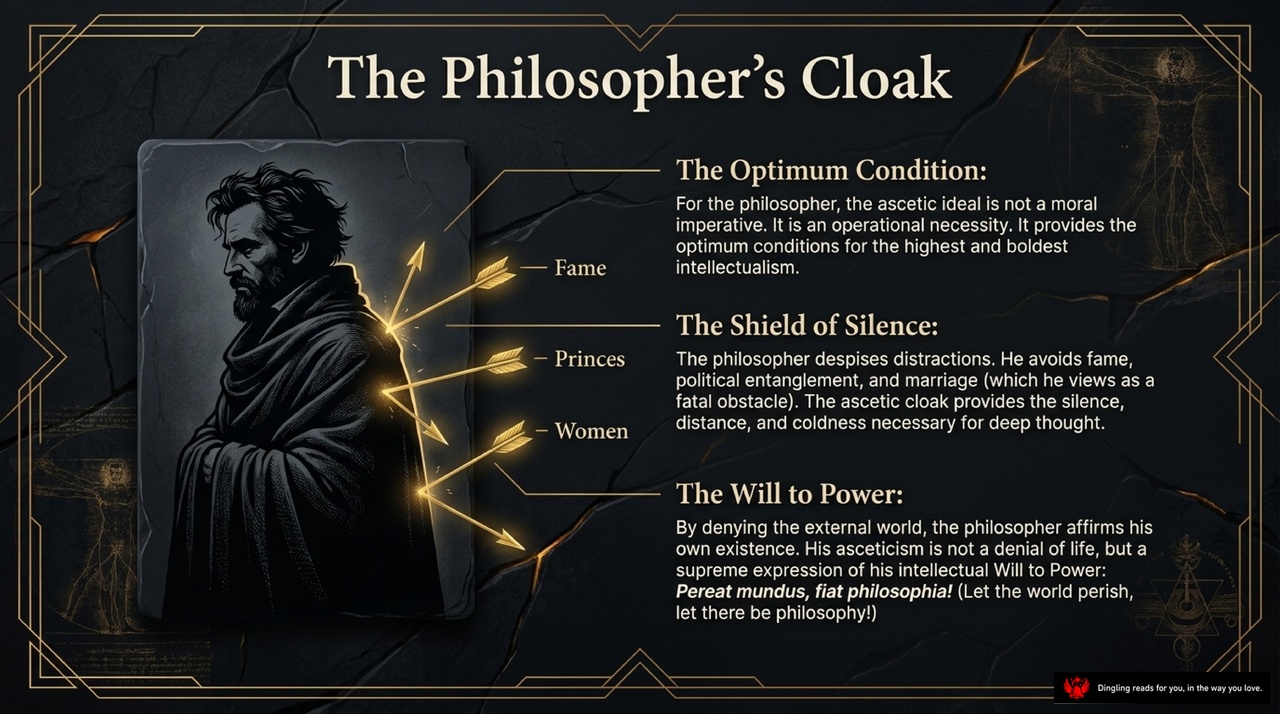
Look at this image, "The Philosopher's Cloak." It visualizes a stark truth about the highest intellect: asceticism isn't a moral choice for the philosopher; it is an operational necessity. To achieve the boldest intellectualism, the thinker must create the optimum condition for thought, and that condition is silence.
Notice the arrows striking the philosopher's back, labeled "Fame," "Princes," and "Women." These are the distractions the philosopher despises. Fame is a trap; political entanglement with princes is a fatal distraction; and marriage, which the philosopher views as a binding chain, is an obstacle to deep thought. The "ascetic cloak" isn't just a garment; it is a shield of silence. It provides the distance and coldness necessary to let the mind work without interference.
But why go this far? This is where we hit "The Will to Power." By denying the external world and rejecting life's usual comforts, the philosopher affirms his own existence. This isn't a denial of life, but a supreme expression of intellectual power. It is a declaration that the mind is stronger than the world. As the image captures with that powerful Latin phrase, *Pereat mundus, fiat philosophia*—"Let the world perish, let there be philosophy!" The philosopher is willing to let the chaotic world fade away just to ensure the purity of thought survives.
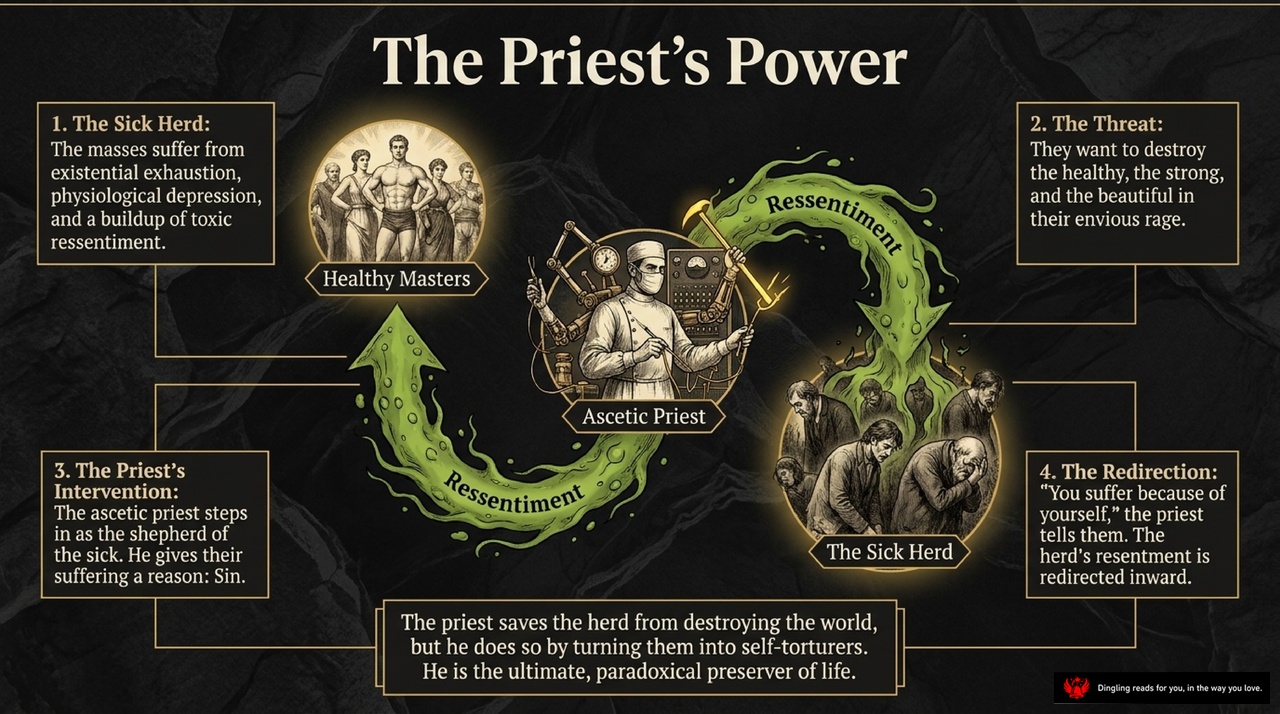
Imagine a world where the sick herd is exhausted, drowning in existential despair and toxic resentment. They look at the strong, the beautiful, and feel a burning envy that threatens to tear them apart. This is the dangerous moment where the ascetic priest steps in as the ultimate shepherd. He doesn't offer a cure for their physical ailments; instead, he offers a new story. He tells them, "You suffer because of yourself." Suddenly, their rage at the healthy masters is redirected inward. The resentment that could have destroyed the world is now turned into a weapon against the self. The priest saves them by turning them into self-torturers, creating a moral system where weakness is redefined as virtue and suffering is seen as a sign of holiness. In this paradoxical twist, the priest becomes the greatest preserver of life, not by healing the body, but by taming the mind.

The image before us poses a stark, almost terrifying question: What is the cure for nihilism? The slide suggests that without an "Ascetic Ideal," human existence is nothing more than an empty void. The real enemy isn't suffering itself, but the meaningless of that suffering. When we feel pain but cannot find a reason for it, the pain becomes unbearable.
So, how do we fix this? The slide points to a counterintuitive solution: the Ascetic Ideal. This isn't about avoiding pain; it's about giving pain a purpose. By framing all our suffering under the perspective of "guilt," we transform meaningless agony into a meaningful struggle. It brings new, deeper, and yes, vicier suffering—but crucially, it provides a goal.
This ideal effectively closes the door to suicidal nihilism. It proves a hard truth: humans must have a goal. As the quote at the bottom reminds us, "Man would rather will nothingness than not will at all." We would rather choose a painful, defined purpose than face the abyss of having no purpose at all. The cure for the horror of the void is not happiness, but a reason to suffer.
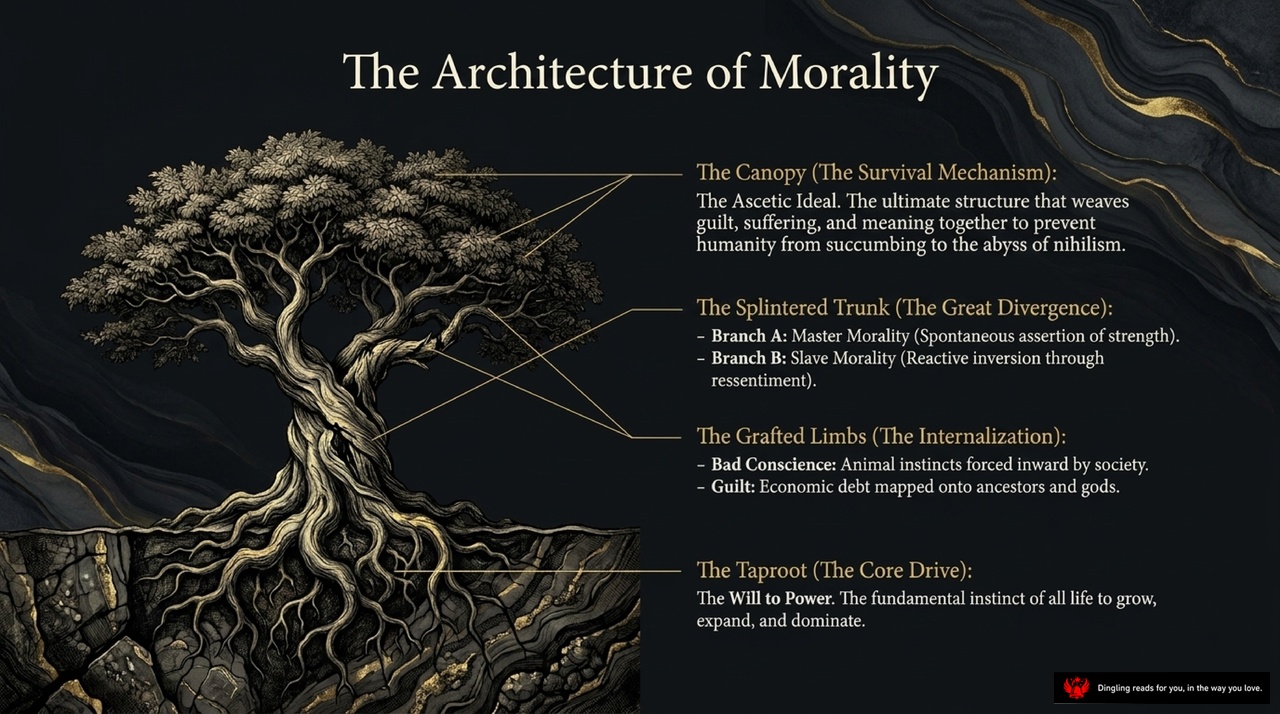
Look at this tree. It's not just a plant; it's the entire architecture of morality, grown from the raw soil of our instincts. At the very bottom, buried deep in the rock, lies the taproot: the Will to Power. This is the core drive of all life, the fundamental instinct to grow, expand, and dominate. It's the raw, unfiltered truth of existence.
But as this tree rises, it hits the splintered trunk—the Great Divergence. Here, life splits into two branches. One is Master Morality, a spontaneous assertion of strength where the noble define good as what they are. The other is Slave Morality, a reactive inversion born from resentment, where the weak twist the strong's values into "evil" to feel better about their own weakness.
As the tree grows higher, society grafts new limbs onto this structure. We take those raw animal instincts and force them inward. This creates the grafted limbs of internalization. Our natural aggression becomes a "bad conscience," a self-directed cruelty. We then map our economic debts onto our ancestors and gods, turning simple failure into a cosmic "guilt."
Finally, at the very top, we reach the canopy: the Survival Mechanism. This is the Ascetic Ideal. It's the ultimate structure that weaves together guilt, suffering, and meaning. Why? To prevent humanity from succumbing to the abyss of nihilism. Without this canopy, without the stories we tell ourselves about suffering having a purpose, we would have nothing to hold onto. We would fall into the void. So, morality isn't just a set of rules; it's a life-support system, a tree we built to keep us standing when the ground beneath us feels like it's disappearing.

Our "highest" moral values were not handed down from the heavens. They were forged in the dark crucibles of economic debt, the cruelty of the creditor, the resentment of the powerless, and the violent internalization of our wildest animal instincts. We have survived the abyss of meaninglessness only by wrapping ourselves in the sickness of guilt and the ascetic ideal. Now that we have unearthed the bloody roots of our morality, do we have the courage to cultivate values of our own making?