
One Sentence Is Ten Thousand Sentences: Complete Chapter-by-Chapter Summary

Hello everyone, welcome to today's reading session. We are diving into a profound exploration of human connection and the heavy weight of cultural solitude.
The image before us captures the essence of our book, *One Sentence Is Ten Thousand Sentences* by Liu Zhenyun. Set against a backdrop of misty, towering mountains and a winding, solitary path, the scene reflects a journey that is both physical and deeply spiritual. It speaks to a millennium of longing—a relentless, exhausting search for a single true connection in a vast, often indifferent world.
As we begin, let's consider the core theme: the illusion of friendship versus the reality of isolation. The book opens with the story of Old Yang, a humble tofu seller who believes he has a deep, soul-brother bond with Old Ma, a carriage driver. To Old Yang, they are inseparable friends who share everything. But the truth is far more painful. Old Ma views Yang merely as a nuisance, a source of gossip, and someone beneath him socially. Their "friendship" is entirely one-sided, built on Yang's desperate need for validation and Old Ma's polite but hollow tolerance.
This dynamic mirrors a larger truth about human relationships: we often mistake proximity for intimacy, and expectation for reality. We cling to people who listen to us, hoping they will understand our deepest selves, only to find they are merely passing through. The book asks us to confront this painful gap—the moment we realize that the person we thought knew us best, never really did.
In the pages that follow, we will see this pattern repeat across generations and lives. From Old Yang's futile search for a friend to the tragic story of Wu Moxi, who changes his name three times in a desperate attempt to escape his past, the narrative is a meditation on identity and loneliness. It challenges us to ask: Are we truly seen by others? Or are we just performing roles for an audience that isn't listening?
This book is not just a story; it is a mirror. It holds up the complexities of our own relationships, forcing us to look at the people we love, the friends we cherish, and the connections we take for granted. It reminds us that sometimes, the most profound loneliness comes not from being alone, but from being with someone who simply doesn't see you.
Let's turn the page and begin this journey into the heart of human connection.
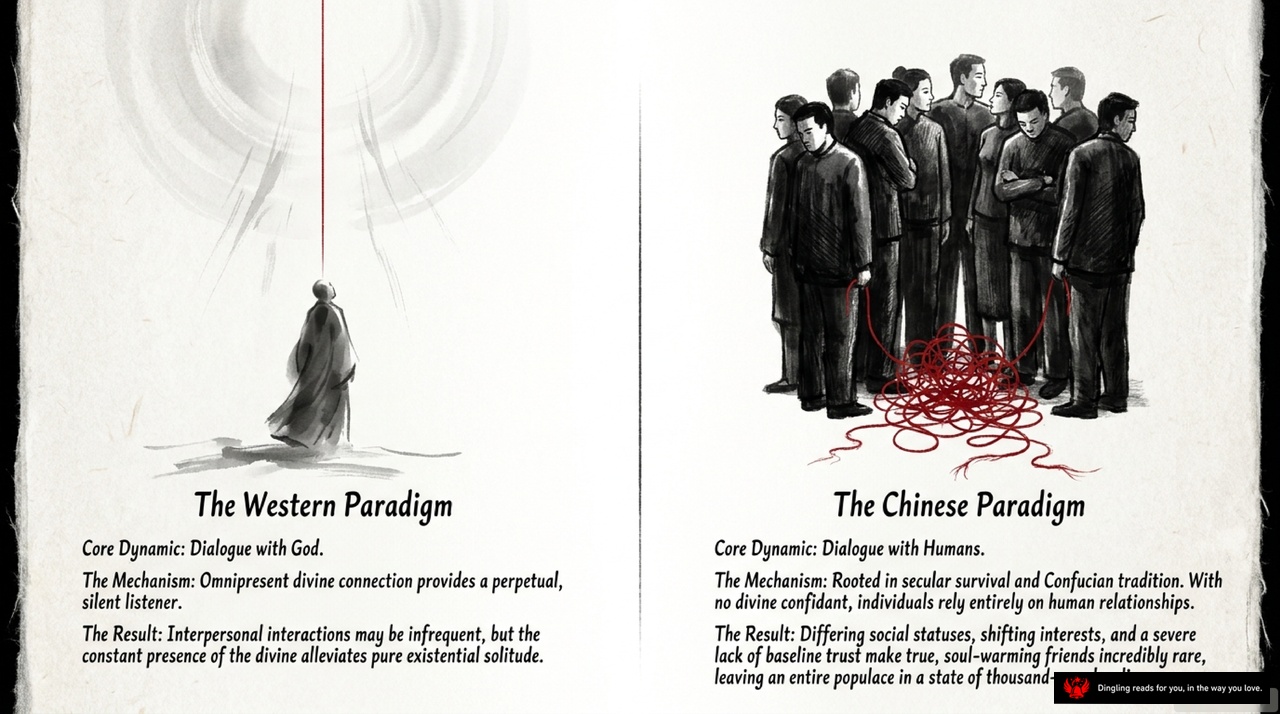
On this page, we see a striking contrast between two worlds: The Western Paradigm and The Chinese Paradigm. The image on the left shows a solitary figure connected to a distant light, while the right side depicts a tangled group of people bound by red strings. This visual metaphor captures a fundamental truth about human connection that runs deep in our cultural DNA.
In the West, our core dynamic is a dialogue with God. As the text explains, the omnipresent divine connection acts as a perpetual, silent listener. Even when interpersonal interactions are infrequent, the constant presence of the divine alleviates that crushing feeling of existential solitude. You don't need to explain yourself to everyone; you have a higher power that understands you.
Now, look at the right side. The Chinese Paradigm is rooted in a dialogue with humans. Without a divine confidant, individuals rely entirely on human relationships for survival and meaning. But here lies the trap. As the book illustrates, differing social statuses and shifting interests create a severe lack of baseline trust. True, soul-warming friends become incredibly rare. Instead of a divine listener, we are left in a state of thousand-threaded knots—tangled, anxious, and desperately needing someone else to validate our existence. We build walls out of relationships, only to find ourselves trapped inside them, wondering why no one truly sees us.

Look at this image. It captures a profound truth about human connection: we often build walls of noise just to hide how empty we feel inside.
Above the water, characters create "manufactured resonance." They scream, drum, and play instruments not because they have something to say, but to mask their profound isolation. Think of Luo Changli, who becomes a local legend by screaming passionately at funerals, or Old Yang, who beats a complex rhythm on a drum just to sell tofu. They are performing for the world, trying to fill the silence with sound.
But below the water lies the tragic reality: internal silence. No matter how grand the spectacle or how loud the occupation, it cannot alter their fate. The louder their external environment, the deeper their internal inability to communicate a single honest word to their own families.
This is the tragic irony of the Yanjin populace. They are drowning in noise while starving for connection, trapped in a cycle where the louder they become, the more alone they truly are.

The image before us maps out three distinct, painful nodes of human connection: The Transactional Friend, The Oppressive Spouse, and The Inherited Silence. These aren't just abstract concepts; they are the heavy, invisible chains that bind the characters in this story, repeating across generations.
First, look at Node 1: The Transactional Friend. We see Old Yang and Old Ma. On the surface, they seem close—sharing jokes, history, and daily commerce. But the dynamic is a lie. One seeks guidance out of inadequacy, while the other secretly looks down upon him. They share a proximity that feels real, but it's an illusion. Old Yang clings to Old Ma for advice, believing they are soulmates, while Old Ma sees him only as a nuisance, a source of trivial gossip. Their friendship is built on one-sided dependency and hidden contempt.
Then, Node 2: The Oppressive Spouse. Here, we see Old Pei and Lao Cai. They are bound not by love, but by past grievances, leverage, and secrets. Logic and reason have turned into weapons. Lao Cai holds the power, using Old Pei's hidden past as a tool to maintain dominance and exact revenge. There is no space for understanding here, only a cold war where every word is a trap.
Finally, Node 3: The Inherited Silence. This is the most haunting node, featuring Old Yang and his son, Yang Baishun. Generational trauma creates a wall where fathers and sons inhabit the same physical space but cannot exchange a single honest sentence. Communication breaks down into physical violence, manipulation, and eventual estrangement. The silence isn't peaceful; it's a violent void where truth cannot survive.
These three nodes show a tragic pattern: relationships that start with the hope of connection, only to end in isolation, manipulation, or a suffocating silence that is passed down from father to son.

Step 1: Yang Baishun, the tofu maker's son, runs from a manipulative father and a life of crushing silence.
Step 2: Yang Moses, the priest's disciple, adopts a foreign name seeking answers from Pastor James, only to realize their definitions of finding a path are fundamentally incompatible.
Step 3: Wu Moses, the matrilocal husband, marries a widow and trades his surname for survival, but is ultimately abandoned, left to care for a stepdaughter who isn't his own.
Step 4: Luo Changli, the fugitive, loses his stepdaughter—the only person he could truly speak to. He abandons Yanjin entirely, assuming the name of his childhood idol, wandering blindly into the unknown.
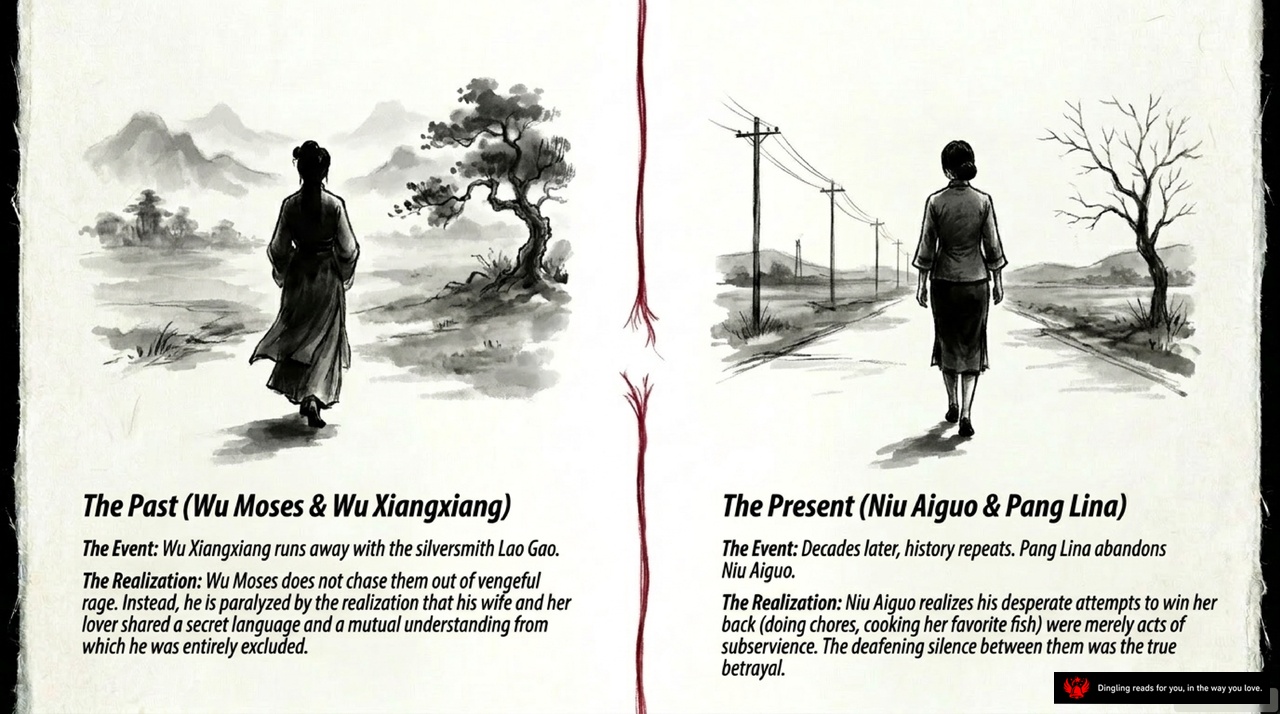
Look at this split image. On the left, we see the past: Wu Moses and Wu Xiangxiang. On the right, the present: Niu Aiguo and Pang Lina. The story here is about a cruel, repeating cycle of betrayal.
In the past, Wu Xiangxiang runs away with a silversmith. Instead of chasing her out of rage, Wu Moses is paralyzed. Why? Because he realizes his wife and her lover shared a secret language and a deep understanding that he was entirely excluded from. He wasn't betrayed by an affair; he was betrayed by silence. He was deafened by the fact that he never truly knew them.
Decades later, history repeats itself. Pang Lina abandons Niu Aiguo. But the twist is in Niu Aiguo's realization. He finally understands that his desperate attempts to win her back—doing chores, cooking her favorite fish—were merely acts of subservience. He was trying to buy her love with service, not connection. That deafening silence between them was the true betrayal.
Both men suffer from the same wound: the realization that they were never the main characters in their own love stories. They were just background noise to someone else's secret language.

Look at this cycle. It's a haunting loop that runs through the entire history of Yanjin, connecting the grandfather, Wu Moses, with his grandson, Niu Aiguo. The slide breaks it down into three parts: The Catalyst, The Direction, and The Result.
In the past, Wu Moses is the catalyst. He loses his only stepdaughter, the only person he could speak honestly to. So, his direction is to leave Yanjin, wandering outward into the vast country just to find a connection. But the result? A century passes, the physical landscapes transform, yet that existential exhaustion remains identical. He runs away, but he never really escapes himself.
Fast forward to the present. The catalyst for Niu Aiguo is betrayal by a wife he simply cannot speak to. His direction is the opposite of his grandfather; he returns toward Yanjin, tracing his grandfather's footsteps inward to uncover a lost sentence. He goes back, seeking the dialogue his grandfather abandoned.
The final column reveals the cyclical truth. It's a massive cycle of leaving and returning, driven purely by this agonizing search for dialogue. Whether running away into the unknown or digging back into the past, both men are trapped in the same silence. They are searching for a voice, but the landscape of their loneliness remains unchanged.

The weight of the unspoken is a heavy burden, grinding down the spirit not through physical labor, but through the endless, hyper-vigilant navigation of human relationships without the safety net of total trust. This is the profound cultural fatigue revealed in the novel. To avoid the crushing isolation of being alone, individuals pay an exorbitant psychological cost. They compromise their core values, adopt fake personas, and linger in loveless dynamics just to keep from being left behind.
In this desperate search for connection, the quest for "one sentence that equals ten thousand" becomes a life-long survival tactic. We try to find the perfect words that will finally make us feel seen and understood. But instead of bringing relief, this desperate performance leaves the collective soul perpetually exhausted. We are trapped in a cycle of pretending, watching our true selves wither away while we tirelessly perform roles for others, never finding the genuine rest that comes from being truly known.

Friends, we've just walked through a century of broken lives in Yanjin. From Old Yang's one-sided friendship with Old Ma to Yang Baisun's endless name changes, from Wu Moxi's desperate search for his daughter to Niu Aiguo's tangled heartbreak—these characters prove something vital: human survival isn't just about food or shelter. It demands the spiritual warmth of true understanding. Yet, trapped by social calculations and deep-seated mistrust, they spend their entire lives chasing a genuine conversation, remaining profoundly lonely amidst a deafening sea of noise.
So, I leave you with this haunting question from our story: If our entire lives are spent masking our true selves just to survive society, who is left to speak the truth when we finally find someone willing to listen?