
Open: Complete Chapter-by-Chapter Summary
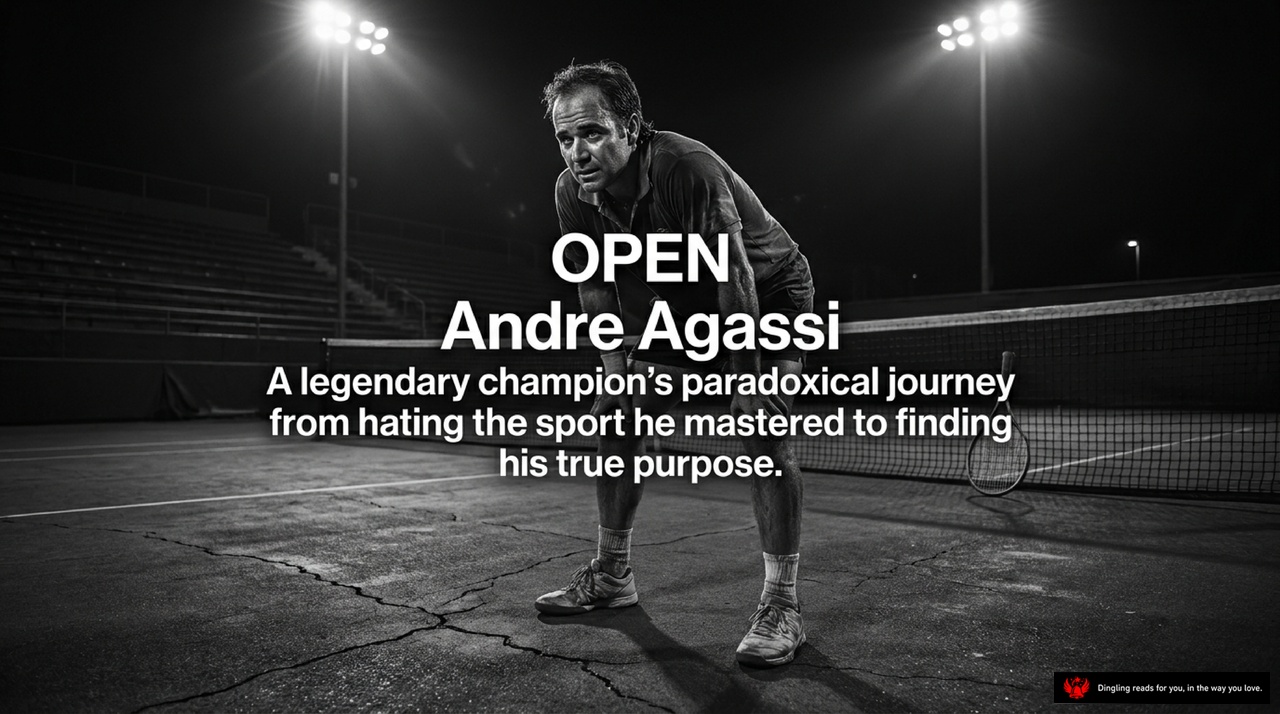
Welcome to the story of Open by Andre Agassi. This book isn't just about tennis; it's a raw, honest look at a legendary champion's paradoxical journey. As the title suggests, it chronicles his path from hating the very sport he mastered to finally finding his true purpose.
Imagine a man standing alone on a court at night, the lights blazing above him, yet he looks exhausted, as if carrying the weight of his entire life. That is Andre Agassi. For 29 years, he lived a life defined by contradiction. He was a global icon, a six-time Grand Slam winner, yet deep down, he despised the game. He played not because he loved it, but because he feared what would happen if he stopped.
The book takes you back to his childhood, where tennis wasn't a passion but a weapon of control wielded by his father. It explores the intense pressure, the fear of failure, and the moments where he wanted nothing more than to quit. But it's also a story of transformation. It shows how he learned to break free from the expectations of others, to embrace his flaws, and ultimately to play for himself rather than for the trophy.
Through Agassi's eyes, you'll see that true victory isn't just about winning matches; it's about finding the courage to live authentically. Whether you are an athlete or just navigating life's challenges, this story offers a powerful reminder: your worth isn't defined by your achievements, but by your ability to be true to yourself. So, grab your copy of Open and get ready for a journey that will change how you see success, failure, and the meaning of life.

Look at this split image. On the left, we see the ultimate high: a global icon, basking in public adoration, lifting a golden trophy to a roaring crowd. It's the dream everyone chases. But on the right, the reality hits hard. It's private, solitary confinement. It's physical agony. This is the core paradox of my life, and the life of every high-achiever who hates their craft.
"I play tennis for a living, even though I hate tennis, with a dark and secret passion, and always have."
These words define my entire existence. I was a global superstar, a household name, yet inside, I was trapped. My body wasn't my own; it was a tool I was forced to use. My father treated me like a machine, drilling me with a terrifying machine he called "Big Dragon," a发球机 that screamed like a monster, demanding perfection until I broke. I was told that thinking was a crime, that failure was unacceptable, and that my only purpose was to win.
For decades, I lived in this contradiction. I hated the noise, the pressure, and the pain, yet I couldn't stop. I was addicted to the very thing that destroyed me. I played because I had to, because the alternative was a life I couldn't imagine, but deep down, there was a secret passion. A desire to finally be free, to stop running, and to live.
This image captures that duality perfectly. The glittering surface versus the dark, solitary struggle underneath. It's the story of how I learned to love myself enough to say goodbye to the game that defined me, and finally, to become the person I was always meant to be.

Picture this: a machine so terrifying, so relentless, that it didn't just teach you how to hit a ball—it taught you how to fear the act of hitting a ball itself. This is the story of "The Dragon," the custom-built发球机 (serving machine) that became the architect of a tennis empire, but also the builder of a psychological prison.
Look at those numbers in the center. 2,500 balls a day. Multiply that by seven days, and you get 17,500 a week. Multiply that by a year, and you hit one million balls. That's the brutal equation Mike Agassi's father engineered. It was designed to create a "perfect swing" through sheer volume and exhaustion. The machine, nicknamed "The Dragon," wasn't just equipment; it was a monster. It stood tall, looming over a small boy, forcing him to hit the ball before it even hit the ground. Every missed ball, every error, was met with a roar that echoed in the soul.
The text on the left tells us the dark cost of this perfection. While the machine engineered a technically flawless swing, it built something far more damaging inside the mind: a psychological prison. The father's philosophy was simple yet cruel: "Put a blister on their brain." He believed that by constantly attacking the opponent's strengths and creating a sense of unbearable pressure, you could force a break. But when he applied this to his own son, the result wasn't a champion; it was a child who learned to associate love, success, and his very identity with fear and pain.
So, we see the math of perfection laid out in stark blue numbers, but underneath it lies the human cost. It's a reminder that while we can measure success in thousands of repetitions and millions of hits, we can't measure the scars we leave behind in the process. The Dragon taught us how to win, but it almost forgot to teach us how to live.

The image captures a chaotic, raw collage of Andre Agassi's life, centered around the jarring neon sign: "Image is Everything." It's a visual scream of the pressure he felt, surrounded by the brands that defined him—Canon, Polaroid, Nike—and the barcodes that reduced his humanity to a product. But look closer at the text on the right. It reveals the truth behind the rebellion: Agassi wasn't just a punk-rock rebel; he was an insecure kid hiding premature baldness, terrified that his hairpiece would fall off during the 1990 French Open final.
This slide perfectly encapsulates the turning point in his career. The "Rebellion of Image" wasn't about freedom; it was a desperate shield against the crushing weight of expectations. He was marketed as a Zen Master, a cool, detached artist, but inside, he was a child fighting for his father's approval and terrified of his own flaws. The "Image is Everything" sign wasn't his philosophy; it was the cage he built for himself. He thought if he perfected the image, he could escape the pain of being a flawed human. But as the photos show, no amount of styling or branding could fix the deep insecurity that drove him. It was only by eventually destroying that image, by letting the mask fall, that he finally found himself.

Look at this graph. It starts at "Rock Bottom (Rank 141)" and spirals downward, mapping the lowest point of my career. The red line hits a breaking point: a failing marriage to Brooke Shields, a complete loss of physical conditioning, a failed drug test for methamphetamine, and finally, playing minor-league Challenger tournaments to empty stands.
This isn't just a chart; it's a confession of what happens when you lose yourself. I had everything, and then I had nothing. The mirror showed me a stranger—someone who had faked confidence for too long until the cracks appeared. You cannot fake it in front of the mirror. The pain was real, the addiction was real, and the decline was undeniable. But even in this darkest valley, I was still here, staring at the empty stands, ready to rebuild from the ashes.
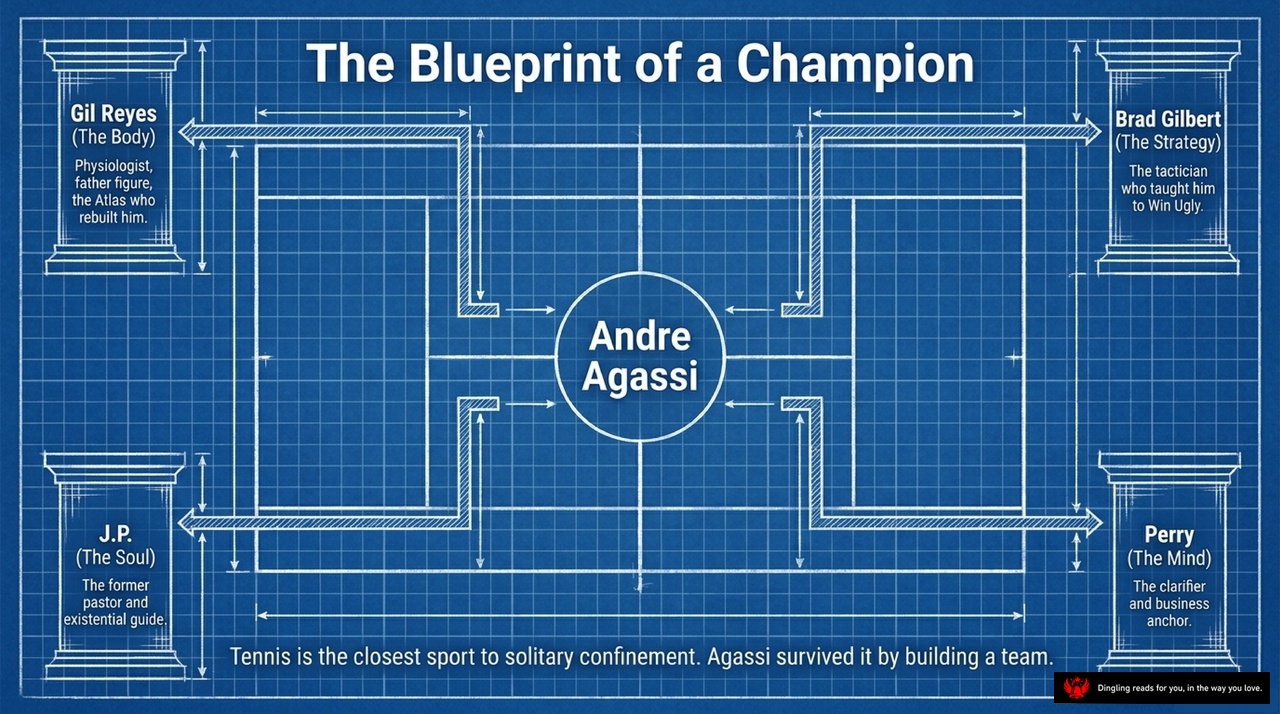
The blueprint of a champion isn't drawn on paper; it's built by four distinct pillars that held Andre Agassi together when the weight of the world felt like it was crushing him down. Look at the diagram: on the left stands Gil Reyes, representing "The Body." He was the physiologist who rebuilt Agassi from the inside out, transforming a broken frame into a weapon capable of enduring the grueling demands of the tour. On the top right is Brad Gilbert, embodying "The Strategy." He was the tactical genius who taught Agassi how to win ugly, pushing him to embrace aggression and stop playing for perfection. Below that sits Perry, the anchor for "The Mind," the clarifier who grounded Agassi in reality and business. And on the bottom left is J.P., guiding "The Soul," the former pastor who provided the existential compass Agassi desperately needed.
This wasn't just a team; it was a lifeline. Tennis is arguably the closest sport to solitary confinement, a game played in isolation where one mistake can end your career. Agassi survived that isolation by refusing to play alone. He constructed a fortress of support around himself, ensuring that no matter how much pain he felt or how deep his doubts went, he never had to face the silence by himself. It was the collective strength of these four pillars that allowed him to rise from the ashes of addiction and failure, turning a solitary struggle into a shared victory.

Look at this blueprint of "Re-Engineering the Machine." This isn't just about fixing a body; it's about redesigning a life. The image breaks down a tennis player like a high-performance vehicle, highlighting three critical upgrades: the spine, the equipment, and hydration.
First, notice the spine. The diagram points to spondylolisthesis, a displaced vertebra that can cripple an athlete. Instead of forcing the body through standard, painful routines, the strategy here is radical customization. By abandoning the standard incline bench press, the player protects a compromised back, proving that listening to your body's limits is the ultimate engineering principle.
Then, look at the custom equipment. These aren't off-the-shelf rackets; they are machines hand-welded specifically to protect the joints. This mirrors a deeper truth: when you are built differently, you need tools designed for your unique mechanics, not a one-size-fits-all approach.
Finally, there's the fuel. Hydration is engineered with precision—custom elixirs where pink is for energy, red for recovery, and brown for nutrients. It's about optimizing every variable to sustain peak performance.
The caption at the bottom sums it all up perfectly: "You have the mechanics of an engineer and the intuition of an artist." This page teaches us that true success comes from respecting your unique design, re-engineering your tools, and fueling your journey with intention.
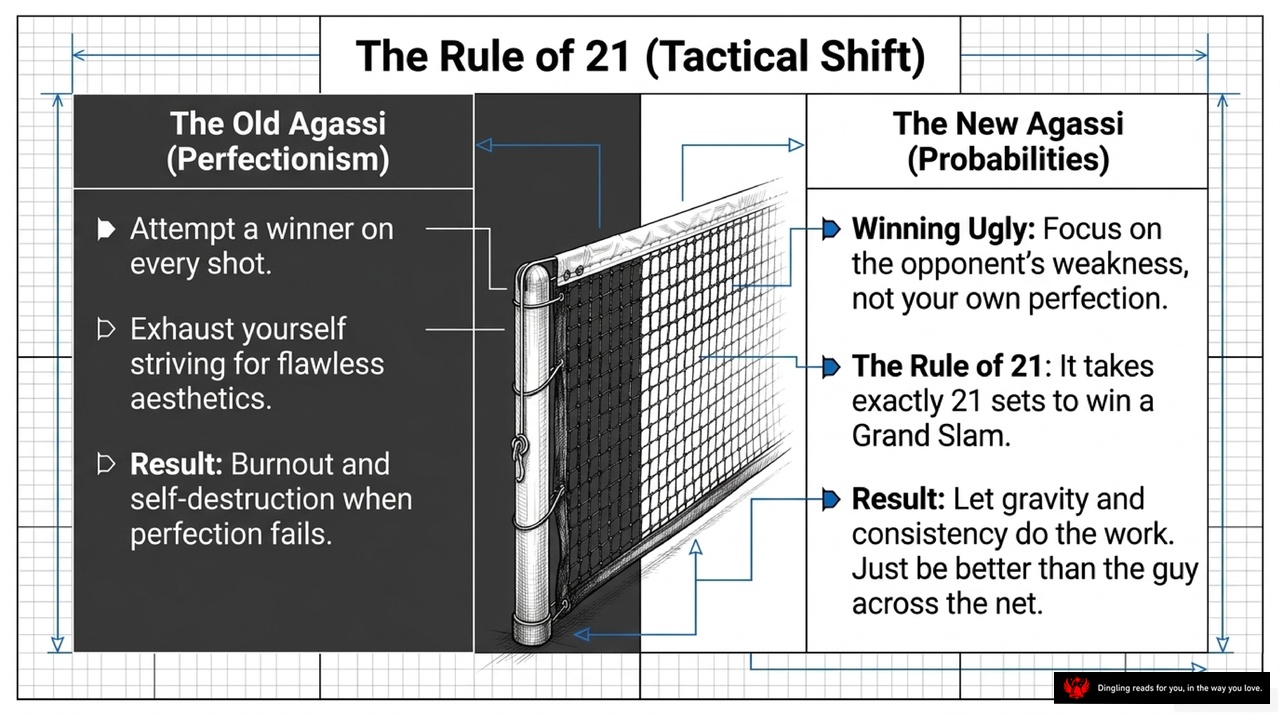
The old Andre Agassi was a slave to perfection. He believed every shot had to be a winner, every movement had to look flawless. He exhausted himself chasing an aesthetic that never existed, leading to burnout and self-destruction the moment reality failed his expectations. But then came the tactical shift. The new Agassi stopped trying to be perfect and started focusing on probabilities. He realized that winning ugly—targeting the opponent's weaknesses rather than his own perfection—was the only path to victory. This is the Rule of 21: it takes exactly 21 sets to win a Grand Slam, but more importantly, it takes 21 moments of letting go of the ego. Instead of forcing the ball, he let gravity and consistency do the work. He simply needed to be better than the guy across the net. In the end, he didn't win by being perfect; he won by being real, by embracing the messy, human side of the game where the only requirement is to beat your opponent, not to impress the world.
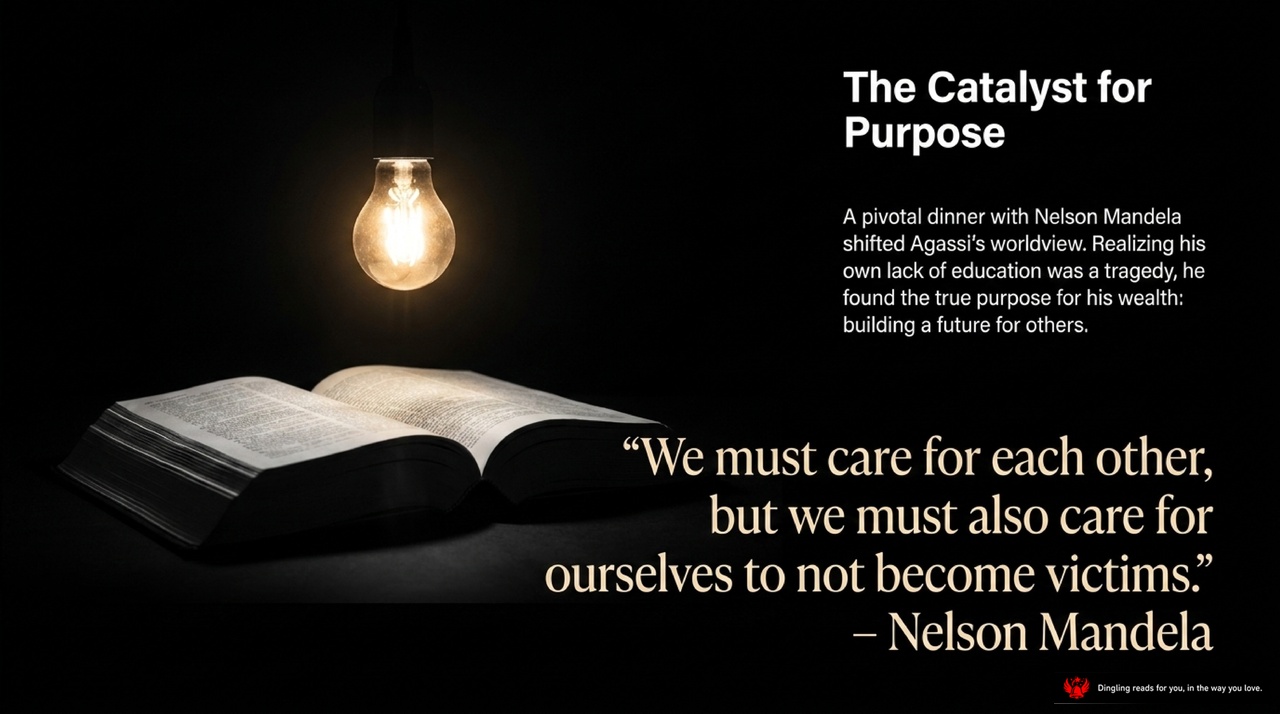
Picture shows an open book illuminated by a hanging light bulb, symbolizing enlightenment and reflection. The text highlights a pivotal moment in Andre Agassi's life: a dinner with Nelson Mandela that shifted his worldview. Mandela's words, "We must care for each other, but we must also care for ourselves to not become victims," resonate deeply. This realization led Agassi to find true purpose in his wealth: building a future for others.
In this transformative chapter, Agassi reflects on how Mandela's wisdom helped him understand the importance of balancing self-care with caring for others. It was through this insight that he decided to dedicate his resources and efforts to creating opportunities for those in need, particularly children. This shift marked a turning point in his life, transforming him from a tennis player obsessed with winning to a philanthropist committed to making a difference. The image of the light bulb over the book beautifully captures this moment of clarity and the beginning of a new chapter in Agassi's journey.

The Ultimate Partnership isn't just about two legends standing side by side; it's about how their opposite souls created the perfect balance. Look at this Venn diagram. On the left, you have Andre Agassi, described here as a "Rebel turned tactician, seeking grounding." He was the chaotic force, the one who needed structure and stability to survive. On the right stands Steffi Graf, the "stoic perfectionist, a cathedral builder." She was the steady anchor, the embodiment of discipline and grace.
When these two circles overlap, they create something magical: The Golden Slam. As the slide highlights, they are the only two players in history to win all four Majors plus an Olympic Gold medal. But beyond the record, it was about their dynamic. Following the 1999 French Open, Agassi relentlessly pursued Graf. Why? Because she provided the quiet strength and the perfect counterbalance to his chaotic life. Where he was fire, she was water. Where he needed to be grounded, she offered a cathedral of focus. It wasn't just a romantic relationship; it was the ultimate strategic partnership that allowed them to achieve the impossible.

Look at this blueprint of the Agassi College Preparatory Academy. This isn't just a school; it's a physical manifestation of legacy, built in one of Las Vegas's most overlooked neighborhoods. But don't let the location fool you—this place operates on strict codes. Think extended hours and mandatory uniforms, designed to counterbalance the immense surprises you get here, like having legends like Ali and Clinton walk through your doors as guest speakers.
Notice the College Street Bridge on the map. It's not just a pathway; it represents the ultimate goal of higher education, the bridge from where we are to where we're meant to go. And look at the Constellation Glass. The architects integrated the North Star and the Big Dipper right into the building's structure. Why? To symbolize the guide to freedom and self-determination. It's a constant reminder that even when the path gets dark, you have a fixed point to guide you toward your own destiny.

Look at this broken racket string. It perfectly captures the state of Andre Agassi's life during the 2006 US Open, his final match. The image breaks down the agony into three stages. Before the match, he had a 7-inch cortisone needle injected directly into his spine, a desperate measure to silence the pain. During the match, he was lying flat on the floor in agony, fighting grueling rallies against Pete Sampras. And after the match? He was standing under a massive ovation, completely unable to walk, weeping in the locker room.
This was the ultimate conflict: his body had completely rejected the sport, but his mind refused to quit. He prayed, "Please let this end," yet he knew he wasn't ready. It was a heartbreaking moment where a legendary career finally drew its last breath.

Look at this slide, "Synthesis: The Evolution of a Champion." It's a stark comparison between who I was in 1990 and who I became by 2006. In 1990, my motivation was driven by external validation and fear. I played for the image, for the applause, and I hated the very platform I stood on. My strategy was brute force, chasing aesthetic perfection, while my identity was entirely wrapped up in how I looked. I viewed tennis as a prison I desperately wanted to escape.
But fast forward to 2006, and everything flips. My motivation shifts to internal purpose and philanthropy. I'm no longer playing to prove something to others; I'm playing to give back and stay true to myself. My strategy evolves from brute force to tactical percentages and efficiency. I stop trying to be perfect and start playing smart. My identity becomes authentic; I embrace the fact that I can contradict myself and that my true self matters more than my image. Finally, my relationship with tennis transforms from hating the prison to respecting the platform. I've learned that the game isn't the enemy; it's the vehicle for my life. This evolution wasn't just about winning more titles; it was about finally becoming the person I wanted to be, on and off the court.
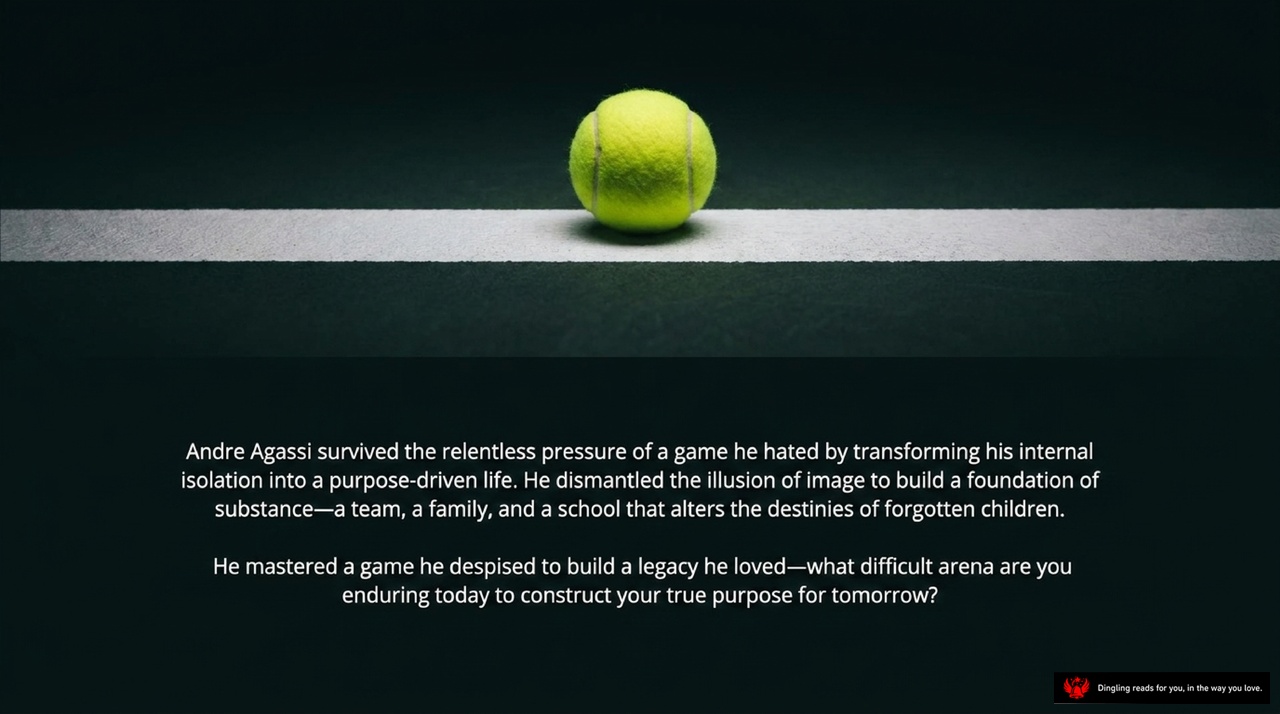
Andre Agassi didn't just survive the relentless pressure of a game he once hated; he transformed his internal isolation into a purpose-driven life. Look at that tennis ball sitting right on the line—it represents the boundary he crossed, moving from mere survival to building a foundation of true substance. He dismantled the illusion of image to create something real: a team, a family, and a school that alters the destinies of forgotten children.
He mastered a game he despised to build a legacy he loved. But now, the question shifts from him to you. What difficult arena are you enduring today to construct your true purpose for tomorrow? Are you just playing a role, or are you finally building the life that matters?