
Out of the Darkest Hours: Complete Chapter-by-Chapter Summary

Welcome to today's book club. We're diving into a story that is as much about resilience as it is about the human spirit. Our featured book is *Stepping Out of the Darkest Hour* by He Xulin.
As the title suggests, this is a profound memoir of a man who, paralyzed at just twenty-one, used a pen to shatter his physical prison and write his way into literary immortality.
Imagine being struck down by fate at the peak of your youth, confined to a wheelchair, and facing a future that seems entirely closed off. That was He Xulin's reality. Yet, from that darkest hour, he didn't just wait for the light to return; he became the one who lit it. Through his powerful writing, he transformed his personal tragedy into a beacon of hope for millions, proving that while a body may be broken, the human will can remain unbreakable. This is a story of how one man refused to be defined by his limitations, choosing instead to define himself through his courage and his words.
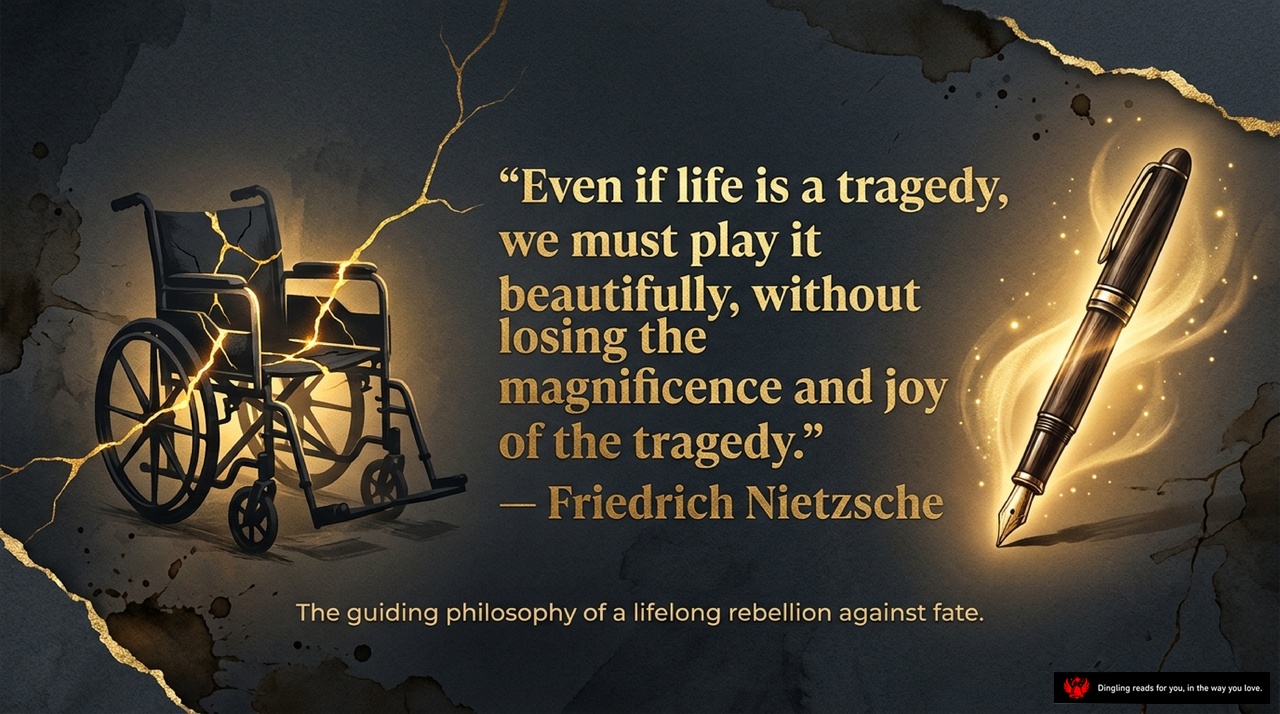
Even if life is a tragedy, we must play it beautifully, without losing the magnificence and joy of the tragedy. These words by Friedrich Nietzsche aren't just a quote; they are the very philosophy that guided my lifelong rebellion against fate.
Look at this image. On the left, a wheelchair, cracked and illuminated by golden lightning. That is my reality. On the right, a fountain pen, glowing with light. That is my choice.
When I was twenty-one, I fell from a tree trying to fix a wire. I suffered a spinal fracture and became paralyzed. My world suddenly shrank to the size of a courtyard. For years, I sat in the dark, wondering if life had any meaning left. But then, I remembered Nietzsche's words. I realized that even when fate knocks you down, you still hold the pen.
I didn't let my body define my soul. While others saw a broken man, I saw a writer rising. I wrote stories about hunger, about my father's courage, and about the fierce loyalty of my mother and my sister-in-law who became my second mother. I turned my pain into art. From a paralyzed boy in a wheelchair, I became a celebrated author, writing novels that touch millions of hearts across China.
This is the power of perspective. The tragedy is real, but the story you choose to tell is yours to write. Do not let the cracks in your life steal the light from your spirit. Play your role with magnificence.

The Guanzhong Earth, Maternal Devotion, and The Seed of Literature—these three pillars define the story of a life forged in fire. Let's walk through them together.
First, look at the wheat in the snow. This is the Guanzhong Earth. My father was born in 1914, a tall, strong man who carried the weight of a whole family on his shoulders. But strength isn't just about muscle; it's about endurance. When famine hit in the 1960s, we didn't just survive; we adapted. My mother, a woman of immense quiet strength, became the backbone of our survival. She would walk miles through blinding snowstorms, her small feet struggling against the ice, just to fetch a little sheep's milk for her frail infant. She was my shield against starvation, feeding me while she starved herself, cooking bitter wild vegetables just to make sure I had enough to eat. Her love wasn't loud; it was the steady rhythm of her life, a silent promise that I would live.
But even in the darkest times, hope found a way to take root. That's The Seed of Literature. While the world around us was crumbling under hunger and hardship, I was already dreaming. I had an early thirst for stories. I remember sneaking coins from my meager allowance just to buy a novel called *Tracks in the Snowy Forest*. I also spent hours listening to local legends about bandits, huddled by the fire in the feeding room, letting those tales of rebellion and justice fill my mind. These weren't just distractions; they were my escape and my education. They planted the idea in my heart that there was more to life than just surviving, that there was a story to be told, and a hero to be written.
So, here we stand at the crossroads of my past. The harsh earth taught me resilience, my mother's devotion gave me life, and the stories I devoured gave me a purpose. These three elements didn't just shape my childhood; they shaped the man I would become. They turned a boy who barely had a future into a writer who would spend his life giving voice to the silent and the suffering. This is the foundation of everything that followed.

At age 21, in September 1974, a single moment changed everything. While pulling an electric wire, a devastating fall left me with severe traumatic paraplegia—a total loss of lower body mobility. What followed was a period of deep confinement, trapped in a tiny, windowless room barely nine square meters, surrounded by dirt walls. The isolation was absolute. There was no escape, only the crushing weight of physical decay and pervasive suicidal ideation. It felt like the nadir of my life, stripped of any future I had ever imagined, facing a lifetime confined to a bed. But even in that darkest hour, buried beneath the despair, a small voice began to whisper that life must go on, no matter how broken it seemed.

Picture this: three beams of golden light cutting through the darkness, illuminating the path from silence to sound, from isolation to connection. This slide captures the very essence of how I rebuilt my world after being paralyzed at 21.
On the left, we see "Unyielding Maternal Love." My mother's silence was louder than any scream. When I was a child, she changed my infected dressings without a single complaint, even starving herself to make sure I ate. Later, when I was injured, she spent days nursing me, her small, bound feet unable to move fast enough to catch me when I ran away in frustration. She didn't just feed me; she gave me the courage to keep breathing.
In the center, under "A Window to the World," stands a small "Sunflower" brand radio. My mother bought it with her meager savings, transforming my isolated bed into a gateway to the vastness of human events, music, and ideas. That radio became my lifeline. It was through it that I discovered heroes forged in suffering—like Pavel Korchagin from *How the Steel Was Tempered* and Xing Linzi, a Taiwanese writer confined to a wheelchair. They proved that physical limitations do not define the soul.
On the right, "Literary Lifelines" shows how I turned pain into purpose. Discovering these heroes inspired me to write. I realized that while my body was trapped, my mind could travel anywhere. That radio and those stories gave me the strength to face the future, one word at a time.

Today's slide captures the heart of my journey: the contrast between "The Broken Vessel" and "The Spiritual Spring." On the left, we see a withered tree, representing my paralyzed, scarred, and deteriorating physical body—the reality I faced after the accident that left me with a spinal fracture and paralysis. It is a reflection of the pain, the limitations, and the sheer struggle of living with a broken body.
But look at the right side. That is "The Spiritual Spring." It shows a tree bursting with life, bearing fruit under the light. This represents my realization that biological resilience can defy aesthetic perfection. Just because my body couldn't walk or function like others did, didn't mean my spirit had to wither. I learned that I cannot easily hand over my life to the "god of fate." As the quote in the center reminds us: "Do not easily hand over life to the god of fate."
My story is proof of this. After years of despair, when I felt trapped in my wheelchair, I found a new way to stand. I picked up a pen. Through writing, I rebuilt my life. I turned my suffering into stories, my pain into art, and my limitations into a unique perspective. I stopped waiting for a cure that never came and started building a life that was rich, meaningful, and full of hope. The broken vessel is real, but the spiritual spring is the choice we make every day to keep growing, no matter how hard the ground is beneath us.

Welcome to the final chapter of our journey, where we see how adversity transformed into art. This slide, "The Funnel of Resilience," perfectly captures the alchemy of a life rebuilt. Look at that funnel: at the top, we see the raw materials of suffering—the relentless trial and error, the years spent reading textbooks and history under the dim light of a kerosene lamp. That wasn't just study; it was survival.
Then, the funnel narrows. This represents the crucial process of refinement. It was about accepting failure, shifting focus to the world he knew best—rural life and human suffering—and finding his unique voice. He didn't try to be someone else; he became himself.
Finally, look at the bottom. In 1980, a single 400-word fable titled "Melons" was published in *Shaanxi Youth*. The payout was just 4 yuan, but the value was infinite. That spark proved he could survive by the pen. From the crushing weight of a broken spine to the light of a published story, this is the true definition of resilience. It's not about avoiding the fall; it's about how you rise with a story in your hand.

Welcome back to our journey through He Xulin's life. Today, we're looking at the final chapter: The Architecture of Mentorship. This slide maps out the three critical figures who didn't just read his words—they actively built his career.
First, we have **The Encourager**, Shang Ziyong. When He Xulin's early work was rejected, Shang didn't just send a form letter. He wrote a personal, handwritten note of encouragement alongside the rejection. He even traveled to He's remote village to offer direct guidance. That human touch made all the difference.
Next is **The Editor**, He Qizhi. This was the turning point. He Qizhi traveled from the bustling capital to a rural dirt room in Shaanxi to personally edit He Xulin's manuscript. He saw potential where others saw only despair, saving He's career from fading away completely.
Finally, we have **The Visionary**, Ding Yuqing. A TV director who saw the visual power in He's early short story, "Regret." She adapted it for television in 1985, proving that He's narratives had the mainstream power to reach a national audience.
These three mentors provided the encouragement, the editing, and the vision He needed to transform from a disabled writer in a small village into a celebrated literary force.

Look at this comparison chart. It lays out the DNA of He Xulin's "Guanzhong Bandit" fiction versus standard regional stories. On the left, you have the typical mold: clear heroes, black-and-white class struggles, and simple oppressor-versus-oppressed conflicts. But on the right? That's where He Xulin breaks the mold.
First, the protagonist. Instead of a flawless hero, we get morally complex outlaws driven by survival, blending extreme brutality with profound filial piety. Then, the moral code shifts from simple class warfare to a raw "Bandit Honor"—a folk justice system built on loyalty, blood ties, and survival in a lawless land.
The language itself changes. It moves from standardized Mandarin to an unapologetic, authentic Shaanxi dialect that feels rugged, rhythmic, and fiercely masculine. Finally, the conflict architecture becomes multi-layered, weaving friction between officials, bandits, civilians, and soldiers. This isn't just a story about crime; it's a deep dive into the human soul, where even the most ruthless figures operate under a code of their own.

In the heart of Guanzhong Bandit Stories, four pillars hold up the narrative of resilience and identity. First, the story is rooted in **Historical Authenticity**, grounded in the famines and social collapse of the 1930s Guanzhong plains. It's not just fiction; it's the raw reality of a time when survival was the only law.
This harsh backdrop gives rise to the **"Qin" Spirit**, capturing the uncompromising blood, tears, and raw folk energy of the Shaanxi people. These weren't just bandits; they were men shaped by a land that demanded everything.
The narrative brilliantly explores **Blurring Boundaries**, probing the razor-thin line between righteous rebellion and criminal banditry. In this world, a man might steal from a tyrant but protect the innocent, forcing us to question where heroism ends and villainy begins.
Finally, the **Narrative Pacing** is masterful, inherited from oral village traditions. It's suspenseful, rapid-fire, and deeply engaging, pulling you into a story where every breath matters and no one escapes their fate.

Welcome back to our journey through the life of He Xulin. Today, we pause to look at the incredible transformation of his work from a quiet, solitary novel to a massive cultural phenomenon that captivated millions.
As you can see on the screen, we are focusing on two powerful pillars: "The Text" and "The Screen."
Let's start with "The Text." This is the original novel, *Last Night's Wind and Rain*. This book wasn't written in a comfortable studio; it was forged in isolation and physical pain. Written by He Xulin, who had been paralyzed since his twenties, this novel is a testament to the human spirit's resilience. It is a story of a bandit leader who, despite living in a chaotic era, adheres to a strict code of honor. It's a story that asks us to look beyond the violence and see the humanity within.
Now, let's move to "The Screen." This text was adapted into the 30-episode hit TV series, *Guanzhong Fei Shi*, also known as *Guanzhong Bandit Stories*. This adaptation took the raw, emotional narrative of the novel and translated it into a visual spectacle that resonated deeply with audiences across China. The show became a cultural phenomenon, turning He Xulin's personal struggle and his fictional bandit characters into a shared national memory.
The journey from a book written on a desk by a man in a wheelchair to a television series watched by millions is a powerful reminder of the enduring power of storytelling. It shows how art can transcend physical limitations and touch the hearts of people everywhere. From the quiet pages of the novel to the vibrant screen of the series, He Xulin's work proves that as long as there is a story to tell, there is a way to reach the world.

Look at these two stones. On the left, we see a man writing with his very life, possessing a hero's spirit. On the right, a towering achievement that commands absolute respect. These aren't just quotes; they are the twin pillars holding up my entire literary identity.
The left stone speaks to my raw, life-or-death creative energy. It describes how I used the framework of banditry to express a profound, unapologetic vitality. This connects directly to my five novels in the "Guanzhong Xionghou" series. When I wrote about these bandits, I wasn't glorifying chaos. I was exploring a deep truth: even in the darkest times, there is a code. These characters, though born of desperation, often held onto a primitive sense of justice. They robbed the rich to feed the poor. They protected their own kind. This "banditry" became my vehicle to tell the story of the Chinese spirit—resilient, stubborn, and refusing to apologize for surviving.
But the right stone focuses on my historical weight and stamina within Shaanxi literature. It says I write with a constant, enduring power. This isn't about fleeting fame. It's about the decades of grinding. From my first short story published in 1980 to my latest works, I have kept writing despite the pain. My disability, my poverty, the loss of my father and mother, the tragedy of my wife's passing—none of these stopped the pen. Instead, they fueled it. I wrote about hunger, about the pain of paralysis, about the fierce love of a mother who spun thread until her fingers looked like chicken claws. I wrote about the land of my birth, the wind, the dust, and the people who shaped me.
Together, these two validations define my journey. One validates the fire in my belly—the courage to write about the rough, untamed sides of human nature. The other validates the discipline of my soul—the ability to keep writing long after the world might have given up on me. I am the bandit who writes with a hero's heart, and I am the scholar who stands firm against time. This is my story.

Look at these three golden links. They aren't just metal; they represent the unbreakable chain of love that held my life together when everything else fell apart.
First, we have **The Mother, The Foundation**. She was my absolute bedrock. During the famines, she sacrificed her own food, silently tending to my bedsores while I lay helpless. She was the only reason I had the will to live. Without her, I would have faded away long ago.
Then, **The Sister-in-Law, The Bridge**. When my mother passed, she stepped in as my lifeline. She cared for me for twenty years, delivering three meals a day and even building my very first writing desk from scratch. She was the bridge that carried me from despair to creation.
Finally, **The Wife, Deng Yasu, The Harbor**. She married me against all societal odds. She offered me unconditional love, a family, and a safe, joyful harbor for my later years. She is the shelter where I finally found peace.
These three women didn't just help me survive; they gave me a reason to thrive. Their love was the gold that kept me from drowning in the darkness.

Literary Immortality: Transforming confinement into a limitless universe.
Look at this pyramid. It's not just a graphic; it's the map of a life rebuilt from the ground up. At the base, we see "Absolute Physical Tragedy." Total paralysis, poverty, and isolation at age 21. The text calls it "the shattering of the vessel." That was the reality for He Xulin. At twenty-one, a simple accident while reaching for an electrical wire in a rainstorm left him with a crushed spinal cord. He was told he would never walk again. The world told him his story was over.
But look higher up the pyramid. That tragedy didn't end him; it became the foundation for "Spiritual Rebellion & Relentless Craft." He refused to surrender to fate. Instead of hiding, he turned inward. He became a student of his own suffering, mastering the oral storytelling traditions of his village and teaching himself through decades of self-education. He wrote through pain, using his wheelchair as his desk and his silence as his fuel. He didn't just survive; he crafted a new identity out of his brokenness.
And at the very peak? That's "Literary Immortality." The slide says his "brokenness" became the exact source of his raw, undeniable power. By transforming his confinement into a limitless universe, he proved that physical limits do not define a human being. His life's scars became the ink for his stories, creating a legacy that transcends time. This is the power of resilience: when you can't move your body, you learn to move the world with your words.

Look at this wheelchair silhouetted against a blazing horizon. It's not just an image; it's a declaration of defiance. This is He Xulin's life story, and today, we're asking the question that hangs in the air: If a man chained to a bed in a windowless room can build a universe that touches millions, what invisible prisons are we allowing to hold us back?
He Xulin was stripped of his physical mobility at the dawn of his youth. Instead of letting tragedy erase him, he refused to accept defeat. Through sheer force of will, he forged an empire of words, transforming a lifetime of confinement into a limitless legacy that captures the fierce, indomitable spirit of the human soul.
His journey wasn't easy. At 21, an accident left him paralyzed, confined to a small room with his mother by his side. But while his legs were trapped, his mind soared. He read everything he could get his hands on, from *How the Steel Was Tempered* to local folk tales about bandits and heroes. He realized that disability was a circumstance, not a definition of his worth.
He didn't just survive; he thrived. He published his first story at 20, became a bestselling author, and even saw his work adapted into a major TV series watched by millions. He proved that when you remove the limits of the body, the limits of the imagination vanish.
So, let this image remind us: Your circumstances do not dictate your potential. The only prison that truly matters is the one we build in our own minds.