
Out of The Exclusive Truth: Complete Chapter-by-Chapter Summary

Welcome to a philosophical journey that starts with a simple but profound realization: we have been living under the illusion of a single truth. For too long, we've been trained to believe there is one absolute answer, one universal framework that explains everything from the cosmos to our daily lives. But as Chen Jiaying explores in this opening chapter, that search for a monolithic truth is actually a trap. It forces the rich, messy diversity of human experience into a rigid box, silencing different paths and devaluing unique cultural traditions.
The real philosophical shift isn't about finding a better single answer; it's about stepping out of that fortress of certainty. We need to move from the pursuit of absolute universalism to the grounded reality of human dialogue. Imagine a world where different "ways" of being aren't enemies locked in a fight to the death, but rather different perspectives that illuminate each other. This isn't about falling into relativism, where anything goes; it's about recognizing that truth is often found in the space between voices, in the shared meaning we build together through conversation.
As we navigate this modern landscape of fragmented information and competing values, the old idea of a single, all-encompassing truth has collapsed. The world is too complex, and our experiences too varied, for one system to rule them all. Instead, we are called to become facilitators of dialogue, guiding ourselves and others through an open exploration of meaning. This journey away from the illusion of a single truth is the first step toward a more honest, inclusive, and truly human way of thinking.

On the left, we see "The Old Paradigm": a single, rigid pyramid illuminated by one central light. This visual represents the ancient belief in one ultimate, universal truth that governs all human experience. For centuries, we were trained to think there is only one correct answer, one absolute system that explains everything from the cosmos to our daily lives. We assumed that if we just found this one truth, we would hold the ultimate key to interpreting the world.
But look at the right side: "The New Paradigm." Here, the single pyramid is gone, replaced by a dynamic, starry network of interconnected paths. As the slide explains, there are different paths. The crucial question is no longer finding the only path, but how these different paths echo, communicate, and grapple with one another. We are moving away from a monologue of one truth into a dialogue of many perspectives.
The realization at the bottom drives this shift home: Philosophy is dead if it insists on a single truth system. History does not march toward a single destined goal. Instead of forcing a complex, diverse world into a narrow, unified framework, we now recognize that different "ways" have their own roots and value. They aren't enemies fighting for dominance; they are distinct voices contributing to a richer, more complete understanding of reality. We no longer seek a single destination for humanity, but rather find meaning in the open, evolving conversation between diverse experiences.

Look at this diagram. It beautifully maps out the relationship between three core ways of knowing: Common Sense, Science, and Philosophy.
On the left, we have Common Sense, labeled as "The Root." It's grounded in our natural language and subjective human perception. Think about it: when you touch a glass of water, you don't measure it; you simply say, "This water is cold." That immediate, personal experience is the root of our understanding.
Moving to the bottom right, we see Science, described as "The Objective." Its job is to systematically strip away that human perception to isolate universal facts. It doesn't care if the water feels cold to you; it tells you, "The water is exactly 25 degrees Celsius." Science gives us precision and objectivity, removing the noise of our feelings to reveal the underlying reality.
Finally, at the top, sits Philosophy, acting as "The Bridge." It connects these two. Philosophy reflects on common sense to find deeper, interconnected reasoning without losing the human element. It takes the raw data from science and the lived experience from common sense, weaving them into a coherent narrative about meaning and existence.
In our daily lives, we often swing between these two extremes. We might rely entirely on scientific metrics, forgetting the human story, or get lost in subjective feelings, ignoring the objective facts. This slide reminds us that true wisdom lies in the intersection. We need the root of common sense to stay human, the objectivity of science to stay grounded, and the bridge of philosophy to make sense of it all. It's not about choosing one over the other, but about how they work together to help us understand the world and our place in it.

When we look at how the world actually works, we often find ourselves navigating two distinct modes of thought: Science and Philosophy. As the slide illustrates, their goals, methods, and outputs are fundamentally different, yet both are essential for understanding our reality.
Science seeks to understand mechanisms—how things work. Its method relies on objectification, effectively removing the human observer to find objective facts. The output of this rigorous process is universal theories that explain the mechanics of the universe.
In contrast, Philosophy seeks meaning—why things matter. Instead of stripping away the human element, its method uses exhaustive reasoning to connect logic back to human subjectivity. Its output isn't a set of cold laws, but translating dialogues that make different meaning systems intelligible to one another.
Think of it this way: Science tells us how to build a bridge so we can cross a river. Philosophy asks us why we need to cross that river in the first place, and what it means for our lives when we do. One provides the tools for survival; the other provides the context for living. Without science, we lack the means to navigate the physical world. Without philosophy, we lack the compass to navigate our place within it. Both are necessary for a complete understanding of human existence.

Let's talk about the real battle against extremism. It's easy to get caught up in a dramatic script of "good versus evil," but that's a trap. When we label our opponents as pure monsters, we actually lose the ability to understand them. True fighting isn't about erasing the other side; it's about defending the right to live while keeping our heads clear.
Look at the words we use. Calling someone a "terrorist" or a "freedom fighter" isn't just a semantic game; it's a clash of entire worldviews. The real conflict isn't about definitions, but about the values behind them. We need to stop treating language as a weapon and start using it to uncover the logic driving the violence.
And let's be honest about communication. We often dream of a "mind-reading" superpower where we instantly understand each other without a word. But that's an illusion. Every person has a unique inner world shaped by their history and culture. Language is the bridge between these islands, but it's not a teleporter. It's messy, imperfect, and full of gaps. That's okay. The struggle to truly understand each other across those gaps is where real human connection happens. We can't merge our minds, but we can respect the distance and keep talking.

Imagine a library not as a dusty archive of old books, but as a living companion that evolves with you. When we are young, books are maps handed to us by strangers, showing us paths we haven't taken yet. I remember hearing stories of heroes like Yue Fei as a child, and suddenly, I was transported into worlds of swords and statesmanship, meeting heroes long before I met real people. It was a thrilling adventure, a way to see the world through someone else's eyes.
But as life gets heavier, the map transforms into a mirror. When I read during difficult times, those ancient poems and philosophical texts didn't just offer stories; they offered comfort. They smoothed out my inner turmoil and showed me that my own struggles were part of a larger human tapestry. Suddenly, the "trivial" details I once ignored in books became the very fabric of my own life.
And then, as we move further along, those books become songs we sing to ourselves. Re-reading a classic like *Dream of the Red Chamber* reveals new layers every time, just like listening to a favorite song with fresh ears after years. The words aren't just ink on paper anymore; they are melodies etched into our souls, offering solace when we feel tired.
Ultimately, reading is a journey of growth. We start by exploring the world, then we learn to understand our own lives, and finally, we find peace with ourselves. This is the unique power of text: unlike images that show us exactly what something looks like, words leave space for our imagination to fill in the gaps. They create a deeper, more lasting imprint. So, let's keep reading, not just to gather information, but to keep our minds humble and connected to the greatest minds in history, rising above the noise of daily life.

Today's slide presents a crucial map for how we influence one another: The Spectrum of Influence. We often mistake the middle of this spectrum for the goal, but true connection lies at the far right.
On the left, we have Violence or Force. This is the complete subjugation of another's will. It's the old-school power play where you simply crush resistance. Moving slightly right, we find Manipulation. This is what I call "soft violence." It bypasses your rational agency through deception or emotional hijacking. You aren't fighting an opponent; you're being tricked into fighting your own battles.
Then comes Persuasion. This is where most business and political efforts stop. It attempts to make you adopt someone else's exact viewpoint, treating you like a target to be won over. It's still a form of winning, just a more polite one.
But look at the far right end: True Dialogue. This is the only form of influence that doesn't require you to lose yourself. It's about mutual reasoning. We illuminate truths for both parties, allowing you to internalize meaning voluntarily while preserving your autonomous selfhood. In true dialogue, we aren't trying to conquer each other; we are trying to understand each other. That is the only way to build a future where everyone can thrive without being forced into a corner.

Let's dive into the final frontier of our discussion: the very nature of the tools we use to think and communicate. Today's slide challenges us to rethink the role of language itself. On the left, we see a solitary figure standing before a glowing, complex geometric structure. This represents the intricate, often abstract world of philosophical inquiry. On the right, a camera is crossed out with a bold red X. This is a powerful visual metaphor: it tells us that the goal of philosophy is not to capture reality like a photograph, but to understand it through interpretation and dialogue.
This brings us to a critical distinction explored in the text: the difference between "word games" and "substantive debates." The author warns us against getting trapped in "word disputes"—arguments that are merely about semantics, like debating whether something is "itchy" or "ticklish." While these might seem trivial, the text reminds us that many profound conflicts, such as the debate over whether a suicide bomber is a "terrorist" or a "freedom fighter," are actually rooted in deep differences about values, politics, and the meaning of life. These aren't just linguistic disagreements; they are clashes of worldviews.
Furthermore, the slide touches on the limits of communication. The image of the crossed-out camera suggests that we can never truly "telepathically" understand another person's mind. We are all trapped in our own unique perspectives, shaped by our specific histories and cultures. Language is the bridge between these isolated islands, but it is not a perfect one. We can never fully possess another person's mind, only approximate it through conversation.
Finally, the text reminds us of the enduring power of written language in an age of images. While we live in a visual culture, the author argues that deep thinking still requires the patience of reading and writing. Unlike a photo that captures a single moment, text allows us to enter the mind of another, to engage in a slow, deliberate dialogue across time. As we move forward, let's remember that true understanding requires us to step out of our own "first-person" bubbles, to listen deeply, and to engage in the messy, beautiful work of bridging our different perspectives.

We are living in an age where the very act of thinking has become a trap. As the slide illustrates, modern life has detached us from the origins of our tools, food, and traditions, breeding a deep-seated sense of risk and existential uncertainty. This disconnection triggers a cycle we often call "over-reflection." We start with doubt, trying to over-intellectualize every minor desire, seeking meaning purely in abstract concepts rather than in lived reality. This leads to abstraction, where we lose touch with the tangible world, and then to endless reflection, which only deepens our isolation.
The danger of this cycle is profound. Constant, ungrounded reflection thins out the richness of life, threatening to crush our natural human vitality under the weight of endless doubt. We end up compensating for our lack of connection by building intellectual fortresses, but these walls only make us more alone. The text reminds us that true meaning isn't found in constructing grand, abstract systems or in the pursuit of a single, universal truth. Instead, it emerges from our specific, messy, and real interactions with the world.
To break free, we must shift from this detached, analytical mode back to a grounded existence. We need to stop trying to solve life's problems from a distance and start engaging with them directly. As the diagram suggests, we must move from "more reflection" back to the raw experience of living. The path forward isn't about finding a new philosophical answer, but about reclaiming our connection to the concrete world—our labor, our relationships, and our daily struggles. Only by stepping out of the loop of abstract doubt can we rediscover the vitality that defines a truly good life.

When we look at the image of this glowing anchor, it represents a powerful philosophical stance: grounding our thoughts in reality. The slide highlights three critical pillars for living a meaningful life.
First, "Action Over Theory." We must engage directly in physical, cooperative activities—whether it's team sports, manual labor, or raising children. Life isn't about abstract concepts; it's about doing things together in the real world.
Second, "Test the Concept." We need to continuously check our abstract reasoning against actual, tactile lived experience. If an idea doesn't hold up when you touch the ground, it's not a valid philosophy.
Finally, "Limit the Mind." This is crucial. We must ensure that our philosophical reflection only goes as far as the vitality of our life can support. Sometimes, the 'thick' survival of simply getting through the day holds up the heavy weight of our thoughts. Don't let endless overthinking drown out your ability to live.
In short, stop over-intellectualizing and start anchoring yourself in action, experience, and the limits of what it truly means to be alive.

Imagine a scale balancing two worlds: on one side, the simplified drama of "Good vs. Evil," represented by stark black-and-white blocks; on the other, the messy, rugged terrain of real-world conflicts. We have a reflex to take complex human struggles and elevate them into grand ideological battles, framing them as a clash between absolute good and absolute evil. But the reality is far more complicated. Our basic survival instincts and political disagreements often get cloaked in a garb of ultimate moral superiority. This false narrative prevents true understanding.
The insight we need is to defend ourselves and fight for what is ours without falsely claiming a monopoly on universal justice. We must stop trying to force the world into a binary of heroes and villains. Instead, we should recognize that different conflicts stem from different survival situations and cultural traditions. There is no single "right" answer that applies everywhere. By letting go of the need to declare one side the absolute good, we open the door to genuine dialogue and a deeper, more honest understanding of the human condition.

Today's slide centers on a golden hourglass, symbolizing the tension between biological endurance and the quality of our final days. On the left, we see "The Modern Twist," which critiques how medical advances relentlessly focus on extending life at all costs, often stripping away the dignity and quality of our last moments. This aligns with the text's warning that modern society, in its pursuit of a "good life," often reduces it to a static accumulation of indicators like wealth or status, missing the dynamic process of self-perfection.
On the right, "The Lesson" offers a profound counterpoint: facing mortality is the ultimate philosophical act. The text explains that the absolute boundary of death gives life its actual shape, urgency, and meaning. Without the realization of finitude, our choices lose their weight. We are reminded that a "good life" isn't about avoiding the end, but about fully inhabiting the present. As the hourglass empties, revealing ancient ruins inside, the message is clear: we don't just want to live longer; we crave connection, consciousness, and a sense of completeness. True meaning comes not from biological endurance, but from embracing the finite nature of our existence and living with intention.
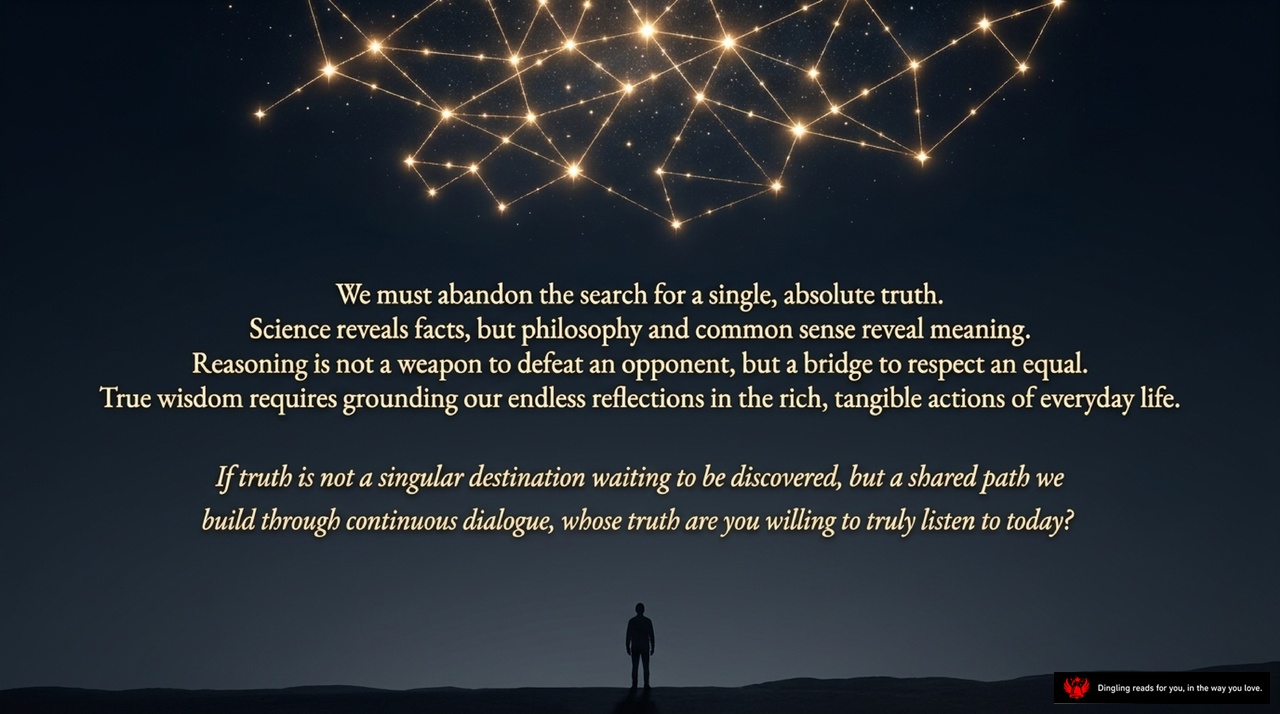
Imagine standing alone under a vast, starry sky, looking up at a constellation formed by connecting lights. That image perfectly captures our current moment: we are no longer searching for a single, absolute truth waiting to be discovered. Instead, we are building a shared path through continuous dialogue.
The text reminds us that we must abandon the quest for a one-size-fits-all answer. While science excels at revealing facts, it is philosophy and common sense that help us uncover meaning. Reasoning shouldn't be a weapon used to defeat an opponent; it should be a bridge that allows us to respect an equal. True wisdom isn't found in abstract theories alone, but by grounding our endless reflections in the rich, tangible actions of everyday life.
If truth isn't a singular destination, but a journey we create together, the question becomes: whose truth are you willing to truly listen to today? In a world filled with fragmented information, choosing to listen deeply to different perspectives is the first step toward finding our way.